charging Hyundai Elantra 2006 Owner's Manual
[x] Cancel search | Manufacturer: HYUNDAI, Model Year: 2006, Model line: Elantra, Model: Hyundai Elantra 2006Pages: 277, PDF Size: 10.18 MB
Page 14 of 277

YOUR VEHICLE AT A GLANCE
B255A01E-GAT INDICATOR SYMBOLS ON THE INSTRUMENT PANEL * More detailed explanations of these items will be found beginning on page 1-48
O/D OFF Indicator Light (1.6 Automatic Transaxle only)
Fuel Filter Warning Light (Diesel only)
Diesel Pre-heat Indicator Light (Diesel only)
Immobilizer Warning Indicator Light (If installed)
SRS (Airbag) Service Reminder Indicator ABS Service Reminder Indicator Turn Signal Indicator Lights High Beam Indicator Light Low Oil Pressure Warning Light Parking Brake/Low Brake Fluid Level Warning Light Charging System Warning Light Seat Belt Warning Light Trunk Lid /Tail Gate Open Warning Light Door Ajar Warning Light Low Fuel Level Warning LightCruise Indicator Light (If installed)
Front Fog Indicator Light (If installed) Malfunction Indicator Light Traction Control Indicator Light (If installed)
Page 59 of 277
1
FEATURES OF YOUR HYUNDAI
45
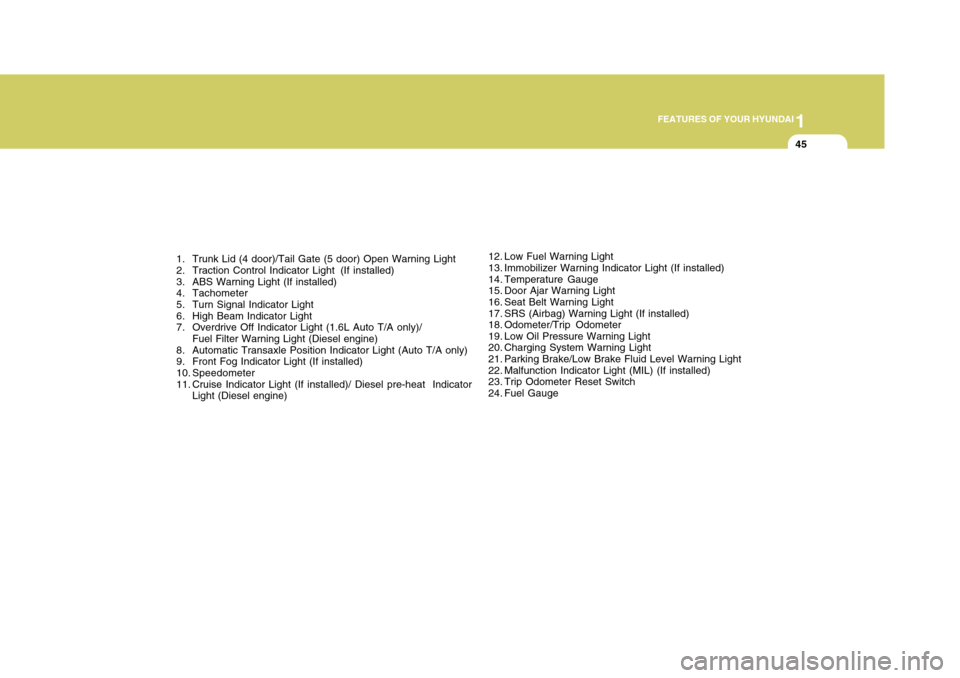
1. Trunk Lid (4 door)/Tail Gate (5 door) Open Warning Light
2. Traction Control Indicator Light (If installed)
3. ABS Warning Light (If installed)
4. Tachometer
5. Turn Signal Indicator Light
6. High Beam Indicator Light
7. Overdrive Off Indicator Light (1.6L Auto T/A only)/ Fuel Filter Warning Light (Diesel engine)
8. Automatic Transaxle Position Indicator Light (Auto T/A only)
9. Front Fog Indicator Light (If installed)
10. Speedometer
11. Cruise Indicator Light (If installed)/ Diesel pre-heat Indicator Light (Diesel engine) 12. Low Fuel Warning Light
13. Immobilizer Warning Indicator Light (If installed)
14. Temperature Gauge
15. Door Ajar Warning Light
16. Seat Belt Warning Light
17. SRS (Airbag) Warning Light (If installed)
18. Odometer/Trip Odometer
19. Low Oil Pressure Warning Light
20. Charging System Warning Light
21. Parking Brake/Low Brake Fluid Level Warning Light
22. Malfunction Indicator Light (MIL) (If installed)
23. Trip Odometer Reset Switch
24. Fuel Gauge
Page 61 of 277
1
FEATURES OF YOUR HYUNDAI
47
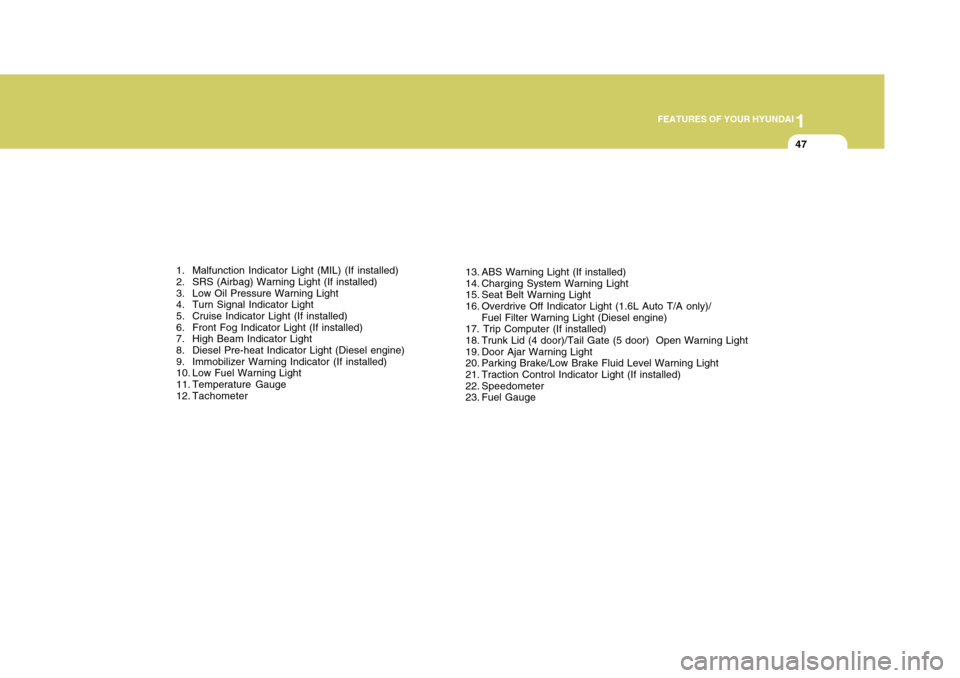
1. Malfunction Indicator Light (MIL) (If installed)
2. SRS (Airbag) Warning Light (If installed)
3. Low Oil Pressure Warning Light
4. Turn Signal Indicator Light
5. Cruise Indicator Light (If installed)
6. Front Fog Indicator Light (If installed)
7. High Beam Indicator Light
8. Diesel Pre-heat Indicator Light (Diesel engine)
9. Immobilizer Warning Indicator (If installed)
10. Low Fuel Warning Light
11. Temperature Gauge
12. Tachometer 13. ABS Warning Light (If installed)
14. Charging System Warning Light
15. Seat Belt Warning Light
16. Overdrive Off Indicator Light (1.6L Auto T/A only)/
Fuel Filter Warning Light (Diesel engine)
17. Trip Computer (If installed)
18. Trunk Lid (4 door)/Tail Gate (5 door) Open Warning Light
19. Door Ajar Warning Light
20. Parking Brake/Low Brake Fluid Level Warning Light
21. Traction Control Indicator Light (If installed)
22. Speedometer
23. Fuel Gauge
Page 64 of 277
1FEATURES OF YOUR HYUNDAI
50
B260J01S-GAT
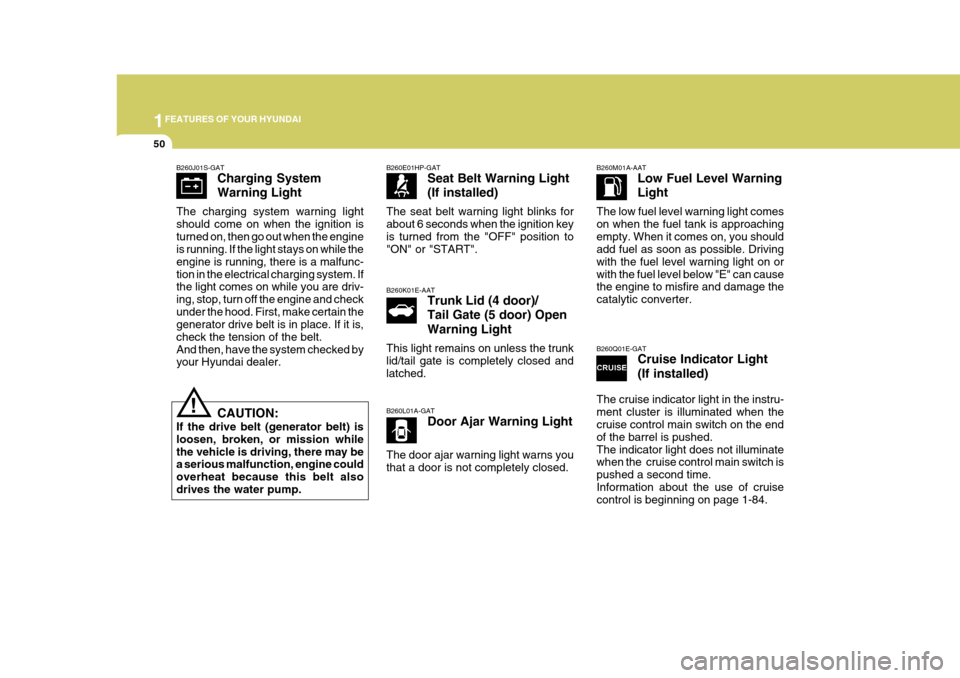
Charging System Warning Light
The charging system warning light should come on when the ignition isturned on, then go out when the engine is running. If the light stays on while the engine is running, there is a malfunc-tion in the electrical charging system. If the light comes on while you are driv- ing, stop, turn off the engine and checkunder the hood. First, make certain the generator drive belt is in place. If it is, check the tension of the belt.And then, have the system checked by your Hyundai dealer.
CAUTION:
If the drive belt (generator belt) is loosen, broken, or mission whilethe vehicle is driving, there may be a serious malfunction, engine could overheat because this belt alsodrives the water pump.
!
B260E01HP-GAT Seat Belt Warning Light (If installed)
The seat belt warning light blinks for about 6 seconds when the ignition keyis turned from the "OFF" position to "ON" or "START". B260K01E-AAT Trunk Lid (4 door)/ Tail Gate (5 door) Open Warning Light
This light remains on unless the trunk lid/tail gate is completely closed and latched. B260L01A-GAT Door Ajar Warning Light
The door ajar warning light warns you that a door is not completely closed.B260M01A-AAT Low Fuel Level Warning Light
The low fuel level warning light comes on when the fuel tank is approachingempty. When it comes on, you should add fuel as soon as possible. Driving with the fuel level warning light on orwith the fuel level below "E" can cause the engine to misfire and damage the catalytic converter. B260Q01E-GAT Cruise Indicator Light (If installed)
The cruise indicator light in the instru- ment cluster is illuminated when the cruise control main switch on the end of the barrel is pushed.The indicator light does not illuminate when the cruise control main switch is pushed a second time.Information about the use of cruise control is beginning on page 1-84.
Page 178 of 277

2
DRIVING YOUR HYUNDAI
25
C190F01E-GAT Trailer or Vehicle Towing Tips
1. Before towing, check hitch and safety chain connections as well as proper operation of the trailer run- ning lights, brake lights, and turn signals.
2. Always drive your vehicle at a mod- erate speed (Less than 100 km/H)
3. Trailer towing requires more fuel than normal conditions.
4. To maintain engine braking effi-
ciency and electrical charging per-formance, do not use fifth gear (manual transmission) or overdrive (automatic transmission).
5. Always secure items in the trailer to prevent load shift while driving.
6. Check the condition and air pres- sure of all tires on the trailer and your vehicle. Low tire pressure can seriously affect the handling. Alsocheck the spare tire.
7. The vehicle/trailer combination is
more affected by crosswind andbuffeting. When being passed by a large ve-hicle, keep a constant speed andsteer straight ahead. If there is too much wind buffeting, slow down to get out of the other vehicle's airturbulence.
8. When parking your vehicle and trailer,
especially on a hill, be sure to followall the normal precautions. Turn your front wheel into the curb, set the parking brake firmly, and put thetransmission in 1st or Reverse (manual) or Park (automatic). In addition, place wheel chocks at eachof the trailer's tires.
9. If the trailer has electric brakes,
start your vehicle and trailer mov-ing, and then apply the trailer brake controller by hand to be sure the brakes are working. This lets youcheck your electrical connection at the same time.
10.During your trip, check occasion- ally to be sure that the load issecure, and that the lights and any trailer brakes are still working.
11.Avoid jerky starts, sudden accel- eration or sudden stops.
12.Avoid sharp turns and rapid lane changes. 13. Avoid holding the brake pedal down
too long or too frequently. This couldcause the brakes to overheat, re- sulting in reduced braking efficiency.
14.When going down a hill, shift into a lower gear and use the engine brak-ing effect. When ascending a long grade,downshift the transmission to a lower gear and reduce speed to reduce chances of engine over-loading and/or overheating.
15.If you have to stop while going
uphill, do not hold the vehicle inplace by pressing on the accelera- tor. This can cause the automatic transmission to overheat. Use theparking brake or footbrake.
NOTE: When towing check transaxle fluid more frequently.
Page 183 of 277
3 WHAT TO DO IN AN EMERGENCY
4IF THE ENGINE OVERHEATS
D030A02A-AAT If your temperature gauge indicates overheating, you experience a loss of power, or hear loud pinging or knock- ing, the engine is probably too hot. Ifthis happens to you, you should:
1. Pull off the road and stop as soon as it is safe to do so.
2. Place the gear selector lever in "P"
(automatic) or neutral (manual transaxle) and set the parking brake. If the air conditioning is on, turn it off.
3. If engine coolant is running out un- der the car or steam is coming outfrom the hood, stop the engine. Donot open the hood until the engine coolant has stopped running or the steaming has stopped. If there is novisible loss of engine coolant and no steam, leave the engine running and check to be sure the enginecooling fan is operating. If the fan is not running, turn the engine off.
4. Check to see if the water pump drive belt is missing. If it is not missing,check to see that it is tight. If the drive belt seems to be satisfactory,
3. Attach the clamps of the jumper
cable in the exact location shown.first, attach one clamp of the jumper cable to the positive (+) post or cable of the discharged battery. Thenattach the other end of the same cable to the positive (+) post or cable of the booster battery. Next,using the other cable, attach one clamp to the negative (-) post or cable of the booster battery. Thenattach the other end of that cable to a solid metal part of the engine away from the battery. Do not con-nect the cable to any moving part.
4. Start the engine in the car with the
booster battery and let it run for afew minutes. This will help to as- sure that the booster battery is fully charged. During the jumping opera-tion, run the engine in this vehicle at about 2,000 rpm.
5. Start the engine in the car with the discharged battery using the nor-mal starting procedure. After the engine starts, leave the jumpercables connected and let the engine run at fast idle or about 2,000 rpm for several minutes. 6. Carefully remove the jumper cables
in the reverse order of attachment.
If you do not know why your batterybecame discharged (because the lightswere left on, etc.), have the charging system checked by your Hyundai dealer.
Page 242 of 277
6
DO-IT-YOURSELF MAINTENANCE
33
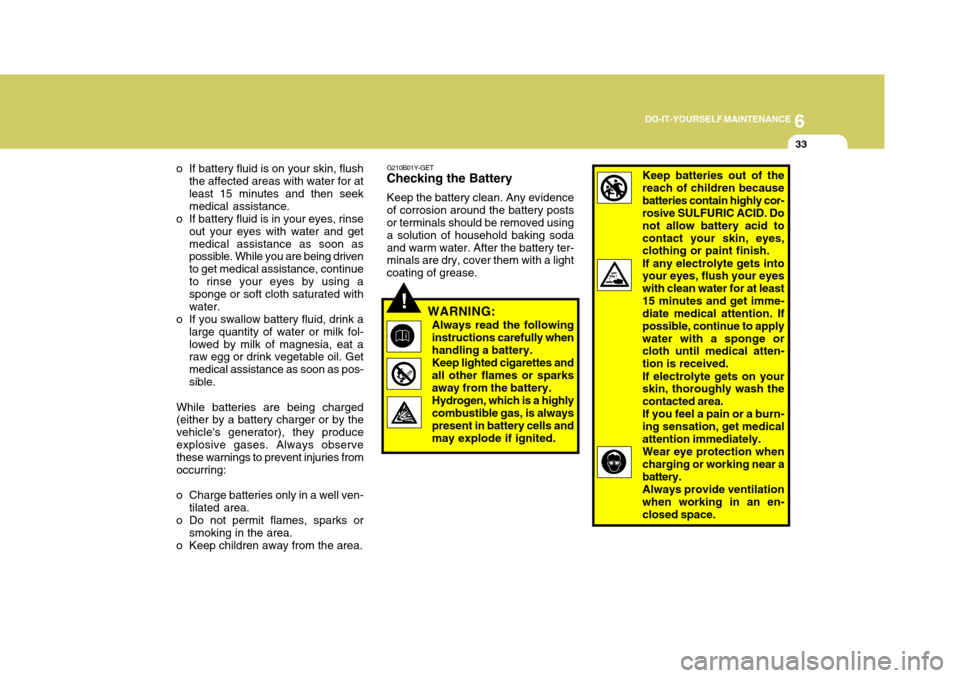
o If battery fluid is on your skin, flush the affected areas with water for at least 15 minutes and then seek medical assistance.
o If battery fluid is in your eyes, rinse out your eyes with water and getmedical assistance as soon as possible. While you are being driven to get medical assistance, continueto rinse your eyes by using a sponge or soft cloth saturated with water.
o If you swallow battery fluid, drink a large quantity of water or milk fol-lowed by milk of magnesia, eat a raw egg or drink vegetable oil. Get medical assistance as soon as pos-sible.
While batteries are being charged (either by a battery charger or by the vehicle's generator), they produceexplosive gases. Always observe these warnings to prevent injuries from occurring:
o Charge batteries only in a well ven- tilated area.
o Do not permit flames, sparks or smoking in the area.
o Keep children away from the area.
!
G210B01Y-GET
Checking the Battery
Keep the battery clean. Any evidence of corrosion around the battery posts or terminals should be removed using a solution of household baking sodaand warm water. After the battery ter- minals are dry, cover them with a light coating of grease.
WARNING:Always read the followinginstructions carefully whenhandling a battery.Keep lighted cigarettes andall other flames or sparksaway from the battery.Hydrogen, which is a highlycombustible gas, is always present in battery cells and may explode if ignited.Keep batteries out of the reach of children becausebatteries contain highly cor- rosive SULFURIC ACID. Do not allow battery acid tocontact your skin, eyes, clothing or paint finish. If any electrolyte gets into your eyes, flush your eyes with clean water for at least15 minutes and get imme- diate medical attention. If possible, continue to applywater with a sponge or cloth until medical atten- tion is received. If electrolyte gets on your skin, thoroughly wash the contacted area.If you feel a pain or a burn-ing sensation, get medicalattention immediately.Wear eye protection whencharging or working near abattery.Always provide ventilationwhen working in an en- closed space.