service Hyundai Elantra 2009 Инструкция по эксплуатации (in Russian)
[x] Cancel search | Manufacturer: HYUNDAI, Model Year: 2009, Model line: Elantra, Model: Hyundai Elantra 2009Pages: 308, PDF Size: 15.03 MB
Page 204 of 308
Driving your vehicle
42
5
5. Start the vehicle, hold the brakes, shift
to neutral, release the hand brake and
slowly release the brakes until the trail-
er chocks absorb the load.
6. Reapply the brakes, reapply the hand brake and shift the vehicle to R
(Reverse) for manual transaxle or P
(Park) for automatic transaxle.
7. Shut off the vehicle and release the vehicle brakes but leave the hand
brake set.
When you are ready to leave after park-ing on a hill
1. With the manual transaxle in Neutral or automatic transaxle in P (Park),
apply your brakes and hold the brake
pedal down while you:
and
2. Slowly remove your foot from the
brake pedal.
3. Drive slowly until the trailer is clear of the chocks.
4. Stop and have someone pick up and store the chocks.
Maintenance when trailer towing
Your vehicle will need service more often
when you regularly pull a trailer.
Important items to pay particular atten-tion to include engine oil, automatic
transaxle fluid, axle lubricant and cooling
system fluid. Brake condition is another
important item to frequently check. Each
item is covered in this manual, and the
Index will help you find them quickly. If
you’re trailering, it’s a good idea to review
these sections before you start your trip.
Don’t forget to also maintain your trailer
and towbar. Follow the maintenance
schedule that accompanied your trailer
and check it periodically. Preferably, con-
duct the check at the start of each day’s
driving. Most importantly, all towbar nutsand bolts should be tight.
WARNING - Hand brake
It can be dangerous to get out of
your vehicle if the hand brake is not
firmly set.
If you have left the engine running,
the vehicle can move suddenly. You
or others could be seriously injured
or cause fatality.
CAUTION
Due to higher load during trailer usage, overheating might occurin hot days or during uphill driv- ing. If the coolant gauge indicates
over-heating, switch off the A/C and stop the vehicle in a safe areato cool down the engine.
When towing check transaxle fluid more frequently.
If your vehicle is not equipped with the air conditioner, youshould install a condenser fan to improve engine performance
when towing a trailer.
Page 212 of 308
What to do in an emergency
4
6
EMERGENCY STARTING
Jump starting
Jump starting can be dangerous if done
incorrectly. Therefore, to avoid harm to
yourself or damage to your vehicle or
battery, follow the jump starting proce-
dures. If in doubt, we strongly recom-
mend that you have a competent techni-
cian or towing service jump start your
vehicle.
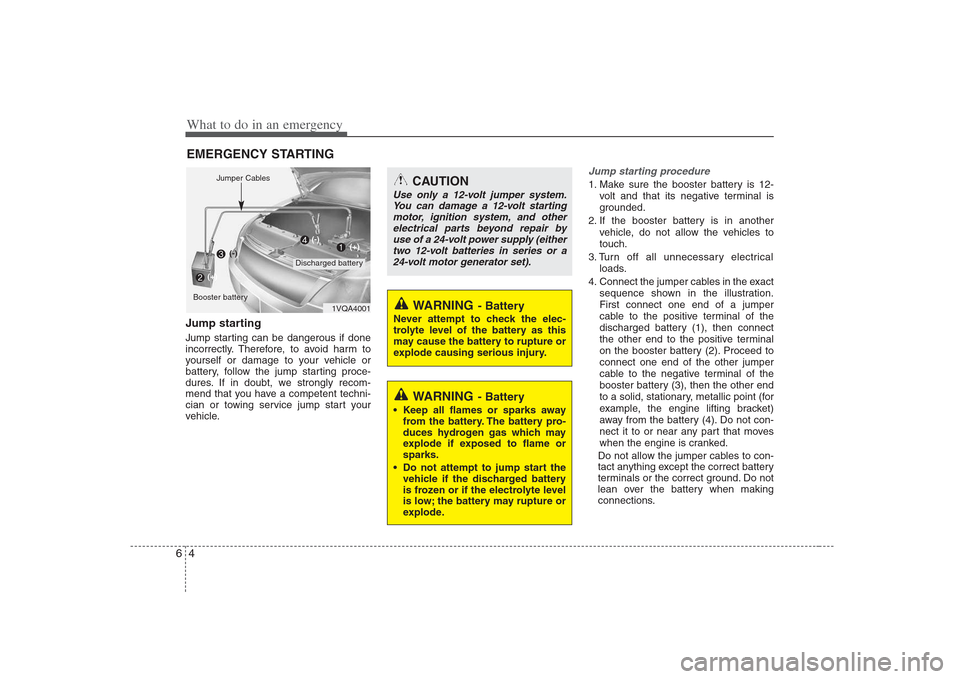
Jump starting procedure
1. Make sure the booster battery is 12- volt and that its negative terminal is
grounded.
2. If the booster battery is in another vehicle, do not allow the vehicles totouch.
3. Turn off all unnecessary electrical loads.
4. Connect the jumper cables in the exact sequence shown in the illustration.First connect one end of a jumper
cable to the positive terminal of the
discharged battery (1), then connect
the other end to the positive terminal
on the booster battery (2). Proceed toconnect one end of the other jumper
cable to the negative terminal of the
booster battery (3), then the other end
to a solid, stationary, metallic point (for
example, the engine lifting bracket)
away from the battery (4). Do not con-
nect it to or near any part that moves
when the engine is cranked.
Do not allow the jumper cables to con-
tact anything except the correct battery
terminals or the correct ground. Do not
lean over the battery when making
connections.CAUTION
Use only a 12-volt jumper system. You can damage a 12-volt startingmotor, ignition system, and other electrical parts beyond repair by
use of a 24-volt power supply (eithertwo 12-volt batteries in series or a 24-volt motor generator set).
WARNING - Battery
• Keep all flames or sparks away from the battery. The battery pro-
duces hydrogen gas which may
explode if exposed to flame orsparks.
Do not attempt to jump start the vehicle if the discharged battery
is frozen or if the electrolyte level
is low; the battery may rupture or
explode.
WARNING - Battery
Never attempt to check the elec-
trolyte level of the battery as this
may cause the battery to rupture or
explode causing serious injury.1VQA4001
Discharged battery
Jumper Cables
Booster battery(-)
(+)
(+)(-)
Page 215 of 308
67
What to do in an emergency
IF YOU HAVE A FLAT TYRE
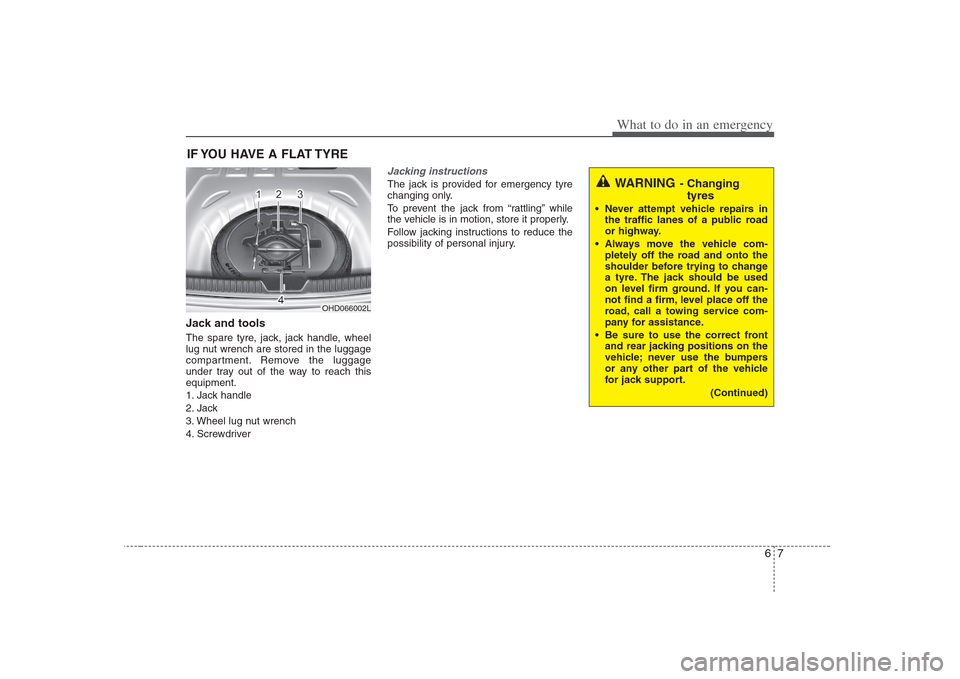
Jack and tools
The spare tyre, jack, jack handle, wheel
lug nut wrench are stored in the luggage
compartment. Remove the luggage
under tray out of the way to reach thisequipment.
1. Jack handle
2. Jack
3. Wheel lug nut wrench
4. Screwdriver
Jacking instructions
The jack is provided for emergency tyre
changing only.
To prevent the jack from “rattling” while
the vehicle is in motion, store it properly.
Follow jacking instructions to reduce the
possibility of personal injury.
OHD066002L
WARNING - Changing
tyres
Never attempt vehicle repairs in the traffic lanes of a public road
or highway.
Always move the vehicle com- pletely off the road and onto the
shoulder before trying to change
a tyre. The jack should be used
on level firm ground. If you can-
not find a firm, level place off the
road, call a towing service com-
pany for assistance.
Be sure to use the correct front and rear jacking positions on the
vehicle; never use the bumpers
or any other part of the vehicle
for jack support.
(Continued)
Page 219 of 308
611
What to do in an emergency
10. To reinstall the wheel, hold it on thestuds, put the wheel nuts on the studs and tighten them finger tight.
The nuts should be installed withtheir small diameter ends directed
inward. Jiggle the tyre to be sure it iscompletely seated, then tighten the
nuts as much as possible with yourfingers again.
11. Lower the car to the ground by turn- ing the wheel nut wrench counter-
clockwise.
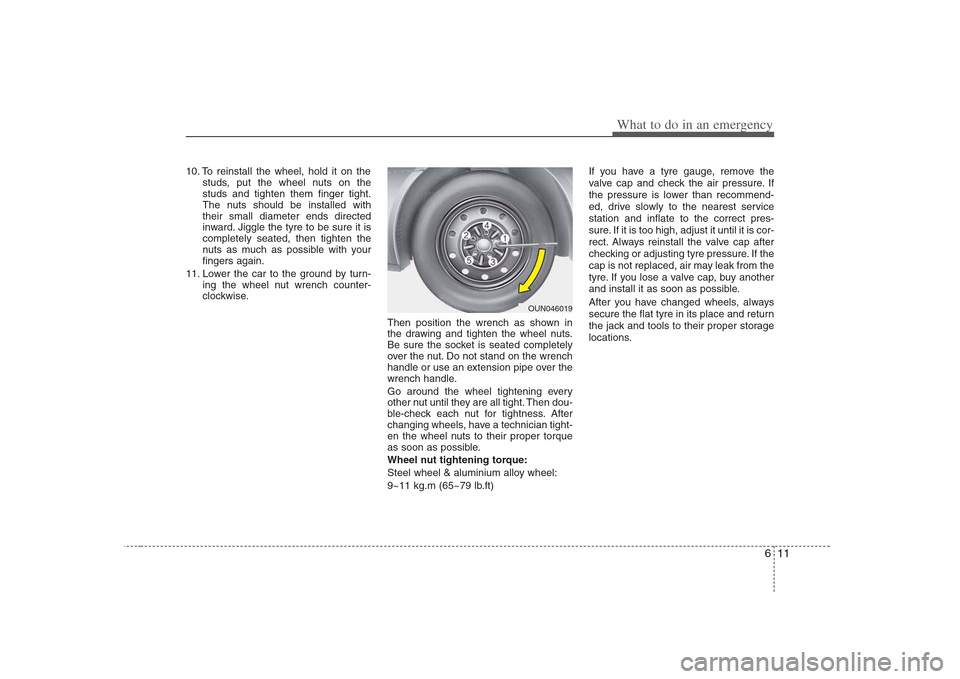
Then position the wrench as shown in
the drawing and tighten the wheel nuts.
Be sure the socket is seated completely
over the nut. Do not stand on the wrench
handle or use an extension pipe over the
wrench handle.
Go around the wheel tightening every
other nut until they are all tight. Then dou-
ble-check each nut for tightness. After
changing wheels, have a technician tight-
en the wheel nuts to their proper torque
as soon as possible.
Wheel nut tightening torque:
Steel wheel & aluminium alloy wheel:
9~11 kg.m (65~79 lb.ft) If you have a tyre gauge, remove the
valve cap and check the air pressure. If
the pressure is lower than recommend-
ed, drive slowly to the nearest servicestation and inflate to the correct pres-
sure. If it is too high, adjust it until it is cor-
rect. Always reinstall the valve cap after
checking or adjusting tyre pressure. If the
cap is not replaced, air may leak from the
tyre. If you lose a valve cap, buy another
and install it as soon as possible.
After you have changed wheels, always
secure the flat tyre in its place and return
the jack and tools to their proper storage
locations.
OUN046019
Page 222 of 308
What to do in an emergency
14
6
TOWING
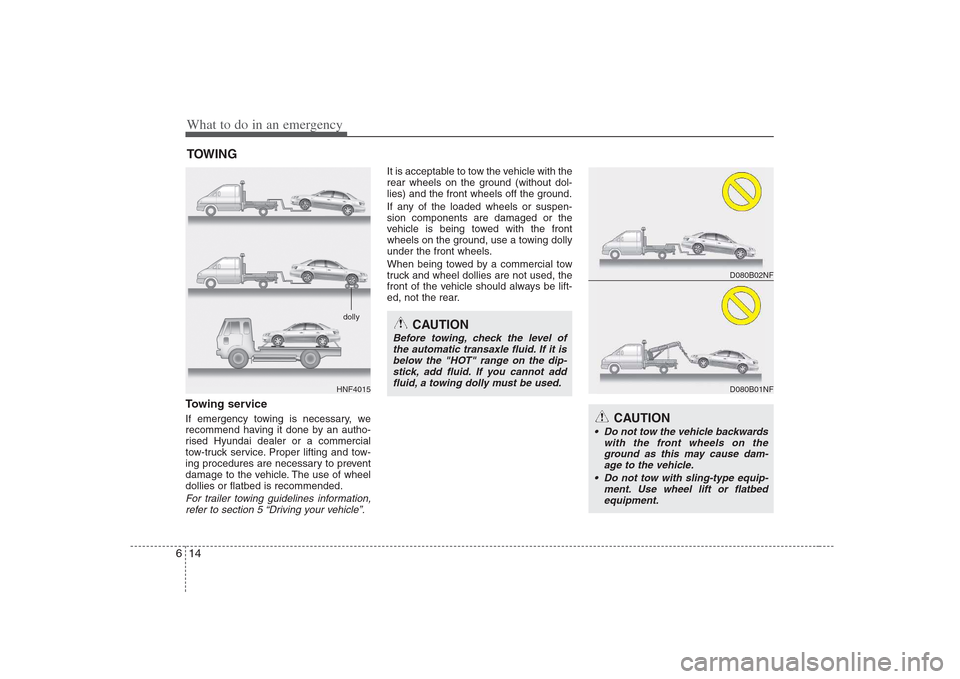
Towing service
If emergency towing is necessary, we
recommend having it done by an autho-
rised Hyundai dealer or a commercial
tow-truck service. Proper lifting and tow-
ing procedures are necessary to prevent
damage to the vehicle. The use of wheeldollies or flatbed is recommended.
For trailer towing guidelines information, refer to section 5 “Driving your vehicle”.
It is acceptable to tow the vehicle with the
rear wheels on the ground (without dol-
lies) and the front wheels off the ground.
If any of the loaded wheels or suspen- sion components are damaged or the
vehicle is being towed with the front
wheels on the ground, use a towing dolly
under the front wheels.
When being towed by a commercial tow
truck and wheel dollies are not used, the
front of the vehicle should always be lift-
ed, not the rear.
HNF4015
D080B02NF
D080B01NF
CAUTION
Do not tow the vehicle backwards
with the front wheels on theground as this may cause dam-age to the vehicle.
Do not tow with sling-type equip- ment. Use wheel lift or flatbed
equipment.
CAUTION
Before towing, check the level ofthe automatic transaxle fluid. If it isbelow the "HOT" range on the dip- stick, add fluid. If you cannot addfluid, a towing dolly must be used.
dolly
Page 223 of 308
615
What to do in an emergency
When towing your vehicle in an emer- gency without wheel dollies :
1. Set the ignition switch in the ACC posi-tion.
2. Place the transaxle shift lever in N (Neutral).
3. Release the hand brake.
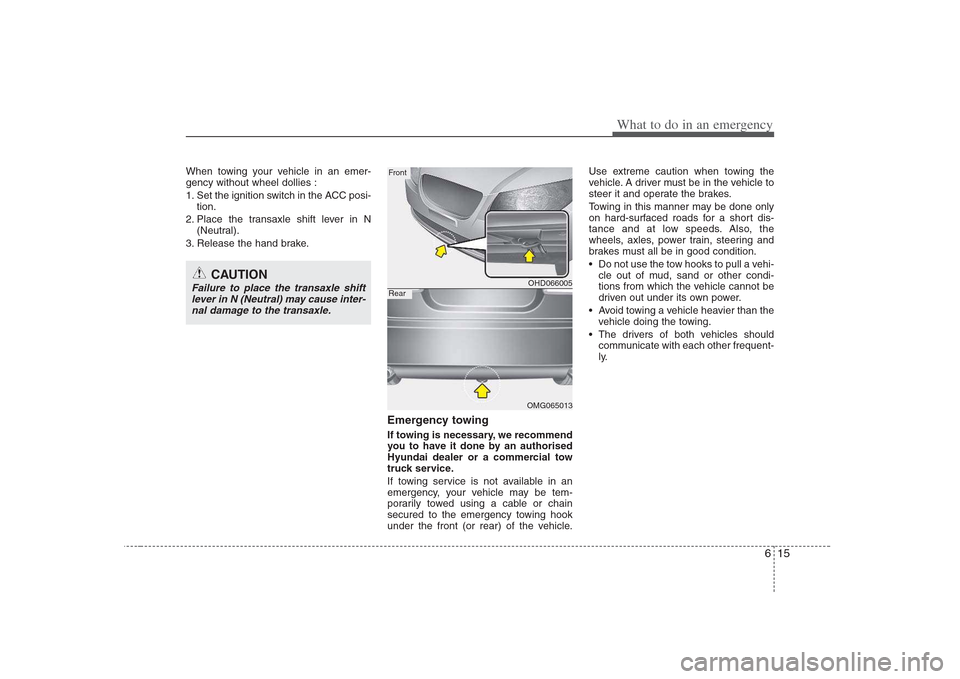
Emergency towing
If towing is necessary, we recommend
you to have it done by an authorised
Hyundai dealer or a commercial tow
truck service.
If towing service is not available in an
emergency, your vehicle may be tem-
porarily towed using a cable or chain
secured to the emergency towing hook
under the front (or rear) of the vehicle.Use extreme caution when towing the
vehicle. A driver must be in the vehicle to
steer it and operate the brakes.
Towing in this manner may be done only
on hard-surfaced roads for a short dis-
tance and at low speeds. Also, the
wheels, axles, power train, steering and
brakes must all be in good condition.
Do not use the tow hooks to pull a vehi-
cle out of mud, sand or other condi-
tions from which the vehicle cannot be
driven out under its own power.
Avoid towing a vehicle heavier than the vehicle doing the towing.
The drivers of both vehicles should communicate with each other frequent-
ly.
CAUTION
Failure to place the transaxle shift
lever in N (Neutral) may cause inter-nal damage to the transaxle.OHD066005
OMG065013
Front
Rear
Page 224 of 308
What to do in an emergency
16
6
Before emergency towing, check that
the hook is not broken or damaged.
Fasten the towing cable or chain securely to the hook.
Do not jerk the hook. Apply steady and even force.
To avoid damaging the hook, do not pull from the side or at a vertical angle.
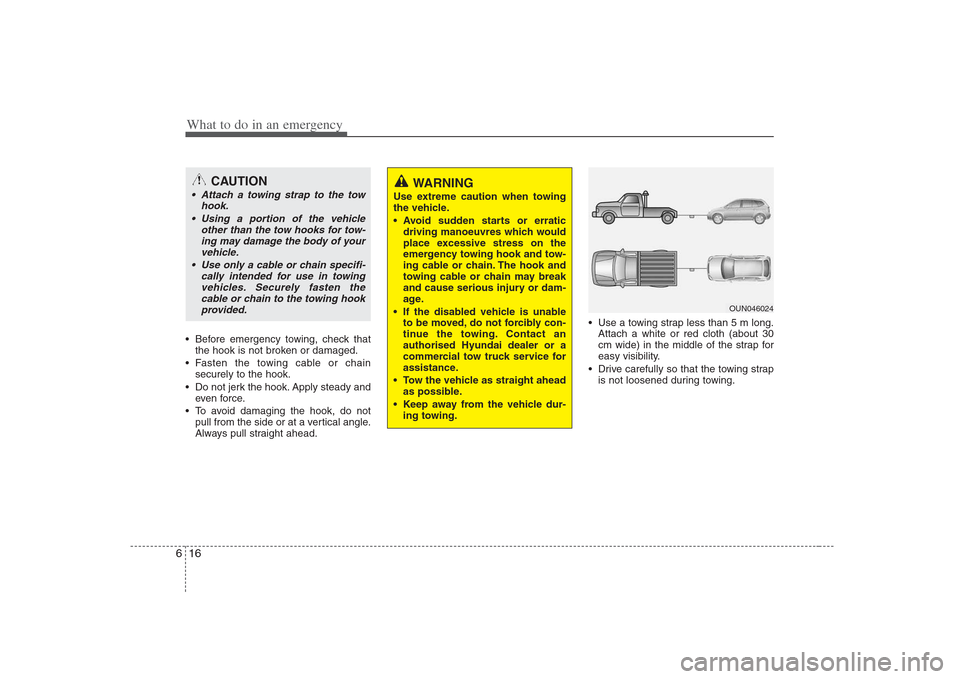
Always pull straight ahead. Use a towing strap less than 5 m long.
Attach a white or red cloth (about 30
cm wide) in the middle of the strap for
easy visibility.
Drive carefully so that the towing strap is not loosened during towing.
CAUTION
Attach a towing strap to the tow
hook.
Using a portion of the vehicle other than the tow hooks for tow-ing may damage the body of your
vehicle.
Use only a cable or chain specifi- cally intended for use in towingvehicles. Securely fasten thecable or chain to the towing hook
provided.WARNING
Use extreme caution when towing
the vehicle.
driving manoeuvres which would
place excessive stress on the
emergency towing hook and tow-
ing cable or chain. The hook and
towing cable or chain may break
and cause serious injury or dam-
age.
If the disabled vehicle is unable to be moved, do not forcibly con-
tinue the towing. Contact anauthorised Hyundai dealer or a
commercial tow truck service for
assistance.
Tow the vehicle as straight ahead as possible.
Keep away from the vehicle dur- ing towing.
OUN046024
Page 226 of 308

7
Engine compartment / 7-2 Maintenance services / 7-3
Owner maintenance / 7-4Scheduled maintenance service / 7-6Explanation of scheduled maintenance items / 7-13Engine oil / 7-16Engine coolant / 7-17Brake and clutch fluid / 7-19Automatic transaxle fluid / 7-20
Washer fluid / 7-22Hand brake / 7-22
Air cleaner / 7-23
Climate control air filter / 7-25
Wiper blades / 7-27Battery / 7-29
Tyres and wheels / 7-32 Fuses / 7-41 Light bulbs / 7-50
Appearance care / 7-56
Emission control system / 7-62
Maintenance
Page 228 of 308
73
Maintenance
MAINTENANCE SERVICES
You should exercise the utmost care to
prevent damage to your vehicle and
injury to yourself whenever performing
any maintenance or inspection proce-
dures.
Should you have any doubts concerning
the inspection or servicing of your vehi-
cle, we strongly recommend that you
have an authorised Hyundai dealer per-
form this work.
An authorised Hyundai dealer has facto-
ry-trained technicians and genuine
Hyundai parts to service your vehicle
properly. For expert advice and quality
service, see an authorised Hyundai deal-
er.
Inadequate, incomplete or insufficient
servicing may result in operational prob-
lems with your vehicle that could lead to
vehicle damage, an accident, or person-
al injury. Owner’s responsibility
✽✽
NOTICE
Maintenance Service and Record
Retention are the owner's responsibility.
You should retain documents that show
proper maintenance has been performed
on your vehicle in accordance with the
scheduled maintenance service charts
shown on the following pages. You need
this information to establish your compli-
ance with the servicing and maintenance
requirements of your vehicle warranties.
Detailed warranty information is provided
in your Service Passport. Repairs and adjustments required as a
result of improper maintenance or a lack
of required maintenance are not covered.
We recommend you have your vehicle
maintained and repaired by an autho-
rised Hyundai dealer. An authorised
Hyundai dealer meets Hyundai’s high
service quality standards and receives
technical support from Hyundai in order
to provide you with a high level of service
satisfaction.
Page 231 of 308
Maintenance
6
7
Owner maintenance precautions
Improper or incomplete service may
result in problems. This section gives
instructions only for the maintenance
items that are easy to perform.
As explained earlier in this section, sev-
eral procedures can be done only by an
authorised Hyundai dealer with special
tools.
✽✽
NOTICE
Improper owner maintenance during the warranty period may affect warran-
ty coverage. For details, read the sepa-
rate Service Passport provided with the
vehicle. If you're unsure about any serv-
icing or maintenance procedure, have it
done by an authorised Hyundai dealer.
SCHEDULED MAINTENANCE
SERVICE
Follow Normal Maintenance Schedule
if the vehicle is usually operated where
none of the following conditions apply. If
any of the following conditions apply, fol-
low Maintenance Under Severe Usage
Conditions.
Repeated short distance driving.
Driving in dusty conditions or sandy areas.
Extensive use of brakes.
Driving in areas where salt or other corrosive materials are being used.
Driving on rough or muddy roads.
Driving in mountainous areas.
Extended periods of idling or low speed operation.
Driving for a prolonged period in cold temperatures and/or extremely humid
climates.
More than 50% driving in heavy city traffic during hot weather above 32°C.
If your vehicle is operated under the
above conditions, you should inspect,replace or refill more frequently than the following Normal Maintenance Schedule.After 96 month or 120,000 km continue
to follow the prescribed maintenance intervals.
WARNING - Maintenance
work
Performing maintenance work on a vehicle can be dangerous. You
can be seriously injured while
performing some maintenance
procedures. If you lack sufficient
knowledge and experience or the
proper tools and equipment to do
the work, have it done by an
authorised Hyundai dealer.
Working under the bonnet with the engine running is dangerous.
It becomes even more dangerous
when you wear jewelry or loose
clothing. These can become
entangled in moving parts and
result in injury. Therefore, if you
must run the engine while work-
ing under the bonnet, make cer-
tain that you remove all jewelry
(especially rings, bracelets,
watches, and necklaces) and all
neckties, scarves, and similar
loose clothing before gettingnear the engine or cooling fans.