service Hyundai Elantra 2009 Инструкция по эксплуатации (in Russian)
[x] Cancel search | Manufacturer: HYUNDAI, Model Year: 2009, Model line: Elantra, Model: Hyundai Elantra 2009Pages: 308, PDF Size: 15.03 MB
Page 236 of 308
711
Maintenance
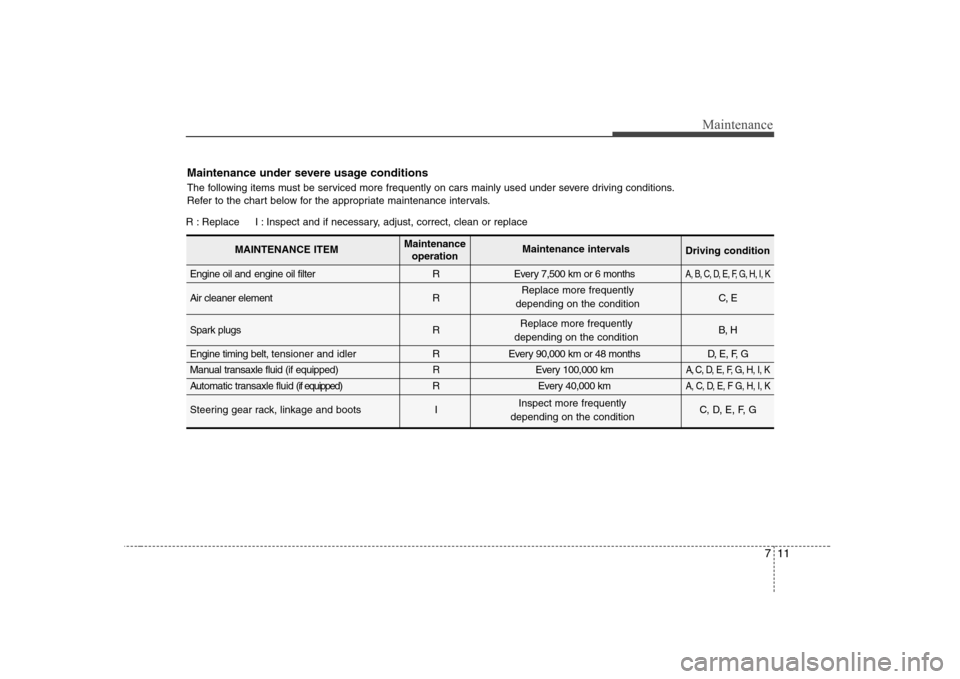
Maintenance under severe usage conditions
The following items must be serviced more frequently on cars mainly used under severe driving conditions.
Refer to the chart below for the appropriate maintenance intervals.
R : Replace I : Inspect and if necessary, adjust, correct, clean or replaceEngine oil and engine oil filter R Every 7,500 km or 6 months
A, B, C, D, E, F, G, H, I, K
Air cleaner element R C, E
Spark plugs R B, H
Engine timing belt, tensioner and idler R Every 90,000 km or 48 months D, E, F, G
Manual transaxle fluid (if equipped)
REvery 100,000 km A, C, D, E, F, G, H, I, K
Automatic transaxle fluid (if equipped)R Every 40,000 kmA, C, D, E, F G, H, I, K
Steering gear rack, linkage and boots I C, D, E, F, G
MAINTENANCE ITEMMaintenance
operation Maintenance intervals
Driving condition
Replace more frequently
depending on the condition
Inspect more frequently
depending on the condition Replace more frequently
depending on the condition
Page 240 of 308

715
Maintenance
Manual transaxle fluid (if equipped)
Inspect the manual transaxle fluid
according to the maintenance schedule.
✽✽NOTICE
If the oil level is low, check for possible
leaks before adding oil. Do not overfill.
Automatic transaxle fluid (if equipped)
The fluid level should be in the "HOT"
range of the dipstick, after the engine
and transaxle are at normal operating
temperature. Check the automatic
transaxle fluid level with the engine run-
ning and the transaxle in neutral, with the
hand brake properly applied. Brake hoses and lines
Visually check for proper installation,
chafing, cracks, deterioration and any
leakage. Replace any deteriorated or
damaged parts immediately. Brake fluid
Check brake fluid level in the brake fluid
reservoir. The level should be between
“MIN” and “MAX” marks on the side of
the reservoir. Use only hydraulic brake
fluid conforming to DOT 3 or DOT 4. Hand brake
Inspect the hand brake system including
the hand brake lever and cables. For
detailed service procedures, refer to the
Shop Manual.
Brake pads, calipers and rotors
Check the pads for excessive wear, discs
for run out and wear, and calipers for fluid
leakage. Suspension mounting bolts
Check the suspension connections for
looseness or damage. Retighten to the
specified torque.
Steering gear box, linkage &
boots/lower arm ball joint
With the vehicle stopped and engine off,
check for excessive free-play in the
steering wheel.
Check the linkage for bends or damage.
Check the dust boots and ball joints for
deterioration, cracks, or damage.
Replace any damaged parts. Drive shafts and boots
Check the drive shafts, boots and clamps
for cracks, deterioration, or damage.
Replace any damaged parts and, if nec-
essary, repack the grease.
Air conditioning refrigerant (if equipped)
Check the air conditioning lines and con-
nections for leakage and damage. Check
air conditioning performance according
to the relevant shop manual if necessary.
Page 254 of 308
729
Maintenance
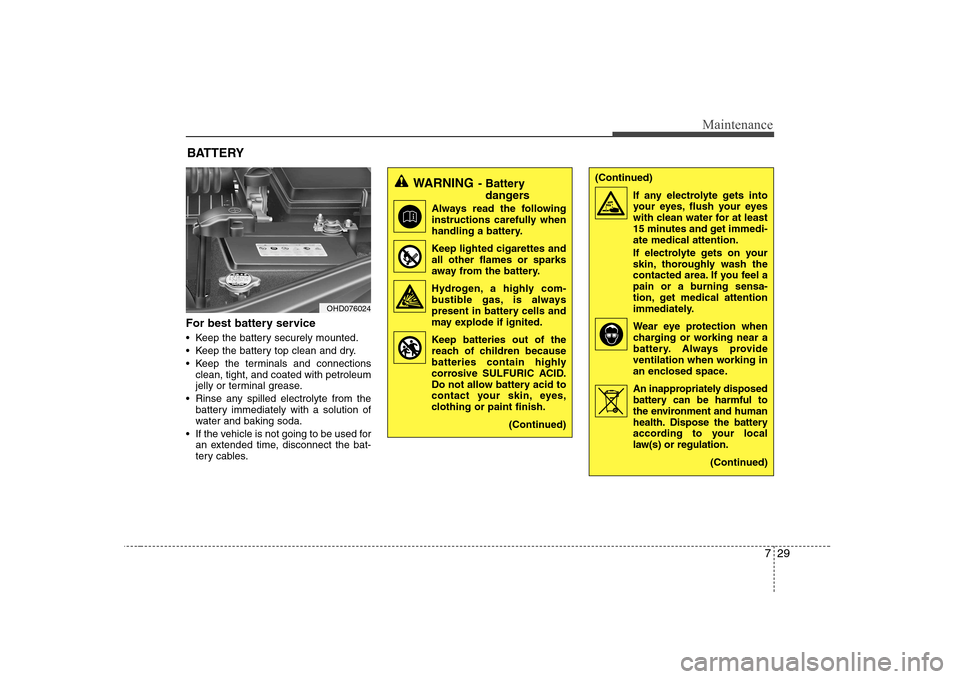
For best battery service
Keep the battery securely mounted.
Keep the battery top clean and dry.
Keep the terminals and connectionsclean, tight, and coated with petroleum
jelly or terminal grease.
Rinse any spilled electrolyte from the battery immediately with a solution of
water and baking soda.
If the vehicle is not going to be used for an extended time, disconnect the bat-
tery cables.
WARNING - Battery
dangers
Always read the following
instructions carefully when
handling a battery.
Keep lighted cigarettes and all other flames or sparks
away from the battery.
Hydrogen, a highly com- bustible gas, is always
present in battery cells and
may explode if ignited.
Keep batteries out of the
reach of children because
batteries contain highly
corrosive SULFURIC ACID.
Do not allow battery acid to
contact your skin, eyes,
clothing or paint finish.
(Continued)(Continued)If any electrolyte gets intoyour eyes, flush your eyes
with clean water for at least
15 minutes and get immedi-ate medical attention.
If electrolyte gets on your
skin, thoroughly wash the
contacted area. If you feel a
pain or a burning sensa-
tion, get medical attention
immediately.
Wear eye protection when charging or working near a
battery. Always provide
ventilation when working in
an enclosed space.
An inappropriately disposed battery can be harmful to
the environment and human
health. Dispose the battery
according to your local
law(s) or regulation.
(Continued)
BATTERY
OHD076024
Page 264 of 308
739
Maintenance
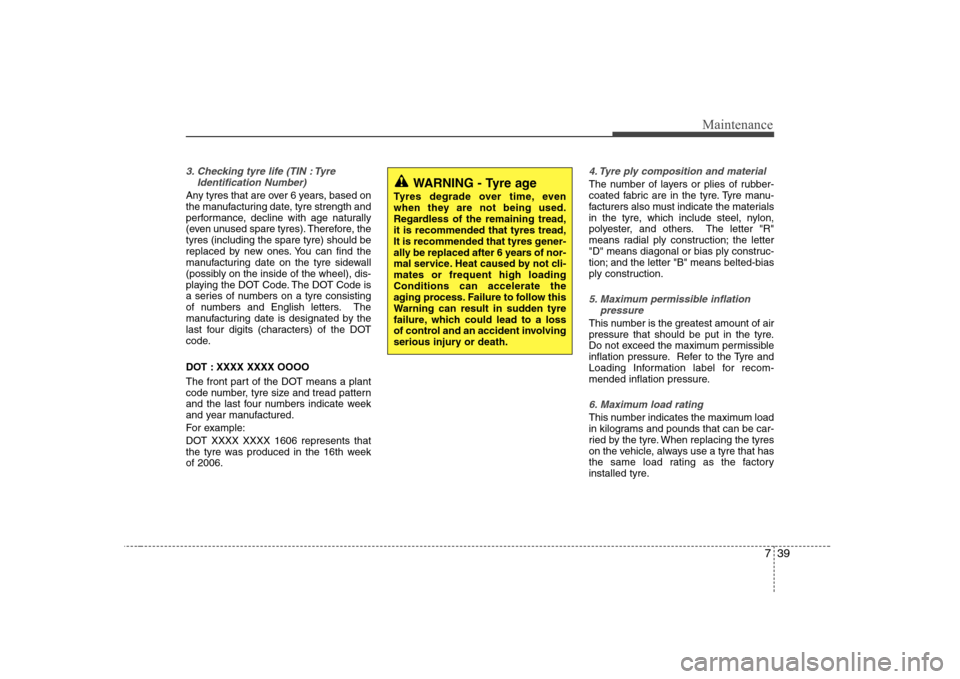
3. Checking tyre life (TIN : TyreIdentification Number)
Any tyres that are over 6 years, based on
the manufacturing date, tyre strength and
performance, decline with age naturally
(even unused spare tyres). Therefore, thetyres (including the spare tyre) should be
replaced by new ones. You can find the
manufacturing date on the tyre sidewall
(possibly on the inside of the wheel), dis-
playing the DOT Code. The DOT Code is
a series of numbers on a tyre consisting
of numbers and English letters. The
manufacturing date is designated by the
last four digits (characters) of the DOT
code.
DOT : XXXX XXXX OOOO
The front part of the DOT means a plant
code number, tyre size and tread pattern
and the last four numbers indicate week
and year manufactured.
For example:
DOT XXXX XXXX 1606 represents that
the tyre was produced in the 16th weekof 2006.
4. Tyre ply composition and material
The number of layers or plies of rubber-
coated fabric are in the tyre. Tyre manu-
facturers also must indicate the materials
in the tyre, which include steel, nylon,
polyester, and others. The letter "R"
means radial ply construction; the letter
"D" means diagonal or bias ply construc-
tion; and the letter "B" means belted-bias
ply construction.
5. Maximum permissible inflationpressure
This number is the greatest amount of air
pressure that should be put in the tyre.
Do not exceed the maximum permissible
inflation pressure. Refer to the Tyre and
Loading Information label for recom-
mended inflation pressure.
6. Maximum load rating
This number indicates the maximum load
in kilograms and pounds that can be car-
ried by the tyre. When replacing the tyres
on the vehicle, always use a tyre that has
the same load rating as the factory
installed tyre.
WARNING - Tyre age
Tyres degrade over time, even
when they are not being used.
Regardless of the remaining tread,it is recommended that tyres tread,
It is recommended that tyres gener-
ally be replaced after 6 years of nor-
mal service. Heat caused by not cli-mates or frequent high loadingConditions can accelerate the
aging process. Failure to follow this
Warning can result in sudden tyre
failure, which could lead to a loss
of control and an accident involving
serious injury or death.
Page 265 of 308
Maintenance
40
7
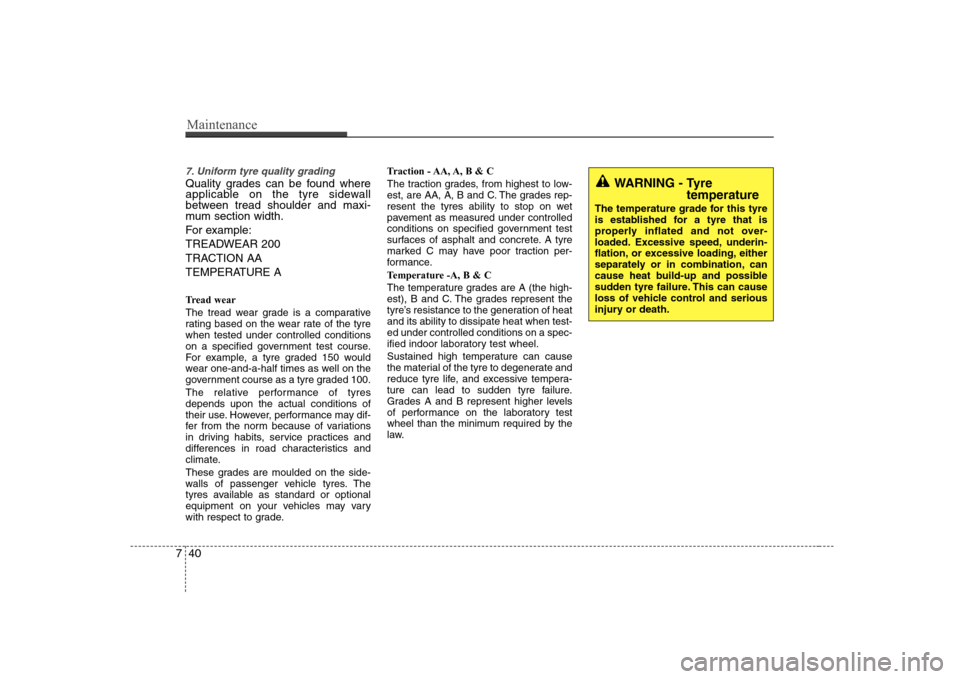
7. Uniform tyre quality grading
Quality grades can be found where
applicable on the tyre sidewall
between tread shoulder and maxi-
mum section width.
For example:
TREADWEAR 200
TRACTION AA
TEMPERATURE A
Tread wear
The tread wear grade is a comparative
rating based on the wear rate of the tyrewhen tested under controlled conditions
on a specified government test course.
For example, a tyre graded 150 would
wear one-and-a-half times as well on the
government course as a tyre graded 100.
The relative performance of tyres depends upon the actual conditions of
their use. However, performance may dif-
fer from the norm because of variations
in driving habits, service practices and
differences in road characteristics and
climate.
These grades are moulded on the side-
walls of passenger vehicle tyres. The
tyres available as standard or optional
equipment on your vehicles may vary
with respect to grade. Traction - AA, A, B & C
The traction grades, from highest to low-
est, are AA, A, B and C. The grades rep-
resent the tyres ability to stop on wet
pavement as measured under controlled
conditions on specified government test
surfaces of asphalt and concrete. A tyre
marked C may have poor traction per-
formance.
Temperature -A, B & C
The temperature grades are A (the high-
est), B and C. The grades represent the
tyre’s resistance to the generation of heatand its ability to dissipate heat when test-ed under controlled conditions on a spec-
ified indoor laboratory test wheel.
Sustained high temperature can cause
the material of the tyre to degenerate and
reduce tyre life, and excessive tempera-
ture can lead to sudden tyre failure.
Grades A and B represent higher levels
of performance on the laboratory test
wheel than the minimum required by the
law.WARNING - Tyre
temperature
The temperature grade for this tyre
is established for a tyre that is
properly inflated and not over-
loaded. Excessive speed, underin-
flation, or excessive loading, either
separately or in combination, can
cause heat build-up and possible
sudden tyre failure. This can cause
loss of vehicle control and serious
injury or death.
Page 278 of 308
753
Maintenance
4. Remove the bulb by pulling it straightout.
5. Insert a new bulb in the socket.
6. Reassemble the socket and the lens part.
7. Connect the bulb electrical connector.
8. Reinstall the light assembly to the body of the vehicle.
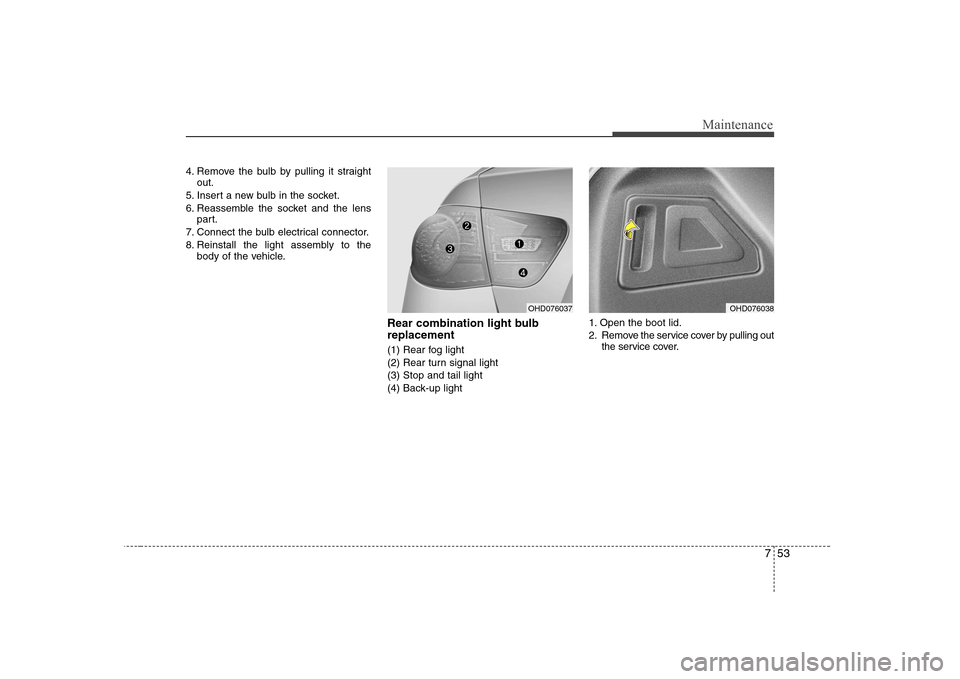
Rear combination light bulb replacement
(1) Rear fog light
(2) Rear turn signal light(3) Stop and tail light
(4) Back-up light 1. Open the boot lid.
2. Remove the service cover by pulling out
the service cover.
OHD076037OHD076038
Page 279 of 308
Maintenance
54
7
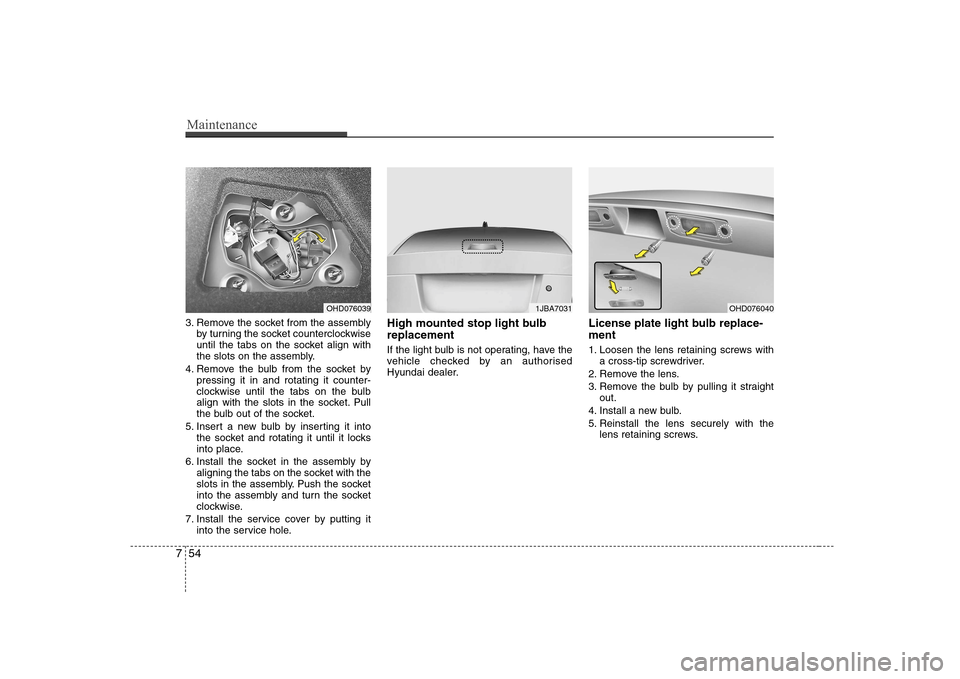
3. Remove the socket from the assembly
by turning the socket counterclockwise
until the tabs on the socket align with
the slots on the assembly.
4. Remove the bulb from the socket by pressing it in and rotating it counter-
clockwise until the tabs on the bulb
align with the slots in the socket. Pull
the bulb out of the socket.
5. Insert a new bulb by inserting it into the socket and rotating it until it locks
into place.
6. Install the socket in the assembly by aligning the tabs on the socket with the
slots in the assembly. Push the socket
into the assembly and turn the socket
clockwise.
7. Install the service cover by putting it into the service hole. High mounted stop light bulb replacement
If the light bulb is not operating, have the
vehicle checked by an authorised
Hyundai dealer.
License plate light bulb replace- ment
1. Loosen the lens retaining screws with
a cross-tip screwdriver.
2. Remove the lens.
3. Remove the bulb by pulling it straight out.
4. Install a new bulb.
5. Reinstall the lens securely with the lens retaining screws.
OHD0760391JBA7031OHD076040
Page 287 of 308
Maintenance
62
7
EMISSION CONTROL SYSTEM
The emission control system of your
vehicle is covered by a written limited
warranty. Please see the warranty infor-
mation contained in the Service Passport
in your vehicle.
Your vehicle is equipped with an emis-
sion control system to meet all Australian
Design Rules (ADR) requirements. There are three emission control sys-
tems which are as follows.
(1) Crankcase emission control system
(2) Evaporative emission control system(3) Exhaust emission control system In order to assure the proper function of
the emission control systems, it is rec-
ommended that you have your car
inspected and maintained by an autho-
rised Hyundai dealer in accordance with
the maintenance schedule in this manu-al. Caution for the Inspection and
Maintenance Test (With Electronic
Stability Program (ESP) system)
To prevent the vehicle from misfir-
ing during dynamometer testing,
turn the Electronic Stability
Program (ESP) system off by press-
ing the ESP switch.
After dynamometer testing is com- pleted, turn the ESP system back on
by pressing the ESP switch again.
1. Crankcase emission control system
The positive crankcase ventilation sys-
tem is employed to prevent air pollution
caused by blow-by gases being emitted
from the crankcase. This system supplies
fresh filtered air to the crankcase through
the air intake hose. Inside the crankcase,
the fresh air mixes with blow-by gases,
which then pass through the PCV valveinto the induction system. 2. Evaporative emission control
System
The Evaporative Emission Control
System is designed to prevent fuel
vapours from escaping into the atmos-
phere.
Canister
Fuel vapours generated inside the fuel tank are absorbed and stored in the
onboard canister. When the engine is
running, the fuel vapours absorbed in the
canister are drawn into the surge tank
through the purge control solenoid valve.
Purge Control Solenoid Valve (PCSV)
The purge control solenoid valve is con-
trolled by the Engine Control Module
(ECM); when the engine coolant temper-
ature is low during idling, the PCSV clos-
es so that evaporated fuel is not taken
into the engine. After the engine warms-
up during ordinary driving, the PCSV
opens to introduce evaporated fuel to the
engine.
Page 293 of 308
Specifications & Consumer information
4
8
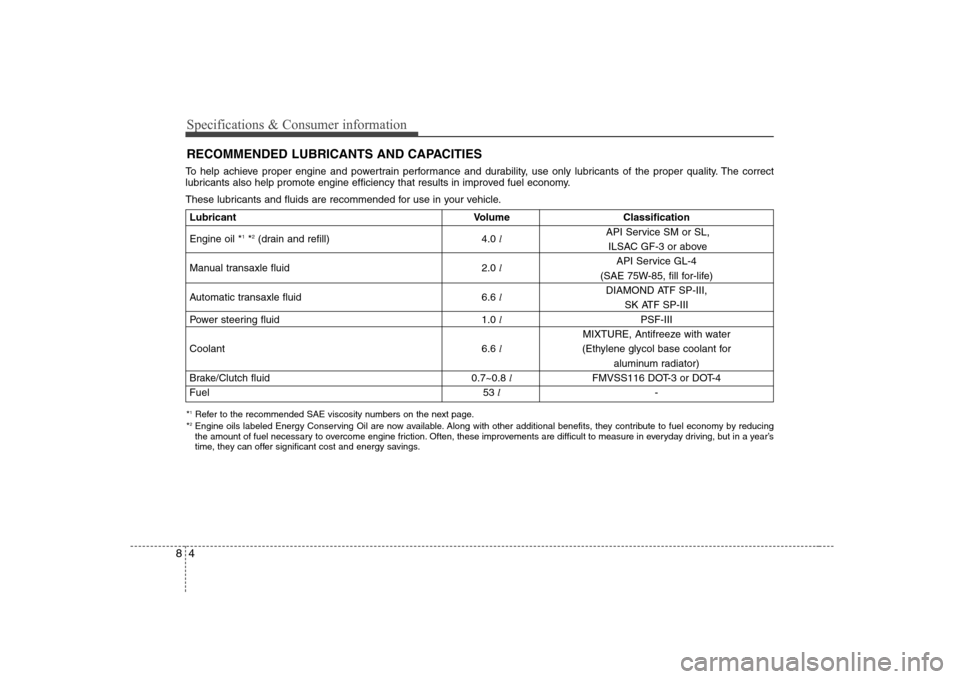
RECOMMENDED LUBRICANTS AND CAPACITIES
To help achieve proper engine and powertrain performance and durability, use only lubricants of the proper quality. The correct
lubricants also help promote engine efficiency that results in improved fuel economy.
These lubricants and fluids are recommended for use in your vehicle.
* 1
Refer to the recommended SAE viscosity numbers on the next page.
* 2
Engine oils labeled Energy Conserving Oil are now available. Along with other additional benefits, they contribute to fuel econo my by reducing
the amount of fuel necessary to overcome engine friction. Often, these improvements are difficult to measure in everyday driving, but in a year’s
time, they can offer significant cost and energy savings.
Lubricant Volume Classification
Engine oil * 1
*2
(drain and refill) 4.0 l
Manual transaxle fluid 2.0 l API Service GL-4
(SAE 75W-85, fill for-life)
Automatic transaxle fluid 6.6 l DIAMOND ATF SP-III,
SK ATF SP-III
Power steering fluid 1.0 l PSF-III
MIXTURE, Antifreeze with water
Coolant 6.6 l (Ethylene glycol base coolant for
aluminum radiator)
Brake/Clutch fluid 0.7~0.8 l FMVSS116 DOT-3 or DOT-4
Fuel 53 l -
API Service SM or SL,
ILSAC GF-3 or above
Page 301 of 308
F4FOREWORD
Thank you for choosing Hyundai. We are pleased to welcome you to the growing number of discriminating people who drive
Hyundai. The advanced engineering and high-quality construction of each Hyundai we build is something of which we're veryproud.
Your Owner's Manual will introduce you to the features and operation of your new Hyundai. It is suggested that you read it care-
fully because the information it contains can contribute greatly to the satisfaction you receive from your new car.
The manufacturer also recommends that all service and maintenance on your car be performed by an authorised Hyundai deal-
er. Hyundai dealers are prepared to provide high-quality service, maintenance and any other assistance that may be required. HYUNDAI MOTOR COMPANY
Note : If for any reason in the future you should sell your Hyundai, please leave this manual in the vehicle for the new owner's use.
Copyright 2009 Hyundai Motor Company. All rights reserved. No part of this publication may be reproduced, stored in any retrieva l
system or transmitted in any form or by any means without the prior written permission of Hyundai Motor Company.
CAUTION
Severe engine and transaxle damage may result from the use of poor quality fuels and lubricants that do not meet Hyundai specifications. You must always use high quality fuels and lubricants that meet the specifications listed on Page 8-4 in the Vehicle Specifications section of the Owner's Manual.