trailer Hyundai Elantra 2009 Инструкция по эксплуатации (in Russian)
[x] Cancel search | Manufacturer: HYUNDAI, Model Year: 2009, Model line: Elantra, Model: Hyundai Elantra 2009Pages: 308, PDF Size: 15.03 MB
Page 207 of 308
545
Driving your vehicle
(Continued)
Never exceed the maximumweight limits of the trailer or trail-
er towing equipment. Improper
loading can result in damage to
your vehicle and/or personal
injury. Check weights and loading
at a commercial scale or highway
patrol office equipped withscales.
An improperly loaded trailer can cause loss of vehicle control.
Page 208 of 308
Driving your vehicle
46
5
This section will guide you in the proper
loading of your vehicle and/or trailer, to
keep your loaded vehicle weight within its
design rating capability, with or without a
trailer. Properly loading your vehicle will
provide maximum return of the vehicle
design performance. Before loading your
vehicle, familiarise yourself with the fol-
lowing terms for determining your vehi-
cle's weight ratings, with or without a
trailer, from the vehicle's specificationsand the compliance plate: Base curb weight
This is the weight of the vehicle including a full tank of fuel and all standard equip-
ment. It does not include passengers,
cargo, or optional equipment.
Vehicle curb weight
This is the weight of your new vehicle
when you picked it up from your dealer
plus any aftermarket equipment.
Cargo weight
This figure includes all weight added to
the Base Curb Weight, including cargoand optional equipment. GAW (Gross axle weight)
This is the total weight placed on each
axle (front and rear) - including vehicle
curb weight and all payload.
GAWR (Gross axle weight rating)
This is the maximum allowable weight
that can be carried by a single axle (front
or rear). These numbers are shown on
the compliance plate.
The total load on each axle must never
exceed its GAWR.
GVW (Gross vehicle weight)
This is the Base Curb Weight plus actual
Cargo Weight plus passengers.
GVWR (Gross vehicle weight rating)
This is the maximum allowable weight of
the fully loaded vehicle (including all
options, equipment, passengers and
cargo). The GVWR is shown on the com-pliance plate located inside boot.
Overloading
WEIGHT OF THE VEHICLE
WARNING -
Vehicle weight
The gross axle weight rating
(GAWR) and the gross vehicle
weight rating (GVWR) for your vehi-
cle are on the manufacturer's plate
located to the boot. Exceedingthese ratings can cause an acci-
dent or vehicle damage. You can
calculate the weight of your load byweighing the items (and people)
before putting them in the vehicle.
Be careful not to overload your
vehicle.
Page 221 of 308
613
What to do in an emergency
The compact spare should be inflated to
420 kPa (60 psi).
✽✽NOTICE
Check the inflation pressure after
installing the spare tire. Adjust it to the
specified pressure, as necessary.
When using a compact spare tire,
observe the following precautions:
Under no circumstances should you exceed 80 km/h (50 mph); a higher
speed could damage the tire.
Ensure that you drive slowly enough for the road conditions to avoid all haz-
ards. Any road hazard, such as a pot-
hole or debris, could seriously damage
the compact spare.
Any continuous road use of this tire could result in tire failure, loss of vehi-
cle control, and possible personal
injury.
Do not exceed the vehicle’s maximum load rating or the load-carrying capaci-
ty shown on the sidewall of the com-
pact spare tire.
Avoid driving over obstacles. The com- pact spare tire diameter is smaller than
the diameter of a conventional tire and
reduces the ground clearance approxi-mately 25 mm (1 inch), which could
result in damage to the vehicle.
Do not take this vehicle through an automatic car wash while the compactspare tire is installed.
Do not use tire chains on the compact spare tire. Because of the smaller size,
a tire chain will not fit properly. This
could damage the vehicle and result inloss of the chain. The compact spare tire should not be
installed on the front axle if the vehicle
must be driven in snow or on ice.
Do not use the compact spare tire on any other vehicle because this tire has
been designed especially for your vehi-
cle.
The compact spare tire’s tread life is shorter than a regular tire. Inspect your
compact spare tire regularly and
replace worn compact spare tires with
the same size and design, mounted onthe same wheel.
The temporary spare tire should not be used on any other wheels, nor should
standard tires, snow tires, wheel cov-
ers or trim rings be used with the tem-
porary spare wheel. If such use isattempted, damage to these items or
other car components may occur.
Do not use more than one temporary spare tire at a time.
Do not tow a trailer while the temporary spare tire is installed.
WARNING
This spare tire should be used only
for VERY short distances. Compact
spares should NEVER be used for
long drives or extended distances.
Page 222 of 308
What to do in an emergency
14
6
TOWING
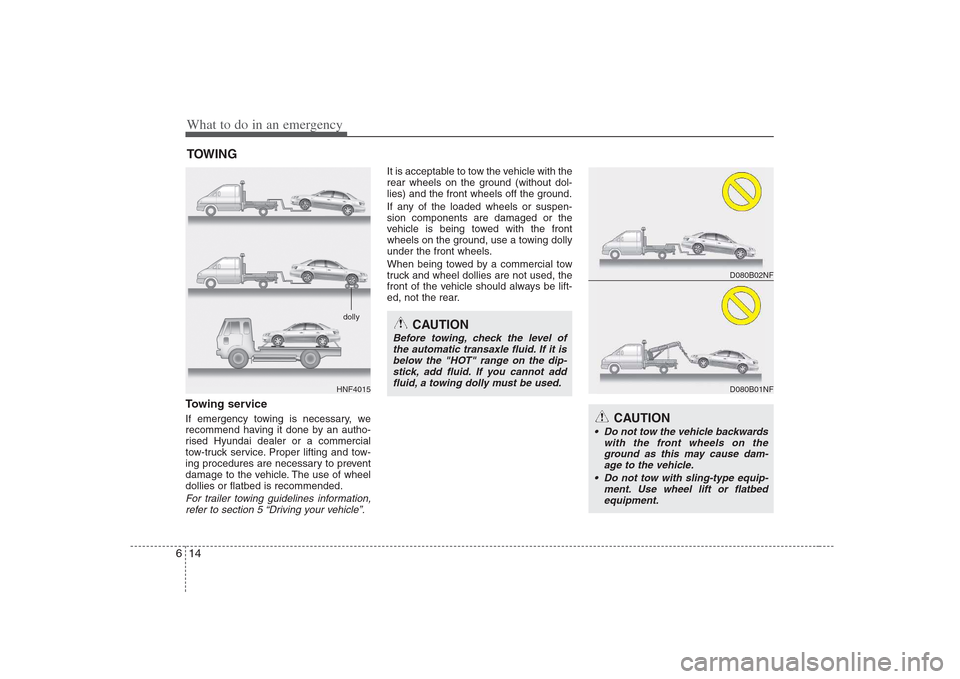
Towing service
If emergency towing is necessary, we
recommend having it done by an autho-
rised Hyundai dealer or a commercial
tow-truck service. Proper lifting and tow-
ing procedures are necessary to prevent
damage to the vehicle. The use of wheeldollies or flatbed is recommended.
For trailer towing guidelines information, refer to section 5 “Driving your vehicle”.
It is acceptable to tow the vehicle with the
rear wheels on the ground (without dol-
lies) and the front wheels off the ground.
If any of the loaded wheels or suspen- sion components are damaged or the
vehicle is being towed with the front
wheels on the ground, use a towing dolly
under the front wheels.
When being towed by a commercial tow
truck and wheel dollies are not used, the
front of the vehicle should always be lift-
ed, not the rear.
HNF4015
D080B02NF
D080B01NF
CAUTION
Do not tow the vehicle backwards
with the front wheels on theground as this may cause dam-age to the vehicle.
Do not tow with sling-type equip- ment. Use wheel lift or flatbed
equipment.
CAUTION
Before towing, check the level ofthe automatic transaxle fluid. If it isbelow the "HOT" range on the dip- stick, add fluid. If you cannot addfluid, a towing dolly must be used.
dolly
Page 237 of 308

Maintenance
12
7
Severe driving conditions
A : Repeated short distance driving
B : Extensive idling
C : Driving in dusty, rough roads
D : Driving in areas using salt or other corrosive
materials or in very cold weather
E : Driving in sandy areas F : More than 50 % driving in heavy city traffic during hot
weather above 32°C
G : Driving in mountainous areas.
H : Towing a trailer
I : Driving for patrol car, taxi, commercial car or vehicle tow- ing
J : Driving over 140 km/h
K : Driving over 170 km/h
Front suspension ball joints I C, D, E, F, G
Disc brakes and pads, calipers and rotors I C, D, E, G, H
Hand brake I C, D, G, H
Driveshaft and boots I C, D, E, F, I, H, K
Climate control air filter R C, E
MAINTENANCE ITEMMaintenance
operation Maintenance intervals
Driving condition
Inspect more frequently
depending on the condition
Inspect more frequently
depending on the condition
Inspect more frequently
depending on the condition
Inspect more frequently
depending on the condition
Replace more frequently
depending on the condition
Page 308 of 308

Index
4I
Theft-alarm system ························································ 4-6
Towing ········································································· 6-14
Trailer towing ······························································ 5-38
Tyre specification/pressure label ··································· 8-8
Tyres and wheels ·················································· 7-32, 8-3
Vehicle compliance plate ·················································8-7
Vehicle identification number (VIN) ····························· 8-6
Vehicle run-in process ··················································· 1-5
Washer fluid ································································· 7-22
Weight of the vehicle ··················································· 5-46
Windows ······································································ 4-13
Windshield defrosting and defogging ························· 4-72
Winter driving ······························································ 5-34
Wiper blades ································································ 7-27
Wipers and washers ····················································· 4-49
V
W
T