tyre pressure Hyundai Elantra 2009 Инструкция по эксплуатации (in Russian)
[x] Cancel search | Manufacturer: HYUNDAI, Model Year: 2009, Model line: Elantra, Model: Hyundai Elantra 2009Pages: 308, PDF Size: 15.03 MB
Page 259 of 308
Maintenance
34
7
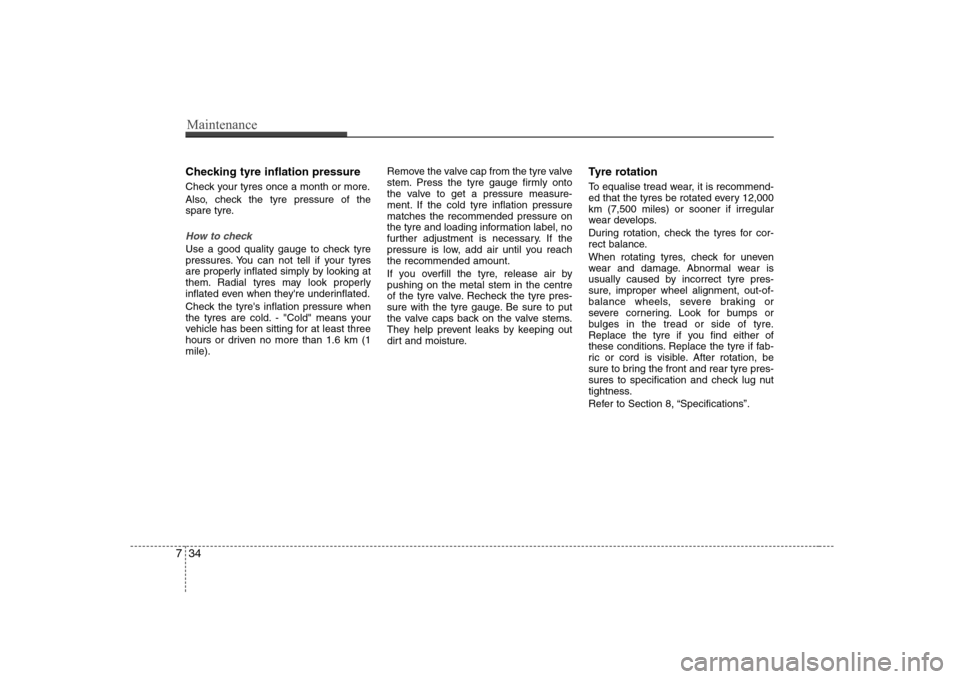
Checking tyre inflation pressure
Check your tyres once a month or more.
Also, check the tyre pressure of the
spare tyre.
How to check
Use a good quality gauge to check tyre
pressures. You can not tell if your tyres
are properly inflated simply by looking at
them. Radial tyres may look properly
inflated even when they're underinflated.
Check the tyre's inflation pressure when
the tyres are cold. - "Cold" means your
vehicle has been sitting for at least three
hours or driven no more than 1.6 km (1mile). Remove the valve cap from the tyre valve
stem. Press the tyre gauge firmly onto
the valve to get a pressure measure-
ment. If the cold tyre inflation pressurematches the recommended pressure on
the tyre and loading information label, no
further adjustment is necessary. If the
pressure is low, add air until you reachthe recommended amount.
If you overfill the tyre, release air by pushing on the metal stem in the centre
of the tyre valve. Recheck the tyre pres-
sure with the tyre gauge. Be sure to put
the valve caps back on the valve stems.
They help prevent leaks by keeping out
dirt and moisture.
Tyre rotation
To equalise tread wear, it is recommend-
ed that the tyres be rotated every 12,000km (7,500 miles) or sooner if irregular
wear develops.
During rotation, check the tyres for cor-
rect balance.
When rotating tyres, check for uneven
wear and damage. Abnormal wear is
usually caused by incorrect tyre pres-
sure, improper wheel alignment, out-of-
balance wheels, severe braking or
severe cornering. Look for bumps or
bulges in the tread or side of tyre.
Replace the tyre if you find either of
these conditions. Replace the tyre if fab-
ric or cord is visible. After rotation, be
sure to bring the front and rear tyre pres-
sures to specification and check lug nut
tightness.
Refer to Section 8, “Specifications”.
Page 264 of 308
739
Maintenance
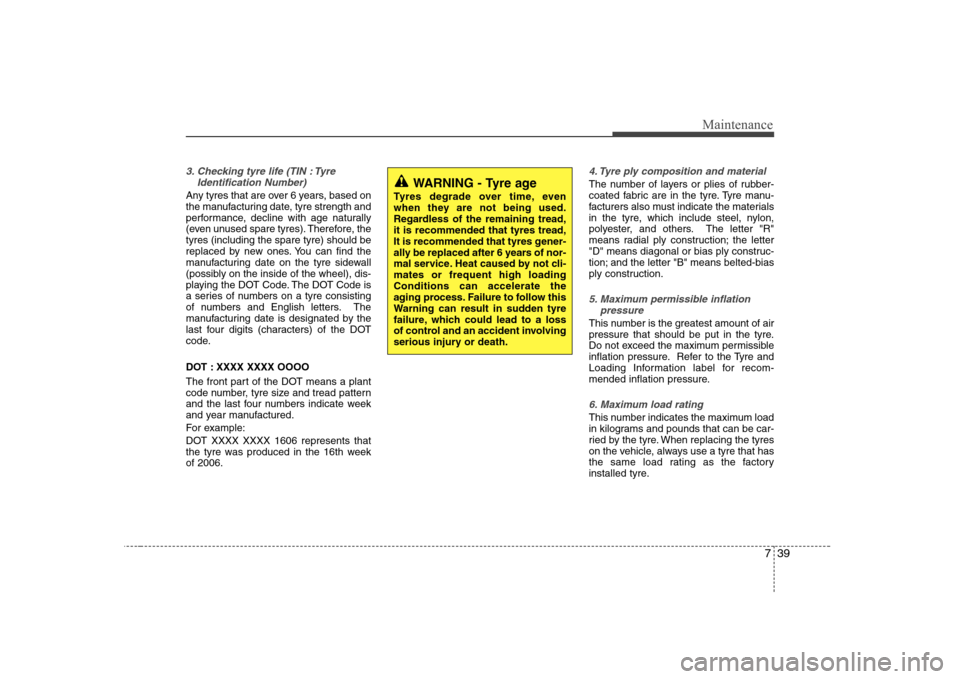
3. Checking tyre life (TIN : TyreIdentification Number)
Any tyres that are over 6 years, based on
the manufacturing date, tyre strength and
performance, decline with age naturally
(even unused spare tyres). Therefore, thetyres (including the spare tyre) should be
replaced by new ones. You can find the
manufacturing date on the tyre sidewall
(possibly on the inside of the wheel), dis-
playing the DOT Code. The DOT Code is
a series of numbers on a tyre consisting
of numbers and English letters. The
manufacturing date is designated by the
last four digits (characters) of the DOT
code.
DOT : XXXX XXXX OOOO
The front part of the DOT means a plant
code number, tyre size and tread pattern
and the last four numbers indicate week
and year manufactured.
For example:
DOT XXXX XXXX 1606 represents that
the tyre was produced in the 16th weekof 2006.
4. Tyre ply composition and material
The number of layers or plies of rubber-
coated fabric are in the tyre. Tyre manu-
facturers also must indicate the materials
in the tyre, which include steel, nylon,
polyester, and others. The letter "R"
means radial ply construction; the letter
"D" means diagonal or bias ply construc-
tion; and the letter "B" means belted-bias
ply construction.
5. Maximum permissible inflationpressure
This number is the greatest amount of air
pressure that should be put in the tyre.
Do not exceed the maximum permissible
inflation pressure. Refer to the Tyre and
Loading Information label for recom-
mended inflation pressure.
6. Maximum load rating
This number indicates the maximum load
in kilograms and pounds that can be car-
ried by the tyre. When replacing the tyres
on the vehicle, always use a tyre that has
the same load rating as the factory
installed tyre.
WARNING - Tyre age
Tyres degrade over time, even
when they are not being used.
Regardless of the remaining tread,it is recommended that tyres tread,
It is recommended that tyres gener-
ally be replaced after 6 years of nor-
mal service. Heat caused by not cli-mates or frequent high loadingConditions can accelerate the
aging process. Failure to follow this
Warning can result in sudden tyre
failure, which could lead to a loss
of control and an accident involving
serious injury or death.
Page 290 of 308
8
Dimensions / 8-2 Bulb wattage / 8-2
Tyres and wheels / 8-3Recommended lubricants and capacities / 8-4
Vehicle identification number (VIN) / 8-6
Engine number / 8-7
Vehicle compliance plate / 8-7
Tyre specification/pressure label / 8-8
Specifications & Consumer information
Page 292 of 308
83
Specifications & Consumer information
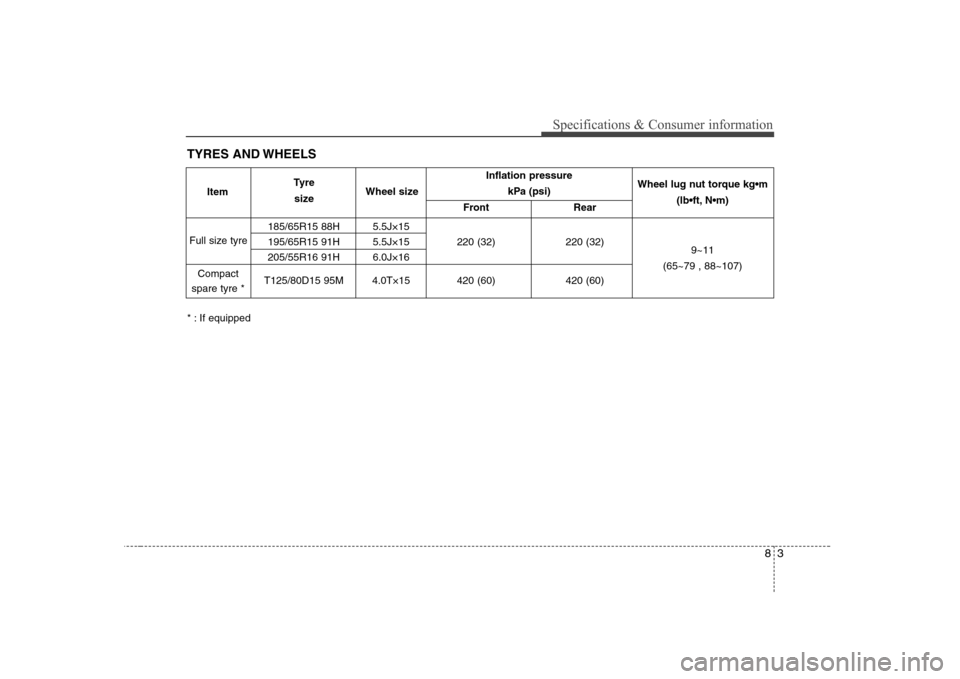
TYRES AND WHEELS
Inflation pressure kPa (psi)
Front Rear
185/65R15 88H 5.5J×15
195/65R15 91H 5.5J×15 220 (32) 220 (32)
205/55R16 91H 6.0J×16
T125/80D15 95M 4.0T×15 420 (60) 420 (60)
Full size tyre
Compact
spare tyre * Wheel lug nut torque kg•m
(lb N
9~11
(65~79 , 88~107)
Item
Tyre
size Wheel size
* : If equipped
Page 297 of 308

Specifications & Consumer information
8
8
The tyres supplied on your new vehicle
are chosen to provide the best perform-
ance for normal driving.
The tyre label located on the driver's side
of the centre pillar outer panel gives the
tyre pressures recommended for your
car.
TYRE SPECIFICATION/PRESSURE LABEL
OHD086003R
Page 308 of 308

Index
4I
Theft-alarm system ························································ 4-6
Towing ········································································· 6-14
Trailer towing ······························································ 5-38
Tyre specification/pressure label ··································· 8-8
Tyres and wheels ·················································· 7-32, 8-3
Vehicle compliance plate ·················································8-7
Vehicle identification number (VIN) ····························· 8-6
Vehicle run-in process ··················································· 1-5
Washer fluid ································································· 7-22
Weight of the vehicle ··················································· 5-46
Windows ······································································ 4-13
Windshield defrosting and defogging ························· 4-72
Winter driving ······························································ 5-34
Wiper blades ································································ 7-27
Wipers and washers ····················································· 4-49
V
W
T