air condition Hyundai Elantra 2009 Инструкция по эксплуатации (in Russian)
[x] Cancel search | Manufacturer: HYUNDAI, Model Year: 2009, Model line: Elantra, Model: Hyundai Elantra 2009Pages: 308, PDF Size: 15.03 MB
Page 232 of 308
77
Maintenance
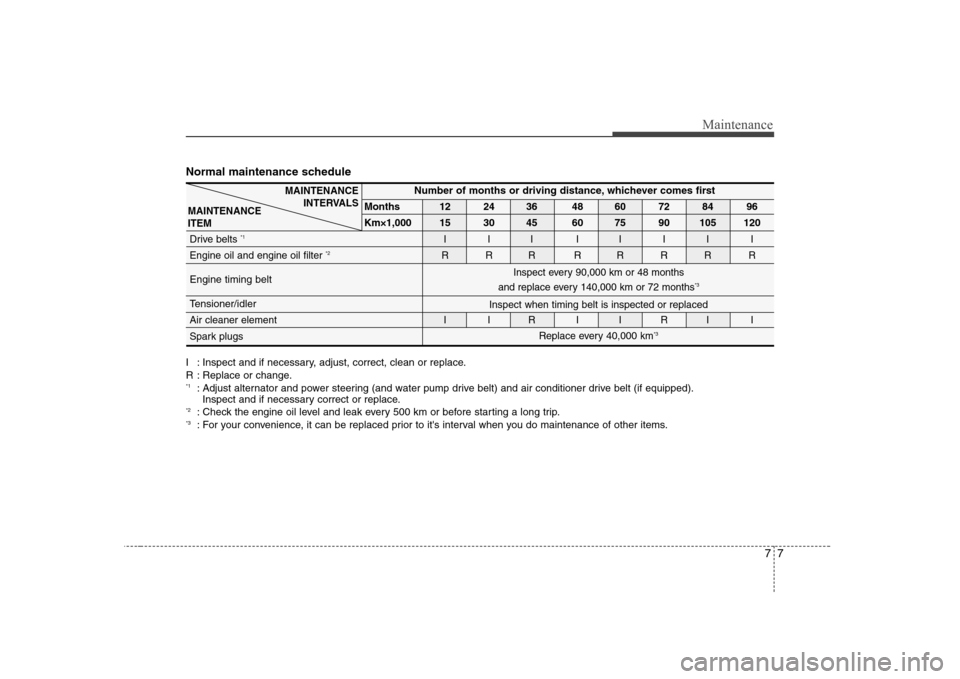
Normal maintenance schedule
I : Inspect and if necessary, adjust, correct, clean or replace.
R : Replace or change. *1: Adjust alternator and power steering (and water pump drive belt) and air conditioner drive belt (if equipped).
Inspect and if necessary correct or replace.
*2 : Check the engine oil level and leak every 500 km or before starting a long trip.
*3 : For your convenience, it can be replaced prior to it's interval when you do maintenance of other items.
MAINTENANCE
INTERVALSNumber of months or driving distance, whichever comes first
Months 12 24 36 48 60 72 84 96
Km×1,000 15 30 45 60 75 90 105 120
Drive belts *1
III IIIII
Engine oil and engine oil filter *2
RRR RRRRR
Engine timing belt
Tensioner/idler
Air cleaner element I I R I I R I I
Spark plugs
Inspect every 90,000 km or 48 months
and replace every 140,000 km or 72 months*3
Replace every 40,000 km *3
Inspect when timing belt is inspected or replaced
MAINTENANCE ITEM
Page 235 of 308
Maintenance
10
7
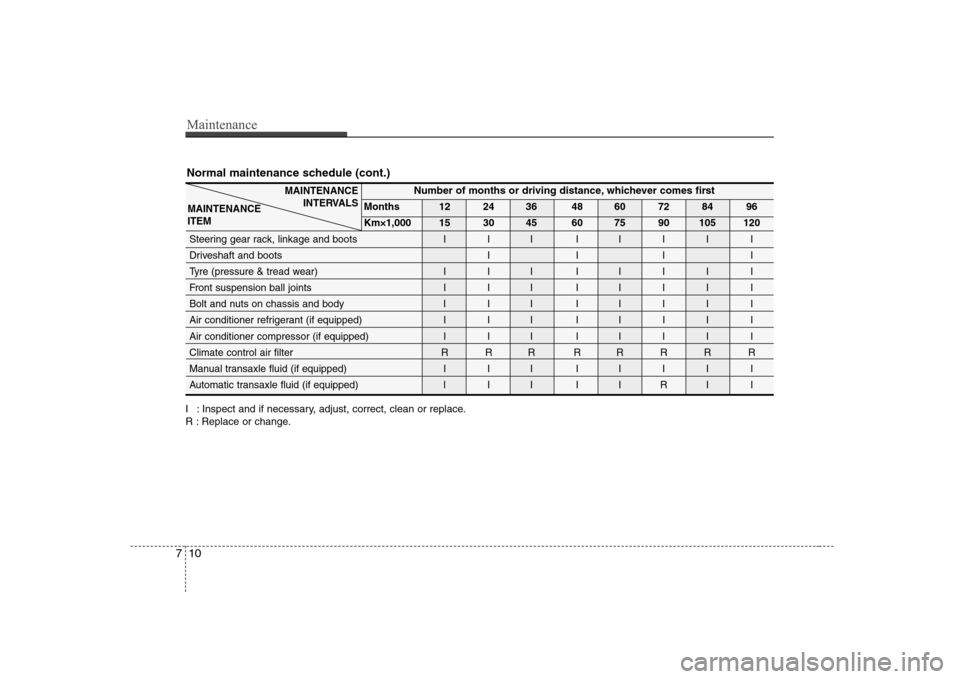
Normal maintenance schedule (cont.)
I : Inspect and if necessary, adjust, correct, clean or replace.
R : Replace or change.
Number of months or driving distance, whichever comes first
Months 12 24 36 48 60 72 84 96
Km×1,000 15 30 45 60 75 90 105 120
Steering gear rack, linkage and boots I I I I I I I I
Driveshaft and boots I I I I
Tyre (pressure & tread wear) I I I I I I I I
Front suspension ball joints I I I I I I I I
Bolt and nuts on chassis and body I I I I I I I I
Air conditioner refrigerant (if equipped) I I I I I I I I
Air conditioner compressor (if equipped) I I I I I I I I
Climate control air filter R R R R R R R R
Manual transaxle fluid (if equipped) I I I I I I I I
Automatic transaxle fluid (if equipped)
III IIRI I
MAINTENANCE INTERVALS
MAINTENANCE ITEM
Page 236 of 308
711
Maintenance
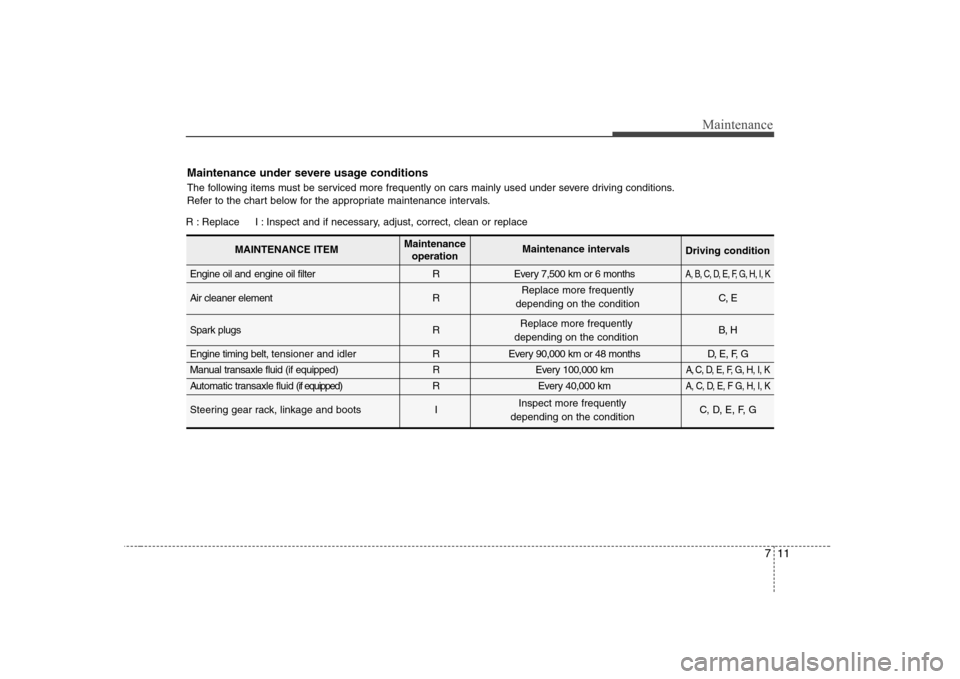
Maintenance under severe usage conditions
The following items must be serviced more frequently on cars mainly used under severe driving conditions.
Refer to the chart below for the appropriate maintenance intervals.
R : Replace I : Inspect and if necessary, adjust, correct, clean or replaceEngine oil and engine oil filter R Every 7,500 km or 6 months
A, B, C, D, E, F, G, H, I, K
Air cleaner element R C, E
Spark plugs R B, H
Engine timing belt, tensioner and idler R Every 90,000 km or 48 months D, E, F, G
Manual transaxle fluid (if equipped)
REvery 100,000 km A, C, D, E, F, G, H, I, K
Automatic transaxle fluid (if equipped)R Every 40,000 kmA, C, D, E, F G, H, I, K
Steering gear rack, linkage and boots I C, D, E, F, G
MAINTENANCE ITEMMaintenance
operation Maintenance intervals
Driving condition
Replace more frequently
depending on the condition
Inspect more frequently
depending on the condition Replace more frequently
depending on the condition
Page 237 of 308

Maintenance
12
7
Severe driving conditions
A : Repeated short distance driving
B : Extensive idling
C : Driving in dusty, rough roads
D : Driving in areas using salt or other corrosive
materials or in very cold weather
E : Driving in sandy areas F : More than 50 % driving in heavy city traffic during hot
weather above 32°C
G : Driving in mountainous areas.
H : Towing a trailer
I : Driving for patrol car, taxi, commercial car or vehicle tow- ing
J : Driving over 140 km/h
K : Driving over 170 km/h
Front suspension ball joints I C, D, E, F, G
Disc brakes and pads, calipers and rotors I C, D, E, G, H
Hand brake I C, D, G, H
Driveshaft and boots I C, D, E, F, I, H, K
Climate control air filter R C, E
MAINTENANCE ITEMMaintenance
operation Maintenance intervals
Driving condition
Inspect more frequently
depending on the condition
Inspect more frequently
depending on the condition
Inspect more frequently
depending on the condition
Inspect more frequently
depending on the condition
Replace more frequently
depending on the condition
Page 240 of 308

715
Maintenance
Manual transaxle fluid (if equipped)
Inspect the manual transaxle fluid
according to the maintenance schedule.
✽✽NOTICE
If the oil level is low, check for possible
leaks before adding oil. Do not overfill.
Automatic transaxle fluid (if equipped)
The fluid level should be in the "HOT"
range of the dipstick, after the engine
and transaxle are at normal operating
temperature. Check the automatic
transaxle fluid level with the engine run-
ning and the transaxle in neutral, with the
hand brake properly applied. Brake hoses and lines
Visually check for proper installation,
chafing, cracks, deterioration and any
leakage. Replace any deteriorated or
damaged parts immediately. Brake fluid
Check brake fluid level in the brake fluid
reservoir. The level should be between
“MIN” and “MAX” marks on the side of
the reservoir. Use only hydraulic brake
fluid conforming to DOT 3 or DOT 4. Hand brake
Inspect the hand brake system including
the hand brake lever and cables. For
detailed service procedures, refer to the
Shop Manual.
Brake pads, calipers and rotors
Check the pads for excessive wear, discs
for run out and wear, and calipers for fluid
leakage. Suspension mounting bolts
Check the suspension connections for
looseness or damage. Retighten to the
specified torque.
Steering gear box, linkage &
boots/lower arm ball joint
With the vehicle stopped and engine off,
check for excessive free-play in the
steering wheel.
Check the linkage for bends or damage.
Check the dust boots and ball joints for
deterioration, cracks, or damage.
Replace any damaged parts. Drive shafts and boots
Check the drive shafts, boots and clamps
for cracks, deterioration, or damage.
Replace any damaged parts and, if nec-
essary, repack the grease.
Air conditioning refrigerant (if equipped)
Check the air conditioning lines and con-
nections for leakage and damage. Check
air conditioning performance according
to the relevant shop manual if necessary.
Page 244 of 308
719
Maintenance
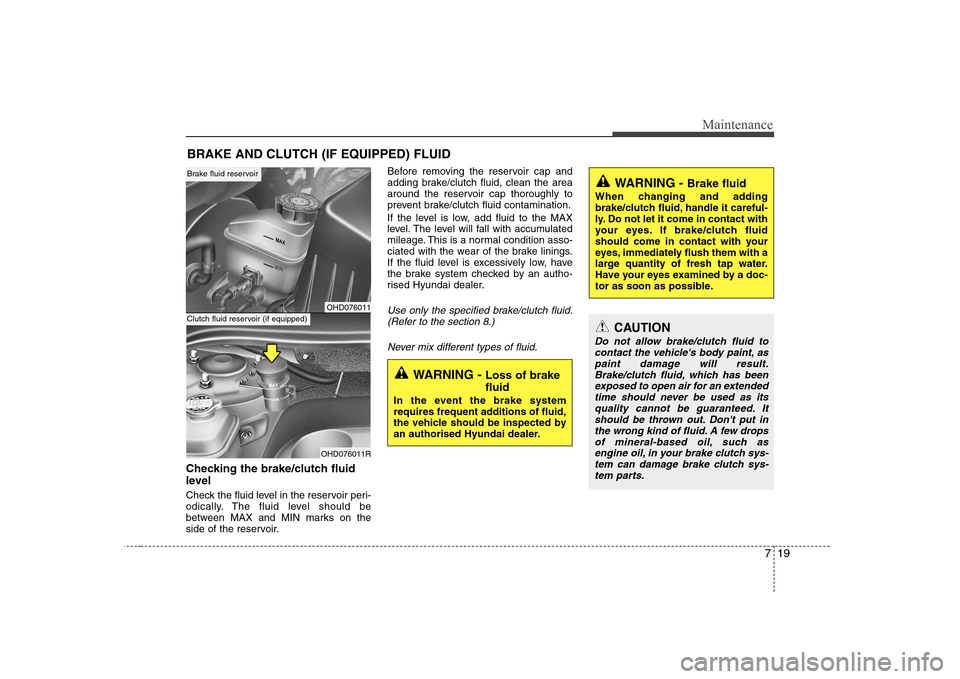
BRAKE AND CLUTCH (IF EQUIPPED) FLUID
Checking the brake/clutch fluid
level
Check the fluid level in the reservoir peri-
odically. The fluid level should be
between MAX and MIN marks on the
side of the reservoir. Before removing the reservoir cap and
adding brake/clutch fluid, clean the area
around the reservoir cap thoroughly to
prevent brake/clutch fluid contamination.
If the level is low, add fluid to the MAX
level. The level will fall with accumulated
mileage. This is a normal condition asso-
ciated with the wear of the brake linings.
If the fluid level is excessively low, have
the brake system checked by an autho-
rised Hyundai dealer.
Use only the specified brake/clutch fluid.
(Refer to the section 8.)
Never mix different types of fluid.
WARNING - Brake fluid
When changing and adding
brake/clutch fluid, handle it careful-
ly. Do not let it come in contact with
your eyes. If brake/clutch fluid
should come in contact with your
eyes, immediately flush them with a
large quantity of fresh tap water.
Have your eyes examined by a doc-
tor as soon as possible.
WARNING - Loss of brake fluid
In the event the brake system
requires frequent additions of fluid,
the vehicle should be inspected by
an authorised Hyundai dealer.
CAUTION
Do not allow brake/clutch fluid to contact the vehicle's body paint, as paint damage will result.
Brake/clutch fluid, which has been exposed to open air for an extendedtime should never be used as itsquality cannot be guaranteed. Itshould be thrown out. Don't put in
the wrong kind of fluid. A few dropsof mineral-based oil, such as engine oil, in your brake clutch sys-tem can damage brake clutch sys-
tem parts.
OHD076011
OHD076011R
Brake fluid reservoir
Clutch fluid reservoir (if equipped)
Page 259 of 308
Maintenance
34
7
Checking tyre inflation pressure
Check your tyres once a month or more.
Also, check the tyre pressure of the
spare tyre.
How to check
Use a good quality gauge to check tyre
pressures. You can not tell if your tyres
are properly inflated simply by looking at
them. Radial tyres may look properly
inflated even when they're underinflated.
Check the tyre's inflation pressure when
the tyres are cold. - "Cold" means your
vehicle has been sitting for at least three
hours or driven no more than 1.6 km (1mile). Remove the valve cap from the tyre valve
stem. Press the tyre gauge firmly onto
the valve to get a pressure measure-
ment. If the cold tyre inflation pressurematches the recommended pressure on
the tyre and loading information label, no
further adjustment is necessary. If the
pressure is low, add air until you reachthe recommended amount.
If you overfill the tyre, release air by pushing on the metal stem in the centre
of the tyre valve. Recheck the tyre pres-
sure with the tyre gauge. Be sure to put
the valve caps back on the valve stems.
They help prevent leaks by keeping out
dirt and moisture.
Tyre rotation
To equalise tread wear, it is recommend-
ed that the tyres be rotated every 12,000km (7,500 miles) or sooner if irregular
wear develops.
During rotation, check the tyres for cor-
rect balance.
When rotating tyres, check for uneven
wear and damage. Abnormal wear is
usually caused by incorrect tyre pres-
sure, improper wheel alignment, out-of-
balance wheels, severe braking or
severe cornering. Look for bumps or
bulges in the tread or side of tyre.
Replace the tyre if you find either of
these conditions. Replace the tyre if fab-
ric or cord is visible. After rotation, be
sure to bring the front and rear tyre pres-
sures to specification and check lug nut
tightness.
Refer to Section 8, “Specifications”.
Page 264 of 308
739
Maintenance
3. Checking tyre life (TIN : TyreIdentification Number)
Any tyres that are over 6 years, based on
the manufacturing date, tyre strength and
performance, decline with age naturally
(even unused spare tyres). Therefore, thetyres (including the spare tyre) should be
replaced by new ones. You can find the
manufacturing date on the tyre sidewall
(possibly on the inside of the wheel), dis-
playing the DOT Code. The DOT Code is
a series of numbers on a tyre consisting
of numbers and English letters. The
manufacturing date is designated by the
last four digits (characters) of the DOT
code.
DOT : XXXX XXXX OOOO
The front part of the DOT means a plant
code number, tyre size and tread pattern
and the last four numbers indicate week
and year manufactured.
For example:
DOT XXXX XXXX 1606 represents that
the tyre was produced in the 16th weekof 2006.
4. Tyre ply composition and material
The number of layers or plies of rubber-
coated fabric are in the tyre. Tyre manu-
facturers also must indicate the materials
in the tyre, which include steel, nylon,
polyester, and others. The letter "R"
means radial ply construction; the letter
"D" means diagonal or bias ply construc-
tion; and the letter "B" means belted-bias
ply construction.
5. Maximum permissible inflationpressure
This number is the greatest amount of air
pressure that should be put in the tyre.
Do not exceed the maximum permissible
inflation pressure. Refer to the Tyre and
Loading Information label for recom-
mended inflation pressure.
6. Maximum load rating
This number indicates the maximum load
in kilograms and pounds that can be car-
ried by the tyre. When replacing the tyres
on the vehicle, always use a tyre that has
the same load rating as the factory
installed tyre.
WARNING - Tyre age
Tyres degrade over time, even
when they are not being used.
Regardless of the remaining tread,it is recommended that tyres tread,
It is recommended that tyres gener-
ally be replaced after 6 years of nor-
mal service. Heat caused by not cli-mates or frequent high loadingConditions can accelerate the
aging process. Failure to follow this
Warning can result in sudden tyre
failure, which could lead to a loss
of control and an accident involving
serious injury or death.
Page 284 of 308
759
Maintenance
Corrosion protection
Protecting your vehicle from corro-sion
By using the most advanced design and
construction practices to combat corro-
sion, we produces cars of the highest
quality. However, this is only part of the
job. To achieve the long-term corrosion
resistance your vehicle can deliver, the
owner's cooperation and assistance isalso required.
Common causes of corrosion
The most common causes of corrosion
on your car are:
allowed to accumulate underneath the
car.
Removal of paint or protective coatings by stones, gravel, abrasion or minor
scrapes and dents which leave unpro-
tected metal exposed to corrosion.
High-corrosion areas
If you live in an area where your car is
regularly exposed to corrosive materials,
corrosion protection is particularly impor-
tant. Some of the common causes of
accelerated corrosion are road salts,
dust control chemicals, ocean air and
industrial pollution.
Moisture breeds corrosion
Moisture creates the conditions in which
corrosion is most likely to occur. For
example, corrosion is accelerated by
high humidity, particularly when tempera-
tures are just above freezing. In such
conditions, the corrosive material is kept
in contact with the car surfaces by mois-
ture that is slow to evaporate.
Mud is particularly corrosive because it is
slow to dry and holds moisture in contact
with the vehicle. Although the mud
appears to be dry, it can still retain themoisture and promote corrosion.
High temperatures can also accelerate
corrosion of parts that are not properly
ventilated so the moisture can be dis-
persed. For all these reasons, it is par-
ticularly important to keep your car clean
and free of mud or accumulations of
other materials. This applies not only to
the visible surfaces but particularly to the
underside of the car.