steering wheel Hyundai Elantra 2009 Инструкция по эксплуатации (in Russian)
[x] Cancel search | Manufacturer: HYUNDAI, Model Year: 2009, Model line: Elantra, Model: Hyundai Elantra 2009Pages: 308, PDF Size: 15.03 MB
Page 229 of 308
Maintenance
4
7
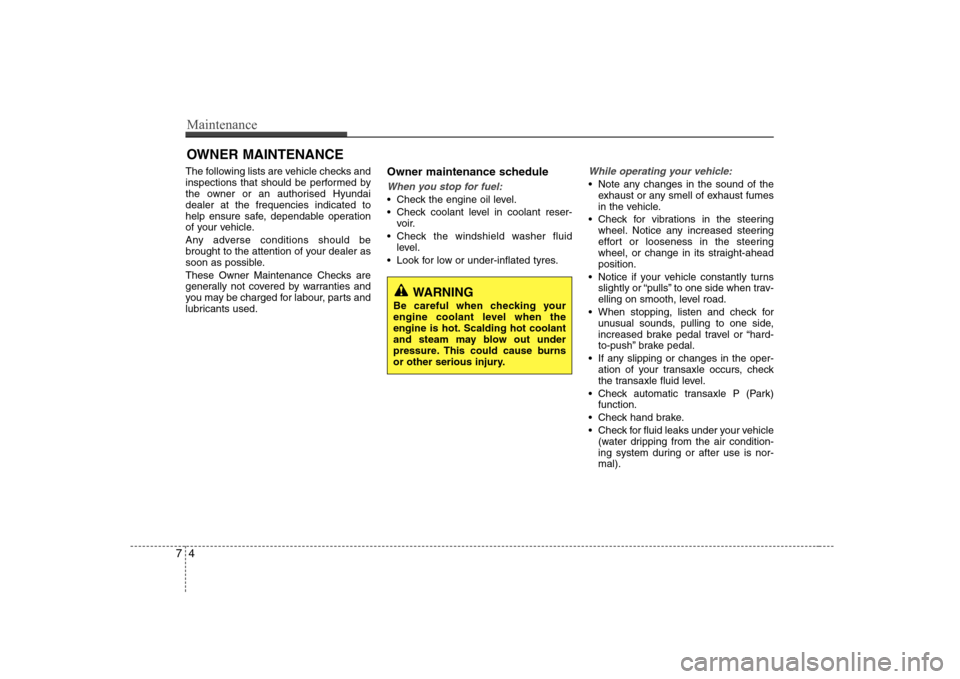
OWNER MAINTENANCE
The following lists are vehicle checks and
inspections that should be performed by
the owner or an authorised Hyundaidealer at the frequencies indicated to
help ensure safe, dependable operation
of your vehicle.
Any adverse conditions should be
brought to the attention of your dealer as
soon as possible.
These Owner Maintenance Checks are
generally not covered by warranties and
you may be charged for labour, parts and
lubricants used. Owner maintenance schedule
When you stop for fuel:
Check the engine oil level.
Check coolant level in coolant reser-
voir.
Check the windshield washer fluid level.
Look for low or under-inflated tyres.
While operating your vehicle:
Note any changes in the sound of the exhaust or any smell of exhaust fumes
in the vehicle.
Check for vibrations in the steering wheel. Notice any increased steering
effort or looseness in the steering
wheel, or change in its straight-aheadposition.
Notice if your vehicle constantly turns slightly or “pulls” to one side when trav-
elling on smooth, level road.
When stopping, listen and check for unusual sounds, pulling to one side,
increased brake pedal travel or “hard-
to-push” brake pedal.
If any slipping or changes in the oper- ation of your transaxle occurs, check
the transaxle fluid level.
Check automatic transaxle P (Park) function.
Check hand brake.
Check for fluid leaks under your vehicle (water dripping from the air condition-
ing system during or after use is nor-mal).
WARNING
Be careful when checking your
engine coolant level when the
engine is hot. Scalding hot coolant
and steam may blow out under
pressure. This could cause burns
or other serious injury.
Page 240 of 308

715
Maintenance
Manual transaxle fluid (if equipped)
Inspect the manual transaxle fluid
according to the maintenance schedule.
✽✽NOTICE
If the oil level is low, check for possible
leaks before adding oil. Do not overfill.
Automatic transaxle fluid (if equipped)
The fluid level should be in the "HOT"
range of the dipstick, after the engine
and transaxle are at normal operating
temperature. Check the automatic
transaxle fluid level with the engine run-
ning and the transaxle in neutral, with the
hand brake properly applied. Brake hoses and lines
Visually check for proper installation,
chafing, cracks, deterioration and any
leakage. Replace any deteriorated or
damaged parts immediately. Brake fluid
Check brake fluid level in the brake fluid
reservoir. The level should be between
“MIN” and “MAX” marks on the side of
the reservoir. Use only hydraulic brake
fluid conforming to DOT 3 or DOT 4. Hand brake
Inspect the hand brake system including
the hand brake lever and cables. For
detailed service procedures, refer to the
Shop Manual.
Brake pads, calipers and rotors
Check the pads for excessive wear, discs
for run out and wear, and calipers for fluid
leakage. Suspension mounting bolts
Check the suspension connections for
looseness or damage. Retighten to the
specified torque.
Steering gear box, linkage &
boots/lower arm ball joint
With the vehicle stopped and engine off,
check for excessive free-play in the
steering wheel.
Check the linkage for bends or damage.
Check the dust boots and ball joints for
deterioration, cracks, or damage.
Replace any damaged parts. Drive shafts and boots
Check the drive shafts, boots and clamps
for cracks, deterioration, or damage.
Replace any damaged parts and, if nec-
essary, repack the grease.
Air conditioning refrigerant (if equipped)
Check the air conditioning lines and con-
nections for leakage and damage. Check
air conditioning performance according
to the relevant shop manual if necessary.
Page 261 of 308
Maintenance
36
7
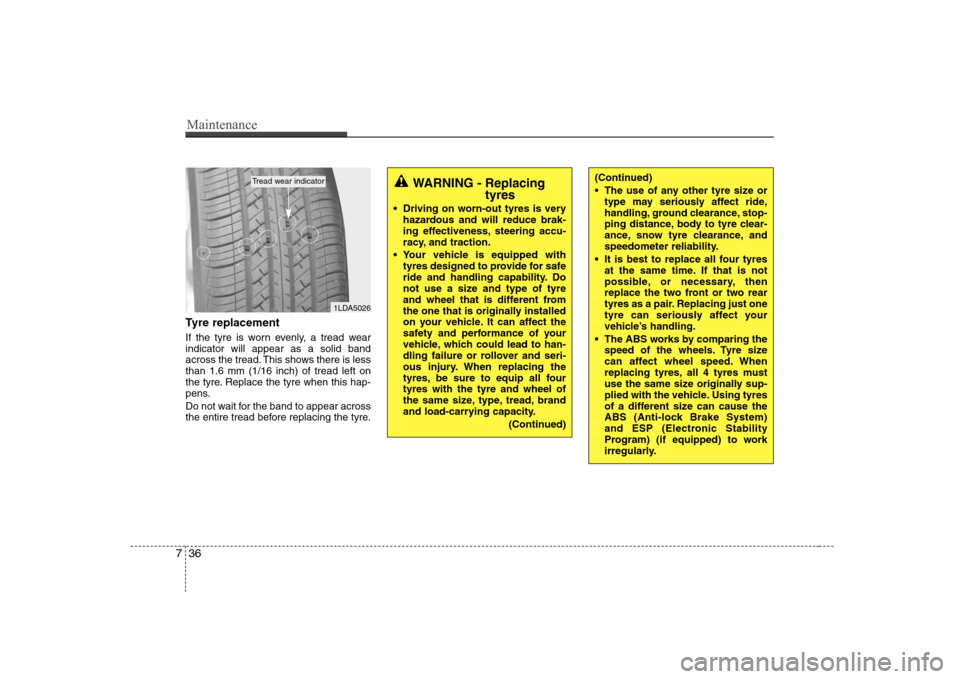
Tyre replacement
If the tyre is worn evenly, a tread wear indicator will appear as a solid band
across the tread. This shows there is lessthan 1.6 mm (1/16 inch) of tread left on
the tyre. Replace the tyre when this hap-
pens.
Do not wait for the band to appear across
the entire tread before replacing the tyre.
WARNING - Replacing
tyres
Driving on worn-out tyres is very hazardous and will reduce brak-
ing effectiveness, steering accu-
racy, and traction.
Your vehicle is equipped with tyres designed to provide for safe
ride and handling capability. Do
not use a size and type of tyre
and wheel that is different from
the one that is originally installed
on your vehicle. It can affect the
safety and performance of your
vehicle, which could lead to han-
dling failure or rollover and seri-
ous injury. When replacing the
tyres, be sure to equip all fourtyres with the tyre and wheel of
the same size, type, tread, brand
and load-carrying capacity.
(Continued)
1LDA5026
Tread wear indicator(Continued)
The use of any other tyre size ortype may seriously affect ride,
handling, ground clearance, stop-
ping distance, body to tyre clear-
ance, snow tyre clearance, and
speedometer reliability.
It is best to replace all four tyres at the same time. If that is not
possible, or necessary, then
replace the two front or two rear
tyres as a pair. Replacing just one
tyre can seriously affect your
vehicle’s handling.
The ABS works by comparing the speed of the wheels. Tyre size
can affect wheel speed. When
replacing tyres, all 4 tyres must
use the same size originally sup-
plied with the vehicle. Using tyres
of a different size can cause the
ABS (Anti-lock Brake System)
and ESP (Electronic Stability
Program) (if equipped) to work
irregularly.
Page 307 of 308
I3
Index
Hand brake ·····································································7-22
Hazard warning flasher ··············································· 4-45
How to use this manual ················································· 1-2
If the engine overheats ·················································· 6-5
If the engine will not start ············································· 6-3
If you have a flat tyre ···················································· 6-7
In case of an emergency while driving ························· 6-2
Indicator symbols on the instrument cluster ················· 1-6
Instrument cluster ························································ 4-33
Instrument panel overview ············································ 2-3
Interior features ··························································· 4-77
Interior light ································································· 4-51
Interior overview ··························································· 2-2
Key positions ································································· 5-4
Keys ··············································································· 4-2
Light bulbs ··································································· 7-50
Lighting ······································································· 4-46 Maintenance services ····················································· 7-3
Manual climate control system ··································· 4-55
Manual transaxle ··························································· 5-6
Mirrors ········································································· 4-29
Owner maintenance ······················································· 7-4
Recommended lubricants and capacities ······················· 8-4
Remote keyless entry ····················································· 4-4
Road warning ································································· 6-2
Scheduled maintenance service ····································· 7-6
Seat ················································································ 3-2
Seat belts ······································································ 3-10
Special driving conditions ··········································· 5-31
Starting the engine ························································· 5-5
Steering wheel ····························································· 4-26
Storage compartment ··················································· 4-75
Sunroof ········································································ 4-22
H
I
K
L
M
O
R
S