belt Hyundai Elantra 2009 Инструкция по эксплуатации (in Russian)
[x] Cancel search | Manufacturer: HYUNDAI, Model Year: 2009, Model line: Elantra, Model: Hyundai Elantra 2009Pages: 308, PDF Size: 15.03 MB
Page 230 of 308
75
Maintenance
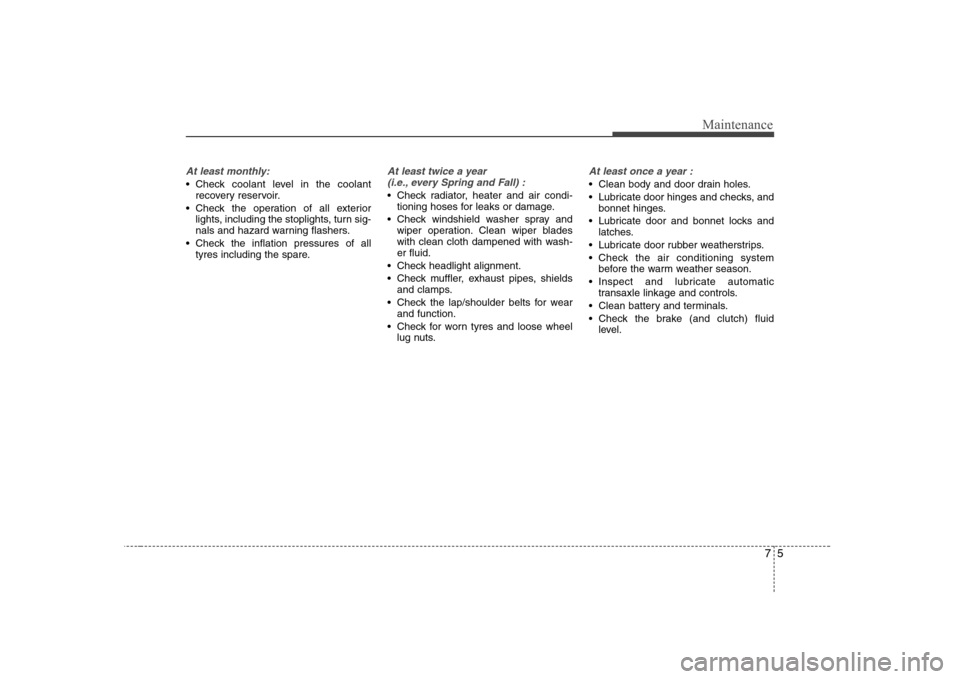
At least monthly:
Check coolant level in the coolantrecovery reservoir.
Check the operation of all exterior lights, including the stoplights, turn sig-
nals and hazard warning flashers.
Check the inflation pressures of all tyres including the spare.
At least twice a year
(i.e., every Spring and Fall) :
Check radiator, heater and air condi- tioning hoses for leaks or damage.
Check windshield washer spray and wiper operation. Clean wiper blades
with clean cloth dampened with wash-er fluid.
Check headlight alignment.
Check muffler, exhaust pipes, shields and clamps.
Check the lap/shoulder belts for wear and function.
Check for worn tyres and loose wheel lug nuts.
At least once a year :
Clean body and door drain holes.
Lubricate door hinges and checks, and
bonnet hinges.
Lubricate door and bonnet locks and latches.
Lubricate door rubber weatherstrips.
Check the air conditioning system before the warm weather season.
Inspect and lubricate automatic transaxle linkage and controls.
Clean battery and terminals.
Check the brake (and clutch) fluid level.
Page 232 of 308
77
Maintenance
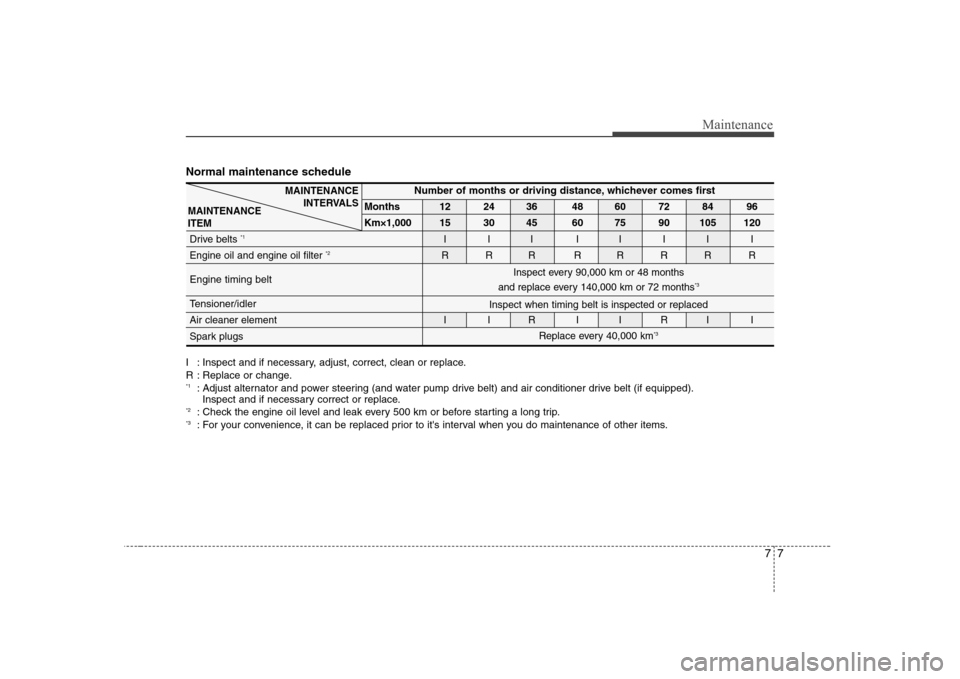
Normal maintenance schedule
I : Inspect and if necessary, adjust, correct, clean or replace.
R : Replace or change. *1: Adjust alternator and power steering (and water pump drive belt) and air conditioner drive belt (if equipped).
Inspect and if necessary correct or replace.
*2 : Check the engine oil level and leak every 500 km or before starting a long trip.
*3 : For your convenience, it can be replaced prior to it's interval when you do maintenance of other items.
MAINTENANCE
INTERVALSNumber of months or driving distance, whichever comes first
Months 12 24 36 48 60 72 84 96
Km×1,000 15 30 45 60 75 90 105 120
Drive belts *1
III IIIII
Engine oil and engine oil filter *2
RRR RRRRR
Engine timing belt
Tensioner/idler
Air cleaner element I I R I I R I I
Spark plugs
Inspect every 90,000 km or 48 months
and replace every 140,000 km or 72 months*3
Replace every 40,000 km *3
Inspect when timing belt is inspected or replaced
MAINTENANCE ITEM
Page 233 of 308
Maintenance
8
7
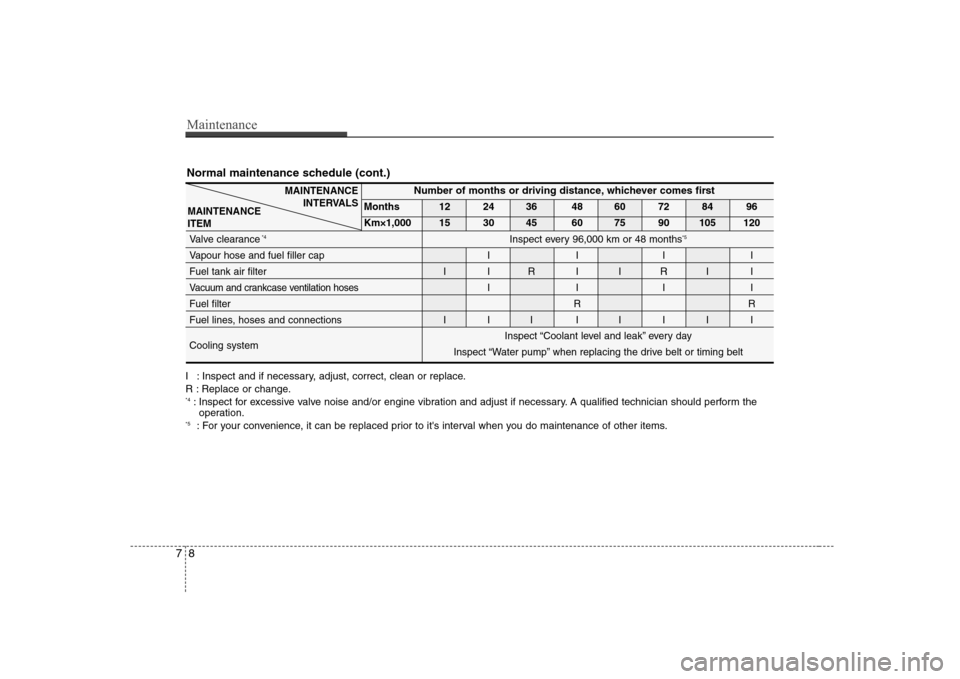
Normal maintenance schedule (cont.)
MAINTENANCE
INTERVALSNumber of months or driving distance, whichever comes first
Months 12 24 36 48 60 72 84 96
Km×1,000 15 30 45 60 75 90 105 120
Valve clearance *4
Vapour hose and fuel filler cap
I I I I
Fuel tank air filter I I R I I R I I
Vacuum and crankcase ventilation hosesIIII
Fuel filter
RR
Fuel lines, hoses and connections I I I I I I I I Cooling system Inspect every 96,000 km or 48 months
*5
Inspect “Coolant level and leak” every day
Inspect “Water pump” when replacing the drive belt or timing belt
I : Inspect and if necessary, adjust, correct, clean or replace.
R : Replace or change. *4 : Inspect for excessive valve noise and/or engine vibration and adjust if necessary. A qualified technician should perform the
operation.
*5 : For your convenience, it can be replaced prior to it's interval when you do maintenance of other items.
MAINTENANCE ITEM
Page 236 of 308
711
Maintenance
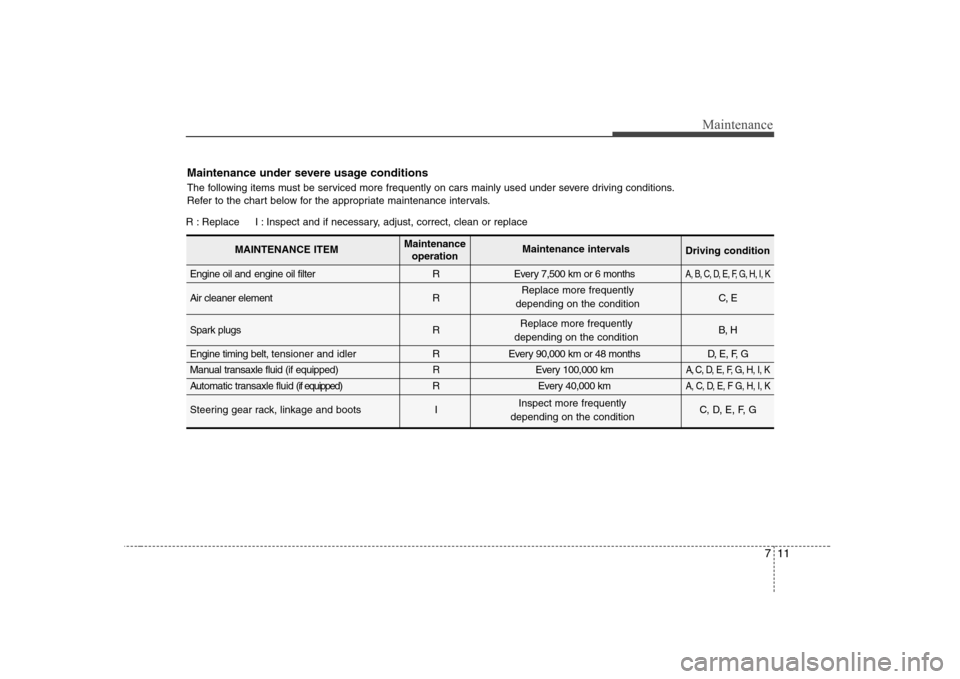
Maintenance under severe usage conditions
The following items must be serviced more frequently on cars mainly used under severe driving conditions.
Refer to the chart below for the appropriate maintenance intervals.
R : Replace I : Inspect and if necessary, adjust, correct, clean or replaceEngine oil and engine oil filter R Every 7,500 km or 6 months
A, B, C, D, E, F, G, H, I, K
Air cleaner element R C, E
Spark plugs R B, H
Engine timing belt, tensioner and idler R Every 90,000 km or 48 months D, E, F, G
Manual transaxle fluid (if equipped)
REvery 100,000 km A, C, D, E, F, G, H, I, K
Automatic transaxle fluid (if equipped)R Every 40,000 kmA, C, D, E, F G, H, I, K
Steering gear rack, linkage and boots I C, D, E, F, G
MAINTENANCE ITEMMaintenance
operation Maintenance intervals
Driving condition
Replace more frequently
depending on the condition
Inspect more frequently
depending on the condition Replace more frequently
depending on the condition
Page 238 of 308
713
Maintenance
EXPLANATION OF SCHEDULED MAINTENANCE ITEMS
Engine oil and filter The engine oil and filter should be
changed at the intervals specified in the
maintenance schedule. If the car is being
driven in severe conditions, more fre-quent oil and filter changes are required. Drive belts
Inspect all drive belts for evidence of
cuts, cracks, excessive wear or oil satu-
ration and replace if necessary. Drive
belts should be checked periodically forproper tension and adjusted as neces-
sary. Fuel filter (cartridge) A clogged filter can limit the speed at
which the vehicle may be driven, damagethe emission system and cause hard
starting. If an excessive amount of for-
eign matter accumulates in the fuel tank,
the filter may require replacement more
frequently.
After installing a new filter, run the engine
for several minutes, and check for leaks
at the connections. Fuel filters should be
installed by trained technicians.
Fuel lines, fuel hoses and con- nections
Check the fuel lines, fuel hoses and con-
nections for leakage and damage. Have
a trained technician replace any dam-
aged or leaking parts immediately.
Page 239 of 308
Maintenance
14
7
Timing belt
Inspect all parts related to the timing belt
for damage and deformation. Replace
any damaged parts immediately.
Vapour hose and fuel filler cap
The vapour hose and fuel filler cap
should be inspected at those intervals
specified in the maintenance schedule.
Make sure that a new vapour hose or fuelfiller cap is correctly replaced. Vacuum crankcase ventilation hoses
Inspect the surface of hoses for evidence
of heat and/or mechanical damage. Hard
and brittle rubber, cracking, tears, cuts,
abrasions, and excessive swelling indi-
cate deterioration. Particular attention
should be paid to examine those hose
surfaces nearest to high heat sources,
such as the exhaust manifold. Inspect the hose routing to assure that the hoses do not come in contact with
any heat source, sharp edges or movingcomponent which might cause heat dam-
age or mechanical wear. Inspect all hose
connections, such as clamps and cou-
plings, to make sure they are secure, and
that no leaks are present. Hoses should
be replaced immediately if there is any
evidence of deterioration or damage.Air cleaner filter
A Genuine Hyundai air cleaner filter is recommended when the filter isreplaced. Spark plugs
Make sure to install new spark plugs of
the correct heat range.
Valve clearance
Inspect excessive valve noise and/or
engine vibration and adjust if necessary.
A qualified technician should perform the
operation. Cooling system
Check the cooling system part, such as
radiator, coolant reservoir, hoses and
connections for leakage and damage.
Replace any damaged parts. Coolant The coolant should be changed at the
intervals specified in the maintenance
schedule.
Page 264 of 308
739
Maintenance
3. Checking tyre life (TIN : TyreIdentification Number)
Any tyres that are over 6 years, based on
the manufacturing date, tyre strength and
performance, decline with age naturally
(even unused spare tyres). Therefore, thetyres (including the spare tyre) should be
replaced by new ones. You can find the
manufacturing date on the tyre sidewall
(possibly on the inside of the wheel), dis-
playing the DOT Code. The DOT Code is
a series of numbers on a tyre consisting
of numbers and English letters. The
manufacturing date is designated by the
last four digits (characters) of the DOT
code.
DOT : XXXX XXXX OOOO
The front part of the DOT means a plant
code number, tyre size and tread pattern
and the last four numbers indicate week
and year manufactured.
For example:
DOT XXXX XXXX 1606 represents that
the tyre was produced in the 16th weekof 2006.
4. Tyre ply composition and material
The number of layers or plies of rubber-
coated fabric are in the tyre. Tyre manu-
facturers also must indicate the materials
in the tyre, which include steel, nylon,
polyester, and others. The letter "R"
means radial ply construction; the letter
"D" means diagonal or bias ply construc-
tion; and the letter "B" means belted-bias
ply construction.
5. Maximum permissible inflationpressure
This number is the greatest amount of air
pressure that should be put in the tyre.
Do not exceed the maximum permissible
inflation pressure. Refer to the Tyre and
Loading Information label for recom-
mended inflation pressure.
6. Maximum load rating
This number indicates the maximum load
in kilograms and pounds that can be car-
ried by the tyre. When replacing the tyres
on the vehicle, always use a tyre that has
the same load rating as the factory
installed tyre.
WARNING - Tyre age
Tyres degrade over time, even
when they are not being used.
Regardless of the remaining tread,it is recommended that tyres tread,
It is recommended that tyres gener-
ally be replaced after 6 years of nor-
mal service. Heat caused by not cli-mates or frequent high loadingConditions can accelerate the
aging process. Failure to follow this
Warning can result in sudden tyre
failure, which could lead to a loss
of control and an accident involving
serious injury or death.
Page 286 of 308
761
Maintenance
Interior care
Interior general precautions
Prevent caustic solutions such as per- fume and cosmetic oil from contacting
the dashboard because they may cause
damage or discoloration. If they do con-tact the dashboard, wipe them off imme-
diately. See the instructions that follow for
the proper way to clean vinyl.
Cleaning the upholstery and interiortrim
Vinyl
Remove dust and loose dirt from vinyl
with a whisk broom or vacuum cleaner.
Clean vinyl surfaces with a vinyl cleaner. Fabric
Remove dust and loose dirt from fabric
with a whisk broom or vacuum cleaner.Clean with a mild soap solution recom-
mended for upholstery or carpets.
Remove fresh spots immediately with a
fabric spot cleaner. If fresh spots do not
receive immediate attention, the fabriccan be stained and its color can be
affected. Also, its fire-resistant properties
can be reduced if the material is not
properly maintained.
Cleaning the lap/shoulder belt web-bing
Clean the belt webbing with any mild
soap solution recommended for cleaning
upholstery or carpet. Follow the instruc-
tions provided with the soap. Do not
bleach or re-dye the webbing because
this may weaken it.
Cleaning the interior window glass
If the interior glass surfaces of the vehi-
cle become fogged (that is, covered with
an oily, greasy or waxy film), they should
be cleaned with glass cleaner. Follow the
directions on the glass cleaner container.CAUTION
Never allow water or other liquids to come in contact with electrical/electronic components
inside the vehicle as this may dam-age them.
CAUTION
Using anything but recommended cleaners and procedures may affect
the fabric’s appearance and fire- resistant properties.
CAUTION
Do not scrape or scratch the insideof the rear window. This may result in damage to the rear window defroster grid.
Page 307 of 308
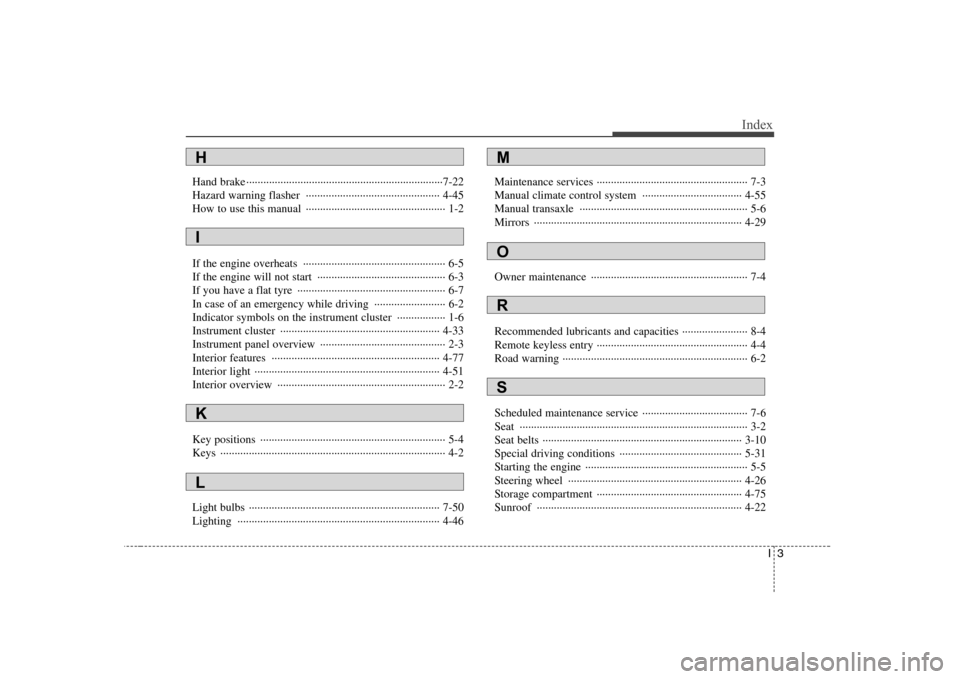
I3
Index
Hand brake ·····································································7-22
Hazard warning flasher ··············································· 4-45
How to use this manual ················································· 1-2
If the engine overheats ·················································· 6-5
If the engine will not start ············································· 6-3
If you have a flat tyre ···················································· 6-7
In case of an emergency while driving ························· 6-2
Indicator symbols on the instrument cluster ················· 1-6
Instrument cluster ························································ 4-33
Instrument panel overview ············································ 2-3
Interior features ··························································· 4-77
Interior light ································································· 4-51
Interior overview ··························································· 2-2
Key positions ································································· 5-4
Keys ··············································································· 4-2
Light bulbs ··································································· 7-50
Lighting ······································································· 4-46 Maintenance services ····················································· 7-3
Manual climate control system ··································· 4-55
Manual transaxle ··························································· 5-6
Mirrors ········································································· 4-29
Owner maintenance ······················································· 7-4
Recommended lubricants and capacities ······················· 8-4
Remote keyless entry ····················································· 4-4
Road warning ································································· 6-2
Scheduled maintenance service ····································· 7-6
Seat ················································································ 3-2
Seat belts ······································································ 3-10
Special driving conditions ··········································· 5-31
Starting the engine ························································· 5-5
Steering wheel ····························································· 4-26
Storage compartment ··················································· 4-75
Sunroof ········································································ 4-22
H
I
K
L
M
O
R
S