wheel Hyundai Elantra 2009 Инструкция по эксплуатации (in Russian)
[x] Cancel search | Manufacturer: HYUNDAI, Model Year: 2009, Model line: Elantra, Model: Hyundai Elantra 2009Pages: 308, PDF Size: 15.03 MB
Page 202 of 308
Driving your vehicle
40
5
Driving with a trailer
Towing a trailer requires a certain
amount of experience. Before setting out
for the open road, you must get to know
your trailer. Acquaint yourself with the
feel of handling and braking with the
added weight of the trailer. And always
keep in mind that the vehicle you are
driving is now a good deal longer and not
nearly so responsive as your vehicle is
by itself.
Before you start, check the trailer towbar
and platform, safety chains, electrical
connector(s), lights, tyres and mirror
adjustment. If the trailer has electric
brakes, start your vehicle and trailer mov-
ing and then apply the trailer brake con-
troller by hand to be sure the brakes are
working. This lets you check your electri-
cal connection at the same time.
During your trip, check occasionally to be
sure that the load is secure, and that the
lights and any trailer brakes are still work-ing.Following distance
Stay at least twice as far behind the vehi-
cle ahead as you would when driving
your vehicle without a trailer. This can
help you avoid situations that require
heavy braking and sudden turns.
Passing
You’ll need more passing distance up
ahead when you’re towing a trailer. Due
to the increased vehicle length, you’ll
need to go much farther beyond the
passed vehicle before you can return to
your lane.
Backing up
Hold the bottom of the steering wheel
with one hand. Then, to move the trailer
to the left, just move your hand to the left.
To move the trailer to the right, move your
hand to the right. Always back up slowly
and, if possible, have someone guide
you.
Making turns
When you’re turning with a trailer, make
wider turns than normal. Do this so your
trailer won’t strike soft shoulders, curbs,
road signs, trees, or other objects. Avoid
jerky or sudden manoeuvres. Signal well
in advance.
Turn signals when towing a trailer
When you tow a trailer, your vehicle has
to have a different turn signal flasher and
extra wiring. The green arrows on your
instrument panel will flash whenever you
signal a turn or lane change. Properly
connected, the trailer lights will also flash
to alert other drivers you’re about to turn,
change lanes, or stop.
When towing a trailer, the green arrows
on your instrument panel will flash for
turns even if the bulbs on the trailer are
burned out. Thus, you may think drivers
behind you are seeing your signals
when, in fact, they are not. It’s important
to check occasionally to be sure the trail-
er bulbs are still working. You must also
check the lights every time you discon-
nect and then reconnect the wires.
Do not connect a trailer lighting system
directly to your vehicle’s lighting system.
Use only an approved trailer wiring har-
ness.
An authorised Hyundai dealer can assist
you in installing the wiring harness.
WARNING
Failure to use an approved trailer wiring harness could result in dam-
age to the vehicle electrical system
and/or personal injury.
Page 203 of 308
541
Driving your vehicle
Driving on grades
Reduce speed and shift to a lower gear
before you start down a long or steep
downgrade. If you don’t shift down, you
might have to use your brakes so much
that they would get hot and no longer
operate efficiently.
On a long uphill grade, shift down and
reduce your speed to around 30 km/h toreduce the possibility of engine and
transaxle overheating.
If your trailer weighs more than the max-
imum trailer weight without trailer brakes
and you have an automatic transaxle,
you should drive in D (Drive) when tow-
ing a trailer.
Operating your vehicle in D (Drive) when
towing a trailer will minimise heat build up
and extend the life of your transaxle.
Parking on hills
Generally, if you have a trailer attached to
your vehicle, you should not park your
vehicle on a hill. People can be seriously
or fatally injured, and both your vehicle
and the trailer can be damaged if unex-
pectedly roll down hill.
However, if you ever have to park your
trailer on a hill, here's how to do it:
1. Pull the vehicle into the parking space.Turn the steering wheel in the direction
of the curb (right if headed down hill,left if headed up hill).
2. If the vehicle has a manual transaxle, place the car in neutral. If the vehicle
has an automatic transaxle, place the
car in P (Park).
3. Set the hand brake and shut off the vehicle.
4. Place chocks under the trailer wheels on the down hill side of the wheels.CAUTION
When towing a trailer on steep
grades (in excess of 8%) payclose attention to the enginecoolant temperature gauge to
ensure the engine does not over- heat. If the needle of the coolanttemperature gauge moves across the dial towards “H” (HOT), pull
over and stop as soon as it is safe to do so, and allow the engine toidle until it cools down. You may proceed once the engine has
cooled sufficiently.
You must decide driving speed depending on trailer weight anduphill grade to reduce the possi-
bility of engine and transaxle overheating.
WARNING - Parking on a
hill
Parking your vehicle on a hill with a
trailer attached could cause seri-
ous injury or death, should the trail-
er break loose.
Page 205 of 308
543
Driving your vehicle
If you do decide to pull a trailer
Here are some important points if you
decide to pull a trailer:
Consider using a sway control. You canask a towbar dealer about sway con- trol.
Do not do any towing with your car dur- ing its first 2,000 km in order to allow
the engine to properly break in. Failure
to heed this caution may result in seri-
ous engine or transaxle damage.
When towing a trailer, be sure to con- sult an authorised Hyundai dealer for
further information on additional
requirements such as a towing kit, etc.
Always drive your vehicle at a moder- ate speed (less than 100 km/h).
On a long uphill grade, do not exceed 30 km/h with 2 people in the car or the
posted towing speed limit, whichever is
lower.
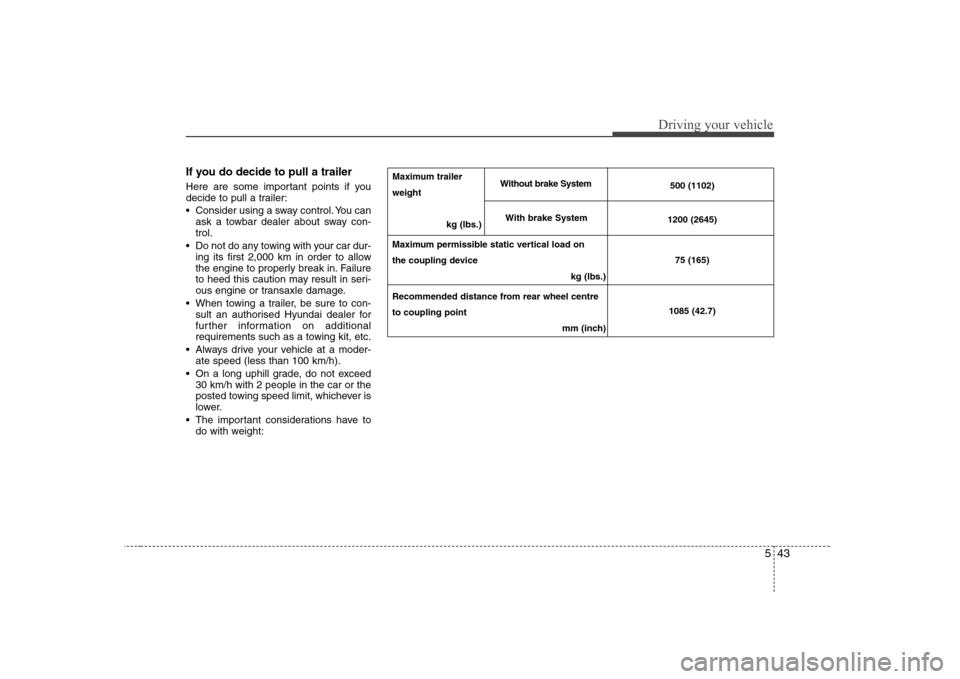
The important considerations have to do with weight:
500 (1102)
1200 (2645)
75 (165)
1085 (42.7)Maximum trailer weight kg (lbs.)
Maximum permissible static vertical load on
the coupling device kg (lbs.)
Recommended distance from rear wheel centre to coupling point mm (inch)
Without brake System
With brake System
Page 215 of 308
67
What to do in an emergency
IF YOU HAVE A FLAT TYRE
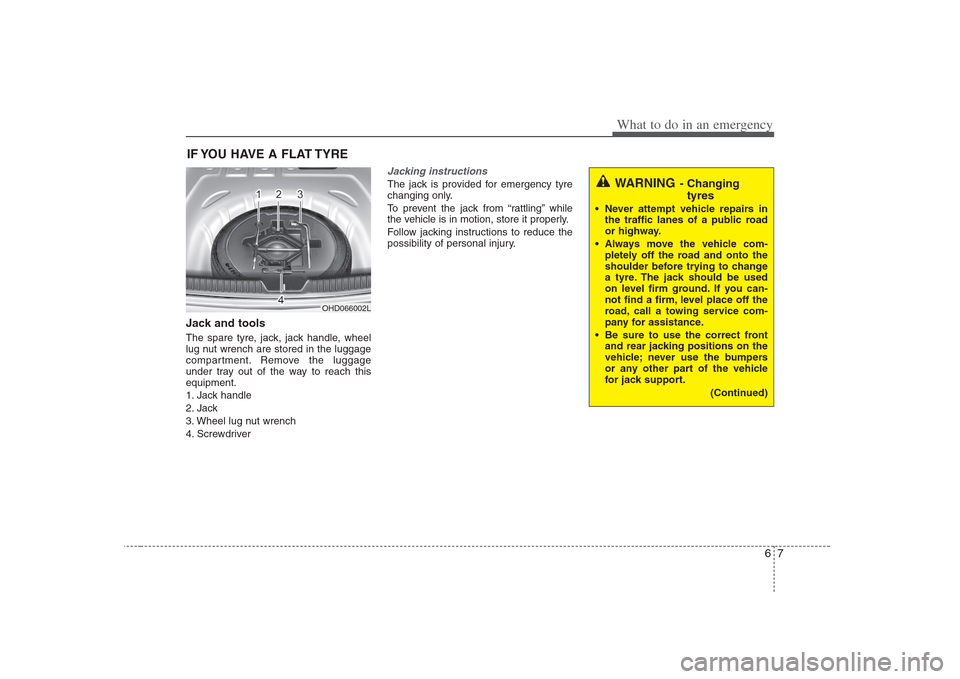
Jack and tools
The spare tyre, jack, jack handle, wheel
lug nut wrench are stored in the luggage
compartment. Remove the luggage
under tray out of the way to reach thisequipment.
1. Jack handle
2. Jack
3. Wheel lug nut wrench
4. Screwdriver
Jacking instructions
The jack is provided for emergency tyre
changing only.
To prevent the jack from “rattling” while
the vehicle is in motion, store it properly.
Follow jacking instructions to reduce the
possibility of personal injury.
OHD066002L
WARNING - Changing
tyres
Never attempt vehicle repairs in the traffic lanes of a public road
or highway.
Always move the vehicle com- pletely off the road and onto the
shoulder before trying to change
a tyre. The jack should be used
on level firm ground. If you can-
not find a firm, level place off the
road, call a towing service com-
pany for assistance.
Be sure to use the correct front and rear jacking positions on the
vehicle; never use the bumpers
or any other part of the vehicle
for jack support.
(Continued)
Page 217 of 308
69
What to do in an emergency
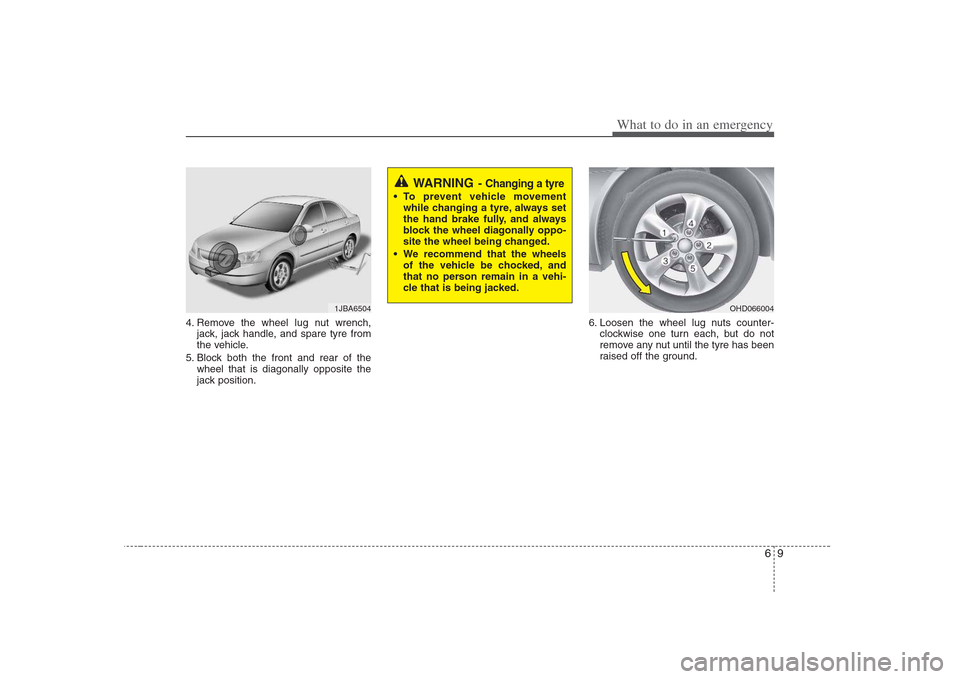
4. Remove the wheel lug nut wrench,jack, jack handle, and spare tyre from
the vehicle.
5. Block both the front and rear of the wheel that is diagonally opposite the
jack position. 6. Loosen the wheel lug nuts counter-
clockwise one turn each, but do not
remove any nut until the tyre has been
raised off the ground.
1JBA6504OHD066004
WARNING - Changing a tyre
To prevent vehicle movement
while changing a tyre, always set
the hand brake fully, and always
block the wheel diagonally oppo-
site the wheel being changed.
We recommend that the wheels of the vehicle be chocked, and
that no person remain in a vehi-
cle that is being jacked.
Page 218 of 308
What to do in an emergency
10
6
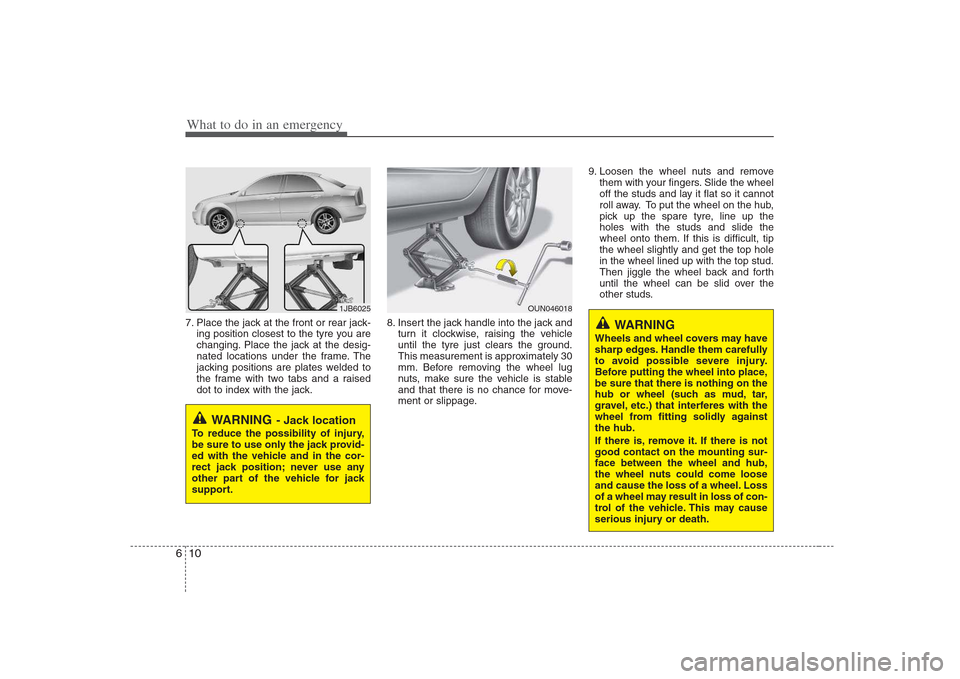
7. Place the jack at the front or rear jack-
ing position closest to the tyre you are
changing. Place the jack at the desig-
nated locations under the frame. The
jacking positions are plates welded to
the frame with two tabs and a raised
dot to index with the jack. 8. Insert the jack handle into the jack and
turn it clockwise, raising the vehicle
until the tyre just clears the ground.
This measurement is approximately 30
mm. Before removing the wheel lug
nuts, make sure the vehicle is stable
and that there is no chance for move-
ment or slippage. 9. Loosen the wheel nuts and remove
them with your fingers. Slide the wheel
off the studs and lay it flat so it cannot
roll away. To put the wheel on the hub,
pick up the spare tyre, line up theholes with the studs and slide the
wheel onto them. If this is difficult, tipthe wheel slightly and get the top holein the wheel lined up with the top stud.
Then jiggle the wheel back and forth
until the wheel can be slid over the
other studs.
WARNING - Jack location
To reduce the possibility of injury,
be sure to use only the jack provid-
ed with the vehicle and in the cor-
rect jack position; never use any
other part of the vehicle for jack
support.
1JB6025OUN046018
WARNING
Wheels and wheel covers may have
sharp edges. Handle them carefully
to avoid possible severe injury.
Before putting the wheel into place,be sure that there is nothing on the
hub or wheel (such as mud, tar,
gravel, etc.) that interferes with the
wheel from fitting solidly againstthe hub.
If there is, remove it. If there is not good contact on the mounting sur-face between the wheel and hub,
the wheel nuts could come loose
and cause the loss of a wheel. Loss
of a wheel may result in loss of con-
trol of the vehicle. This may cause
serious injury or death.
Page 219 of 308
611
What to do in an emergency
10. To reinstall the wheel, hold it on thestuds, put the wheel nuts on the studs and tighten them finger tight.
The nuts should be installed withtheir small diameter ends directed
inward. Jiggle the tyre to be sure it iscompletely seated, then tighten the
nuts as much as possible with yourfingers again.
11. Lower the car to the ground by turn- ing the wheel nut wrench counter-
clockwise.
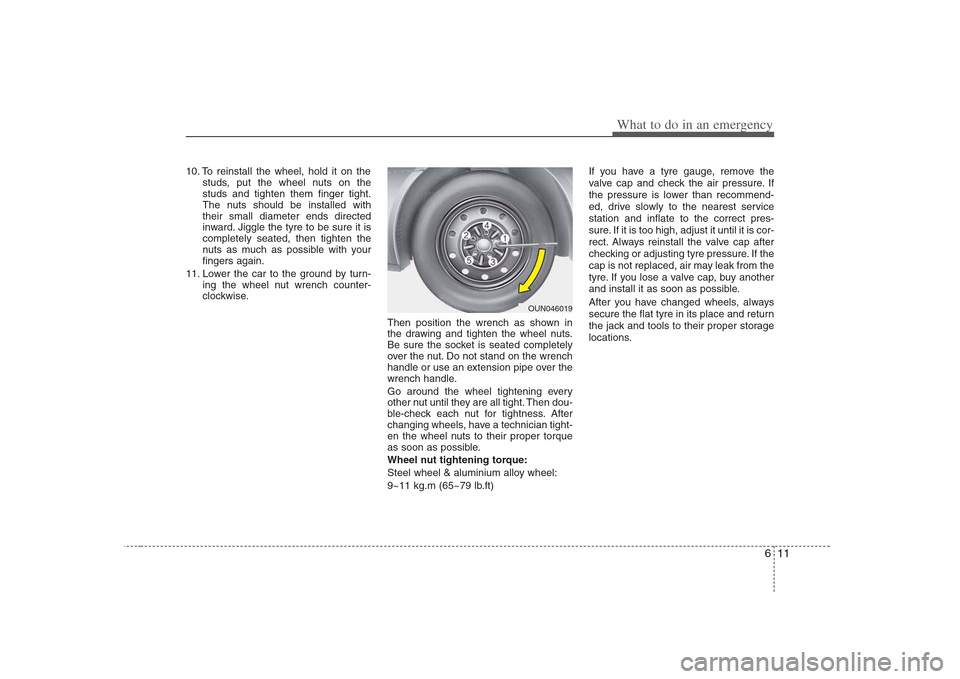
Then position the wrench as shown in
the drawing and tighten the wheel nuts.
Be sure the socket is seated completely
over the nut. Do not stand on the wrench
handle or use an extension pipe over the
wrench handle.
Go around the wheel tightening every
other nut until they are all tight. Then dou-
ble-check each nut for tightness. After
changing wheels, have a technician tight-
en the wheel nuts to their proper torque
as soon as possible.
Wheel nut tightening torque:
Steel wheel & aluminium alloy wheel:
9~11 kg.m (65~79 lb.ft) If you have a tyre gauge, remove the
valve cap and check the air pressure. If
the pressure is lower than recommend-
ed, drive slowly to the nearest servicestation and inflate to the correct pres-
sure. If it is too high, adjust it until it is cor-
rect. Always reinstall the valve cap after
checking or adjusting tyre pressure. If the
cap is not replaced, air may leak from the
tyre. If you lose a valve cap, buy another
and install it as soon as possible.
After you have changed wheels, always
secure the flat tyre in its place and return
the jack and tools to their proper storage
locations.
OUN046019
Page 220 of 308
What to do in an emergency
12
6
To prevent the jack, jack handle, wheel
lug nut wrench and spare tyre from rat-
tling while the vehicle is in motion, store
them properly.
Important - use of compact spare tire
(if equipped)
Your vehicle is equipped with a compact
spare tire. This compact spare tire takes
up less space than a regular-size tire.
This tire is smaller than a conventional
tire and is designed for temporary use
only.
CAUTION
Your vehicle has metric threads on
the wheel studs and nuts. Make cer-tain during wheel removal that the same nuts removed are reinstalled -
or, if replaced, that nuts with metricthreads and the same chamfer con-figuration are used. Installation of a non-metric thread nut on a metric
stud or vice-versa will not securethe wheel to the hub properly andwill damage the stud so that it must be replaced.
Note that most lug nuts do not havemetric threads. Be sure to useextreme care in checking for thread style before installing aftermarket
lug nuts or wheels. If in doubt, con-sult an authorised Hyundai dealer.WARNING - Wheel studs
If the studs are damaged, they may lose their ability to retain the wheel.This could lead to the loss of thewheel and a collision resulting inserious injuries.
WARNING - Inadequate
spare tyre pressure
Check the inflation pressures as
soon as possible after installing the
spare tyre. Adjust it to the specified
pressure, if necessary. Refer to
Section 8, Specifications.
CAUTION
You should drive carefully when the compact spare is in use. Thecompact spare should bereplaced by the proper conven-
tional tire and rim at the firstopportunity.
The operation of this vehicle is not recommended with more than
one compact spare tire in use atthe same time.
Page 221 of 308
613
What to do in an emergency
The compact spare should be inflated to
420 kPa (60 psi).
✽✽NOTICE
Check the inflation pressure after
installing the spare tire. Adjust it to the
specified pressure, as necessary.
When using a compact spare tire,
observe the following precautions:
Under no circumstances should you exceed 80 km/h (50 mph); a higher
speed could damage the tire.
Ensure that you drive slowly enough for the road conditions to avoid all haz-
ards. Any road hazard, such as a pot-
hole or debris, could seriously damage
the compact spare.
Any continuous road use of this tire could result in tire failure, loss of vehi-
cle control, and possible personal
injury.
Do not exceed the vehicle’s maximum load rating or the load-carrying capaci-
ty shown on the sidewall of the com-
pact spare tire.
Avoid driving over obstacles. The com- pact spare tire diameter is smaller than
the diameter of a conventional tire and
reduces the ground clearance approxi-mately 25 mm (1 inch), which could
result in damage to the vehicle.
Do not take this vehicle through an automatic car wash while the compactspare tire is installed.
Do not use tire chains on the compact spare tire. Because of the smaller size,
a tire chain will not fit properly. This
could damage the vehicle and result inloss of the chain. The compact spare tire should not be
installed on the front axle if the vehicle
must be driven in snow or on ice.
Do not use the compact spare tire on any other vehicle because this tire has
been designed especially for your vehi-
cle.
The compact spare tire’s tread life is shorter than a regular tire. Inspect your
compact spare tire regularly and
replace worn compact spare tires with
the same size and design, mounted onthe same wheel.
The temporary spare tire should not be used on any other wheels, nor should
standard tires, snow tires, wheel cov-
ers or trim rings be used with the tem-
porary spare wheel. If such use isattempted, damage to these items or
other car components may occur.
Do not use more than one temporary spare tire at a time.
Do not tow a trailer while the temporary spare tire is installed.
WARNING
This spare tire should be used only
for VERY short distances. Compact
spares should NEVER be used for
long drives or extended distances.
Page 222 of 308
What to do in an emergency
14
6
TOWING
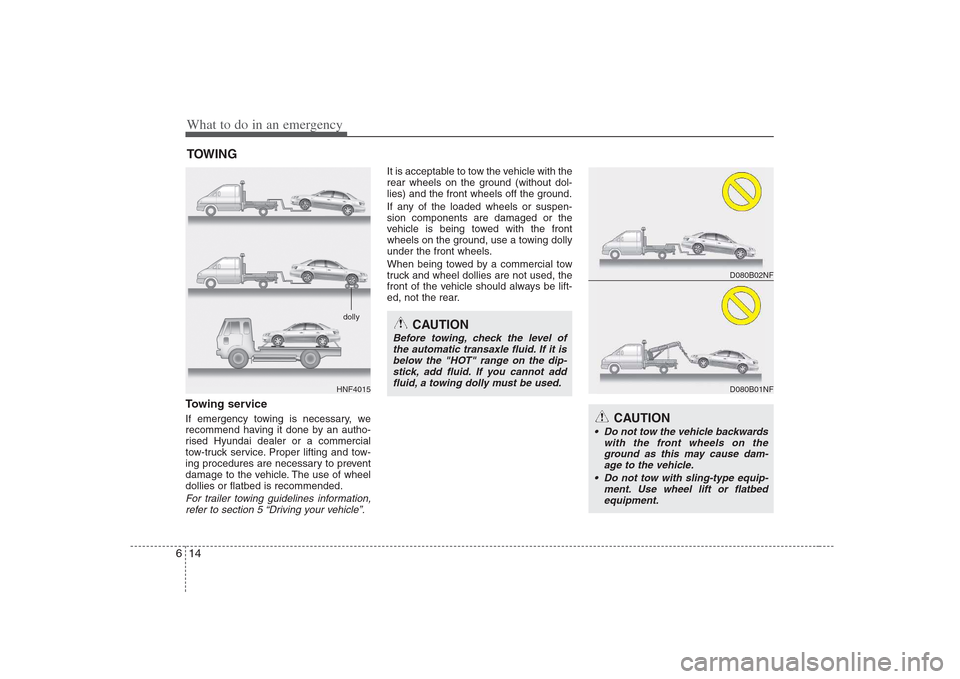
Towing service
If emergency towing is necessary, we
recommend having it done by an autho-
rised Hyundai dealer or a commercial
tow-truck service. Proper lifting and tow-
ing procedures are necessary to prevent
damage to the vehicle. The use of wheeldollies or flatbed is recommended.
For trailer towing guidelines information, refer to section 5 “Driving your vehicle”.
It is acceptable to tow the vehicle with the
rear wheels on the ground (without dol-
lies) and the front wheels off the ground.
If any of the loaded wheels or suspen- sion components are damaged or the
vehicle is being towed with the front
wheels on the ground, use a towing dolly
under the front wheels.
When being towed by a commercial tow
truck and wheel dollies are not used, the
front of the vehicle should always be lift-
ed, not the rear.
HNF4015
D080B02NF
D080B01NF
CAUTION
Do not tow the vehicle backwards
with the front wheels on theground as this may cause dam-age to the vehicle.
Do not tow with sling-type equip- ment. Use wheel lift or flatbed
equipment.
CAUTION
Before towing, check the level ofthe automatic transaxle fluid. If it isbelow the "HOT" range on the dip- stick, add fluid. If you cannot addfluid, a towing dolly must be used.
dolly