warning Hyundai Elantra 2010 Owner's Guide
[x] Cancel search | Manufacturer: HYUNDAI, Model Year: 2010, Model line: Elantra, Model: Hyundai Elantra 2010Pages: 348, PDF Size: 5.78 MB
Page 46 of 348
329
Safety features of your vehicle
LATCH anchors have been provided in
your vehicle. The LATCH anchors are
located in the left and right outboard rear
seating positions. Their locations are
shown in the illustration. There is no
LATCH anchor provided for the center
rear seating position.
The LATCH anchors are located between
the seatback and the seat cushion of the
rear seat left and right outboard seating
positions.
Follow the child seat manufacturer’s
instructions to properly install child
restraint seats with LATCH or LATCH-
compatible attachments.
Once you have installed the LATCH child
restraint, assure that the seat is properly
attached to the LATCH and tether
anchors.
Also, test the child restraint seat before
you place the child in it. Tilt the seat from
side to side. Also try to tug the seat for-
ward. Check to see if the anchors hold
the seat in place.
WARNING
When using the vehicle's "LATCH"
system to install a child restraint
system in the rear seat, all unused
vehicle rear seat belt metal latch
plates or tabs must be latched
securely in their seat belt buckles
and the seat belt webbing must be
retracted behind the child restraint
to prevent the child from reaching
and taking hold of unretracted seat
belts. Unlatched metal latch plates
or tabs may allow the child to reach
the unretracted seat belts which
may result in strangulation and a
serious injury or death to the child
in the child restraint.
WARNING
If the child restraint is not anchored
properly, the risk of a child being
seriously injured or killed in a colli-
sion greatly increases.
WARNING - LATCH lower
anchors
LATCH lower anchors are only to
be used with the left and right rear
outboard seating positions. Never
attempt to attach a LATCH
equipped seat in the center seating
position. You may damage the
anchors or the anchors may fail
and break in a collision.
CAUTION
Do not allow the rear seat belt web-
bing to get scratched or pinched bythe child-seat latch and LATCHanchor during the installation.
WARNING
Install the child restraint seat fully
rearward against the seatback with
the seatback reclined two positions
from the most upright latched posi-
tion.
Page 48 of 348

331
Safety features of your vehicle
SRS components and functions
The SRS consists of the following com-
ponents:
1. Front Impact Sensors
2. “PASSENGER AIR BAG OFF”Indicator (Front passenger’s seat only)
3. SRS Air Bag Warning Light
4. Passenger's Air bag Module
5. Driver's Air Bag Module
6. SRS Control Module (SRSCM)
7. Occupant Classification System (Front passenger's seat only)
8. Driver's Seat Track Position Sensor
9. Driver's and Front Passenger's Seat Belt Buckle Sensors
10. Side Impact Sensors
11. Retractor Pre-tensioner Assemblies
12. Side Air Bag Modules
13. Curtain Air bag Modules
* : If equipped The SRSCM continually monitors all
SRS components while the ignition
switch is ON to determine if a crash
impact is severe enough to require air
bag deployment or pre-tensioner seat
belt deployment.
The SRS air bag warning light on the
instrument panel will illuminate for about
6 seconds after the ignition switch is
turned to the ON position, after which the
air bag warning light should go out.
If any of the following conditions occurs,
this indicates a malfunetion of the SRS.
Have an authorized Hyundai dealer
inspect the air bag system as soon as
possible.
The light does not turn on briefly when
you turn the ignition ON.
The light stays on after illuminating for approximately 6 seconds.
The light comes on while the vehicle is in motion. The air bag modules are located both in
the center of the steering wheel and in
the front passenger's panel above the
glove box. When the SRSCM detects a
sufficiently severe impact to the front of
the vehicle, it will automatically deploy
the front air bags.
B240B01L
Driver’s front air bag (1)
Page 49 of 348
Safety features of your vehicle
32
3
B240B05L
Passenger’s front air bag
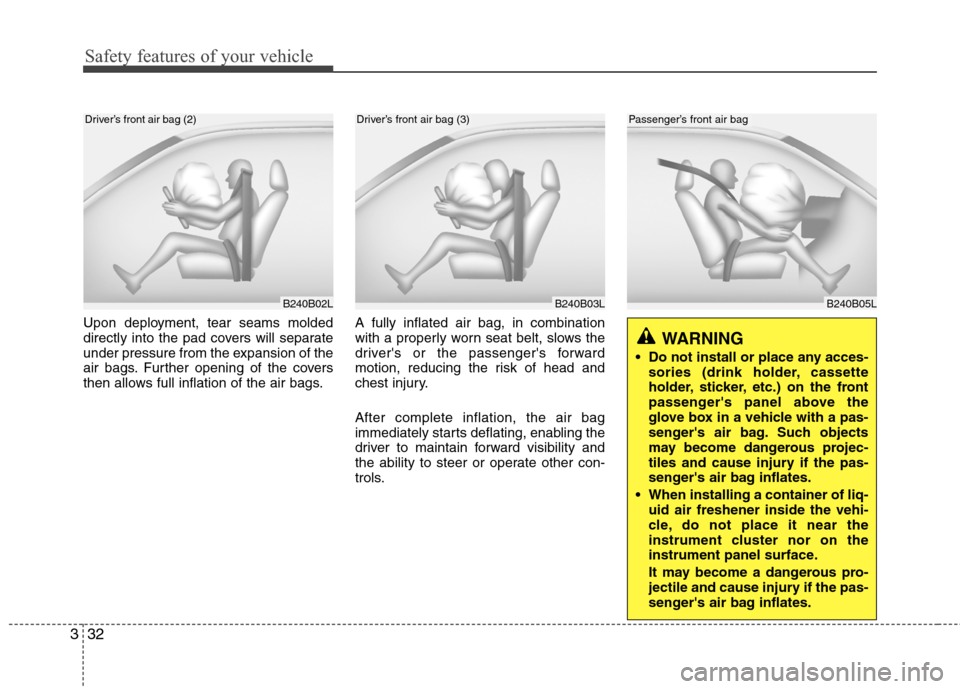
Upon deployment, tear seams molded
directly into the pad covers will separate
under pressure from the expansion of the
air bags. Further opening of the covers
then allows full inflation of the air bags. A fully inflated air bag, in combination
with a properly worn seat belt, slows the
driver's or the passenger's forward
motion, reducing the risk of head and
chest injury.
After complete inflation, the air bag
immediately starts deflating, enabling the
driver to maintain forward visibility and
the ability to steer or operate other con-
trols.
B240B02L
B240B03L
Driver’s front air bag (2)Driver’s front air bag (3)
WARNING
Do not install or place any acces-
sories (drink holder, cassette
holder, sticker, etc.) on the front
passenger's panel above the
glove box in a vehicle with a pas-
senger's air bag. Such objects
may become dangerous projec-
tiles and cause injury if the pas-
senger's air bag inflates.
When installing a container of liq- uid air freshener inside the vehi-
cle, do not place it near the
instrument cluster nor on the
instrument panel surface.
It may become a dangerous pro-
jectile and cause injury if the pas-
senger's air bag inflates.
Page 50 of 348
333
Safety features of your vehicle
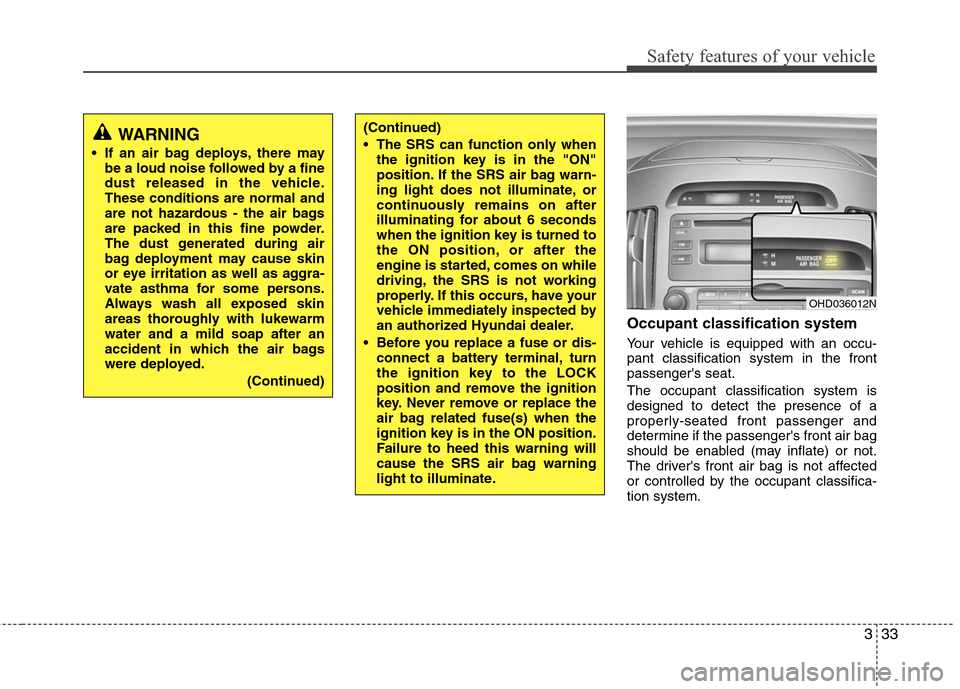
Occupant classification system
Your vehicle is equipped with an occu-
pant classification system in the front
passenger's seat.
The occupant classification system is
designed to detect the presence of a
properly-seated front passenger and
determine if the passenger's front air bag
should be enabled (may inflate) or not.
The driver's front air bag is not affected
or controlled by the occupant classifica-
tion system.
WARNING
If an air bag deploys, there maybe a loud noise followed by a fine
dust released in the vehicle.
These conditions are normal and
are not hazardous - the air bags
are packed in this fine powder.
The dust generated during air
bag deployment may cause skin
or eye irritation as well as aggra-
vate asthma for some persons.
Always wash all exposed skin
areas thoroughly with lukewarm
water and a mild soap after an
accident in which the air bags
were deployed.
(Continued)
(Continued)
The SRS can function only whenthe ignition key is in the "ON"
position. If the SRS air bag warn-
ing light does not illuminate, or
continuously remains on after
illuminating for about 6 seconds
when the ignition key is turned to
the ON position, or after the
engine is started, comes on while
driving, the SRS is not working
properly. If this occurs, have your
vehicle immediately inspected by
an authorized Hyundai dealer.
Before you replace a fuse or dis- connect a battery terminal, turn
the ignition key to the LOCK
position and remove the ignition
key. Never remove or replace the
air bag related fuse(s) when the
ignition key is in the ON position.
Failure to heed this warning will
cause the SRS air bag warning
light to illuminate.
OHD036012N
Page 51 of 348
Safety features of your vehicle
34
3
Main components of occupant
classification system
A detection device located under the
front passenger seat track.
Electronic system to determine whether the passenger air bag sys-
tems (both front and side) should be
activated or deactivated.
A warning light located on the instru- ment panel which illuminates the
words "PASSENGER AIR BAG OFF"
indicating the front passenger air bag
system is deactivated.
The instrument panel air bag warning light is interconnected with the occu-
pant classification system. If the front passenger seat is occupied by
a person that the system determines to
be of adult size, and he/she sits properly
(sitting upright with the seatback in an
upright position, centered on the seat
cushion with their seat belt on, legs com-
fortably extended and their feet on the
floor), the "PASSENGER AIR BAG OFF"
indicator will be turned off and the front
passenger's air bag will be able to inflate,
if necessary, in frontal crashes.
You will find the "PASSENGER AIR BAG
OFF" indicator on the center facia panel.
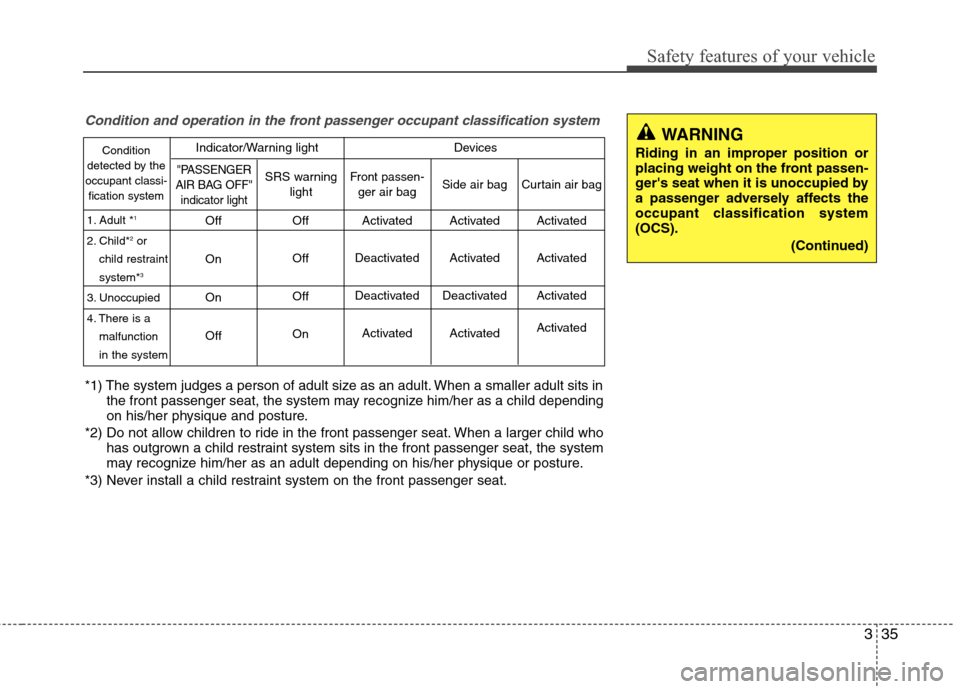
This system detects the conditions 1~4
in the following table and activates or
deactivates the front passenger air bag
based on these conditions. Always be sure that you and all vehicle
occupants are seated and restrained
properly (sitting upright with the seat in
an upright position, centered on the seat
cushion, with the person's legs comfort-
ably extended, feet on the floor, and
wearing the safety belt properly) for the
most effective protection by the air bag
and the safety belt.
The OCS (Occupant Classification
System) may not function properly if
the passenger takes actions which can
defect the detection system. These
include:
(1) Failing to sit in an upright position.
(2) Leaning against the door or center console.
(3) Sitting towards the sides or the front of the seat.
(4) Putting legs on the dashboard or resting them on other locations
which reduce the passenger weight
on the front seat.
(5) Improperly wearing the safety belt.
(6) Reclining the seat back.
Page 52 of 348
335
Safety features of your vehicle
Condition and operation in the front passenger occupant classification system
Condition
detected by the
occupant classi- fication system
1. Adult *
1
2. Child*2or
child restraint
system*
3
3. Unoccupied
4. There is a malfunction
in the system
Off
On
On
Off Off
Off
Off
On Activated
Deactivated
Deactivated Activated
"PASSENGER
AIR BAG OFF" indicator lightSRS warning lightFront passen-ger air bag
Activated
Activated
Deactivated Activated
Side air bag
Activated
Activated
Activated
Activated
Curtain air bag
Indicator/Warning light Devices
*1) The system judges a person of adult size as an adult. When a smaller adult sits in the front passenger seat, the system may recognize him/her as a child depending
on his/her physique and posture.
*2) Do not allow children to ride in the front passenger seat. When a larger child who has outgrown a child restraint system sits in the front passenger seat, the system
may recognize him/her as an adult depending on his/her physique or posture.
*3) Never install a child restraint system on the front passenger seat.
WARNING
Riding in an improper position or
placing weight on the front passen-
ger's seat when it is unoccupied by
a passenger adversely affects the
occupant classification system
(OCS). (Continued)
Page 54 of 348

337
Safety features of your vehicle
When an adult is seated in the front pas-
senger seat, if the "PASSENGER AIR
BAG OFF" indicator is on, turn the igni-
tion key to "LOCK" and ask the passen-
ger to sit properly (sitting upright with the
seat back in an upright position, centered
on the seat cushion with their seat belt
on, legs comfortably extended and their
feet on the floor). Restart the engine and
have the person remain in that position.
This will allow the system to detect the
person and to enable the passenger air
bag.If the "PASSENGER AIR BAG OFF" indi-
cator is still on, ask the passenger to
move to the rear seat.
✽ ✽
NOTICE
The "PASSENGER AIR BAG OFF"
indicator illuminates for about 4 sec-
onds after the ignition key is turned to
the "ON" position or after the engine is
started. If the front passenger seat is
occupied, the occupant classification
sensor will then classify the front pas-
senger after several more seconds.
B990A01O
Proper position
WARNING
Do not allow an adult passenger to
ride in the front seat when the
“PASSENGER AIR BAG OFF” indi-
cator is illuminated, because the air
bag will not deploy in the event of a
crash. If the "PASSENGER AIR
BAG OFF" indicator remains illumi-
nated after the passenger reposi-
tions themselves properly and the
car is restarted, we recommend
that passenger move to the rear
seat because the passenger's front
air bag will not deploy.
Front seat passengers must stay
properly seated to avoid serious
injury from a deploying air bag.
WARNING
Do not put a heavy load in the front
passenger seatback pocket or on
the front passenger seat. Do not
hang onto the front passenger seat.
Do not hang any items such as
seatback table on the front passen-
ger seatback. Do not place feet on
the front passenger seatback. Do
not place any items under the front
passenger seat. Any of these could
interfere with proper sensor opera-
tion.
Page 55 of 348
Safety features of your vehicle
38
3
WARNING
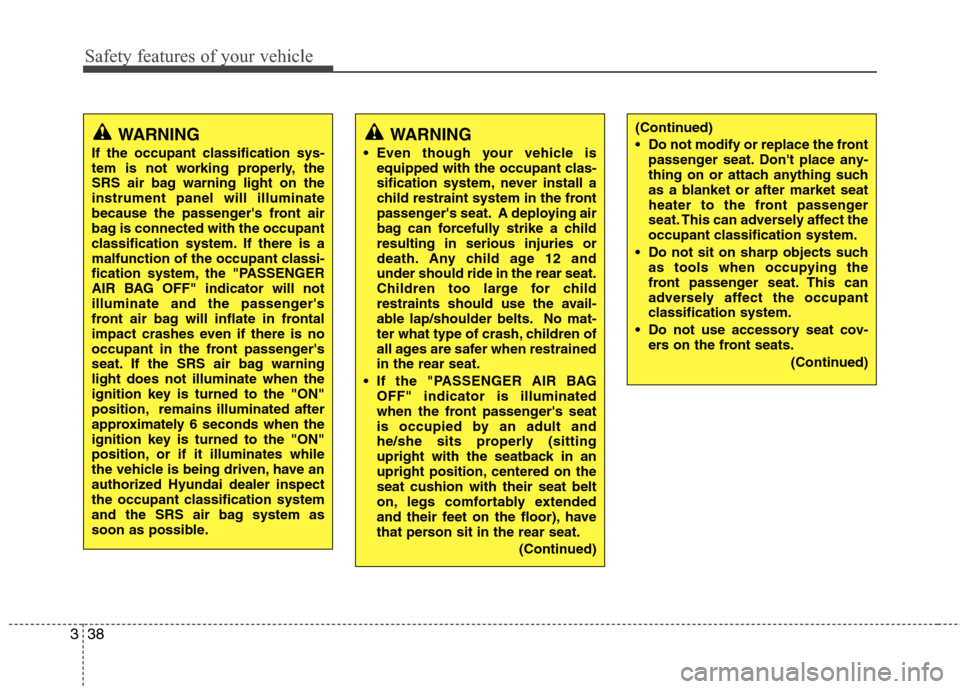
If the occupant classification sys-
tem is not working properly, the
SRS air bag warning light on the
instrument panel will illuminate
because the passenger's front air
bag is connected with the occupant
classification system. If there is a
malfunction of the occupant classi-
fication system, the "PASSENGER
AIR BAG OFF" indicator will not
illuminate and the passenger's
front air bag will inflate in frontal
impact crashes even if there is no
occupant in the front passenger's
seat. If the SRS air bag warning
light does not illuminate when the
ignition key is turned to the "ON"
position, remains illuminated after
approximately 6 seconds when the
ignition key is turned to the "ON"
position, or if it illuminates while
the vehicle is being driven, have an
authorized Hyundai dealer inspect
the occupant classification system
and the SRS air bag system as
soon as possible.
(Continued)
Do not modify or replace the front
passenger seat. Don't place any-
thing on or attach anything such
as a blanket or after market seat
heater to the front passenger
seat. This can adversely affect the
occupant classification system.
Do not sit on sharp objects such as tools when occupying the
front passenger seat. This can
adversely affect the occupant
classification system.
Do not use accessory seat cov- ers on the front seats.
(Continued)WARNING
Even though your vehicle isequipped with the occupant clas-
sification system, never install a
child restraint system in the front
passenger's seat. A deploying air
bag can forcefully strike a child
resulting in serious injuries or
death. Any child age 12 and
under should ride in the rear seat.
Children too large for child
restraints should use the avail-
able lap/shoulder belts. No mat-
ter what type of crash, children of
all ages are safer when restrained
in the rear seat.
If the "PASSENGER AIR BAG OFF" indicator is illuminated
when the front passenger's seat
is occupied by an adult and
he/she sits properly (sitting
upright with the seatback in an
upright position, centered on the
seat cushion with their seat belt
on, legs comfortably extended
and their feet on the floor), have
that person sit in the rear seat.
(Continued)
Page 57 of 348

Safety features of your vehicle
40
3
The purpose of the SRS is to provide the
vehicle's driver and/or the front passen-
ger with additional protection than that
offered by the seat belt system alone in
case of a frontal impact of sufficient
severity. The SRS uses sensors to gath-
er information about the driver's seat
position, the driver's and front passen-
ger's seat belt usage and impact severi-
ty. The driver's seat track position sensors,
which are installed on the seat track,
determine if the seat is fore or aft of a ref-
erence position. The seat belt buckle
sensors determine if the driver and front
passenger's seat belts are fastened.
These sensors provide the ability to con-
trol the SRS deployment based on how
close the driver's seat is to the steering
wheel, whether or not the seat belts are
fastened, and how severe the impact is.
The advanced SRS offers the ability to
control the air bag inflation with two lev-
els. A first stage level is provided for mod-
erate-severity impacts. A second stage
level is provided for more severe impacts.
According to the impact severity, seating
position and seat belt usage, the
SRSCM(SRS Control Module) controls
the air bag inflation. Failure to properly
wear seat belts can increase the risk or
severity of injury in an accident.Additionally, your vehicle is equipped
with an occupant classification system in
the front passenger's seat. The occupant
classification system detects the pres-
ence of a passenger in the front passen-
ger's seat and will turn off the front pas-
senger's air bag under certain condi-
tions. For more detail, see "Occupant
Classification System" in this section.
OHD036024
Passenger’s front air bag
WARNING
If a seat track position sensor or an
occupant classification system is
not working properly, the SRS air
bag warning light on the instrument
panel will illuminate because the
SRS air bag warning light is con-
nected with the seat track position
sensor and the occupant classifica-
tion system. If the SRS air bag
warning light does not illuminate
when the ignition key is turned to
the "ON" position, remains illumi-
nated after approximately 6 sec-
onds when the ignition key is
turned to the "ON" position, or if it
illuminates while the vehicle is
being driven, have an authorized
Hyundai dealer inspect the
advanced SRS air bag system as
soon as possible.
Page 58 of 348

341
Safety features of your vehicle
✽
✽NOTICE
• Be sure to read information about the
SRS on the labels provided on the sun
visor and in the glove box.
• Advanced air bags are combined with pre-tensioner seat belts to help pro-
vide enhanced occupant protection in
frontal crashes. Front air bags are not
intended to deploy in collisions in
which sufficient protection can be
provided by the pre-tensioner seat
belt.
• If you are considering modification of your vehicle due to a disability, please
contact the Hyundai Customer
Assistance Center at 1-800-633-5151.WARNING
Always use seat belts and child
restraints – every trip, every time,
everyone! Air bags inflate with
considerable force and in the blink
of an eye. Seat belts help keep
occupants in proper position to
obtain maximum benefit from the
air bag. Even with advanced air
bags, improperly and unbelted
occupants can be severely injured
when the air bag inflates. Always
follow the precautions about seat
belts, air bags and occupant safety
contained in this manual.
To reduce the chance of serious or
fatal injuries and receive the maxi-
mum safety benefit from your
restraint system:
Never place a child in any child or
booster seat in the front seat.
ABC – Always Buckle Children in the back seat. It is the safest
place for children of any age to
ride.
Front and side air bags can injure occupants improperly positioned
in the front seats.
(Continued)
WARNING
Modification to the seat structurecan adversely affect the seat
track position sensor and cause
the air bag to deploy at a different
level than should be provided.
Do not place any objects under- neath the front seats as they
could damage the seat track
position sensor or interfere with
the occupant classification sys-
tem.
Do not place any objects that may cause magnetic fields near the
front seat. These may cause a
malfunction of the seat track
position sensor.