Headlight Hyundai Elantra 2014 User Guide
[x] Cancel search | Manufacturer: HYUNDAI, Model Year: 2014, Model line: Elantra, Model: Hyundai Elantra 2014Pages: 668, PDF Size: 35.58 MB
Page 164 of 668
Features of your vehicle
78
4
Daytime running light (DRL)
(if equipped)
The Daytime Running Lights (DRL)
can make it easier for others to see
the front of your vehicle during the
day, especially after dawn and before
sunset.
Type A
The DRL will turn off when:
1. The headlight is ON.
2. The light switch is in the DRL OFF position.
3. The parking brake is applied.
4. The engine is turned OFF.
Type B
The DRL will turn off when:
1. The headlight is ON.
2. The light switch is in the OFF posi- tion.
3. The parking brake is applied.
4. The engine is turned OFF.
Interior lightsAutomatic turn off function (if equipped)
When all doors are closed, if you lock
the vehicle by using the remote key
or smart key, all interior lamp will be
off within 5 seconds.
If you do not operate anything in the
vehicle after turning off the engine,
the lights will turn off after 20 minutes.
CAUTION
Do not use the interior lights forextended periods when theengine is turned off or the bat-tery will discharge.
WARNING
Do not use the interior lights
when driving in the dark. The
interior lights may obscure your
view and cause an accident.
Page 505 of 668
549
Driving your vehicle
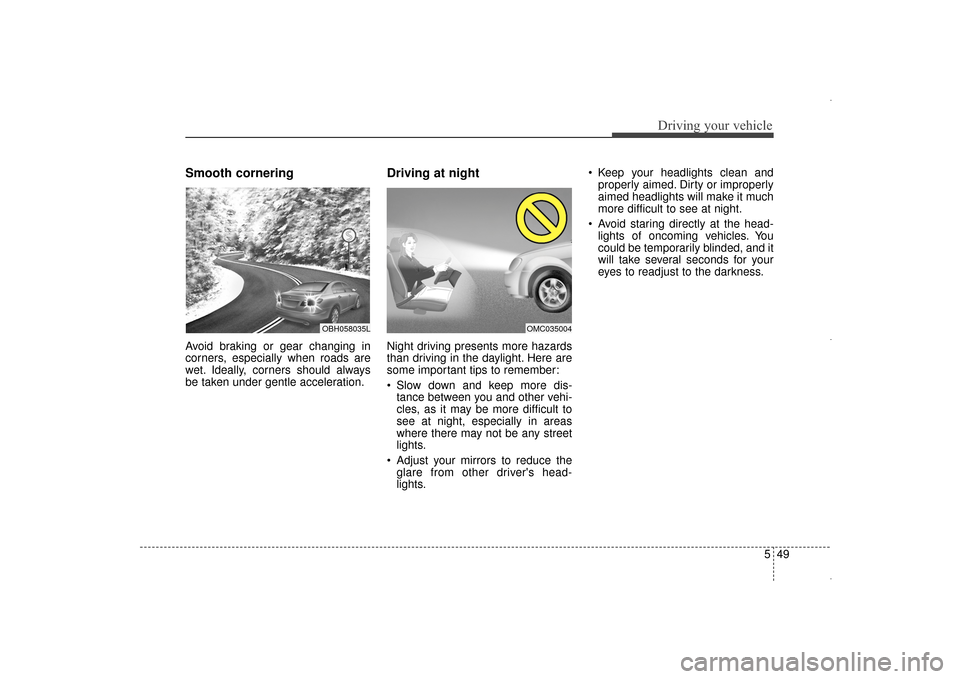
Smooth cornering
Avoid braking or gear changing in
corners, especially when roads are
wet. Ideally, corners should always
be taken under gentle acceleration.
Driving at night
Night driving presents more hazards
than driving in the daylight. Here are
some important tips to remember:
Slow down and keep more dis-tance between you and other vehi-
cles, as it may be more difficult to
see at night, especially in areas
where there may not be any street
lights.
Adjust your mirrors to reduce the glare from other driver's head-
lights. Keep your headlights clean and
properly aimed. Dirty or improperly
aimed headlights will make it much
more difficult to see at night.
Avoid staring directly at the head- lights of oncoming vehicles. You
could be temporarily blinded, and it
will take several seconds for your
eyes to readjust to the darkness.
OBH058035LOMC035004
UD(FL) HMA 5.qxp 6/26/2014 3:23 PM Page 49
Page 506 of 668
Driving your vehicle
50
5
Driving in the rain
Rain and wet roads can make driving
dangerous. Here are a few things to
consider when driving in the rain or
on slick pavement:
Slow down and allow extra follow-
ing distance. A heavy rainfall
makes it harder to see and increas-
es the distance needed to stop
your vehicle.
Turn OFF your Cruise Control. (if equipped)
Replace your windshield wiper blades when they show signs of
streaking or missing areas on the
windshield. Be sure your tires have enough
tread. If your tires do not have
enough tread, making a quick stop
on wet pavement can cause a skid
and possibly lead to an accident.
See “Tire Tread” in chapter 7.
Turn on your headlights to make it easier for others to see you.
Driving too fast through large pud- dles can affect your brakes. If you
must go through puddles, try to
drive through them slowly.
If you believe your brakes may be wet, apply them lightly while driv-
ing until normal braking operation
returns.
Hydroplaning
If the road is wet enough and you are
going fast enough, your vehicle may
have little or no contact with the road
surface and actually ride on the
water. The best advice is SLOW
DOWN when the road is wet. The
risk of hydroplaning increases as the
depth of tire tread decreases, refer to
“Tire Tread” in chapter 7.
Driving in flooded areas
Avoid driving through flooded areas
unless you are sure the water is no
higher than the bottom of the wheel
hub. Drive through any water slowly.
Allow adequate stopping distance
because brake performance may be
reduced.
After driving through water, dry the
brakes by gently applying them sev-
eral times while the vehicle is moving
slowly.
1JBB3303
UD(FL) HMA 5.qxp 6/26/2014 3:23 PM Page 50
Page 550 of 668

Fuses . . . . . . . . . . . . . . . . . . . . . . . . . . . . . . . . . . . . \
7-63
• Instrument panel fuse replacement . . . . . . . . . . . . . . 7-64
• Memory fuse . . . . . . . . . . . . . . . . . . . . . . . . . . . . . . . . 7-65
• Engine compartment panel fuse replacement . . . . . 7-66
• Fuse/relay panel description. . . . . . . . . . . . . . . . . . . . 7-68
Light bulbs . . . . . . . . . . . . . . . . . . . . . . . . . . . . . . . 7-76
• Headlight, parking light, turn signal light, side marker and front fog light bulb
replacement. . . . . . . . . . . . . . . . . . . . . . . . . . . . . . . . 7-76
• Side repeater light replacement . . . . . . . . . . . . . . . . . 7-80
• Rear combination light bulb replacement . . . . . . . . 7-81
• High mounted stop light replacement . . . . . . . . . . . . 7-84
• License plate light bulb replacement. . . . . . . . . . . . . 7-85
• Interior light bulb replacement . . . . . . . . . . . . . . . . . 7-85
Appearance care . . . . . . . . . . . . . . . . . . . . . . . . . . . 7-87
• Exterior care . . . . . . . . . . . . . . . . . . . . . . . . . . . . . . . . 7-87
• Interior care . . . . . . . . . . . . . . . . . . . . . . . . . . . . . . . . . 7-92
Emission control system . . . . . . . . . . . . . . . . . . . . 7-94
• Crankcase emission control system . . . . . . . . . . . . . . 7-94
• Evaporative emission control system including onboard refueling vapor recovery (ORVR). . . . . . 7-94
• Exhaust emission control system . . . . . . . . . . . . . . . . 7-95
California perchlorate notice . . . . . . . . . . . . . . . . 7-98
7
Page 556 of 668
Maintenance
87
At least twice a year:(i.e., every Spring and Fall):
Check radiator, heater and air con- ditioning hoses for leaks or dam-
age.
Check windshield washer spray and wiper operation. Clean wiper
blades with clean cloth dampened
with washer fluid.
Check headlight alignment.
Check muffler, exhaust pipes, shields and clamps.
Check the seat belts for wear and function.
At least once a year:
Clean body and door drain holes.
Lubricate door hinges and hoodhinges.
Lubricate door and hood locks and latches.
Lubricate door rubber weather strips.
Check the air conditioning system.
Inspect and lubricate automatic transaxle linkage and controls.
Clean the battery and terminals.
Check the brake/clutch fluid level. Follow Normal Maintenance
Schedule if the vehicle is usually
operated where none of the following
conditions apply. If any of the follow-
ing conditions apply, you must follow
the Maintenance Under Severe
Usage Conditions.
Repeated short distance driving.
Driving in dusty conditions or
sandy areas.
Extensive use of brakes.
Driving in areas where salt or other corrosive materials are used.
Driving on rough or muddy roads.
Driving in mountainous areas.
Extended periods of idling or low speed operation.
Driving for a prolonged period in cold temperatures and/or extreme-
ly humid climates.
More than 50% driving in heavy city traffic during hot weather
above 90°F (32°C).
For additional information or assis-
tance see your authorized HYUNDAI
dealer.
SCHEDULED MAINTENANCE
SERVICES
Page 593 of 668
745
Maintenance
Battery recharging
By battery charger
Your vehicle has a maintenance-free,
calcium-based battery.
If the battery becomes dischargedin a short time (because, for exam-
ple, the headlights or interior lights
were left on while the vehicle was
not in use), recharge it by slow
charging (trickle) for 10 hours.
If the battery gradually discharges because of high electric load while
the vehicle is being used, recharge
it at 20-30A for two hours.
WARNING
Always follow these instruc-
tions when recharging your
vehicle’s battery to avoid the
risk of SERIOUS INJURY or
DEATH from explosions or acid
burns:
Before performing mainte-nance or recharging the bat-
tery, turn off all accessories
and place the ignition switch
in the LOCK/OFF position.
Keep all flames, sparks, or smoking materials away from
the battery.
Always work outdoors or in an area with plenty of ventilation.
Wear eye protection when checking the battery during
charging.
The battery must be removed from the vehicle and placed in
a well ventilated area.
(Continued)
(Continued)
Watch the battery duringcharging, and stop or reduce
the charging rate if the battery
cells begin boiling violently.
The negative battery cable must be removed first and
installed last when the battery
is disconnected. Disconnect
the battery charger in the fol-
lowing order:
(1) Turn off the battery charg- er main switch.
(2) Unhook the negative clamp from the negative
battery terminal.
(3) Unhook the positive clamp from the positive battery
terminal.
Always use a genuine HYUNDAI approved battery
when you replace the battery.
Page 613 of 668
765
Maintenance
In an emergency, if you do not have
a spare fuse, use a fuse of the same
rating from a circuit you may not
need for operating the vehicle, such
as the cigarette lighter fuse.
If the headlights or other electrical
components do not work and the
fuses are OK, check the fuse panel
in the engine compartment. If a fuse
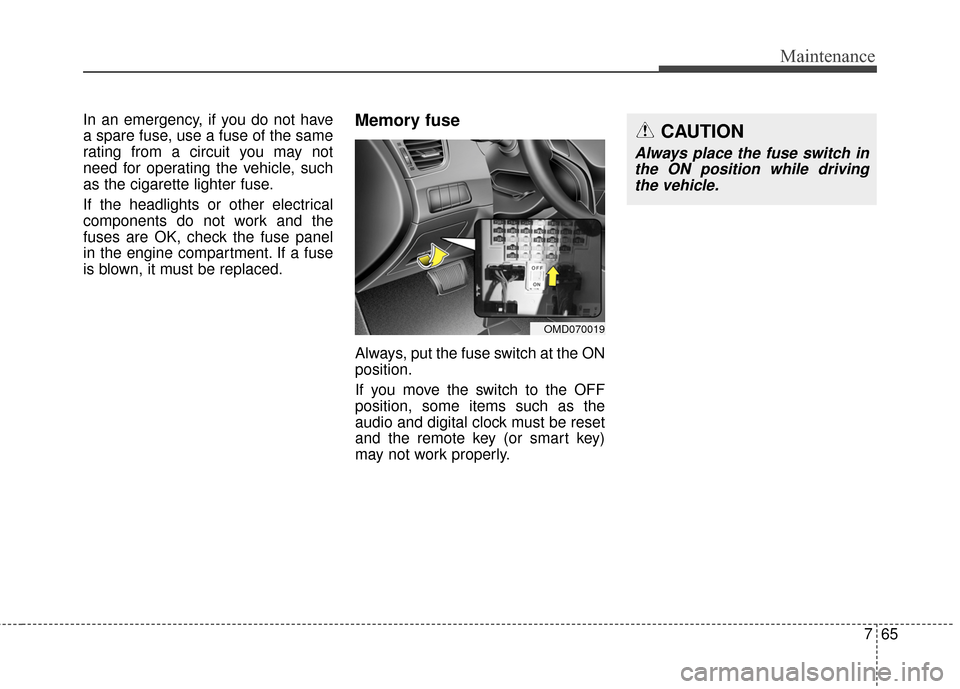
is blown, it must be replaced.Memory fuse
Always, put the fuse switch at the ON
position.
If you move the switch to the OFF
position, some items such as the
audio and digital clock must be reset
and the remote key (or smart key)
may not work properly.
OMD070019
CAUTION
Always place the fuse switch inthe ON position while drivingthe vehicle.
Page 624 of 668
Maintenance
76
7
LIGHT BULBS
Consult an authorized HYUNDAI
dealer to replace most vehicle light
bulbs. It is difficult to replace vehicle
light bulbs because other parts of the
vehicle must be removed before you
can get to the bulb. This is especially
true for removing the headlight
assembly to get to the bulb(s).
Removing/installing the headlight
assembly can result in damage to
the vehicle.
✽ ✽
NOTICE
After heavy driving, rain or wash-
ing, headlight and taillight lenses
could appear frosty. This condition
is caused by the temperature differ-
ence between the lamp inside and
the outside temperature. This is sim-
ilar to the condensation on your win-
dows inside your vehicle during the
rain and doesn’t indicate a problem
with your vehicle. If the water leaks
into the lamp bulb circuitry, have
your vehicle checked by an author-
ized HYUNDAI dealer.
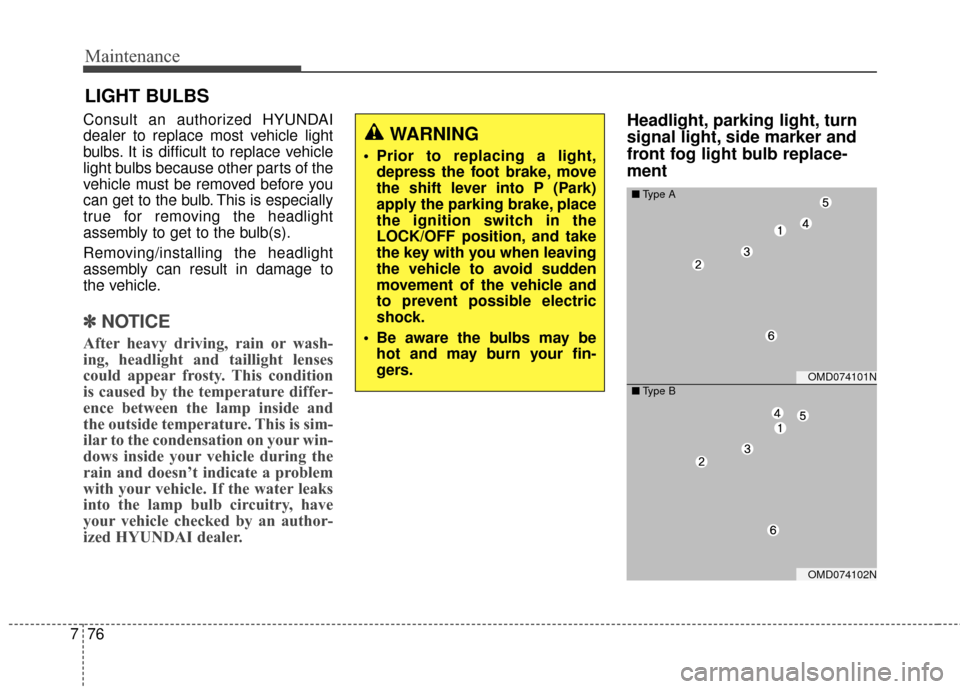
Headlight, parking light, turn
signal light, side marker and
front fog light bulb replace-
ment WARNING
Prior to replacing a light,
depress the foot brake, move
the shift lever into P (Park)
apply the parking brake, place
the ignition switch in the
LOCK/OFF position, and take
the key with you when leaving
the vehicle to avoid sudden
movement of the vehicle and
to prevent possible electric
shock.
Be aware the bulbs may be hot and may burn your fin-
gers.
OMD074101N
■ Type A
OMD074102N
■Type B
Page 625 of 668
777
Maintenance
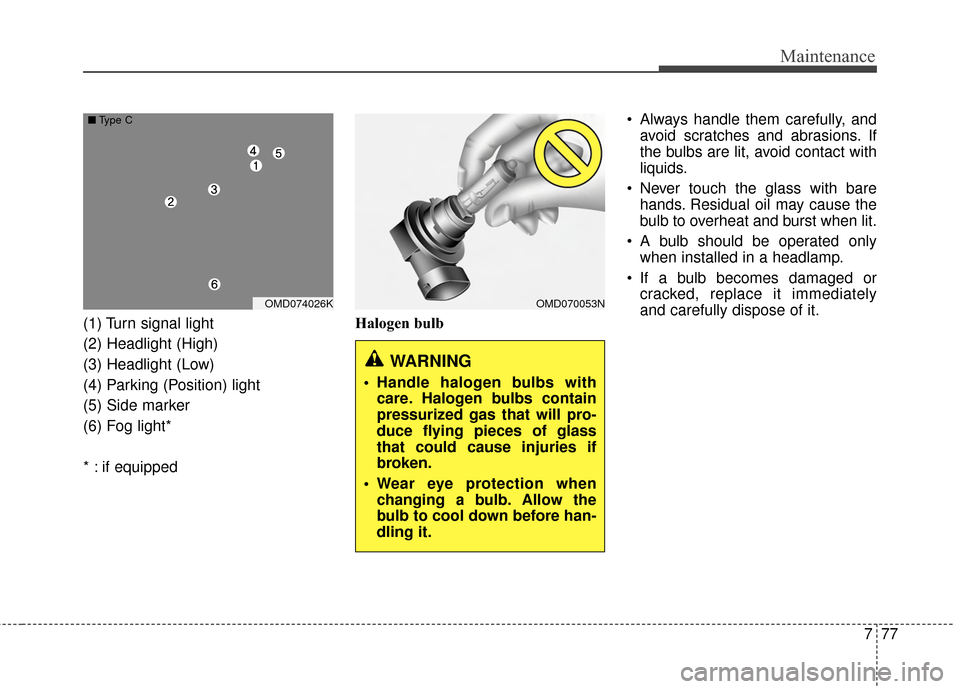
(1) Turn signal light
(2) Headlight (High)
(3) Headlight (Low)
(4) Parking (Position) light
(5) Side marker
(6) Fog light*
* : if equippedHalogen bulb Always handle them carefully, and
avoid scratches and abrasions. If
the bulbs are lit, avoid contact with
liquids.
Never touch the glass with bare hands. Residual oil may cause the
bulb to overheat and burst when lit.
A bulb should be operated only when installed in a headlamp.
If a bulb becomes damaged or cracked, replace it immediately
and carefully dispose of it.
OMD070053N
WARNING
Handle halogen bulbs withcare. Halogen bulbs contain
pressurized gas that will pro-
duce flying pieces of glass
that could cause injuries if
broken.
Wear eye protection when changing a bulb. Allow the
bulb to cool down before han-
dling it.
OMD074026K
■ Type C
Page 626 of 668
Maintenance
78
7
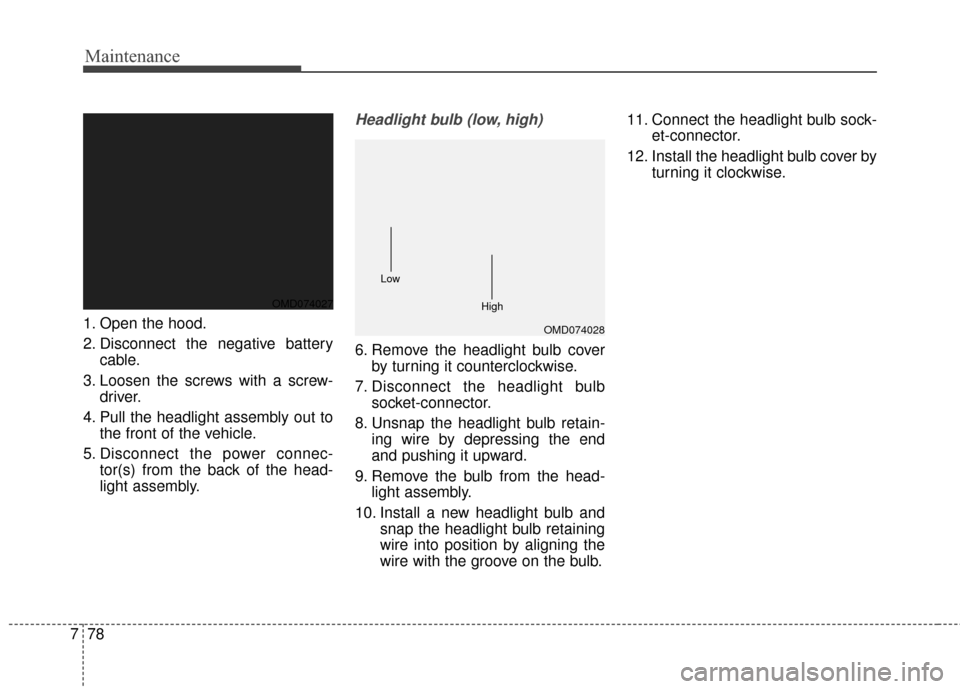
1. Open the hood.
2. Disconnect the negative battery
cable.
3. Loosen the screws with a screw- driver.
4. Pull the headlight assembly out to the front of the vehicle.
5. Disconnect the power connec- tor(s) from the back of the head-
light assembly.
Headlight bulb (low, high)
6. Remove the headlight bulb coverby turning it counterclockwise.
7. Disconnect the headlight bulb socket-connector.
8. Unsnap the headlight bulb retain- ing wire by depressing the end
and pushing it upward.
9. Remove the bulb from the head- light assembly.
10. Install a new headlight bulb and snap the headlight bulb retaining
wire into position by aligning the
wire with the groove on the bulb. 11. Connect the headlight bulb sock-
et-connector.
12. Install the headlight bulb cover by turning it clockwise.
OMD074028
Low
HighOMD074027