battery Hyundai Elantra 2014 Repair Manual
[x] Cancel search | Manufacturer: HYUNDAI, Model Year: 2014, Model line: Elantra, Model: Hyundai Elantra 2014Pages: 668, PDF Size: 35.58 MB
Page 593 of 668
745
Maintenance
Battery recharging
By battery charger
Your vehicle has a maintenance-free,
calcium-based battery.
If the battery becomes dischargedin a short time (because, for exam-
ple, the headlights or interior lights
were left on while the vehicle was
not in use), recharge it by slow
charging (trickle) for 10 hours.
If the battery gradually discharges because of high electric load while
the vehicle is being used, recharge
it at 20-30A for two hours.
WARNING
Always follow these instruc-
tions when recharging your
vehicle’s battery to avoid the
risk of SERIOUS INJURY or
DEATH from explosions or acid
burns:
Before performing mainte-nance or recharging the bat-
tery, turn off all accessories
and place the ignition switch
in the LOCK/OFF position.
Keep all flames, sparks, or smoking materials away from
the battery.
Always work outdoors or in an area with plenty of ventilation.
Wear eye protection when checking the battery during
charging.
The battery must be removed from the vehicle and placed in
a well ventilated area.
(Continued)
(Continued)
Watch the battery duringcharging, and stop or reduce
the charging rate if the battery
cells begin boiling violently.
The negative battery cable must be removed first and
installed last when the battery
is disconnected. Disconnect
the battery charger in the fol-
lowing order:
(1) Turn off the battery charg- er main switch.
(2) Unhook the negative clamp from the negative
battery terminal.
(3) Unhook the positive clamp from the positive battery
terminal.
Always use a genuine HYUNDAI approved battery
when you replace the battery.
Page 594 of 668
Maintenance
46
7
By jump starting
After a jump start from a good bat-
tery, drive the vehicle for 20-30 min-
utes before it is shutoff. The vehicle
may not restart if you shut it off
before the battery had a chance to
adequately recharge. See “Jump
Starting” in chapter 6 for more infor-
mation on jump starting procedures.
✽ ✽
NOTICE
An inappropriately disposed
battery can be harmful to
the environment and human
health. Dispose the battery
according to your local
law(s) or regulation.
Reset features
Some items need to be reset after
the battery has been discharged or
the battery has been disconnected.
See chapter 4 for:
Auto up/down window
Sunroof
Trip computer
Climate control system
Clock
Audio system
Page 611 of 668
763
Maintenance
FUSES
A vehicle’s electrical system is pro-
tected from electrical overload dam-
age by fuses.
This vehicle has 2 (or 3) fuse panels,
one located in the driver’s side panel
bolster, the other in the engine com-
partment near the battery.
If any of your vehicle’s lights, acces-
sories, or controls do not work, check
the appropriate circuit fuse. If a fuse
has blown, the element inside the
fuse will be melted or broken.
If the electrical system does not
work, first check the driver’s side
fuse panel. Before replacing a blown
fuse, disconnect the negative battery
cable. Always replace a blown fuse
with one of the same rating.
If the replacement fuse blows, this
indicates an electrical problem. Avoid
using the system involved and imme-
diately consult an authorized
HYUNDAI dealer.✽ ✽NOTICE
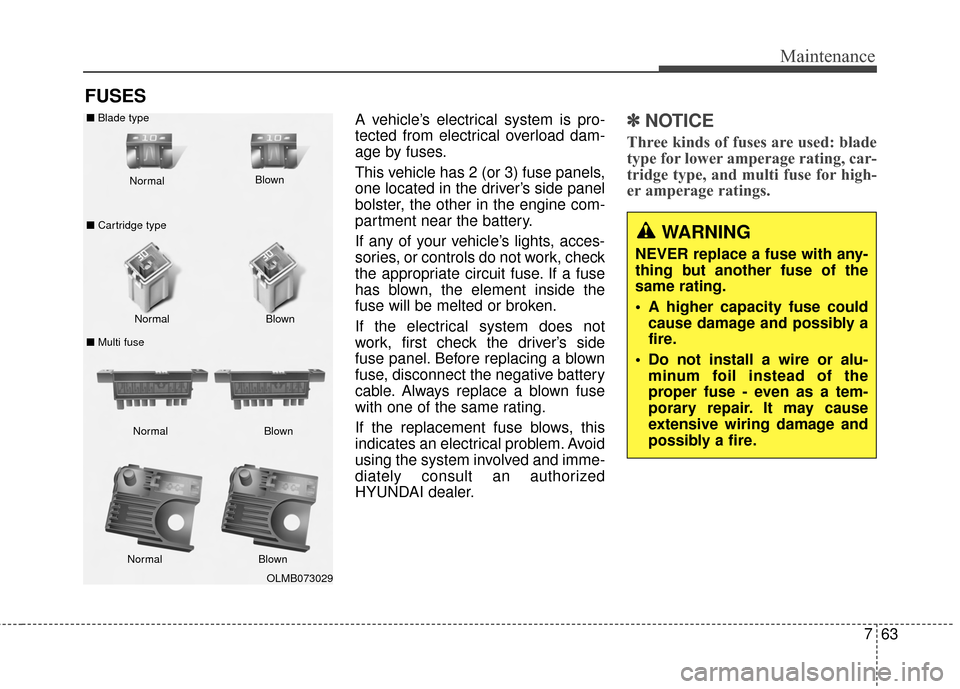
Three kinds of fuses are used: blade
type for lower amperage rating, car-
tridge type, and multi fuse for high-
er amperage ratings.
OLMB073029
Normal
Normal
■
Blade type
■ Cartridge type
■ Multi fuse Blown
Blown
Normal Blown
Normal Blown
WARNING
NEVER replace a fuse with any-
thing but another fuse of the
same rating.
A higher capacity fuse could
cause damage and possibly a
fire.
Do not install a wire or alu- minum foil instead of the
proper fuse - even as a tem-
porary repair. It may cause
extensive wiring damage and
possibly a fire.
Page 614 of 668
Maintenance
66
7
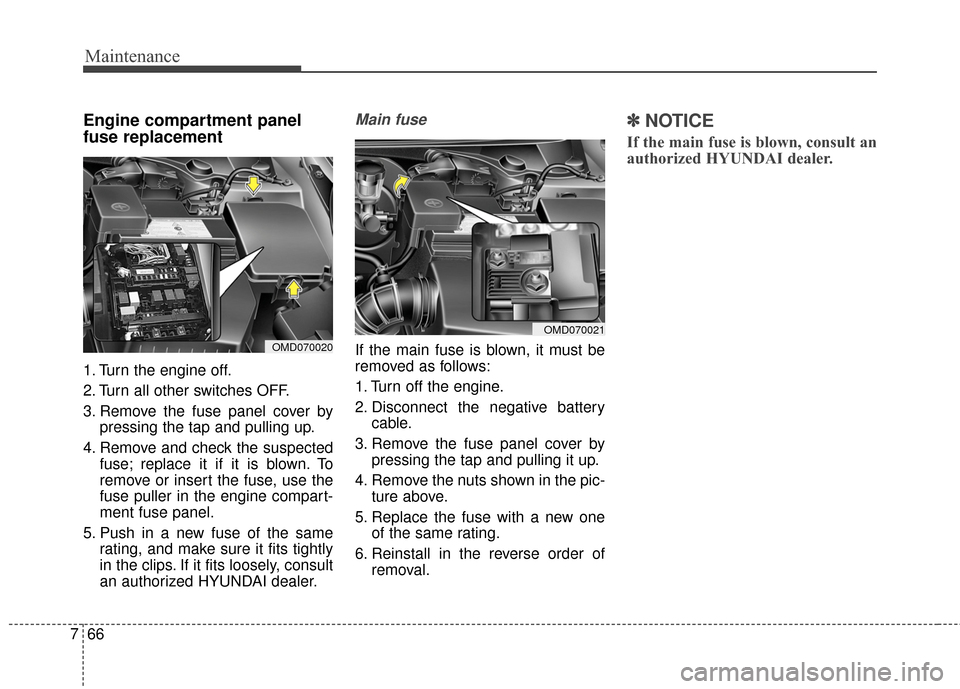
Engine compartment panel
fuse replacement
1. Turn the engine off.
2. Turn all other switches OFF.
3. Remove the fuse panel cover by
pressing the tap and pulling up.
4. Remove and check the suspected fuse; replace it if it is blown. To
remove or insert the fuse, use the
fuse puller in the engine compart-
ment fuse panel.
5. Push in a new fuse of the same rating, and make sure it fits tightly
in the clips. If it fits loosely, consult
an authorized HYUNDAI dealer.
Main fuse
If the main fuse is blown, it must be
removed as follows:
1. Turn off the engine.
2. Disconnect the negative batterycable.
3. Remove the fuse panel cover by pressing the tap and pulling it up.
4. Remove the nuts shown in the pic- ture above.
5. Replace the fuse with a new one of the same rating.
6. Reinstall in the reverse order of removal.
✽ ✽NOTICE
If the main fuse is blown, consult an
authorized HYUNDAI dealer.
OMD070020
OMD070021
Page 615 of 668
767
Maintenance
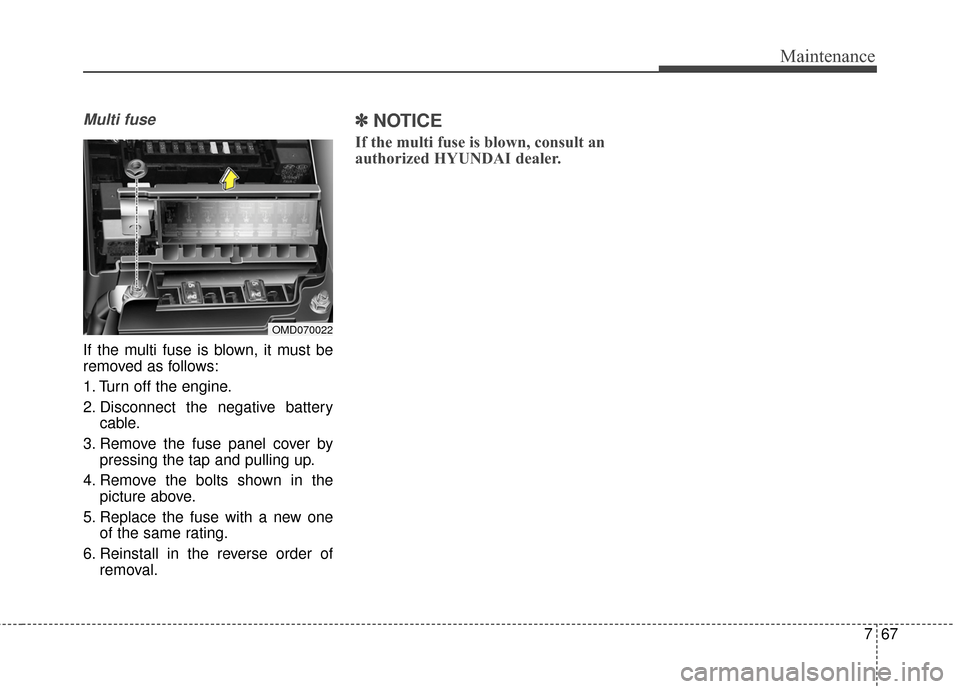
Multi fuse
If the multi fuse is blown, it must be
removed as follows:
1. Turn off the engine.
2. Disconnect the negative batterycable.
3. Remove the fuse panel cover by pressing the tap and pulling up.
4. Remove the bolts shown in the picture above.
5. Replace the fuse with a new one of the same rating.
6. Reinstall in the reverse order of removal.
✽ ✽NOTICE
If the multi fuse is blown, consult an
authorized HYUNDAI dealer.
OMD070022
Page 626 of 668
Maintenance
78
7
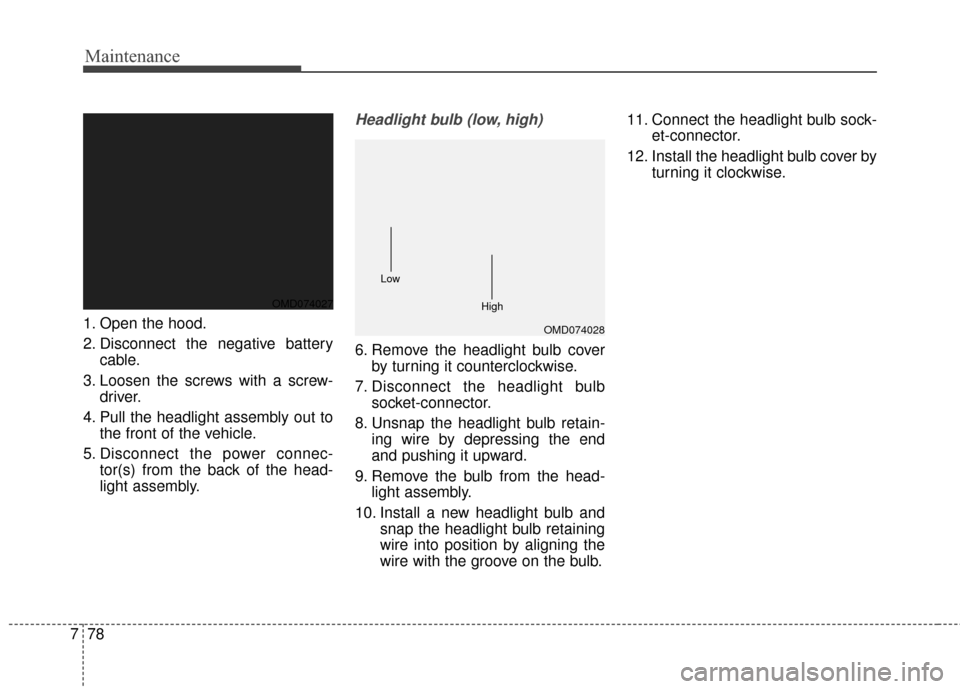
1. Open the hood.
2. Disconnect the negative battery
cable.
3. Loosen the screws with a screw- driver.
4. Pull the headlight assembly out to the front of the vehicle.
5. Disconnect the power connec- tor(s) from the back of the head-
light assembly.
Headlight bulb (low, high)
6. Remove the headlight bulb coverby turning it counterclockwise.
7. Disconnect the headlight bulb socket-connector.
8. Unsnap the headlight bulb retain- ing wire by depressing the end
and pushing it upward.
9. Remove the bulb from the head- light assembly.
10. Install a new headlight bulb and snap the headlight bulb retaining
wire into position by aligning the
wire with the groove on the bulb. 11. Connect the headlight bulb sock-
et-connector.
12. Install the headlight bulb cover by turning it clockwise.
OMD074028
Low
HighOMD074027
Page 643 of 668
795
Maintenance
Canister
Fuel vapors generated inside the fuel
tank are absorbed and stored in the
onboard canister. When the engine is
running, the fuel vapors absorbed in
the canister are drawn into the surge
tank through the purge control sole-
noid valve.
Purge Control Solenoid Valve(PCSV)
The purge control solenoid valve is
controlled by the Engine Control
Module (ECM); when the engine
coolant temperature is low during
idling, the PCSV closes so that evap-
orated fuel is not taken into the
engine. After the engine warms-up
during ordinary driving, the PCSV
opens to introduce evaporated fuel to
the engine.
3. Exhaust emission control system
The Exhaust Emission Control
System is a highly effective system
which controls exhaust emissions
while maintaining good vehicle per-
formance.
When the engine starts or fails to
start, excessive attempts to restart
the engine may cause damage to the
emission system.
Vehicle modifications
This vehicle should not be modi-
fied. Modification of your vehicle
could affect its performance, safety
or durability and may even violate
governmental safety and emis-
sions regulations.
In addition, damage or performance
problems resulting from any modifi-
cation may not be covered under
warranty.
If you use unauthorized electronic devices, it may cause the vehicle to
operate abnormally, wire damage,
battery discharge and fire. For your
safety, do not use unauthorized
electronic devices.
Engine exhaust (carbon monox-
ide) precautions
Carbon monoxide can be present with other exhaust fumes. If you
smell exhaust fumes of any kind in
your vehicle, drive with all the win-
dows fully open. Have your vehicle
checked and repaired immediately.
WARNING
Engine exhaust gases contain
carbon monoxide (CO). Though
colorless and odorless, it is
dangerous and could be lethal if
inhaled. Follow the instructions
on this page to avoid CO poi-
soning.
Page 658 of 668
I3
Index
Manual heating and air conditioning ..........................4-96
Mode selection ............................................................4-96
OFF mode ..................................................................4-101
Temperature control ....................................................4-97
Automatic transaxle ........................................................5-22 Good driving practices ................................................5-27
Ignition key interlock system ......................................5-27
Parking ........................................................................\
5-27
Shift lock system ........................................................5-25
Shift-lock release ........................................................5-26
Sports mode ................................................................5-24
Automatic turn off function ............................................4-78
Aux, USB and iPod ......................................................3-102 Battery ........................................................................\
....7-43
Battery recharging ......................................................7-45
Battery saver function ....................................................4-77
Before driving ..................................................................5-3
Blind zone mirror............................................................4-49
Blue Link
®center ..........................................................4-42
Brake system ..................................................................5-29 Anti-lock brake system (ABS) ....................................5-32
Disc brakes wear indicator ..........................................5-30
Electronic stability control (ESC) ..............................5-34
Good braking practices................................................5-39
Hill-Start Assist Control (HAC) ................................5-39
Parking brake ..............................................................5-30
Power brakes ..............................................................5-29
Vehicle stability management (VSM) ........................5-38
Brake/clutch fluid ..........................................................7-35
Bulb replacement ............................................................7-76 Front side marker ........................................................7-79
Front turn signal light ..................................................7-79
High mounted stop light ..............................................7-84
Interior light ................................................................7-85
License plate light ......................................................7-85
Rear combination light ................................................7-81
Side repeater light ......................................................7-80
Bulb wattage ....................................................................8-2
Button start/stop, see engine start/stop button ..................5-9
B
Page 663 of 668
Index
8I
Jack and tools..................................................................6-15
Jump starting ....................................................................6-5
LabelRefrigerant label ............................................................8-7
Jack label ....................................................................6-21\
Tire sidewall labeling ..................................................7-53
Tire specification and pressure label ............................8-7
Vehicle certification label ..............................................8-6
Light ........................................................................\
........4-72 Auto light position ......................................................4-73
Automatic turn off function ........................................4-78
Battery saver function ................................................4-77
Daytime running light ................................................4-78
Exterior lights ..............................................................4-72
Front fog light..............................................................4-76
Front lamps ..................................................................4-79
Headlight escort function ............................................4-77
Headlight position ......................................................4-73
High beam operation ..................................................4-74
Lighting control ..........................................................4-72
Map lamp ....................................................................4-79\
One-touch lane change function..................................4-76
Parking light position ..................................................4-72 Rear room lamp ..........................................................4-80
Room lamp ..................................................................4-36
Trunk lamp ..................................................................4-80
Turn signals ................................................................4-75
Vanity mirror lamp ......................................................4-80
Light bulbs ......................................................................7-\
76
Lubricants and capacities..................................................8-4
Luggage net (holder) ....................................................4-119
Main fuse ........................................................................\
7-66
Maintenance Explanation of scheduled maintenance items ............7-26
Maintenance services ....................................................7-3
Maintenance under severe usage conditions ..............7-24
Normal maintenance service ........................................7-9
Owner maintenance ......................................................7-6
Scheduled maintenance service ....................................7-8
Tire maintenance ........................................................7-53
Maintenance services ........................................................7-3
Manual climate control system ......................................4-84 Air conditioning ..........................................................4-90
Air Conditioning refrigerant label ..............................4-93
Air intake control ........................................................4-88
Checking the amount of air conditioner refrigerant and compressor lubricant ..........................................4-93
Climate control air filter ..............................................4-92
M
J
L
Page 665 of 668

Index
10I
Rear combination light replacement ..............................7-81
Rear seat........................................................................\
..3-12
Rearview camera ............................................................4-71
Recommended cold tire inflation pressures ..................7-48
Recommended lubricants and capacities ..........................8-4Recommended SAE viscosity number ..........................8-5
Refrigerant label ..............................................................8-7
Remote key ......................................................................4-\
3 Battery replacement ......................................................4-6
Removable towing hook ................................................6-29
Replacement light bulb ..................................................7-76
Reporting safety defects ..................................................8-9
Rocking the vehicle ........................................................5-48
Room lamp......................................................................4-\
37
Rotation (Tire) ................................................................7-50 Scheduled maintenance service ........................................7-8
Seat belt warning light ....................................................3-22
Seat belts ........................................................................\
3-21
Additional seat belt safety precautions ......................3-29
Care of seat belts ........................................................3-32
Do not lie down ..........................................................3-32
Emergency Fastening Device (EFD) ..........................3-27
Height adjustment........................................................3-23
Keep belts clean and dry ............................................3-32
One person per belt ....................................................3-31
Passenger’s 3-point system with combination locking retractor ........................................................3-25
Periodic inspection ......................................................3-32
Pre-tensioner seat belt ................................................3-27
Retractor Pre-tensioner ................................................3-27
Seat belt restraint system ............................................3-23
Seat belt safety precautions ........................................3-21
Seat belt use and children............................................3-29
Seat belt warning light ................................................3-22
Seat Belt-Driver’s 3-point system with emergency locking retractor ........................................................3-23
Transporting an injured person....................................3-31
When to replace seat belts ..........................................3-33
Seat warmers ..................................................................3-19
Seatback pocket ..............................................................3-11
RS