air condition Hyundai Elantra 2016 - RHD (UK. Australia) Service Manual
[x] Cancel search | Manufacturer: HYUNDAI, Model Year: 2016, Model line: Elantra, Model: Hyundai Elantra 2016Pages: 498, PDF Size: 9.45 MB
Page 407 of 498
Maintenance
12 7
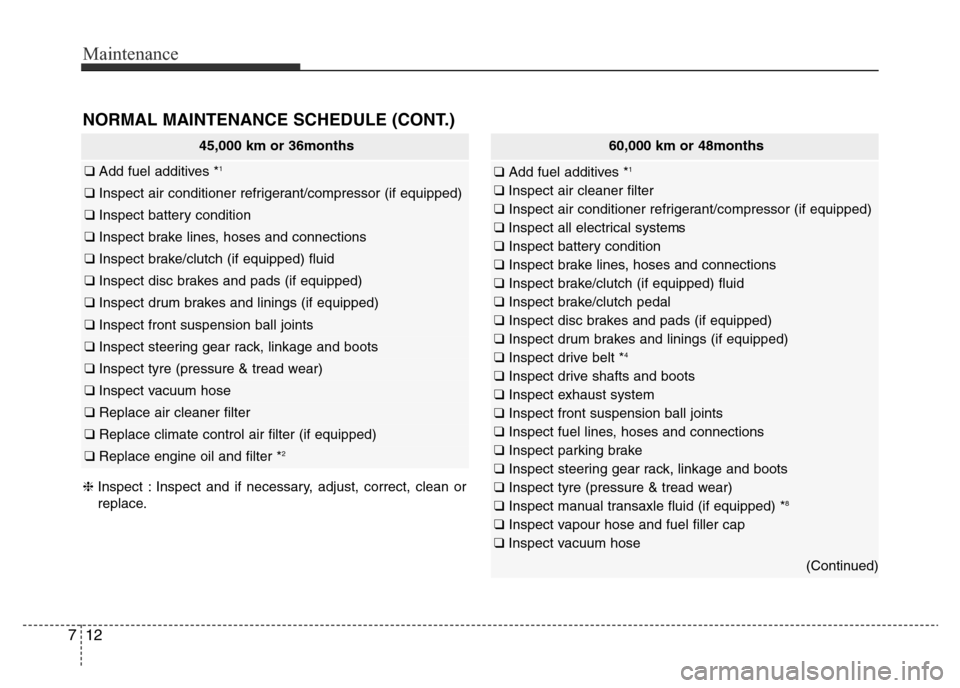
60,000 km or 48months
❑ Add fuel additives *1
❑ Inspect air cleaner filter
❑ Inspect air conditioner refrigerant/compressor (if equipped)
❑ Inspect all electrical systems
❑ Inspect battery condition
❑ Inspect brake lines, hoses and connections
❑ Inspect brake/clutch (if equipped) fluid
❑ Inspect brake/clutch pedal
❑ Inspect disc brakes and pads (if equipped)
❑ Inspect drum brakes and linings (if equipped)
❑ Inspect drive belt *
4
❑ Inspect drive shafts and boots
❑ Inspect exhaust system
❑ Inspect front suspension ball joints
❑ Inspect fuel lines, hoses and connections
❑ Inspect parking brake
❑ Inspect steering gear rack, linkage and boots
❑ Inspect tyre (pressure & tread wear)
❑ Inspect manual transaxle fluid (if equipped) *
8
❑ Inspect vapour hose and fuel filler cap
❑ Inspect vacuum hose
(Continued)
NORMAL MAINTENANCE SCHEDULE (CONT.)
45,000 km or 36months
❑ Add fuel additives *1
❑ Inspect air conditioner refrigerant/compressor (if equipped)
❑ Inspect battery condition
❑ Inspect brake lines, hoses and connections
❑ Inspect brake/clutch (if equipped) fluid
❑ Inspect disc brakes and pads (if equipped)
❑ Inspect drum brakes and linings (if equipped)
❑ Inspect front suspension ball joints
❑ Inspect steering gear rack, linkage and boots
❑ Inspect tyre (pressure & tread wear)
❑ Inspect vacuum hose
❑ Replace air cleaner filter
❑ Replace climate control air filter (if equipped)
❑ Replace engine oil and filter *2
❈Inspect : Inspect and if necessary, adjust, correct, clean or
replace.
Page 408 of 498
713
Maintenance
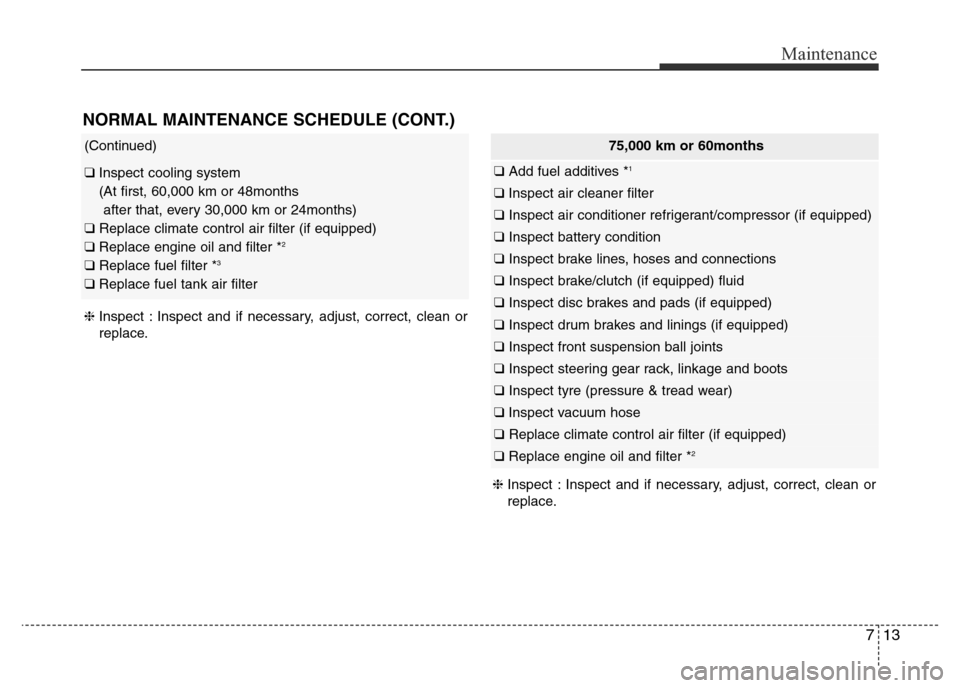
NORMAL MAINTENANCE SCHEDULE (CONT.)
❈Inspect : Inspect and if necessary, adjust, correct, clean or
replace.
(Continued)
❑ Inspect cooling system
(At first, 60,000 km or 48months
after that, every 30,000 km or 24months)
❑ Replace climate control air filter (if equipped)
❑ Replace engine oil and filter *
2
❑ Replace fuel filter *3
❑ Replace fuel tank air filter
75,000 km or 60months
❑ Add fuel additives *1
❑ Inspect air cleaner filter
❑ Inspect air conditioner refrigerant/compressor (if equipped)
❑ Inspect battery condition
❑ Inspect brake lines, hoses and connections
❑ Inspect brake/clutch (if equipped) fluid
❑ Inspect disc brakes and pads (if equipped)
❑ Inspect drum brakes and linings (if equipped)
❑ Inspect front suspension ball joints
❑ Inspect steering gear rack, linkage and boots
❑ Inspect tyre (pressure & tread wear)
❑ Inspect vacuum hose
❑ Replace climate control air filter (if equipped)
❑ Replace engine oil and filter *2
❈Inspect : Inspect and if necessary, adjust, correct, clean or
replace.
Page 409 of 498
Maintenance
14 7
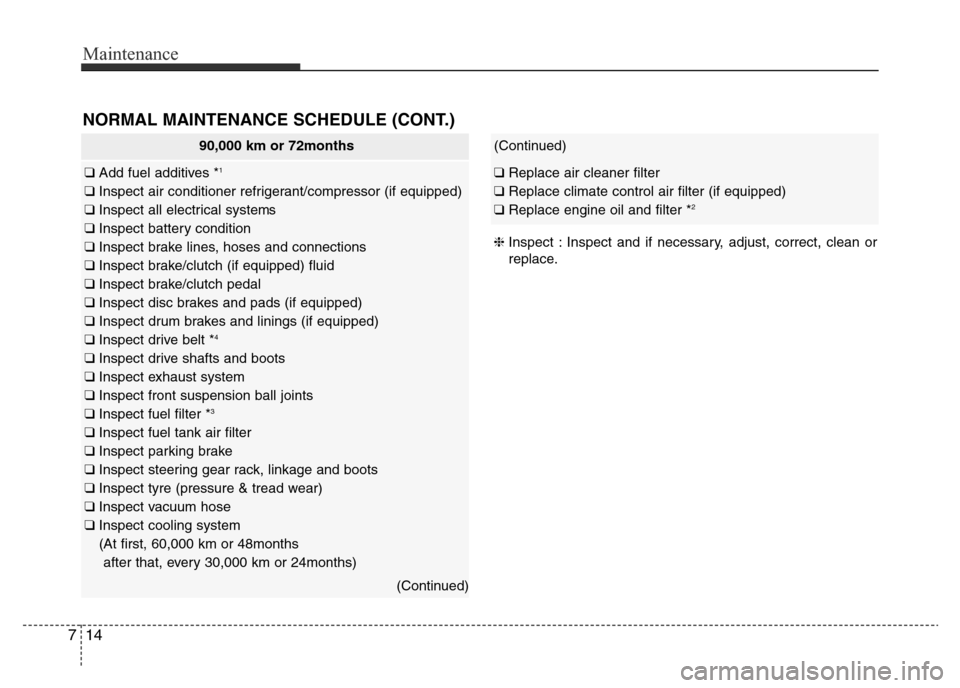
NORMAL MAINTENANCE SCHEDULE (CONT.)
❈Inspect : Inspect and if necessary, adjust, correct, clean or
replace.
90,000 km or 72months
❑ Add fuel additives *1
❑ Inspect air conditioner refrigerant/compressor (if equipped)
❑ Inspect all electrical systems
❑ Inspect battery condition
❑ Inspect brake lines, hoses and connections
❑ Inspect brake/clutch (if equipped) fluid
❑ Inspect brake/clutch pedal
❑ Inspect disc brakes and pads (if equipped)
❑ Inspect drum brakes and linings (if equipped)
❑ Inspect drive belt *
4
❑ Inspect drive shafts and boots
❑ Inspect exhaust system
❑ Inspect front suspension ball joints
❑ Inspect fuel filter *
3
❑ Inspect fuel tank air filter
❑ Inspect parking brake
❑ Inspect steering gear rack, linkage and boots
❑ Inspect tyre (pressure & tread wear)
❑ Inspect vacuum hose
❑ Inspect cooling system
(At first, 60,000 km or 48months
after that, every 30,000 km or 24months)
(Continued)
(Continued)
❑ Replace air cleaner filter
❑ Replace climate control air filter (if equipped)
❑ Replace engine oil and filter *
2
Page 410 of 498
715
Maintenance
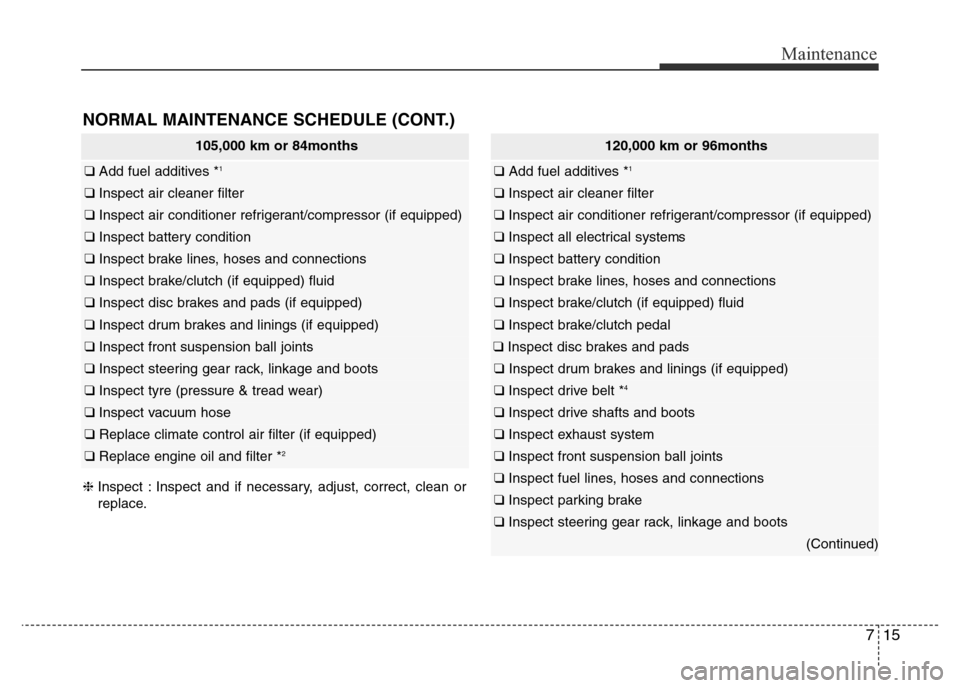
NORMAL MAINTENANCE SCHEDULE (CONT.)
105,000 km or 84months
❑ Add fuel additives *1
❑ Inspect air cleaner filter
❑ Inspect air conditioner refrigerant/compressor (if equipped)
❑ Inspect battery condition
❑ Inspect brake lines, hoses and connections
❑ Inspect brake/clutch (if equipped) fluid
❑ Inspect disc brakes and pads (if equipped)
❑ Inspect drum brakes and linings (if equipped)
❑ Inspect front suspension ball joints
❑ Inspect steering gear rack, linkage and boots
❑ Inspect tyre (pressure & tread wear)
❑ Inspect vacuum hose
❑ Replace climate control air filter (if equipped)
❑ Replace engine oil and filter *2
❈Inspect : Inspect and if necessary, adjust, correct, clean or
replace.
120,000 km or 96months
❑ Add fuel additives *1
❑ Inspect air cleaner filter
❑ Inspect air conditioner refrigerant/compressor (if equipped)
❑ Inspect all electrical systems
❑ Inspect battery condition
❑ Inspect brake lines, hoses and connections
❑ Inspect brake/clutch (if equipped) fluid
❑ Inspect brake/clutch pedal
❑ Inspect disc brakes and pads
❑ Inspect drum brakes and linings (if equipped)
❑ Inspect drive belt *4
❑ Inspect drive shafts and boots
❑ Inspect exhaust system
❑ Inspect front suspension ball joints
❑ Inspect fuel lines, hoses and connections
❑ Inspect parking brake
❑ Inspect steering gear rack, linkage and boots
(Continued)
Page 412 of 498
717
Maintenance
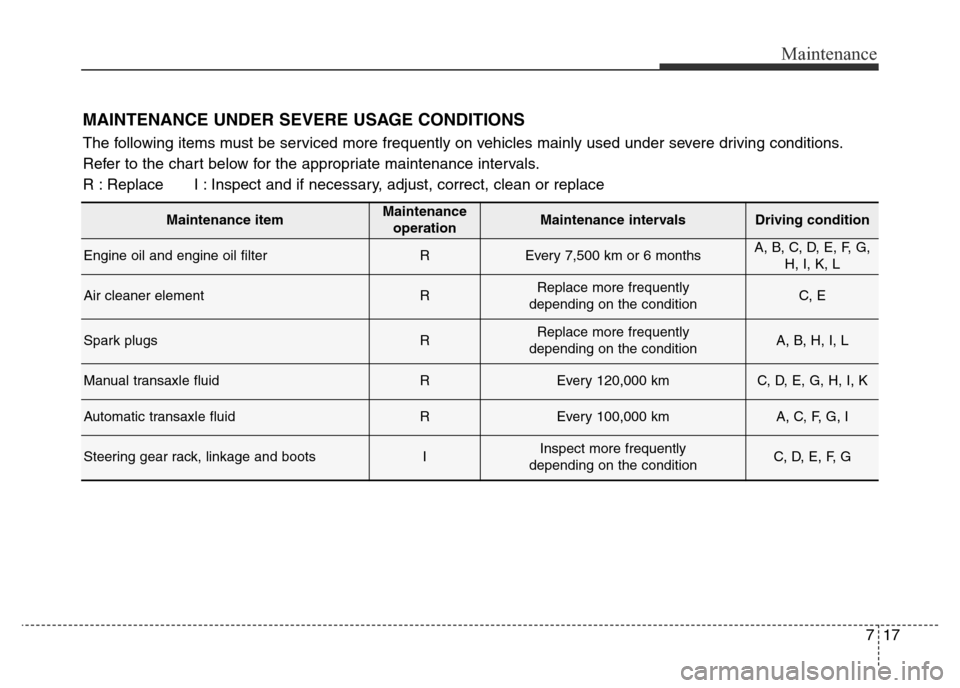
MAINTENANCE UNDER SEVERE USAGE CONDITIONS
The following items must be serviced more frequently on vehicles mainly used under severe driving conditions.
Refer to the chart below for the appropriate maintenance intervals.
R : Replace I : Inspect and if necessary, adjust, correct, clean or replace
Maintenance itemMaintenance
operationMaintenance intervalsDriving condition
Engine oil and engine oil filterREvery 7,500 km or 6 monthsA, B, C, D, E, F, G,
H, I, K, L
Air cleaner elementRReplace more frequently
depending on the conditionC, E
Spark plugs RReplace more frequently
depending on the conditionA, B, H, I, L
Manual transaxle fluid REvery 120,000 kmC, D, E, G, H, I, K
Automatic transaxle fluidREvery 100,000 kmA, C, F, G, I
Steering gear rack, linkage and bootsIInspect more frequently
depending on the conditionC, D, E, F, G
Page 413 of 498
Maintenance
18 7
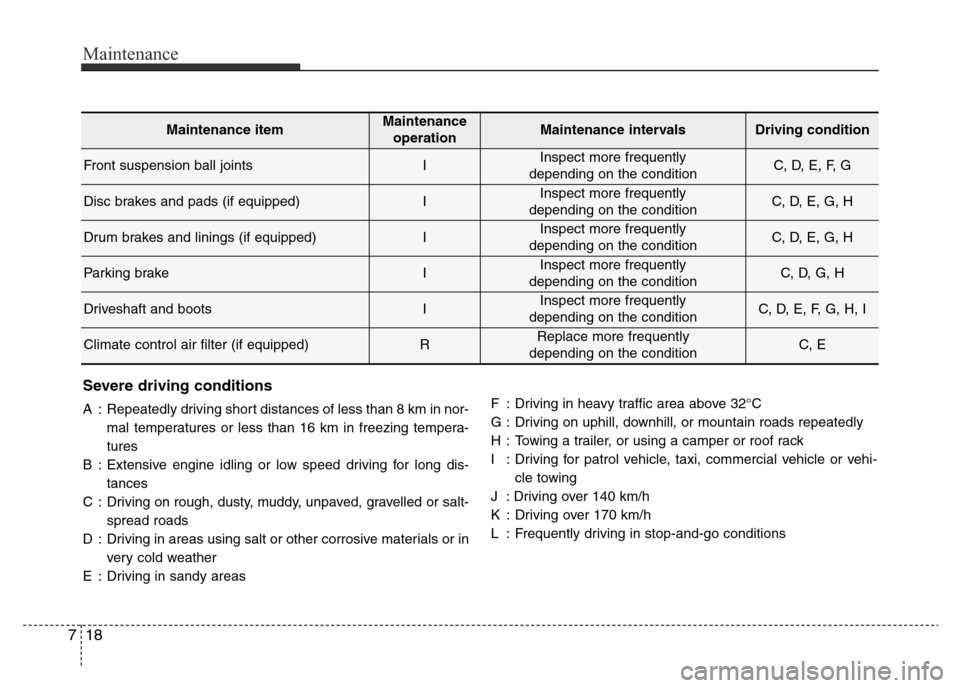
Maintenance itemMaintenance
operationMaintenance intervalsDriving condition
Front suspension ball jointsIInspect more frequently
depending on the conditionC, D, E, F, G
Disc brakes and pads (if equipped)IInspect more frequently
depending on the conditionC, D, E, G, H
Drum brakes and linings (if equipped)IInspect more frequently
depending on the conditionC, D, E, G, H
Parking brakeIInspect more frequently
depending on the conditionC, D, G, H
Driveshaft and bootsIInspect more frequently
depending on the conditionC, D, E, F, G, H, I
Climate control air filter (if equipped)RReplace more frequently
depending on the conditionC, E
Severe driving conditions
A : Repeatedly driving short distances of less than 8 km in nor-
mal temperatures or less than 16 km in freezing tempera-
tures
B : Extensive engine idling or low speed driving for long dis-
tances
C : Driving on rough, dusty, muddy, unpaved, gravelled or salt-
spread roads
D : Driving in areas using salt or other corrosive materials or in
very cold weather
E : Driving in sandy areasF : Driving in heavy traffic area above 32°C
G : Driving on uphill, downhill, or mountain roads repeatedly
H : Towing a trailer, or using a camper or roof rack
I : Driving for patrol vehicle, taxi, commercial vehicle or vehi-
cle towing
J : Driving over 140 km/h
K : Driving over 170 km/h
L : Frequently driving in stop-and-go conditions
Page 417 of 498
Maintenance
22 7
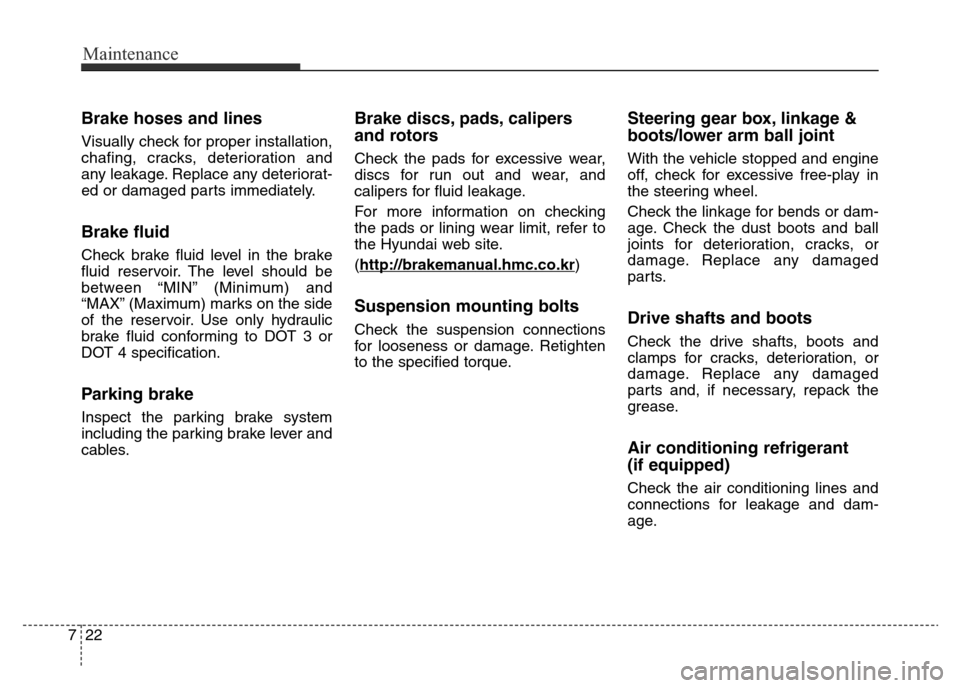
Brake hoses and lines
Visually check for proper installation,
chafing, cracks, deterioration and
any leakage. Replace any deteriorat-
ed or damaged parts immediately.
Brake fluid
Check brake fluid level in the brake
fluid reservoir. The level should be
between “MIN” (Minimum) and
“MAX” (Maximum) marks on the side
of the reservoir. Use only hydraulic
brake fluid conforming to DOT 3 or
DOT 4 specification.
Parking brake
Inspect the parking brake system
including the parking brake lever and
cables.
Brake discs, pads, calipers
and rotors
Check the pads for excessive wear,
discs for run out and wear, and
calipers for fluid leakage.
For more information on checking
the pads or lining wear limit, refer to
the Hyundai web site.
(http://brakeman
ual.hmc.co.kr)
Suspension mounting bolts
Check the suspension connections
for looseness or damage. Retighten
to the specified torque.
Steering gear box, linkage &
boots/lower arm ball joint
With the vehicle stopped and engine
off, check for excessive free-play in
the steering wheel.
Check the linkage for bends or dam-
age. Check the dust boots and ball
joints for deterioration, cracks, or
damage. Replace any damaged
parts.
Drive shafts and boots
Check the drive shafts, boots and
clamps for cracks, deterioration, or
damage. Replace any damaged
parts and, if necessary, repack the
grease.
Air conditioning refrigerant
(if equipped)
Check the air conditioning lines and
connections for leakage and dam-
age.
Page 424 of 498
729
Maintenance
BRAKE/CLUTCH FLUID (IF EQUIPPED)
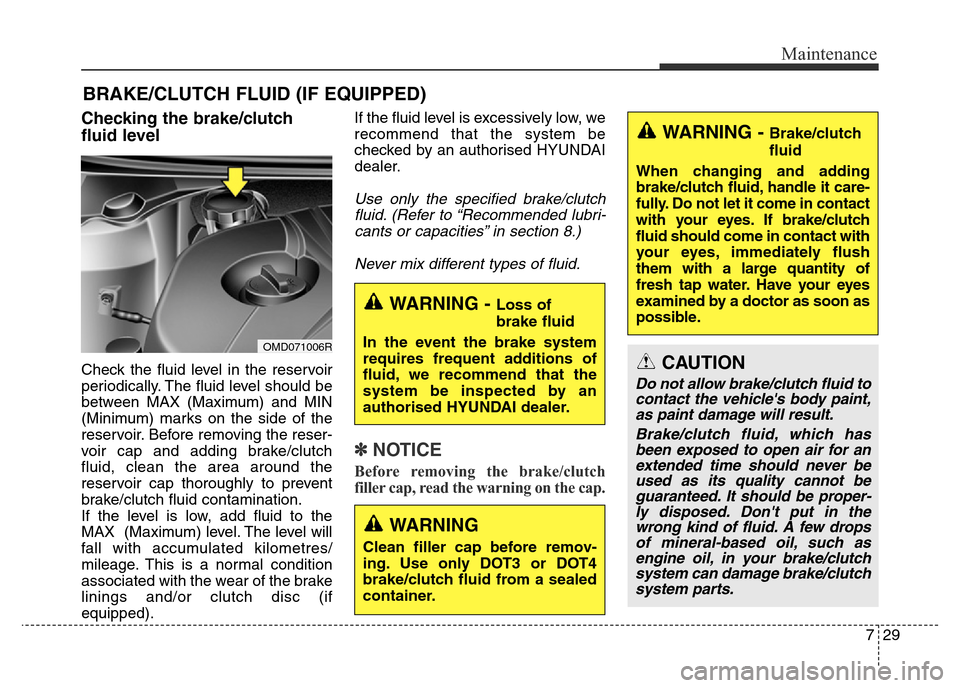
Checking the brake/clutch
fluid level
Check the fluid level in the reservoir
periodically. The fluid level should be
between MAX (Maximum) and MIN
(Minimum) marks on the side of the
reservoir. Before removing the reser-
voir cap and adding brake/clutch
fluid, clean the area around the
reservoir cap thoroughly to prevent
brake/clutch fluid contamination.
If the level is low, add fluid to the
MAX (Maximum) level. The level will
fall with accumulated kilometres/
mileage. This is a normal condition
associated with the wear of the brake
linings and/or clutch disc (if
equipped).If the fluid level is excessively low, we
recommend that the system be
checked by an authorised HYUNDAI
dealer.
Use only the specified brake/clutch
fluid. (Refer to “Recommended lubri-
cants or capacities” in section 8.)
Never mix different types of fluid.
✽NOTICE
Before removing the brake/clutch
filler cap, read the warning on the cap.
WARNING - Loss of
brake fluid
In the event the brake system
requires frequent additions of
fluid, we recommend that the
system be inspected by an
authorised HYUNDAI dealer.
WARNING - Brake/clutch
fluid
When changing and adding
brake/clutch fluid, handle it care-
fully. Do not let it come in contact
with your eyes. If brake/clutch
fluid should come in contact with
your eyes, immediately flush
them with a large quantity of
fresh tap water. Have your eyes
examined by a doctor as soon as
possible.
CAUTION
Do not allow brake/clutch fluid to
contact the vehicle's body paint,
as paint damage will result.
Brake/clutch fluid, which has
been exposed to open air for an
extended time should never be
used as its quality cannot be
guaranteed. It should be proper-
ly disposed. Don't put in the
wrong kind of fluid. A few drops
of mineral-based oil, such as
engine oil, in your brake/clutch
system can damage brake/clutch
system parts.
OMD071006R
WARNING
Clean filler cap before remov-
ing. Use only DOT3 or DOT4
brake/clutch fluid from a sealed
container.
Page 426 of 498
731
Maintenance
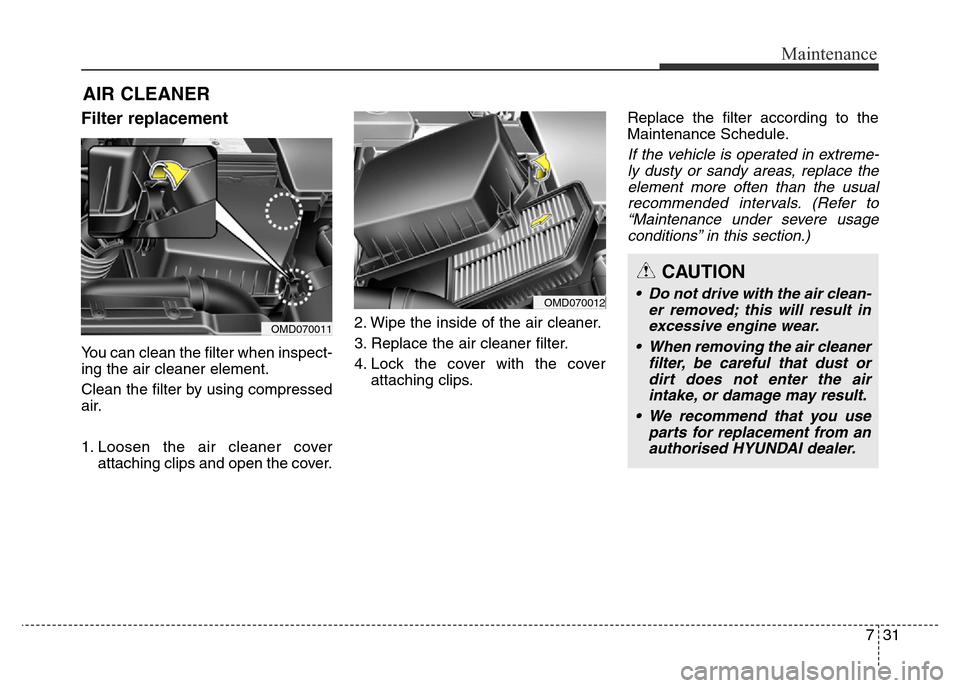
AIR CLEANER
Filter replacement
You can clean the filter when inspect-
ing the air cleaner element.
Clean the filter by using compressed
air.
1. Loosen the air cleaner cover
attaching clips and open the cover.2. Wipe the inside of the air cleaner.
3. Replace the air cleaner filter.
4. Lock the cover with the cover
attaching clips.Replace the filter according to the
Maintenance Schedule.
If the vehicle is operated in extreme-
ly dusty or sandy areas, replace the
element more often than the usual
recommended intervals. (Refer to
“Maintenance under severe usage
conditions” in this section.)
CAUTION
• Do not drive with the air clean-
er removed; this will result in
excessive engine wear.
• When removing the air cleaner
filter, be careful that dust or
dirt does not enter the air
intake, or damage may result.
• We recommend that you use
parts for replacement from an
authorised HYUNDAI dealer.
OMD070011
OMD070012
Page 445 of 498
Maintenance
50 7
4. Tyre ply composition and mate-
rial
The number of layers or plies of rub-
ber-coated fabric are in the tyre. Tyre
manufacturers also must indicate the
materials in the tyre, which include
steel, nylon, polyester, and others.
The letter "R" means radial ply con-
struction; the letter "D" means diago-
nal or bias ply construction; and the
letter "B" means restrained-bias ply
construction.
5. Maximum permissible inflation
pressure
This number is the greatest amount of
air pressure that should be put in the
tyre. Do not exceed the maximum per-
missible inflation pressure. Refer to
the Tyre and Loading Information
label for recommended inflation pres-
sure.
6. Maximum load rating
This number indicates the maximum
load in kilograms and pounds that can
be carried by the tyre. When replacing
the tyres on the vehicle, always use a
tyre that has the same load rating as
the factory installed tyre.
7. Uniform tyre quality grading
Quality grades can be found where
applicable on the tyre sidewall
between tread shoulder and maxi-
mum section width.
For example:
TREAD wear 200
TRACTION AA
TEMPERATURE ATread wear
The tread wear grade is a compara-
tive rating based on the wear rate of
the tyre when tested under controlled
conditions on a specified govern-
ment test course. For example, a tyre
graded 150 would wear one-and-a-
half times (1½) as well on the gov-
ernment course as a tyre graded
100.
The relative performance of tyres
depends upon the actual conditions
of their use, however, and may
depart significantly from the norm
due to variations in driving habits,
service practices and differences in
road characteristics and climate.
These grades are molded on the
side-walls of passenger vehicle
tyres. The tyres available as standard
or optional equipment on your vehi-
cle may vary with respect to grade.