service Hyundai Elantra 2016 Owner's Guide
[x] Cancel search | Manufacturer: HYUNDAI, Model Year: 2016, Model line: Elantra, Model: Hyundai Elantra 2016Pages: 669, PDF Size: 31.96 MB
Page 537 of 669
619
What to do in an emergency
If you have a tire gauge, check the
tire pressure (see “Tires and Wheels”
in chapter 8 for tire pressure instruc-
tions.). If the pressure is lower or
higher than recommended, drive
slowly to the nearest service station
and adjust it to the recommended
pressure. Always reinstall the valve
cap after checking or adjusting tire
pressure. If the cap is not replaced,
air may leak from the tire. If you lose
a valve cap, buy another and install it
as soon as possible. After changing
tires, secure the flat tire and return
the jack and tools to their proper stor-
age locations.
✽ ✽NOTICE
Check the tire pressure as soon as
possible after installing a spare tire.
Adjust it to the recommended pres-
sure.
If any of the equipment such as the
jack, lug nuts, studs, or other equip-
ment is damaged or in poor condi-
tion, do not attempt to change the
tire and call for assistance.
Use of compact spare tires
(if equipped)
Compact spare tires are designed for
emergency use only. Drive carefully
on the compact spare tire and
always follow the safety precautions.
CAUTION
Your vehicle has metric threadson the studs and lug nuts. Makecertain during tire changing thatthe same nuts that wereremoved are reinstalled. If youhave to replace your lug nutsmake sure they have metricthreads to avoid damaging thestuds and ensure the wheel isproperly secured to the hub.Consult an authorized HYUNDAIdealer for assistance.
WARNING
To prevent compact spare tire
failure and loss of control pos-
sibly resulting in an accident:
Use the compact spare tire only in an emergency.
NEVER operate your vehicle over 50 mph (80 km/h).
Do not exceed the vehicle’s maximum load rating or the
load carrying capacity shown
on the sidewall of the com-
pact spare tire.
Do not use the compact spare tire continuously. Repair or
replace the original tire as
soon as possible to avoid fail-
ure of the compact spare tire.
Page 540 of 669
What to do in an emergency
22
6
With Tire Mobility Kit
(TMK, if equipped)
For safe operation, carefully read
and follow the instructions in this
manual before use.
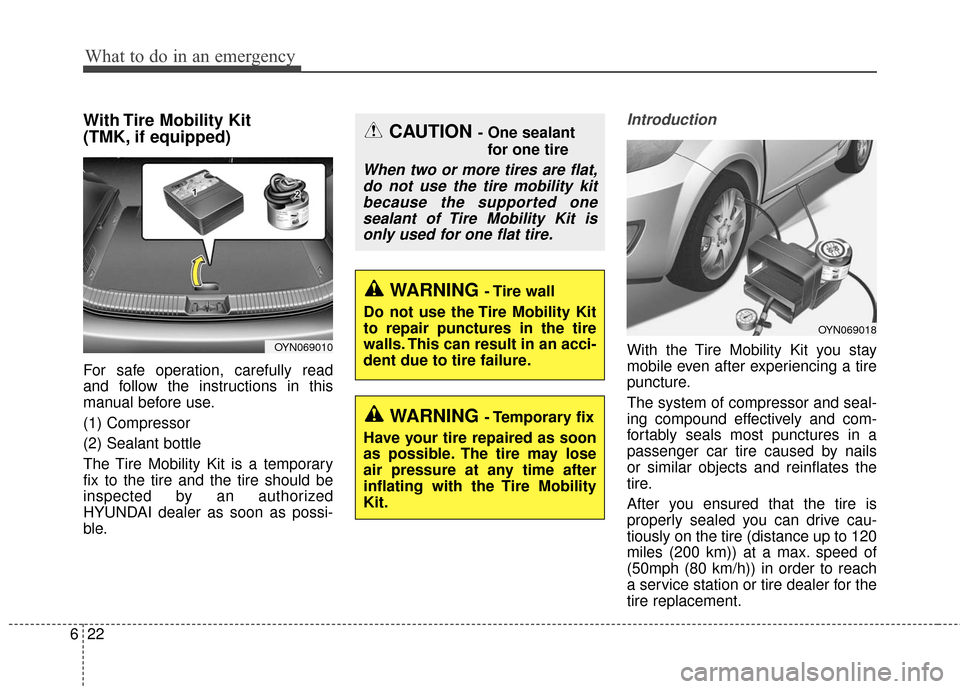
(1) Compressor
(2) Sealant bottle
The Tire Mobility Kit is a temporary
fix to the tire and the tire should be
inspected by an authorized
HYUNDAI dealer as soon as possi-
ble.
Introduction
With the Tire Mobility Kit you stay
mobile even after experiencing a tire
puncture.
The system of compressor and seal-
ing compound effectively and com-
fortably seals most punctures in a
passenger car tire caused by nails
or similar objects and reinflates the
tire.
After you ensured that the tire is
properly sealed you can drive cau-
tiously on the tire (distance up to 120
miles (200 km)) at a max. speed of
(50mph (80 km/h)) in order to reach
a service station or tire dealer for the
tire replacement.
CAUTION - One sealant
for one tire
When two or more tires are flat,do not use the tire mobility kitbecause the supported onesealant of Tire Mobility Kit isonly used for one flat tire.
WARNING - Tire wall
Do not use the Tire Mobility Kit
to repair punctures in the tire
walls. This can result in an acci-
dent due to tire failure.
WARNING - Temporary fix
Have your tire repaired as soon
as possible. The tire may lose
air pressure at any time after
inflating with the Tire Mobility
Kit.
OYN069010
OYN069018
Page 544 of 669
What to do in an emergency
26
6
Distributing the sealant
11. Immediately drive approximately
4~6miles (7~10km or about 10
minutes) to evenly distribute the
sealant in the tire.
Do not exceed a speed of 50 mph
(80 km/h). If possible, do not fall
below a speed of 12 mph (20 km/h).
While driving, if you experience any
unusual vibration, ride disturbance or
noise, reduce your speed and drive
with caution until you can safely pull
off of the side of the road.
Call for road side service or towing.
When you use the Tire Mobility Kit,
the tire pressure sensors and wheel
may be damaged by sealant, remove
the sealant stained with tire pressure
sensors and wheel and inspect at an
authorized dealer. Checking the tire inflation pres-
sure
1.After driving approximately
4~6miles (7~10km or about
10 minutes), stop at a safety loca-
tion.
2.Connect connection hose (9) of the compressor directly to the tire
valve.
3.Plug the compressor power cord into the vehicle power outlet.
4.Adjust the tire inflation pressure to the recommended tire inflation.
With the ignition on, proceed as fol-
lows.
- To increase the inflation pressure: Switch on the compressor, posi-
tion I. To check the current infla-
tion pressure setting, briefly
switch off the compressor.
✽ ✽ NOTICE
The pressure gauge may show high-
er than actual reading when the
compressor is running. To get an
accurate tire pressure, the compres-
sor needs to be turned off.
- To reduce the inflation pressure:
Loosen the screw cap (8) on the
compressor hose.
Page 546 of 669
What to do in an emergency
28
6
Towing service
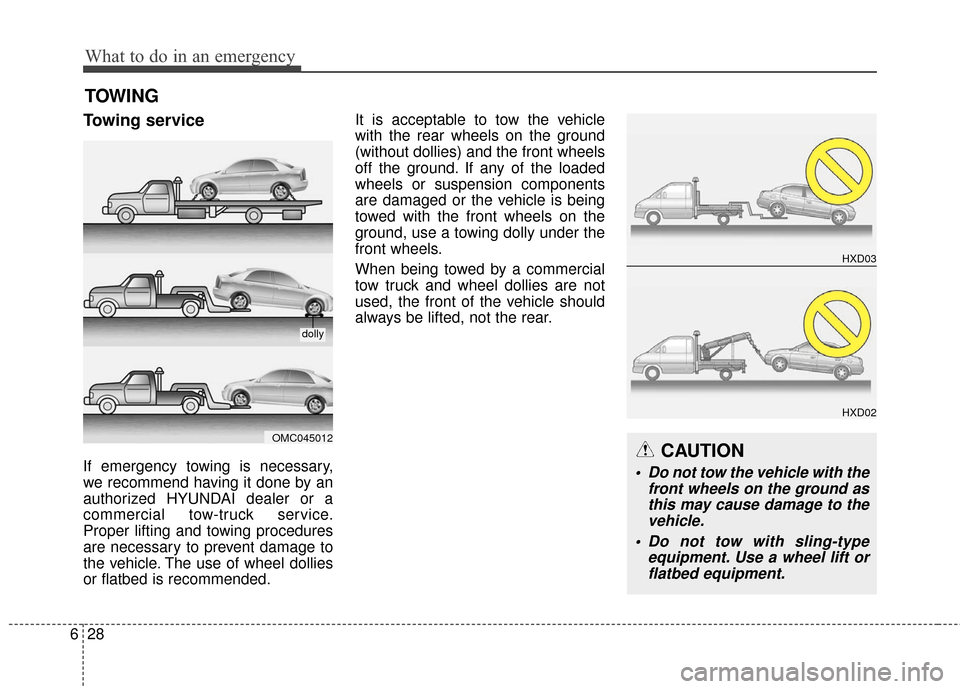
If emergency towing is necessary,
we recommend having it done by an
authorized HYUNDAI dealer or a
commercial tow-truck service.
Proper lifting and towing procedures
are necessary to prevent damage to
the vehicle. The use of wheel dollies
or flatbed is recommended. It is acceptable to tow the vehicle
with the rear wheels on the ground
(without dollies) and the front wheels
off the ground. If any of the loaded
wheels or suspension components
are damaged or the vehicle is being
towed with the front wheels on the
ground, use a towing dolly under the
front wheels.
When being towed by a commercial
tow truck and wheel dollies are not
used, the front of the vehicle should
always be lifted, not the rear.
TOWING
OMC045012
HXD03
HXD02
dolly
CAUTION
Do not tow the vehicle with the
front wheels on the ground asthis may cause damage to thevehicle.
Do not tow with sling-type equipment. Use a wheel lift orflatbed equipment.
Page 547 of 669
629
What to do in an emergency
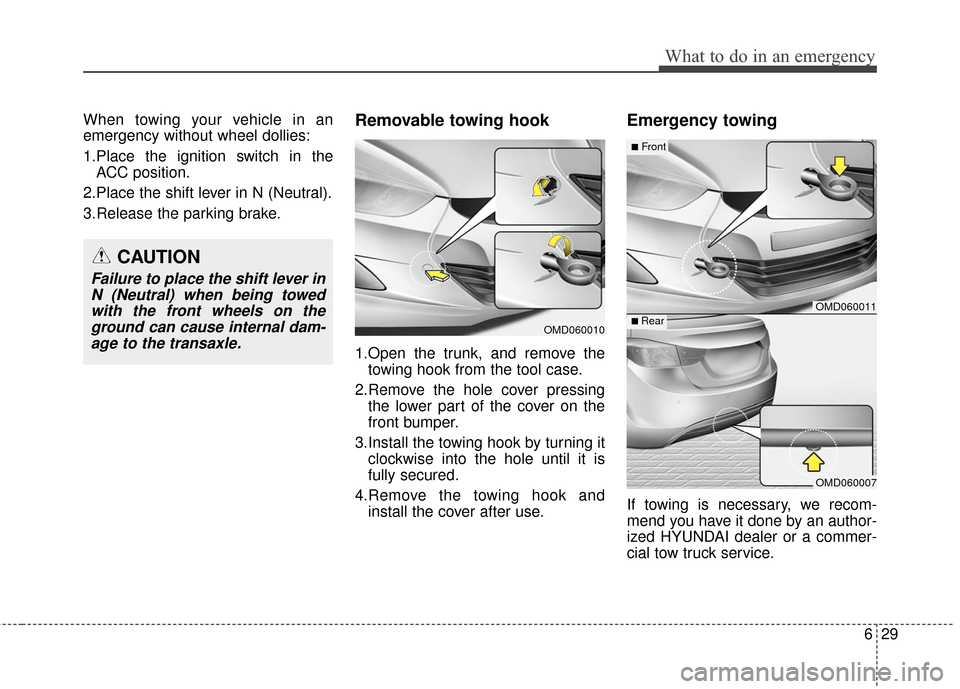
When towing your vehicle in an
emergency without wheel dollies:
1.Place the ignition switch in theACC position.
2.Place the shift lever in N (Neutral).
3.Release the parking brake.Removable towing hook
1.Open the trunk, and remove the towing hook from the tool case.
2.Remove the hole cover pressing the lower part of the cover on the
front bumper.
3.Install the towing hook by turning it clockwise into the hole until it is
fully secured.
4.Remove the towing hook and install the cover after use.
Emergency towing
If towing is necessary, we recom-
mend you have it done by an author-
ized HYUNDAI dealer or a commer-
cial tow truck service.
CAUTION
Failure to place the shift lever inN (Neutral) when being towedwith the front wheels on theground can cause internal dam-age to the transaxle.
OMD060010
OMD060011
OMD060007
■Front
■ Rear
Page 548 of 669
What to do in an emergency
30
6
If towing service is not available in an
emergency, your vehicle may be
temporarily towed using a cable or
chain secured to the emergency tow-
ing hook at the front (or rear) of the
vehicle.
Use extreme caution when towing
the vehicle with a cable or chain. A
driver must be in the vehicle to steer
it and operate the brakes.
Towing in this manner may be done
only on hard-surfaced roads for a
short distance and at low speeds.
Also, the wheels, axles, power train,
steering and brakes must all be in
good condition. Always follow these emergency tow-
ing precautions:
Place the ignition switch in the
ACC position so the steering
wheel is not locked. (if equipped)
Place the shift lever in N (Neutral).
Release the parking brake.
Depress the brake pedal with more force than normal since you will
have reduced braking perform-
ance.
More steering effort will be required because the power steer-
ing system will be disabled.
Use a vehicle heavier than your own to tow your vehicle.
The drivers of both vehicles should communicate with each other fre-
quently.
Before emergency towing, check that the hook is not broken or dam-
aged.
Fasten the towing cable or chain securely to the hook.
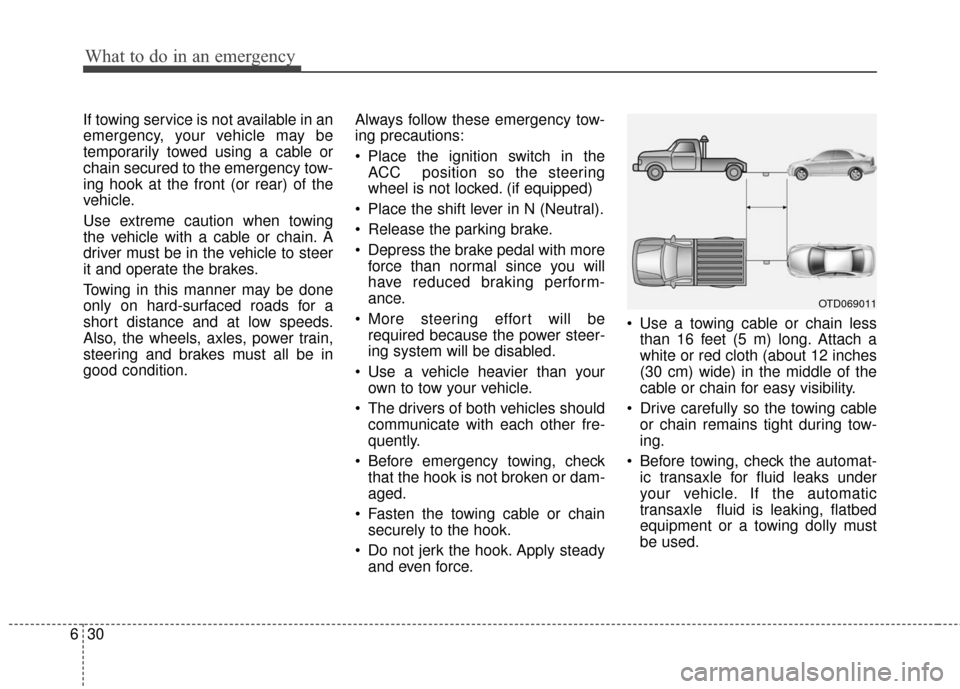
Do not jerk the hook. Apply steady and even force. Use a towing cable or chain less
than 16 feet (5 m) long. Attach a
white or red cloth (about 12 inches
(30 cm) wide) in the middle of the
cable or chain for easy visibility.
Drive carefully so the towing cable or chain remains tight during tow-
ing.
Before towing, check the automat- ic transaxle for fluid leaks under
your vehicle. If the automatic
transaxle fluid is leaking, flatbed
equipment or a towing dolly must
be used.
OTD069011
Page 550 of 669
Maintenance
Engine compartment . . . . . . . . . . . . . . . . . . . . . . . . 7-3
Maintenance services . . . . . . . . . . . . . . . . . . . . . . . . 7-4
• Owner’s responsibility . . . . . . . . . . . . . . . . . . . . . . . . . 7-4
• Owner maintenance precautions . . . . . . . . . . . . . . . . . 7-4
Owner maintenance . . . . . . . . . . . . . . . . . . . . . . . . . 7-6
• Owner maintenance schedule. . . . . . . . . . . . . . . . . . . . 7-7
Scheduled maintenance services . . . . . . . . . . . . . . . 7-8
Explanation of scheduled maintenance items . . . 7-26
Engine oil. . . . . . . . . . . . . . . . . . . . . . . . . . . . . . . . . 7-30
• Checking the engine oil level . . . . . . . . . . . . . . . . . . . 7-30
• Checking the engine oil and filter . . . . . . . . . . . . . . . 7-31
Engine coolant . . . . . . . . . . . . . . . . . . . . . . . . . . . . 7-32
• Checking the engine coolant level . . . . . . . . . . . . . . . 7-32
• Changing engine coolant. . . . . . . . . . . . . . . . . . . . . . . 7-34
Brake/clutch fluid . . . . . . . . . . . . . . . . . . . . . . . . . . 7-35
• Checking the brake/clutch fluid level . . . . . . . . . . . . 7-35
Washer fluid . . . . . . . . . . . . . . . . . . . . . . . . . . . . . . 7-36
• Checking the washer fluid level . . . . . . . . . . . . . . . . . 7-36
Parking brake . . . . . . . . . . . . . . . . . . . . . . . . . . . . . 7-36
• Checking the parking brake. . . . . . . . . . . . . . . . . . . . 7-36
Air cleaner. . . . . . . . . . . . . . . . . . . . . . . . . . . . . . . . 7-37
• Filter replacement . . . . . . . . . . . . . . . . . . . . . . . . . . . . 7-37
Climate control air cleaner . . . . . . . . . . . . . . . . . . 7-39
• Filter inspection . . . . . . . . . . . . . . . . . . . . . . . . . . . . . . 7-39
Wiper blades . . . . . . . . . . . . . . . . . . . . . . . . . . . . . . 7-41
• Blade inspection . . . . . . . . . . . . . . . . . . . . . . . . . . . . . . 7-41
• Blade replacement . . . . . . . . . . . . . . . . . . . . . . . . . . . . 7-41
Battery . . . . . . . . . . . . . . . . . . . . . . . . . . . . . . . . . . . 7-\
43
• For best battery service . . . . . . . . . . . . . . . . . . . . . . . 7-44
• Battery recharging . . . . . . . . . . . . . . . . . . . . . . . . . . . 7-45
• Reset features . . . . . . . . . . . . . . . . . . . . . . . . . . . . . . . . 7-46
Tires and wheels . . . . . . . . . . . . . . . . . . . . . . . . . . . 7-47
• Tire care . . . . . . . . . . . . . . . . . . . . . . . . . . . . . . . . . . . . \
7-47
• Recommended cold tire inflation pressures . . . . . . . 7-48
• Check tire inflation pressure . . . . . . . . . . . . . . . . . . . 7-49
• Tire rotation . . . . . . . . . . . . . . . . . . . . . . . . . . . . . . . . . 7-50
• Wheel alignment and tire balance . . . . . . . . . . . . . . . 7-51
• Tire replacement . . . . . . . . . . . . . . . . . . . . . . . . . . . . . 7-51
• Wheel replacement . . . . . . . . . . . . . . . . . . . . . . . . . . . 7-52
• Tire traction . . . . . . . . . . . . . . . . . . . . . . . . . . . . . . . . . 7-52
• Tire maintenance . . . . . . . . . . . . . . . . . . . . . . . . . . . . . 7-53
• Tire sidewall labeling . . . . . . . . . . . . . . . . . . . . . . . . . 7-53
• Tire terminology and definitions . . . . . . . . . . . . . . . . 7-57
• All season tires . . . . . . . . . . . . . . . . . . . . . . . . . . . . . . . 7-60
• Summer tires . . . . . . . . . . . . . . . . . . . . . . . . . . . . . . . . 7-60
• Snow tires . . . . . . . . . . . . . . . . . . . . . . . . . . . . . . . . . . . 7-\
60
• Radial-ply tires . . . . . . . . . . . . . . . . . . . . . . . . . . . . . . 7-61
• Low aspect ratio tires . . . . . . . . . . . . . . . . . . . . . . . . . 7-61
7
Page 553 of 669
Maintenance
47
MAINTENANCE SERVICES
You should exercise the utmost care
to prevent damage to your vehicle
and injury to yourself whenever per-
forming any maintenance or inspec-
tion procedures.
We recommend you have your vehi-
cle maintained and repaired by an
authorized HYUNDAI dealer. An
authorized HYUNDAI dealer meets
HYUNDAI’s high service quality
standards and receives technical
support from HYUNDAI in order to
provide you with a high level of serv-
ice satisfaction.Owner’s responsibility
Maintenance service and record
retention are the owner’s responsibil-
ity.
You should retain documents that
show proper maintenance has been
performed on your vehicle in accor-
dance with the scheduled mainte-
nance service charts shown on the
following pages. You need this infor-
mation to establish your compliance
with the servicing and maintenance
requirements of your vehicle war-
ranties. Detailed warranty informa-
tion is provided in your Owner’s
Handbook & Warranty Information
booklet.
Repairs and adjustments required as
a result of improper maintenance or
a lack of required maintenance are
not covered.
Owner maintenance precau-
tions
Inadequate, incomplete or insuffi-
cient servicing may result in opera-
tional problems with your vehicle that
could lead to vehicle damage, an
accident, or personal injury. This
chapter provides instructions only for
the maintenance items that are easy
to perform. Several procedures can
be done only by an authorized
HYUNDAI dealer with special tools.
Your vehicle should not be modified
in any way. Such modifications may
adversely affect the performance,
safety or durability of your vehicle
and may, in addition, violate condi-
tions of the limited warranties cover-
ing the vehicle. Certain modifications
may also be in violation of regula-
tions established by the U.S.
Department of Transportation and
other federal or state agencies.
Page 554 of 669
75
Maintenance
✽
✽NOTICE
Improper owner maintenance dur-
ing the warranty period may affect
warranty coverage. For details, read
the separate Owner’s Handbook &
Warranty Information booklet pro-
vided with the vehicle. If you’re
unsure about any service or mainte-
nance procedure, have it done by an
authorized HYUNDAI dealer.
Page 557 of 669
Maintenance
87
At least twice a year:(i.e., every Spring and Fall):
Check radiator, heater and air con- ditioning hoses for leaks or dam-
age.
Check windshield washer spray and wiper operation. Clean wiper
blades with clean cloth dampened
with washer fluid.
Check headlight alignment.
Check muffler, exhaust pipes, shields and clamps.
Check the seat belts for wear and function.
At least once a year:
Clean body and door drain holes.
Lubricate door hinges and hoodhinges.
Lubricate door and hood locks and latches.
Lubricate door rubber weather strips.
Check the air conditioning system.
Inspect and lubricate automatic transaxle linkage and controls.
Clean the battery and terminals.
Check the brake/clutch fluid level. Follow Normal Maintenance
Schedule if the vehicle is usually
operated where none of the following
conditions apply. If any of the follow-
ing conditions apply, you must follow
the Maintenance Under Severe
Usage Conditions.
Repeated short distance driving.
Driving in dusty conditions or
sandy areas.
Extensive use of brakes.
Driving in areas where salt or other corrosive materials are used.
Driving on rough or muddy roads.
Driving in mountainous areas.
Extended periods of idling or low speed operation.
Driving for a prolonged period in cold temperatures and/or extreme-
ly humid climates.
More than 50% driving in heavy city traffic during hot weather
above 90°F (32°C).
For additional information or assis-
tance see your authorized HYUNDAI
dealer.
SCHEDULED MAINTENANCE
SERVICES