check engine Hyundai Elantra 2018 Workshop Manual
[x] Cancel search | Manufacturer: HYUNDAI, Model Year: 2018, Model line: Elantra, Model: Hyundai Elantra 2018Pages: 526, PDF Size: 17.2 MB
Page 441 of 526
7-23
7
Maintenance
B
BR
RA
A K
KE
E/
/C
C L
LU
U T
TC
CH
H
F
F L
LU
U I
ID
D
Changing Engine Coolant
Have coolant changed by an authorized
HYUNDAI dealer according to the
Maintenance Schedule at the beginning
of this chapter.
To prevent damage to engine parts,
put a thick towel around the radiator
cap before refilling the coolant to pre-
vent the coolant from overflowing into
engine parts, such as the generator.
Checking the Brake/Clutch
Fluid Level
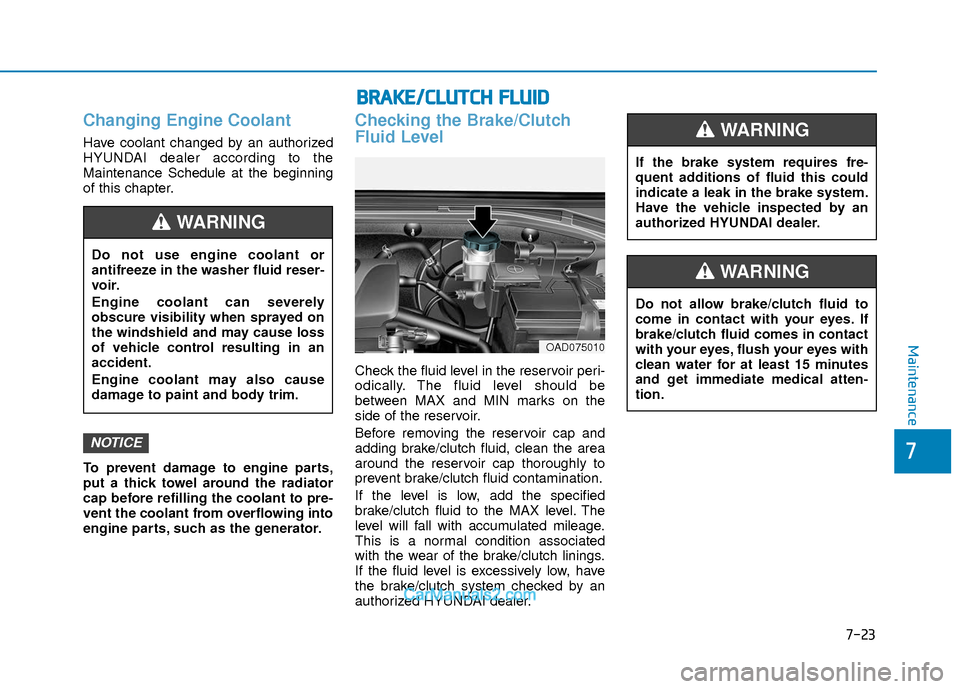
Check the fluid level in the reservoir peri-
odically. The fluid level should be
between MAX and MIN marks on the
side of the reservoir.
Before removing the reservoir cap and
adding brake/clutch fluid, clean the area
around the reservoir cap thoroughly to
prevent brake/clutch fluid contamination.
If the level is low, add the specified
brake/clutch fluid to the MAX level. The
level will fall with accumulated mileage.
This is a normal condition associated
with the wear of the brake/clutch linings.
If the fluid level is excessively low, have
the brake/clutch system checked by an
authorized HYUNDAI dealer.
NOTICE
Do not use engine coolant or
antifreeze in the washer fluid reser-
voir.
Engine coolant can severely
obscure visibility when sprayed on
the windshield and may cause loss
of vehicle control resulting in an
accident.
Engine coolant may also cause
damage to paint and body trim.
WARNING
If the brake system requires fre-
quent additions of fluid this could
indicate a leak in the brake system.
Have the vehicle inspected by an
authorized HYUNDAI dealer.
WARNING
Do not allow brake/clutch fluid to
come in contact with your eyes. If
brake/clutch fluid comes in contact
with your eyes, flush your eyes with
clean water for at least 15 minutes
and get immediate medical atten-
tion.
WARNING
OAD075010
Page 442 of 526
7-24
Maintenance
W
WA
AS
SH
H E
ER
R
F
F L
LU
U I
ID
D
Do not allow brake/clutch fluid to
contact the vehicle's body paint, as
paint damage will result.
Brake/clutch fluid, which has been exposed to open air for an extended
time should NEVER be used as its
quality cannot be guaranteed. It
should be disposed of properly.
Do not use the wrong kind of brake/clutch fluid. A few drops of
mineral based oil, such as engine
oil, in your brake/clutch system can
damage brake/clutch system parts.
Information
Use only the specified brake/clutch fluid
(refer to "Recommended Lubricants and
Capacities" in chapter 8).
Checking the Washer Fluid
Level
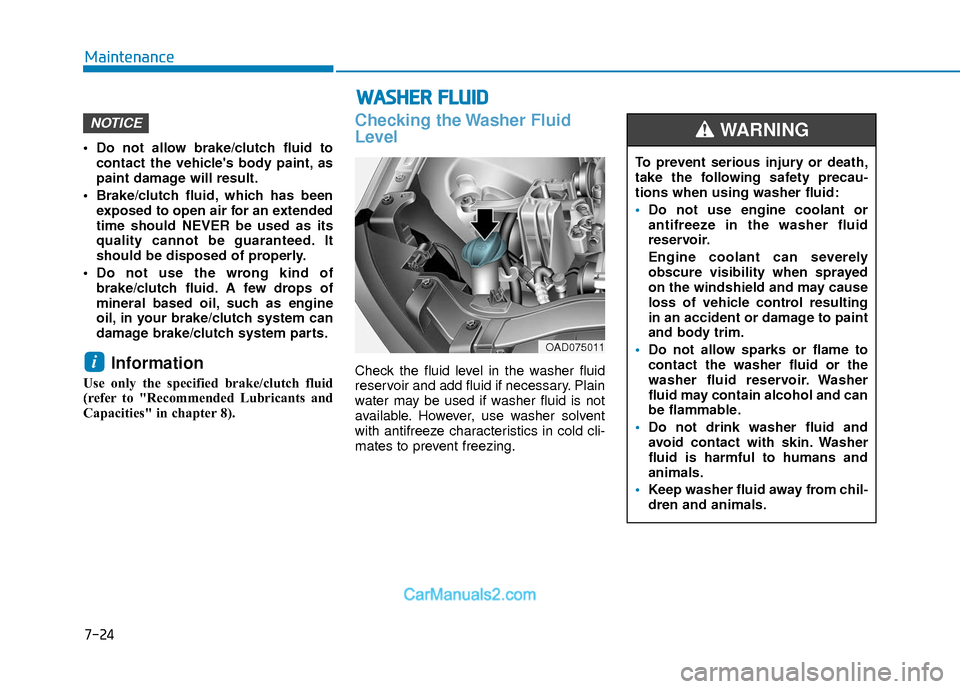
Check the fluid level in the washer fluid
reservoir and add fluid if necessary. Plain
water may be used if washer fluid is not
available. However, use washer solvent
with antifreeze characteristics in cold cli-
mates to prevent freezing.i
NOTICE
OAD075011
To prevent serious injury or death,
take the following safety precau-
tions when using washer fluid:
Do not use engine coolant or
antifreeze in the washer fluid
reservoir.
Engine coolant can severely
obscure visibility when sprayed
on the windshield and may cause
loss of vehicle control resulting
in an accident or damage to paint
and body trim.
Do not allow sparks or flame to
contact the washer fluid or the
washer fluid reservoir. Washer
fluid may contain alcohol and can
be flammable.
Do not drink washer fluid and
avoid contact with skin. Washer
fluid is harmful to humans and
animals.
Keep washer fluid away from chil-
dren and animals.
WARNING
Page 466 of 526
7-48
Maintenance
F
FU
U S
SE
E S
S
A vehicle’s electrical system is protected
from electrical overload damage by
fuses.
This vehicle has 2 (or 3) fuse panels, one
located in the driver's side panel bolster,
the other in the engine compartment
near the battery.
If any of your vehicle’s lights, acces-
sories, or controls do not work, check the
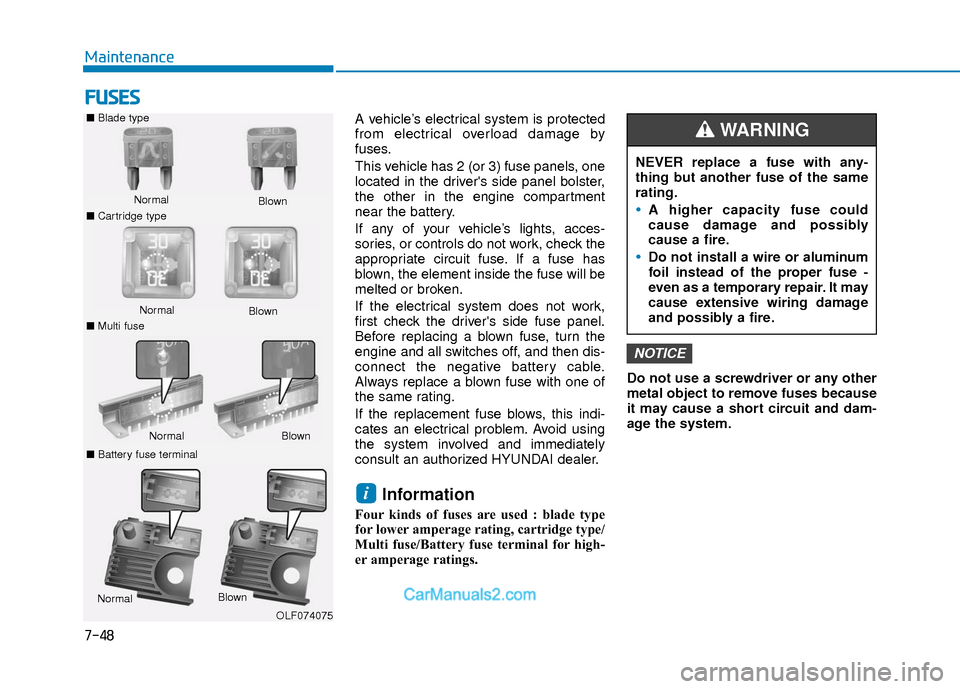
appropriate circuit fuse. If a fuse has
blown, the element inside the fuse will be
melted or broken.
If the electrical system does not work,
first check the driver's side fuse panel.
Before replacing a blown fuse, turn the
engine and all switches off, and then dis-
connect the negative battery cable.
Always replace a blown fuse with one of
the same rating.
If the replacement fuse blows, this indi-
cates an electrical problem. Avoid using
the system involved and immediately
consult an authorized HYUNDAI dealer.
Information
Four kinds of fuses are used : blade type
for lower amperage rating, cartridge type/
Multi fuse/Battery fuse terminal for high-
er amperage ratings. Do not use a screwdriver or any other
metal object to remove fuses because
it may cause a short circuit and dam-
age the system.
NOTICE
i
NEVER replace a fuse with any-
thing but another fuse of the same
rating.
A higher capacity fuse could
cause damage and possibly
cause a fire.
Do not install a wire or aluminum
foil instead of the proper fuse -
even as a temporary repair. It may
cause extensive wiring damage
and possibly a fire.
WARNING ■
Blade type
Normal
■ Cartridge type Blown
Normal
Blown
■ Multi fuse
Normal Blown
■
Battery fuse terminal
Normal Blown
OLF074075
Page 467 of 526
7-49
7
Maintenance
Instrument Panel Fuse
Replacement
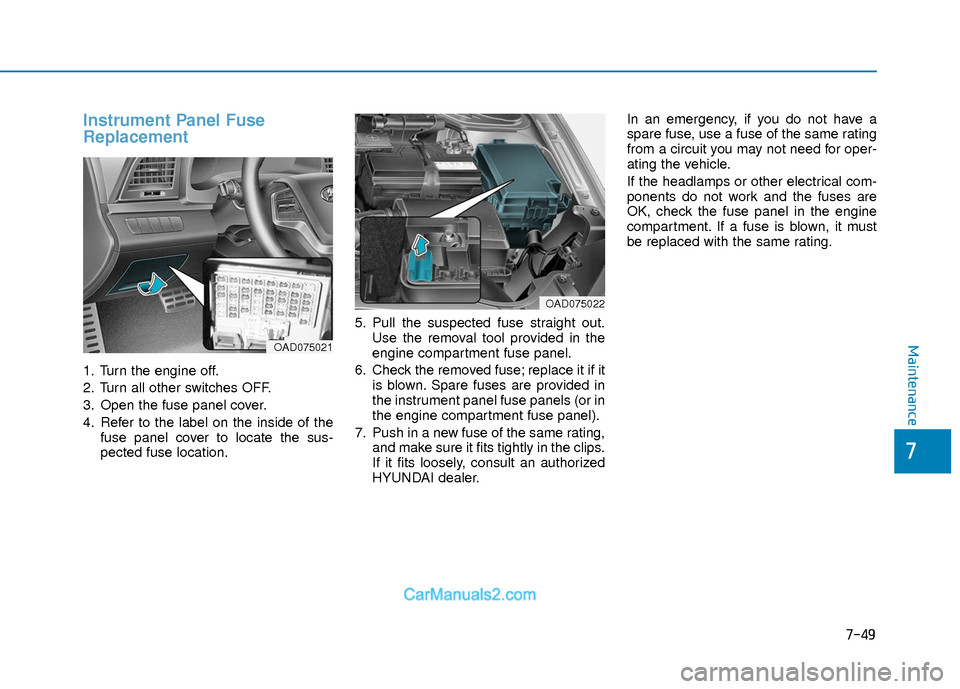
1. Turn the engine off.
2. Turn all other switches OFF.
3. Open the fuse panel cover.
4. Refer to the label on the inside of thefuse panel cover to locate the sus-
pected fuse location. 5. Pull the suspected fuse straight out.
Use the removal tool provided in the
engine compartment fuse panel.
6. Check the removed fuse; replace it if it is blown. Spare fuses are provided in
the instrument panel fuse panels (or in
the engine compartment fuse panel).
7. Push in a new fuse of the same rating, and make sure it fits tightly in the clips.
If it fits loosely, consult an authorized
HYUNDAI dealer. In an emergency, if you do not have a
spare fuse, use a fuse of the same rating
from a circuit you may not need for oper-
ating the vehicle.
If the headlamps or other electrical com-
ponents do not work and the fuses are
OK, check the fuse panel in the engine
compartment. If a fuse is blown, it must
be replaced with the same rating.
OAD075022
OAD075021
Page 468 of 526
7-50
Maintenance
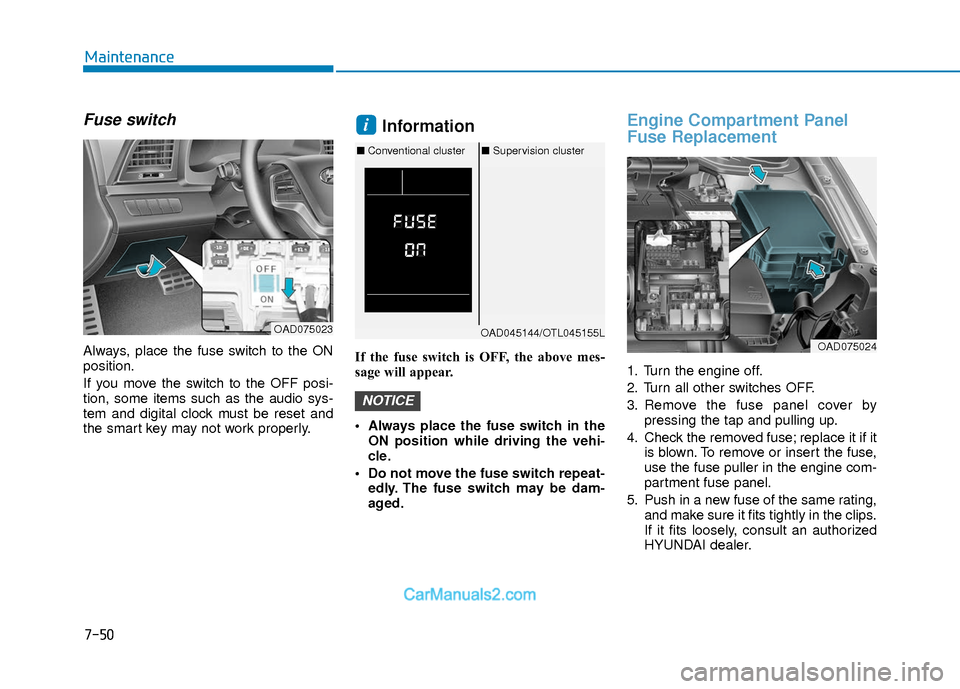
Fuse switch
Always, place the fuse switch to the ON
position.
If you move the switch to the OFF posi-
tion, some items such as the audio sys-
tem and digital clock must be reset and
the smart key may not work properly.
Information
If the fuse switch is OFF, the above mes-
sage will appear.
Always place the fuse switch in theON position while driving the vehi-
cle.
Do not move the fuse switch repeat- edly. The fuse switch may be dam-
aged.
Engine Compartment Panel
Fuse Replacement
1. Turn the engine off.
2. Turn all other switches OFF.
3. Remove the fuse panel cover by pressing the tap and pulling up.
4. Check the removed fuse; replace it if it is blown. To remove or insert the fuse,
use the fuse puller in the engine com-
partment fuse panel.
5. Push in a new fuse of the same rating, and make sure it fits tightly in the clips.
If it fits loosely, consult an authorized
HYUNDAI dealer.
NOTICE
i
OAD075023OAD045144/OTL045155L
■Conventional cluster ■Supervision cluster
OAD075024
Page 469 of 526
7-51
7
Maintenance
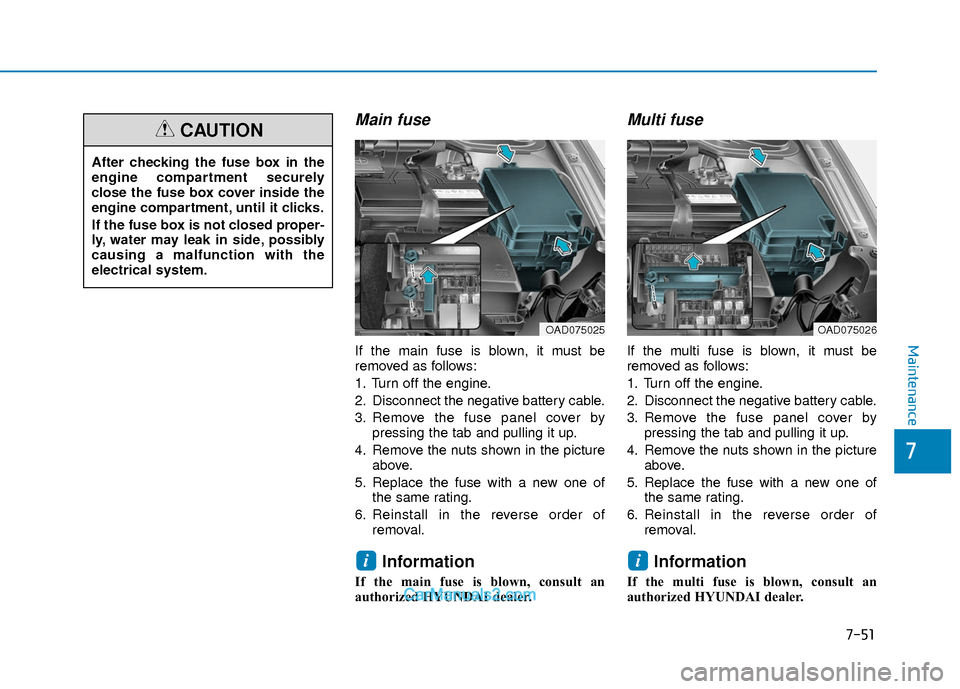
Main fuse
If the main fuse is blown, it must be
removed as follows:
1. Turn off the engine.
2. Disconnect the negative battery cable.
3. Remove the fuse panel cover bypressing the tab and pulling it up.
4. Remove the nuts shown in the picture above.
5. Replace the fuse with a new one of the same rating.
6. Reinstall in the reverse order of removal.
Information
If the main fuse is blown, consult an
authorized HYUNDAI dealer.
Multi fuse
If the multi fuse is blown, it must be
removed as follows:
1. Turn off the engine.
2. Disconnect the negative battery cable.
3. Remove the fuse panel cover bypressing the tab and pulling it up.
4. Remove the nuts shown in the picture above.
5. Replace the fuse with a new one of the same rating.
6. Reinstall in the reverse order of removal.
Information
If the multi fuse is blown, consult an
authorized HYUNDAI dealer.
ii
After checking the fuse box in the
engine compartment securely
close the fuse box cover inside the
engine compartment, until it clicks.
If the fuse box is not closed proper-
ly, water may leak in side, possibly
causing a malfunction with the
electrical system.
CAUTION
OAD075025OAD075026
Page 502 of 526
7-84
Maintenance
Canister
Fuel vapors generated inside the fuel
tank are absorbed and stored in the
onboard canister. When the engine is
running, the fuel vapors absorbed in the
canister are drawn into the surge tank
through the purge control solenoid valve.
Purge Control Solenoid Valve(PCSV)
The purge control solenoid valve is con-
trolled by the Engine Control Module
(ECM); when the engine coolant temper-
ature is low during idling, the PCSV clos-
es so that evaporated fuel is not taken
into the engine. After the engine warms-
up during ordinary driving, the PCSV
opens to introduce evaporated fuel to the
engine.
3. Exhaust Emission Control System
The Exhaust Emission Control System is
a highly effective system which controls
exhaust emissions while maintaining
good vehicle performance.
When the engine starts or fails to start,
excessive attempts to restart the engine
may cause damage to the emission sys-
tem.
Engine exhaust (carbon monox-
ide) precautions
Carbon monoxide can be present with
other exhaust fumes. If you smell
exhaust fumes of any kind in your vehi-
cle, drive with all the windows fully
open. Have your vehicle checked and
repaired immediately.
Engine exhaust gases contain car-
bon monoxide (CO). Though color-
less and odorless, it is dangerous
and could be lethal if inhaled.
Follow the instructions on this
page to avoid CO poisoning.
WARNING
CALIFORNIA PROPOSITION 65
WARNING
Engine exhaust and a wide variety
of automobile components and
parts, including components found
in the interior furnishings in a vehi-
cle, contain or emit chemicals
known to the State of California to
cause cancer and birth defects and
reproductive harm. In addition, cer-
tain fluids contained in vehicles
and certain products of component
wear contain or emit chemicals
known to the State of California to
cause cancer and birth defects or
other reproductive harm.
WARNING
Page 513 of 526
8-9
88
Specifications, Consumer information and Reporting safety defects
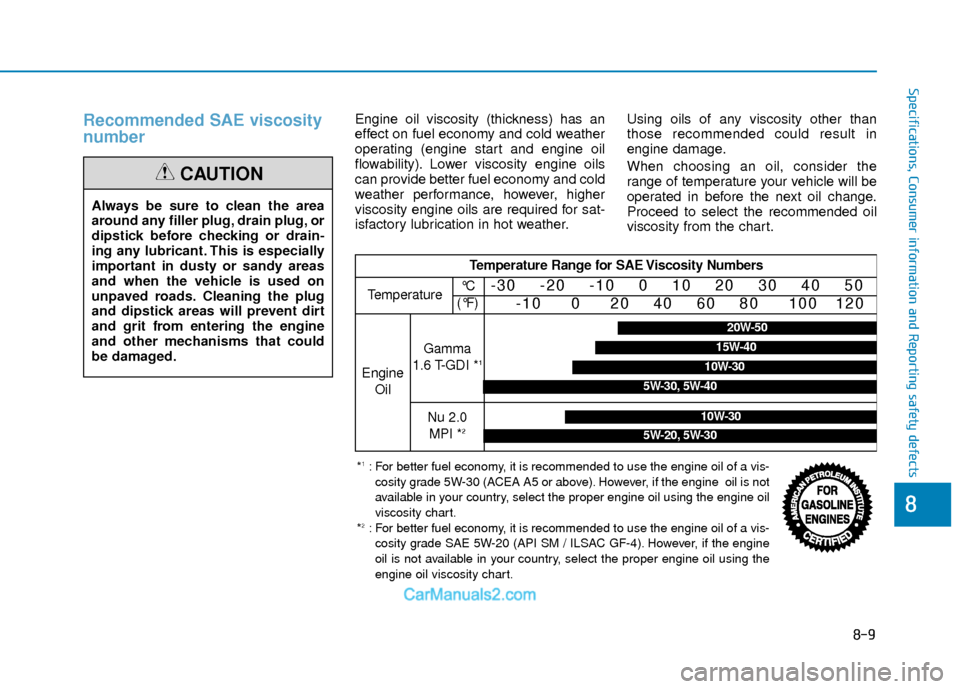
Recommended SAE viscosity
number Engine oil viscosity (thickness) has an
effect on fuel economy and cold weather
operating (engine start and engine oil
flowability). Lower viscosity engine oils
can provide better fuel economy and cold
weather performance, however, higher
viscosity engine oils are required for sat-
isfactory lubrication in hot weather.Using oils of any viscosity other than
those recommended could result in
engine damage.
When choosing an oil, consider the
range of temperature your vehicle will be
operated in before the next oil change.
Proceed to select the recommended oil
viscosity from the chart.
Always be sure to clean the area
around any filler plug, drain plug, or
dipstick before checking or drain-
ing any lubricant. This is especially
important in dusty or sandy areas
and when the vehicle is used on
unpaved roads. Cleaning the plug
and dipstick areas will prevent dirt
and grit from entering the engine
and other mechanisms that could
be damaged.
CAUTION
Temperature Range for SAE Viscosity Numbers
Temperature -30 -20 -10 0 10 20 30 40 50
-10 0 20 40 60 80 100 120
Engine
Oil
Gamma
1.6 T-GDI *1
Nu 2.0 MPI *2
°C
(°F)
*1: For better fuel economy, it is recommended to use the engine oil of a vis-
cosity grade 5W-30 (ACEA A5 or above). However, if the engine oil is not
available in your country, select the proper engine oil using the engine oil
viscosity chart.
*
2: For better fuel economy, it is recommended to use the engine oil of a vis- cosity grade SAE 5W-20 (API SM / ILSAC GF-4). However, if the engine
oil is not available in your country, select the proper engine oil using the
engine oil viscosity chart.
5W-30, 5W-40
10W-30
15W-40
20W-50
10W-30
5W-20, 5W-30
Page 521 of 526
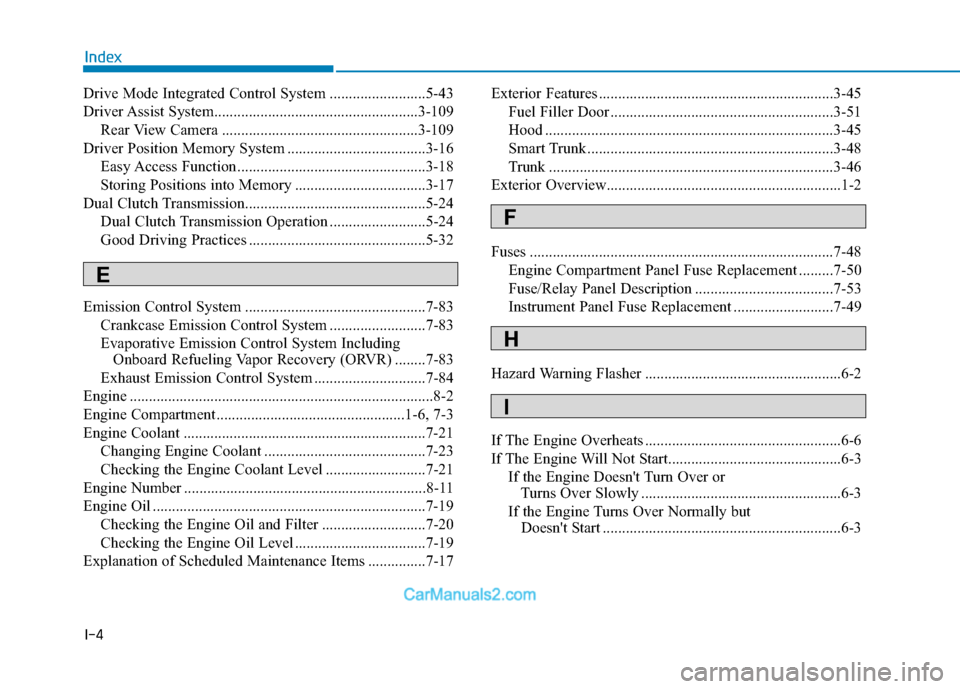
I-4
Drive Mode Integrated Control System .........................5-43
Driver Assist System.....................................................3-109Rear View Camera ...................................................3-109
Driver Position Memory System ....................................3-16 Easy Access Function .................................................3-18
Storing Positions into Memory ..................................3-17
Dual Clutch Transmission...............................................5-24 Dual Clutch Transmission Operation .........................5-24
Good Driving Practices ..............................................5-32
Emission Control System ...............................................7-83 Crankcase Emission Control System .........................7-83
Evaporative Emission Control System Including Onboard Refueling Vapor Recovery (ORVR) ........7-83
Exhaust Emission Control System .............................7-84
Engine ........................................................................\
.......8-2
Engine Compartment.................................................1-6, 7-3
Engine Coolant ...............................................................7-21 Changing Engine Coolant ..........................................7-23
Checking the Engine Coolant Level ..........................7-21
Engine Number ...............................................................8-11
Engine Oil .......................................................................7\
-19 Checking the Engine Oil and Filter ...........................7-20
Checking the Engine Oil Level ..................................7-19
Explanation of Scheduled Maintenance Items ...............7-17 Exterior Features .............................................................3-45
Fuel Filler Door ..........................................................3-51
Hood ........................................................................\
...3-45
Smart Trunk ................................................................3-48
Trunk ........................................................................\
..3-46
Exterior Overview.............................................................1-2
Fuses ........................................................................\
.......7-48 Engine Compartment Panel Fuse Replacement .........7-50
Fuse/Relay Panel Description ....................................7-53
Instrument Panel Fuse Replacement ..........................7-49
Hazard Warning Flasher ...................................................6-2
If The Engine Overheats ...................................................6-6
If The Engine Will Not Start.............................................6-3 If the Engine Doesn't Turn Over or Turns Over Slowly ....................................................6-3
If the Engine Turns Over Normally but Doesn't Start ..............................................................6-3
Index
E
F
H
I
Page 522 of 526
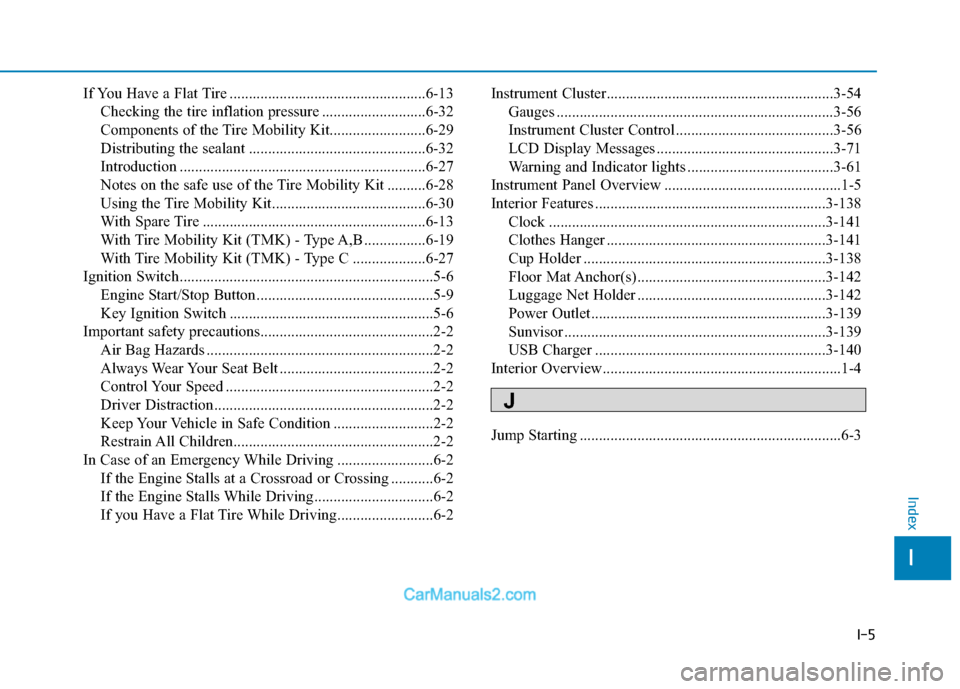
I-5
If You Have a Flat Tire ...................................................6-13Checking the tire inflation pressure ...........................6-32
Components of the Tire Mobility Kit.........................6-29
Distributing the sealant ..............................................6-32
Introduction ................................................................6-27
Notes on the safe use of the Tire Mobility Kit ..........6-28
Using the Tire Mobility Kit........................................6-30
With Spare Tire ..........................................................6-13
With Tire Mobility Kit (TMK) - Type A,B ................6-19
With Tire Mobility Kit (TMK) - Type C ...................6-27
Ignition Switch..................................................................5-6 Engine Start/Stop Button ..............................................5-9
Key Ignition Switch .....................................................5-6
Important safety precautions.............................................2-2 Air Bag Hazards ...........................................................2-2
Always Wear Your Seat Belt ........................................2-2
Control Your Speed ......................................................2-2
Driver Distraction.........................................................2-2
Keep Your Vehicle in Safe Condition ..........................2-2
Restrain All Children....................................................2-2
In Case of an Emergency While Driving .........................6-2 If the Engine Stalls at a Crossroad or Crossing ...........6-2
If the Engine Stalls While Driving...............................6-2
If you Have a Flat Tire While Driving.........................6-2 Instrument Cluster...........................................................3-54
Gauges ........................................................................\
3-56
Instrument Cluster Control .........................................3-56
LCD Display Messages ..............................................3-71
Warning and Indicator lights ......................................3-61
Instrument Panel Overview ..............................................1-5
Interior Features ............................................................3-138 Clock ........................................................................\
3-141
Clothes Hanger .........................................................3-141
Cup Holder ...............................................................3-138
Floor Mat Anchor(s) .................................................3-142
Luggage Net Holder .................................................3-142
Power Outlet.............................................................3-139
Sunvisor ....................................................................3-13\
9
USB Charger ............................................................3-140
Interior Overview..............................................................1-4
Jump Starting ....................................................................6-3
I
Index
J