stop start HYUNDAI ELANTRA 2021 Repair Manual
[x] Cancel search | Manufacturer: HYUNDAI, Model Year: 2021, Model line: ELANTRA, Model: HYUNDAI ELANTRA 2021Pages: 570, PDF Size: 52.21 MB
Page 471 of 570
Emergency Situations8-8
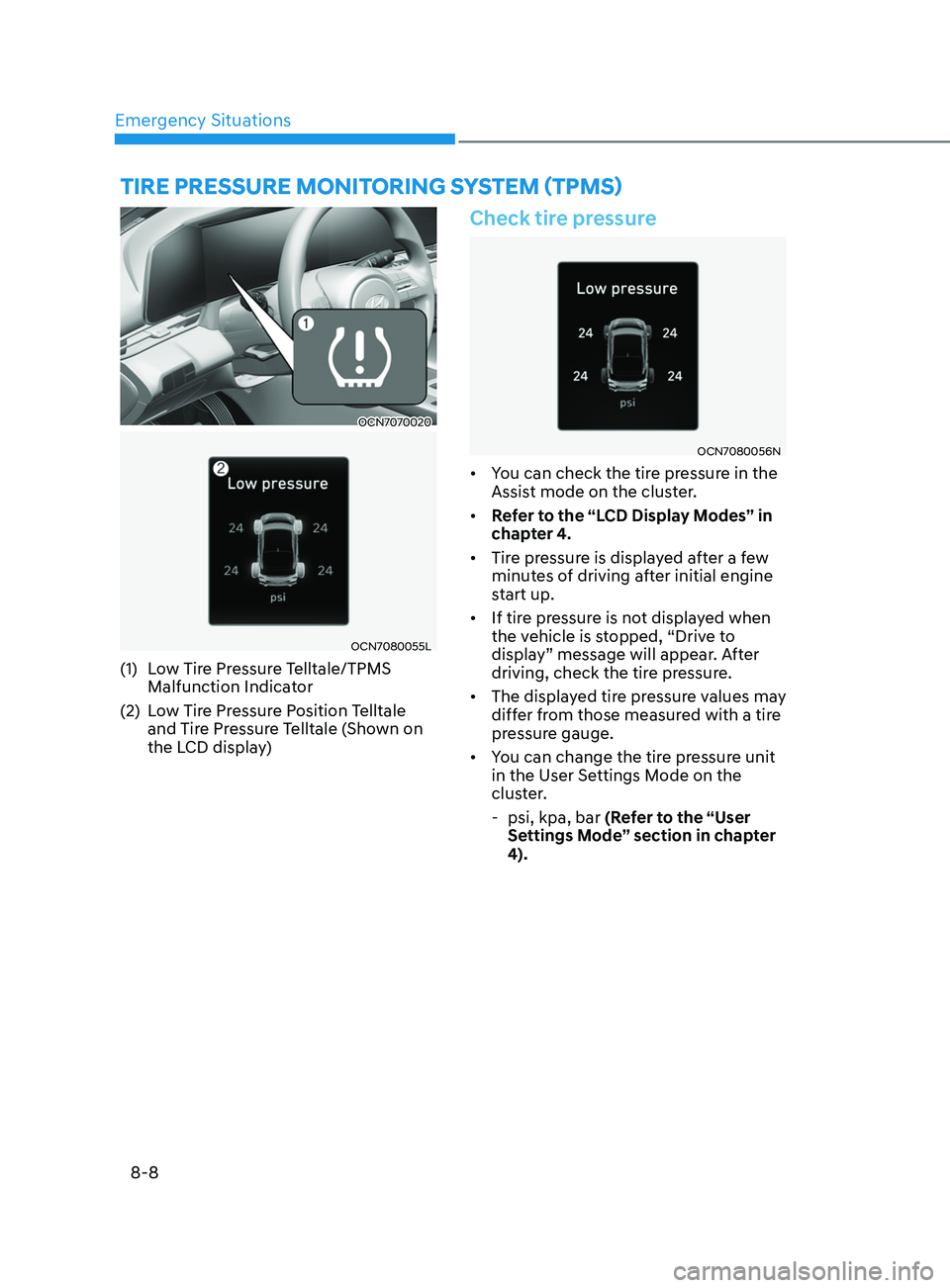
Tire Pressure MoniToring sysTeM (TPMs)
OCN7070020
OCN7080055L
(1) Low Tire Pressure Telltale/TPMS
Malfunction Indica tor
(2)
Lo
w Tire Pressure Position Telltale
and Tire Pressure Telltale (Shown on
the LCD display)
Check tire pressure
OCN7080056N
• You can check the tire pressure in the
Assist mode on the cluster.
• Refer to the “LCD Display Modes” in
chapter 4.
• Tire pressure is displayed after a few
minutes of driving after initial engine
start up.
• If tire pressure is not displayed when
the vehicle is stopped, “Drive to
display” message will appear. After
driving, check the tire pressure.
• The displayed tire pressure values may
differ from those measured with a tire
pressure gauge.
• You can change the tire pressure unit
in the User Settings Mode on the
cluster.
- psi, kpa, bar (R
efer to the “User
Settings Mode” section in chapter
4).
Page 472 of 570
08
8-9
Tire pressure monitoring system
WARNING
Over-inflation or under-inflation can
reduce tire life, adversely affect vehicle
handling, and lead to sudden tire failure
that may cause loss of vehicle control
resulting in an accident.
Each tire, including the spare (if
provided), should be checked monthly
when cold and inflated to the inflation
pressure recommended by the vehicle
manufacturer on the vehicle placard
or tire inflation pressure label. (If your
vehicle has tires of a different size than
the size indicated on the vehicle placard
or tire inflation pressure label, you should
determine the proper tire inflation
pressure for those tires.)
As an added safety feature, your
vehicle has been equipped with a tire
pressure monitoring system (TPMS)
that illuminates a low tire pressure
telltale when one or more of your tires is
significantly under-inflated. Accordingly,
when the low tire pressure telltale
illuminates, you should stop and check
your tires as soon as possible, and inflate
them to the proper pressure. Driving on
a significantly underinflated tire causes
the tire to overheat and can lead to tire
failure.
Under-inflation also reduces fuel
efficiency and tire tread life, and may
affect the vehicle’s handling and
stopping ability.Please note that the TPMS is not a
substitute for proper tire maintenance,
and it is the driver’s responsibility to
maintain correct tire pressure, even if
under-inflation has not reached the level
to trigger illumination of the TPMS low
tire pressure telltale.
Your vehicle has also been equipped with
a TPMS malfunction indicator to indicate
when the system is not operating
properly. The TPMS malfunction
indicator is combined with the low
tire pressure telltale. When the system
detects a malfunction, the telltale will
flash for approximately one minute and
then remain continuously illuminated.
This sequence will continue upon
subsequent vehicle start-ups as long as
the malfunction exists.
When the malfunction indicator is
illuminated, the system may not be able
to detect or signal low tire pressure as
intended. TPMS malfunctions may occur
for a variety of reasons, including the
installation of replacement or alternate
tires or wheels on the vehicle that
prevent the TPMS from functioning
properly.
Always check the TPMS malfunction
telltale after replacing one or more tires
or wheels on your vehicle to ensure that
the replacement or alternate tires and
wheels allow the TPMS to continue to
function properly.
Page 512 of 570
Maintenance9-26
Battery Recharging
WARNING
Always follow these instructions when
recharging your vehicle’s battery to
avoid the risk of SERIOUS INJURY or
DEATH from explosions or acid burns:
• Before performing maintenance or
recharging the battery, turn off all
accessories and place the ignition
switch to the LOCK/OFF position.
• Keep all flames, sparks, or smoking
materials away from the battery.
• Always work outdoors or in an area
with plenty of ventilation.
• Wear eye protection when checking
the battery during charging.
• The battery must be removed from
the vehicle and placed in a well
ventilated area.
• Watch the battery during charging,
and stop or reduce the charging
rate if the battery cells begin boiling
violently.
• Vehicle is equipped with the
Absorbent Glass Mat (AGM) battery.
Do not charge the AGM battery with
a general charger. It may damage
or explode the AGM battery. Only
charge the AGM battery with a
charger that has AGM battery
setting.
• The negative battery cable must
be removed first and installed last
when the battery is disconnected.
Disconnect the battery charger in the
following order:
1.
Turn o
ff the battery charger main
switch.
2.
Unhook the nega
tive clamp from
the negative battery terminal.
3.
Unhook the positiv
e clamp from
the positive battery terminal.
• Always use a genuine HYUNDAI
approved battery when you replace
the battery.
NOTICE
AGM battery (if equipped)
• Absorbent Glass Matt (AGM)
batteries are maintenance-free
and we recommend that the AGM
battery be serviced by an authorized
HYUNDAI dealer. For charging
your AGM battery, use only fully
automatic battery chargers that
are specially developed for AGM
batteries.
• When replacing the AGM battery,
we recommend that you use parts
for replacement from an authorized
HYUNDAI dealer.
• Do not open or remove the cap on
top of the battery. This may cause
leaks of internal electrolyte that
could result in severe injury.
By jump starting
After a jump start from a good battery,
drive the vehicle for 20-30 minutes
before it is shutoff. The vehicle may
not restart if you shut it off before the
battery had a chance to adequately
recharge. See “Jump Starting” in chapter
7 for more information on jump starting
procedures.
Information
An inappropriately disposed
battery can be harmful to
the environment and human
health. Dispose of the battery
according to your local law(s) or
regulations.
Reset items
Items should be reset after the battery
has been discharged or the battery has
been disconnected.
• Auto up/down window (See chapter 5)
• Sunroof (See chapter 5)
• Trip computer (See chapter 4)
• Climate control system (See chapter 5)
Page 530 of 570
Maintenance
9-44
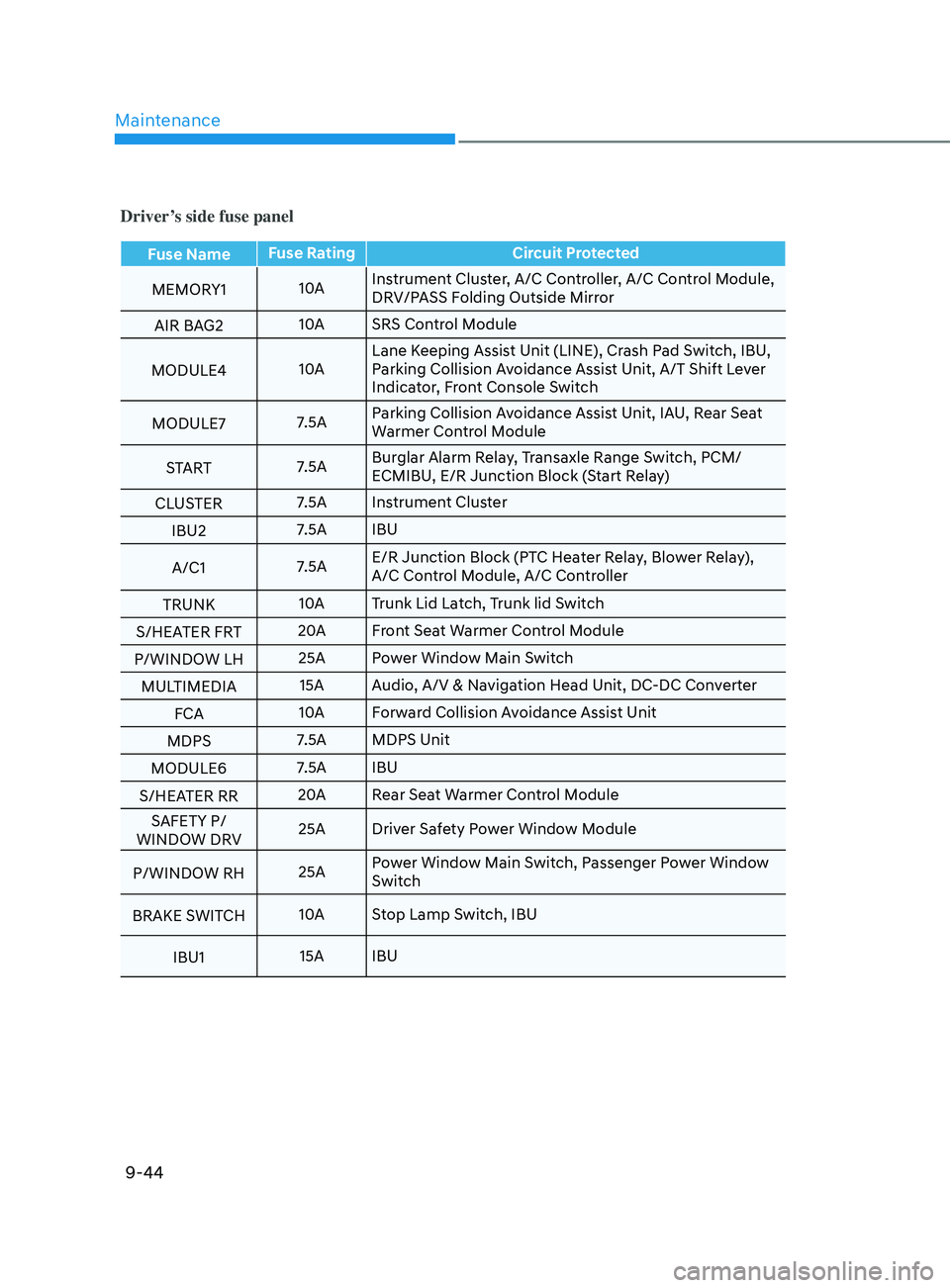
Driver’s side fuse panel
Fuse NameFuse Rating
Circuit Protected
MEMORY1 10AInstrument Cluster, A/C Controller, A/C Control Module,
DRV/PASS Folding Outside Mirror
AIR BAG2 10A
SRS Control Module
MODULE4 10ALane Keeping Assist Unit (LINE), Crash Pad Switch, IBU,
Parking Collision Avoidance Assist Unit, A/T Shift Lever
Indicator, Front Console Switch
MODULE7 7.5AParking Collision Avoidance Assist Unit, IAU,
Rear Sea
t
Warmer Control Module
START 7.5ABurglar Alarm Relay, Transaxle Range Switch, PCM/
ECM
IBU, E/R Junction Block (
Start Relay)
CLUSTER 7.5A Instrument Cluster
IBU2 7.5A IBU
A/C1 7.5AE/R Junction Block (PTC Heater Relay, Blower Relay),
A/C Control Module, A/C Controller
TRUNK 10A
Trunk Lid Latch, Trunk lid Switch
S/HEATER FRT 20A
Front Seat Warmer Control Module
P/WINDOW LH 25A Power Window Main Switch
MULTIMEDIA 15A Audio, A/V & Navigation Head Unit, DC-DC Converter
FCA 10A
Forward Collision Avoidance Assist Unit
MDPS 7.5A MDPS Unit
MODULE6 7.5A IBU
S/HEATER RR 20A
Rear Seat Warmer Control Module
SAFETY P/
WINDOW DRV 25A Driver Safety Power Window Module
P/WINDOW RH 25APower Window Main Switch, Passenger Power Window
Switch
BRAKE SWITCH 10A
Stop Lamp Switch, IBU
IBU1 15A IBU
Page 555 of 570
09
9-69
3. Exhaust Emission Control
System
The Exhaust Emission Control System is
a highly effective system which controls
exhaust emissions while maintaining
good vehicle performance.
When the engine starts or fails to start,
excessive attempts to restart the engine
may cause damage to the emission
system.
Engine exhaust (carbon monoxide)
precautions
• Carbon monoxide can be present
with other exhaust fumes. If you smell
exhaust fumes of any kind in your
vehicle, drive with all the windows
fully open. Have your vehicle checked
and repaired immediately.
WARNING
Engine exhaust gases contain carbon
monoxide (CO). Though colorless and
odorless, it is dangerous and could be
lethal if inhaled. Follow the instructions
on this page to avoid CO poisoning.
WARNING
CALIFORNIA PROPOSITION 65
WARNING
Engine exhaust and a wide variety of
automobile components and parts,
including components found in the
interior furnishings in a vehicle, contain
or emit chemicals known to the State
of California to cause cancer and
birth defects and reproductive harm.
In addition, certain fluids contained
in vehicles and certain products of
component wear contain or emit
chemicals known to the State of
California to cause cancer and birth
defects or other reproductive harm. •
Do not operate the engine in confined
or closed areas (such as garages) any
more than what is necessary to move
the vehicle in or out of the area.
• When the vehicle is stopped in an
open area for more than a short time
with the engine running, adjust the
ventilation system (as needed) to draw
outside air into the vehicle.
• Never sit in a parked or stopped
vehicle for any extended time with the
engine running.
• When the engine stalls or fails to
start, excessive attempts to restart
the engine may cause damage to the
emission control system.
Page 563 of 570
 ........................................................................\
7-109
Function malfunction and limitations ...........................................")
Index
I-6
Highway Driving Assist (HDA) ........................................................................\
7-109
Function malfunction and limitations ............................................................7-1
13
Function operation ........................................................................\
..................7
-111
Function settings ........................................................................\
....................7-1
10
Hood
........................................................................\
............................................ 5-59
How to Use
This Manual
........................................................................\
............... 1-4
I
If the Engine Overheats
........................................................................\
................. 8-6
If the Engine
Will not Start
........................................................................\
............ 8-3
If the Engine Doesn’t
Turn Over or Turns Over Slowly
....................................8-3
If the Engine T
urns Over Normally but Doesn’t Start
....................................... 8-3
If you Have a Flat
Tire (With spare tire)
............................................................. 8-14
Changing Tires ........................................................................\
......................... 8-15
Jack and T
ools
........................................................................\
.......................... 8-14
Ignition Switch
........................................................................\
.............................. 6-5
Engine Start/Stop Button ........................................................................\
............6-8
Key Ignition Switch ........................................................................\
.................. 6-5
Important Safety Precautions
........................................................................\
......... 3-2
Air Bag Hazards ........................................................................\
......................... 3-2
Always W
ear Your Seat Belt
........................................................................\
...... 3-2
Control Your
Speed
........................................................................\
.................... 3-2
Driver Distraction ........................................................................\
....................... 3-2
Keep Y
our Vehicle in Safe Condition
................................................................. 3-2
Restrain All
Children
........................................................................\
.................. 3-2
In Case of an Emer
gency While Driving
............................................................... 8-2
If the Engine Stalls at a Crossroad or Crossing ..................................................8-2
If the Engine Stalls While Driving ..................................................................... 8-2
If you Have a Flat T
ire While Driving
............................................................... 8-3
Infotainment System
........................................................................\
.................. 5-1
17
Antenna ........................................................................\
..................................5-1
18
Bluetooth® Wireless Technology hands-free ..................................................5-120
How vehicle radio works ........................................................................\
........ 5-121
Infotainment system ........................................................................\
............... 5-120
Steering wheel audio control ........................................................................\
..5-1
19
USB Port ........................................................................\
................................5-1
17
Voice recognition ........................................................................\
....................5-120
Page 565 of 570

............................")
Index
I-8
J
Jump Starting
........................................................................\
.................................8-4
L
Lane Following
Assist (LFA)
........................................................................\
... 7-105
Function malfunction and limitations ............................................................7-108
Function operation ........................................................................\
.................. 7-106
Function settings ........................................................................\
.................... 7-105
Lane Keeping
Assist (LKA)
........................................................................\
....... 7-30
Function malfunction and limitations ..............................................................7-34
Function operation ........................................................................\
.................... 7-32
Function settings ........................................................................\
..................... 7-30
LCD Display (T
ype A)
........................................................................\
................. 4-25
LCD Display Control ........................................................................\
...............4-25
LCD display modes ........................................................................\
.................. 4-26
Trip Computer ........................................................................\
.......................... 4-36
User settings mode ........................................................................\
...................4-29
LCD display (T
ype B)
........................................................................\
................. 4-40
LCD Display Control ........................................................................\
...............4-40
User settings mode ........................................................................\
................... 4-44
Utility group ........................................................................\
............................. 4-42
View modes ........................................................................\
.............................. 4-41
Light Bulbs
........................................................................\
.................................. 9-50
Headlamp, Parking Lamp, Daytime Running Light, T
urn Signal Lamp and
Side Marker ........................................................................\
............................ 9-51
High mounted stop lamp replacement ..............................................................9-57
Interior Light Bulb Replacement ...................................................................... 9-58
License Plate Light Bulb Replacement ............................................................9-57
Rear combination lamp bulb replacement ........................................................9-54
Side repeater lamp replacement ....................................................................... 9-54
M
Maintenance Services
........................................................................\
.................... 9-4
Owner Maintenance Precautions ........................................................................\
9-4
Owner’
s Responsibility
........................................................................\
.............. 9-4