ECU HYUNDAI ELANTRA GT 2019 Service Manual
[x] Cancel search | Manufacturer: HYUNDAI, Model Year: 2019, Model line: ELANTRA GT, Model: HYUNDAI ELANTRA GT 2019Pages: 486, PDF Size: 78.59 MB
Page 388 of 486
7-15
7
Maintenance
EEXX PPLLAA NN AATTIIOO NN OO FF SS CC HH EEDD UU LLEE DD MM AAIINN TTEENN AANN CCEE IITT EEMM SS
Engine Oil and Filter
The engine oil and filter should be
changed at the intervals specified in
the maintenance schedule. If the
vehicle is being driven in severe con-
ditions, more frequent oil and filterchanges are required.
Drive Belts
Inspect all drive belts for evidence of
cuts, cracks, excessive wear or oil
saturation and replace if necessary.
Drive belts should be checked peri-
odically for proper tension and
adjusted as necessary.
Fuel Filter
A clogged-up fuel filter may limit the
vehicle driving speed, damage theemission system, and cause the
hard starting. When a considerable
amount of foreign substances are
accumulated in the fuel tank, the fuelfilter should be replaced.
Upon installing a new fuel filter, oper-
ate the engine for several minutes,
and check the connections for any
leakages. Fuel filters should be
installed by an authorized HYUNDAI
dealer.
Fuel Lines, Fuel Hoses and Connections
Check the fuel lines, fuel hoses and
connections for leakage and dam-
age. Have an authorized HYUNDAI
dealer replace any damaged or leak-
ing parts immediately.
Vapor Hose and Fuel Filler Cap
The vapor hose and fuel filler cap should be inspected at those inter-
vals specified in the maintenance
schedule. Make sure a new vaporhose or fuel filler cap is correctlyreplaced.
Vacuum Crankcase Ventilation Hoses (if equipped)
Inspect the surface of hoses for evi- dence of heat and/or mechanical
damage. Hard and brittle rubber,
cracking, tears, cuts, abrasions, and
excessive swelling indicate deterio-
ration. Particular attention should be
paid to examine those hose surfaces
nearest to high heat sources, such
as the exhaust manifold. Inspect the hose routing to ensure that the hoses do not come in con-
tact with any heat source, sharp
edges or moving component whichmight cause heat damage or
mechanical wear. Inspect all hose
connections, such as clamps and
couplings, to make sure they are
secure, and that no leaks are pres-
ent. Hoses should be replaced
immediately if there is any evidence
of deterioration or damage.
Page 394 of 486
7-21
7
Maintenance
Do not use a solution that containsmore than 60% antifreeze or less
than 35% antifreeze, which would
reduce the effectiveness of thesolution.
For mixing percentage, refer to the
following table:
Information
If in doubt about the mix ratio, a 50%
water and 50% antifreeze mix is the
easiest to mix together as it will be the
same quantity of each. It is suitable to
use for most temperature ranges of
-35°C (-31°F) and higher.
i
Ambient
Temperature Mixture Percentage
(volume)
Antifreeze Water
-15°C (5°F) 35 65
-25°C (-13°F) 40 60
-35°C (-31°F) 50 50
-45°C (-49°F) 60 40
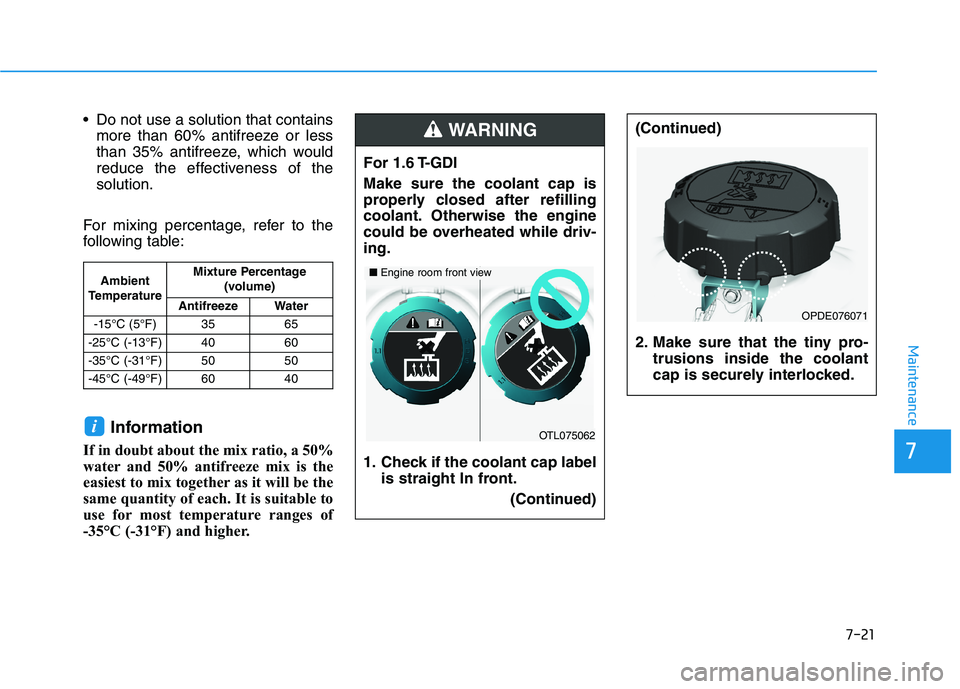
For 1.6 T-GDI Make sure the coolant cap is
properly closed after refilling
coolant. Otherwise the engine
could be overheated while driv-ing.
1. Check if the coolant cap label is straight In front.
(Continued)
WARNING
OTL075062
■Engine room front view (Continued)
2. Make sure that the tiny pro-
trusions inside the coolant
cap is securely interlocked.
OPDE076071
Page 398 of 486
7-25
7
Maintenance
WWAASSHH EERR FF LLUU IIDD
Checking the Washer Fluid
Level
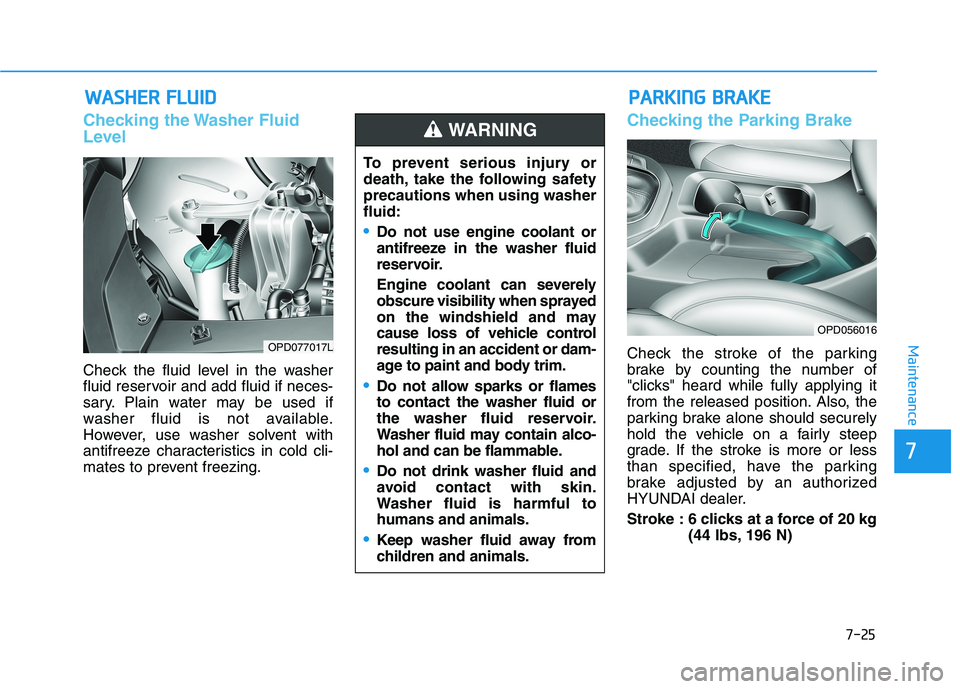
Check the fluid level in the washer
fluid reservoir and add fluid if neces-
sary. Plain water may be used if
washer fluid is not available.
However, use washer solvent with
antifreeze characteristics in cold cli-
mates to prevent freezing.
Checking the Parking Brake
Check the stroke of the parking
brake by counting the number of
"clicks" heard while fully applying it
from the released position. Also, the
parking brake alone should securely
hold the vehicle on a fairly steep
grade. If the stroke is more or less
than specified, have the parking
brake adjusted by an authorized
HYUNDAI dealer.
Stroke : 6 clicks at a force of 20 kg
(44 lbs, 196 N)OPD077017L
OPD056016
PPAA RRKK IINN GG BB RRAA KKEE
To prevent serious injury or
death, take the following safetyprecautions when using washerfluid:
Do not use engine coolant or
antifreeze in the washer fluid
reservoir.
Engine coolant can severely
obscure visibility when sprayed
on the windshield and may
cause loss of vehicle controlresulting in an accident or dam-
age to paint and body trim.
Do not allow sparks or flames to contact the washer fluid or
the washer fluid reservoir.
Washer fluid may contain alco-
hol and can be flammable.
Do not drink washer fluid and
avoid contact with skin.
Washer fluid is harmful tohumans and animals.
Keep washer fluid away from
children and animals.
WARNING
Page 406 of 486
7-33
7
Maintenance
For Best Battery Service
Keep the battery securely mount-ed.
Keep the battery top clean and dry.
Keep the terminals and connec- tions clean, tight, and coated with
petroleum jelly or terminal grease.
Rinse any spilled acid from the bat- tery immediately with a solution of
water and baking soda.
Battery Recharging
Always follow these instruc-
tions when recharging your
vehicle's battery to avoid the
risk of SERIOUS INJURY or
DEATH from explosions or acid
burns:
Before performing mainte-
nance or recharging the bat-
tery, turn off all accessories
and place the ignition switchto the LOCK/OFF position.
Keep all flames, sparks, or
smoking materials away from
the battery.
Always work outdoors or in an area with plenty of ventilation.
Wear eye protection when
checking the battery during
charging.
The battery must be removed
from the vehicle and placed ina well ventilated area.
(Continued)
WARNING
OPD077028L (Continued)
Watch the battery during
charging, and stop or reduce
the charging rate if the battery
cells begin boiling violently.
The negative battery cable
must be removed first and
installed last when the battery
is disconnected. Disconnect
the battery charger in the fol-
lowing order:
(1) Turn off the battery charg-
er main switch.
(2) Unhook the negative clamp from the negative
battery terminal.
(3) Unhook the positive clamp from the positive batteryterminal.
Always use a genuine
HYUNDAI approved battery
when you replace the battery.
Page 428 of 486
7-55
7
Maintenance
4. Check the removed fuse; replaceit if it is blown. To remove or insert
the fuse, use the fuse puller in the
engine compartment fuse panel.
5. Push in a new fuse of the same rating, and make sure it fits tightly
in the clips. If it fits loosely, consult
an authorized HYUNDAI dealer.Main fuse
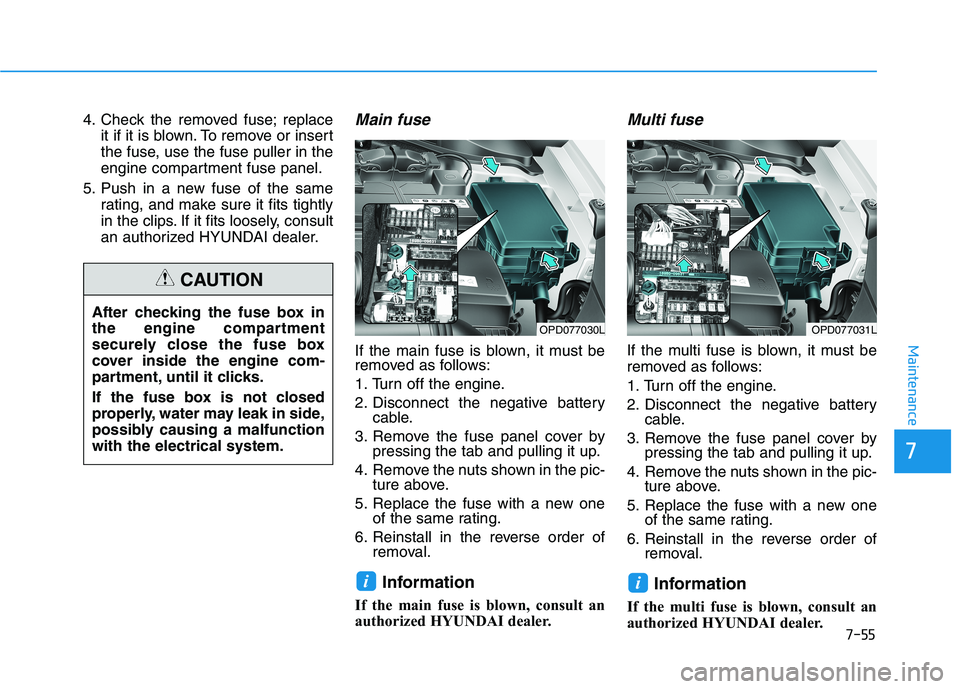
If the main fuse is blown, it must be
removed as follows:
1. Turn off the engine.
2. Disconnect the negative batterycable.
3. Remove the fuse panel cover by pressing the tab and pulling it up.
4. Remove the nuts shown in the pic- ture above.
5. Replace the fuse with a new one of the same rating.
6. Reinstall in the reverse order of removal.
Information
If the main fuse is blown, consult an
authorized HYUNDAI dealer.
Multi fuse
If the multi fuse is blown, it must be
removed as follows:
1. Turn off the engine.
2. Disconnect the negative battery cable.
3. Remove the fuse panel cover by pressing the tab and pulling it up.
4. Remove the nuts shown in the pic- ture above.
5. Replace the fuse with a new one of the same rating.
6. Reinstall in the reverse order of removal.
Information
If the multi fuse is blown, consult an
authorized HYUNDAI dealer.
ii
After checking the fuse box in
the engine compartment
securely close the fuse box
cover inside the engine com-
partment, until it clicks.
If the fuse box is not closed
properly, water may leak in side,
possibly causing a malfunctionwith the electrical system.
CAUTION
OPD077030LOPD077031L
Page 432 of 486
7-59
7
Maintenance
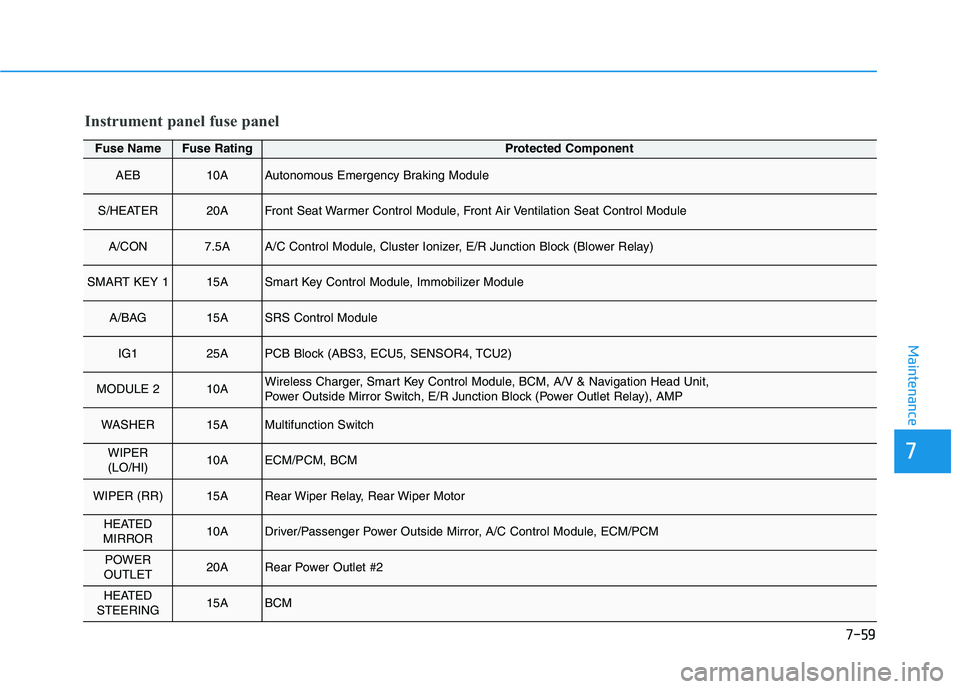
Fuse NameFuse RatingProtected Component
AEB10AAutonomous Emergency Braking Module
S/HEATER20AFront Seat Warmer Control Module, Front Air Ventilation Seat Control Module
A/CON7.5AA/C Control Module, Cluster Ionizer, E/R Junction Block (Blower Relay)
SMART KEY 115ASmart Key Control Module, Immobilizer Module
A/BAG15ASRS Control Module
IG125APCB Block (ABS3, ECU5, SENSOR4, TCU2)
MODULE 210AWireless Charger, Smart Key Control Module, BCM, A/V & Navigation Head Unit,
Power Outside Mirror Switch, E/R Junction Block (Power Outlet Relay), AMP
WASHER15AMultifunction Switch
WIPER(LO/HI)10AECM/PCM, BCM
WIPER (RR)15ARear Wiper Relay, Rear Wiper Motor
HEATED
MIRROR10ADriver/Passenger Power Outside Mirror, A/C Control Module, ECM/PCM
POWER
OUTLET20ARear Power Outlet #2
HEATED
STEERING15ABCM
Instrument panel fuse panel
Page 434 of 486
7-61
7
Maintenance
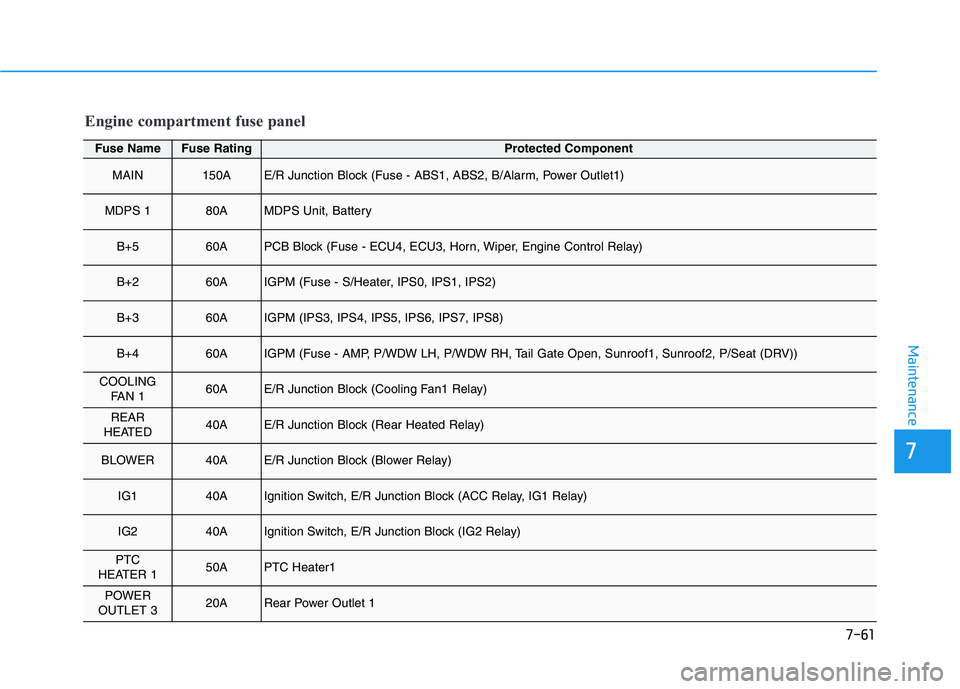
Engine compartment fuse panel
Fuse NameFuse RatingProtected Component
MAIN150AE/R Junction Block (Fuse - ABS1, ABS2, B/Alarm, Power Outlet1)
MDPS 180AMDPS Unit, Battery
B+560APCB Block (Fuse - ECU4, ECU3, Horn, Wiper, Engine Control Relay)
B+260AIGPM (Fuse - S/Heater, IPS0, IPS1, IPS2)
B+360AIGPM (IPS3, IPS4, IPS5, IPS6, IPS7, IPS8)
B+460AIGPM (Fuse - AMP, P/WDW LH, P/WDW RH, Tail Gate Open, Sunroof1, Sunroof2, P/Seat (DRV))
COOLINGFAN 160AE/R Junction Block (Cooling Fan1 Relay)
REAR
HEATED40AE/R Junction Block (Rear Heated Relay)
BLOWER40AE/R Junction Block (Blower Relay)
IG140AIgnition Switch, E/R Junction Block (ACC Relay, IG1 Relay)
IG240AIgnition Switch, E/R Junction Block (IG2 Relay)
PTC
HEATER 150APTC Heater1
POWER
OUTLET 320ARear Power Outlet 1
Page 436 of 486
7-63
7
Maintenance
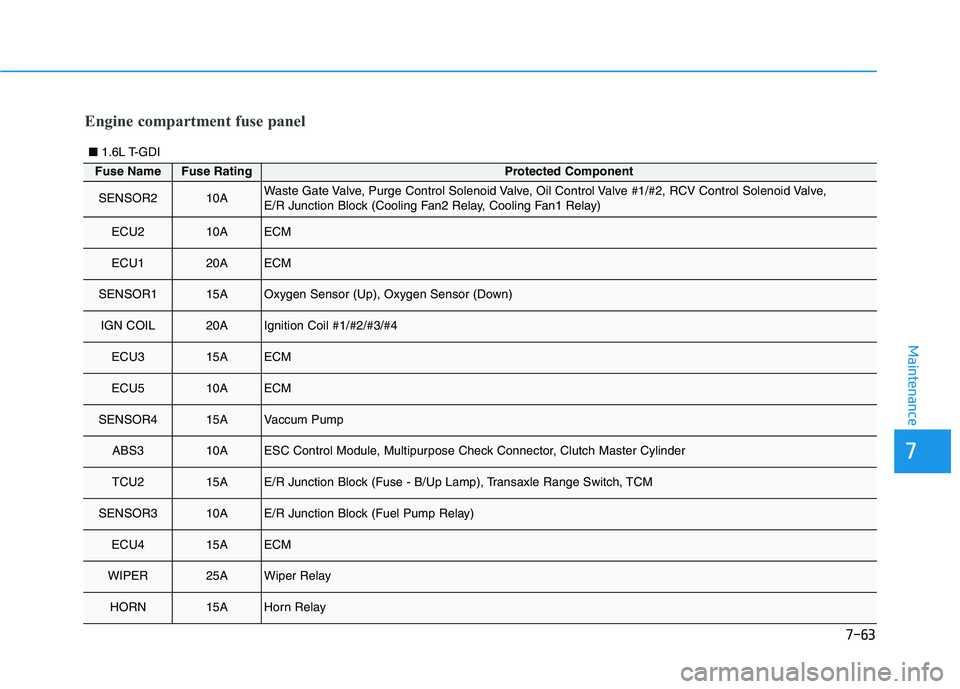
Fuse NameFuse RatingProtected Component
SENSOR210AWaste Gate Valve, Purge Control Solenoid Valve, Oil Control Valve #1/#2, RCV Control Solenoid Valve,
E/R Junction Block (Cooling Fan2 Relay, Cooling Fan1 Relay)
ECU210AECM
ECU120AECM
SENSOR115AOxygen Sensor (Up), Oxygen Sensor (Down)
IGN COIL20AIgnition Coil #1/#2/#3/#4
ECU315AECM
ECU510AECM
SENSOR415AVaccum Pump
ABS310AESC Control Module, Multipurpose Check Connector, Clutch Master Cylinder
TCU215AE/R Junction Block (Fuse - B/Up Lamp), Transaxle Range Switch, TCM
SENSOR310AE/R Junction Block (Fuel Pump Relay)
ECU415AECM
WIPER25AWiper Relay
HORN15AHorn Relay
■ 1.6L T-GDI
Engine compartment fuse panel
Page 437 of 486
7-64
Maintenance
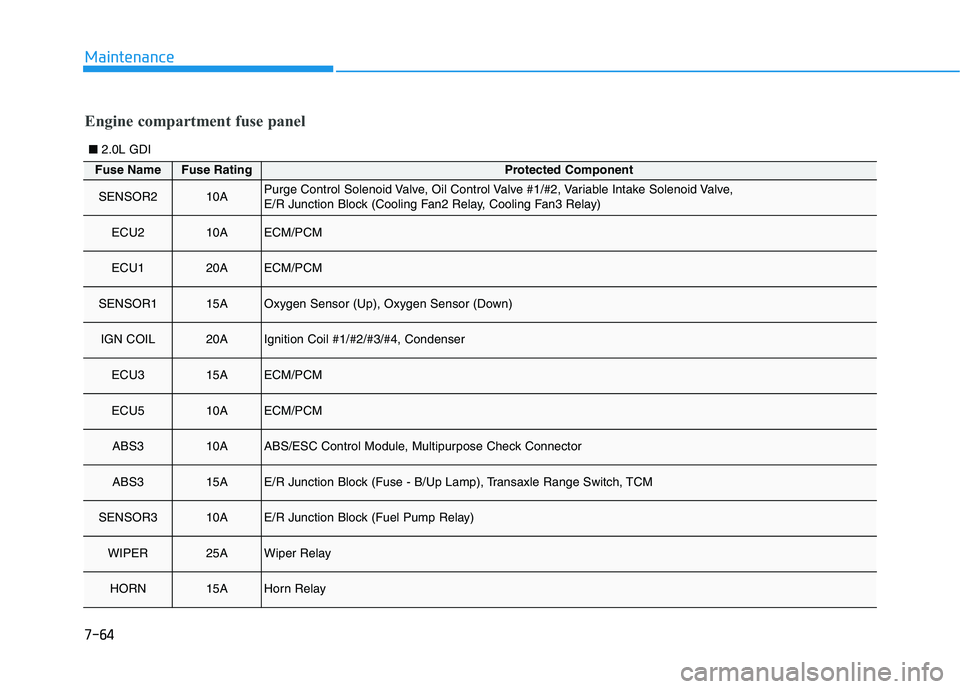
■2.0L GDI
Fuse NameFuse RatingProtected Component
SENSOR210APurge Control Solenoid Valve, Oil Control Valve #1/#2, Variable Intake Solenoid Valve,
E/R Junction Block (Cooling Fan2 Relay, Cooling Fan3 Relay)
ECU210AECM/PCM
ECU120AECM/PCM
SENSOR115AOxygen Sensor (Up), Oxygen Sensor (Down)
IGN COIL20AIgnition Coil #1/#2/#3/#4, Condenser
ECU315AECM/PCM
ECU510AECM/PCM
ABS310AABS/ESC Control Module, Multipurpose Check Connector
ABS315AE/R Junction Block (Fuse - B/Up Lamp), Transaxle Range Switch, TCM
SENSOR310AE/R Junction Block (Fuel Pump Relay)
WIPER25AWiper Relay
HORN15AHorn Relay
Engine compartment fuse panel
Page 438 of 486
7-65
7
Maintenance
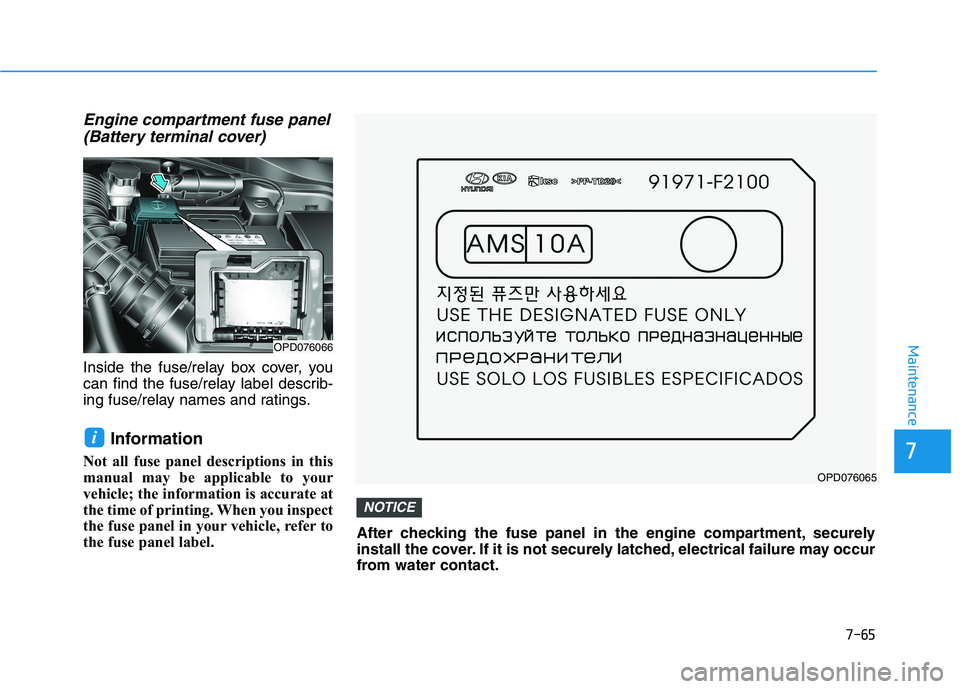
Engine compartment fuse panel(Battery terminal cover)
Inside the fuse/relay box cover, you
can find the fuse/relay label describ-
ing fuse/relay names and ratings.
Information
Not all fuse panel descriptions in this
manual may be applicable to your
vehicle; the information is accurate at
the time of printing. When you inspect
the fuse panel in your vehicle, refer to
the fuse panel label.
i
OPD076066
OPD076065
After checking the fuse panel in the engine compartment, securely
install the cover. If it is not securely latched, electrical failure may occur
from water contact.
NOTICE