key HYUNDAI ELANTRA SEL 2021 Manual PDF
[x] Cancel search | Manufacturer: HYUNDAI, Model Year: 2021, Model line: ELANTRA SEL, Model: HYUNDAI ELANTRA SEL 2021Pages: 570, PDF Size: 52.21 MB
Page 283 of 570
6-24
WARNING
• Whenever leaving the vehicle or
parking, always come to a complete
stop and continue to depress the
brake pedal.
Shift the gear int
o the P (Park)
position, press the EPB switch, and
set the ignition switch to the OFF
position. Take the Key with you when
exiting the vehicle.
Vehicles no
t fully engaged in P (Park)
with the parking brake set are at risk
for moving inadvertently and causing
injury to yourself or others.
• NEVER allow anyone who is
unfamiliar with the vehicle to touch
the EPB switch. If the EPB is released
unintentionally, serious injury may
occur.
• Only release the EPB when you are
seated inside the vehicle with your
foot firmly on the brake pedal.
NOTICE
• Do not apply the accelerator pedal
while the parking brake is engaged.
If you depress the accelerator pedal
with the EPB engaged, a warning will
sound and a message will appear.
Damage to the parking brake may
occur.
• Driving with the parking brake on
can overheat the braking system and
cause premature wear or damage
to brake parts. Make sure the EPB
is released and the Parking Brake
Warning Light is off before driving.
Information
• A clicking sound may be heard while
operating or releasing the EPB. These
conditions are normal and indicate that
the EPB is functioning properly.
• When leaving your keys with a parking
attendant or assistant, make sure to
inform him/her how to operate the
EPB.
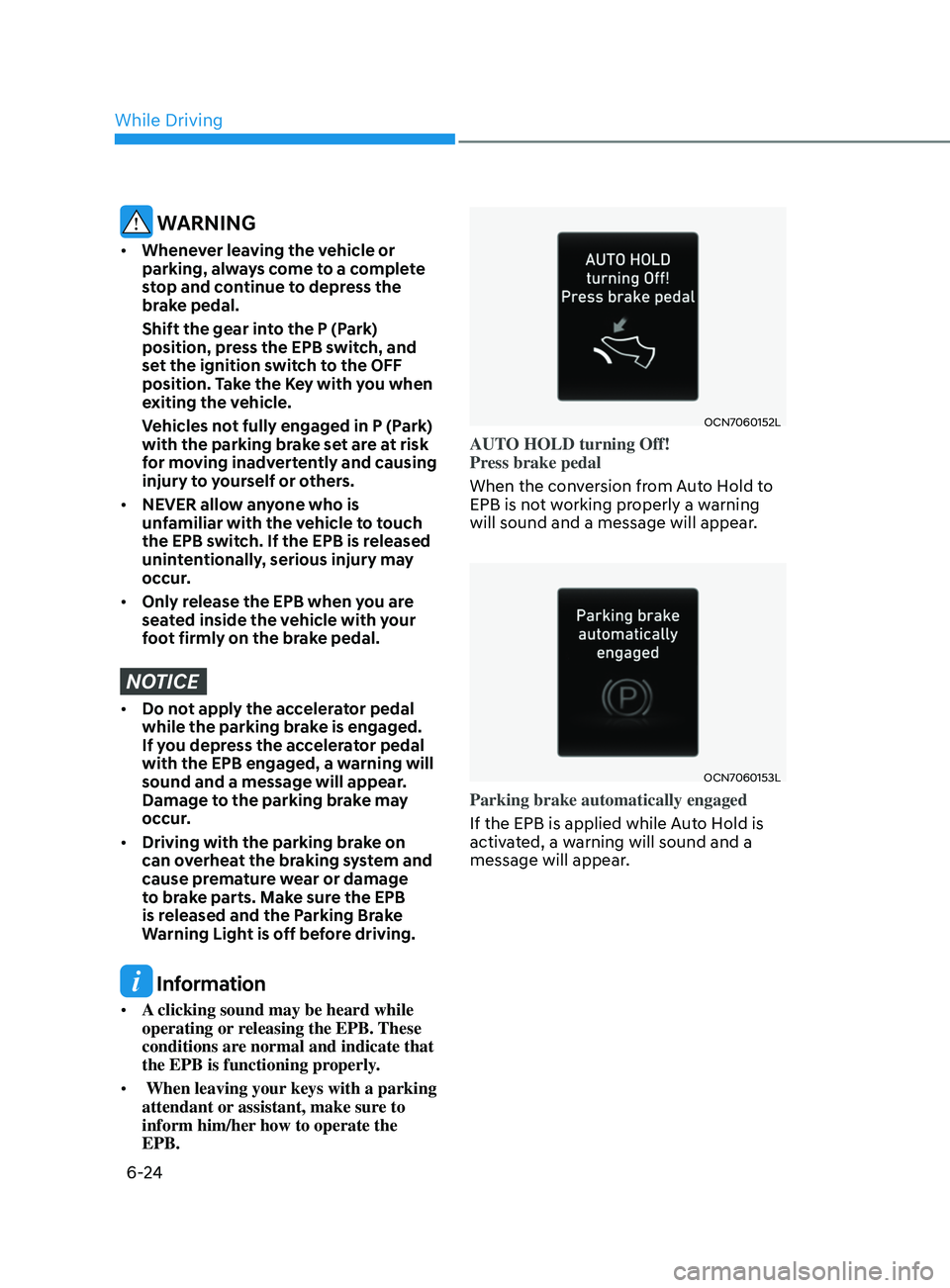
OCN7060152L
AUTO HOLD turning Off!
Press brake pedal
When the conversion from Auto Hold to
EPB is not working properly a warning
will sound and a message will appear.
OCN7060153L
Parking brake automatically engaged
If the EPB is applied while Auto Hold is
activated, a warning will sound and a
message will appear.
While Driving
Page 296 of 570
06
6-37
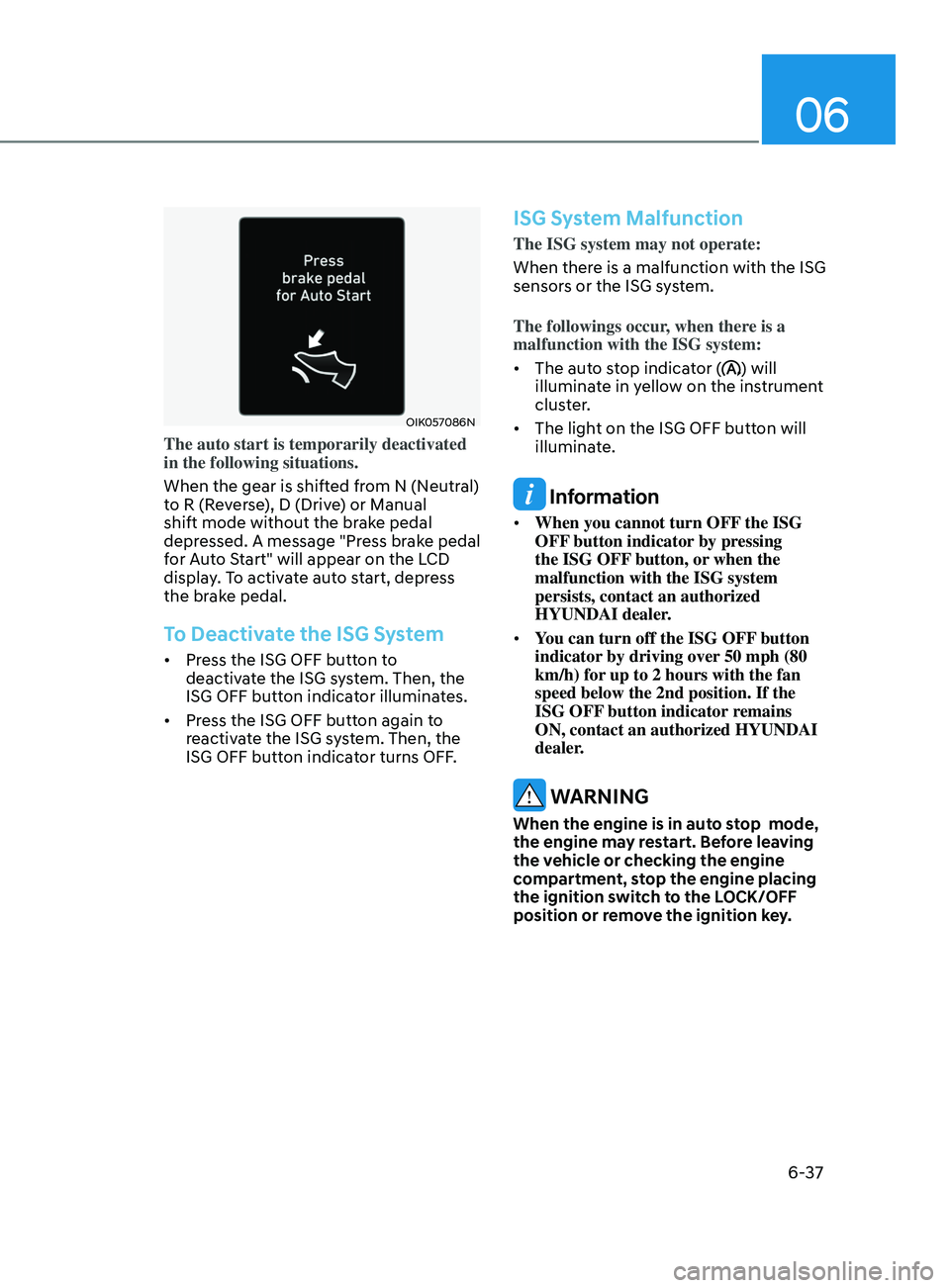
OIK057086N
The auto start is temporarily deactivated
in the following situations.
When the gear is shifted from N (Neutral)
to R (Reverse), D (Drive) or Manual
shift mode without the brake pedal
depressed. A message "Press brake pedal
for Auto Start" will appear on the LCD
display. To activate auto start, depress
the brake pedal.
To Deactivate the ISG System
• Press the ISG OFF button to
deactivate the ISG system. Then, the
ISG OFF button indicator illuminates.
• Press the ISG OFF button again to
reactivate the ISG system. Then, the
ISG OFF button indicator turns OFF.
ISG System Malfunction
The ISG system may not operate:
When there is a malfunction with the ISG
sensors or the ISG system.
The followings occur, when there is a
malfunction with the ISG system:
• The auto stop indicator (
) will
illuminate in yellow on the instrument
cluster.
• The light on the ISG OFF button will
illuminate.
Information
• When you cannot turn OFF the ISG
OFF button indicator by pressing
the ISG OFF button, or when the
malfunction with the ISG system
persists, contact an authorized
HYUNDAI dealer.
• You can turn off the ISG OFF button
indicator by driving over 50 mph (80
km/h) for up to 2 hours with the fan
speed below the 2nd position. If the
ISG OFF button indicator remains
ON, contact an authorized HYUNDAI
dealer.
WARNING
When the engine is in auto stop mode,
the engine may restart. Before leaving
the vehicle or checking the engine
compartment, stop the engine placing
the ignition switch to the LOCK/OFF
position or remove the ignition key.
Page 307 of 570
6-48
Change to "winter weight" oil if
necessary
In some climates it is recommended that
a lower viscosity "winter weight" oil be
used during cold weather. See chapter 8
for recommendations. If you aren't sure
what weight oil you should use, consult
an authorized HYUNDAI dealer.
Check battery and cables
Winter puts additional burdens on the
battery system. Visually inspect the
battery and cables as described in
chapter 8. The level of charge in your
battery can be checked by an authorized
HYUNDAI dealer or a service station.
Check spark plugs and ignition
system
Inspect your spark plugs as described in
chapter 8 and replace them if necessary.
Also check all ignition wiring and
components to be sure they are not
cracked, worn or damaged in any way.
Use approved window washer anti-
freeze in system
To keep the water in the window washer
system from freezing, add an approved
window washer anti-freeze solution in
accordance with instructions on the
container. Window washer anti-freeze is
available from an authorized HYUNDAI
dealer and most auto parts outlets. Do
not use engine coolant or other types
of antifreeze as these may damage the
paint finish.
Do not let your parking brake freeze
Under some conditions your parking
brake can freeze in the engaged position.
This is most likely to happen when
there is an accumulation of snow or
ice around or near the rear brakes or
if the brakes are wet. If there is a risk
the parking brake may freeze, apply
it only temporarily while you put the
gear selector lever in P and block the
rear wheels so the car cannot roll. Then
release the parking brake.
Do not let ice and snow accumulate
underneath
Under some conditions, snow and ice
can build up under the fenders and
interfere with the steering. When driving
in severe winter conditions where this
may happen, you should periodically
check underneath the car to be sure the
movement of the front wheels and the
steering components is not obstructed.
Don't place foreign objects
or materials in the engine
compartment
Placement of foreign object or materials
which prevent cooling of the engine, in
the engine compartment, may cause a
failure or combustion. The manufacturer
is not responsible for the damage caused
by such placement.
To keep locks from freezing
To keep the locks from freezing, squirt
an approved de-icer fluid or glycerine
into the key opening. If a lock is covered
with ice, squirt it with an approved de-
icing fluid to remove the ice. If the lock
is frozen internally, you may be able to
thaw it out by using a heated key. Handle
the heated key with care to avoid injury.
While Driving
Page 531 of 570
09
9-45
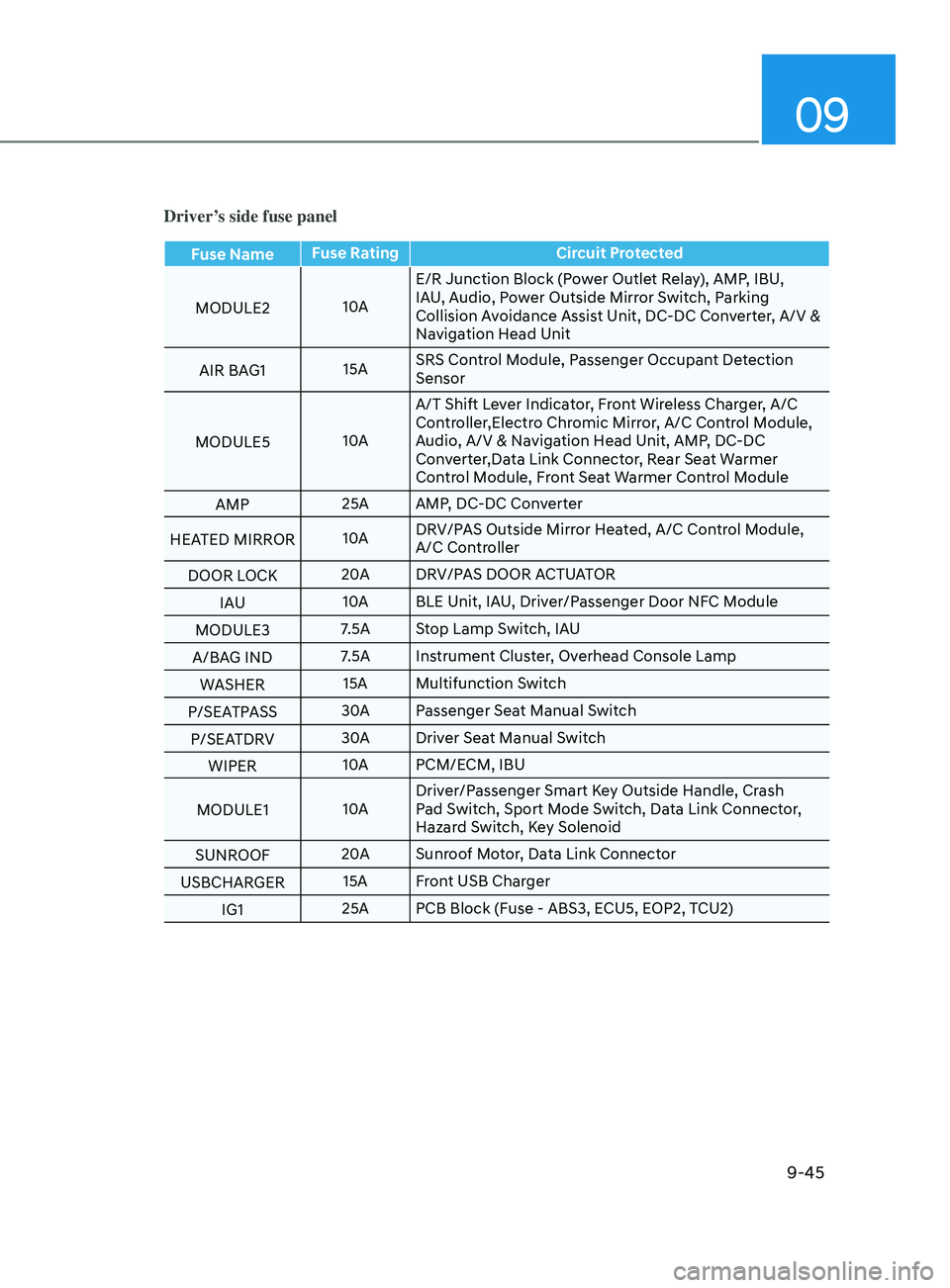
Driver’s side fuse panel
Fuse NameFuse Rating
Circuit Protected
MODULE2 10AE/R Junction Block (Power Outlet Relay), AMP, IBU,
IAU, Audio, Power Outside Mirror Switch, Parking
Collision Avoidance Assist Unit, DC-DC Converter, A/V &
Navigation Head Unit
AIR BAG1 15ASRS Control Module, Passenger Occupant Detection
Sensor
MODULE5 10AA/T Shift Lever Indicator, Front Wireless Charger, A/C
Controller,
Electro Chr
omic Mirror, A/C Control Module,
Audio, A/V & Navigation Head Unit, AMP, DC-DC
Converter,
Data Link Connect
or, Rear Seat Warmer
Control Module, Front Seat Warmer Control Module
AMP 25A AMP, DC-DC Converter
HEATED MIRROR 10ADRV/PAS Outside Mirror Heated, A/C Control Module,
A/C Controller
DOOR LOCK 20A
DRV/PAS DOOR ACTUATOR
IAU 10A
BLE Unit, IAU, Driver/Passenger Door NFC Module
MODULE3 7.5A Stop Lamp Switch, IAU
A/BAG IND 7.5A Instrument Cluster, Overhead Console Lamp
WASHER 15A Multifunction Switch
P/SEAT
P
ASS 30A
Passenger Seat Manual Switch
P/SEAT
DR
V 30A
Driver Seat Manual Switch
WIPER 10A
PCM/ECM, IBU
MODULE1 10ADriver/Passenger Smart Key Outside Handle, Crash
Pad Switch, Sport Mode Switch, Data Link Connector,
Hazard Switch, Key Solenoid
SUNROOF 20A
Sunroof Motor, Data Link Connector
USB
CHAR
GER 15A Front USB Charger
IG1 25A PCB Block (Fuse - ABS3, ECU5, EOP2, TCU2)
Page 536 of 570
Maintenance
9-50
Consult an authorized HYUNDAI dealer
to replace most vehicle light bulbs. It is
difficult to replace vehicle light bulbs
because other parts of the vehicle must
be removed before you can get to the
bulb. This is especially true for removing
the headlamp assembly to get to the
bulb(s).
Removing/installing the headlamp
assembly can result in damage to the
vehicle.
Information
The headlamp and tail lamp lenses could
appear frosty if the vehicle is washed after
driving or the vehicle is driven at night in
wet weather. This condition is caused by
temperature difference between the lamp
inside and outside and does not indicate
a problem with your vehicle. When
moisture condenses in the lamp, it will be
removed after driving with the headlamp
on. The removable level may differ
depending on lamp size, lamp position
and environmental condition. However, if
moisture is not removed, have the vehicle
inspected by an authorized HYUNDAI
dealer.
WARNING
• Prior to replacing a lamp, depress
the foot brake, move the shift button
into P (Park) apply the parking brake,
place the ignition switch to the
LOCK/OFF position, and take the key
with you when leaving the vehicle
to avoid sudden movement of the
vehicle and to prevent possible
electric shock.
• Be aware the bulbs may be hot and
may burn your fingers.
• When the bulb is disconnected or the
lamp connector is removed while the
lamp is operating normally, the fuse
box electronics may recognize the
lamp as a malfunction. Therefore, a
fault record for the lamp may remain
in the Diagnostic Trouble Code (DTC)
recorded in the fuse box.
NOTICE
Be sure to replace the burned-out bulb
with one of the same wattage rating.
Otherwise, it may cause damage to the
fuse or electrical wiring system.
Information
The headlamp aiming should be adjusted
after an accident or after the headlamp
assembly is reinstalled at an authorized
HYUNDAI dealer.
light BulBS
Page 552 of 570
Maintenance
9-66
Leather (if equipped)
• Features of seat leather
- Lea
ther is made from the outer skin
of an animal, which goes through a
special process to be available for
use. Since it is a natural product,
each part differs in thickness or
density.
Wrinkles may appear as a natural
result of stretching and shrinking
depending on the temperature and
humidity.
- The seat is made o
f stretchable
fabric to improve comfort.
- The parts contacting the body ar
e
curved and the side supporting
area is high which provides driving
comfort and stability.
- Wrinkles ma
y appear naturally
from usage. It is not a fault of the
products.
CAUTION
• Wrinkles or abrasions which appear
naturally from usage are not covered
by warranty.
• Belts with metallic accessories,
zippers or keys inside the back
pocket may damage the seat fabric.
• Make sure not to wet the seat. It may
change the nature of natural leather.
• Jeans or clothes which could bleach
may contaminate the surface of the
seat covering fabric. •
Caring for the leather seats
- Vacuum the sea
t periodically to
remove dust and sand on the seat. It
will prevent abrasion or damage of
the leather and maintain its quality.
- Wipe the natur
al leather seat cover
often with dry or soft cloth.
- Use o
f proper leather protector may
prevent abrasion of the cover and
helps maintain the color. Be sure to
read the instructions and consult
a specialist when using leather
coating or protective agent.
- Light color
ed (beige, cream beige)
leather is easily contaminated and
the stain is noticeable. Clean the
seats frequently.
- Av
oid wiping with wet cloth. It may
cause the surface to crack.
• Cleaning the leather seats
- Remo
ve all contaminations
instantly. Refer to instructions below
for removal of each contaminant. - Cosmetic pr oducts (sunscreen,
foundation, etc.)
Apply cleansing cream on a cloth
and wipe the contaminated spot.
Wipe off the cream with a wet cloth
and remove water with a dry cloth.
- Bev
erages (coffee, soft drink, etc.)
Apply a small amount of neutral
detergent and wipe until
contaminations do not smear.
- Oil Remo
ve oil instantly with
absorbable cloth and wipe with
stain remover used only for natural
leather.
- Chewing gum
Har
den the gum with ice and
remove gradually.
Page 557 of 570
09
9-71
Perchlorate Material-special handling may apply, See:
www.dtsc.ca.gov/hazardouswaste/perchlorate.
Notice to California Vehicle Dismantlers:
Perchlorate containing materials, such as air bag inflators, seatbelt pretensioners and
keyless remote entry batteries, must be disposed of according to Title 22 California
Code of Regulations Section 67384.10 (a).
California pErChloratE no tiCE
Page 559 of 570

Index
I-2
A
Accessing Your Vehicle
........................................................................\
.................5-4
Automatic Door Lock and Unlock Features ....................................................5-35
Child-Protector Rear Door Locks .................................................................... 5-35
Hyundai Digital Key ........................................................................\
................ 5-15
Immobilizer System ........................................................................\
................5-14
Operating Door Locks from Inside the V
ehicle................................................ 5-33
Operating Door Locks from Outside the V
ehicle
.............................................5-31
Rear Occupant Alert (ROA) System ................................................................ 5-36
Remote Key ........................................................................\
................................ 5-4
Smart Key ........................................................................\
................................... 5-7
Air Bag -
Advanced Supplemental Restraint System
.......................................... 3-35
Additional Safety Precautions ........................................................................\
.. 3-55
Air Bag W
arning Labels
........................................................................\
........... 3-55
How Does the Air Bag System Operate? .........................................................3-40
Occupant Classification System (OCS) ........................................................... 3-44
SRS Care ........................................................................\
.................................. 3-54
What to Expect After an
Air Bag Inflates
........................................................ 3-43
Where Are
the Air Bags?
........................................................................\
.......... 3-37
Why Didn’t My
Air Bag Go Off in a Collision?
.............................................. 3-50
Air Cleaner
........................................................................\
................................... 9-20
Filter replacement ........................................................................\
..................... 9-20
Air Conditioning System
........................................................................\
............. 2-10
Anti-lock Brake System (ABS)
........................................................................\
... 6-29
Electronic Stability Control (ESC) ..................................................................6-31
Good Braking Practices ........................................................................\
............ 6-34
Hill-Start Assist Control (HAC) .......................................................................6-34
Vehicle Stability Management (VSM) ............................................................6-33
Appearance Care
........................................................................\
.......................... 9-59
Exterior Care ........................................................................\
............................ 9-59
Interior Care ........................................................................\
............................. 9-65
Automatic Climate Control System
..................................................................... 5-92
Automatic heating and air conditioning ...........................................................5-93
Manual heating and air conditioning ................................................................ 5-94
System Maintenance ........................................................................\
.............. 5-102
System operation ........................................................................\
.................... 5-100
Page 563 of 570
 ........................................................................\
7-109
Function malfunction and limitations ...........................................")
Index
I-6
Highway Driving Assist (HDA) ........................................................................\
7-109
Function malfunction and limitations ............................................................7-1
13
Function operation ........................................................................\
..................7
-111
Function settings ........................................................................\
....................7-1
10
Hood
........................................................................\
............................................ 5-59
How to Use
This Manual
........................................................................\
............... 1-4
I
If the Engine Overheats
........................................................................\
................. 8-6
If the Engine
Will not Start
........................................................................\
............ 8-3
If the Engine Doesn’t
Turn Over or Turns Over Slowly
....................................8-3
If the Engine T
urns Over Normally but Doesn’t Start
....................................... 8-3
If you Have a Flat
Tire (With spare tire)
............................................................. 8-14
Changing Tires ........................................................................\
......................... 8-15
Jack and T
ools
........................................................................\
.......................... 8-14
Ignition Switch
........................................................................\
.............................. 6-5
Engine Start/Stop Button ........................................................................\
............6-8
Key Ignition Switch ........................................................................\
.................. 6-5
Important Safety Precautions
........................................................................\
......... 3-2
Air Bag Hazards ........................................................................\
......................... 3-2
Always W
ear Your Seat Belt
........................................................................\
...... 3-2
Control Your
Speed
........................................................................\
.................... 3-2
Driver Distraction ........................................................................\
....................... 3-2
Keep Y
our Vehicle in Safe Condition
................................................................. 3-2
Restrain All
Children
........................................................................\
.................. 3-2
In Case of an Emer
gency While Driving
............................................................... 8-2
If the Engine Stalls at a Crossroad or Crossing ..................................................8-2
If the Engine Stalls While Driving ..................................................................... 8-2
If you Have a Flat T
ire While Driving
............................................................... 8-3
Infotainment System
........................................................................\
.................. 5-1
17
Antenna ........................................................................\
..................................5-1
18
Bluetooth® Wireless Technology hands-free ..................................................5-120
How vehicle radio works ........................................................................\
........ 5-121
Infotainment system ........................................................................\
............... 5-120
Steering wheel audio control ........................................................................\
..5-1
19
USB Port ........................................................................\
................................5-1
17
Voice recognition ........................................................................\
....................5-120