tow HYUNDAI ENTOURAGE 2009 Owners Manual
[x] Cancel search | Manufacturer: HYUNDAI, Model Year: 2009, Model line: ENTOURAGE, Model: HYUNDAI ENTOURAGE 2009Pages: 402, PDF Size: 9.08 MB
Page 12 of 402
13
Introduction
Use of MTBEHyundai recommends that fuels contain-
ing MTBE (Methyl Tertiary Butyl Ether)
over 15.0% vol. (Oxygen Content 2.7%
weight) should not be used in your
Hyundai.
Fuel containing MTBE over 15.0% vol.
(Oxygen Content 2.7% weight) may
reduce vehicle performance and produce
vapor lock or hard starting.Do Not Use MethanolFuels containing methanol (wood alco-
hol) should not be used in your Hyundai.
This type of fuel can reduce vehicle per-
formance and damage components of
the fuel system.
Gasolines for Cleaner AirTo help contribute to cleaner air, Hyundai
recommends that you use gasolines
treated with detergent additives, which
help prevent deposit formation in the
engine. These gasolines will help the
engine run cleaner and enhance per-
formance of the Emission Control
System.Operation in Foreign CountriesIf you are going to drive your Hyundai in
another country, be sure to:
Observe all regulations regarding reg-
istration and insurance.
Determine that acceptable fuel is avail-
able.
During the First 1,200 Miles (2,000
Km)No formal "break-in" procedure is
required with your new Hyundai.
However, you can contribute to the eco-
nomical operation and durability of your
Hyundai by observing the following rec-
ommendations during the first 1,200
miles (2,000 km).
Don't drive faster than 55 MPH (88
km/h).
While driving, keep your engine speed
(rpm, or revolutions per minute)
between 2,000 rpm and 4,000 rpm.
Use moderate acceleration. Don't start
quickly or depress the accelerator
pedal fully.
For the first 200 miles (300 km), try to
avoid hard stops.
Whether going fast or slow, vary your
speed from time to time.
Don't let the engine idle longer than 3
minutes at one time.
Don't tow a trailer during the first 1,200
miles (2,000 km) of operation.
CAUTION
Your Hyundai's New Vehicle Limited
Warranty may not cover damage to
the fuel system and any perform-
ance problems that are caused by
the use of fuels containing
methanol or fuels containing MTBE
(Methyl Tertiary Butyl Ether) over
15.0% vol. (Oxygen Content 2.7%
weight.)
VEHICLE BREAK-IN PROCESS
Page 21 of 402
35
Features of your vehicle
✽ ✽
NOTICEThe power sliding door and power tail-
gate are not opened by pressing the cor-
responding button on the transmitter
directly when all power sliding doors
and power tailgate are locked and
closed. To open the power sliding door
or power tailgate from outside vehicle,
press the unlock button twice within 3
seconds first and press corresponding
power sliding door or power tailgate
opening button.(6) Alarm ( )
The horn sounds and hazard warning
lights flash for about 27 seconds if
this button is pressed. To stop the
horn and lights, press any button on
the transmitter.
✽ ✽
NOTICEThe transmitter will not work if any of
following occur:
• The ignition key is in ignition switch.
• You exceed the operating distance
limit (about 90 feet [30 m]).
• The battery in the transmitter is
weak.
• Other vehicles or objects may be
blocking the signal.
• The weather is extremely cold.
• The transmitter is close to a radio
transmitter such as a radio station or
an airport which can interfere with
normal operation of the transmitter.
When the transmitter does not work
correctly, open and close the door with
the ignition key. If you have a problem
with the transmitter, contact an author-
ized Hyundai Dealer.
Operational distance may vary depend-
ing upon the area the transmitter is used
in. For example, if the vehicle is parked
near police stations, government and
public offices, broadcasting stations, mil-
itary installations, airports, or transmit-
ting towers, etc.
CAUTION
The power doors can be operated
when the engine is not running.
However, the power doors consume
large amounts of vehicle electric
power. To prevent the battery from
being discharged, do not operate
them consecutively (more than
approximately 10 times).
CAUTION
Keep the transmitter away from
water or any liquid. If the keyless
entry system is inoperative due to
exposure to water or liquids, it will
not be covered by your manufactur-
er vehicle warranty.
Page 26 of 402
Features of your vehicle10 34. If all of the digits have been input suc-
cessfully, you have to start the engine
within 30 seconds. If you attempt to
start the engine after 30 seconds, the
engine will not start and you will have
to input your password again.
After performing the limp home proce-
dure, you have to see an authorized
Hyundai dealer immediately to inspect
and repair your ignition key or immobiliz-
er system.
This device complies with Part 15 of
the FCC rules.Operation is subject to
the following two conditions:
1. This device may not cause harmful
interference, and
2. This device must accept any interfer-
ence received, including interference
that may cause undesired operation.
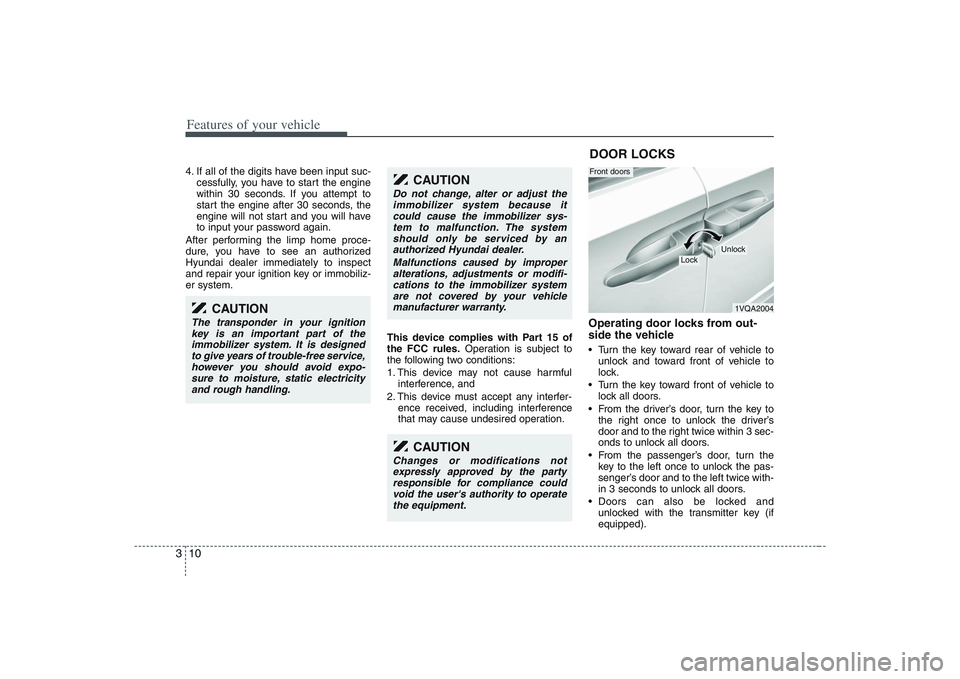
Operating door locks from out-
side the vehicle Turn the key toward rear of vehicle to
unlock and toward front of vehicle to
lock.
Turn the key toward front of vehicle to
lock all doors.
From the driver’s door, turn the key to
the right once to unlock the driver’s
door and to the right twice within 3 sec-
onds to unlock all doors.
From the passenger’s door, turn the
key to the left once to unlock the pas-
senger’s door and to the left twice with-
in 3 seconds to unlock all doors.
Doors can also be locked and
unlocked with the transmitter key (if
equipped).
CAUTION
The transponder in your ignition
key is an important part of the
immobilizer system. It is designed
to give years of trouble-free service,
however you should avoid expo-
sure to moisture, static electricity
and rough handling.
CAUTION
Do not change, alter or adjust the
immobilizer system because it
could cause the immobilizer sys-
tem to malfunction. The system
should only be serviced by an
authorized Hyundai dealer.
Malfunctions caused by improper
alterations, adjustments or modifi-
cations to the immobilizer system
are not covered by your vehicle
manufacturer warranty.
CAUTION
Changes or modifications not
expressly approved by the party
responsible for compliance could
void the user's authority to operate
the equipment.
DOOR LOCKS
1VQA2004
Lock
Unlock
Front doors
Page 27 of 402
311
Features of your vehicle
Once the doors are unlocked, they may
be opened by pulling the door handle.
To close the door, push the door by
hand. Make sure that doors are closed
securely.
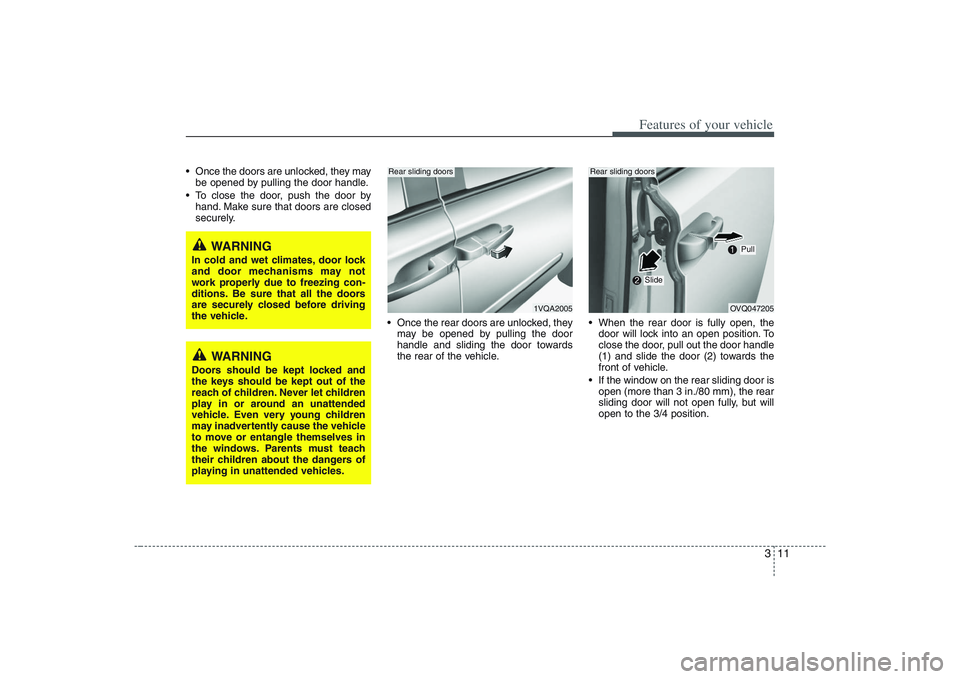
Once the rear doors are unlocked, they
may be opened by pulling the door
handle and sliding the door towards
the rear of the vehicle. When the rear door is fully open, the
door will lock into an open position. To
close the door, pull out the door handle
(1) and slide the door (2) towards the
front of vehicle.
If the window on the rear sliding door is
open (more than 3 in./80 mm), the rear
sliding door will not open fully, but will
open to the 3/4 position.
1VQA2005
Rear sliding doors
WARNING
In cold and wet climates, door lock
and door mechanisms may not
work properly due to freezing con-
ditions. Be sure that all the doors
are securely closed before driving
the vehicle.
WARNING
Doors should be kept locked and
the keys should be kept out of the
reach of children. Never let children
play in or around an unattended
vehicle. Even very young children
may inadvertently cause the vehicle
to move or entangle themselves in
the windows. Parents must teach
their children about the dangers of
playing in unattended vehicles.
OVQ047205
Rear sliding doors
Pull
Slide
Page 52 of 402
Features of your vehicle36 3
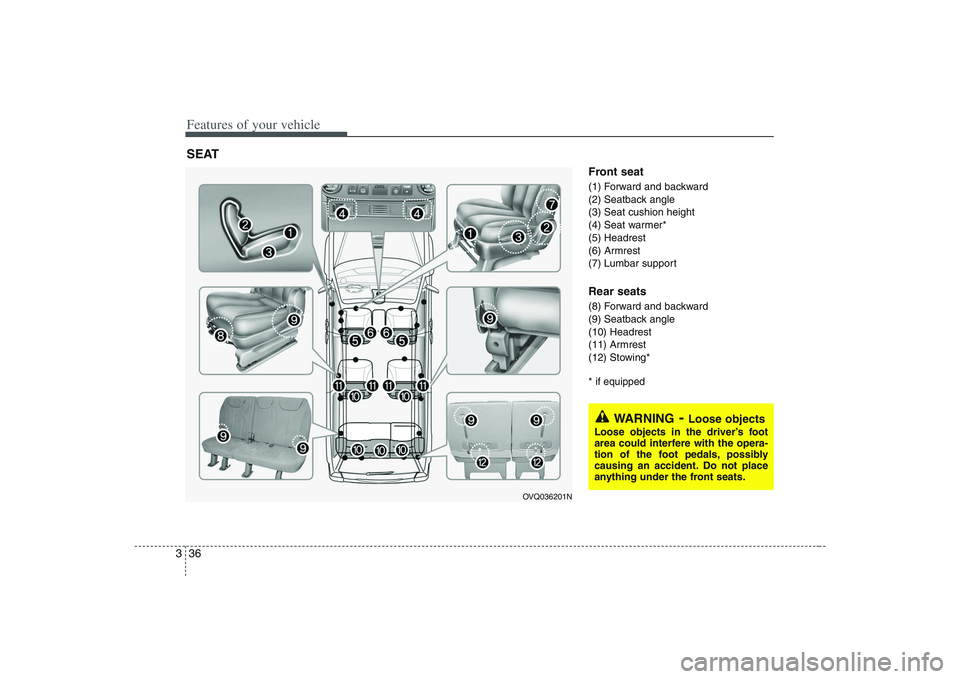
Front seat(1) Forward and backward
(2) Seatback angle
(3) Seat cushion height
(4) Seat warmer*
(5) Headrest
(6) Armrest
(7) Lumbar supportRear seats(8) Forward and backward
(9) Seatback angle
(10) Headrest
(11) Armrest
(12) Stowing** if equipped
SEAT
OVQ036201N
WARNING
- Loose objects
Loose objects in the driver’s foot
area could interfere with the opera-
tion of the foot pedals, possibly
causing an accident. Do not place
anything under the front seats.
Page 70 of 402
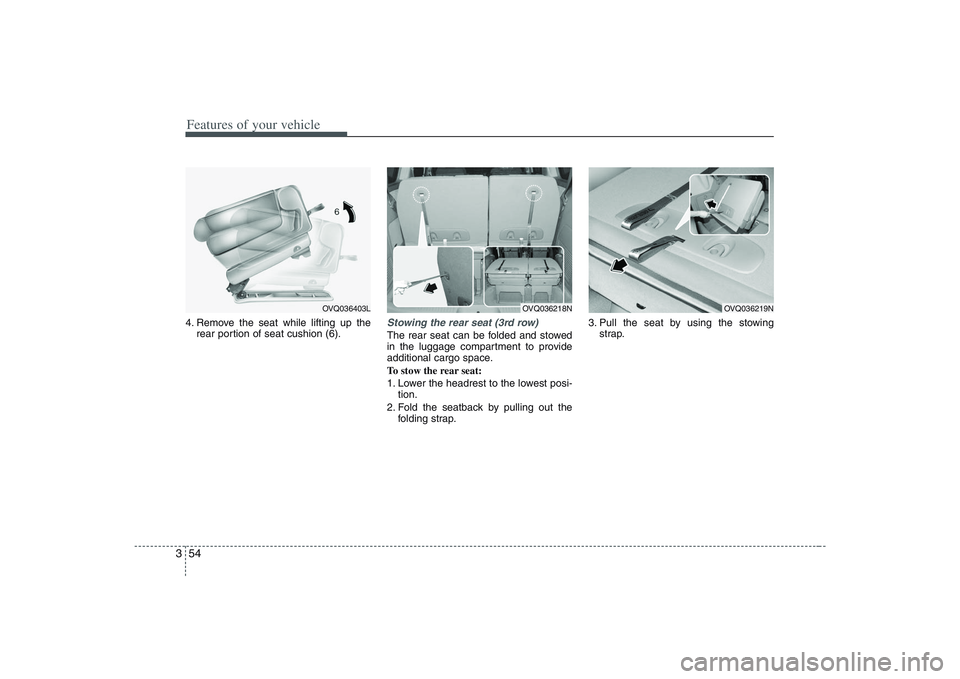
Features of your vehicle54 34. Remove the seat while lifting up the
rear portion of seat cushion (6).
Stowing the rear seat (3rd row)The rear seat can be folded and stowed
in the luggage compartment to provide
additional cargo space.
To stow the rear seat:
1. Lower the headrest to the lowest posi-
tion.
2. Fold the seatback by pulling out the
folding strap.3. Pull the seat by using the stowing
strap.
OVQ036218N
OVQ036219N
OVQ036403L
Page 71 of 402
355
Features of your vehicle
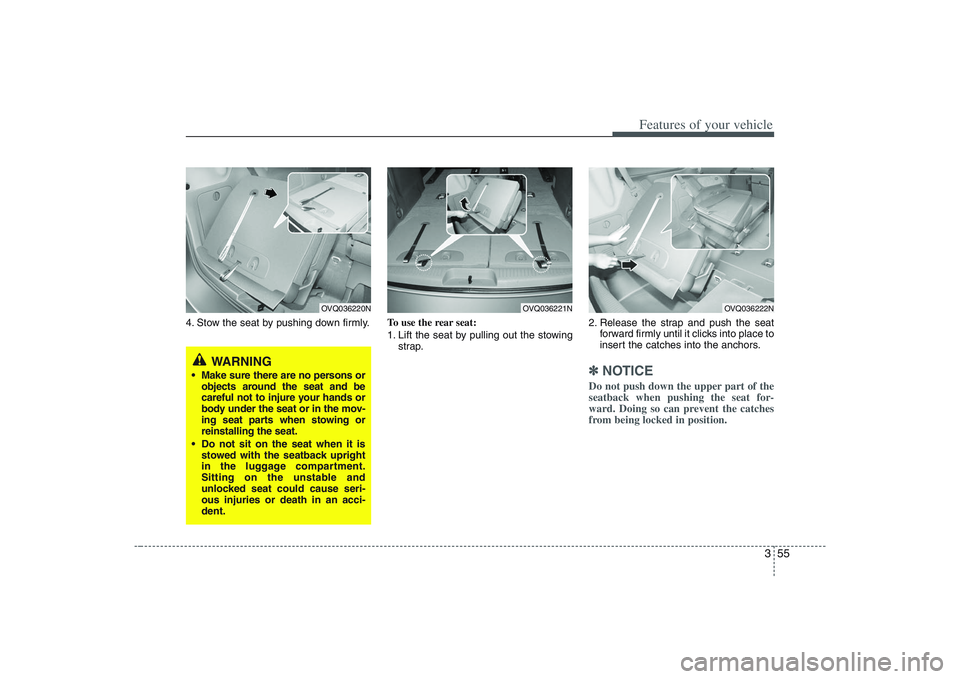
4. Stow the seat by pushing down firmly.To use the rear seat:
1. Lift the seat by pulling out the stowing
strap.2. Release the strap and push the seat
forward firmly until it clicks into place to
insert the catches into the anchors.
✽ ✽
NOTICEDo not push down the upper part of the
seatback when pushing the seat for-
ward. Doing so can prevent the catches
from being locked in position.
WARNING
Make sure there are no persons or
objects around the seat and be
careful not to injure your hands or
body under the seat or in the mov-
ing seat parts when stowing or
reinstalling the seat.
Do not sit on the seat when it is
stowed with the seatback upright
in the luggage compartment.
Sitting on the unstable and
unlocked seat could cause seri-
ous injuries or death in an acci-
dent.
OVQ036220N
OVQ036221N
OVQ036222N
Page 75 of 402
359
Features of your vehicle
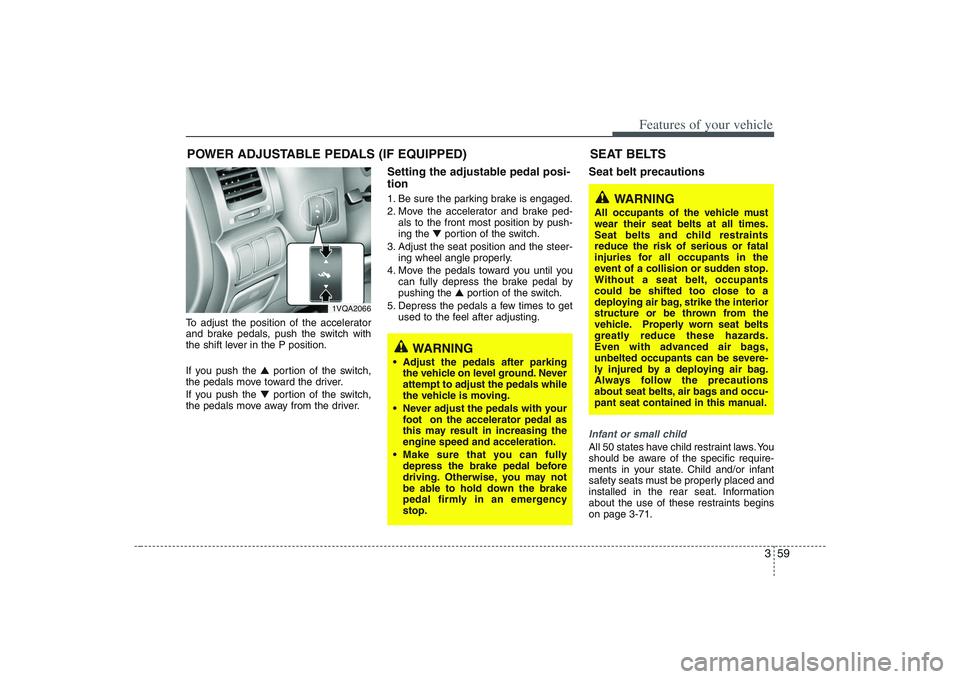
To adjust the position of the accelerator
and brake pedals, push the switch with
the shift lever in the P position.
If you push the ▲portion of the switch,
the pedals move toward the driver.
If you push the ▼portion of the switch,
the pedals move away from the driver.
Setting the adjustable pedal posi-
tion1. Be sure the parking brake is engaged.
2. Move the accelerator and brake ped-
als to the front most position by push-
ing the ▼portion of the switch.
3. Adjust the seat position and the steer-
ing wheel angle properly.
4. Move the pedals toward you until you
can fully depress the brake pedal by
pushing the ▲portion of the switch.
5. Depress the pedals a few times to get
used to the feel after adjusting.
Seat belt precautionsInfant or small childAll 50 states have child restraint laws. You
should be aware of the specific require-
ments in your state. Child and/or infant
safety seats must be properly placed and
installed in the rear seat. Information
about the use of these restraints begins
on page 3-71.
POWER ADJUSTABLE PEDALS (IF EQUIPPED)
1VQA2066
WARNING
Adjust the pedals after parking
the vehicle on level ground. Never
attempt to adjust the pedals while
the vehicle is moving.
Never adjust the pedals with your
foot on the accelerator pedal as
this may result in increasing the
engine speed and acceleration.
Make sure that you can fully
depress the brake pedal before
driving. Otherwise, you may not
be able to hold down the brake
pedal firmly in an emergency
stop.
SEAT BELTS
WARNING
All occupants of the vehicle must
wear their seat belts at all times.
Seat belts and child restraints
reduce the risk of serious or fatal
injuries for all occupants in the
event of a collision or sudden stop.
Without a seat belt, occupants
could be shifted too close to a
deploying air bag, strike the interior
structure or be thrown from the
vehicle. Properly worn seat belts
greatly reduce these hazards.
Even with advanced air bags,
unbelted occupants can be severe-
ly injured by a deploying air bag.
Always follow the precautions
about seat belts, air bags and occu-
pant seat contained in this manual.
Page 83 of 402
367
Features of your vehicle
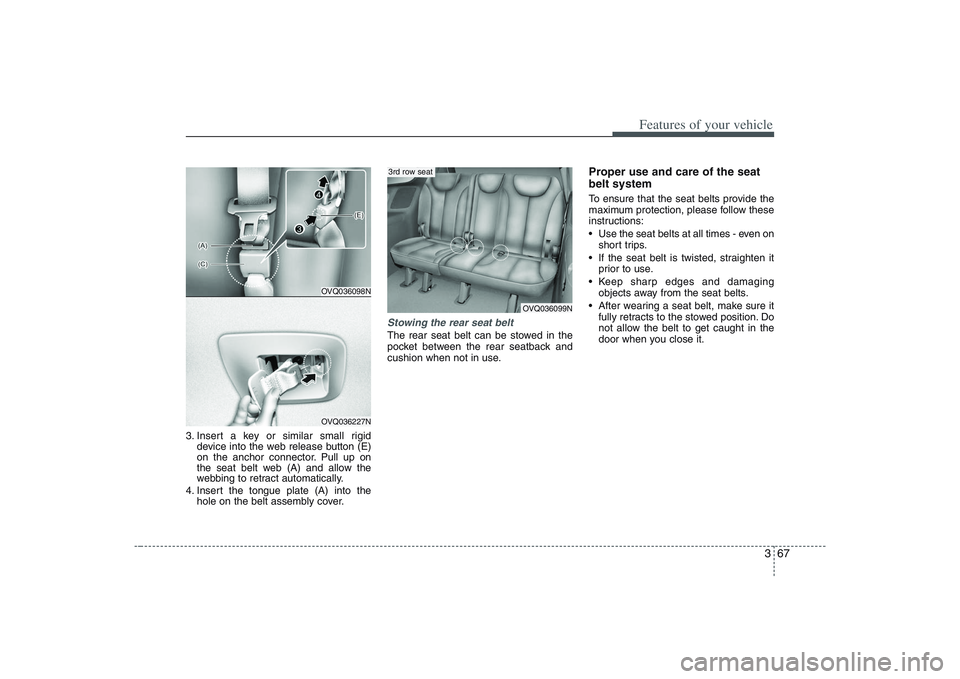
3. Insert a key or similar small rigid
device into the web release button (E)
on the anchor connector. Pull up on
the seat belt web (A) and allow the
webbing to retract automatically.
4. Insert the tongue plate (A) into the
hole on the belt assembly cover.
Stowing the rear seat belt The rear seat belt can be stowed in the
pocket between the rear seatback and
cushion when not in use.
Proper use and care of the seat
belt system To ensure that the seat belts provide the
maximum protection, please follow these
instructions:
Use the seat belts at all times - even on
short trips.
If the seat belt is twisted, straighten it
prior to use.
Keep sharp edges and damaging
objects away from the seat belts.
After wearing a seat belt, make sure it
fully retracts to the stowed position. Do
not allow the belt to get caught in the
door when you close it.
OVQ036099N
OVQ036098NOVQ036227N
3rd row seat
Page 93 of 402
377
Features of your vehicle
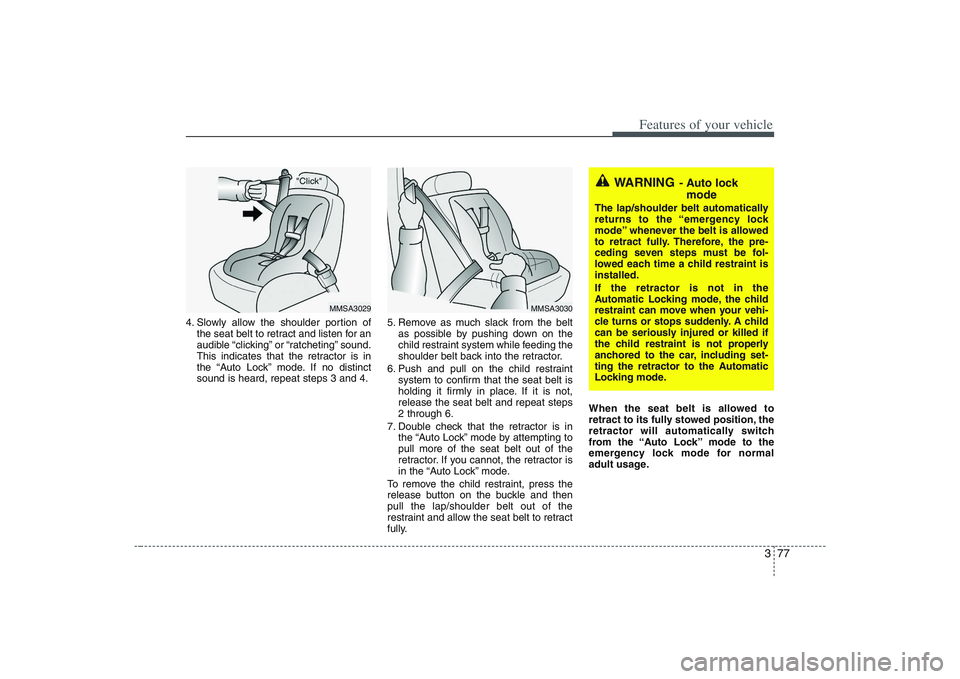
4. Slowly allow the shoulder portion of
the seat belt to retract and listen for an
audible “clicking” or “ratcheting” sound.
This indicates that the retractor is in
the “Auto Lock” mode. If no distinct
sound is heard, repeat steps 3 and 4.5. Remove as much slack from the belt
as possible by pushing down on the
child restraint system while feeding the
shoulder belt back into the retractor.
6. Push and pull on the child restraint
system to confirm that the seat belt is
holding it firmly in place. If it is not,
release the seat belt and repeat steps
2 through 6.
7. Double check that the retractor is in
the “Auto Lock” mode by attempting to
pull more of the seat belt out of the
retractor. If you cannot, the retractor is
in the “Auto Lock” mode.
To remove the child restraint, press the
release button on the buckle and then
pull the lap/shoulder belt out of the
restraint and allow the seat belt to retract
fully.When the seat belt is allowed to
retract to its fully stowed position, the
retractor will automatically switch
from the “Auto Lock” mode to the
emergency lock mode for normal
adult usage.
MMSA3029
MMSA3030
WARNING
- Auto lock
mode
The lap/shoulder belt automatically
returns to the “emergency lock
mode” whenever the belt is allowed
to retract fully. Therefore, the pre-
ceding seven steps must be fol-
lowed each time a child restraint is
installed.
If the retractor is not in the
Automatic Locking mode, the child
restraint can move when your vehi-
cle turns or stops suddenly. A child
can be seriously injured or killed if
the child restraint is not properly
anchored to the car, including set-
ting the retractor to the Automatic
Locking mode.