sensor Hyundai Equus 2010 Owner's Guide
[x] Cancel search | Manufacturer: HYUNDAI, Model Year: 2010, Model line: Equus, Model: Hyundai Equus 2010Pages: 374, PDF Size: 41.29 MB
Page 250 of 374

Driving your vehicle
46
5
This system detects the lane with the
sensor at the front windshield and warns
you when your vehicle leaves the lane. To operate the LDWS, pull the switch or
press the switch with the engine
start/stop button in the ON position. The
indicator illuminates on the cluster. To
cancel the LDWS, pull the switch or
press the switch again.
LANE DEPARTURE WARNING SYSTEM (LDWS) (IF EQUIPPED)
OVI059012
OVI059013
WARNING
The LDWS does not make the vehicle change lanes. It is driver's
responsibility to always check
the road conditions.
Do not turn the steering wheel suddenly, when the LDWS warns
that your vehicle leaving the lane.
If the sensor can not detect the lane or if the vehicle speed does
not exceed 60km/h, the LDWS
won't warn you even though vehi-
cle leaves the lane.
If your vehicle has window tint or other types of coating on the
front windshield, the LDWS may
not work properly.
Prevent the LDWS sensor from water or any liquid.
Do not remove the LDWS parts and do not affect the sensor by a
strong impact.
Do not put objects that reflect light on the dash board.
Always check the road conditions because you may not hear the
warning chime because of audio,
and external conditions.
OVI059062L
Type AType B
Page 252 of 374
Driving your vehicle
48
5
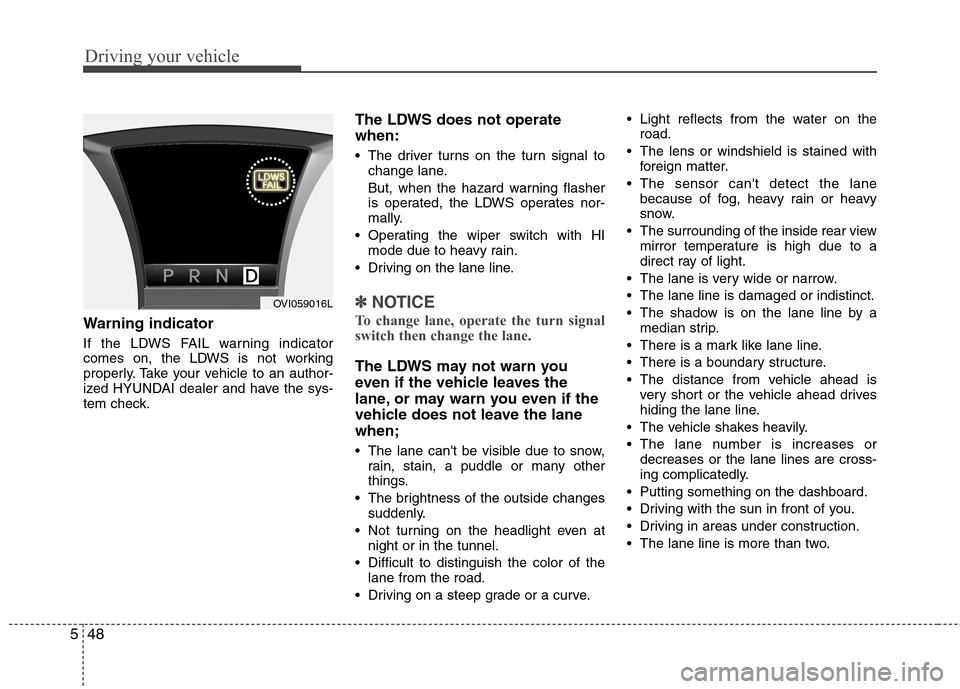
Warning indicator
If the LDWS FAIL warning indicator
comes on, the LDWS is not working
properly. Take your vehicle to an author-
ized HYUNDAI dealer and have the sys-
tem check. The LDWS does not operate when:
The driver turns on the turn signal to
change lane.
But, when the hazard warning flasher
is operated, the LDWS operates nor-
mally.
Operating the wiper switch with HI mode due to heavy rain.
Driving on the lane line.
✽✽ NOTICE
To change lane, operate the turn signal
switch then change the lane.
The LDWS may not warn you
even if the vehicle leaves the
lane, or may warn you even if the
vehicle does not leave the lanewhen;
The lane can't be visible due to snow, rain, stain, a puddle or many other
things.
The brightness of the outside changes suddenly.
Not turning on the headlight even at night or in the tunnel.
Difficult to distinguish the color of the lane from the road.
Driving on a steep grade or a curve. Light reflects from the water on the
road.
The lens or windshield is stained with foreign matter.
The sensor can't detect the lane because of fog, heavy rain or heavy
snow.
The surrounding of the inside rear view mirror temperature is high due to a
direct ray of light.
The lane is very wide or narrow.
The lane line is damaged or indistinct.
The shadow is on the lane line by a median strip.
There is a mark like lane line.
There is a boundary structure.
The distance from vehicle ahead is very short or the vehicle ahead drives
hiding the lane line.
The vehicle shakes heavily.
The lane number is increases or decreases or the lane lines are cross-
ing complicatedly.
Putting something on the dashboard.
Driving with the sun in front of you.
Driving in areas under construction.
The lane line is more than two.
OVI059016L
Page 253 of 374
549
Driving your vehicle
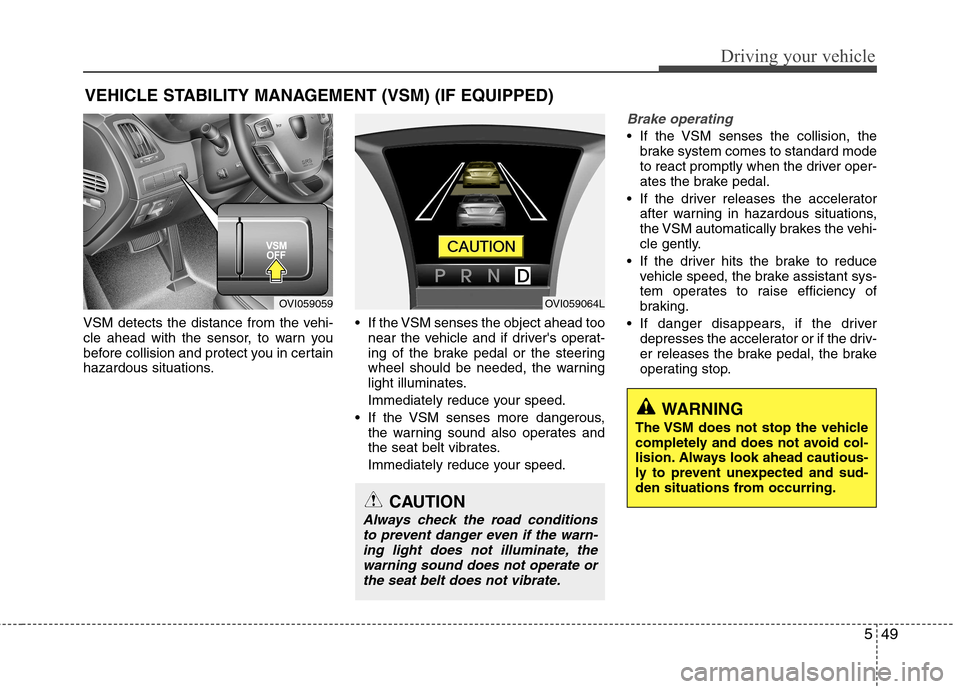
VSM detects the distance from the vehi-
cle ahead with the sensor, to warn you
before collision and protect you in certain
hazardous situations. If the VSM senses the object ahead too
near the vehicle and if driver's operat-
ing of the brake pedal or the steering
wheel should be needed, the warning
light illuminates.
Immediately reduce your speed.
If the VSM senses more dangerous, the warning sound also operates and
the seat belt vibrates.
Immediately reduce your speed.
Brake operating
If the VSM senses the collision, thebrake system comes to standard mode
to react promptly when the driver oper-
ates the brake pedal.
If the driver releases the accelerator after warning in hazardous situations,
the VSM automatically brakes the vehi-
cle gently.
If the driver hits the brake to reduce vehicle speed, the brake assistant sys-
tem operates to raise efficiency of
braking.
If danger disappears, if the driver depresses the accelerator or if the driv-
er releases the brake pedal, the brake
operating stop.
VEHICLE STABILITY MANAGEMENT (VSM) (IF EQUIPPED)
CAUTION
Always check the road conditions
to prevent danger even if the warn-ing light does not illuminate, the
warning sound does not operate or the seat belt does not vibrate.
OVI059059OVI059064L
WARNING
The VSM does not stop the vehicle
completely and does not avoid col-
lision. Always look ahead cautious-
ly to prevent unexpected and sud-
den situations from occurring.
Page 255 of 374
551
Driving your vehicle
WARNING
The VSM is not a substitute for safe
driving practices but a supplemen-
tary function only. It is the respon-
sibility of the driver to always checkthe speed and the distance to the
vehicle ahead.WARNING
Even if there is a malfunction to the brake operating of the VSM,
when you depress the brake
pedal, the brake is operating nor-
mally. But, the VSM brake operat-
ing does not operate even in cer-
tain hazardous situations.
The VSM is designed to function above approximately 15 km/h (9.3
mph) and below approximately180 km/h (111.8 mph).
The VSM does not react to
- Persons or animals.
- Oncoming vehicles in the oppo-site lane or the vehicle in the
intersection.
- Stopped objects.
The VSM can not detect the objects certainly, when:
- The sensors are stained withdirt or covered.
- There is heavy rain or heavy snow.
- There is interference by electro- magnetic waves.
(Continued)(Continued)
- There are strong radar reflec-tions.
- Driving in curve.
- Driving uphill or downhill.
- Driving in areas under construc- tion.
- The object ahead is very narrow such as motorcycles or bicy-
cles.
- The vehicle cuts in suddenly.
The VSM brake operating does not operates, if the driver doesnot release the accelerator pedalor does not operate the brakepedal.
Page 275 of 374
What to do in an emergency
8
6
Always check the TPMS malfunction telltale after replacing one or more
tires or wheels on your vehicle toensure that the replacement or alter-
nate tires and wheels allow the TPMS
to continue to function properly.
✽✽
NOTICE
If the TPMS, Low Tire Pressure tell-
tale do not illuminate for 3 seconds
when the ignition switch is turned to
the ON position or engine is run-
ning, or if they remain illuminated
after coming on for approximately 3
seconds, take your car to your near-
est authorized HYUNDAI dealer
and have the system checked.
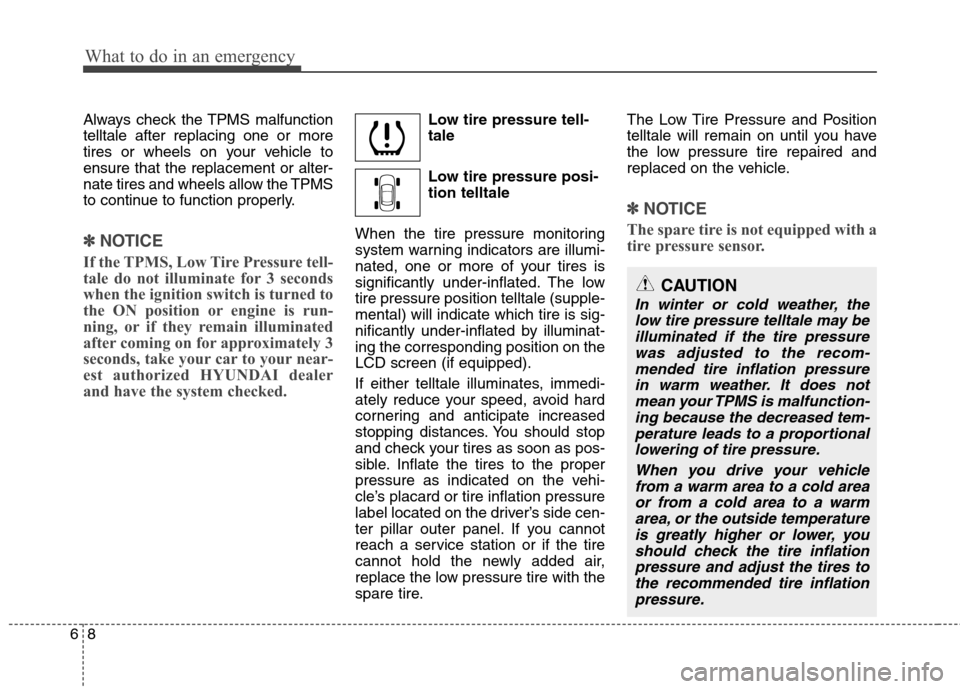
Low tire pressure tell- tale
Low tire pressure posi- tion telltale
When the tire pressure monitoring
system warning indicators are illumi-
nated, one or more of your tires is
significantly under-inflated. The lowtire pressure position telltale (supple-mental) will indicate which tire is sig-
nificantly under-inflated by illuminat-ing the corresponding position on theLCD screen (if equipped).
If either telltale illuminates, immedi-
ately reduce your speed, avoid hard
cornering and anticipate increased
stopping distances. You should stop
and check your tires as soon as pos-
sible. Inflate the tires to the proper
pressure as indicated on the vehi-
cle’s placard or tire inflation pressure
label located on the driver’s side cen-
ter pillar outer panel. If you cannot
reach a service station or if the tire
cannot hold the newly added air,
replace the low pressure tire with the
spare tire. The Low Tire Pressure and Position
telltale will remain on until you have
the low pressure tire repaired and
replaced on the vehicle.
✽✽
NOTICE
The spare tire is not equipped with a
tire pressure sensor.
CAUTION
In winter or cold weather, the low tire pressure telltale may beilluminated if the tire pressurewas adjusted to the recom- mended tire inflation pressurein warm weather. It does notmean your TPMS is malfunction- ing because the decreased tem-perature leads to a proportionallowering of tire pressure.
When you drive your vehiclefrom a warm area to a cold area or from a cold area to a warmarea, or the outside temperatureis greatly higher or lower, you should check the tire inflationpressure and adjust the tires tothe recommended tire inflation pressure.
Page 276 of 374
69
What to do in an emergency
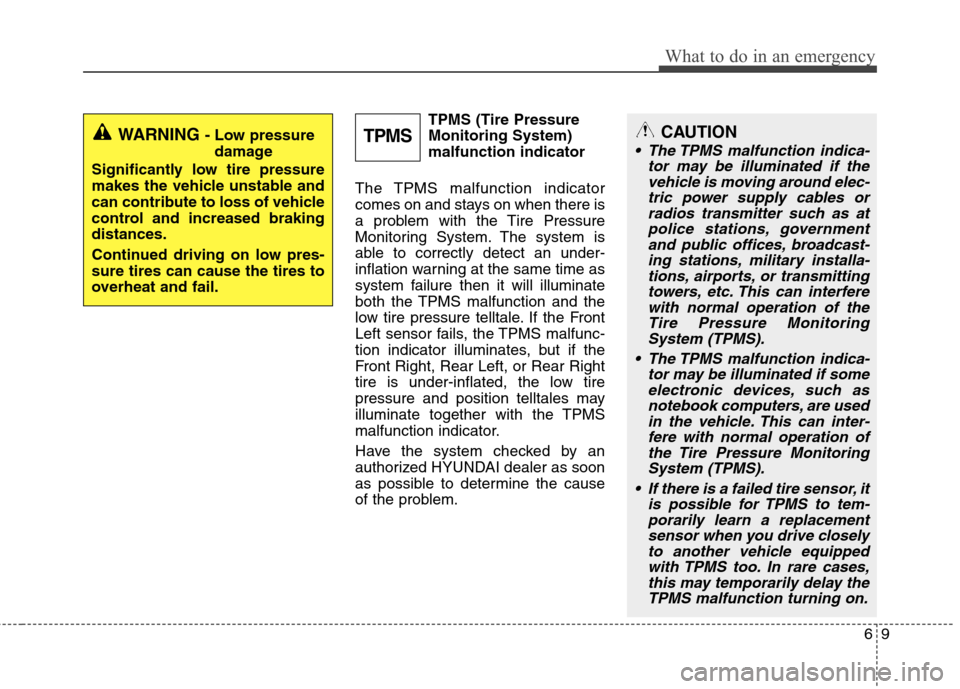
TPMS (Tire Pressure Monitoring System)malfunction indicator
The TPMS malfunction indicator
comes on and stays on when there is
a problem with the Tire Pressure
Monitoring System. The system is
able to correctly detect an under-
inflation warning at the same time as
system failure then it will illuminate
both the TPMS malfunction and the
low tire pressure telltale. If the Front
Left sensor fails, the TPMS malfunc-
tion indicator illuminates, but if the
Front Right, Rear Left, or Rear Right
tire is under-inflated, the low tire
pressure and position telltales may
illuminate together with the TPMS
malfunction indicator.
Have the system checked by an
authorized HYUNDAI dealer as soon
as possible to determine the cause
of the problem.
WARNING - Low pressure
damage
Significantly low tire pressure
makes the vehicle unstable and
can contribute to loss of vehicle
control and increased brakingdistances.
Continued driving on low pres- sure tires can cause the tires to
overheat and fail.TPMSCAUTION
The TPMS malfunction indica- tor may be illuminated if thevehicle is moving around elec-tric power supply cables orradios transmitter such as at police stations, governmentand public offices, broadcast-ing stations, military installa-tions, airports, or transmitting towers, etc. This can interferewith normal operation of theTire Pressure Monitoring System (TPMS).
The TPMS malfunction indica- tor may be illuminated if someelectronic devices, such asnotebook computers, are usedin the vehicle. This can inter- fere with normal operation ofthe Tire Pressure MonitoringSystem (TPMS).
If there is a failed tire sensor, it is possible for TPMS to tem-porarily learn a replacementsensor when you drive closely to another vehicle equippedwith TPMS too. In rare cases,this may temporarily delay the TPMS malfunction turning on.
Page 277 of 374
What to do in an emergency
10
6
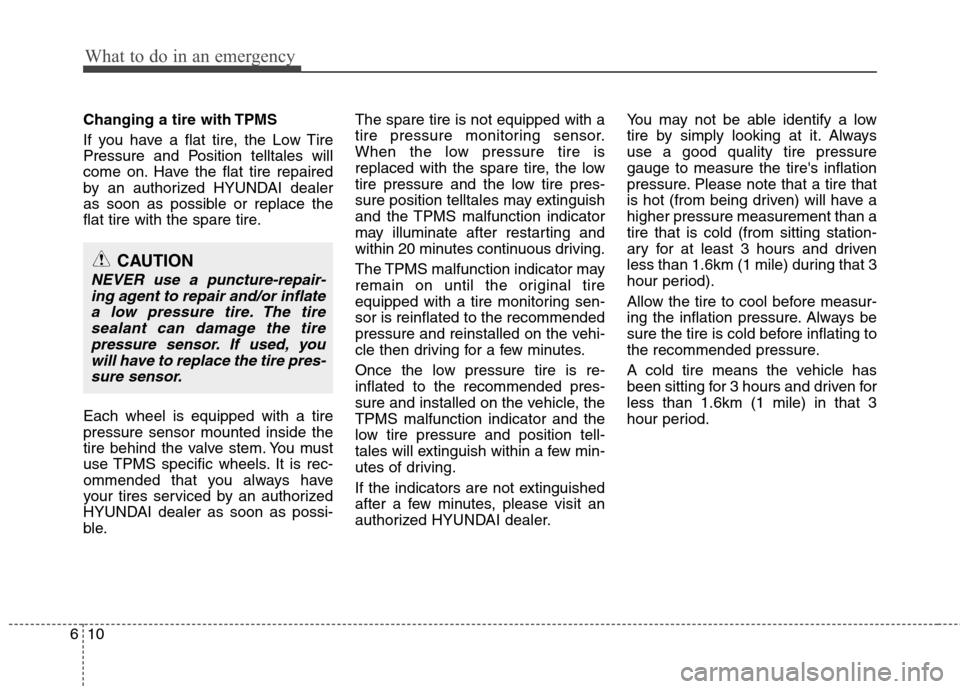
Changing a tire with TPMS
If you have a flat tire, the Low Tire
Pressure and Position telltales will
come on. Have the flat tire repaired
by an authorized HYUNDAI dealer
as soon as possible or replace the
flat tire with the spare tire. Each wheel is equipped with a tire pressure sensor mounted inside the
tire behind the valve stem. You must
use TPMS specific wheels. It is rec-
ommended that you always have
your tires serviced by an authorized
HYUNDAI dealer as soon as possi-
ble. The spare tire is not equipped with a
tire pressure monitoring sensor.
When the low pressure tire is
replaced with the spare tire, the low
tire pressure and the low tire pres-
sure position telltales may extinguish
and the TPMS malfunction indicator
may illuminate after restarting and
within 20 minutes continuous driving.
The TPMS malfunction indicator may
remain on until the original tire
equipped with a tire monitoring sen-sor is reinflated to the recommended
pressure and reinstalled on the vehi-
cle then driving for a few minutes.
Once the low pressure tire is re- inflated to the recommended pres-
sure and installed on the vehicle, theTPMS malfunction indicator and the
low tire pressure and position tell-
tales will extinguish within a few min-
utes of driving.
If the indicators are not extinguished
after a few minutes, please visit an
authorized HYUNDAI dealer.
You may not be able identify a low
tire by simply looking at it. Alwaysuse a good quality tire pressuregauge to measure the tire's inflation
pressure. Please note that a tire that
is hot (from being driven) will have ahigher pressure measurement than atire that is cold (from sitting station-
ary for at least 3 hours and driven
less than 1.6km (1 mile) during that 3
hour period).
Allow the tire to cool before measur-
ing the inflation pressure. Always be
sure the tire is cold before inflating to
the recommended pressure.
A cold tire means the vehicle has
been sitting for 3 hours and driven forless than 1.6km (1 mile) in that 3
hour period.
CAUTION
NEVER use a puncture-repair-
ing agent to repair and/or inflatea low pressure tire. The tire sealant can damage the tirepressure sensor. If used, youwill have to replace the tire pres- sure sensor.
Page 316 of 374
725
Maintenance
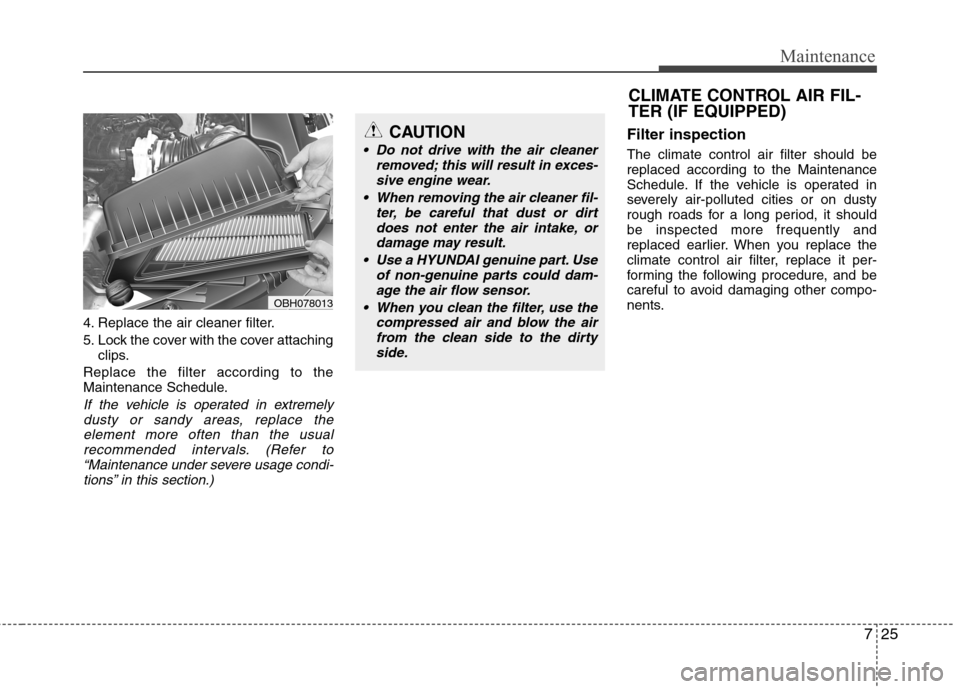
4. Replace the air cleaner filter.
5. Lock the cover with the cover attachingclips.
Replace the filter according to the
Maintenance Schedule.
If the vehicle is operated in extremely dusty or sandy areas, replace the element more often than the usual
recommended intervals. (Refer to“Maintenance under severe usage condi- tions” in this section.)
Filter inspection The climate control air filter should be replaced according to the Maintenance
Schedule. If the vehicle is operated in
severely air-polluted cities or on dusty
rough roads for a long period, it shouldbe inspected more frequently and
replaced earlier. When you replace the
climate control air filter, replace it per-
forming the following procedure, and be
careful to avoid damaging other compo-
nents.
OBH078013
CAUTION
Do not drive with the air cleaner removed; this will result in exces-
sive engine wear.
When removing the air cleaner fil- ter, be careful that dust or dirtdoes not enter the air intake, or
damage may result.
Use a HYUNDAI genuine part. Use of non-genuine parts could dam-age the air flow sensor.
When you clean the filter, use the compressed air and blow the air
from the clean side to the dirty side.
CLIMATE CONTROL AIR FIL-
TER (IF EQUIPPED)
Page 339 of 374
Maintenance
48
7
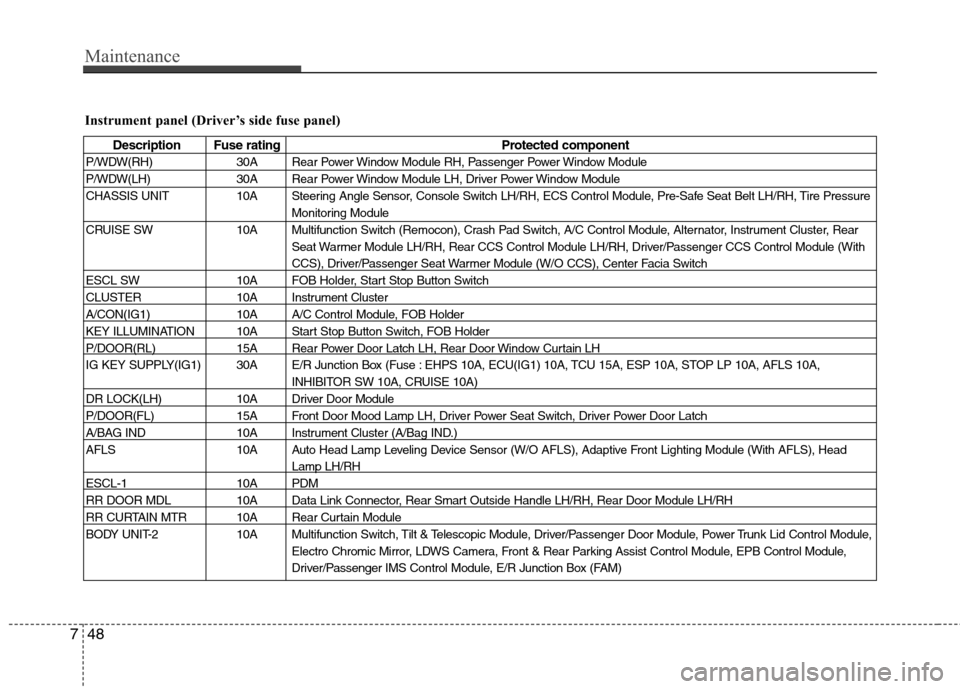
Instrument panel (Driver’s side fuse panel)
Description Fuse rating Protected component
P/WDW(RH) 30A Rear Power Window Module RH, Passenger Power Window Module
P/WDW(LH) 30A Rear Power Window Module LH, Driver Power Window Module
CHASSIS UNIT 10A Steering Angle Sensor, Console Switch LH/RH, ECS Control Module, Pre-Safe Seat Belt LH/RH, Tire Pressure Monitoring Module
CRUISE SW 10A Multifunction Switch (Remocon), Crash Pad Switch, A/C Control Module, Alternator, Instrument Cluster, Rear Seat Warmer Module LH/RH, Rear CCS Control Module LH/RH, Driver/Passenger CCS Control Module (With
CCS), Driver/Passenger Seat Warmer Module (W/O CCS), Center Facia Switch
ESCL SW 10A FOB Holder, Start Stop Button Switch
CLUSTER 10A Instrument Cluster
A/CON(IG1) 10A A/C Control Module, FOB Holder
KEY ILLUMINATION 10A Start Stop Button Switch, FOB Holder
P/DOOR(RL) 15A Rear Power Door Latch LH, Rear Door Window Curtain LH
IG KEY SUPPLY(IG1) 30A E/R Junction Box (Fuse : EHPS 10A, ECU(IG1) 10A, TCU 15A, ESP 10A, STOP LP 10A, AFLS 10A, INHIBITOR SW 10A, CRUISE 10A)
DR LOCK(LH) 10A Driver Door Module
P/DOOR(FL) 15A Front Door Mood Lamp LH, Driver Power Seat Switch, Driver Power Door Latch
A/BAG IND 10A Instrument Cluster (A/Bag IND.)
AFLS 10A Auto Head Lamp Leveling Device Sensor (W/O AFLS), Adaptive Front Lighting Module (With AFLS), Head Lamp LH/RH
ESCL-1 10A PDM
RR DOOR MDL 10A Data Link Connector, Rear Smart Outside Handle LH/RH, Rear Door Module LH/RH
RR CURTAIN MTR 10A Rear Curtain Module
BODY UNIT-2 10A Multifunction Switch, Tilt & Telescopic Module, Driver/Passenger Door Module, Power Trunk Lid Control Module, Electro Chromic Mirror, LDWS Camera, Front & Rear Parking Assist Control Module, EPB Control Module,
Driver/Passenger IMS Control Module, E/R Junction Box (FAM)
Page 340 of 374
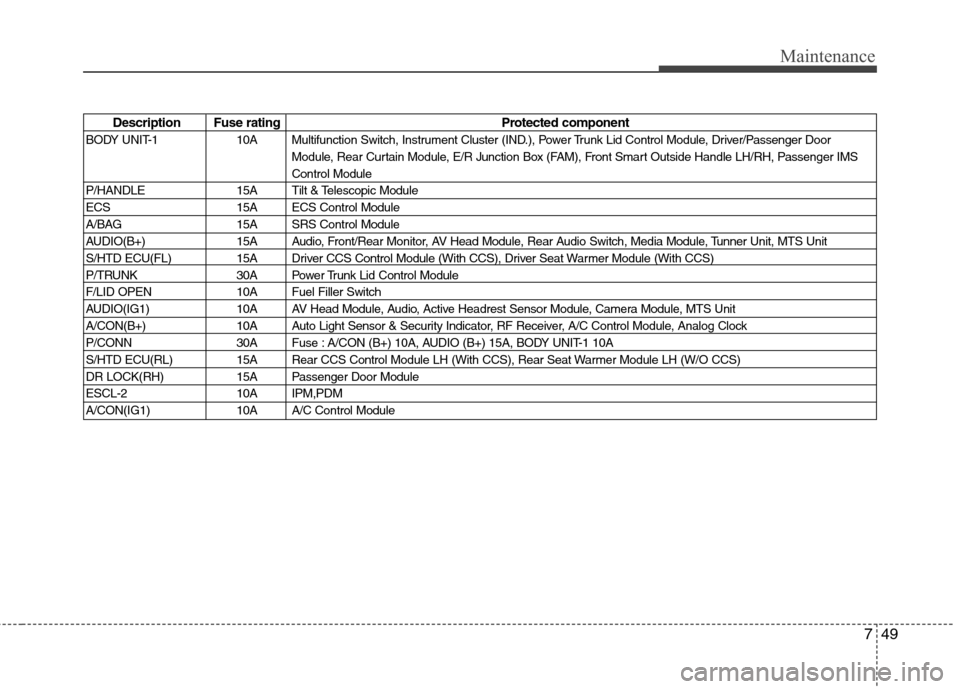
749
Maintenance
Description Fuse ratingProtected component
BODY UNIT-1 10A Multifunction Switch, Instrument Cluster (IND.), Power Trunk Lid Control Module, Driver/Passenger Door Module, Rear Curtain Module, E/R Junction Box (FAM), Front Smart Outside Handle LH/RH, Passenger IMS Control Module
P/HANDLE 15A Tilt & Telescopic Module
ECS 15A ECS Control Module
A/BAG 15A SRS Control Module
AUDIO(B+) 15A Audio, Front/Rear Monitor, AV Head Module, Rear Audio Switch, Media Module, Tunner Unit, MTS Unit
S/HTD ECU(FL) 15A Driver CCS Control Module (With CCS), Driver Seat Warmer Module (With CCS)
P/TRUNK 30A Power Trunk Lid Control Module
F/LID OPEN 10A Fuel Filler Switch
AUDIO(IG1) 10A AV Head Module, Audio, Active Headrest Sensor Module, Camera Module, MTS Unit
A/CON(B+) 10A Auto Light Sensor & Security Indicator, RF Receiver, A/C Control Module, Analog Clock
P/CONN 30A Fuse : A/CON (B+) 10A, AUDIO (B+) 15A, BODY UNIT-1 10A
S/HTD ECU(RL) 15A Rear CCS Control Module LH (With CCS), Rear Seat Warmer Module LH (W/O CCS)
DR LOCK(RH) 15A Passenger Door Module
ESCL-2 10A IPM,PDM
A/CON(IG1) 10A A/C Control Module