light Hyundai Equus 2015 User Guide
[x] Cancel search | Manufacturer: HYUNDAI, Model Year: 2015, Model line: Equus, Model: Hyundai Equus 2015Pages: 483, PDF Size: 13.26 MB
Page 60 of 483
341
Safety features of your vehicle
WARNING
To reduce the chance of serious
or fatal injuries:
• Children of all ages are safer
when restrained in the rear
seat. A child riding in the
front passenger seat can be
forcefully struck by an inflat-
ing air bag resulting in seri-
ous or fatal injuries.
• Always follow the child
restraint system manufactur-
er’s instructions for installa-
tion and use of the child
restraint.
• Always make sure the child
seat is secured properly in the
vehicle and your child is
securely restrained in the
child seat.
• Never hold a child in your
arms or lap when riding in a
vehicle. The violent forces cre-
ated during a crash will tear
the child from your arms and
throw the child against the
vehicle’s interior.
(Continued)
(Continued)
Always properly position and
secure children in the rear
seat.
• Never allow a child to stand-
up or kneel on the seat or
floor of a moving vehicle.
During a collision or sudden
stop, the child can be violent-
ly thrown against the vehicle’s
interior, resulting in serious
injury.
• Never use an infant carrier or
a child safety seat that
"hooks" over a seatback, it
may not provide adequate
security in an accident.
• Seat belts can become very
hot, especially when the vehi-
cle is parked in direct sun-
light. Always check seat belt
buckles before fastening them
over a child.
• After an accident, we recom-
mend that the system be
checked by an authorized
HYUNDAI dealer.
(Continued)(Continued)
• Never put a seat belt over
yourself and a child. During a
crash, the belt could press
deep into the child causing
serious internal injuries.
• Never leave children unat-
tended in a vehicle – not even
for a short time. The car can
heat up very quickly, resulting
in serious injuries to children
inside. Even very young chil-
dren may inadvertently cause
the vehicle to move, entangle
themselves in the windows, or
lock themselves or others
inside the vehicle.
• Never allow two children, or
any two persons, to use the
same seat belt.
• Children often squirm and
reposition themselves
improperly. Never let a child
ride with the shoulder belt
under their arm or behind
their back.
(Continued)
Page 72 of 483
353
Safety features of your vehicle
In addition, do not place front-facing
child restraints in the front passen-
ger’s seat either. If the front passen-
ger air bag inflates, it could cause
serious or fatal injuries to the child.Air bag warning light
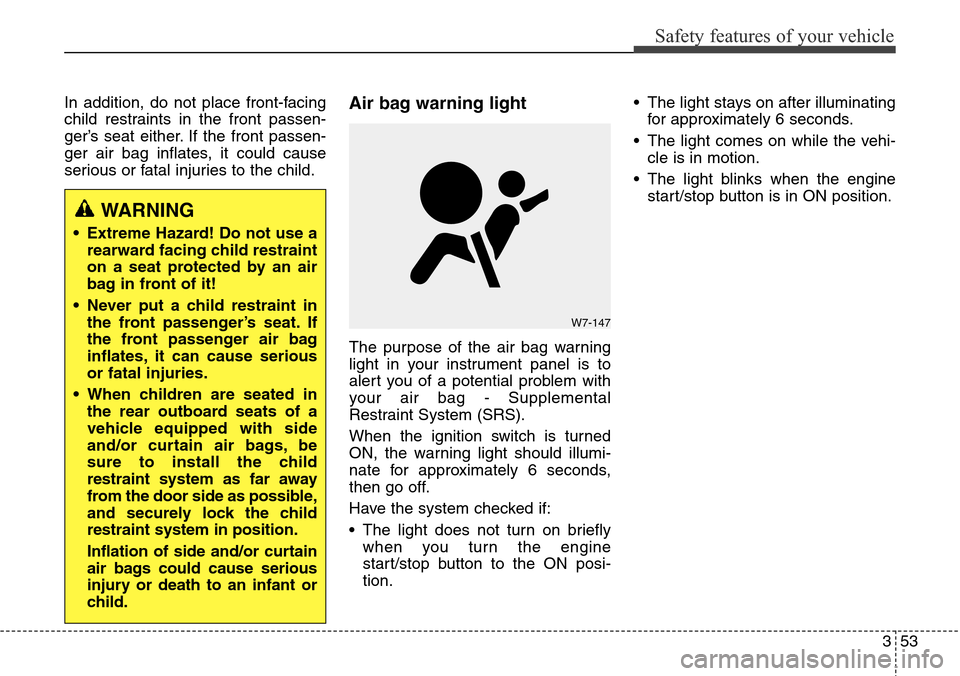
The purpose of the air bag warning
light in your instrument panel is to
alert you of a potential problem with
your air bag - Supplemental
Restraint System (SRS).
When the ignition switch is turned
ON, the warning light should illumi-
nate for approximately 6 seconds,
then go off.
Have the system checked if:
• The light does not turn on briefly
when you turn the engine
start/stop button to the ON posi-
tion.• The light stays on after illuminating
for approximately 6 seconds.
• The light comes on while the vehi-
cle is in motion.
• The light blinks when the engine
start/stop button is in ON position.
WARNING
• Extreme Hazard! Do not use a
rearward facing child restraint
on a seat protected by an air
bag in front of it!
• Never put a child restraint in
the front passenger’s seat. If
the front passenger air bag
inflates, it can cause serious
or fatal injuries.
• When children are seated in
the rear outboard seats of a
vehicle equipped with side
and/or curtain air bags, be
sure to install the child
restraint system as far away
from the door side as possible,
and securely lock the child
restraint system in position.
Inflation of side and/or curtain
air bags could cause serious
injury or death to an infant or
child.
W7-147
Page 73 of 483
Safety features of your vehicle
54 3
SRS components and func-
tions
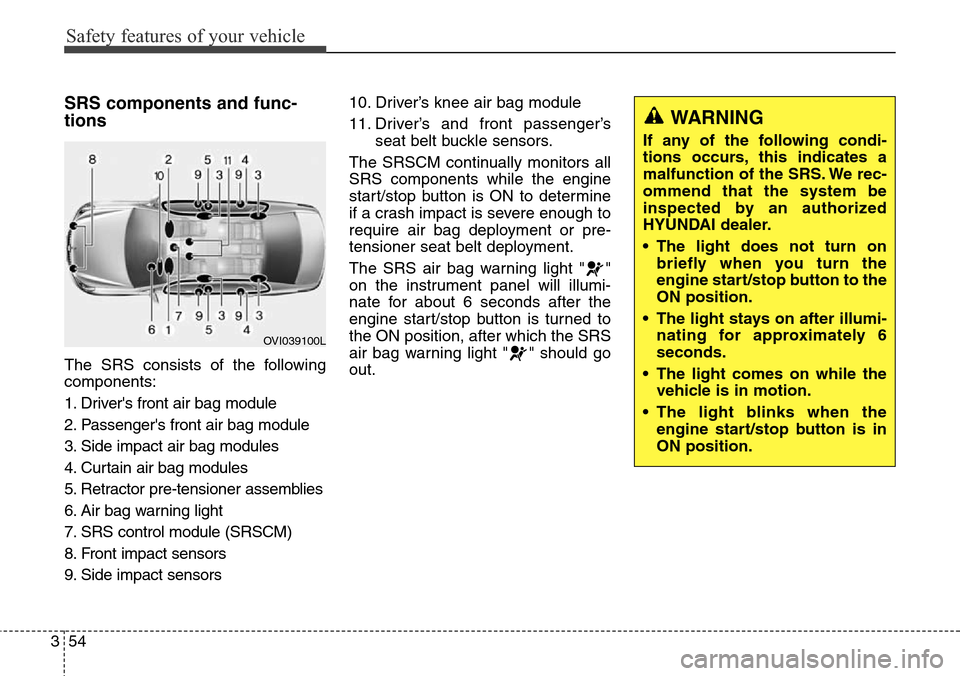
The SRS consists of the following
components:
1. Driver's front air bag module
2. Passenger's front air bag module
3. Side impact air bag modules
4. Curtain air bag modules
5. Retractor pre-tensioner assemblies
6. Air bag warning light
7. SRS control module (SRSCM)
8. Front impact sensors
9. Side impact sensors10. Driver’s knee air bag module
11. Driver’s and front passenger’s
seat belt buckle sensors.
The SRSCM continually monitors all
SRS components while the engine
start/stop button is ON to determine
if a crash impact is severe enough to
require air bag deployment or pre-
tensioner seat belt deployment.
The SRS air bag warning light " "
on the instrument panel will illumi-
nate for about 6 seconds after the
engine start/stop button is turned to
the ON position, after which the SRS
air bag warning light " " should go
out.
OVI039100L
WARNING
If any of the following condi-
tions occurs, this indicates a
malfunction of the SRS. We rec-
ommend that the system be
inspected by an authorized
HYUNDAI dealer.
• The light does not turn on
briefly when you turn the
engine start/stop button to the
ON position.
• The light stays on after illumi-
nating for approximately 6
seconds.
• The light comes on while the
vehicle is in motion.
• The light blinks when the
engine start/stop button is in
ON position.
Page 76 of 483
357
Safety features of your vehicle
Driver's and passenger's front
air bag
Your vehicle is equipped with a
Supplemental Restraint (Air Bag)
System and the lap/shoulder belts at
both the driver and passenger seat-
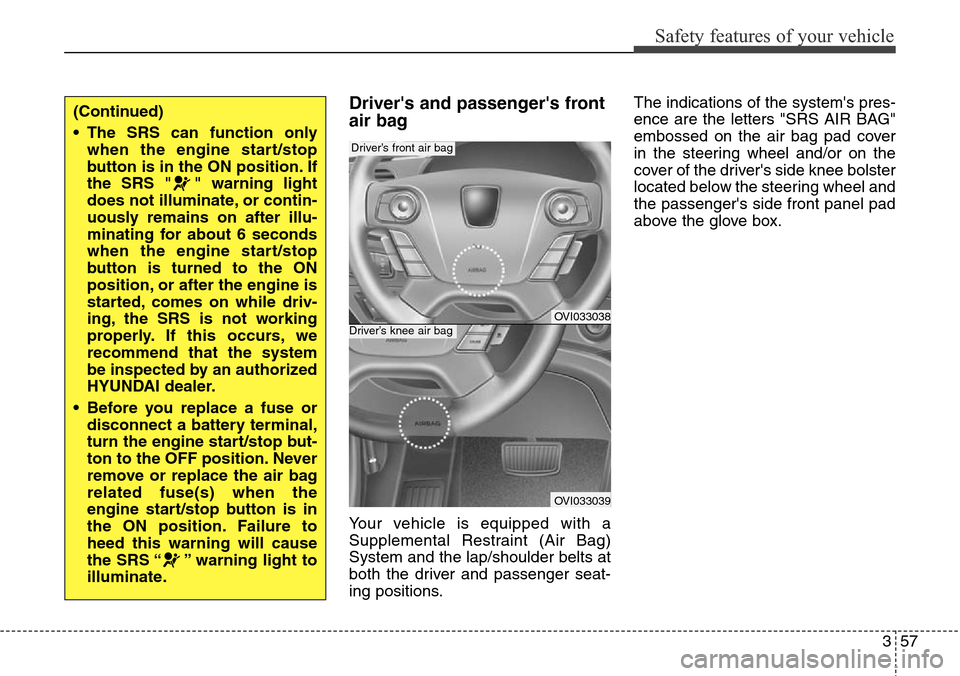
ing positions.The indications of the system's pres-
ence are the letters "SRS AIR BAG"
embossed on the air bag pad cover
in the steering wheel and/or on the
cover of the driver's side knee bolster
located below the steering wheel and
the passenger's side front panel pad
above the glove box.
(Continued)
• The SRS can function only
when the engine start/stop
button is in the ON position. If
the SRS " " warning light
does not illuminate, or contin-
uously remains on after illu-
minating for about 6 seconds
when the engine start/stop
button is turned to the ON
position, or after the engine is
started, comes on while driv-
ing, the SRS is not working
properly. If this occurs, we
recommend that the system
be inspected by an authorized
HYUNDAI dealer.
• Before you replace a fuse or
disconnect a battery terminal,
turn the engine start/stop but-
ton to the OFF position. Never
remove or replace the air bag
related fuse(s) when the
engine start/stop button is in
the ON position. Failure to
heed this warning will cause
the SRS “ ” warning light to
illuminate.
OVI033038
OVI033039
Driver’s knee air bag
Driver’s front air bag
Page 78 of 483
359
Safety features of your vehicle
(Continued)
• No objects should be placed
over or near the air bag mod-
ules on the steering wheel,
instrument panel, driver’s side
knee bolster, and the front
passenger's panel above the
glove box, because any such
object could cause harm if the
vehicle is in a crash severe
enough to cause the air bags
to deploy.
• Do not tamper with or discon-
nect SRS wiring or other com-
ponents of the SRS system.
Doing so could result in injury,
due to accidental deployment
of the air bags or by rendering
the SRS inoperative.
• If the SRS air bag warning
light “ ”remains illuminat-
ed while the vehicle is being
driven, we recommend that
the system be replaced by an
authorized HYUNDAI dealer.
(Continued)(Continued)
• ABC – Always Buckle
Children in the back seat. It is
the safest place for children of
any age to ride.
• Front and side impact air bags
can injure occupants improp-
erly positioned.
• Move your seat as far back as
practical from the front air
bags, while still maintaining
control of the vehicle.
• You and your passengers
should never sit or lean
unnecessarily close to the air
bags. Improperly positioned
drivers and passengers can
be severely injured by inflat-
ing air bags.
• Never lean against the door or
center console – always sit in
an upright position.
(Continued)(Continued)
• Air bags can only be used
once - we recommend that the
system be replaced by an
authorized HYUNDAI dealer.
• The SRS is designed to deploy
the front air bags only when an
impact is sufficiently severe
and when the impact angle is
less than 30° from the forward
longitudinal axis of the vehi-
cle. Additionally, the air bags
will only deploy once. Seat
belts must be worn at all times.
• Front air bags are not intended
to deploy in side-impact, rear-
impact or rollover crashes. In
addition, front air bags will not
deploy in frontal crashes
below the deployment thresh-
old.
• A child restraint system must
never be placed in the front
seat. The infant or child could
be severely injured or killed by
an air bag deployment in case
of an accident.
(Continued)
Page 87 of 483
Safety features of your vehicle
68 3
SRS Care
The SRS is virtually maintenance-
free and so there are no parts you
can safely service by yourself. If the
SRS air bag warning light does not
illuminate when you turn the ignition
ON, or if it continuously remains on,
we recommend that the system be
inspected by an authorized HYUNDAI
dealer.
Improper handling of the SRS sys-
tem may result in serious personal
injury.WARNING
• Modification to SRS compo-
nents or wiring, including the
addition of any kind of badges
to the pad covers or modifica-
tions to the body structure,
can adversely affect SRS per-
formance and lead to possible
injury.
• For cleaning the air bag pad
covers, use only a soft, dry
cloth or one which has been
moistened with plain water.
Solvents or cleaners could
adversely affect the air bag
covers and proper deploy-
ment of the system.
• No objects should be placed
over or near the air bag mod-
ules on the steering wheel,
instrument panel, and the
front passenger's panel above
the glove box, because any
such object could cause harm
if the vehicle is in a crash
severe enough to cause the
air bags to inflate.
(Continued)
(Continued)
• If the air bags inflate, they
must be replaced by an
authorized HYUNDAI dealer.
• Do not tamper with or discon-
nect SRS wiring, or other
components of the SRS sys-
tem. Doing so could result in
injury, due to accidental infla-
tion of the air bags or by ren-
dering the SRS inoperative.
• If components of the air bag
system must be discarded, or
if the vehicle must be
scrapped, certain safety pre-
cautions must be observed.
An authorized HYUNDAI deal-
er knows these precautions
and can give you the neces-
sary information. Failure to
follow these precautions and
procedures could increase
the risk of personal injury.
• If your car was flooded and
has soaked carpeting or water
on the flooring, you shouldn't
try to start the engine; have
the car towed to an authorized
HYUNDAI dealer.
Page 91 of 483
Trip computer . . . . . . . . . . . . . . . . . . . . . . . . . . . . . 4-90
• Overview. . . . . . . . . . . . . . . . . . . . . . . . . . . . . . . . . . . . 4-90
• Trip A/B . . . . . . . . . . . . . . . . . . . . . . . . . . . . . . . . . . . . 4-91
• Fuel economy . . . . . . . . . . . . . . . . . . . . . . . . . . . . . . . . 4-92
Warning and indicator lights . . . . . . . . . . . . . . . . 4-94
• Warning lights . . . . . . . . . . . . . . . . . . . . . . . . . . . . . . . 4-94
• Indicator lights. . . . . . . . . . . . . . . . . . . . . . . . . . . . . . 4-103
Head up display (HUD) . . . . . . . . . . . . . . . . . . . . 4-108
Parking assist system . . . . . . . . . . . . . . . . . . . . . . 4-111
• Operation . . . . . . . . . . . . . . . . . . . . . . . . . . . . . . . . . . 4-111
• Non-operational conditions . . . . . . . . . . . . . . . . . . . 4-113
• Self-diagnosis . . . . . . . . . . . . . . . . . . . . . . . . . . . . . . . 4-115
Rearview camera . . . . . . . . . . . . . . . . . . . . . . . . . 4-116
Parking guide system . . . . . . . . . . . . . . . . . . . . . . 4-117
Around view monitoring system . . . . . . . . . . . . . 4-120
Lighting . . . . . . . . . . . . . . . . . . . . . . . . . . . . . . . . . 4-121
• Battery saver function. . . . . . . . . . . . . . . . . . . . . . . . 4-121
• Headlamp escort function. . . . . . . . . . . . . . . . . . . . . 4-121
• Lighting control . . . . . . . . . . . . . . . . . . . . . . . . . . . . . 4-122
• High beam operation. . . . . . . . . . . . . . . . . . . . . . . . . 4-124
• Turn signals and lane change signals . . . . . . . . . . . 4-125
• Front fog light . . . . . . . . . . . . . . . . . . . . . . . . . . . . . . 4-126
• Rear fog light . . . . . . . . . . . . . . . . . . . . . . . . . . . . . . . 4-126
• Daytime running light . . . . . . . . . . . . . . . . . . . . . . . . 4-127
• Headlamp leveling device . . . . . . . . . . . . . . . . . . . . . 4-127
• Headlamp washer . . . . . . . . . . . . . . . . . . . . . . . . . . . 4-127
Wipers and washers . . . . . . . . . . . . . . . . . . . . . . . 4-128
• Windshield wipers . . . . . . . . . . . . . . . . . . . . . . . . . . . 4-128
• Windshield washers. . . . . . . . . . . . . . . . . . . . . . . . . . 4-129
Interior light . . . . . . . . . . . . . . . . . . . . . . . . . . . . . 4-131
• Front . . . . . . . . . . . . . . . . . . . . . . . . . . . . . . . . . . . . . . 4-131
• Rear . . . . . . . . . . . . . . . . . . . . . . . . . . . . . . . . . . . . . . 4-132
• Trunk room lamp . . . . . . . . . . . . . . . . . . . . . . . . . . . 4-133
• Door courtesy lamp . . . . . . . . . . . . . . . . . . . . . . . . . . 4-133
• Glove box lamp . . . . . . . . . . . . . . . . . . . . . . . . . . . . . 4-133
• Vanity mirror lamp . . . . . . . . . . . . . . . . . . . . . . . . . . 4-134
Welcome system . . . . . . . . . . . . . . . . . . . . . . . . . . 4-135
• Puddle lamp . . . . . . . . . . . . . . . . . . . . . . . . . . . . . . . . 4-135
• Headlight . . . . . . . . . . . . . . . . . . . . . . . . . . . . . . . . . . 4-135
• Interior light. . . . . . . . . . . . . . . . . . . . . . . . . . . . . . . . 4-135
Defroster . . . . . . . . . . . . . . . . . . . . . . . . . . . . . . . . 4-136
Automatic climate control system. . . . . . . . . . . . 4-137
Windshield defrosting and defogging . . . . . . . . . 4-152
Storage compartments . . . . . . . . . . . . . . . . . . . . . 4-156
• Center console storage . . . . . . . . . . . . . . . . . . . . . . . 4-156
• Glove box . . . . . . . . . . . . . . . . . . . . . . . . . . . . . . . . . . 4-156
• Sunglass holder . . . . . . . . . . . . . . . . . . . . . . . . . . . . . 4-157
• Rear console storage . . . . . . . . . . . . . . . . . . . . . . . . . 4-158
• Cool and warm box . . . . . . . . . . . . . . . . . . . . . . . . . . 4-158
4
Page 94 of 483
45
Features of your vehicle
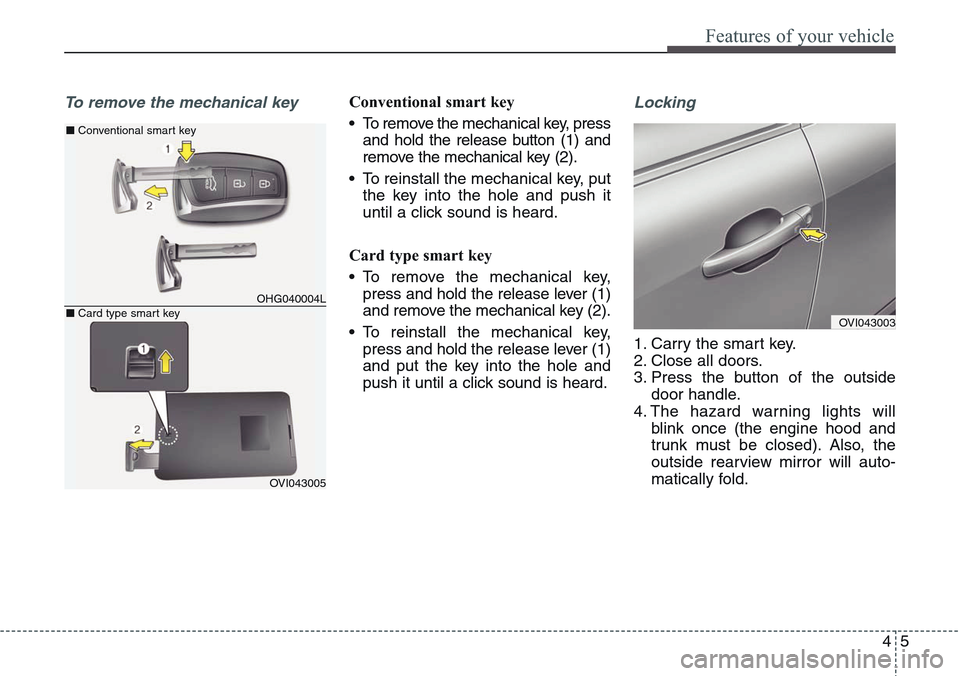
To remove the mechanical keyConventional smart key
• To remove the mechanical key, press
and hold the release button (1) and
remove the mechanical key (2).
• To reinstall the mechanical key, put
the key into the hole and push it
until a click sound is heard.
Card type smart key
• To remove the mechanical key,
press and hold the release lever (1)
and remove the mechanical key (2).
• To reinstall the mechanical key,
press and hold the release lever (1)
and put the key into the hole and
push it until a click sound is heard.Locking
1. Carry the smart key.
2. Close all doors.
3. Press the button of the outside
door handle.
4. The hazard warning lights will
blink once (the engine hood and
trunk must be closed). Also, the
outside rearview mirror will auto-
matically fold.
OHG040004L
■Conventional smart key
OVI043005
■Card type smart keyOVI043003
Page 95 of 483
Features of your vehicle
6 4
✽NOTICE
• The button will only operate when
the smart key is within 0.7 m (28
in.) from the outside door handle.
• Even though you press the outside
door handle button, the doors will
not lock and the chime will sound
for 3 seconds if any of following
occur:
- The smart key is in the vehicle.
- The engine start/stop button is
in ACC or ON position.
- Any door except the trunk is
opened.
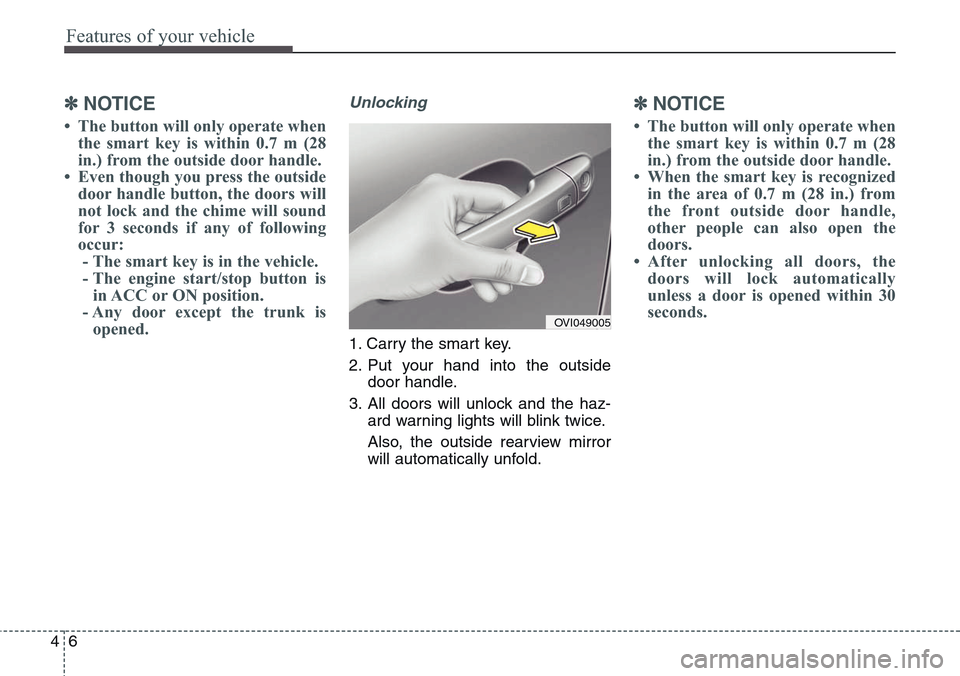
Unlocking
1. Carry the smart key.
2. Put your hand into the outside
door handle.
3. All doors will unlock and the haz-
ard warning lights will blink twice.
Also, the outside rearview mirror
will automatically unfold.
✽NOTICE
• The button will only operate when
the smart key is within 0.7 m (28
in.) from the outside door handle.
• When the smart key is recognized
in the area of 0.7 m (28 in.) from
the front outside door handle,
other people can also open the
doors.
• After unlocking all doors, the
doors will lock automatically
unless a door is opened within 30
seconds.
OVI049005
Page 96 of 483
47
Features of your vehicle
Trunk unlocking
Power trunk
1. Carry the smart key.
2. Press the trunk handle switch.
3. The trunk will unlock and open.
Non-powered trunk
1. Carry the smart key.
2. Press the trunk handle switch.
3. The trunk will unlock.
✽NOTICE
• Once the trunk is opened and then
closed, the trunk will lock auto-
matically.
• The button will only operate when
the smart key is within 0.7 m (28
in.) from the trunk handle.
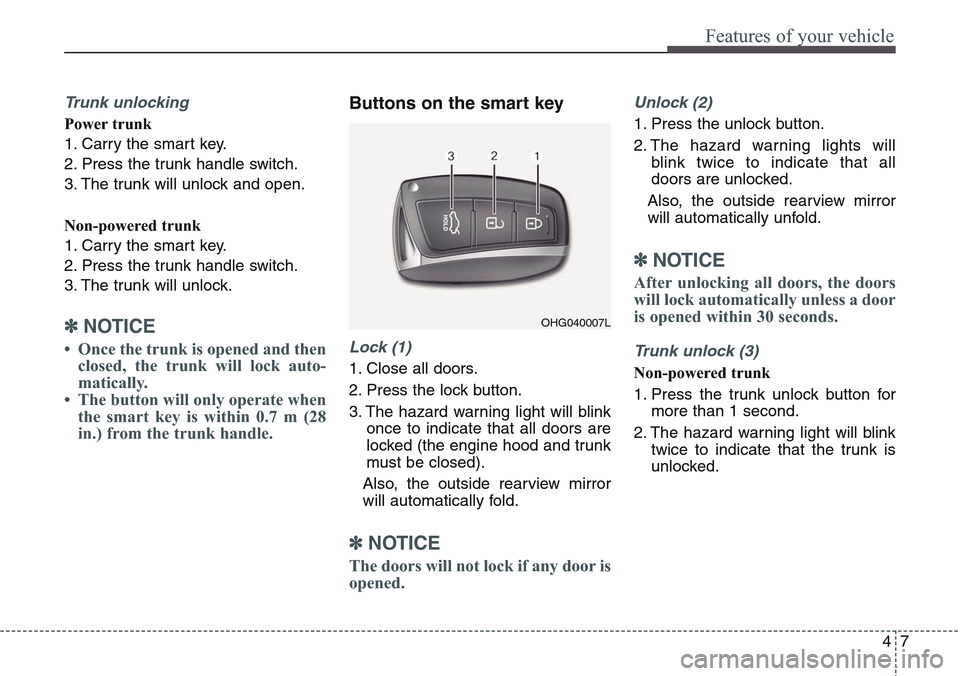
Buttons on the smart key
Lock (1)
1. Close all doors.
2. Press the lock button.
3. The hazard warning light will blink
once to indicate that all doors are
locked (the engine hood and trunk
must be closed).
Also, the outside rearview mirror
will automatically fold.
✽NOTICE
The doors will not lock if any door is
opened.
Unlock (2)
1. Press the unlock button.
2. The hazard warning lights will
blink twice to indicate that all
doors are unlocked.
Also, the outside rearview mirror
will automatically unfold.
✽NOTICE
After unlocking all doors, the doors
will lock automatically unless a door
is opened within 30 seconds.
Trunk unlock (3)
Non-powered trunk
1. Press the trunk unlock button for
more than 1 second.
2. The hazard warning light will blink
twice to indicate that the trunk is
unlocked.
OHG040007L