lock Hyundai Equus 2016 Owners Manual
[x] Cancel search | Manufacturer: HYUNDAI, Model Year: 2016, Model line: Equus, Model: Hyundai Equus 2016Pages: 477, PDF Size: 16.25 MB
Page 369 of 477
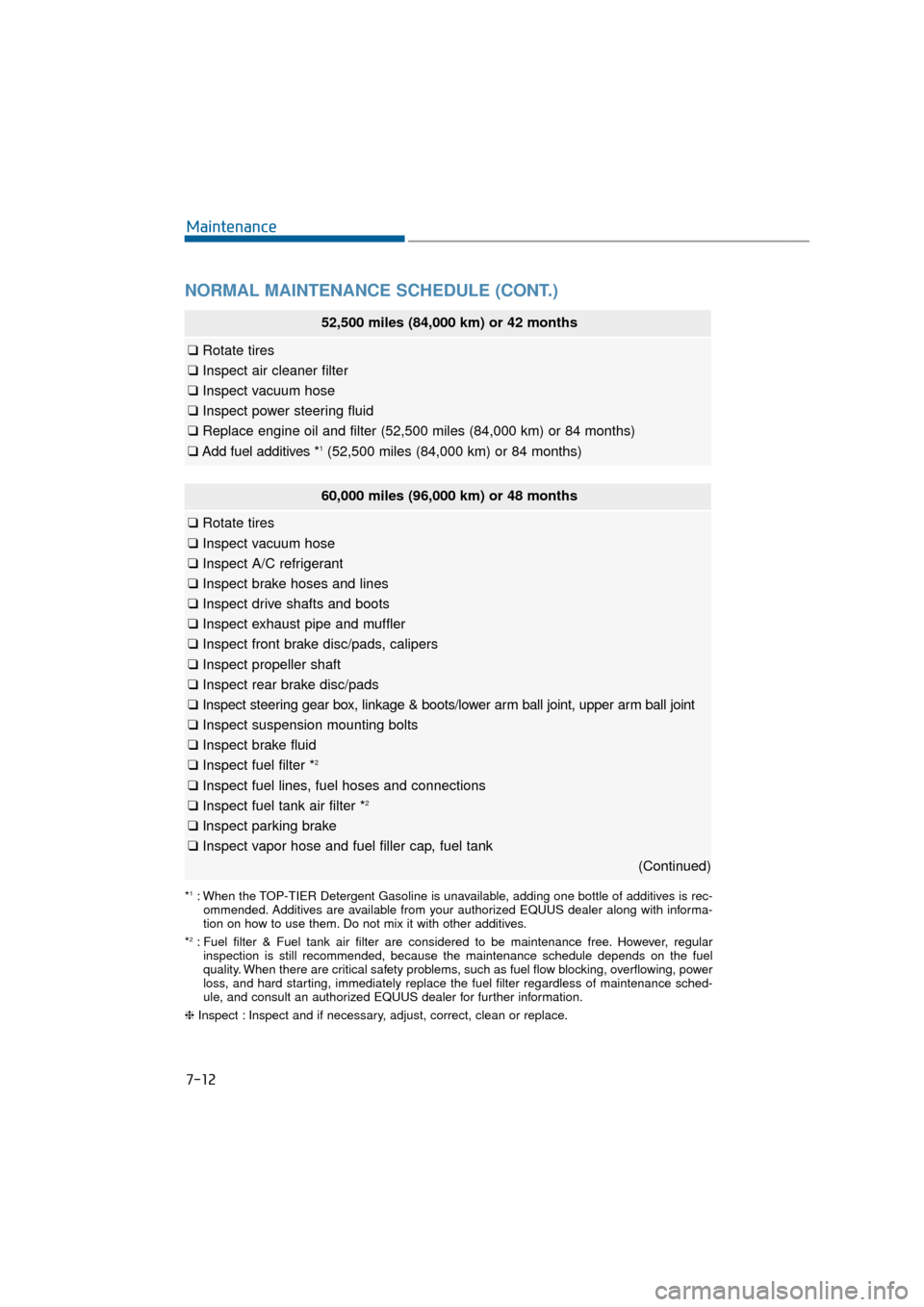
NORMAL MAINTENANCE SCHEDULE (CONT.)
7-12
Maintenance
52,500 miles (84,000 km) or 42 months
❑Rotate tires
❑ Inspect air cleaner filter
❑ Inspect vacuum hose
❑ Inspect power steering fluid
❑ Replace engine oil and filter (52,500 miles (84,000 km) or 84 months)\
❑ Add fuel additives *
1(52,500 miles (84,000 km) or 84 months)
60,000 miles (96,000 km) or 48 months
❑ Rotate tires
❑ Inspect vacuum hose
❑ Inspect A/C refrigerant
❑ Inspect brake hoses and lines
❑ Inspect drive shafts and boots
❑ Inspect exhaust pipe and muffler
❑ Inspect front brake disc/pads, calipers
❑ Inspect propeller shaft
❑ Inspect rear brake disc/pads
❑ Inspect steering gear box, linkage & boots/lower arm ball joint, upper arm ball joint
❑ Inspect suspension mounting bolts
❑ Inspect brake fluid
❑ Inspect fuel filter *
2
❑Inspect fuel lines, fuel hoses and connections
❑ Inspect fuel tank air filter *2
❑Inspect parking brake
❑ Inspect vapor hose and fuel filler cap, fuel tank
(Continued)
*1: When the TOP-TIER Detergent Gasoline is unavailable, adding one bottle of additives is rec-ommended. Additives are available from your authorized EQUUS dealer along with informa-
tion on how to use them. Do not mix it with other additives.
*
2: Fuel filter & Fuel tank air filter are considered to be maintenance free\
. However, regular inspection is still recommended, because the maintenance schedule depend\
s on the fuel
quality. When there are critical safety problems, such as fuel flow blocking, overflowing, power
loss, and hard starting, immediately replace the fuel filter regardless of maintenance sche\
d-
ule, and consult an authorized EQUUS dealer for further information.
❈ Inspect : Inspect and if necessary, adjust, correct, clean or replace.
Page 372 of 477
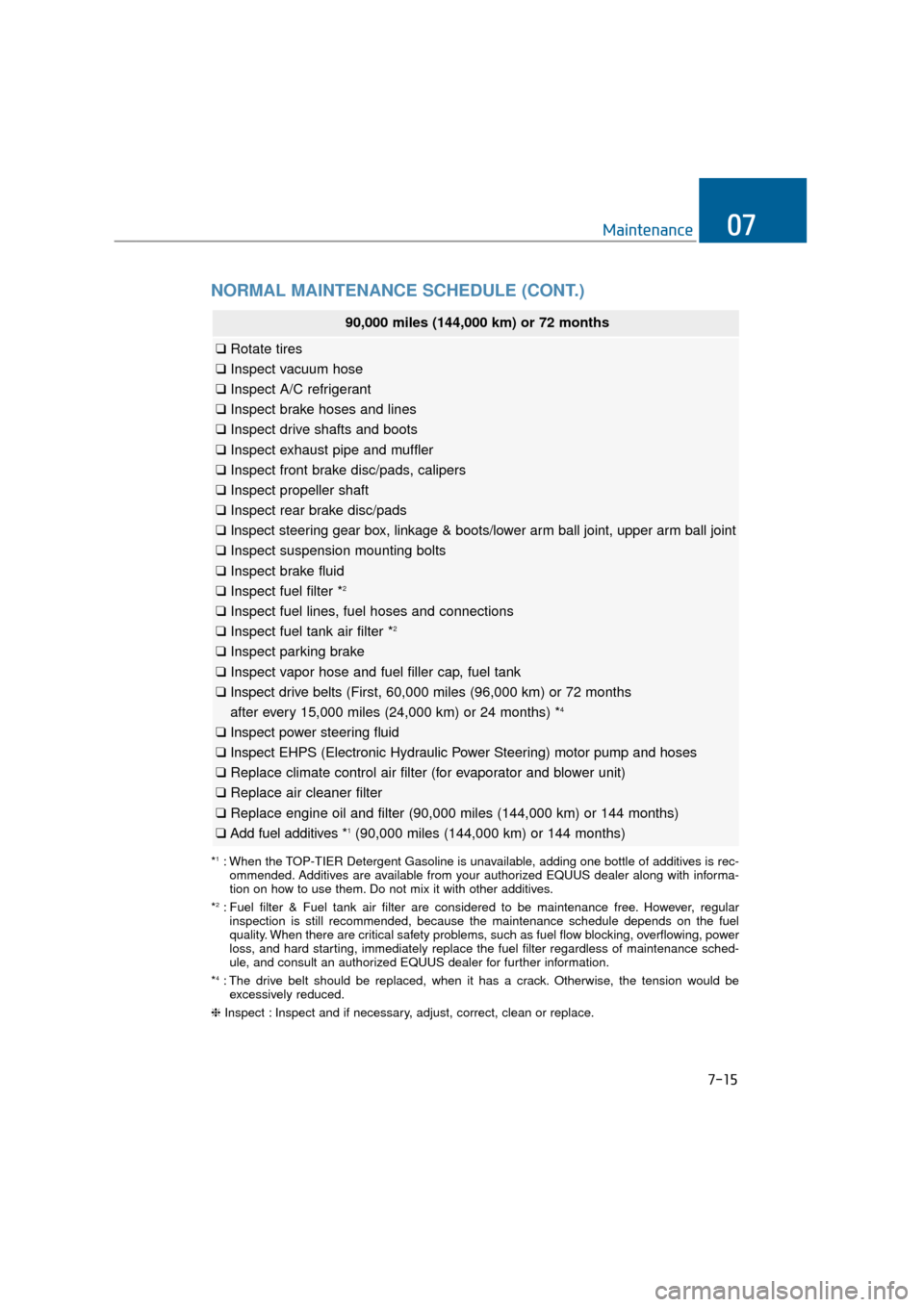
NORMAL MAINTENANCE SCHEDULE (CONT.)
7-15
Maintenance07
90,000 miles (144,000 km) or 72 months
❑Rotate tires
❑ Inspect vacuum hose
❑ Inspect A/C refrigerant
❑ Inspect brake hoses and lines
❑ Inspect drive shafts and boots
❑ Inspect exhaust pipe and muffler
❑ Inspect front brake disc/pads, calipers
❑ Inspect propeller shaft
❑ Inspect rear brake disc/pads
❑ Inspect steering gear box, linkage & boots/lower arm ball joint, upper arm ball joint
❑ Inspect suspension mounting bolts
❑ Inspect brake fluid
❑ Inspect fuel filter *
2
❑Inspect fuel lines, fuel hoses and connections
❑ Inspect fuel tank air filter *2
❑Inspect parking brake
❑ Inspect vapor hose and fuel filler cap, fuel tank
❑ Inspect drive belts (First, 60,000 miles (96,000 km) or 72 months
after every 15,000 miles (24,000 km) or 24 months) *
4
❑ Inspect power steering fluid
❑ Inspect EHPS (Electronic Hydraulic Power Steering) motor pump and hoses
❑ Replace climate control air filter (for evaporator and blower unit)
❑ Replace air cleaner filter
❑ Replace engine oil and filter (90,000 miles (144,000 km) or 144 month\
s)
❑ Add fuel additives *
1(90,000 miles (144,000 km) or 144 months)
*1: When the TOP-TIER Detergent Gasoline is unavailable, adding one bottle of additives is rec-
ommended. Additives are available from your authorized EQUUS dealer along with informa-
tion on how to use them. Do not mix it with other additives.
*
2: Fuel filter & Fuel tank air filter are considered to be maintenance free\
. However, regular inspection is still recommended, because the maintenance schedule depend\
s on the fuel
quality. When there are critical safety problems, such as fuel flow blocking, overflowing, power
loss, and hard starting, immediately replace the fuel filter regardless of maintenance sche\
d-
ule, and consult an authorized EQUUS dealer for further information.
*
4: The drive belt should be replaced, when it has a crack. Otherwise, the tension would be excessively reduced.
❈ Inspect : Inspect and if necessary, adjust, correct, clean or replace.
Page 374 of 477
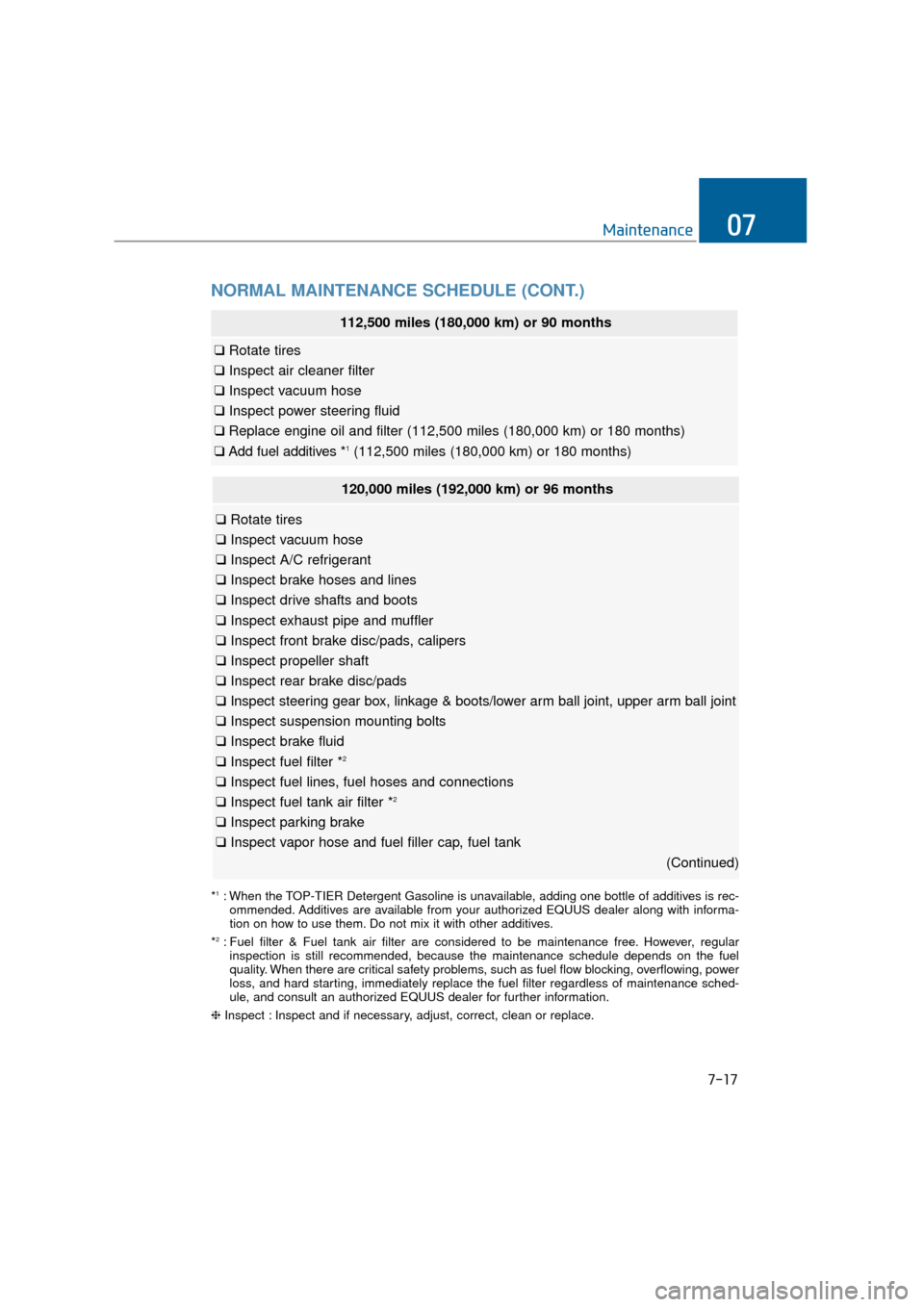
NORMAL MAINTENANCE SCHEDULE (CONT.)
7-17
Maintenance07
112,500 miles (180,000 km) or 90 months
❑Rotate tires
❑ Inspect air cleaner filter
❑ Inspect vacuum hose
❑ Inspect power steering fluid
❑ Replace engine oil and filter (112,500 miles (180,000 km) or 180 mont\
hs)
❑ Add fuel additives *
1(112,500 miles (180,000 km) or 180 months)
120,000 miles (192,000 km) or 96 months
❑ Rotate tires
❑ Inspect vacuum hose
❑ Inspect A/C refrigerant
❑ Inspect brake hoses and lines
❑ Inspect drive shafts and boots
❑ Inspect exhaust pipe and muffler
❑ Inspect front brake disc/pads, calipers
❑ Inspect propeller shaft
❑ Inspect rear brake disc/pads
❑ Inspect steering gear box, linkage & boots/lower arm ball joint, upper arm ball joint
❑ Inspect suspension mounting bolts
❑ Inspect brake fluid
❑ Inspect fuel filter *
2
❑Inspect fuel lines, fuel hoses and connections
❑ Inspect fuel tank air filter *2
❑Inspect parking brake
❑ Inspect vapor hose and fuel filler cap, fuel tank
(Continued)
*1: When the TOP-TIER Detergent Gasoline is unavailable, adding one bottle of additives is rec-ommended. Additives are available from your authorized EQUUS dealer along with informa-
tion on how to use them. Do not mix it with other additives.
*
2: Fuel filter & Fuel tank air filter are considered to be maintenance free\
. However, regular inspection is still recommended, because the maintenance schedule depend\
s on the fuel
quality. When there are critical safety problems, such as fuel flow blocking, overflowing, power
loss, and hard starting, immediately replace the fuel filter regardless of maintenance sche\
d-
ule, and consult an authorized EQUUS dealer for further information.
❈ Inspect : Inspect and if necessary, adjust, correct, clean or replace.
Page 377 of 477
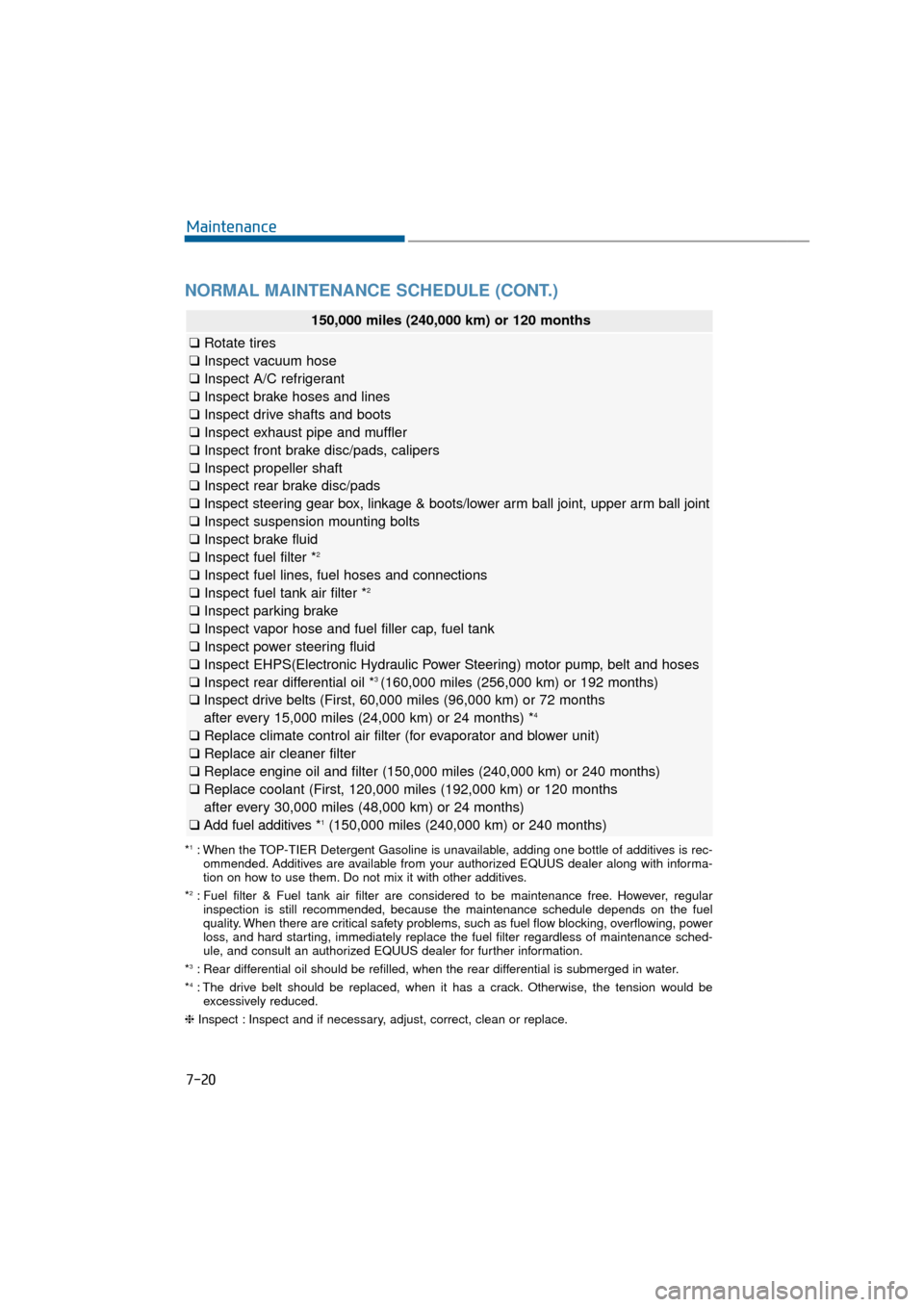
NORMAL MAINTENANCE SCHEDULE (CONT.)
7-20
Maintenance
150,000 miles (240,000 km) or 120 months
❑Rotate tires
❑ Inspect vacuum hose
❑ Inspect A/C refrigerant
❑ Inspect brake hoses and lines
❑ Inspect drive shafts and boots
❑ Inspect exhaust pipe and muffler
❑ Inspect front brake disc/pads, calipers
❑ Inspect propeller shaft
❑ Inspect rear brake disc/pads
❑ Inspect steering gear box, linkage & boots/lower arm ball joint, upper arm ball joint
❑ Inspect suspension mounting bolts
❑ Inspect brake fluid
❑ Inspect fuel filter *
2
❑Inspect fuel lines, fuel hoses and connections
❑ Inspect fuel tank air filter *2
❑Inspect parking brake
❑ Inspect vapor hose and fuel filler cap, fuel tank
❑ Inspect power steering fluid
❑ Inspect EHPS(Electronic Hydraulic Power Steer ing) motor pump, belt and hoses
❑ Inspect rear differential oil *
3 (160,000 miles (256,000 km) or 192 months)
❑ Inspect drive belts (First, 60,000 miles (96,000 km) or 72 months
after every 15,000 miles (24,000 km) or 24 months) *
4
❑ Replace climate control air filter (for evaporator and blower unit)
❑ Replace air cleaner filter
❑ Replace engine oil and filter (150,000 miles (240,000 km) or 240 mont\
hs)
❑ Replace coolant (First, 120,000 miles (192,000 km) or 120 months
after every 30,000 miles (48,000 km) or 24 months)
❑ Add fuel additives *
1(150,000 miles (240,000 km) or 240 months)
*1: When the TOP-TIER Detergent Gasoline is unavailable, adding one bottle of additives is rec-
ommended. Additives are available from your authorized EQUUS dealer along with informa-
tion on how to use them. Do not mix it with other additives.
*
2: Fuel filter & Fuel tank air filter are considered to be maintenance free\
. However, regular inspection is still recommended, because the maintenance schedule depend\
s on the fuel
quality. When there are critical safety problems, such as fuel flow blocking, overflowing, power
loss, and hard starting, immediately replace the fuel filter regardless of maintenance sche\
d-
ule, and consult an authorized EQUUS dealer for further information.
*
3: Rear differential oil should be refilled, when the rear differential is submerged in water.
*4: The drive belt should be replaced, when it has a crack. Otherwise, the tension would be excessively reduced.
❈ Inspect : Inspect and if necessary, adjust, correct, clean or replace.
Page 381 of 477
7-24
Maintenance
The use of an unauthorized fluid
may result in transmission mal-
function and failure. Use only the
authorized automatic transmis-
sion fluid. (Refer to “Recommended
lubricants and capacities” in the
chapter 8.)
Brake hoses and lines
Confirm the proper installation, and
check for any frictions, cracks, dete-
rioration and leakage. If necessary,
immediately replace any deteriorated
or damaged parts.
Brake fluid
Check the brake fluid level. The level
should be between “MIN” and “MAX”
marks on the reservoir. Use only the
hydraulic brake fluid, which meet the
requirements of the DOT3/DOT4
specifications.
Brake discs, pads, calipers
and rotors
Check the pads and the disc for any
excessive wear-out, and inspect
calipers for any fluid leakage.
Exhaust pipe and muffler
Inspect the exhaust pipes, muffler
and hangers for any cracks, deterio-
rations, or damages. Start the
engine, and listen carefully for any
gas leaking noise. If necessary, tight-
en connections or replace the dam-
aged parts.
Suspension mounting bolts
Check the suspension connections
for any looseness or damage. If nec-
essary, retighten the bolt to the spec-
ified torque.
Steering gear box, linkage &
boots/lower arm ball joint
After stopping the vehicle and turn-
ing off the engine, confirm the steer-
ing locking (tightening).
Check the bends for any linkage or
damage. Check the dust boots and
ball joints for any deterioration,
cracks, or damage. If necessary,
replace the damaged parts.
Power steering pump, belt and
hoses
Check the power steering pump and
hoses for any leakage or damage. If
necessary, immediately replace any
damaged or leaking parts. Inspect
the power steering belt (or drive belt)
for any cuts, cracks, excessive wear-
out, oil saturation or looseness. If
necessary, replace or adjust the
damaged part.
Drive shafts and boots
Check the drive shafts, boots and
clamps for any cracks, deterioration,
or damage. If necessary, replace or
grease the damaged part.
Air conditioning refrigerant
Check the air conditioning lines and
connections for any leakage or dam-
age.
NOTICE
Page 384 of 477
7-27
Maintenance07
The high-pressure cooling system
has a reservoir filled with the year-
round antifreeze coolant. The reser-
voir is already filled at the factory.
Check the antifreeze protection and
coolant level at least once a year, at
the beginning of the winter season,
and before traveling to a colder
region.
Checking the coolant level
E EN
N G
GI
IN
N E
E
C
C O
O O
OL
LA
A N
N T
T
(Continued)
operating, but when the
engine and radiator are hot,
do not remove the radiator
cap or the drain the plug. Hot
coolant and steam may blow
out under pressure, causing a
serious injury.
The electric motor (of
the cooling fan) is
controlled by the
engine coolant tem-
perature, refrigerant
pressure and driving speed. It
may operate, even when the
engine is not running. Use
extreme caution, when working
near the cooling fan blades. So,
you are not injured by the fan-
blade rotation. As the engine
coolant temperature decreases,
the electric motor will automati-
cally turn off. This is a normal.
When your vehicle is equipped
with GDI, the electric motor (of
the cooling fan) may operate
until the negative battery cable
is disconnected.
WARNING
Removing the radia-
tor cap
Never attempt to remove the radiator cap while the engine
is running, or when the engine
is hot. This may damage the
cooling system and the
engine, resulting in a serious
personal injury due to the hot
coolant or steam.
Turn the engine off and wait until it cools down. Use
extreme care when removing
the radiator cap. Wrap a thick
towel around it, and slowly turn
it in a counterclockwise direc-
tion to the first stop. Step back
while the pressure is released
from the cooling system.
When you are sure all the pres-
sure is released, press down
on the cap over a thick towel,
and turn it in a counterclock-
wise direction to remove it.
(Continued)
WARNING
Page 391 of 477
7-34
Maintenance
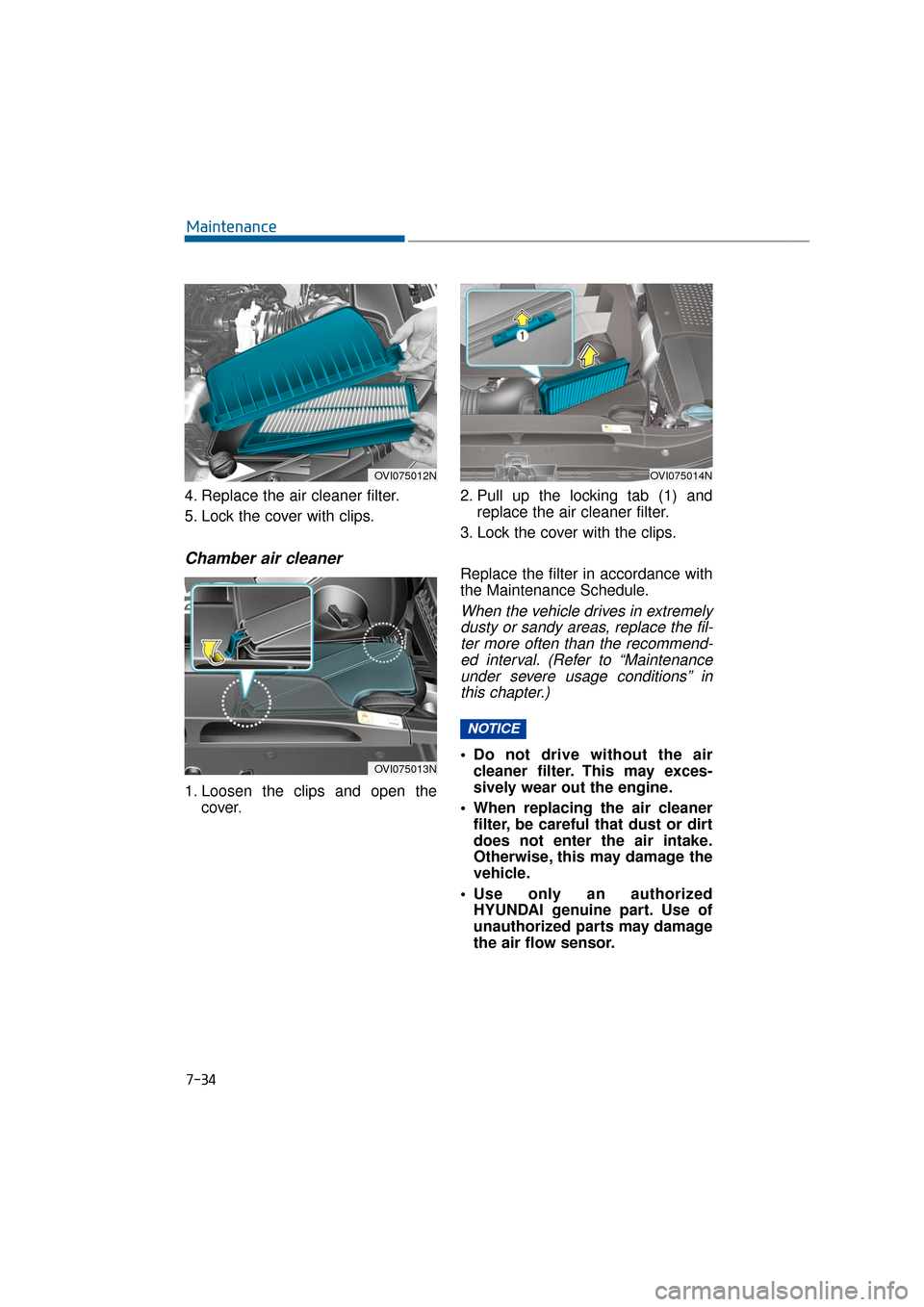
4. Replace the air cleaner filter.
5. Lock the cover with clips.
Chamber air cleaner
1. Loosen the clips and open the cover. 2. Pull up the locking tab (1) and
replace the air cleaner filter.
3. Lock the cover with the clips.
Replace the filter in accordance with
the Maintenance Schedule.
When the vehicle drives in extremely dusty or sandy areas, replace the fil-ter more often than the recommend-ed interval. (Refer to “Maintenanceunder severe usage conditions” inthis chapter.)
Do not drive without the air cleaner filter. This may exces-
sively wear out the engine.
When replacing the air cleaner filter, be careful that dust or dirt
does not enter the air intake.
Otherwise, this may damage the
vehicle.
Use only an authorized HYUNDAI genuine part. Use of
unauthorized parts may damage
the air flow sensor.
NOTICE
OVI075012N
OVI075013N
OVI075014N
Page 399 of 477
7-42
Maintenance
Keep the battery away from water or any other liquid.
The battery is located in the trunk. Thus, be careful when
loading a container filled with
liquid inside the trunk.
For your safety, use only the genuine HYUNDAI battery, when
replacing it.
Reset items
Items should be reset after either a
battery discharge or a battery dis-
connection.
Auto up/down window (See the chapter 3)
Rear door window curtains (See the chapter 3)
Sunroof (See the chapter 3)
Driver position memory system (See the chapter 3)
Trip computer (See the chapter 3)
Climate control system (See the chapter 3)
Clock (See DIS manual)
Audio (See DIS manual)
Power trunk (See the chapter 3)
Tire care
For the better maintenance, safety,
and fuel economy, you must always
maintain the recommended tire infla-
tion pressures, and follow the load
limits and weight distribution recom-
mendation.
Recommended cold tire infla-
tion pressures
The tire pressure (including the
spare) should be measured, when it
is cold. A “cold tire” means the vehi-
cle does not drive for the last 3 hours
or is driven shorter than 1 mile (1.6
km).
The recommended pressure must be
maintained for the best driving, han-
dling, and the minimum tire wear-out.
For the information about the recom-
mended inflation pressure, refer to
“Tire and wheels” in the chapter 8.
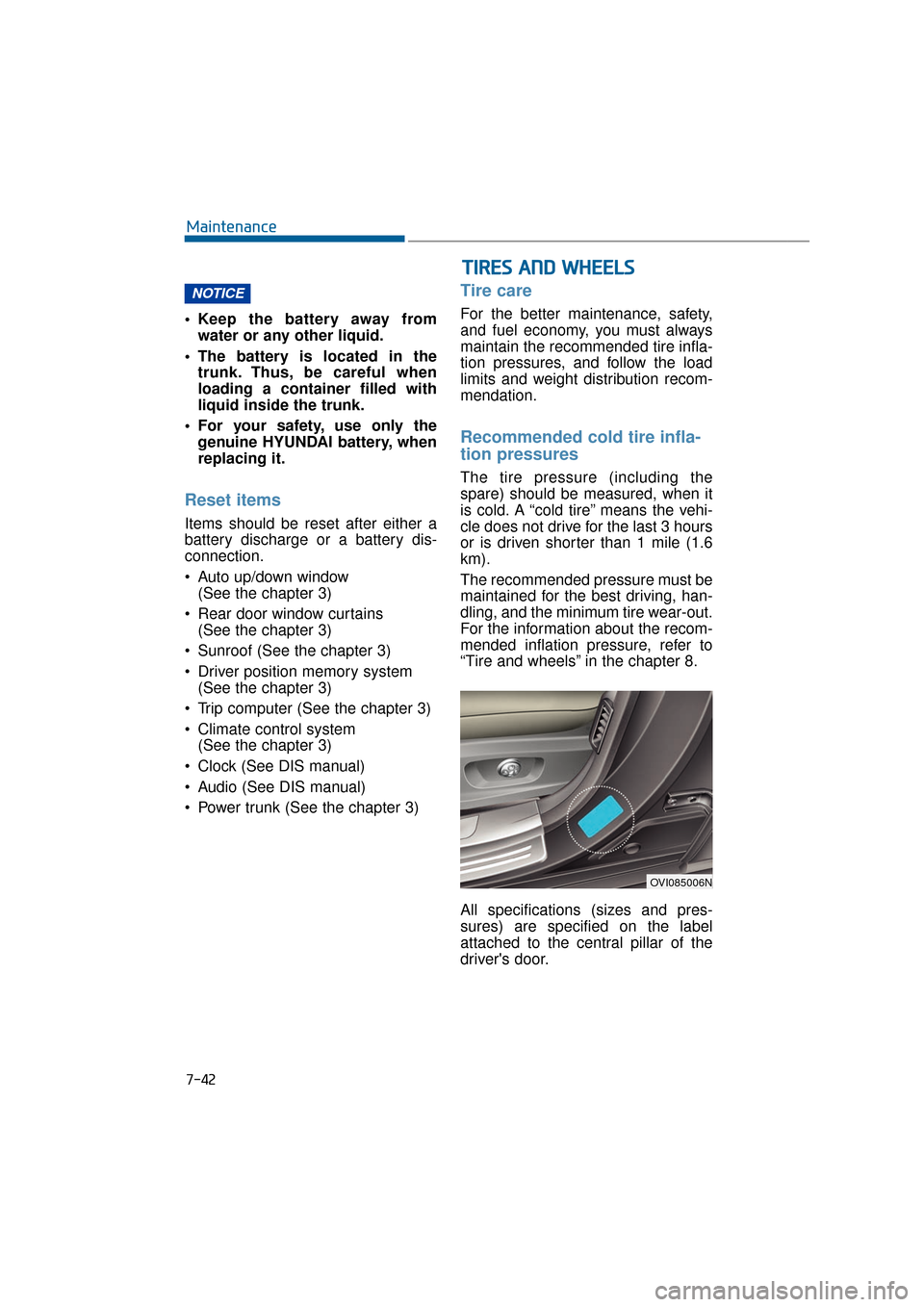
All specifications (sizes and pres-
sures) are specified on the label
attached to the central pillar of the
driver's door.
NOTICE
T T I
IR
R E
ES
S
A
A N
N D
D
W
W H
HE
EE
EL
LS
S
OVI085006N
Page 403 of 477
7-46
Maintenance
Tire replacement
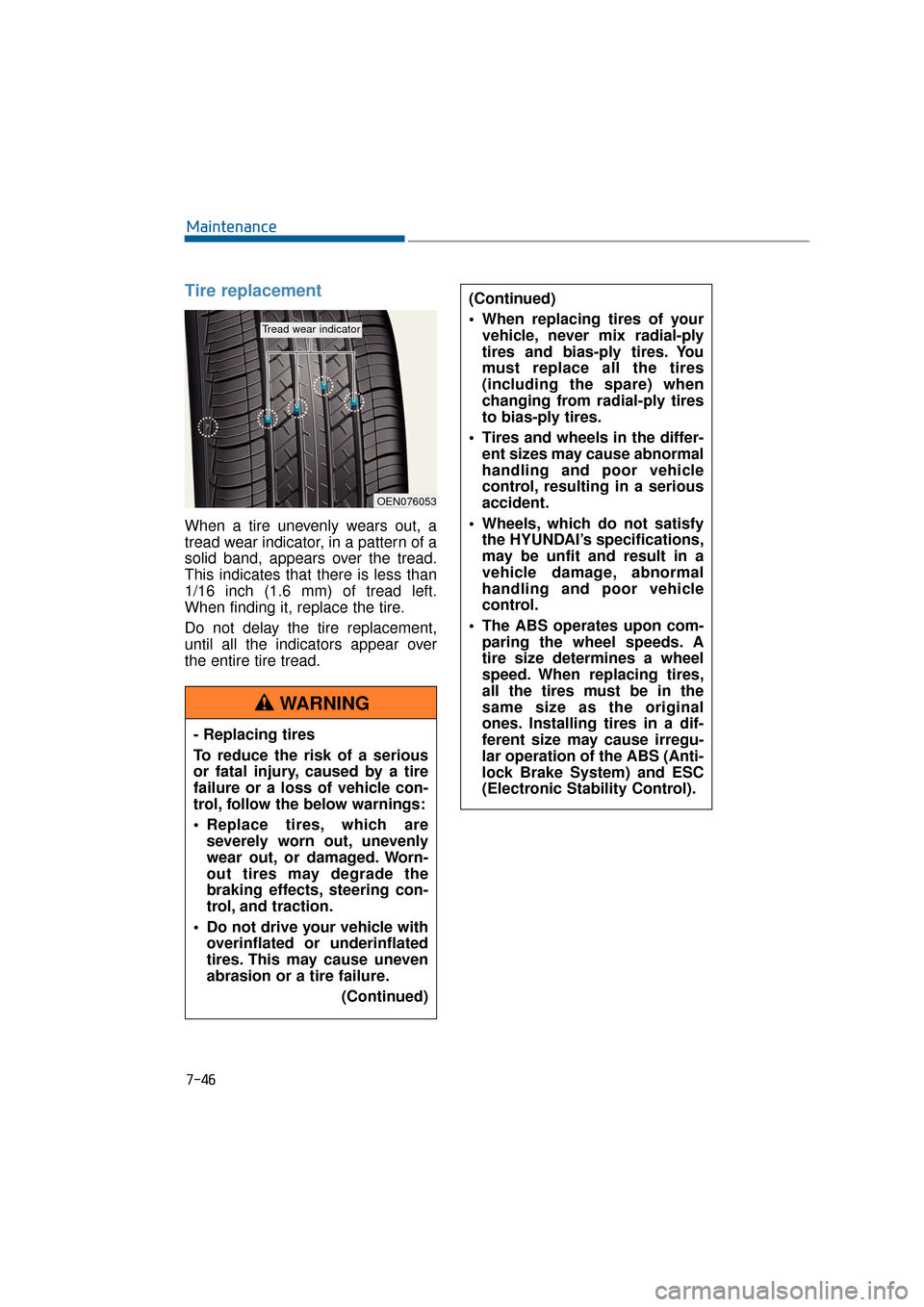
When a tire unevenly wears out, a
tread wear indicator, in a pattern of a
solid band, appears over the tread.
This indicates that there is less than
1/16 inch (1.6 mm) of tread left.
When finding it, replace the tire.
Do not delay the tire replacement,
until all the indicators appear over
the entire tire tread.
OEN076053
Tread wear indicator
- Replacing tires
To reduce the risk of a serious
or fatal injury, caused by a tire
failure or a loss of vehicle con-
trol, follow the below warnings:
Replace tires, which areseverely worn out, unevenly
wear out, or damaged. Worn-
out tires may degrade the
braking effects, steering con-
trol, and traction.
Do not drive your vehicle with overinflated or underinflated
tires. This may cause uneven
abrasion or a tire failure.
(Continued)
(Continued)
When replacing tires of yourvehicle, never mix radial-ply
tires and bias-ply tires. You
must replace all the tires
(including the spare) when
changing from radial-ply tires
to bias-ply tires.
Tires and wheels in the differ- ent sizes may cause abnormal
handling and poor vehicle
control, resulting in a serious
accident.
Wheels, which do not satisfy the HYUNDAI’s specifications,
may be unfit and result in a
vehicle damage, abnormal
handling and poor vehicle
control.
The ABS operates upon com- paring the wheel speeds. A
tire size determines a wheel
speed. When replacing tires,
all the tires must be in the
same size as the original
ones. Installing tires in a dif-
ferent size may cause irregu-
lar operation of the ABS (Anti-
lock Brake System) and ESC
(Electronic Stability Control).
WARNING
Page 415 of 477
7-58
Maintenance
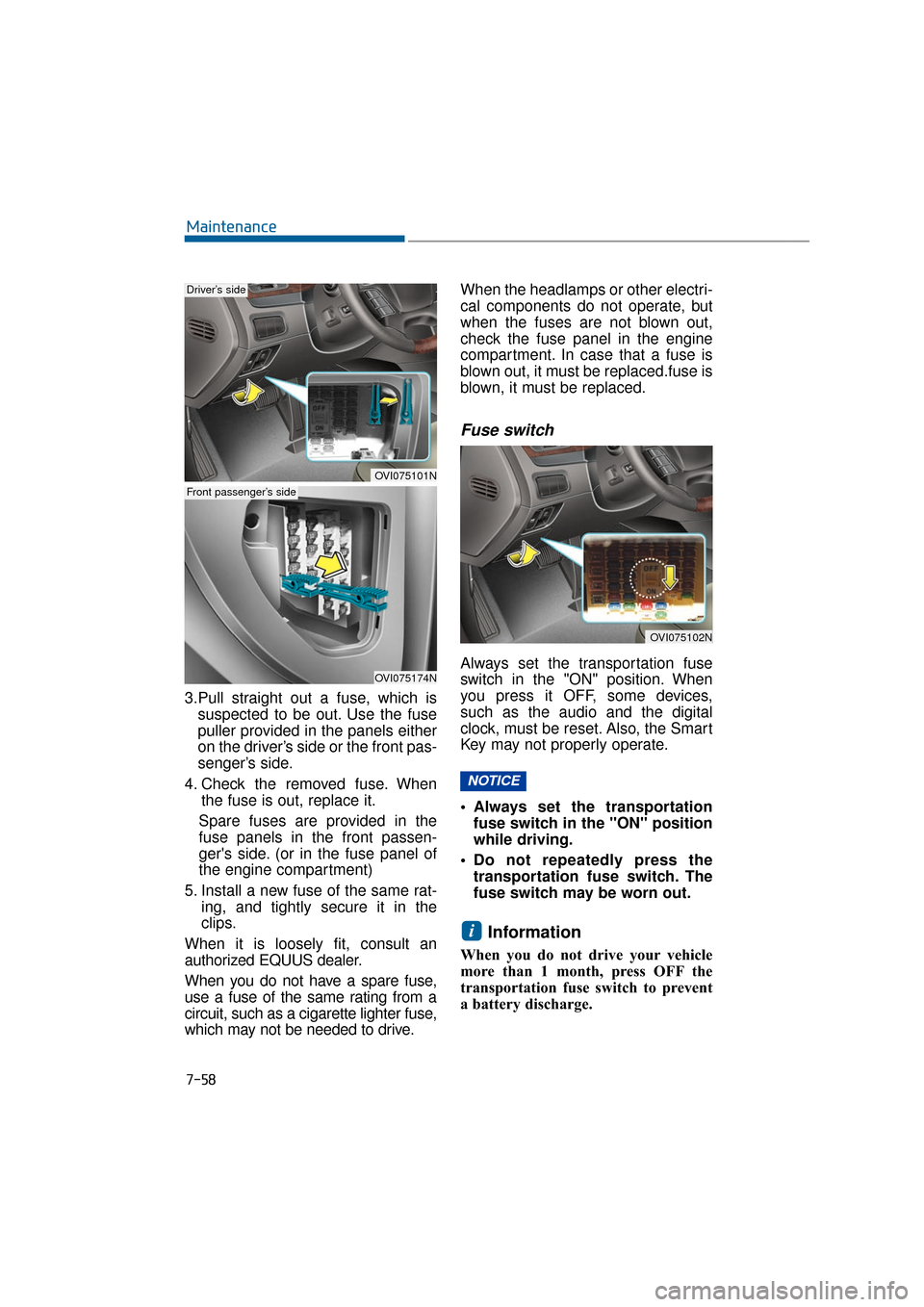
3.Pull straight out a fuse, which is suspected to be out. Use the fuse
puller provided in the panels either
on the driver’s side or the front pas-
senger’s side.
4. Check the removed fuse. When the fuse is out, replace it.
Spare fuses are provided in the
fuse panels in the front passen-
ger's side. (or in the fuse panel of
the engine compartment)
5. Install a new fuse of the same rat- ing, and tightly secure it in the
clips.
When it is loosely fit, consult an
authorized EQUUS dealer.
When you do not have a spare fuse,
use a fuse of the same rating from a
circuit, such as a cigarette lighter fuse,
which may not be needed to drive. When the headlamps or other electri-
cal components do not operate, but
when the fuses are not blown out,
check the fuse panel in the engine
compartment. In case that a fuse is
blown out, it must be replaced.fuse is
blown, it must be replaced.
Fuse switch
Always set the transportation fuse
switch in the "ON" position. When
you press it OFF, some devices,
such as the audio and the digital
clock, must be reset. Also, the Smart
Key may not properly operate.
Always set the transportation
fuse switch in the "ON" position
while driving.
Do not repeatedly press the transportation fuse switch. The
fuse switch may be worn out.
Information
When you do not drive your vehicle
more than 1 month, press OFF the
transportation fuse switch to prevent
a battery discharge.
i
NOTICE
OVI075101N
Driver’s side
OVI075174N
Front passenger’s side
OVI075102N