engine Hyundai Equus 2016 Owner's Manual
[x] Cancel search | Manufacturer: HYUNDAI, Model Year: 2016, Model line: Equus, Model: Hyundai Equus 2016Pages: 477, PDF Size: 16.25 MB
Page 256 of 477
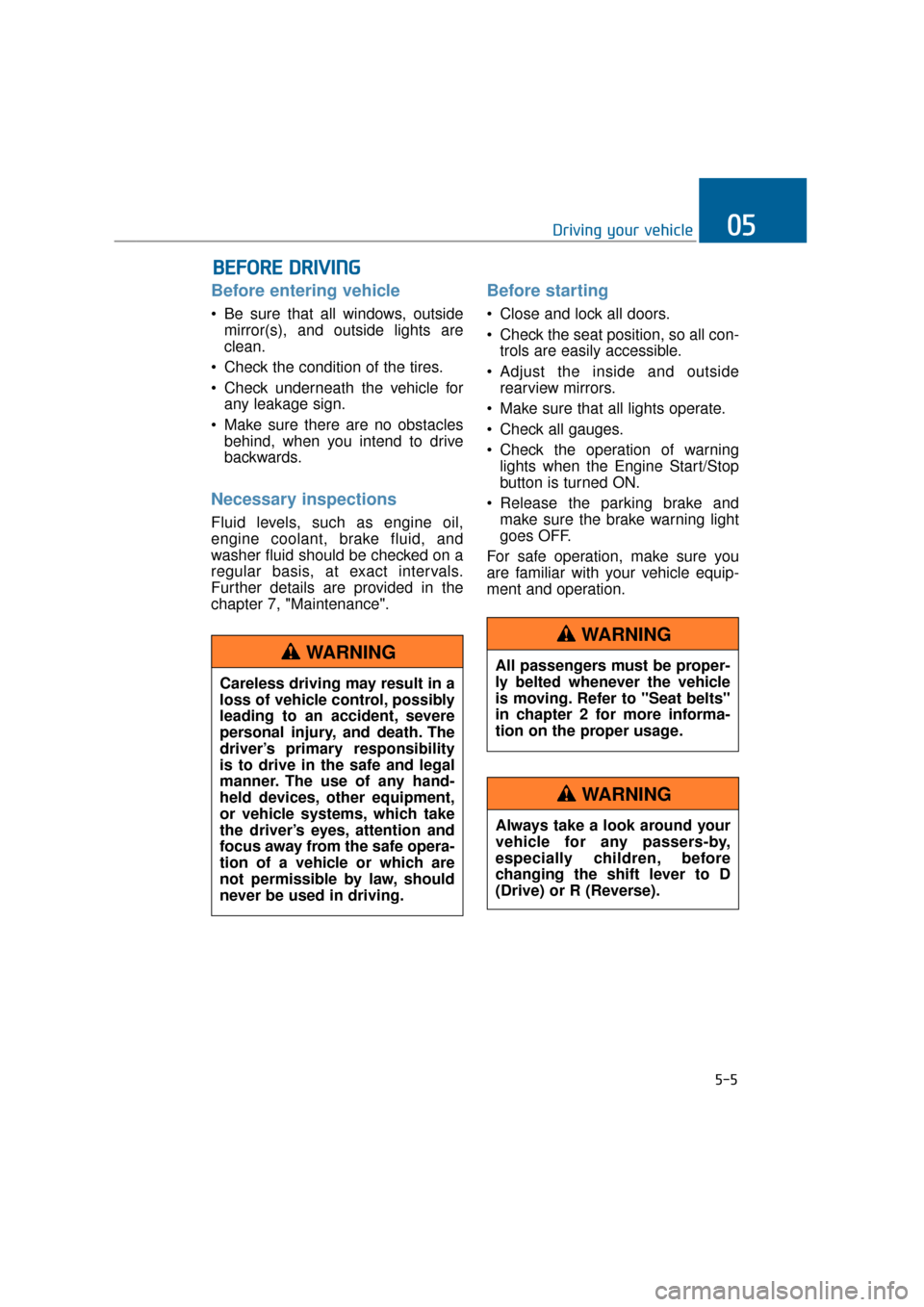
Before entering vehicle
• Be sure that all windows, outsidemirror(s), and outside lights are
clean.
Check the condition of the tires.
Check underneath the vehicle for any leakage sign.
Make sure there are no obstacles behind, when you intend to drive
backwards.
Necessary inspections
Fluid levels, such as engine oil,
engine coolant, brake fluid, and
washer fluid should be checked on a
regular basis, at exact intervals.
Further details are provided in the
chapter 7, "Maintenance".
Before starting
Close and lock all doors.
Check the seat position, so all con-trols are easily accessible.
Adjust the inside and outside rearview mirrors.
Make sure that all lights operate.
Check all gauges.
Check the operation of warning lights when the Engine Start/Stop
button is turned ON.
Release the parking brake and make sure the brake warning light
goes OFF.
For safe operation, make sure you
are familiar with your vehicle equip-
ment and operation.
B B E
EF
FO
O R
RE
E
D
D R
RI
IV
V I
IN
N G
G
5-5
Driving your vehicle05
Careless driving may result in a
loss of vehicle control, possibly
leading to an accident, severe
personal injury, and death. The
driver’s primary responsibility
is to drive in the safe and legal
manner. The use of any hand-
held devices, other equipment,
or vehicle systems, which take
the driver’s eyes, attention and
focus away from the safe opera-
tion of a vehicle or which are
not permissible by law, should
never be used in driving.
WARNINGAll passengers must be proper-
ly belted whenever the vehicle
is moving. Refer to "Seat belts"
in chapter 2 for more informa-
tion on the proper usage.
WARNING
Always take a look around your
vehicle for any passers-by,
especially children, before
changing the shift lever to D
(Drive) or R (Reverse).
WARNING
Page 257 of 477
5-6
Driving your vehicle- Driving under the influence of alcohol or drugs
DUI (driving under the influ-
ence) is dangerous. DUI is the
number one contributor to the
highway death toll each year.
Even a small amount of alcohol
will affect your reflexes, percep-
tions and judgment. Driving
under the influence of drugs is
as dangerous as or more dan-
gerous than driving under the
influence of alcohol.
You are much more likely to
have a serious accident if you
drive under the influence of
alcohol or drug. After you drink
alcohol or take drugs, do not
drive. Do not ride in a passen-
ger's seat when a driver drinks
or takes drugs.
Have a designated driver in
your group or call a cab.
WARNING
When you park or pull over the vehicle with the engine
ON, be careful not to depress
the accelerator pedal for a
long period of time. It may
overheat the engine or
exhaust system and cause
fire.
When you make a sudden stop or rapidly turn the steer-
ing wheel, any loose objects
may toss about inside the
vehicle and interfere with the
pedal operation, possibly
causing an accident. Keep all
things in the vehicle safely
stored.
If you are not concentrated while driving, it may cause an
accident. Be careful when
operating controls such as
the audio or heater. It is
always the driver's responsi-
bility to be attentive to the
driving safety.
WARNING
Page 258 of 477
E
EN
N G
GI
IN
N E
E
S
S T
T A
A R
RT
T/
/S
S T
T O
O P
P
B
B U
U T
TT
TO
O N
N
5-7
Driving your vehicle05
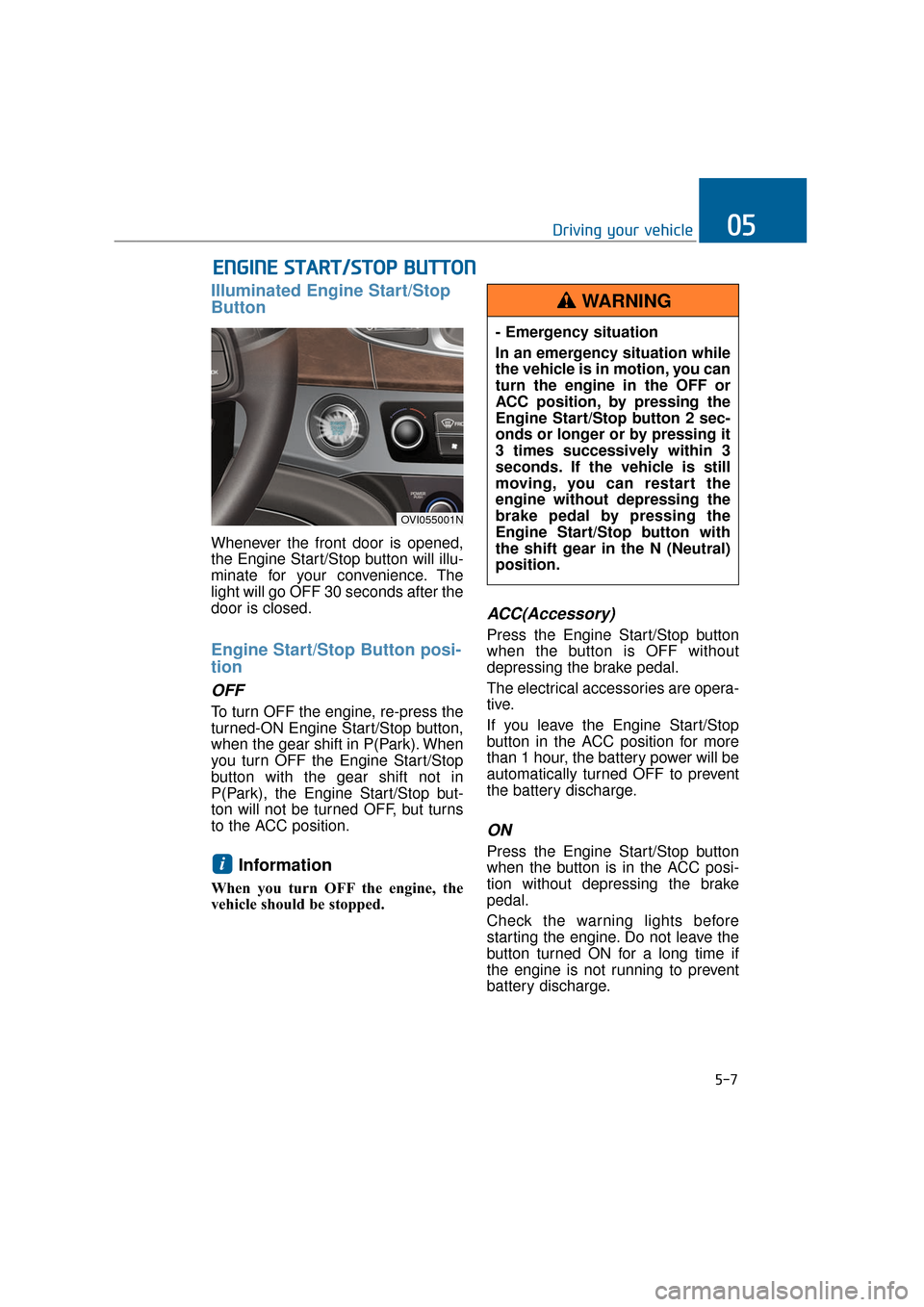
Illuminated Engine Start/Stop
Button
Whenever the front door is opened,
the Engine Start/Stop button will illu-
minate for your convenience. The
light will go OFF 30 seconds after the
door is closed.
Engine Start/Stop Button posi-
tion
OFF
To turn OFF the engine, re-press the
turned-ON Engine Start/Stop button,
when the gear shift in P(Park). When
you turn OFF the Engine Start/Stop
button with the gear shift not in
P(Park), the Engine Start/Stop but-
ton will not be turned OFF, but turns
to the ACC position.
Information
When you turn OFF the engine, the
vehicle should be stopped.
ACC(Accessory)
Press the Engine Start/Stop button
when the button is OFF without
depressing the brake pedal.
The electrical accessories are opera-
tive.
If you leave the Engine Start/Stop
button in the ACC position for more
than 1 hour, the battery power will be
automatically turned OFF to prevent
the battery discharge.
ON
Press the Engine Start/Stop button
when the button is in the ACC posi-
tion without depressing the brake
pedal.
Check the warning lights before
starting the engine. Do not leave the
button turned ON for a long time if
the engine is not running to prevent
battery discharge.i
OVI055001N
- Emergency situation
In an emergency situation while
the vehicle is in motion, you can
turn the engine in the OFF or
ACC position, by pressing the
Engine Start/Stop button 2 sec-
onds or longer or by pressing it
3 times successively within 3
seconds. If the vehicle is still
moving, you can restart the
engine without depressing the
brake pedal by pressing the
Engine Start/Stop button with
the shift gear in the N (Neutral)
position.
WARNING
Page 259 of 477
START
To start the engine, depress the
brake pedal and press the Engine
Start/Stop Button with the shift gear
in P(Park) or N(Neutral).
For your safety, start the engine with
the shift gear in P(Park).
Information
• If you press the Engine Start/Stopbutton without depressing the brake
pedal, the engine does not start.
When the Engine Start/Stop button
is pressed, it changes as follows:
OFF → →
ACC →
→
ON →
→
OFF
• If you leave the Engine Start/Stop Button in the ACC or the ON posi-
tion for a long time, the battery will
be discharged.
i
5-8
Driving your vehicle
Never press the Engine Start/Stop button while the
vehicle is in motion except in
an emergency situation. This
would turn the engine OFF,
resulting in loss of power
assist for the steering wheel
and brake. This may lead to
loss of directional control and
braking function, which could
cause an accident.
(Continued)
(Continued)
Before leaving the driver’sseat, always make sure the
shift gear is engaged in P
(Park), fully set the parking
brake and turn the engine
OFF. Unexpected and sudden
vehicle movement may occur
if these precautions are not
taken.
Never touch the Engine Start/Stop button, or any other
controls on the steering wheel
while the vehicle is in motion.
Reaching out for those con-
trols with your hand or arm
may cause a loss of vehicle
control, an accident, serious
bodily injury or death.
Do not place any loose objects around the driver’s
seat, as they may toss about
while driving, interfering with
the driver's pedal operation
and leading to an accident.
WARNING
Page 260 of 477
1.Carry the Smart Key inside thevehicle.
2.Check the parking brake is firmly applied.
3.Place the shift lever in P(Park).
4.Depress the brake pedal.
5.Press the Engine Start/Stop but- ton.
It should be started without
depressing the accelerator.
6.Do not wait for the engine to warm up while idling the engine.
Start driving at a moderate speed.
(Sudden accelerating and deceler-
ating should be avoided.)
If the engine stops while driving,
do not attempt to move the shift
lever to P (Park). When traffic and
road conditions permit, and while
the vehicle is still moving, you
may move the shift lever to
N(Neutral), and press the Engine
Start/Stop button to restart the
engine. Even though the Smart Key is
inside the vehicle, but when the
key is far away from the driver, the
engine may not start.
When the Engine Start/Stop button is in the ACC or ON position, and
when any door is open, the system
checks for the presence of the
Smart Key. If the Smart Key is not
inside the vehicle, the "Key not in
vehicle" indicator will illuminate.
When all doors are closed, the
chime will also sound for approxi-
mately 5 seconds. The indicator
will be turned OFF while the vehi-
cle is moving. Keep the Smart Key
inside the vehicle when the Engine
Start/Stop button is in the ACC or
ON position.
NOTICE
S ST
T A
A R
RT
TI
IN
N G
G
T
T H
H E
E
E
E N
N G
GI
IN
N E
E
5-9
Driving your vehicle05
Always wear proper shoes
when driving your vehicle.
Improper types of shoes (i.e.
high heels, slippers, ski boots,
etc.) may interfere with your
ability to control the brake and
accelerator pedal.
WARNING
Only when the Smart Key is
inside the vehicle, pressing the
Engine Start/Stop button will
start the engine. Never allow
children or any persons, who
are unfamiliar with the vehicle,
to touch the Engine Start/Stop
button or other related parts.
WARNING
Page 261 of 477
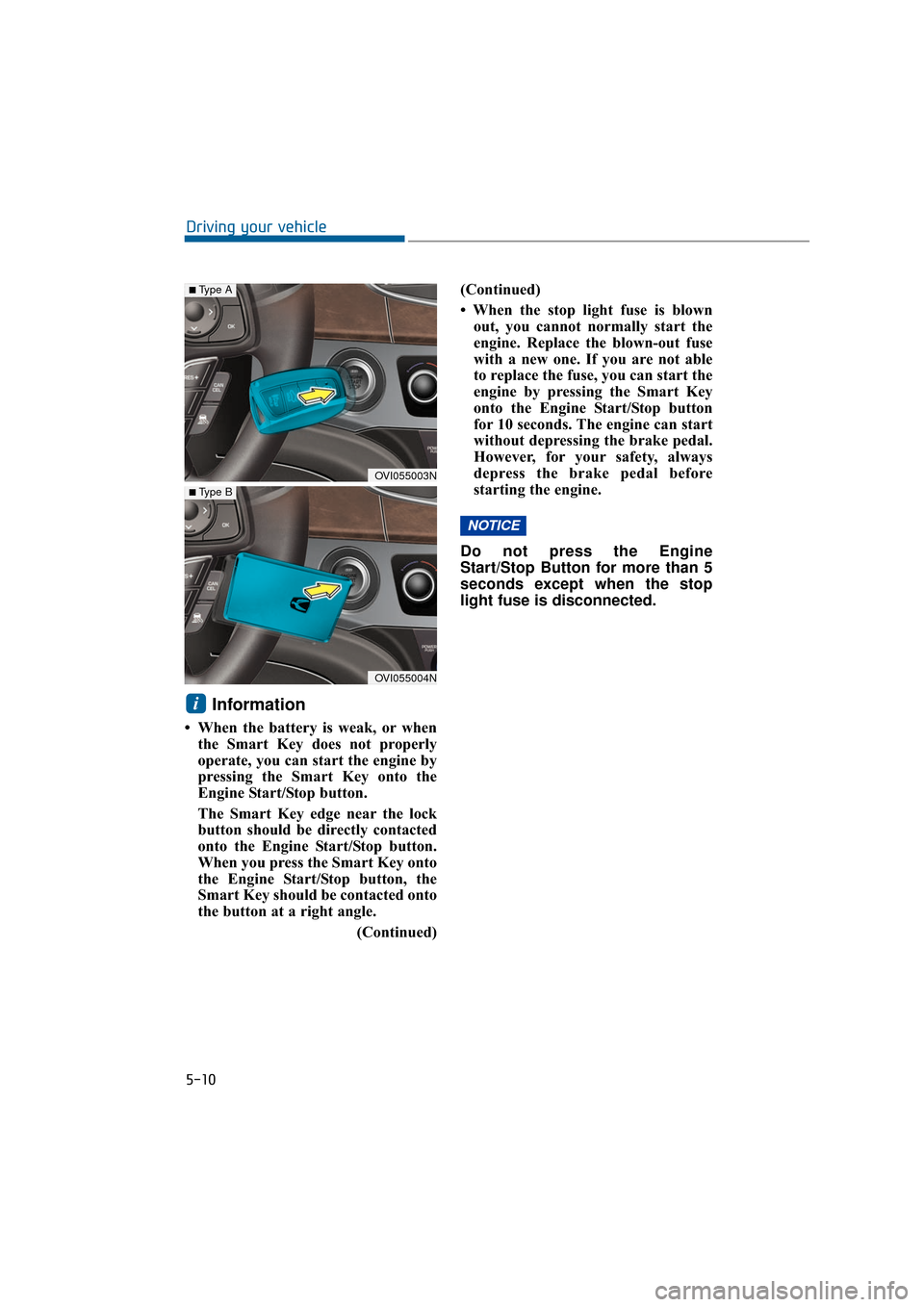
Information
• When the battery is weak, or whenthe Smart Key does not properly
operate, you can start the engine by
pressing the Smart Key onto the
Engine Start/Stop button.
The Smart Key edge near the lock
button should be directly contacted
onto the Engine Start/Stop button.
When you press the Smart Key onto
the Engine Start/Stop button, the
Smart Key should be contacted onto
the button at a right angle.
(Continued)(Continued)
• When the stop light fuse is blown
out, you cannot normally start the
engine. Replace the blown-out fuse
with a new one. If you are not able
to replace the fuse, you can start the
engine by pressing the Smart Key
onto the Engine Start/Stop button
for 10 seconds. The engine can start
without depressing the brake pedal.
However, for your safety, always
depress the brake pedal before
starting the engine.
Do not press the Engine
Start/Stop Button for more than 5
seconds except when the stop
light fuse is disconnected.
NOTICE
i
5-10
Driving your vehicle
OVI055003N
■Type A
OVI055004N
■ Type B
Page 263 of 477
Automatic transmission opera-
tion
The automatic transmission has 8
forward speed levels and 1 reverse
speed level. Vehicle speed is auto-
matically selected, depending on the
shift lever position.
Information
A new vehicle may experience some-
what abrupt movement during the
first few shifts.
Always depress the brake pedalwhen moving the shift lever from N(Neutral) to a forward or reverse gear.
To avoid damage to your trans- mission, do not depress the
accelerator, when the shift lever
is in R (Reverse) or any forward
gear positions, and when the
brake is set.
(Continued)(Continued)
When a vehicle stops on a
slope, do not stop the vehicle
with the engine power.
Set the service brake or the
parking brake.
Do not shift from N(Neutral)/P(Park) to
D(Drive)/R(Reverse), when the
engine runs faster than the idle
speed.
Transmission ranges
The shift lever position is displayed
on the instrument cluster, when the
Engine Start/Stop button is ON.
P (Park)
Always completely stop the vehicle
before moving the shift lever to P
(Park). This locks the transmission
and prevents the drive wheels from
rotating.
NOTICE
i
5-12
Driving your vehicle
- Automatic transmission
Always take a look around your vehicle for any passers-
by, especially children, before
moving the shift lever to D
(Drive) or R (Reverse).
Before leaving the driver’s seat, always make sure the
shift lever is in P (Park). Then,
fully set the parking brake and
turn the engine OFF.
Unexpected and sudden vehi-
cle movement may occur
when these precautions are
not taken.
WARNING
Moving the shift lever to P(Park), while driving, locks the
drive wheels, possibly result-
ing in your loss of vehicle
control.
Do not set the shift lever in P (Park) instead of setting the
parking brake. Always make
sure the shift lever is latched
in P(Park) position, and the
parking brake is fully set.
Never leave a child unattend- ed in a vehicle.
WARNING
Page 264 of 477
R (Reverse)
Set the shift lever in this position to
drive backwards.
Always completely stop the vehi-
cle before changing the shift lever
to or out of R (Reverse). You may
damage the transmission when
changing the shift lever to R while
driving, except as explained in
"Rocking the Vehicle" in this chap-
ter.
N (Neutral)
The wheels and transmission are not
engaged. The vehicle rolls freely
even on the slightest slope, unless
the parking brake or service brake is
applied.
D (Drive)
This is for the forward driving posi-
tion. The transmission will automati-
cally shift in a 8-gear sequence, pro-
viding the best fuel economy and
power.
For extra power to pass ahead
another vehicle or to climb a slope,
fully depress the accelerator. Then,
the transmission will automatically
downshift to the next lower gear (or
gears, as appropriate).
Information
Always come to a complete stop before
changing the shift lever to D (Drive).
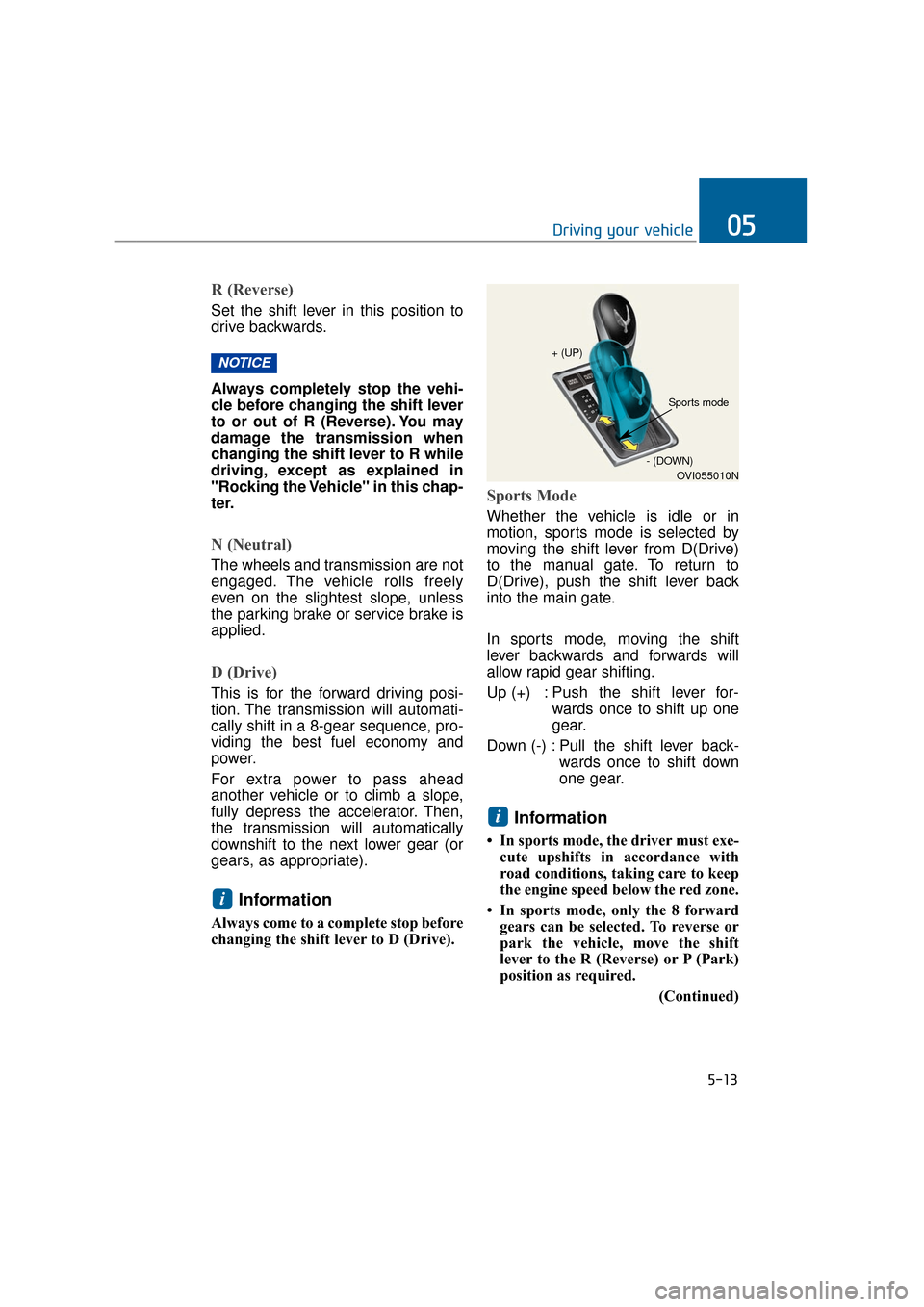
Sports Mode
Whether the vehicle is idle or in
motion, sports mode is selected by
moving the shift lever from D(Drive)
to the manual gate. To return to
D(Drive), push the shift lever back
into the main gate.
In sports mode, moving the shift
lever backwards and forwards will
allow rapid gear shifting.
Up (+) : Push the shift lever for-wards once to shift up one
gear.
Down (-) : Pull the shift lever back- wards once to shift down
one gear.
Information
• In sports mode, the driver must exe-cute upshifts in accordance with
road conditions, taking care to keep
the engine speed below the red zone.
• In sports mode, only the 8 forward gears can be selected. To reverse or
park the vehicle, move the shift
lever to the R (Reverse) or P (Park)
position as required.
(Continued)
i
i
NOTICE
5-13
Driving your vehicle05
OVI055010N
+ (UP)
- (DOWN)
Sports mode
Page 265 of 477
(Continued)
• In sports mode, the transmissionwill automatically downshift, when
it slows down. When the vehicle
stops, the transmission automatical-
ly selects the 1st gear.
• In sports mode, the transmission will automatically upshift, when the
engine rpm approaches toward the
red zone.
• Even though the driver moves the shift lever to a +(up) or -(down)
position, the transmission may not
make the manually-requested gear
change, if the requested gear is out
of the allowable engine RPM range.
• When driving on a slippery road, set the shift lever in the 2nd gear, which
is better for smooth acceleration on
a slippery road.Shift lock system
For your safety, the automatic trans-
mission has a shift lock system to
prevent the transmission shifting
from P(Park) to R (Reverse), unless
the brake pedal is depressed.
To shift the transmission from
P(Park) into R(Reverse):
1. Depress the brake pedal.
2. Start the engine or turn the Engine Start/Stop button ON.
3. Move the shift lever.
When the brake pedal is repeatedly
depressed and released with the
shift lever in P(Park), you may expe-
rience chattering noises near the
shift lever. This is a normal condition.
5-14
Driving your vehicle
Always fully depress the brake
pedal before and while moving
the shift lever out of P (Park) to
another position to avoid inad-
vertent movement of the vehi-
cle. This may injure persons in
or around the car.
WARNING
Page 266 of 477
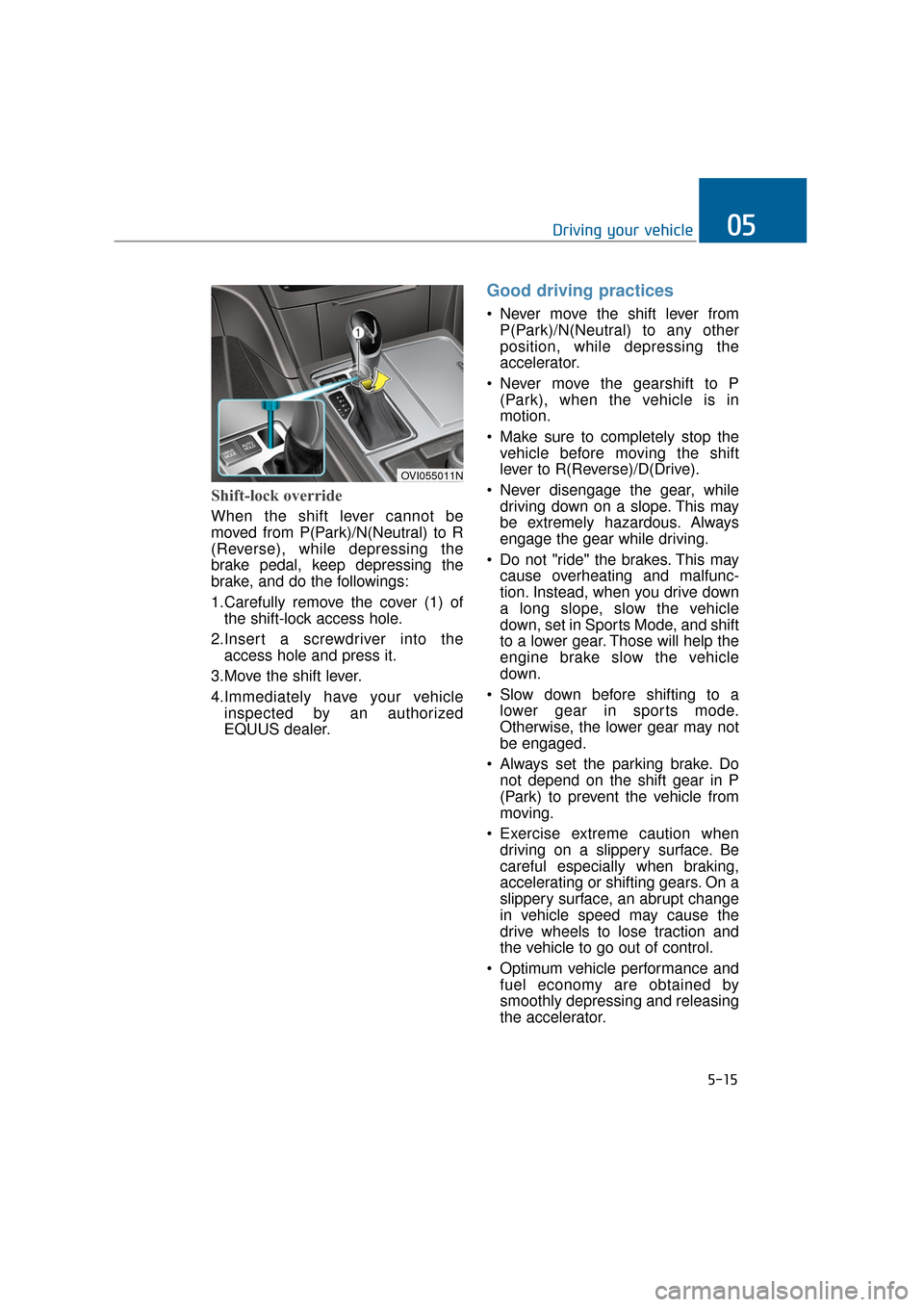
Shift-lock override
When the shift lever cannot be
moved from P(Park)/N(Neutral) to R
(Reverse), while depressing the
brake pedal, keep depressing the
brake, and do the followings:
1.Carefully remove the cover (1) ofthe shift-lock access hole.
2.Insert a screwdriver into the access hole and press it.
3.Move the shift lever.
4.Immediately have your vehicle inspected by an authorized
EQUUS dealer.
Good driving practices
Never move the shift lever fromP(Park)/N(Neutral) to any other
position, while depressing the
accelerator.
Never move the gearshift to P (Park), when the vehicle is in
motion.
Make sure to completely stop the vehicle before moving the shift
lever to R(Reverse)/D(Drive).
Never disengage the gear, while driving down on a slope. This may
be extremely hazardous. Always
engage the gear while driving.
Do not "ride" the brakes. This may cause overheating and malfunc-
tion. Instead, when you drive down
a long slope, slow the vehicle
down, set in Sports Mode, and shift
to a lower gear. Those will help the
engine brake slow the vehicle
down.
Slow down before shifting to a lower gear in sports mode.
Otherwise, the lower gear may not
be engaged.
Always set the parking brake. Do not depend on the shift gear in P
(Park) to prevent the vehicle from
moving.
Exercise extreme caution when driving on a slippery surface. Be
careful especially when braking,
accelerating or shifting gears. On a
slippery surface, an abrupt change
in vehicle speed may cause the
drive wheels to lose traction and
the vehicle to go out of control.
Optimum vehicle performance and fuel economy are obtained by
smoothly depressing and releasing
the accelerator.
5-15
Driving your vehicle05
OVI055011N