engine Hyundai Equus 2016 Owner's Manual
[x] Cancel search | Manufacturer: HYUNDAI, Model Year: 2016, Model line: Equus, Model: Hyundai Equus 2016Pages: 477, PDF Size: 16.25 MB
Page 337 of 477
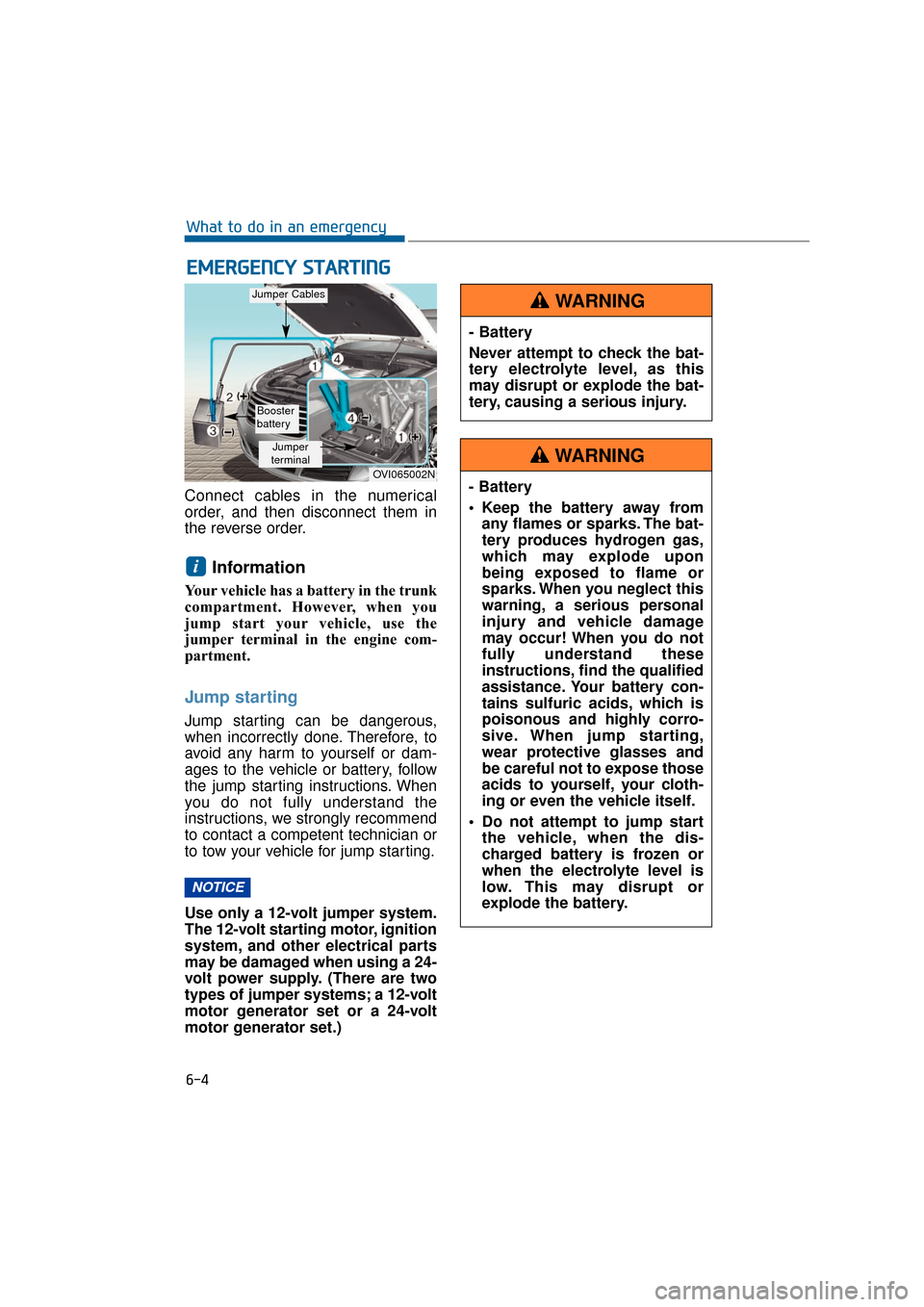
Connect cables in the numerical
order, and then disconnect them in
the reverse order.
Information
Your vehicle has a battery in the trunk
compartment. However, when you
jump start your vehicle, use the
jumper terminal in the engine com-
partment.
Jump starting
Jump starting can be dangerous,
when incorrectly done. Therefore, to
avoid any harm to yourself or dam-
ages to the vehicle or battery, follow
the jump starting instructions. When
you do not fully understand the
instructions, we strongly recommend
to contact a competent technician or
to tow your vehicle for jump starting.
Use only a 12-volt jumper system.
The 12-volt starting motor, ignition
system, and other electrical parts
may be damaged when using a 24-
volt power supply. (There are two
types of jumper systems; a 12-volt
motor generator set or a 24-volt
motor generator set.)
NOTICE
i
E EM
M E
ER
R G
G E
EN
N C
CY
Y
S
S T
T A
A R
RT
TI
IN
N G
G
6-4
What to do in an emergency
OVI065002N
Jumper
terminal
Jumper Cables
Booster
battery
- Battery
Never attempt to check the bat-
tery electrolyte level, as this
may disrupt or explode the bat-
tery, causing a serious injury.
WARNING
- Battery
• Keep the battery away from any flames or sparks. The bat-
tery produces hydrogen gas,
which may explode upon
being exposed to flame or
sparks. When you neglect this
warning, a serious personal
injury and vehicle damage
may occur! When you do not
fully understand these
instructions, find the qualified
assistance. Your battery con-
tains sulfuric acids, which is
poisonous and highly corro-
sive. When jump starting,
wear protective glasses and
be careful not to expose those
acids to yourself, your cloth-
ing or even the vehicle itself.
Do not attempt to jump start the vehicle, when the dis-
charged battery is frozen or
when the electrolyte level is
low. This may disrupt or
explode the battery.
WARNING
Page 338 of 477
Jump starting procedure
Information
Your vehicle has a battery in the trunk
compartment. However, when you
jump start your vehicle, use the
jumper terminal in the engine com-
partment.
1.Make sure the booster battery is12-volt and that its negative termi-
nal is grounded.
2.When the booster battery is in another vehicle, separate the two
vehicles apart.
3.Turn OFF all unnecessary electri- cal systems.
4.Connect the jumper cables in the exact sequence as shown in the
illustration of the previous page.
First connect one of the jumper
cable ends to the positive terminal
of the jumper terminal (1), and then
connect the other end to the posi-
tive terminal on the booster battery
(2). Proceed to connect one of the
other jumper cable ends to the
negative terminal of the booster
battery (3), then the other end to
the negative terminal of the jumper
terminal (4). Clear the jump cables
away from any movable parts or
other battery terminals, when jump
starting.
Keep the jumper cables away from
any others except the correct bat-
tery terminal connections and the
correct grounding connections. Do
not apply unnecessary forces on
the battery when making connec-
tions. - Battery cables
When jump starting the dis-
charged battery in the trunk com-
partment, do not connect the
jumper cable between the nega-
tive terminal of the booster battery
and the negative terminal of the
discharged battery. This may
cause the discharged battery to
overheat, crack, or release the
acids.
Connect the jumper cable
between the negative terminal of
the booster battery and a solid,
stationary or metallic point often
discharges the battery.
5.First, start the engine of the vehicle
with the booster battery, over 2,000
rpm. Then, start your engine with
the discharged battery.
6.Turn your engine ON for at least 20 minutes either in the idling mode or
the driving mode. Otherwise, your
discharged battery is not
recharged enough to re-start the
vehicle.
When the cause of your battery dis-charging is not apparent, have yourvehicle checked by an authorizedEQUUS dealer.
Push-starting
A vehicle equipped with automatic
transmission cannot be push-start-
ed. Follow the instructions in "Jump
starting" of this chapter.
NOTICE
i
6-5
What to do in an emergency06
Page 339 of 477
When the temperature gauge indi-
cates engine overheating, you may
experience a loss of power, loud
pinging, or knocking. The engine is
probably too hot. If this happens, you
should:
1.Pull off the road and stop the vehi-cle as soon as it is safe to do so.
2.Place the shift lever in P(Park), and set the parking brake. When the
A/C is turned ON, turn it OFF.
3.When the engine coolant gushes out, or when steam comes out
from the hood, stop the engine. Do
not open the hood until the coolant
outrushing or steaming stops.
Even when there is no more
coolant outrushing, leave the
engine running and operate the
engine cooling fan. When the fan
does not operate, turn the engine
OFF.
4.Check whether the water pump drive belt is missing. When it is not,
check its tightening. When it seems
to be loose, check for any coolant
leaking from the radiator or hoses
underneath the vehicle. (When the
A/C is turned ON, cold-water drain-
ing is normal upon stopping the
vehicle.) 5.When the water pump drive belt is
broken, or when engine coolant
leaks out, immediately stop the
engine and contact the nearest
authorized EQUUS dealer for
assistance.
6.When you cannot find a cause, wait until the engine temperature
cools down. When there is serious
loss of engine coolant, carefully
add coolant into the reservoir to
bring the fluid level above the
halfway mark.
7.Be cautious and keep alert for fur- ther signs of overheating. When
finding further overheating signs,
contact an authorized EQUUS
dealer for assistance.
I IF
F
T
T H
H E
E
E
E N
N G
GI
IN
N E
E
O
O V
VE
ER
R H
H E
EA
A T
TS
S
6-6
What to do in an emergency
While the engine is running,
keep hair, hands, and clothing
away from moving parts, such
as the fan and drive belts, in
order to prevent an injury.
WARNING
Do not remove theradiator cap, when the
engine is hot. This may
blow out the engine
coolant out of the
opening and cause a
serious burn.
WARNING
Serious loss of coolant indi-
cates a leakage in the cooling
system. This should be immedi-
ately checked by an authorized
EQUUS dealer.
CAUTION
Page 341 of 477
Always check the TPMS malfunction
telltale after replacing one or more
tires or wheels on your vehicle to
ensure that the replacement or alter-
nate tires and wheels allow the TPMS
to continue to function properly.
Information
If any of the followings happens, we
recommend that the system be
checked by an authorized EQUUS
dealer.
1. The low tire pressure telltale/TPMSmalfunction indicator does not illu-
minate for 3 seconds when the igni-
tion switch is turned ON or engine is
running.
2. The TPMS malfunction indicator remains ON after flashing for
approximately 1 minute.
3. The Low tire pressure position tell- tale remains ON.
Low tire pressure tell-
tale
Low tire pres-
sure position
telltale
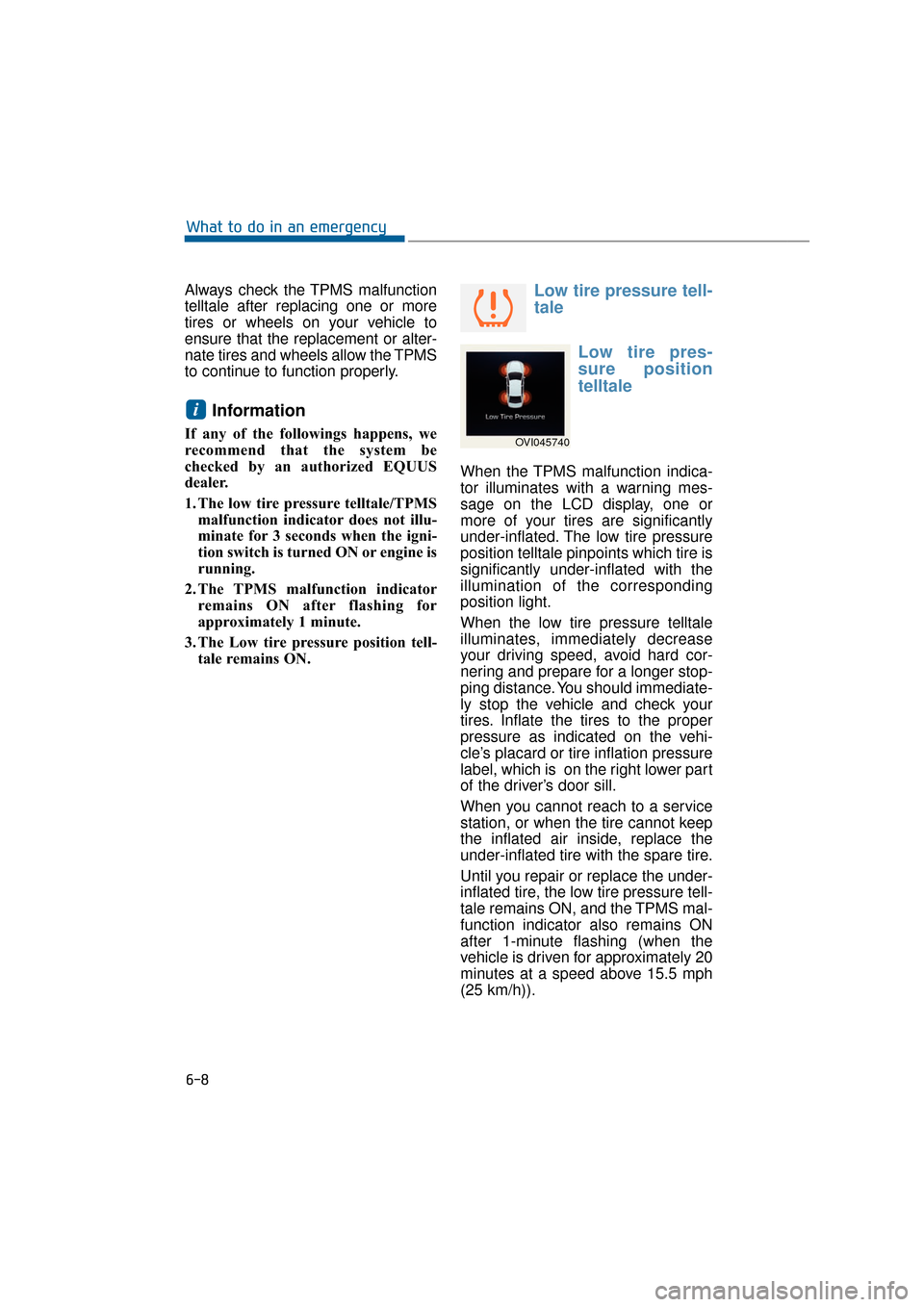
When the TPMS malfunction indica-
tor illuminates with a warning mes-
sage on the LCD display, one or
more of your tires are significantly
under-inflated. The low tire pressure
position telltale pinpoints which tire is
significantly under-inflated with the
illumination of the corresponding
position light.
When the low tire pressure telltale
illuminates, immediately decrease
your driving speed, avoid hard cor-
nering and prepare for a longer stop-
ping distance. You should immediate-
ly stop the vehicle and check your
tires. Inflate the tires to the proper
pressure as indicated on the vehi-
cle’s placard or tire inflation pressure
label, which is on the right lower part
of the driver’s door sill.
When you cannot reach to a service
station, or when the tire cannot keep
the inflated air inside, replace the
under-inflated tire with the spare tire.
Until you repair or replace the under-
inflated tire, the low tire pressure tell-
tale remains ON, and the TPMS mal-
function indicator also remains ON
after 1-minute flashing (when the
vehicle is driven for approximately 20
minutes at a speed above 15.5 mph
(25 km/h)).
i
6-8
What to do in an emergency
OVI045740
Page 345 of 477
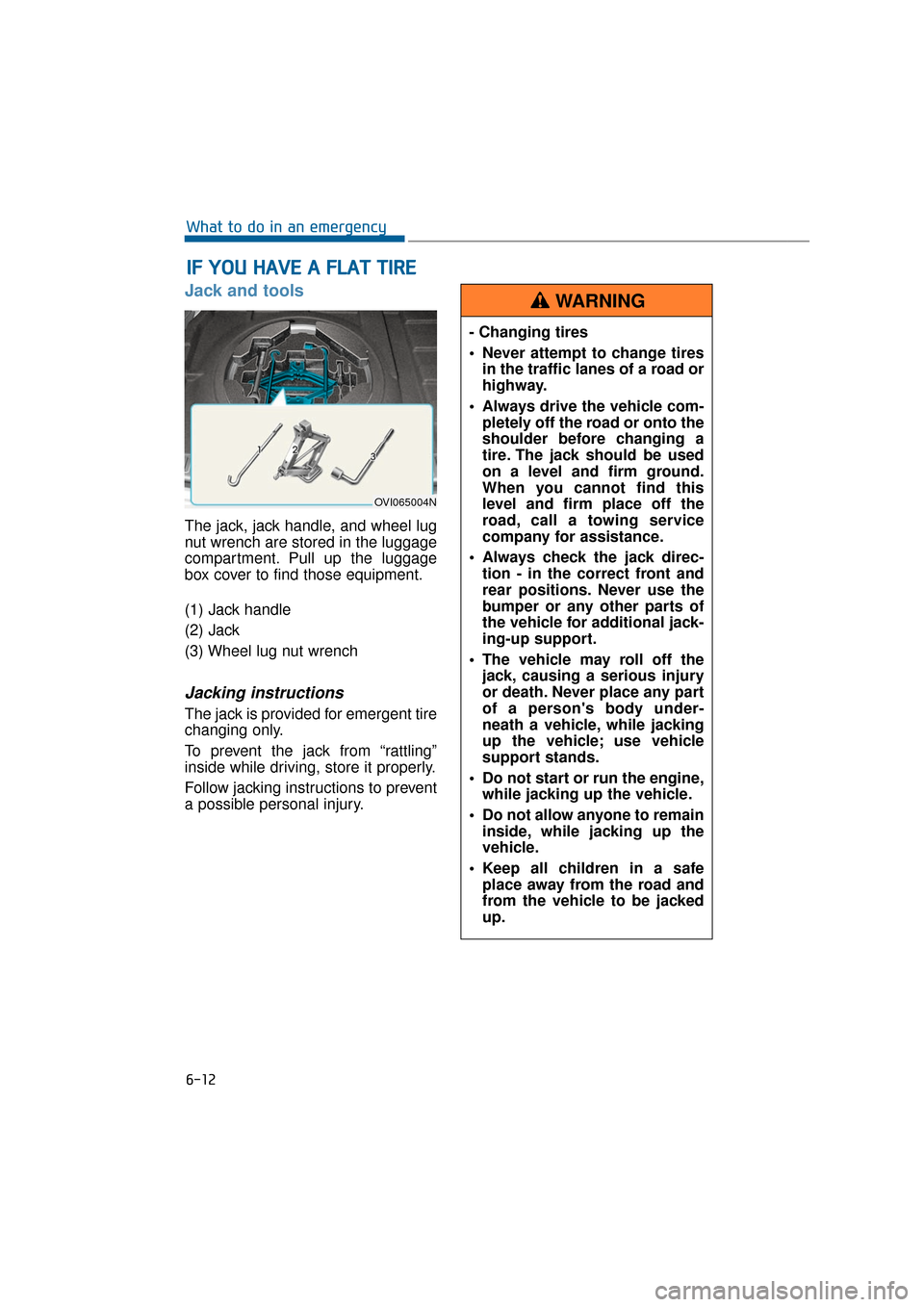
Jack and tools
The jack, jack handle, and wheel lug
nut wrench are stored in the luggage
compartment. Pull up the luggage
box cover to find those equipment.
(1) Jack handle
(2) Jack
(3) Wheel lug nut wrench
Jacking instructions
The jack is provided for emergent tire
changing only.
To prevent the jack from “rattling”
inside while driving, store it properly.
Follow jacking instructions to prevent
a possible personal injury.
I IF
F
Y
Y O
O U
U
H
H A
AV
VE
E
A
A
F
F L
LA
A T
T
T
T I
IR
R E
E
6-12
What to do in an emergency
OVI065004N
- Changing tires
Never attempt to change tires
in the traffic lanes of a road or
highway.
Always drive the vehicle com- pletely off the road or onto the
shoulder before changing a
tire. The jack should be used
on a level and firm ground.
When you cannot find this
level and firm place off the
road, call a towing service
company for assistance.
Always check the jack direc- tion - in the correct front and
rear positions. Never use the
bumper or any other parts of
the vehicle for additional jack-
ing-up support.
The vehicle may roll off the jack, causing a serious injury
or death. Never place any part
of a person's body under-
neath a vehicle, while jacking
up the vehicle; use vehicle
support stands.
Do not start or run the engine, while jacking up the vehicle.
Do not allow anyone to remain inside, while jacking up the
vehicle.
Keep all children in a safe place away from the road and
from the vehicle to be jacked
up.
WARNING
Page 352 of 477
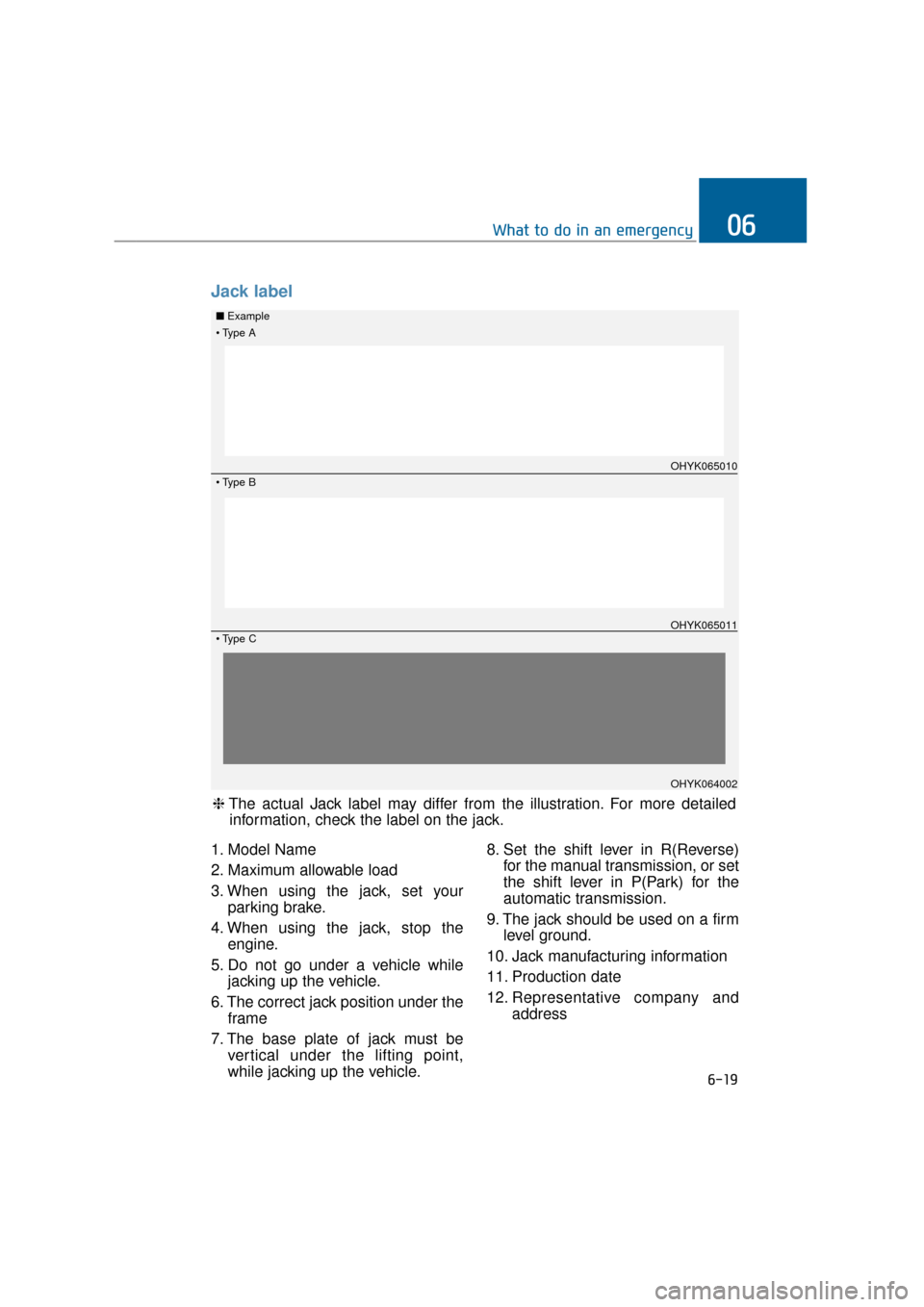
1. Model Name
2. Maximum allowable load
3. When using the jack, set yourparking brake.
4. When using the jack, stop the engine.
5. Do not go under a vehicle while jacking up the vehicle.
6. The correct jack position under the frame
7. The base plate of jack must be vertical under the lifting point,
while jacking up the vehicle. 8. Set the shift lever in R(Reverse)
for the manual transmission, or set
the shift lever in P(Park) for the
automatic transmission.
9. The jack should be used on a firm level ground.
10. Jack manufacturing information
11. Production date
12. Representative company and address
6-19
What to do in an emergency06
❈The actual Jack label may differ from the illustration. For more detailed
information, check the label on the jack.
Jack label
OHYK065010
■ Example
OHYK065011
OHYK064002
Page 354 of 477
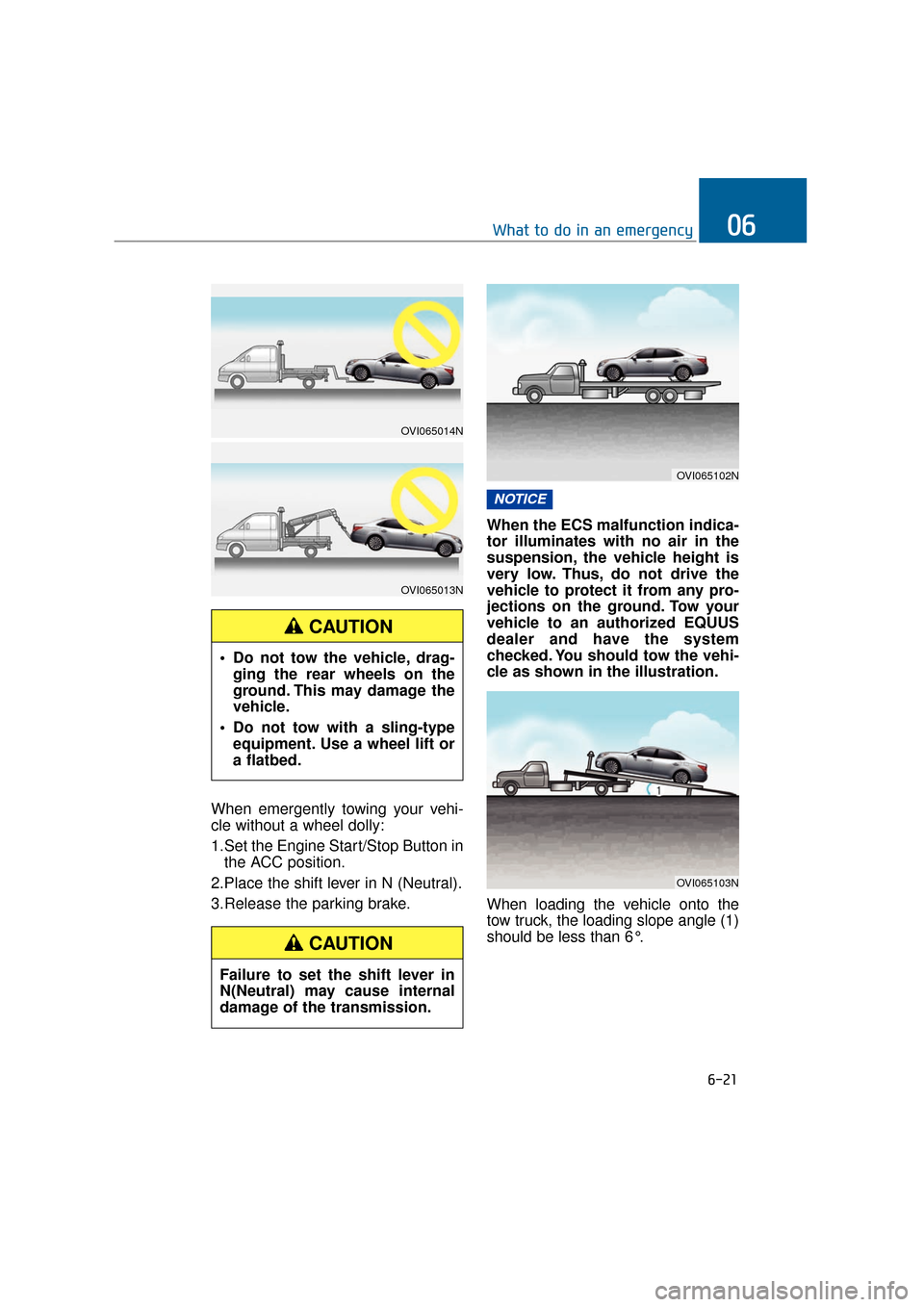
When emergently towing your vehi-
cle without a wheel dolly:
1.Set the Engine Start/Stop Button inthe ACC position.
2.Place the shift lever in N (Neutral).
3.Release the parking brake. When the ECS malfunction indica-
tor illuminates with no air in the
suspension, the vehicle height is
very low. Thus, do not drive the
vehicle to protect it from any pro-
jections on the ground. Tow your
vehicle to an authorized EQUUS
dealer and have the system
checked. You should tow the vehi-
cle as shown in the illustration.
When loading the vehicle onto the
tow truck, the loading slope angle (1)
should be less than 6°.
NOTICE
6-21
What to do in an emergency06
Do not tow the vehicle, drag-
ging the rear wheels on the
ground. This may damage the
vehicle.
Do not tow with a sling-type equipment. Use a wheel lift or
a flatbed.
CAUTION
Failure to set the shift lever in
N(Neutral) may cause internal
damage of the transmission.
CAUTION
OVI065102N
OVI065103N
OVI065014N
OVI065013N
Page 357 of 477
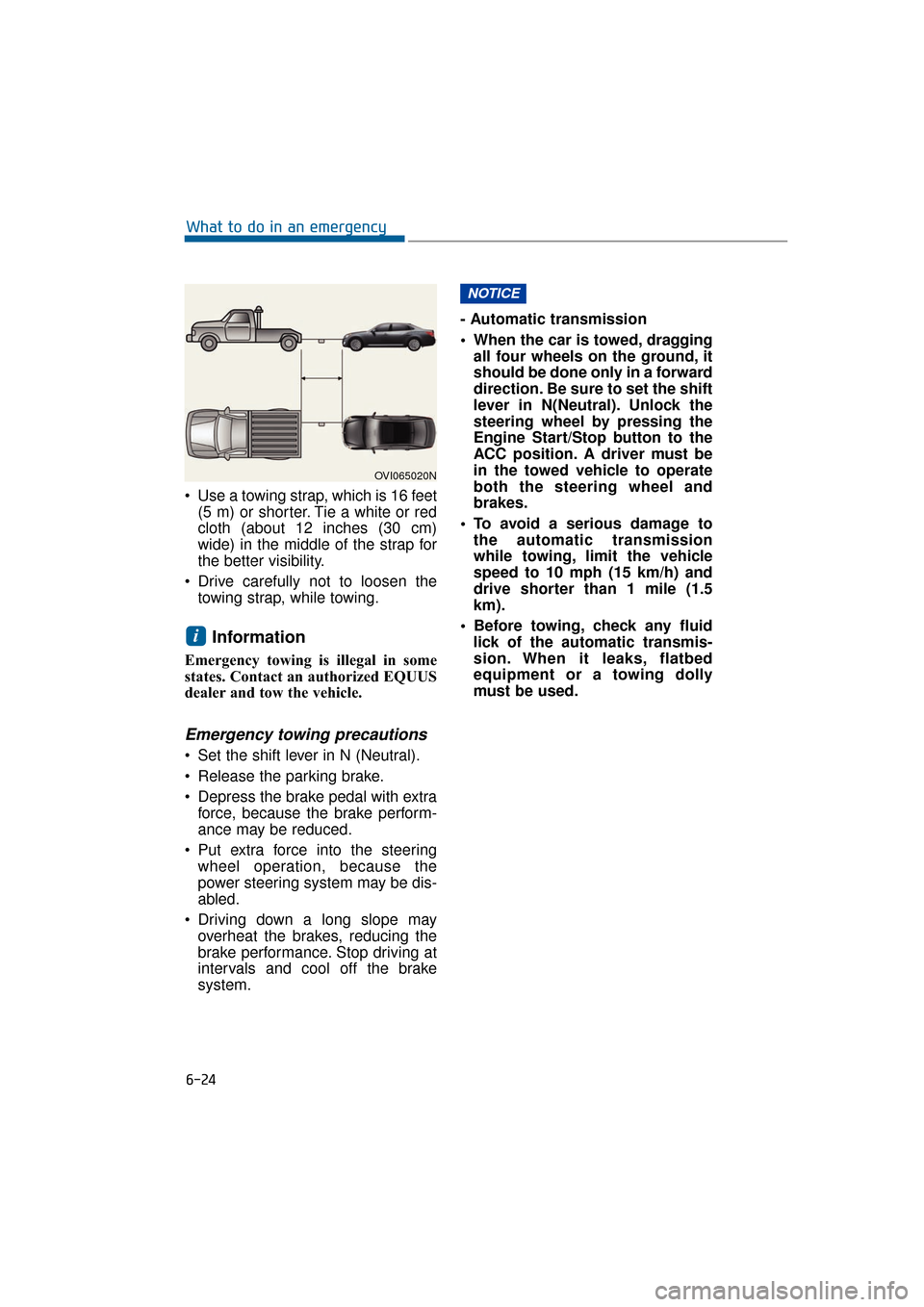
Use a towing strap, which is 16 feet(5 m) or shorter. Tie a white or red
cloth (about 12 inches (30 cm)
wide) in the middle of the strap for
the better visibility.
Drive carefully not to loosen the towing strap, while towing.
Information
Emergency towing is illegal in some
states. Contact an authorized EQUUS
dealer and tow the vehicle.
Emergency towing precautions
Set the shift lever in N (Neutral).
Release the parking brake.
Depress the brake pedal with extraforce, because the brake perform-
ance may be reduced.
Put extra force into the steering wheel operation, because the
power steering system may be dis-
abled.
Driving down a long slope may overheat the brakes, reducing the
brake performance. Stop driving at
intervals and cool off the brake
system. - Automatic transmission
When the car is towed, dragging
all four wheels on the ground, it
should be done only in a forward
direction. Be sure to set the shift
lever in N(Neutral). Unlock the
steering wheel by pressing the
Engine Start/Stop button to the
ACC position. A driver must be
in the towed vehicle to operate
both the steering wheel and
brakes.
To avoid a serious damage to the automatic transmission
while towing, limit the vehicle
speed to 10 mph (15 km/h) and
drive shorter than 1 mile (1.5
km).
Before towing, check any fluid lick of the automatic transmis-
sion. When it leaks, flatbed
equipment or a towing dolly
must be used.
NOTICE
i
6-24
What to do in an emergency
OVI065020N
Page 358 of 477
Maintenance
Engine compartment .............................................7-4
Maintenance services ...........................................7-5
Owner's responsibility ......................................................7-5
Owner's maintenance precautions ...............................7-6
Owner's maintenance ...........................................7-7
Owner's maintenance schedule ....................................7-7
Scheduled maintenance service ..........................7-8
Normal maintenance schedule .......................................7-9
Maintenance under severe usage conditions ..........7-22
Explanation of scheduled maintenance
items.......................................................................7\
-23
Engine oil ..............................................................7-25
Checking the engine oil level ....................................7-25
Changing the engine oil and filter ..............................7-26
Engine coolant......................................................7-27
Checking the coolant level ...........................................7-27
Changing the coolant .....................................................7-29
Brake fluid ............................................................7-30
Checking the brake fluid level .....................................7-30
Power steering fluid ............................................7-31
Checking the power steering fluid level ...................7-31
Checking the power steering hose.............................7-31
Washer fluid .........................................................7-32
Checking the washer fluid level ..................................7-32
Air cleaner ............................................................7-33
Filter replacement ...........................................................7-33
Page 360 of 477

Fuses ......................................................................7-\
56
Inner panel fuse replacement ......................................7-57
Engine compartment fuse replacement ....................7-59
Fuse/relay panel description .......................................7-60
Light bulbs.............................................................7-69
Headlight, position light, turn signal light,
side marker light and front fog light bulb
replacement ......................................................................7-\
70
Side repeater light bulb replacement.........................7-74
Rear combination light bulb replacement .................7-75
High mounted stop light ................................................7-75
License plate lamp replacement ..................................7-79
Interior light bulb replacement ....................................7-82
Appearance care ..................................................7-83
Exterior care ....................................................................7-83\
Interior care......................................................................7-\
88
Emission control system .....................................7-89
Crankcase emission control system ...........................7-89
Evaporative emission control system.........................7-89
Exhaust emission control system ...............................7-90
California perchlorate notice .............................7-92