engine Hyundai Equus 2016 Owner's Manual
[x] Cancel search | Manufacturer: HYUNDAI, Model Year: 2016, Model line: Equus, Model: Hyundai Equus 2016Pages: 477, PDF Size: 16.25 MB
Page 383 of 477
7-26
Maintenance
Changing the engine oil and
filter
Have engine oil and filter changed by
an authorized EQUUS dealer in
accordance with the Maintenance
Schedule, as specified in the begin-
ning of this chapter.
Engine oil contains chemicals
known to the State of California
to cause cancer, birth defects
and reproductive harm. Used
engine oil may cause irritation
or cancer of the skin if left in
contact with the skin for pro-
longed periods of time. Always
protect your skin by washing
your hands thoroughly with
soap and warm water as soon
as possible after handling used
oil.
CALIFORNIA PROPOSI-TION 65 WARNING
OVI075161N
Page 384 of 477
7-27
Maintenance07
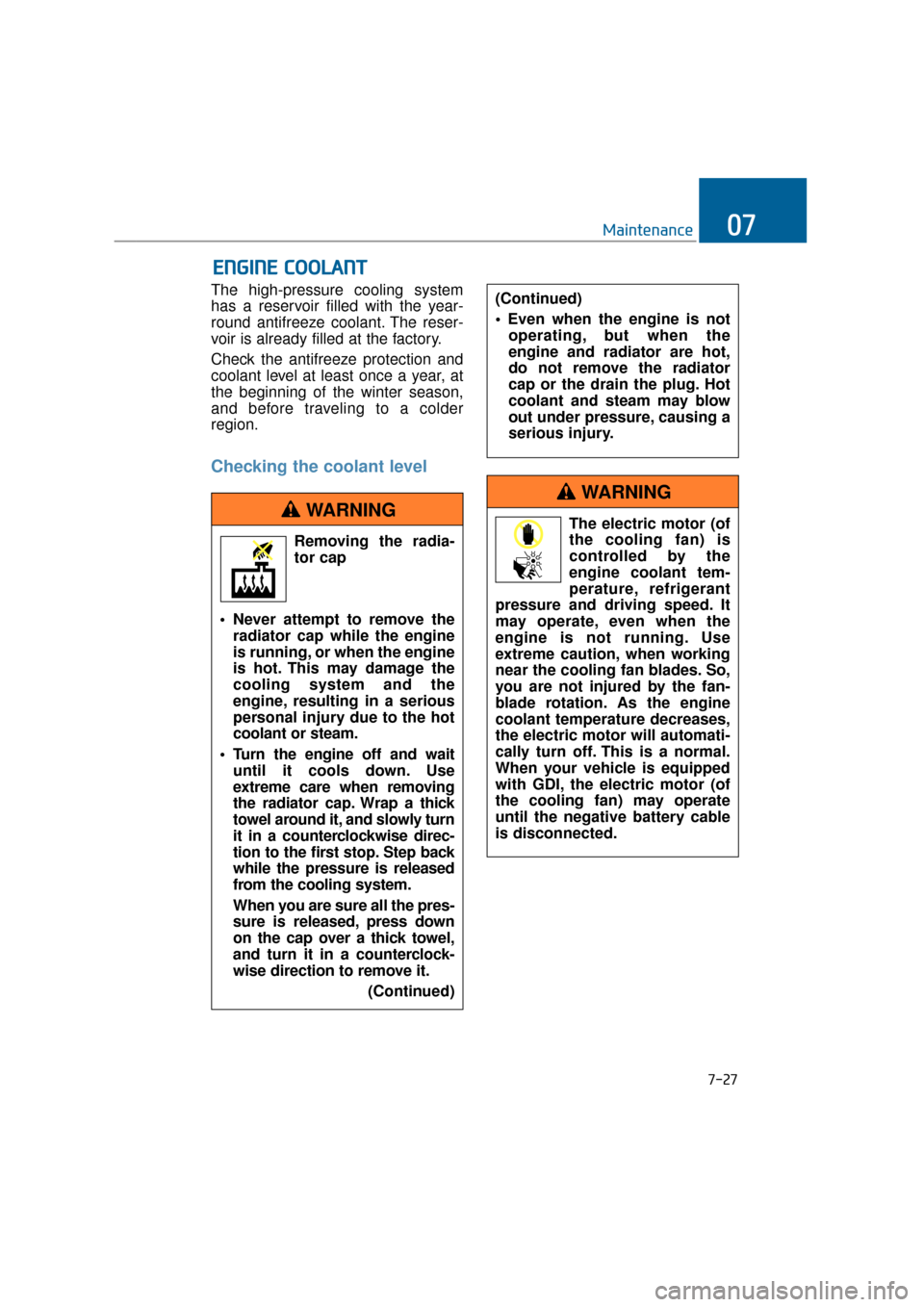
The high-pressure cooling system
has a reservoir filled with the year-
round antifreeze coolant. The reser-
voir is already filled at the factory.
Check the antifreeze protection and
coolant level at least once a year, at
the beginning of the winter season,
and before traveling to a colder
region.
Checking the coolant level
E EN
N G
GI
IN
N E
E
C
C O
O O
OL
LA
A N
N T
T
(Continued)
operating, but when the
engine and radiator are hot,
do not remove the radiator
cap or the drain the plug. Hot
coolant and steam may blow
out under pressure, causing a
serious injury.
The electric motor (of
the cooling fan) is
controlled by the
engine coolant tem-
perature, refrigerant
pressure and driving speed. It
may operate, even when the
engine is not running. Use
extreme caution, when working
near the cooling fan blades. So,
you are not injured by the fan-
blade rotation. As the engine
coolant temperature decreases,
the electric motor will automati-
cally turn off. This is a normal.
When your vehicle is equipped
with GDI, the electric motor (of
the cooling fan) may operate
until the negative battery cable
is disconnected.
WARNING
Removing the radia-
tor cap
Never attempt to remove the radiator cap while the engine
is running, or when the engine
is hot. This may damage the
cooling system and the
engine, resulting in a serious
personal injury due to the hot
coolant or steam.
Turn the engine off and wait until it cools down. Use
extreme care when removing
the radiator cap. Wrap a thick
towel around it, and slowly turn
it in a counterclockwise direc-
tion to the first stop. Step back
while the pressure is released
from the cooling system.
When you are sure all the pres-
sure is released, press down
on the cap over a thick towel,
and turn it in a counterclock-
wise direction to remove it.
(Continued)
WARNING
Page 385 of 477
7-28
Maintenance
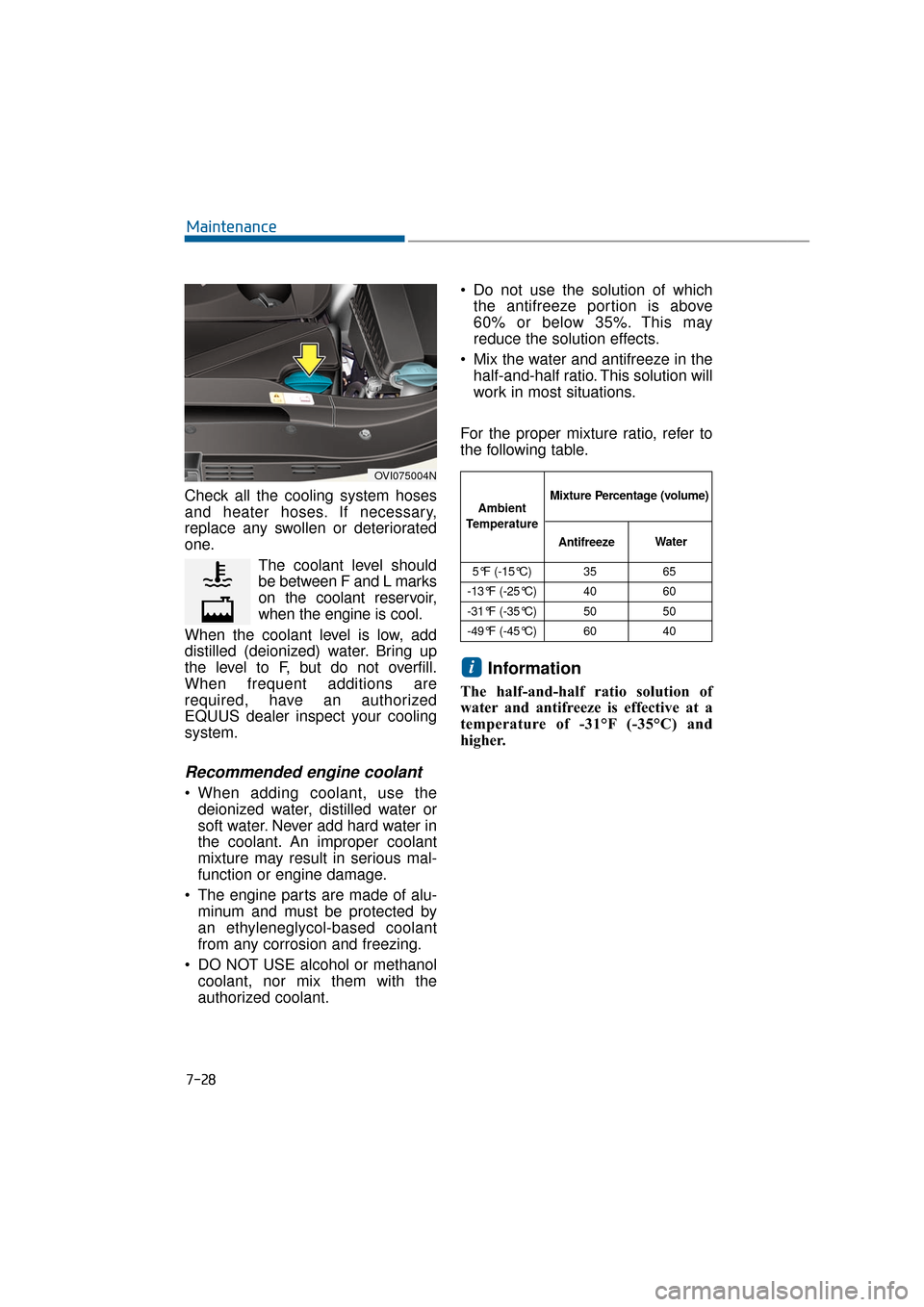
Check all the cooling system hoses
and heater hoses. If necessary,
replace any swollen or deteriorated
one. The coolant level should
be between F and L marks
on the coolant reservoir,
when the engine is cool.
When the coolant level is low, add
distilled (deionized) water. Bring up
the level to F, but do not overfill.
When frequent additions are
required, have an authorized
EQUUS dealer inspect your cooling
system.
Recommended engine coolant
When adding coolant, use the deionized water, distilled water or
soft water. Never add hard water in
the coolant. An improper coolant
mixture may result in serious mal-
function or engine damage.
The engine parts are made of alu- minum and must be protected by
an ethyleneglycol-based coolant
from any corrosion and freezing.
DO NOT USE alcohol or methanol coolant, nor mix them with the
authorized coolant. Do not use the solution of which
the antifreeze portion is above
60% or below 35%. This may
reduce the solution effects.
Mix the water and antifreeze in the half-and-half ratio. This solution will
work in most situations.
For the proper mixture ratio, refer to
the following table.
Information
The half-and-half ratio solution of
water and antifreeze is effective at a
temperature of -31°F (-35°C) and
higher.
i
OVI075004N
5°F (-15°C) 35 65
-13°F (-25°C) 40 60
-31°F (-35°C) 50 50
-49°F (-45°C) 60 40
Ambient
Temperature Mixture Percentage (volume)
Antifreeze Water
Page 386 of 477
7-29
Maintenance07
Changing the coolant
Have coolant changed by an author-
ized EQUUS dealer in accordance
with the Maintenance Schedule, as
specified in the beginning of this
chapter.
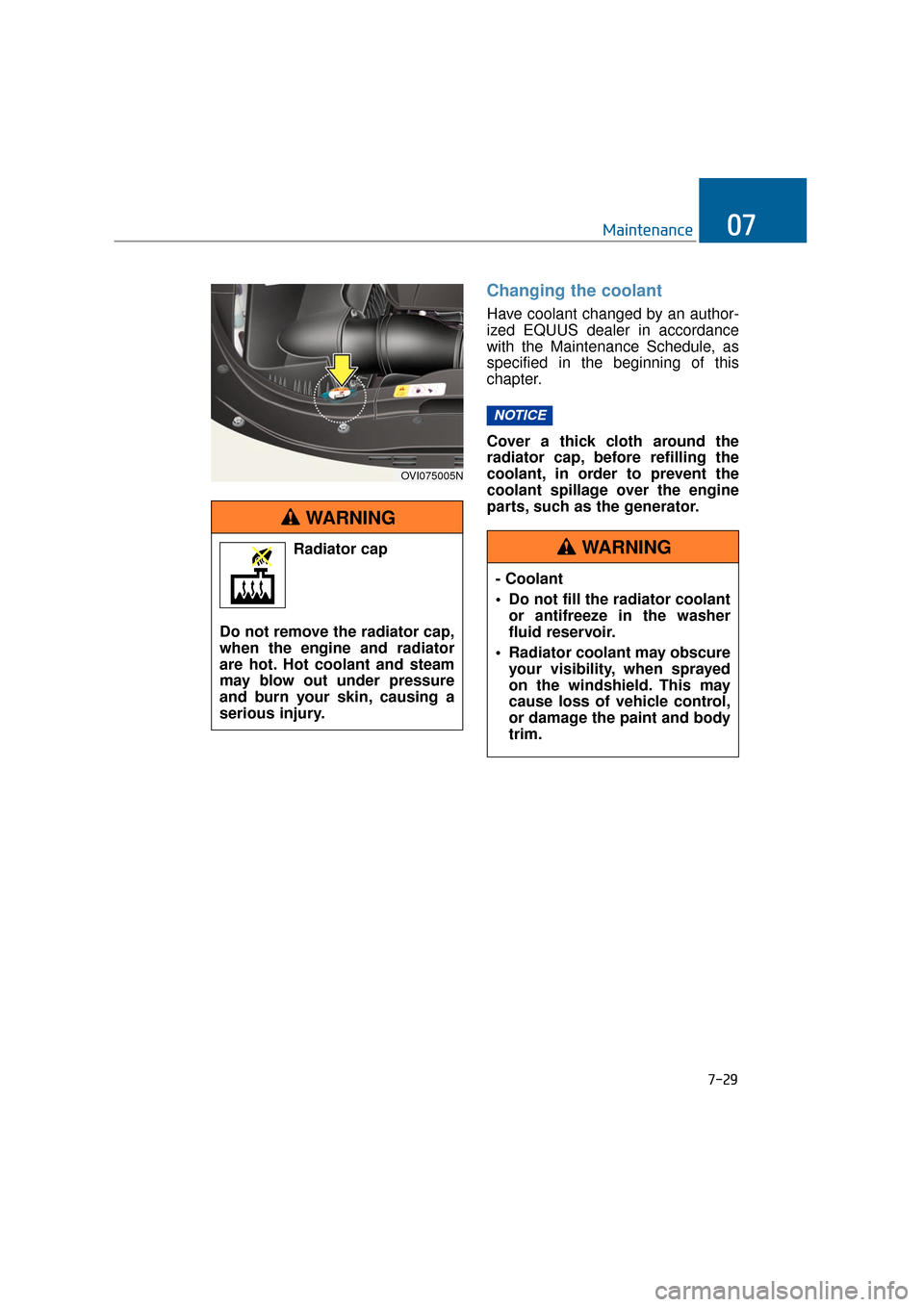
Cover a thick cloth around the
radiator cap, before refilling the
coolant, in order to prevent the
coolant spillage over the engine
parts, such as the generator.
NOTICE
OVI075005N
Radiator cap
Do not remove the radiator cap,
when the engine and radiator
are hot. Hot coolant and steam
may blow out under pressure
and burn your skin, causing a
serious injury.
WARNING
- Coolant
Do not fill the radiator coolant or antifreeze in the washer
fluid reservoir.
Radiator coolant may obscure your visibility, when sprayed
on the windshield. This may
cause loss of vehicle control,
or damage the paint and body
trim.
WARNING
Page 387 of 477
7-30
Maintenance
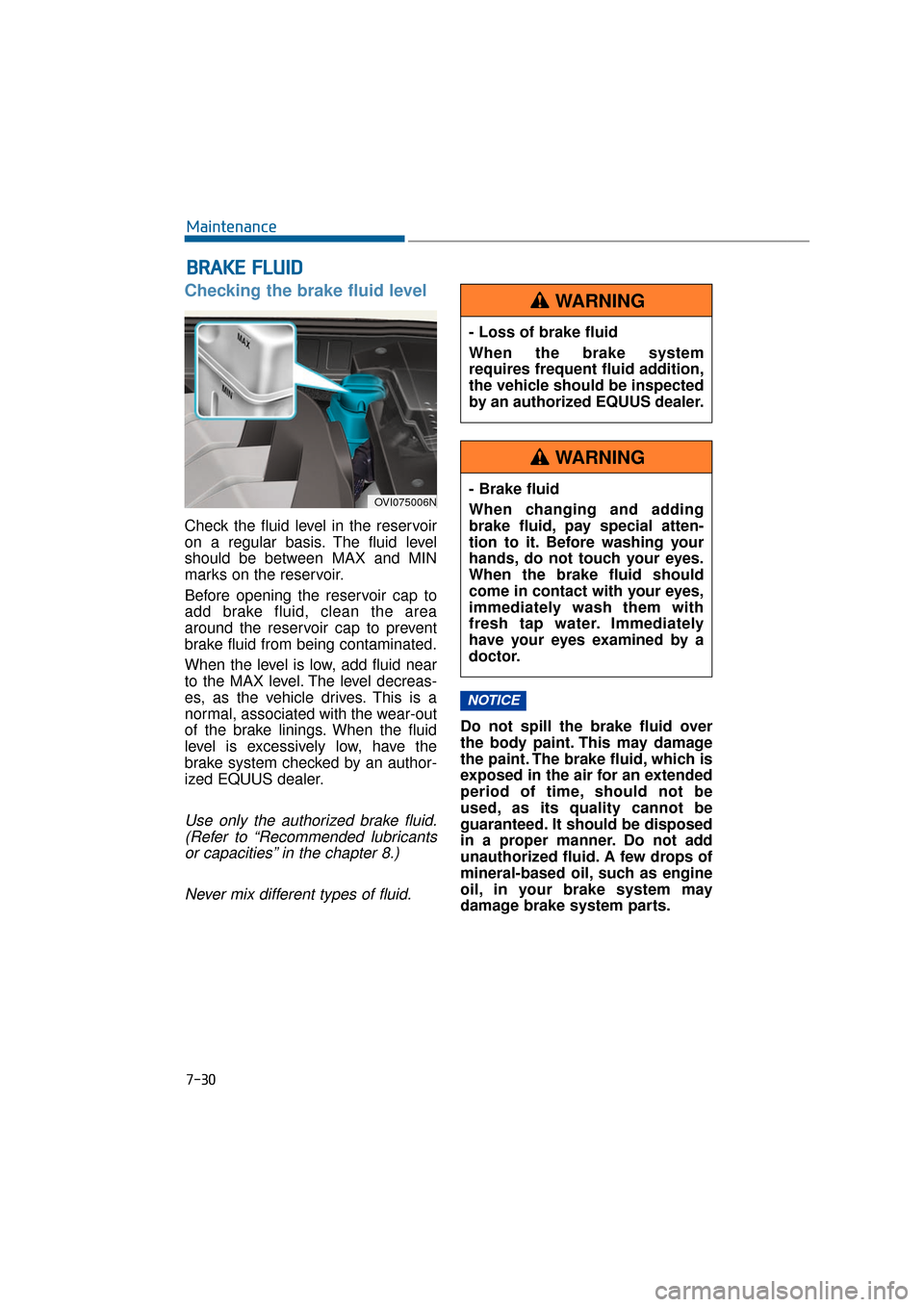
Checking the brake fluid level
Check the fluid level in the reservoir
on a regular basis. The fluid level
should be between MAX and MIN
marks on the reservoir.
Before opening the reservoir cap to
add brake fluid, clean the area
around the reservoir cap to prevent
brake fluid from being contaminated.
When the level is low, add fluid near
to the MAX level. The level decreas-
es, as the vehicle drives. This is a
normal, associated with the wear-out
of the brake linings. When the fluid
level is excessively low, have the
brake system checked by an author-
ized EQUUS dealer.
Use only the authorized brake fluid.(Refer to “Recommended lubricantsor capacities” in the chapter 8.)
Never mix different types of fluid.
Do not spill the brake fluid over
the body paint. This may damage
the paint. The brake fluid, which is
exposed in the air for an extended
period of time, should not be
used, as its quality cannot be
guaranteed. It should be disposed
in a proper manner. Do not add
unauthorized fluid. A few drops of
mineral-based oil, such as engine
oil, in your brake system may
damage brake system parts.
NOTICE
B B R
RA
A K
KE
E
F
F L
LU
U I
ID
D
- Loss of brake fluid
When the brake system
requires frequent fluid addition,
the vehicle should be inspected
by an authorized EQUUS dealer.
WARNING
- Brake fluid
When changing and adding
brake fluid, pay special atten-
tion to it. Before washing your
hands, do not touch your eyes.
When the brake fluid should
come in contact with your eyes,
immediately wash them with
fresh tap water. Immediately
have your eyes examined by a
doctor.
WARNING
OVI075006N
Page 388 of 477
7-31
Maintenance07
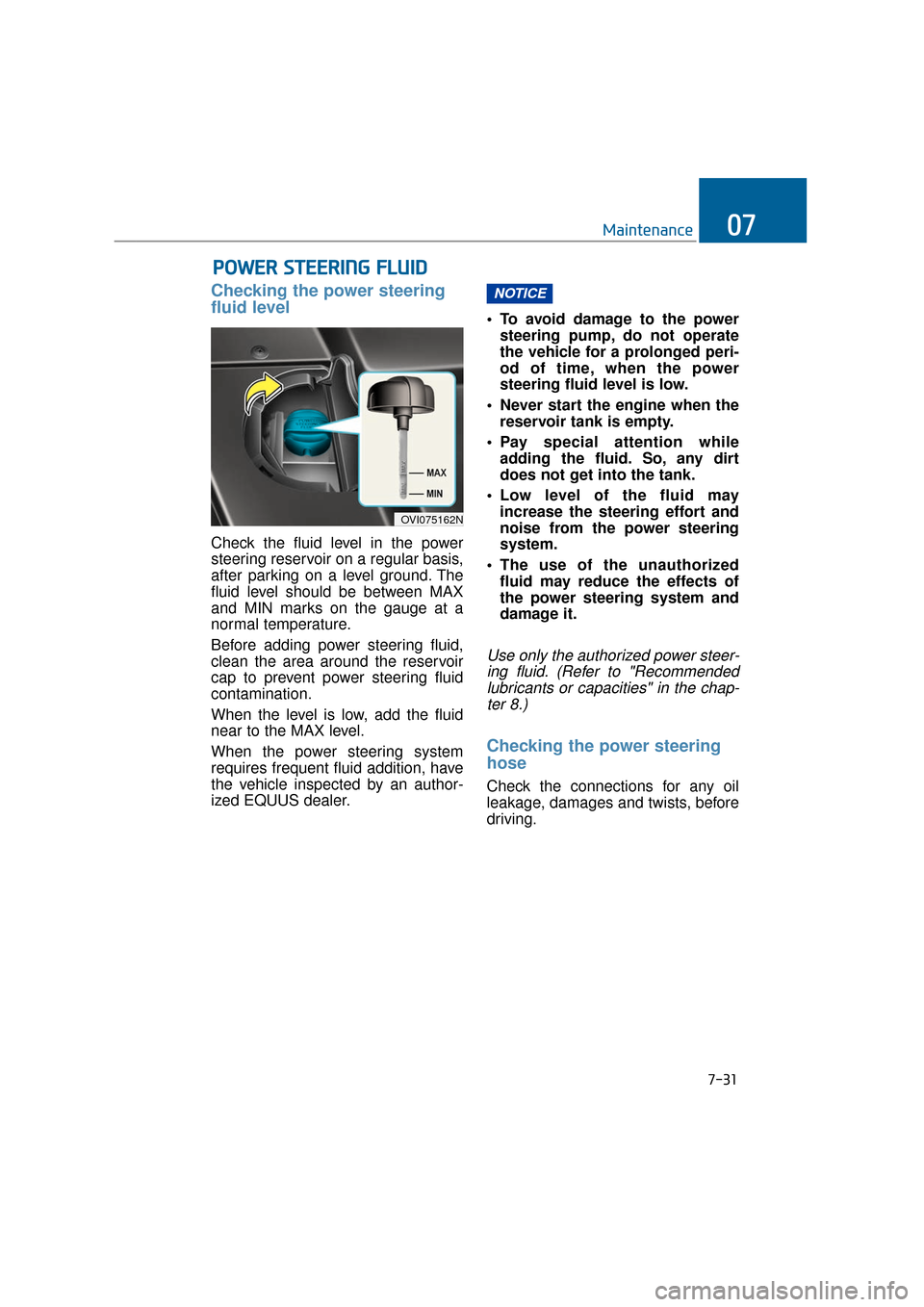
Checking the power steering
fluid level
Check the fluid level in the power
steering reservoir on a regular basis,
after parking on a level ground. The
fluid level should be between MAX
and MIN marks on the gauge at a
normal temperature.
Before adding power steering fluid,
clean the area around the reservoir
cap to prevent power steering fluid
contamination.
When the level is low, add the fluid
near to the MAX level.
When the power steering system
requires frequent fluid addition, have
the vehicle inspected by an author-
ized EQUUS dealer. To avoid damage to the power
steering pump, do not operate
the vehicle for a prolonged peri-
od of time, when the power
steering fluid level is low.
Never start the engine when the reservoir tank is empty.
Pay special attention while adding the fluid. So, any dirt
does not get into the tank.
Low level of the fluid may increase the steering effort and
noise from the power steering
system.
The use of the unauthorized fluid may reduce the effects of
the power steering system and
damage it.
Use only the authorized power steer-ing fluid. (Refer to "Recommendedlubricants or capacities" in the chap-ter 8.)
Checking the power steering
hose
Check the connections for any oil
leakage, damages and twists, before
driving.
NOTICE
P P O
O W
W E
ER
R
S
S T
T E
EE
ER
R I
IN
N G
G
F
F L
LU
U I
ID
D
OVI075162N
Page 391 of 477
7-34
Maintenance
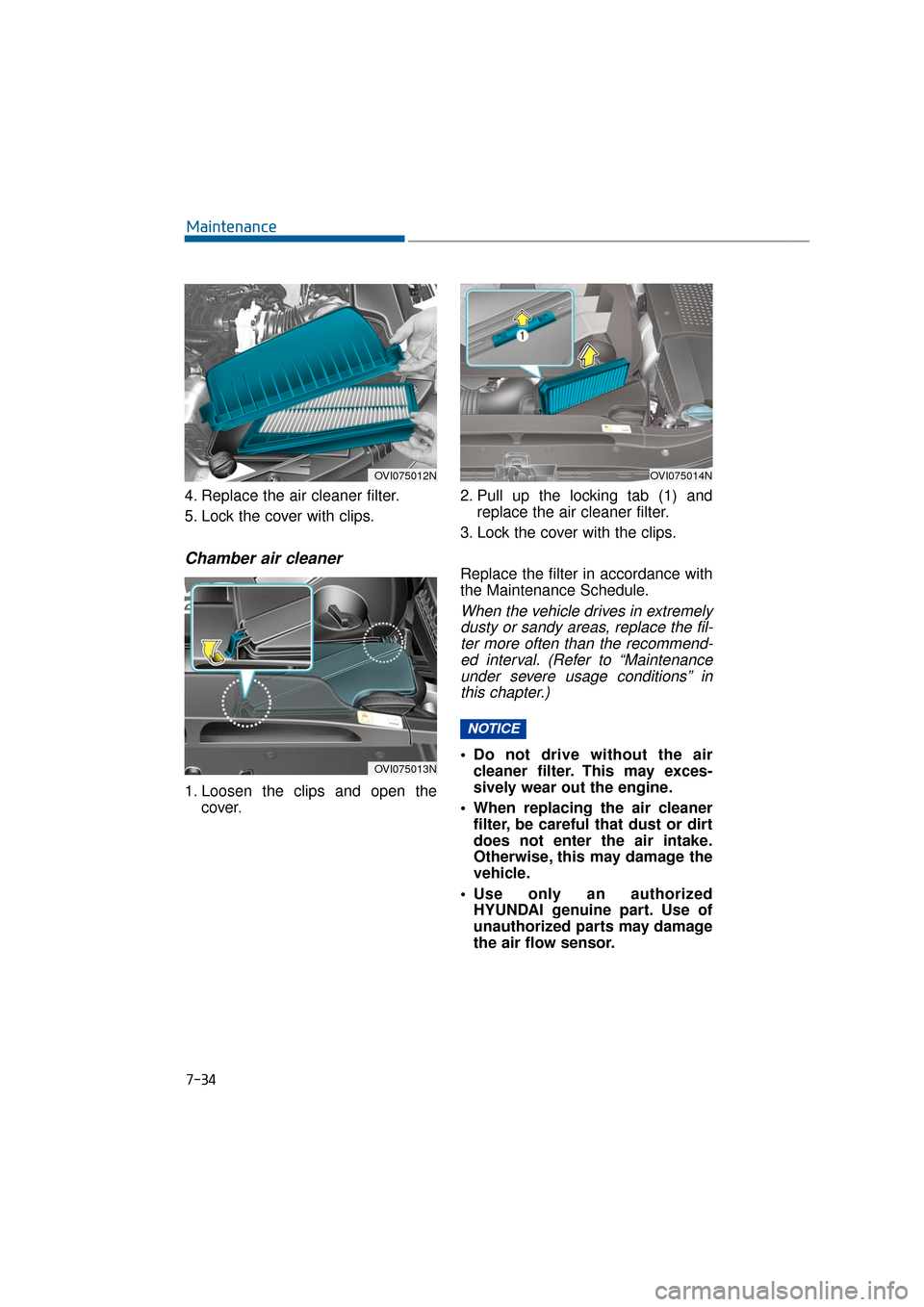
4. Replace the air cleaner filter.
5. Lock the cover with clips.
Chamber air cleaner
1. Loosen the clips and open the cover. 2. Pull up the locking tab (1) and
replace the air cleaner filter.
3. Lock the cover with the clips.
Replace the filter in accordance with
the Maintenance Schedule.
When the vehicle drives in extremely dusty or sandy areas, replace the fil-ter more often than the recommend-ed interval. (Refer to “Maintenanceunder severe usage conditions” inthis chapter.)
Do not drive without the air cleaner filter. This may exces-
sively wear out the engine.
When replacing the air cleaner filter, be careful that dust or dirt
does not enter the air intake.
Otherwise, this may damage the
vehicle.
Use only an authorized HYUNDAI genuine part. Use of
unauthorized parts may damage
the air flow sensor.
NOTICE
OVI075012N
OVI075013N
OVI075014N
Page 393 of 477
7-36
Maintenance
Blade inspectionInformation
Hot wax in market may be used in
automatic car washes. However, it is
known to make it difficult to clean the
windshield.
Contamination of either the wind-
shield or the wiper blades with for-
eign substances may undermine the
effects of the windshield wipers.
Common contamination sources are
insects, tree sap, and hot wax treat-
ments used in some car washes.
When the blades do not properly
wipe off, clean the window and
blades with a good-quality cleaner or
mild detergent. Then, thoroughly
wash them with clean water.
Do not use gasolines, kerosene,
paint thinner, or other solvents on
or near the wiper blades to pre-
vent damage.
Blade replacement
When the wipers no longer ade-
quately clean, the blades may be
worn out or cracked. Then, replace-
ment is required.
To prevent damage to the wiper
arms or other components, do not
attempt to manually move the
wipers.
The use of a non-specified wiper
blade could result in wiper mal-
function and failure.
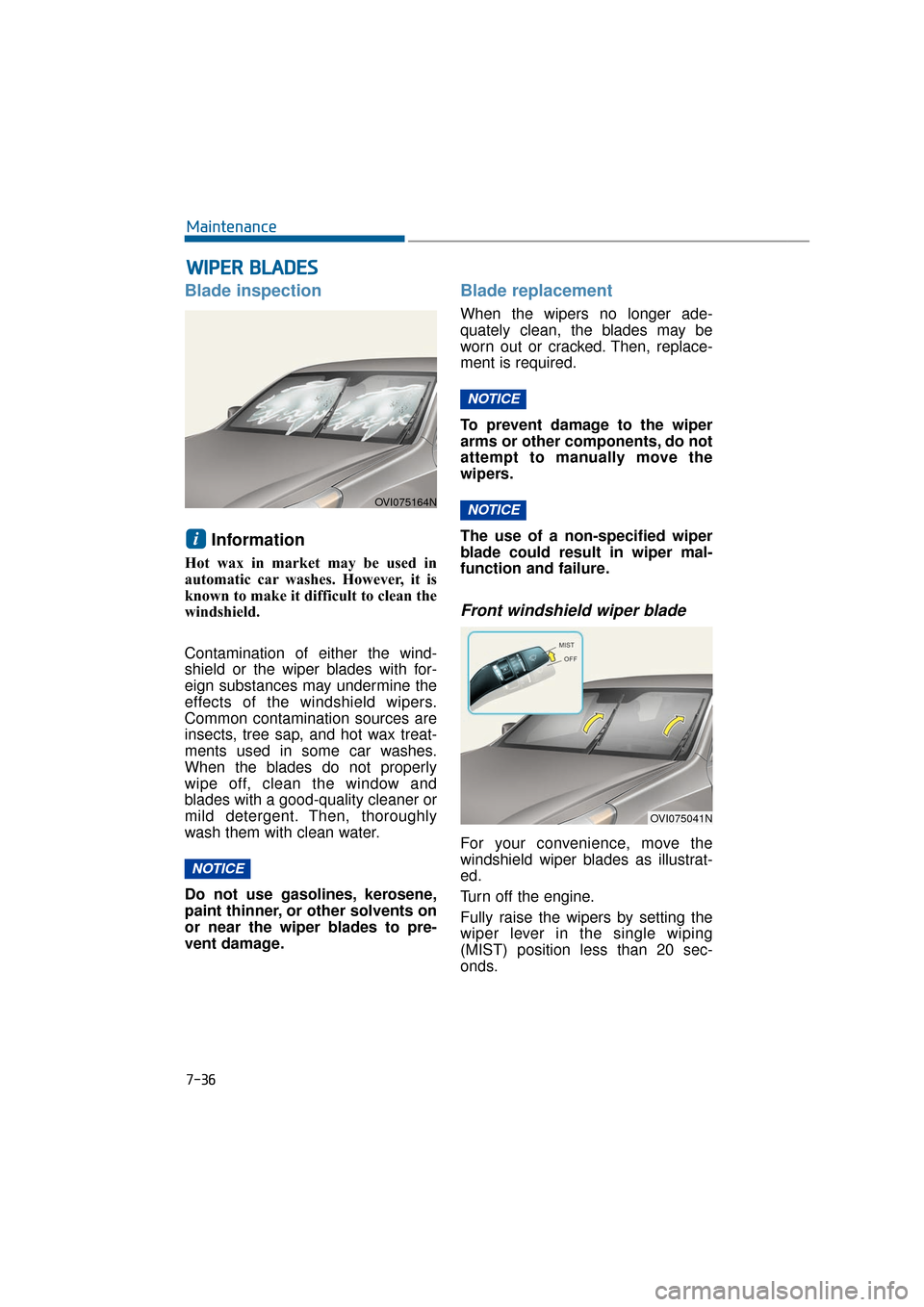
Front windshield wiper blade
For your convenience, move the
windshield wiper blades as illustrat-
ed.
Turn off the engine.
Fully raise the wipers by setting the
wiper lever in the single wiping
(MIST) position less than 20 sec-
onds.
NOTICE
NOTICE
NOTICE
i
W WI
IP
P E
ER
R
B
B L
LA
A D
DE
ES
S
OVI075164N
OVI075041N
Page 397 of 477
7-40
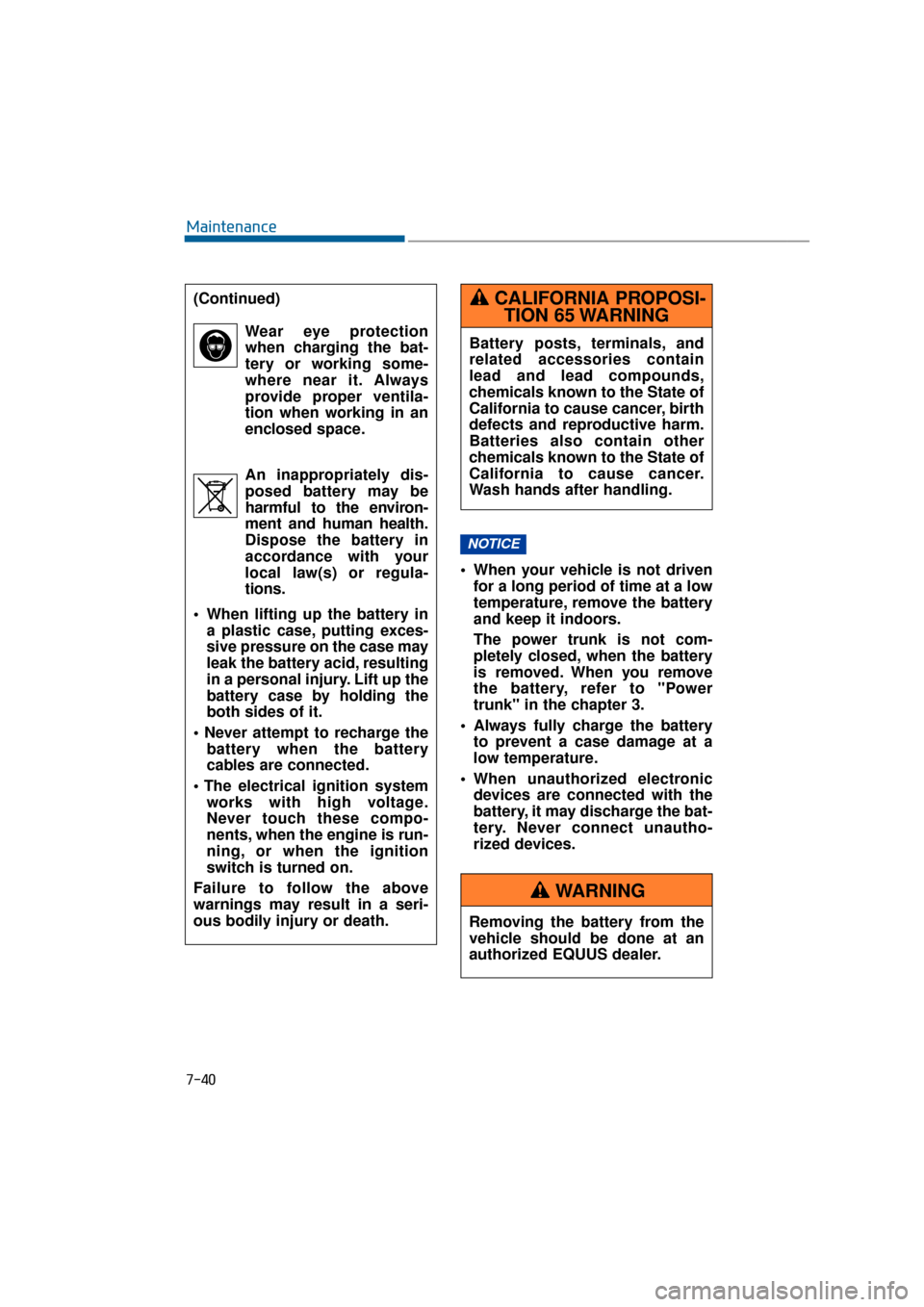
Maintenance When your vehicle is not drivenfor a long period of time at a low
temperature, remove the battery
and keep it indoors.
The power trunk is not com-
pletely closed, when the battery
is removed. When you remove
the battery, refer to "Power
trunk" in the chapter 3.
Always fully charge the battery to prevent a case damage at a
low temperature.
When unauthorized electronic devices are connected with the
battery, it may discharge the bat-
tery. Never connect unautho-
rized devices.
NOTICE
(Continued)
Wear eye protectionwhen charging the bat-
tery or working some-
where near it. Always
provide proper ventila-
tion when working in an
enclosed space.
An inappropriately dis- posed battery may be
harmful to the environ-
ment and human health.
Dispose the battery in
accordance with your
local law(s) or regula-
tions.
When lifting up the battery in a plastic case, putting exces-
sive pressure on the case may
leak the battery acid, resulting
in a personal injury. Lift up the
battery case by holding the
both sides of it.
battery when the battery
cables are connected.
works with high voltage.
Never touch these compo-
nents, when the engine is run-
ning, or when the ignition
switch is turned on.
Failure to follow the above
warnings may result in a seri-
ous bodily injury or death.
Battery posts, terminals, and
related accessories contain
lead and lead compounds,
chemicals known to the State of
California to cause cancer, birth
defects and reproductive harm.
Batteries also contain other
chemicals known to the State of
California to cause cancer.
Wash hands after handling.
CALIFORNIA PROPOSI- TION 65 WARNING
Removing the battery from the
vehicle should be done at an
authorized EQUUS dealer.
WARNING
Page 398 of 477
7-41
Maintenance07
Battery recharging by battery
charger
Your vehicle has a maintenance-free,
calcium-based battery.
When the battery is discharged ina short period of time (possibly
because the headlamps or interior
lights remain on, while the vehicle
is not in use), slowly recharge it
(trickle) for 10 hours.
When the battery is gradually dis- charged due to high electric load,
while the vehicle is in use,
recharge it at 20-30A for 2 hours.
Battery recharging by vehicle
After jump-starting from a good bat-
tery, run the engine for 20-30 min-
utes in either the idle or driving
modes, before turning off the engine.
Your vehicle may not restart, when
the engine is shortly turned off with-
out having an adequate recharging
time.
- Recharging battery
When recharging the battery,
follow the below precautions:
The battery must be removed from the vehicle and placed in
a well-ventilated area.
Keep cigarette lits, sparks, or flames away from the battery.
(Continued)
(Continued)
Keep paying attention to thebattery condition, while
recharging. Stop or slow the
recharging rate, when the bat-
tery gas violently leaks (boil-
ing),or when an electrolyte
temperature exceeds 120°F
(49°C).
Wear the proper eye protection, while watching the battery
recharging conditions.
Disconnect the battery charger in the following order.
1. Turn off the main switch of the battery charger.
2. Unhook the negative clamp from the negative battery ter-
minal.
3. Unhook the positive clamp from the positive battery ter-
minal.
WARNING
Before maintaining orrecharging the battery, turn
off all accessories and stop
the engine.
The negative battery cable must be disconnected first, or
be connected last.
Operation related to the bat- tery should be done by an
authorized EQUUS dealer.
WARNING