engine Hyundai Equus 2016 User Guide
[x] Cancel search | Manufacturer: HYUNDAI, Model Year: 2016, Model line: Equus, Model: Hyundai Equus 2016Pages: 477, PDF Size: 16.25 MB
Page 21 of 477
Dimensions ............................8-2
Bulb wattage .........................8-2
Tires and wheels ..................8-3
Recommended lubricants
and capacities.......................8-4
Recommended SAE viscosity
number ........................................8-5
Vehicle identification number
(VIN).......................................8-6
Vehicle certification label ...8-6
Tire specification and
pressure label .......................8-6
Engine number .....................8-7
Refrigerant label ..................8-7
Consumer information.........8-8
Reporting safety defects ....8-9
8Specifications, Consumer
information and Reporting
safety defects
F21
Page 22 of 477
Your vehicle at a glance
Exterior overview (front) .....................................1-2
: Towing hook, Hood, Front windshield wiper blades, Sunroof, Outside rearview mirror, Door locks,
Tires and wheels, Headlamps, Front fog light
Exterior overview (rear) .......................................1-3
: Glass antenna and Defroster, High mounted stop light, Trunk, Rear combination light, Rearview camera,
Parking assist system, Towing hook, Fuel filler lid,
Door locks, Window
Interior overview ....................................................1-4
: Inside door handle, Driver's seat control, Driver position memory system button, Power window switch,
Outside rearview mirror control, Fuel-filler lid opener,
Trunk lid release switch or power trunk main control
switch, Seats, Steering wheel, etc...
Instrument panel overview ...................................1-5
: Instrument cluster, Lighting control lever, Wiper and washer control lever, Engine Start/Stop Button,
Climate control system, Vehicle height control but-
ton, etc...
Engine compartment .............................................1-6
: Engine coolant reservoir, Air cleaner, Engine oil fillercap, Windshield washer fluid reservoir, Fuse box,
Jump start connector, etc...
Page 26 of 477
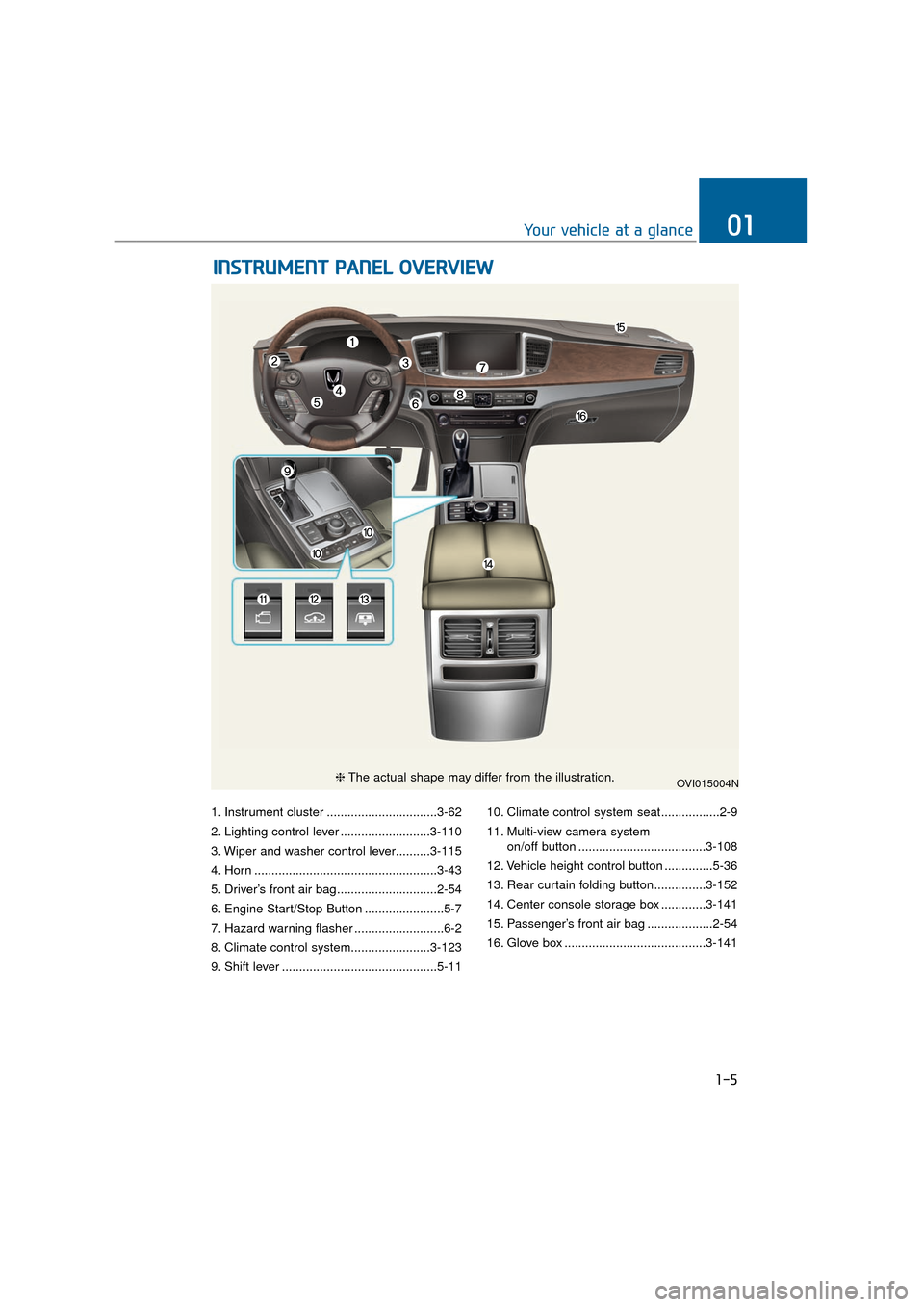
1. Instrument cluster ................................3-62
2. Lighting control lever ..........................3-110
3. Wiper and washer control lever..........3-115
4. Horn .....................................................3-43
5. Driver’s front air bag.............................2-54
6. Engine Start/Stop Button .......................5-7
7. Hazard warning flasher ..........................6-2
8. Climate control system.......................3-123
9. Shift lever .............................................5-1110. Climate control system seat.................2-9
11. Multi-view camera system
on/off button .....................................3-108
12. Vehicle height control button ..............5-36
13. Rear curtain folding button...............3-152
14. Center console storage box .............3-141
15. Passenger’s front air bag ...................2-54
16. Glove box .........................................3-141
I I N
N S
ST
T R
R U
U M
M E
EN
N T
T
P
P A
A N
N E
EL
L
O
O V
VE
ER
R V
V I
IE
E W
W
1-5
Your vehicle at a glance01
OVI015004N❈ The actual shape may differ from the illustration.
Page 27 of 477
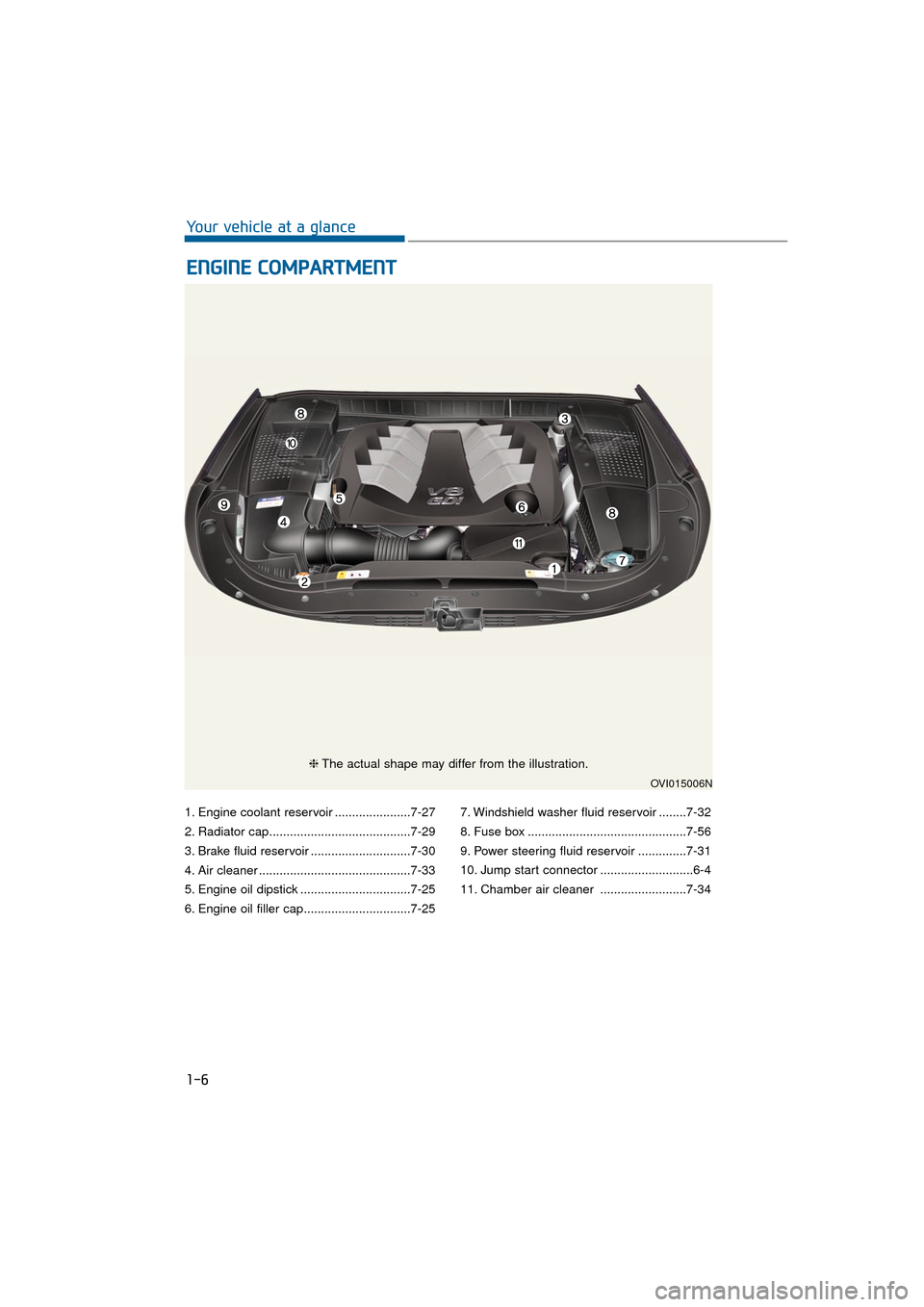
1. Engine coolant reservoir ......................7-27
2. Radiator cap.........................................7-29
3. Brake fluid reservoir .............................7-30
4. Air cleaner ............................................7-33
5. Engine oil dipstick ................................7-25
6. Engine oil filler cap...............................7-257. Windshield washer fluid reservoir ........7-32
8. Fuse box ..............................................7-56
9. Power steering fluid reservoir ..............7-31
10. Jump start connector ...........................6-4
11. Chamber air cleaner .........................7-34
E E
N
N G
GI
IN
N E
E
C
C O
O M
M P
PA
A R
RT
TM
M E
EN
N T
T
1-6
Your vehicle at a glance
OVI015006N
❈ The actual shape may differ from the illustration.
Page 31 of 477
Front seat adjustment
The front seat position can be adjust-
ed by pressing the control switches
on the doors. Before driving, adjust
the seat position, as desired, so as to
easily control the steering wheel,
pedals and instrument-panel but-
tons.
The power seat is operated byelectric motors. Pause the motor
operation after each seat-position
adjustment. Excessive motor
operation may damage the elec-
tric equipment.
The operation of a power seat consumes a large amount of elec-
tric power. To prevent unneces-
sary battery drain, when the
engine is turned OFF, do not
adjust the power seat longer than
necessary.
Do not press two power seat con- trol switches or more at the same
time. Doing so may fail the electric
motor or components.
NOTICE
2-4
Safety system of your vehicle
Do not adjust the seat while fastening a seat belt. Moving
the seat cushion forward may
apply strong pressure on the
abdomen.
While adjusting the seat posi- tion, use extreme caution not
to caught hands or other
objects inside the seat com-
ponents.
Do not leave a cigarette lighter on the floor mat or
seat. The operation of seat
adjustment may leak gas out
of the lighter and cause a fire.
Use extreme caution when picking small objects trapped
under the seats or between
the seat and the center con-
sole. Your hands might be cut
or injured by the sharp edges
of the seat mechanism.
WARNING
Do not adjust the seat position,
while fastening a seat belt.
Moving the seat cushion forward
may apply strong pressure on the
abdomen.
CAUTION
The power seat is operable,
even when the ignition is OFF.
Therefore, children should
never be left unattended in the
vehicle.
CAUTION
Page 36 of 477
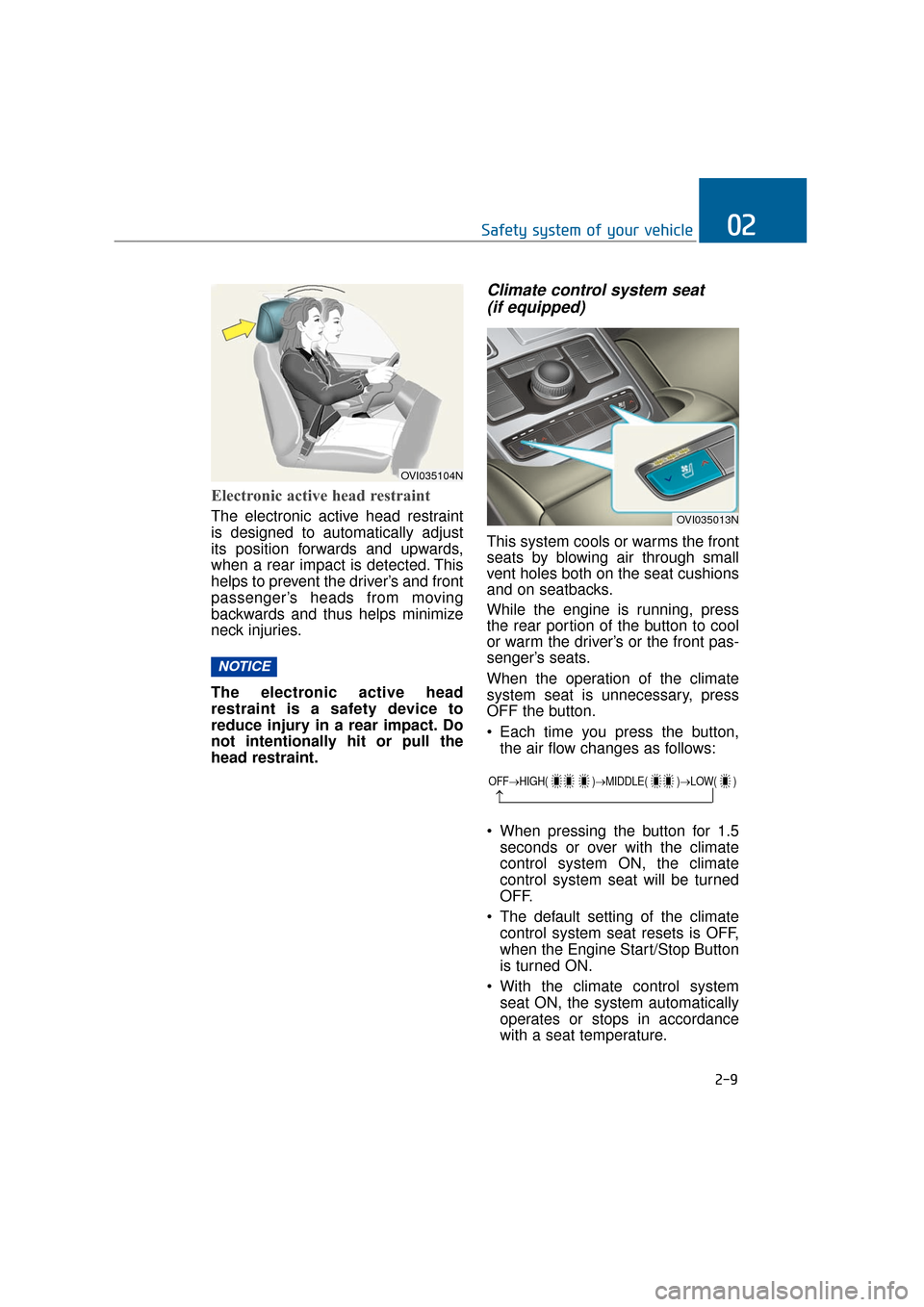
Electronic active head restraint
The electronic active head restraint
is designed to automatically adjust
its position forwards and upwards,
when a rear impact is detected. This
helps to prevent the driver’s and front
passenger’s heads from moving
backwards and thus helps minimize
neck injuries.
The electronic active head
restraint is a safety device to
reduce injury in a rear impact. Do
not intentionally hit or pull the
head restraint.
Climate control system seat (if equipped)
This system cools or warms the front
seats by blowing air through small
vent holes both on the seat cushions
and on seatbacks.
While the engine is running, press
the rear portion of the button to cool
or warm the driver’s or the front pas-
senger’s seats.
When the operation of the climate
system seat is unnecessary, press
OFF the button.
Each time you press the button,
the air flow changes as follows:
When pressing the button for 1.5 seconds or over with the climate
control system ON, the climate
control system seat will be turned
OFF.
The default setting of the climate control system seat resets is OFF,
when the Engine Start/Stop Button
is turned ON.
With the climate control system seat ON, the system automatically
operates or stops in accordance
with a seat temperature.
NOTICE
2-9
Safety system of your vehicle02
OVI035104N
OVI035013N
OFF→ HIGH( )→ MIDDLE( )→LOW( )
→
Page 38 of 477
Rear seat adjustment
The rear seat position can be adjust-
ed by pressing the control switches
on doors.
The power seat is operated byelectric motors. Pause the motor
operation after each seat-posi-
tion adjustment. Excessive
motor operation may damage
the electric equipment.
The operation of a power seat consumes a large amount of
electric power. To prevent
unnecessary battery drain,
when the engine is turned OFF,
do not adjust the power seat
longer than necessary.
Do not press two power seat control switches or more at the
same time. Doing so may fail the
electric motor or components. Do not operate the rear power
seat, when a child restraint is
installed.
NOTICE
NOTICE
2-11
Safety system of your vehicle02
While adjusting the seat posi-
tion, use extreme caution not to
caught hands or other objects
inside the seat components.
Do not adjust the seat while fas-
tening a seat belt. Moving the
seat cushion forward may apply
strong pressure on the
abdomen.
CAUTION
The power seat is operable even
after turning OFF the Engine
Start/Stop button. Therefore,
children should never be left
unattended in the vehicle.
WARNING
Page 47 of 477
While the engine is running, push the
rear portion of the button either to
warm or to cool the rear seats.
When the climate control system seat
is not needed, press OFF the button.
Each time you press the button,the air flow changes as follows:
When pressing the button for 1.5 seconds or over with the climate
control system seat ON, the seat
cooler will turn OFF.
The default setting of the climate control system seat is OFF, when
the Engine Start/Stop Button is
turned ON.
With the climate control system seat ON, the system automatically
operates or stops in accordance
with a seat temperature.
The climate control system seat is a supplementary cooling and
warming system. Operate the
climate control system seat after
turning ON the climate control
system. Operate the climate
control seat for a prolonged
period of time without turning
ON the climate control system
may reduce performance of the
climate control system seat.
When cleaning the seats, do not use an organic solvent such as
thinner, benzene, alcohol and
gasoline. Such solvent may
damage the seat surface.
(Continued)(Continued)
Do not spill liquid such as water
or beverages over the front seat
cushions or seatbacks.
Otherwise, the air vent holes
may be blocked and prevent the
system from working properly.
Do not leave materials, such as plastic bags or newspapers,
under the seats. The air vent
hole may not properly operate,
because the air intake is
blocked.
When the air vent hole does not operate, restart the vehicle. If a
problem persists, we recom-
mend that the system be
inspected by an authorized
EQUUS dealer.
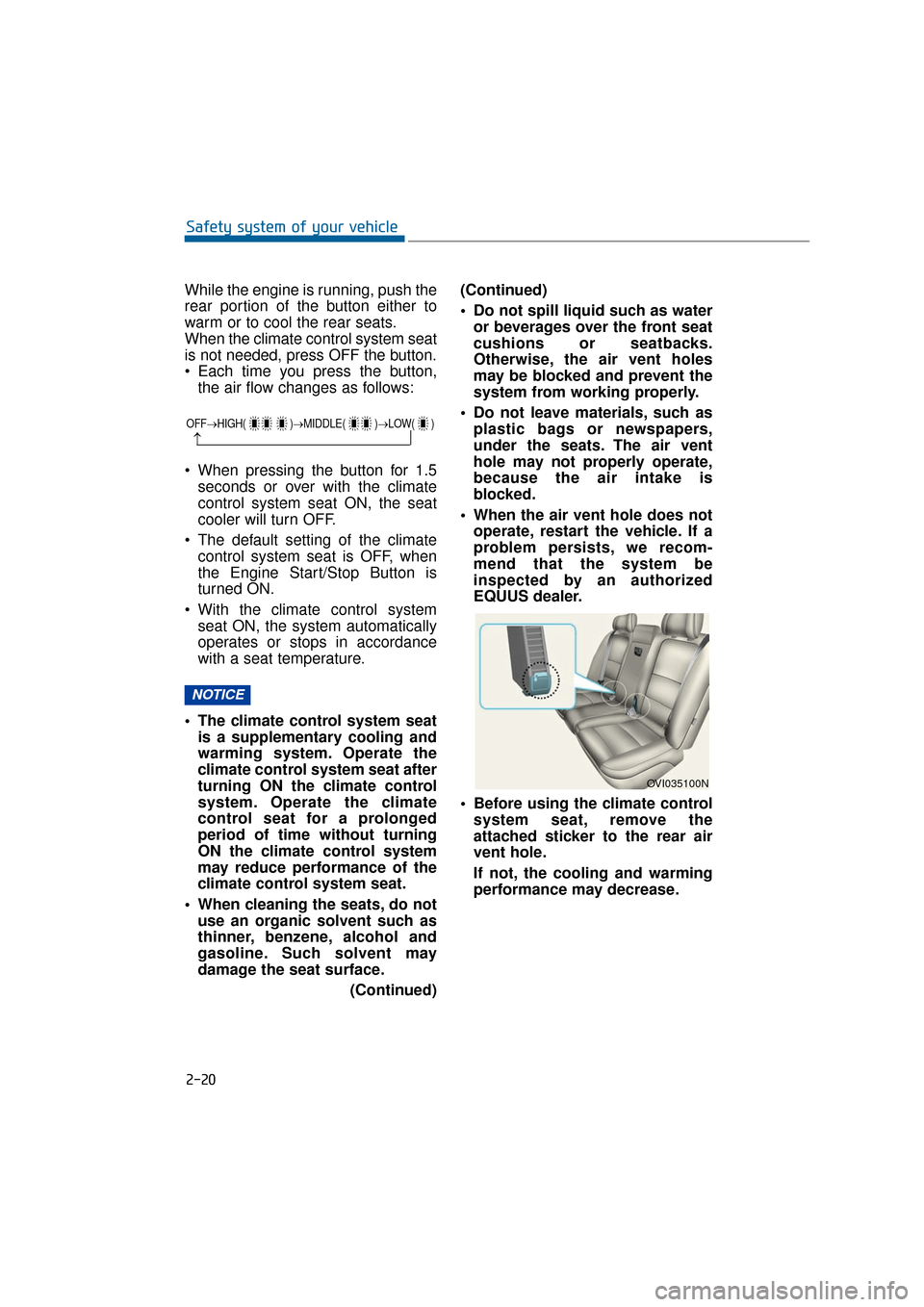
Before using the climate control system seat, remove the
attached sticker to the rear air
vent hole.
If not, the cooling and warming
performance may decrease.
OVI035100N
NOTICE
2-20
Safety system of your vehicle
OFF→ HIGH( )→ MIDDLE( )→LOW( )
→
Page 70 of 477
How the air bag system oper-
ates
Air bags activate (able to inflate ifnecessary) only when the Engine
Start/Stop Button is ON or in the
START position.
Air bags inflate in the event of a severe frontal or side collision in
order to protect occupants from
serious physical injury.
There is no single speed, at which air bags inflate.
Generally, air bags are designed to
inflate based upon a collision
severity and collision direction.
These two factors mainly deter-
mine whether the sensors produce
an electronic deployment/inflation
signal.
Air bag deployment depends on a number of factors, including a driv-
ing speed, impact angles, vehicle
density, vehicle stiffness or an
object, which your vehicle collides
with. Beyond those mentioned
above, there are more determining
factors.
The front air bags completely inflates and then deflates in an
instant. It is virtually impossible for
you to see the air bags inflating
during an accident.
It is much more likely that you sim-
ply see the deflated air bags hang-
ing out of their storage compart-
ments after the collision.
To help provide protection in a severe collision, the air bags must
inflate rapidly. The speed of air bag
inflation is extremely fast, because
a collision instantly requires to
inflate the air bag between an
occupant and the vehicle struc-
tures, before the occupant strikes
with the vehicle interior. This instant inflation reduces the
risk of serious or life-threatening
injury in a severe collision. So, this
fast speed is a necessary part of
air bag design.
However, air bag inflation may also
cause injury, such as facial abra-
sions, bruises and broken bones,
because the inflation speed also
causes the air bags to expand with
a great deal of force.
There are even some circum- stances, under which the air bag
may cause fatal injury, especial-
ly when an occupant is posi-
tioned excessively close to the
air bag.
2-43
Safety system of your vehicle02
To avoid severe personalinjury or death caused by
deploying air bags in a colli-
sion, the driver should sit as
far back from the steering
wheel air bag as possible (at
least 10 inches (250 mm)
away). The front passenger
should always sit in the rear-
most position.
Air bags instantly inflate in the event of a collision, and an
occupant may be injured by
the expanding force, when he
or she sits in an inappropriate
position.
Air bag inflation may cause injury, normally including
facial or bodily abrasions,
injuries from broken glasses
or burns by the air bag infla-
tion gas.
WARNING
Page 72 of 477
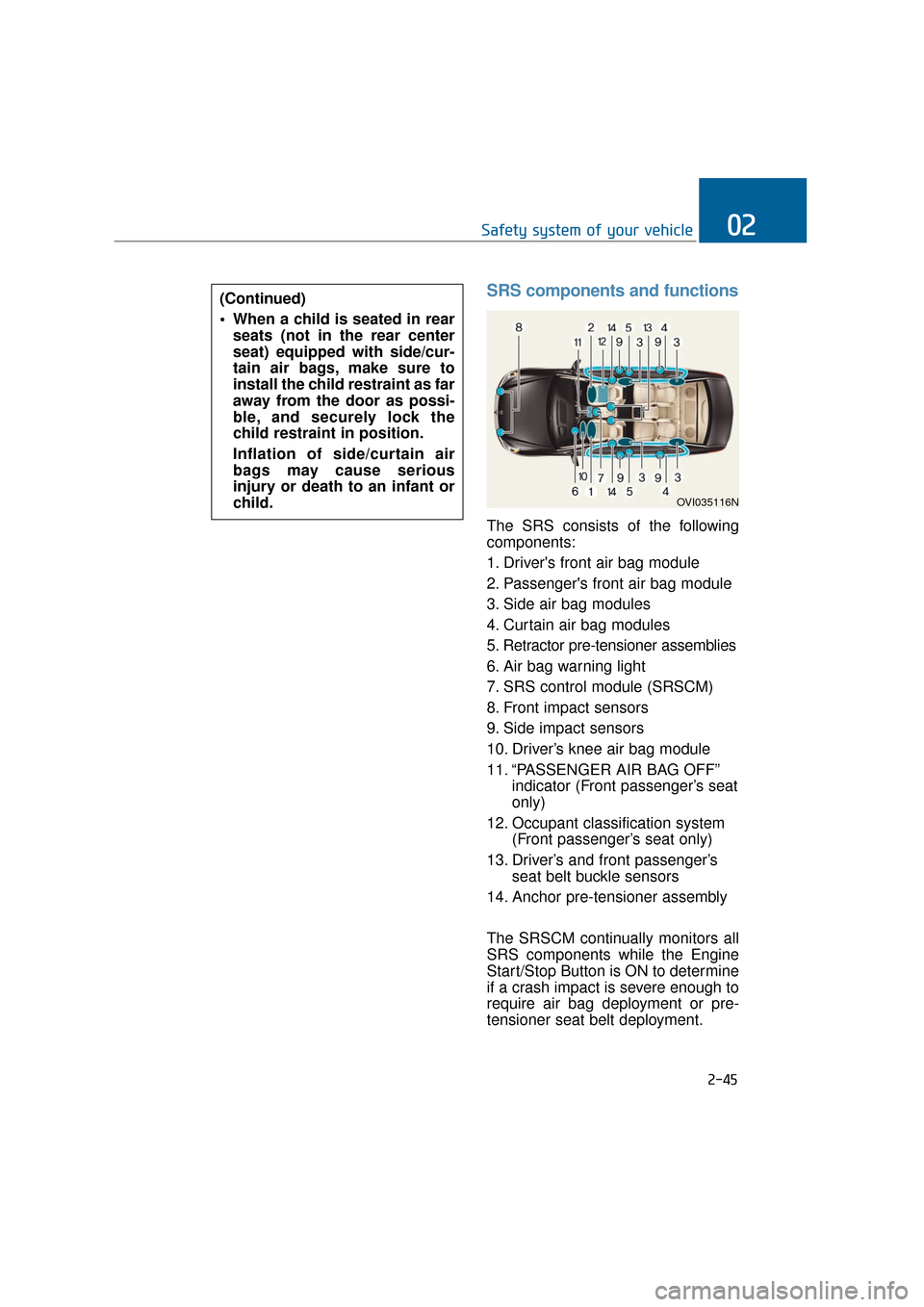
SRS components and functions
The SRS consists of the following
components:
1. Driver's front air bag module
2. Passenger's front air bag module
3. Side air bag modules
4. Curtain air bag modules
5. Retractor pre-tensioner assemblies
6. Air bag warning light
7. SRS control module (SRSCM)
8. Front impact sensors
9. Side impact sensors
10. Driver’s knee air bag module
11. “PASSENGER AIR BAG OFF”indicator (Front passenger’s seat
only)
12. Occupant classification system (Front passenger’s seat only)
13. Driver’s and front passenger’s seat belt buckle sensors
14. Anchor pre-tensioner assembly
The SRSCM continually monitors all
SRS components while the Engine
Start/Stop Button is ON to determine
if a crash impact is severe enough to
require air bag deployment or pre-
tensioner seat belt deployment.
2-45
Safety system of your vehicle02
(Continued)
When a child is seated in rear seats (not in the rear center
seat) equipped with side/cur-
tain air bags, make sure to
install the child restraint as far
away from the door as possi-
ble, and securely lock the
child restraint in position.
Inflation of side/curtain air
bags may cause serious
injury or death to an infant or
child.
OVI035116N