engine coolant Hyundai Equus 2016 User Guide
[x] Cancel search | Manufacturer: HYUNDAI, Model Year: 2016, Model line: Equus, Model: Hyundai Equus 2016Pages: 477, PDF Size: 16.25 MB
Page 256 of 477
Before entering vehicle
• Be sure that all windows, outsidemirror(s), and outside lights are
clean.
Check the condition of the tires.
Check underneath the vehicle for any leakage sign.
Make sure there are no obstacles behind, when you intend to drive
backwards.
Necessary inspections
Fluid levels, such as engine oil,
engine coolant, brake fluid, and
washer fluid should be checked on a
regular basis, at exact intervals.
Further details are provided in the
chapter 7, "Maintenance".
Before starting
Close and lock all doors.
Check the seat position, so all con-trols are easily accessible.
Adjust the inside and outside rearview mirrors.
Make sure that all lights operate.
Check all gauges.
Check the operation of warning lights when the Engine Start/Stop
button is turned ON.
Release the parking brake and make sure the brake warning light
goes OFF.
For safe operation, make sure you
are familiar with your vehicle equip-
ment and operation.
B B E
EF
FO
O R
RE
E
D
D R
RI
IV
V I
IN
N G
G
5-5
Driving your vehicle05
Careless driving may result in a
loss of vehicle control, possibly
leading to an accident, severe
personal injury, and death. The
driver’s primary responsibility
is to drive in the safe and legal
manner. The use of any hand-
held devices, other equipment,
or vehicle systems, which take
the driver’s eyes, attention and
focus away from the safe opera-
tion of a vehicle or which are
not permissible by law, should
never be used in driving.
WARNINGAll passengers must be proper-
ly belted whenever the vehicle
is moving. Refer to "Seat belts"
in chapter 2 for more informa-
tion on the proper usage.
WARNING
Always take a look around your
vehicle for any passers-by,
especially children, before
changing the shift lever to D
(Drive) or R (Reverse).
WARNING
Page 322 of 477
5-71
Driving your vehicle05
Highway driving
Tires
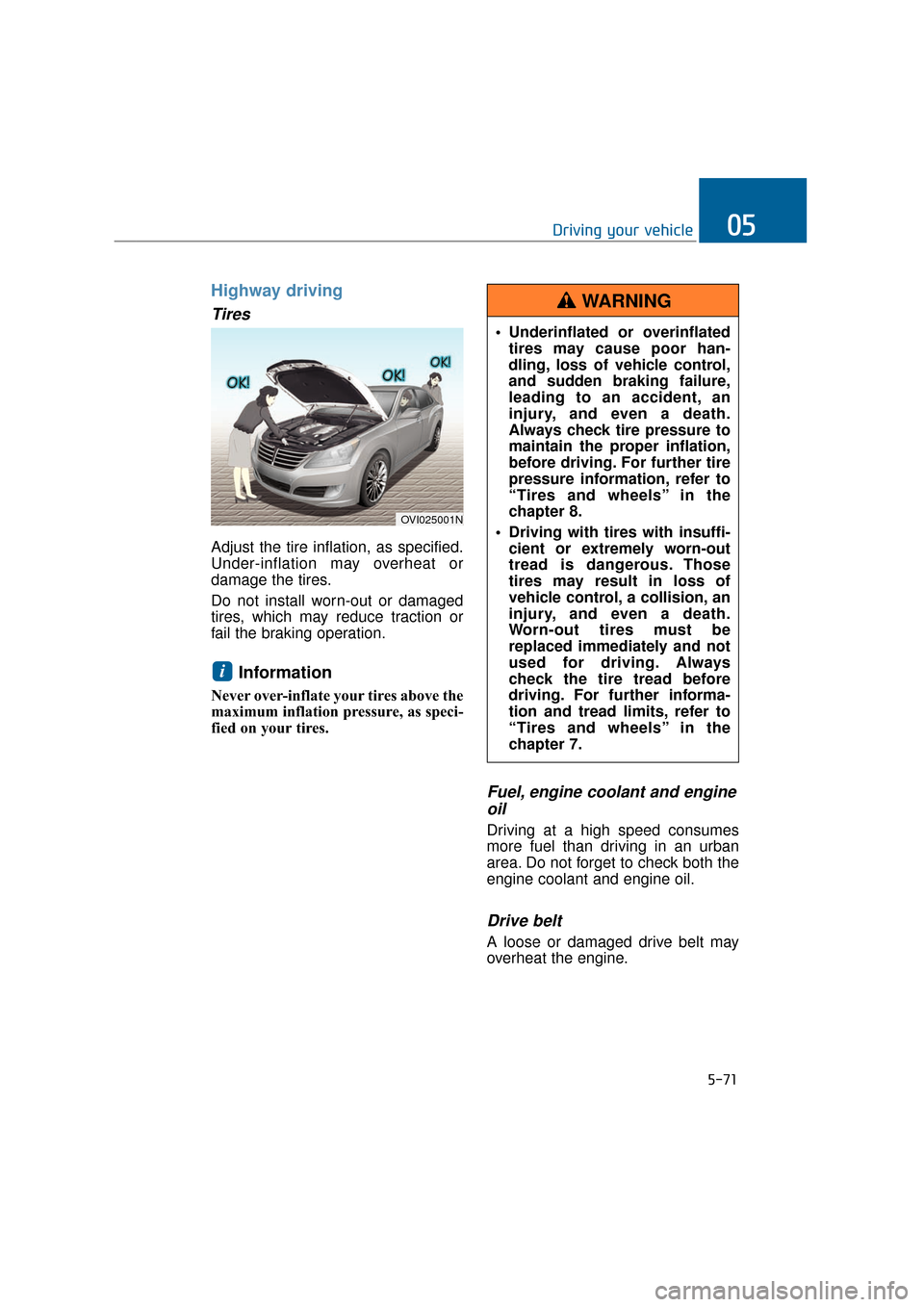
Adjust the tire inflation, as specified.
Under-inflation may overheat or
damage the tires.
Do not install worn-out or damaged
tires, which may reduce traction or
fail the braking operation.
Information
Never over-inflate your tires above the
maximum inflation pressure, as speci-
fied on your tires.
Fuel, engine coolant and engineoil
Driving at a high speed consumes
more fuel than driving in an urban
area. Do not forget to check both the
engine coolant and engine oil.
Drive belt
A loose or damaged drive belt may
overheat the engine.
i
OVI025001N
Underinflated or overinflated
tires may cause poor han-
dling, loss of vehicle control,
and sudden braking failure,
leading to an accident, an
injury, and even a death.
Always check tire pressure to
maintain the proper inflation,
before driving. For further tire
pressure information, refer to
“Tires and wheels” in the
chapter 8.
Driving with tires with insuffi- cient or extremely worn-out
tread is dangerous. Those
tires may result in loss of
vehicle control, a collision, an
injury, and even a death.
Worn-out tires must be
replaced immediately and not
used for driving. Always
check the tire tread before
driving. For further informa-
tion and tread limits, refer to
“Tires and wheels” in the
chapter 7.
WARNING
Page 325 of 477
5-74
Driving your vehicle
An AutoSock, which is in the wrong size or is improperly
installed, may damage brake
lines, suspension, body and
wheels of your vehicle.
Stop driving and retighten the AutoSock, whenever there are
snapping sounds between the
vehicle and the AutoSock.
Use high quality ethylene gly-
col coolant
The cooling system of your vehicle is
filled with the high-quality ethylene
glycol coolant when being delivered.
It is the only type of coolant that your
vehicle is filled with, because it pre-
vents corrosion of the cooling sys-
tem, lubricates the water pump and
prevents freezing. Refill the cooling
system in accordance with your
maintenance schedule in the chapter
7. Before winter, check your coolant
to assure that the freezing point is
sufficiently lower than the expected
winter temperature.
Check battery and cables
The winter temperature increases
the battery consumption. Inspect the
battery and cables, as described in
the chapter 7. The battery charging
level can be checked by an author-
ized EQUUS dealer or in a service
station.
Change to "winter weight" oil,
if necessary
In some regions during the cold win-
ter, it is recommended to use the
"winter weight" oil with lower viscosi-
ty. For further information about this,
refer to the chapter 8. When you can-
not be sure about a type of winter
weight oil, consult an authorized
EQUUS dealer.
Check spark plugs and ignition
system
Inspect your spark plugs and, if nec-
essary, replace them. Also check all
ignition wirings and components for
any cracks, wear-out, and damage.
NOTICE
- Chain installation
When installing the AutoSock,
park the vehicle on level ground
away from other vehicles. Press
ON the Hazard Warning flasher
and place a warning triangle
behind your vehicle, if available.
Place the shift lever in P(Park),
set the parking brake and turn
OFF the engine, before
installing the AutoSock.
WARNING
- Tire chains
The use of the AutoSock may
adversely affect vehicle han-
dling.
Do not drive faster than the lower of the two - 20 mph (30
km/h) and the AutoSock manu-
facturer’s recommended
speed limit.
Drive carefully and avoid bumps, holes, sharp turns, and
other road hazards, which may
bounce the vehicle.
Avoid turning sharply or lock- ing the wheel brake.
WARNING
Page 326 of 477
5-75
Driving your vehicle05
To prevent the locks from
frozen
To prevent the locks from being
frozen, spray authorized de-icing
fluid or glycerin into key openings.
When a lock opening is already cov-
ered with ice, spray authorized de-
icing fluid on the ice to remove it.
When an internal part of a lock
freezes, try to thaw it with a heated
key. Carefully use the heated key to
avoid an injury.
Use authorized window-wash-
er anti-freezer solution in sys-
tem
To prevent the window washer from
being frozen, add authorized win-
dow-washer anti-freeze solution, as
instructed on the window-washer
container. Window-washer anti-
freeze solution is available from an
authorized EQUUS dealer, and so
are the most auto parts outlets. Do
not use engine coolant or other types
of anti-freezer solution, because
these may damage the vehicle paint.
Do not let your parking brake
freeze
Under some conditions, your parking
brake may freeze in the engaged
position. This is most likely to hap-
pen, when there is an accumulation
of snow or ice around/near the rear
brakes, or when the brakes are wet.
When there is the risk that your park-
ing brake may freeze, temporarily
apply it after locating the shift lever in
P(Park). Also, block the rear wheels
in advance, so the vehicle may not
roll. Then, release the parking brake.
Do not let ice and snow accu-
mulate underneath
Under some conditions, snow and
ice may build up under the fenders
and interfere with the steering. When
driving in such conditions during the
severe winter, you should check
underneath the vehicle on a regular
basis to assure that moving the front
wheels and the steering components
is unobstructed.
Carry emergency equipment
In accordance with weather condi-
tions, you should carry appropriate
emergency equipment, while driving.
Some of the items you may want to
carry include tire chains, tow straps,
chains, flashlight, emergency flares,
sand, a shovel, jumper cables, a win-
dow scraper, gloves, ground cloth,
coveralls and a blanket.
Do not place objects or materi-
als in the engine compartment
Putting objects or materials in the
engine compartment may cause an
engine failure or combustion,
because those may block the engine
cooling. The manufacturer is not
responsible for the damage caused
by such placement.
Page 339 of 477
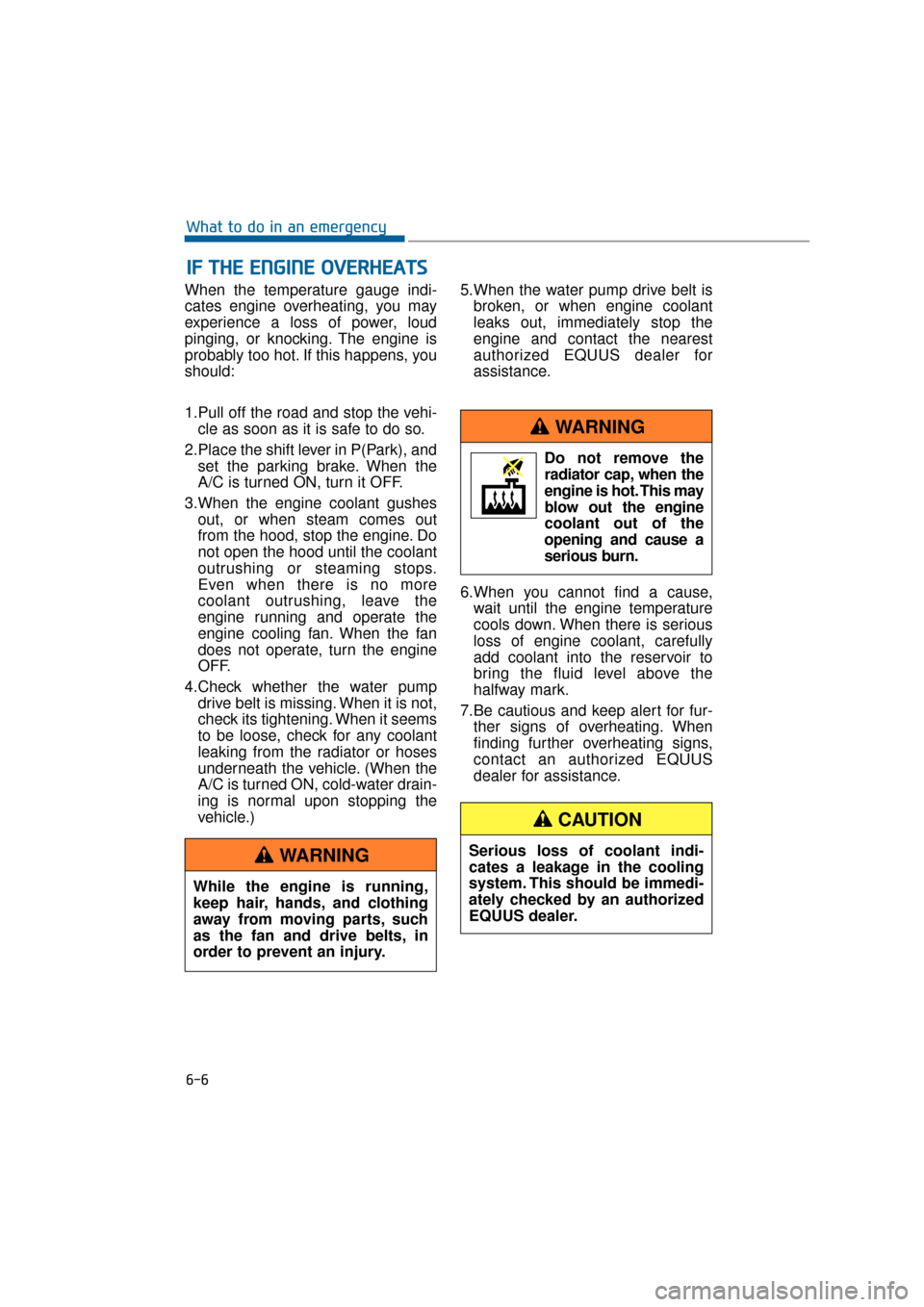
When the temperature gauge indi-
cates engine overheating, you may
experience a loss of power, loud
pinging, or knocking. The engine is
probably too hot. If this happens, you
should:
1.Pull off the road and stop the vehi-cle as soon as it is safe to do so.
2.Place the shift lever in P(Park), and set the parking brake. When the
A/C is turned ON, turn it OFF.
3.When the engine coolant gushes out, or when steam comes out
from the hood, stop the engine. Do
not open the hood until the coolant
outrushing or steaming stops.
Even when there is no more
coolant outrushing, leave the
engine running and operate the
engine cooling fan. When the fan
does not operate, turn the engine
OFF.
4.Check whether the water pump drive belt is missing. When it is not,
check its tightening. When it seems
to be loose, check for any coolant
leaking from the radiator or hoses
underneath the vehicle. (When the
A/C is turned ON, cold-water drain-
ing is normal upon stopping the
vehicle.) 5.When the water pump drive belt is
broken, or when engine coolant
leaks out, immediately stop the
engine and contact the nearest
authorized EQUUS dealer for
assistance.
6.When you cannot find a cause, wait until the engine temperature
cools down. When there is serious
loss of engine coolant, carefully
add coolant into the reservoir to
bring the fluid level above the
halfway mark.
7.Be cautious and keep alert for fur- ther signs of overheating. When
finding further overheating signs,
contact an authorized EQUUS
dealer for assistance.
I IF
F
T
T H
H E
E
E
E N
N G
GI
IN
N E
E
O
O V
VE
ER
R H
H E
EA
A T
TS
S
6-6
What to do in an emergency
While the engine is running,
keep hair, hands, and clothing
away from moving parts, such
as the fan and drive belts, in
order to prevent an injury.
WARNING
Do not remove theradiator cap, when the
engine is hot. This may
blow out the engine
coolant out of the
opening and cause a
serious burn.
WARNING
Serious loss of coolant indi-
cates a leakage in the cooling
system. This should be immedi-
ately checked by an authorized
EQUUS dealer.
CAUTION
Page 358 of 477
Maintenance
Engine compartment .............................................7-4
Maintenance services ...........................................7-5
Owner's responsibility ......................................................7-5
Owner's maintenance precautions ...............................7-6
Owner's maintenance ...........................................7-7
Owner's maintenance schedule ....................................7-7
Scheduled maintenance service ..........................7-8
Normal maintenance schedule .......................................7-9
Maintenance under severe usage conditions ..........7-22
Explanation of scheduled maintenance
items.......................................................................7\
-23
Engine oil ..............................................................7-25
Checking the engine oil level ....................................7-25
Changing the engine oil and filter ..............................7-26
Engine coolant......................................................7-27
Checking the coolant level ...........................................7-27
Changing the coolant .....................................................7-29
Brake fluid ............................................................7-30
Checking the brake fluid level .....................................7-30
Power steering fluid ............................................7-31
Checking the power steering fluid level ...................7-31
Checking the power steering hose.............................7-31
Washer fluid .........................................................7-32
Checking the washer fluid level ..................................7-32
Air cleaner ............................................................7-33
Filter replacement ...........................................................7-33
Page 361 of 477
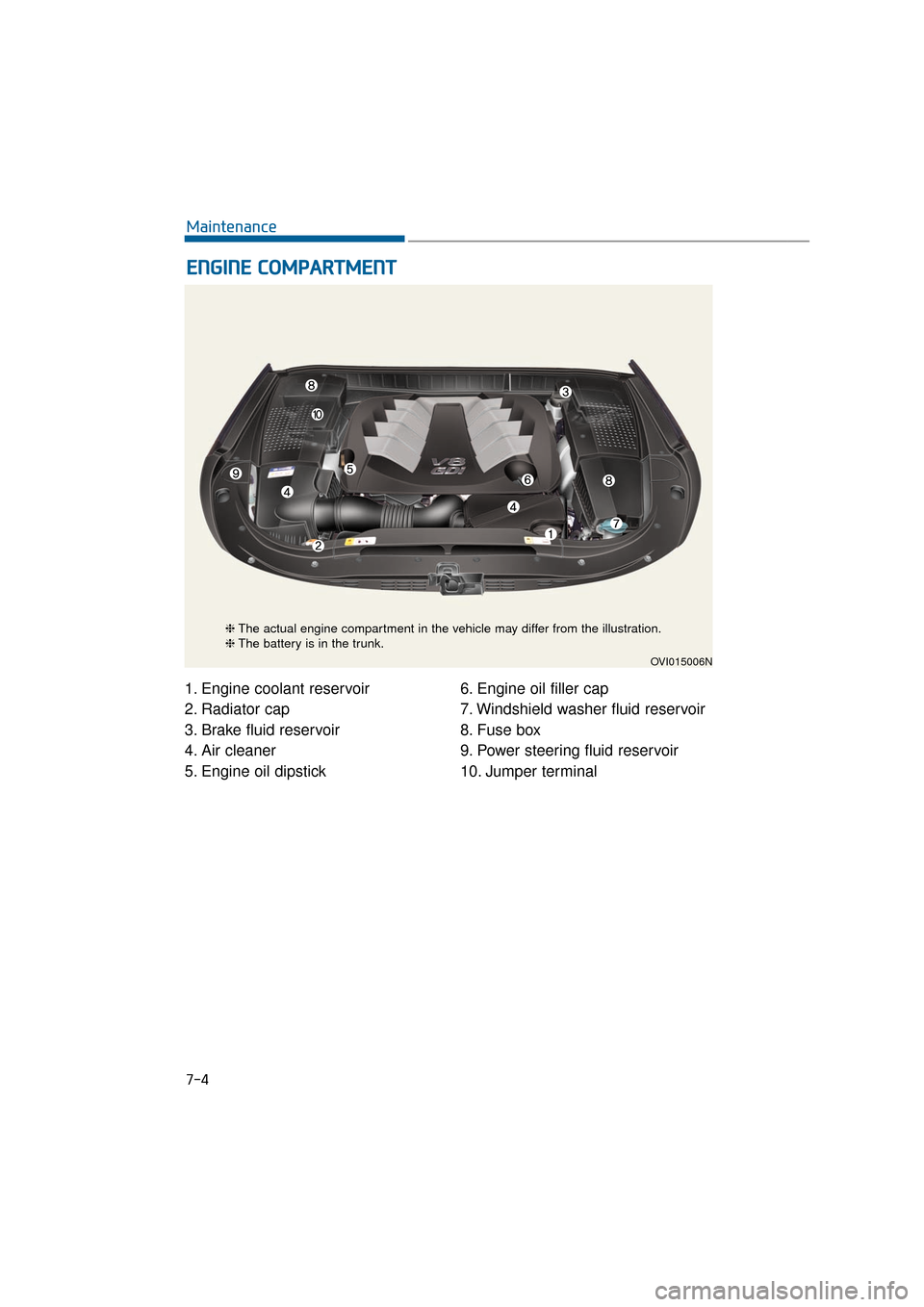
1. Engine coolant reservoir
2. Radiator cap
3. Brake fluid reservoir
4. Air cleaner
5. Engine oil dipstick6. Engine oil filler cap
7. Windshield washer fluid reservoir
8. Fuse box
9. Power steering fluid reservoir
10. Jumper terminal
E E
N
N G
GI
IN
N E
E
C
C O
O M
M P
PA
A R
RT
TM
M E
EN
N T
T
7-4
OVI015006N
Maintenance
❈ The actual engine compartment in the vehicle may differ from the illustration.
❈ The battery is in the trunk.
Page 364 of 477
The following lists are about the vehi-
cle inspection and maintenance that
should be performed by the owner or
an authorized EQUUS dealer, as
indicated. This will ensure your safety
and dependable driving.
Any adverse conditions should imme-
diately be checked by your EQUUS
dealer.
These Owner Maintenance Checklists
are mostly uncovered by your vehicle
warranties. Thus, you may charges
you for expenses of labor, parts or
lubricants.
Owner's maintenance sched-
ule
While refueling:
Check the engine oil level.
Check coolant level in coolantreservoir.
Check the windshield washer fluid level.
Check for any low or under-inflated tires.
While driving:
Check for any changes in theexhaust sounds or the smells.
Check for any steering wheel vibra- tion. Check whether you feel more
tightness or looseness of the steer-
ing wheel.
Check for any slight tilting, or “pulls” to one side, while driving on
a flat surface.
Check for any unusual sounds, tilt- ing, a braking distance, or “hard-to-
push” brake pedal while stopping.
Check the transmission fluid level upon experiencing a skid or a sud-
den transmission gear change.
Check the P(Park) function of the auto transmission.
Check the parking brake.
Check for any fluid leak (water dripping from the A/C while or after
the normal driving).
At least once a month:
Check the coolant level in theengine coolant reservoir.
Check the operation of all exterior lights, such as the stoplights, turn
signals and hazard warning flash-
ers.
Check the inflation pressures of all tires including the spare.
O OW
W N
NE
ER
R '
'S
S
M
M A
AI
IN
N T
TE
EN
N A
AN
N C
CE
E
7-7
Maintenance07
Carefully check your engine
coolant level, when the engine
is hot. The hot coolant or steam
may blow out under pressure.
This may cause a skin burn or
other serious injuries.
WARNING
Page 375 of 477
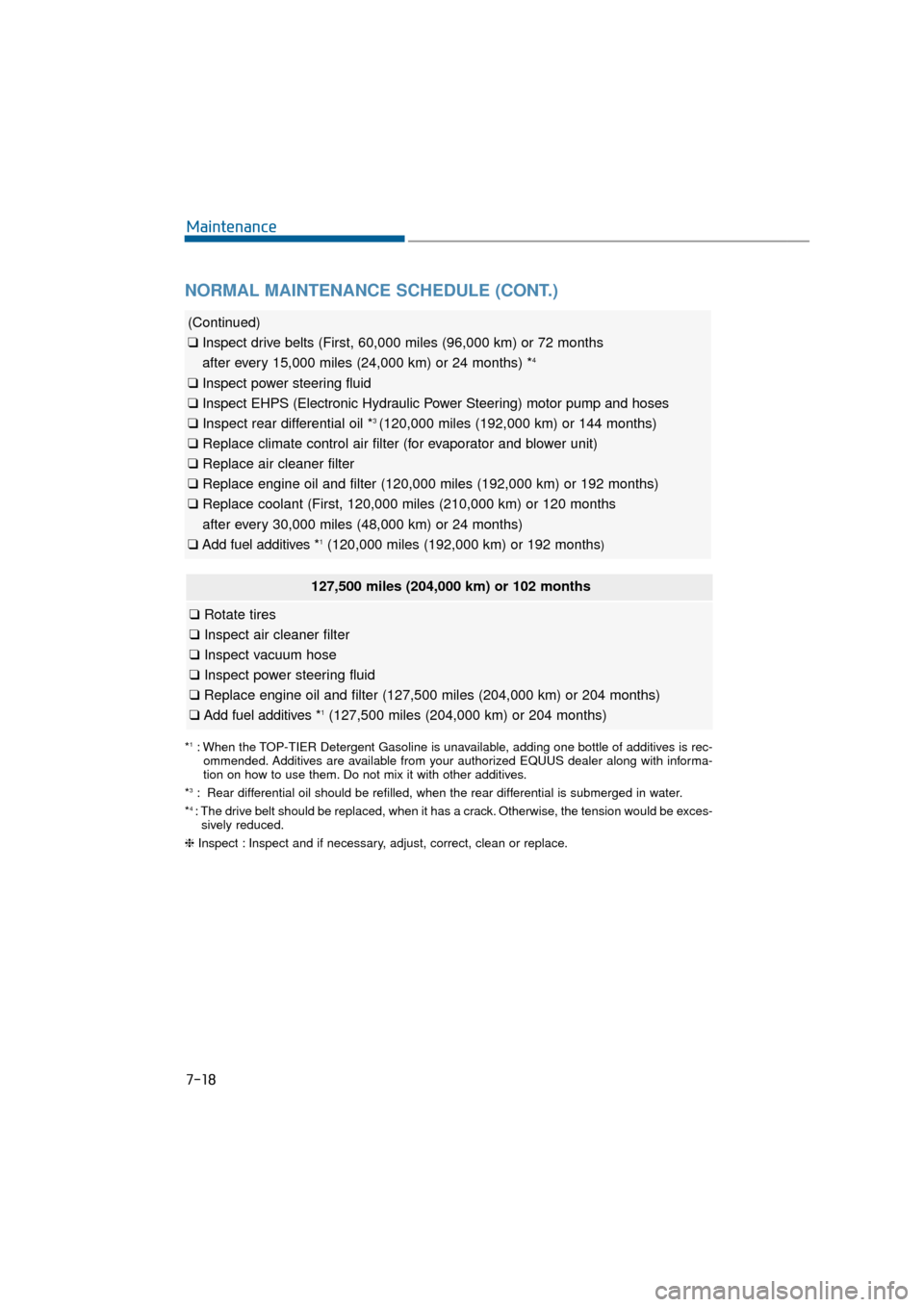
NORMAL MAINTENANCE SCHEDULE (CONT.)
7-18
Maintenance
(Continued)
❑Inspect drive belts (First, 60,000 miles (96,000 km) or 72 months
after every 15,000 miles (24,000 km) or 24 months) *
4
❑ Inspect power steering fluid
❑ Inspect EHPS (Electronic Hydraulic Power Steering) motor pump and hoses
❑ Inspect rear differential oil *
3 (120,000 miles (192,000 km) or 144 months)
❑ Replace climate control air filter (for evaporator and blower unit)
❑ Replace air cleaner filter
❑ Replace engine oil and filter (120,000 miles (192,000 km) or 192 mont\
hs)
❑ Replace coolant (First, 120,000 miles (210,000 km) or 120 months
after every 30,000 miles (48,000 km) or 24 months)
❑ Add fuel additives *
1(120,000 miles (192,000 km) or 192 months)
127,500 miles (204,000 km) or 102 months
❑ Rotate tires
❑ Inspect air cleaner filter
❑ Inspect vacuum hose
❑ Inspect power steering fluid
❑ Replace engine oil and filter (127,500 miles (204,000 km) or 204 mont\
hs)
❑ Add fuel additives *
1(127,500 miles (204,000 km) or 204 months)
*1: When the TOP-TIER Detergent Gasoline is unavailable, adding one bottle of additives is rec-
ommended. Additives are available from your authorized EQUUS dealer along with informa-
tion on how to use them. Do not mix it with other additives.
*
3: Rear differential oil should be refilled, when the rear differential is submerged in water.
*4 : The drive belt should be replaced, when it has a crack. Otherwise, the tension would be exces- sively reduced.
❈ Inspect : Inspect and if necessary, adjust, correct, clean or replace.
Page 377 of 477
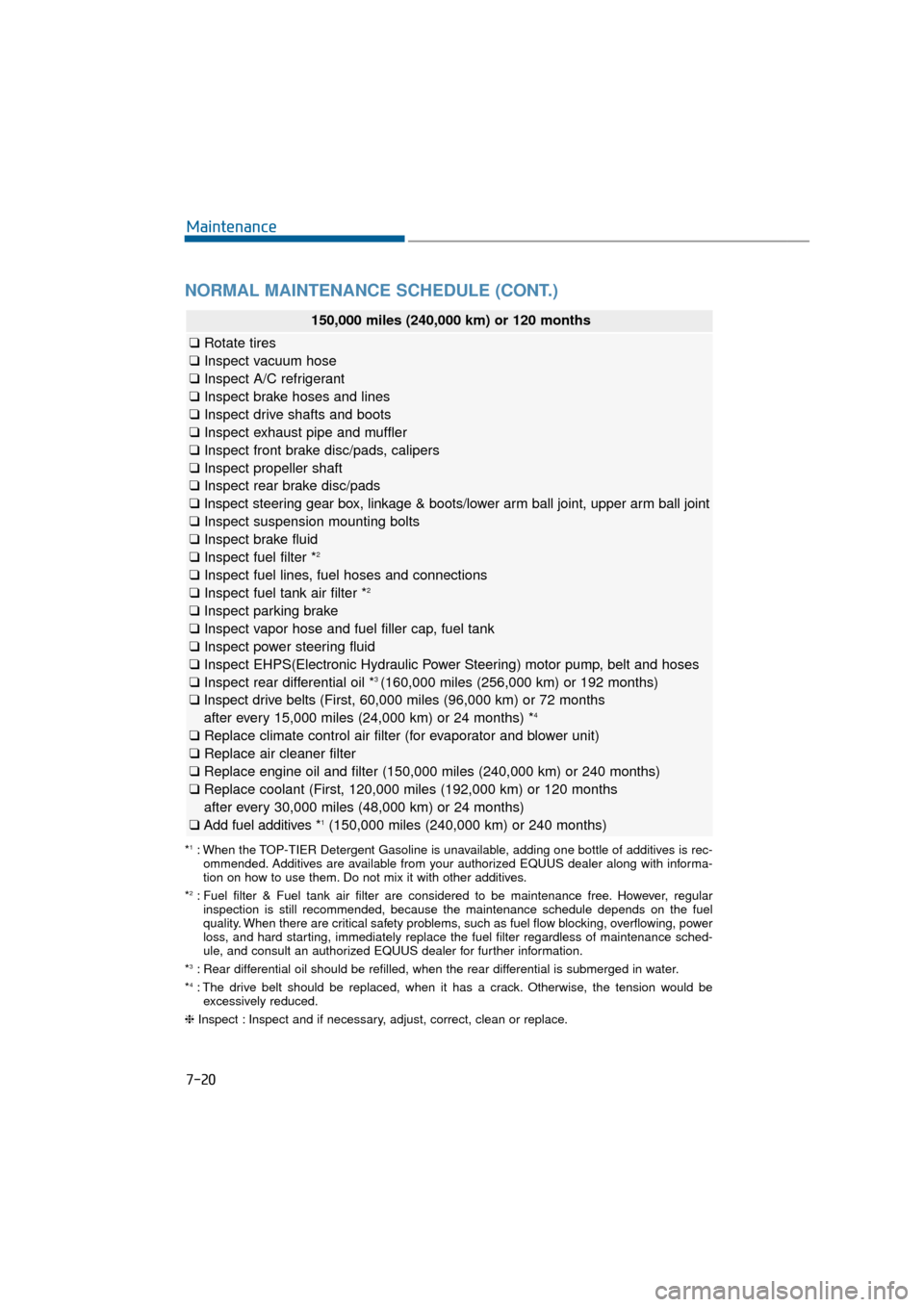
NORMAL MAINTENANCE SCHEDULE (CONT.)
7-20
Maintenance
150,000 miles (240,000 km) or 120 months
❑Rotate tires
❑ Inspect vacuum hose
❑ Inspect A/C refrigerant
❑ Inspect brake hoses and lines
❑ Inspect drive shafts and boots
❑ Inspect exhaust pipe and muffler
❑ Inspect front brake disc/pads, calipers
❑ Inspect propeller shaft
❑ Inspect rear brake disc/pads
❑ Inspect steering gear box, linkage & boots/lower arm ball joint, upper arm ball joint
❑ Inspect suspension mounting bolts
❑ Inspect brake fluid
❑ Inspect fuel filter *
2
❑Inspect fuel lines, fuel hoses and connections
❑ Inspect fuel tank air filter *2
❑Inspect parking brake
❑ Inspect vapor hose and fuel filler cap, fuel tank
❑ Inspect power steering fluid
❑ Inspect EHPS(Electronic Hydraulic Power Steer ing) motor pump, belt and hoses
❑ Inspect rear differential oil *
3 (160,000 miles (256,000 km) or 192 months)
❑ Inspect drive belts (First, 60,000 miles (96,000 km) or 72 months
after every 15,000 miles (24,000 km) or 24 months) *
4
❑ Replace climate control air filter (for evaporator and blower unit)
❑ Replace air cleaner filter
❑ Replace engine oil and filter (150,000 miles (240,000 km) or 240 mont\
hs)
❑ Replace coolant (First, 120,000 miles (192,000 km) or 120 months
after every 30,000 miles (48,000 km) or 24 months)
❑ Add fuel additives *
1(150,000 miles (240,000 km) or 240 months)
*1: When the TOP-TIER Detergent Gasoline is unavailable, adding one bottle of additives is rec-
ommended. Additives are available from your authorized EQUUS dealer along with informa-
tion on how to use them. Do not mix it with other additives.
*
2: Fuel filter & Fuel tank air filter are considered to be maintenance free\
. However, regular inspection is still recommended, because the maintenance schedule depend\
s on the fuel
quality. When there are critical safety problems, such as fuel flow blocking, overflowing, power
loss, and hard starting, immediately replace the fuel filter regardless of maintenance sche\
d-
ule, and consult an authorized EQUUS dealer for further information.
*
3: Rear differential oil should be refilled, when the rear differential is submerged in water.
*4: The drive belt should be replaced, when it has a crack. Otherwise, the tension would be excessively reduced.
❈ Inspect : Inspect and if necessary, adjust, correct, clean or replace.