engine coolant Hyundai Equus 2016 Owner's Guide
[x] Cancel search | Manufacturer: HYUNDAI, Model Year: 2016, Model line: Equus, Model: Hyundai Equus 2016Pages: 477, PDF Size: 16.25 MB
Page 380 of 477
7-23
Maintenance07
E
EX
X P
PL
LA
A N
N A
AT
TI
IO
O N
N
O
O F
F
S
S C
C H
H E
ED
D U
U L
LE
E D
D
M
M A
AI
IN
N T
TE
EN
N A
AN
N C
CE
E
I
IT
T E
EM
M S
S
Engine oil and filter
The engine oil and filter should be
changed at the interval, as specified
in the maintenance schedule. After
driving in severe conditions, you
should more frequently change oil
and filters.
Drive belts
Inspect all belts for any cut, crack,
excessive wear-out, or oil saturation.
If necessary, replace it.
Fuel filter
A clogged filter may limit the acceler-
ating function, damage the emission
system and cause other problems,
such as hard starting. When an
excessive amount of foreign sub-
stances accumulate in the fuel tank,
you should more frequently replace
the filter. After installing a new filter,
run the engine for several minutes,
and check for any leakage from the
connections. Fuel filters should be
installed by an authorized EQUUS
dealer.
Fuel lines, fuel hoses and con-
nections
Check the fuel lines, fuel hoses and
connections for any leakage and
damage. Immediately have an
authorized EQUUS dealer replace
any damaged or leaking parts.
Vapor hose and fuel filler cap
Check the fuel lines, fuel hoses and
connections for any leakage and
damage. Immediately have an
authorized EQUUS dealer replace
any damaged or leaking parts.
Air cleaner filter
An authorized HYUNDAI air cleaner
filter is recommended.
Spark plugs
Make sure to install new spark plugs
of the correct heat range.
Cooling system
Check the cooling system compo-
nents, such as radiator, coolant
reservoir, hoses and connections, for
any leakage and damage. If neces-
sary, replace any damaged parts.
Coolant
The coolant should be changed at
the interval, as specified in the main-
tenance schedule.
Automatic transmission fluid
You do not need to check the auto-
matic transmission fluid, when driv-
ing under normal conditions.
However, after driving in severe con-
ditions, the fluid should be changed
by an authorized EQUUS dealer in
accordance with the maintenance
schedule, as specified in the begin-
ning of this chapter.
Information
The original color of the automatic
transmission fluid is red. However, as
you drive the vehicle, the color will
become darker. This is normal, and
you do not need to change the fluid
due to the changed color.
i
Page 384 of 477
7-27
Maintenance07
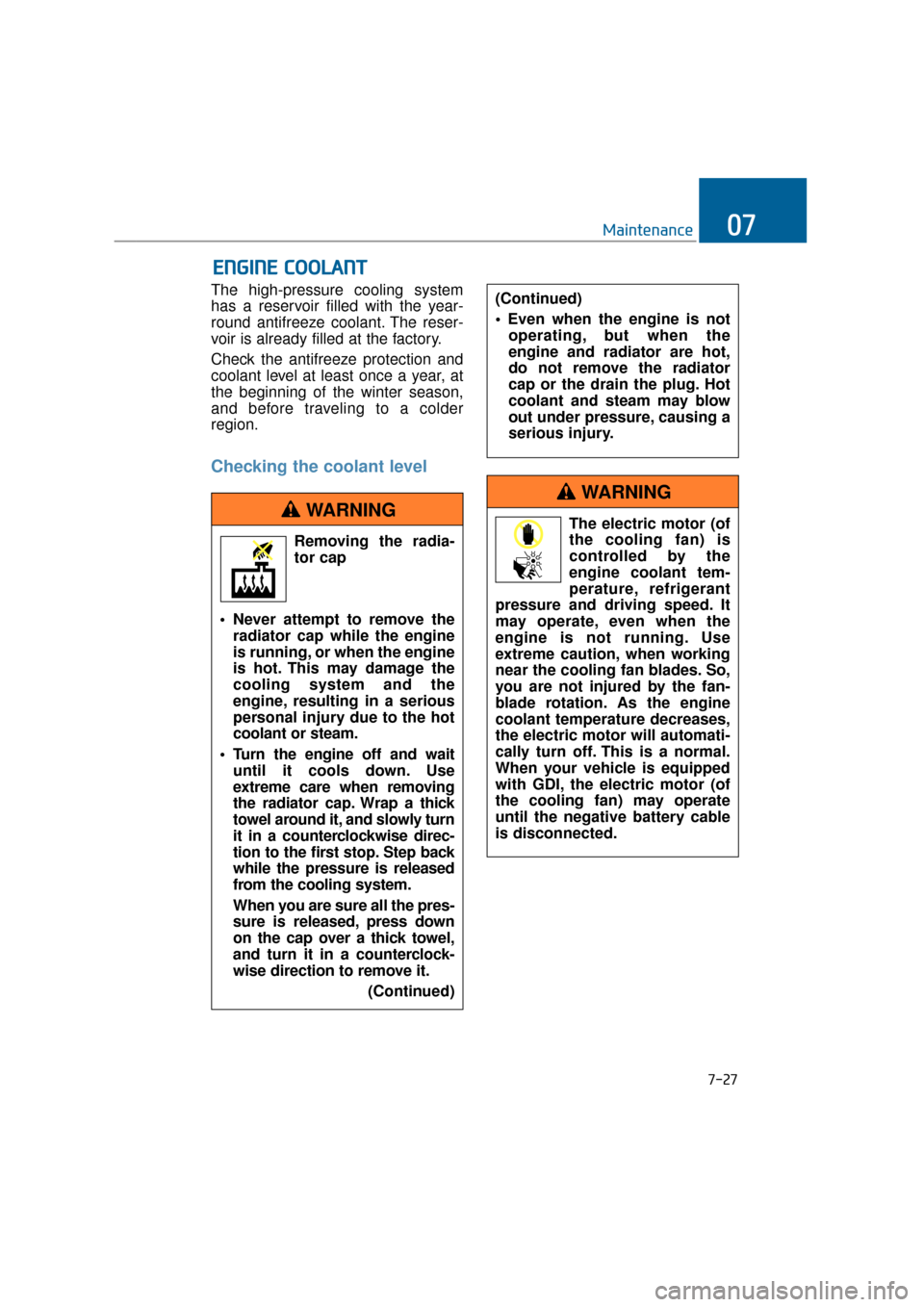
The high-pressure cooling system
has a reservoir filled with the year-
round antifreeze coolant. The reser-
voir is already filled at the factory.
Check the antifreeze protection and
coolant level at least once a year, at
the beginning of the winter season,
and before traveling to a colder
region.
Checking the coolant level
E EN
N G
GI
IN
N E
E
C
C O
O O
OL
LA
A N
N T
T
(Continued)
operating, but when the
engine and radiator are hot,
do not remove the radiator
cap or the drain the plug. Hot
coolant and steam may blow
out under pressure, causing a
serious injury.
The electric motor (of
the cooling fan) is
controlled by the
engine coolant tem-
perature, refrigerant
pressure and driving speed. It
may operate, even when the
engine is not running. Use
extreme caution, when working
near the cooling fan blades. So,
you are not injured by the fan-
blade rotation. As the engine
coolant temperature decreases,
the electric motor will automati-
cally turn off. This is a normal.
When your vehicle is equipped
with GDI, the electric motor (of
the cooling fan) may operate
until the negative battery cable
is disconnected.
WARNING
Removing the radia-
tor cap
Never attempt to remove the radiator cap while the engine
is running, or when the engine
is hot. This may damage the
cooling system and the
engine, resulting in a serious
personal injury due to the hot
coolant or steam.
Turn the engine off and wait until it cools down. Use
extreme care when removing
the radiator cap. Wrap a thick
towel around it, and slowly turn
it in a counterclockwise direc-
tion to the first stop. Step back
while the pressure is released
from the cooling system.
When you are sure all the pres-
sure is released, press down
on the cap over a thick towel,
and turn it in a counterclock-
wise direction to remove it.
(Continued)
WARNING
Page 385 of 477
7-28
Maintenance
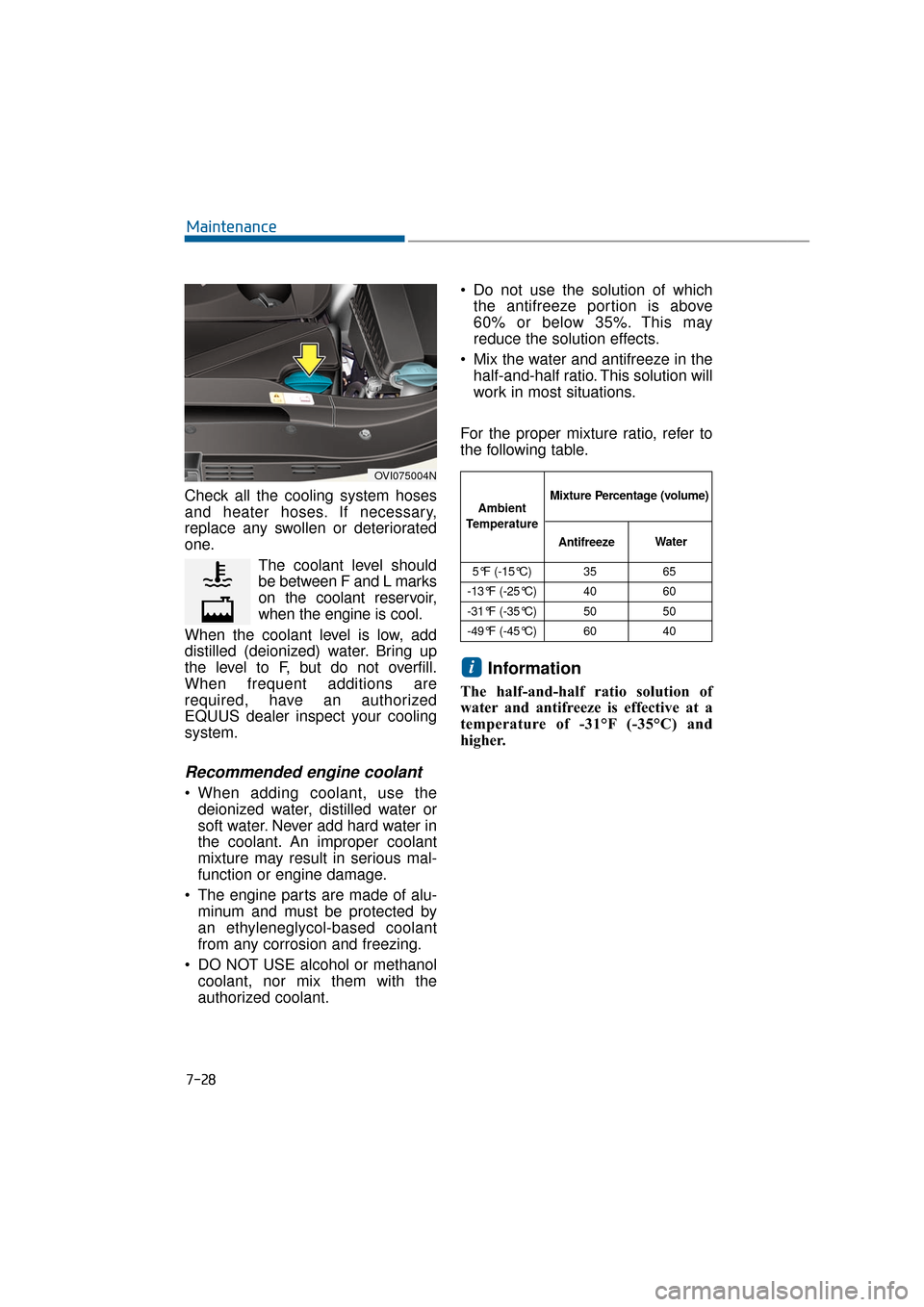
Check all the cooling system hoses
and heater hoses. If necessary,
replace any swollen or deteriorated
one. The coolant level should
be between F and L marks
on the coolant reservoir,
when the engine is cool.
When the coolant level is low, add
distilled (deionized) water. Bring up
the level to F, but do not overfill.
When frequent additions are
required, have an authorized
EQUUS dealer inspect your cooling
system.
Recommended engine coolant
When adding coolant, use the deionized water, distilled water or
soft water. Never add hard water in
the coolant. An improper coolant
mixture may result in serious mal-
function or engine damage.
The engine parts are made of alu- minum and must be protected by
an ethyleneglycol-based coolant
from any corrosion and freezing.
DO NOT USE alcohol or methanol coolant, nor mix them with the
authorized coolant. Do not use the solution of which
the antifreeze portion is above
60% or below 35%. This may
reduce the solution effects.
Mix the water and antifreeze in the half-and-half ratio. This solution will
work in most situations.
For the proper mixture ratio, refer to
the following table.
Information
The half-and-half ratio solution of
water and antifreeze is effective at a
temperature of -31°F (-35°C) and
higher.
i
OVI075004N
5°F (-15°C) 35 65
-13°F (-25°C) 40 60
-31°F (-35°C) 50 50
-49°F (-45°C) 60 40
Ambient
Temperature Mixture Percentage (volume)
Antifreeze Water
Page 386 of 477
7-29
Maintenance07
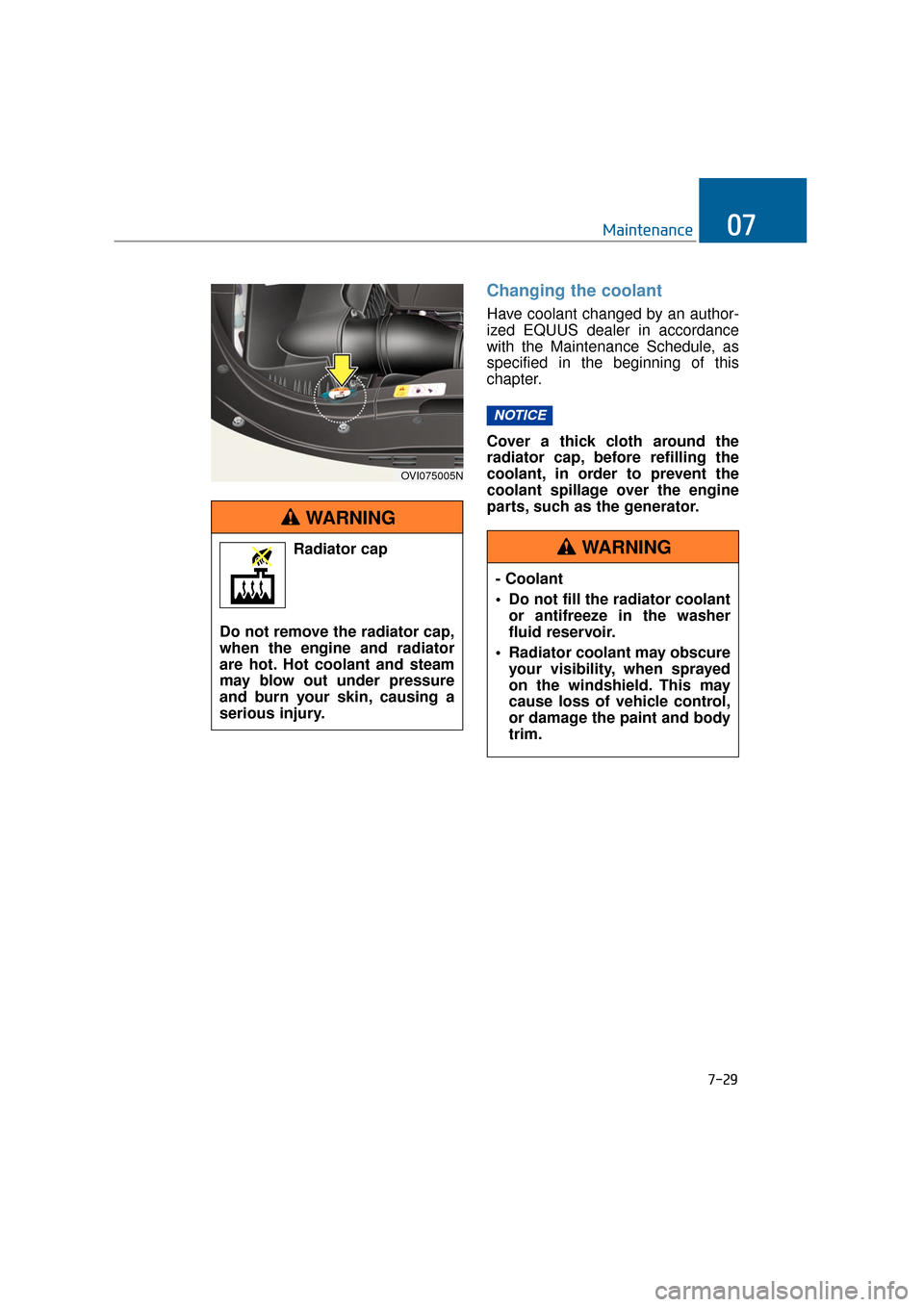
Changing the coolant
Have coolant changed by an author-
ized EQUUS dealer in accordance
with the Maintenance Schedule, as
specified in the beginning of this
chapter.
Cover a thick cloth around the
radiator cap, before refilling the
coolant, in order to prevent the
coolant spillage over the engine
parts, such as the generator.
NOTICE
OVI075005N
Radiator cap
Do not remove the radiator cap,
when the engine and radiator
are hot. Hot coolant and steam
may blow out under pressure
and burn your skin, causing a
serious injury.
WARNING
- Coolant
Do not fill the radiator coolant or antifreeze in the washer
fluid reservoir.
Radiator coolant may obscure your visibility, when sprayed
on the windshield. This may
cause loss of vehicle control,
or damage the paint and body
trim.
WARNING
Page 447 of 477
7-90
Maintenance
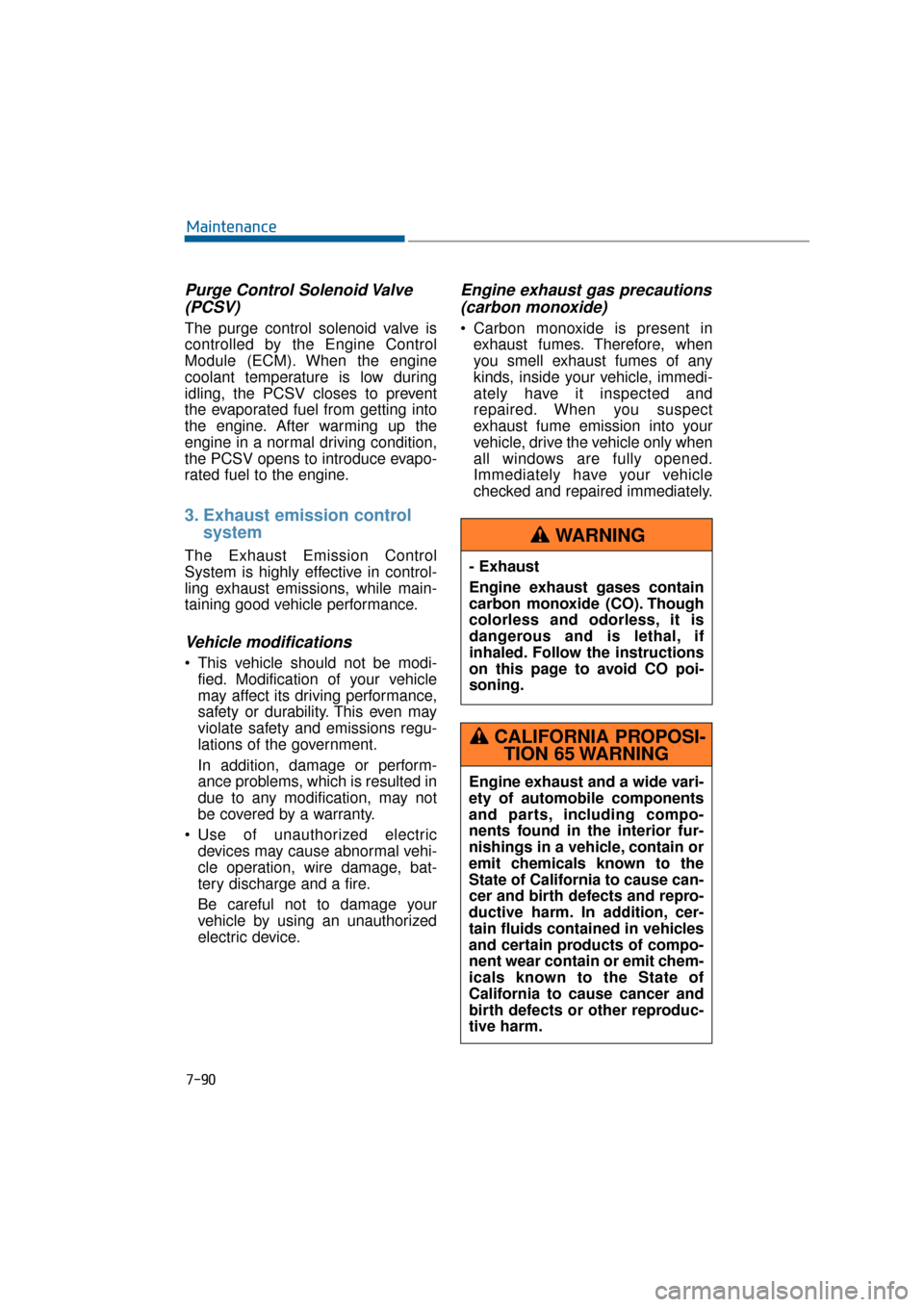
Purge Control Solenoid Valve(PCSV)
The purge control solenoid valve is
controlled by the Engine Control
Module (ECM). When the engine
coolant temperature is low during
idling, the PCSV closes to prevent
the evaporated fuel from getting into
the engine. After warming up the
engine in a normal driving condition,
the PCSV opens to introduce evapo-
rated fuel to the engine.
3. Exhaust emission control system
The Exhaust Emission Control
System is highly effective in control-
ling exhaust emissions, while main-
taining good vehicle performance.
Vehicle modifications
This vehicle should not be modi-
fied. Modification of your vehicle
may affect its driving performance,
safety or durability. This even may
violate safety and emissions regu-
lations of the government.
In addition, damage or perform-
ance problems, which is resulted in
due to any modification, may not
be covered by a warranty.
Use of unauthorized electric devices may cause abnormal vehi-
cle operation, wire damage, bat-
tery discharge and a fire.
Be careful not to damage your
vehicle by using an unauthorized
electric device.
Engine exhaust gas precautions (carbon monoxide)
Carbon monoxide is present in
exhaust fumes. Therefore, when
you smell exhaust fumes of any
kinds, inside your vehicle, immedi-
ately have it inspected and
repaired. When you suspect
exhaust fume emission into your
vehicle, drive the vehicle only when
all windows are fully opened.
Immediately have your vehicle
checked and repaired immediately.
- Exhaust
Engine exhaust gases contain
carbon monoxide (CO). Though
colorless and odorless, it is
dangerous and is lethal, if
inhaled. Follow the instructions
on this page to avoid CO poi-
soning.
WARNING
Engine exhaust and a wide vari-
ety of automobile components
and parts, including compo-
nents found in the interior fur-
nishings in a vehicle, contain or
emit chemicals known to the
State of California to cause can-
cer and birth defects and repro-
ductive harm. In addition, cer-
tain fluids contained in vehicles
and certain products of compo-
nent wear contain or emit chem-
icals known to the State of
California to cause cancer and
birth defects or other reproduc-
tive harm.
CALIFORNIA PROPOSI- TION 65 WARNING
Page 453 of 477
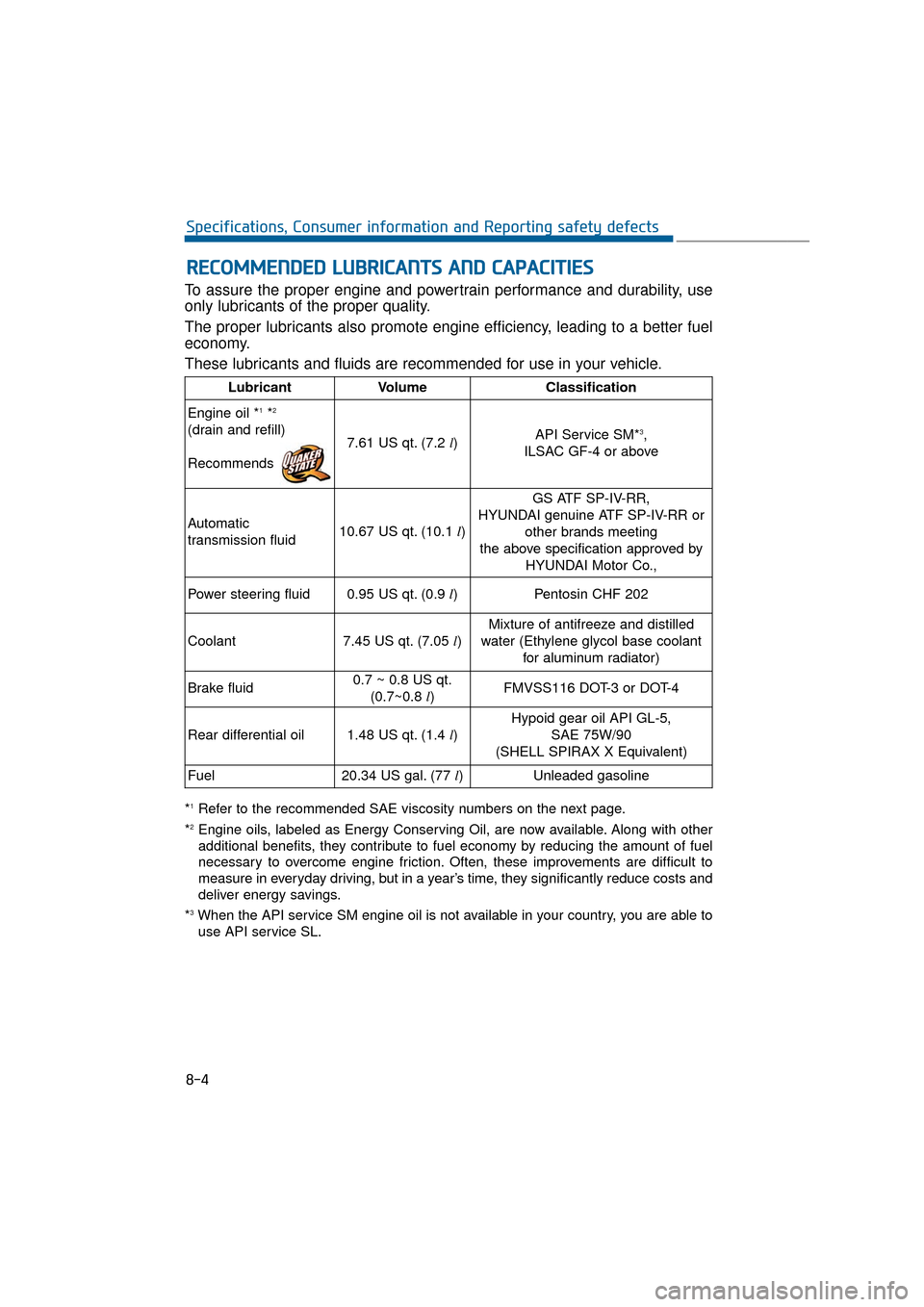
To assure the proper engine and powertrain performance and durability, use
only lubricants of the proper quality.
The proper lubricants also promote engine efficiency, leading to a better fuel
economy.
These lubricants and fluids are recommended for use in your vehicle.
*1Refer to the recommended SAE viscosity numbers on the next page.
*
2Engine oils, labeled as Energy Conserving Oil, are now available. Along with other
additional benefits, they contribute to fuel economy by reducing the amount of fuel
necessary to overcome engine friction. Often, these improvements are difficult to
measure in everyday driving, but in a year’s time, they significantly reduce costs and
deliver energy savings.
*
3When the API service SM engine oil is not available in your country, you are able to use API service SL.
R R E
EC
CO
O M
M M
ME
EN
N D
DE
ED
D
L
L U
U B
BR
RI
IC
C A
A N
N T
TS
S
A
A N
N D
D
C
C A
A P
PA
A C
CI
IT
T I
IE
E S
S
8-4
Specifications, Consumer information and Reporting safety defects
Lubricant Volume Classification
Engine oil *
1*2
(drain and refill)
Recommends 7.61 US qt. (7.2
l)API Service SM*3,
ILSAC GF-4 or above
Automatic
transmission fluid 10.67 US qt. (10.1
l)GS ATF SP-IV-RR,
HYUNDAI genuine ATF SP-IV-RR or other brands meeting
the above specification approved by HYUNDAI Motor Co.,
Power steering fluid 0.95 US qt. (0.9
l)
Pentosin CHF 202
Coolant 7.45 US qt. (7.05
l)Mixture of antifreeze and distilled
water (Ethylene glycol base coolant for aluminum radiator)
Brake fluid 0.7 ~ 0.8 US qt.
(0.7~0.8 l) FMVSS116 DOT-3 or DOT-4
Rear differential oil 1.48 US qt. (1.4 l) Hypoid gear oil API GL-5,
SAE 75W/90
(SHELL SPIRAX X Equivalent)
Fuel 20.34 US gal. (77 l)
Unleaded gasoline
Page 462 of 477
 ........................................................................\
..................3-107
Capacities (Lubricants) ...........................................................")
Camera (Rear view) ........................................................................\
..................3-107
Capacities (Lubricants) ........................................................................\
.................8-4
Card key ........................................................................\
........................................3-6
CareExterior care ........................................................................\
.........................7-83
Interior care ........................................................................\
..........................7-88
Tire care ........................................................................\
................................7-42
Center console storage ........................................................................\
..............3-141
Central door lock switch ........................................................................\
.............3-16
Certification label ........................................................................\
..........................8-6
Chains Tire chains ........................................................................\
............................5-73
Checking tire inflation pressure ........................................................................\
..7-44
Child restraint system........................................................................\
..................2-33 Lower anchor system ........................................................................\
...........2-40
Tether anchor system........................................................................\
............2-38
Child-protector rear door lock ........................................................................\
....3-17
Climate control air filter........................................................................\
..............7-35
Climate control system seat (front seat) ...............................................................2-9
Climate control system seat (rear seat) ...............................................................2-19
Clothes hanger........................................................................\
...........................3-150
Combined instrument, see instrument cluster .....................................................3-62
Compact spare tire ........................................................................\
......................6-17
Compact spare tire replacement ........................................................................\
..7-47
Consumer information ........................................................................\
..................8-8
Cool and warm box ........................................................................\
...................3-143
Coolant ........................................................................\
........................................7-27
Cooling fluid, see engine coolant .......................................................................7\
-27
Crankcase emission control system ....................................................................7-89\
Cruise control system, see advanced smart cruise control system .....................5-38
Cup holder ........................................................................\
.................................3-146
Curtain air bag........................................................................\
.............................2-60
I-4
Index
C
Page 464 of 477

Emission control system ........................................................................\
.............7-89Crankcase emission control system .............................................................7-89
Evaporative emission control system ...........................................................7-89
Exhaust emission control system .................................................................7-90
Engine compartment ........................................................................\
.....................1-6
Engine compartment fuse........................................................................\
............7-59
Engine coolant........................................................................\
.............................7-27
Engine coolant temperature gauge ......................................................................3-\
66
Engine number ........................................................................\
..............................8-7
Engine oil ........................................................................\
....................................7-25
Engine overheating......................................................\
..........................................6-6
Engine start/stop button ........................................................................\
................5-7
Evaporative emission control system..................................................................7-89
Exhaust emission control system ........................................................................\
7-90
Explanation of scheduled maintenance items .....................................................7-23
Exterior care ........................................................................\
................................7-83
Exterior overview (Front) ........................................................................\
.............1-2
Exterior overview (Rear) ........................................................................\
..............1-3
Flat tire ........................................................................\
.......................................6-12 Changing tires ........................................................................\
......................6-13
Compact spare tire........................................................................\
................6-17
Jack and tools ........................................................................\
.......................6-12
Removing and storing the spare tire ............................................................6-13
Floor mat anchor(s) ........................................................................\
...................3-150
Fluid Brake fluid ........................................................................\
............................7-30
Power steering fluid ........................................................................\
.............7-31
Washer fluid ........................................................................\
.........................7-32
Fog light ........................................................................\
...................................3-113
Front seat adjustment ........................................................................\
....................2-4
Fuel Economy ........................................................................\
.............................3-87
Fuel filler lid........................................................................\
................................3-34
Fuel gauge ........................................................................\
...................................3-67
Fuel requirements.......................................................\
...........................................F-8
Fuse switch ........................................................................\
..................................7-58
I-6
Index
F