lock Hyundai Equus 2016 User Guide
[x] Cancel search | Manufacturer: HYUNDAI, Model Year: 2016, Model line: Equus, Model: Hyundai Equus 2016Pages: 477, PDF Size: 16.25 MB
Page 50 of 477
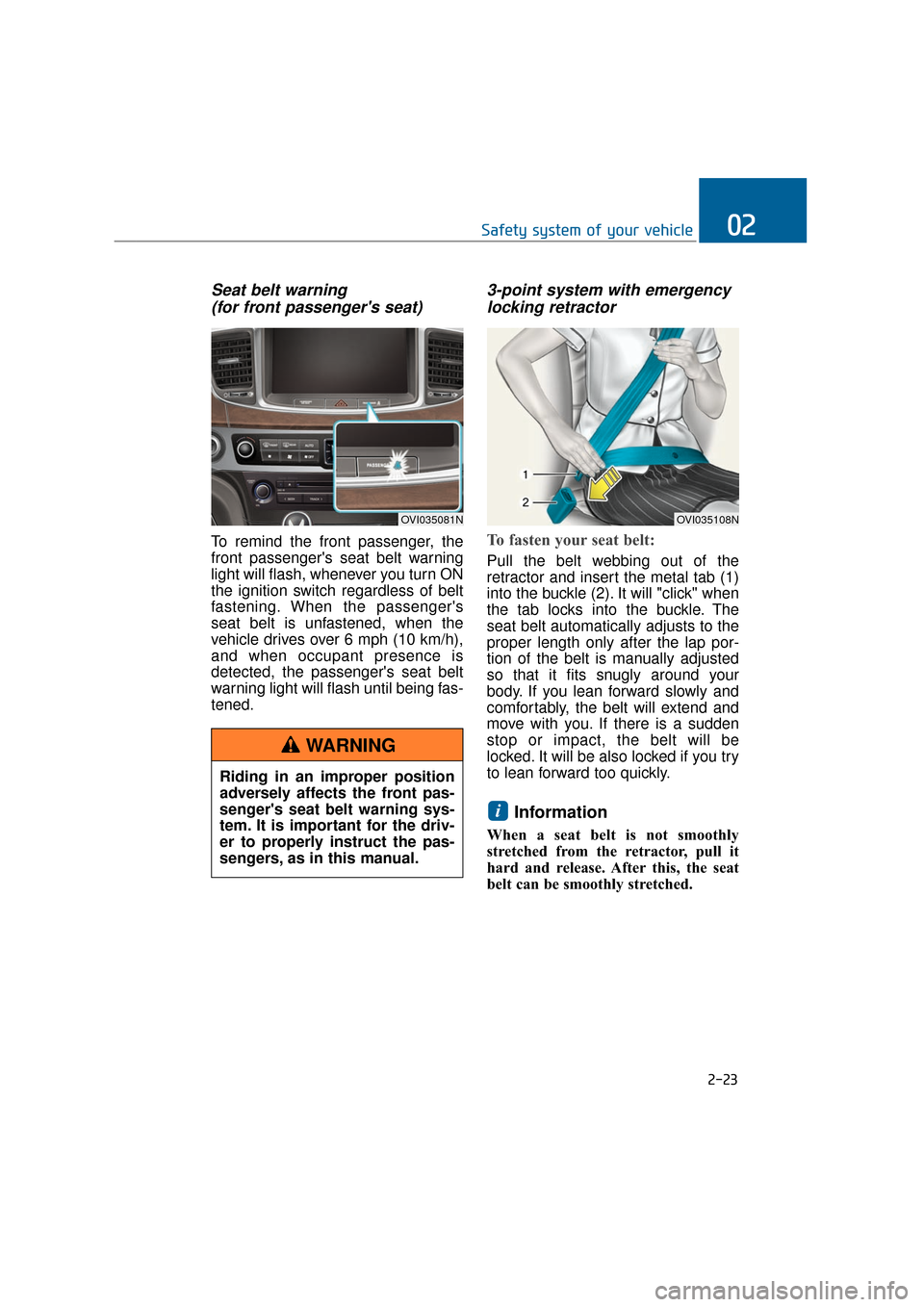
Seat belt warning (for front passenger's seat)
To remind the front passenger, the
front passenger's seat belt warning
light will flash, whenever you turn ON
the ignition switch regardless of belt
fastening. When the passenger's
seat belt is unfastened, when the
vehicle drives over 6 mph (10 km/h),
and when occupant presence is
detected, the passenger's seat belt
warning light will flash until being fas-
tened.
3-point system with emergencylocking retractor
To fasten your seat belt:
Pull the belt webbing out of the
retractor and insert the metal tab (1)
into the buckle (2). It will "click" when
the tab locks into the buckle. The
seat belt automatically adjusts to the
proper length only after the lap por-
tion of the belt is manually adjusted
so that it fits snugly around your
body. If you lean forward slowly and
comfortably, the belt will extend and
move with you. If there is a sudden
stop or impact, the belt will be
locked. It will be also locked if you try
to lean forward too quickly.
Information
When a seat belt is not smoothly
stretched from the retractor, pull it
hard and release. After this, the seat
belt can be smoothly stretched.
i
2-23
Safety system of your vehicle02
OVI035081N
Riding in an improper position
adversely affects the front pas-
senger's seat belt warning sys-
tem. It is important for the driv-
er to properly instruct the pas-
sengers, as in this manual.
WARNING
OVI035108N
Page 51 of 477

Height adjustment
The anchor height for the shoulder
portion of the belt can be adjusted to
one of the 4 positions for your greatest
comfort and safety.
The anchor height should be adjusted,
so the shoulder portion is fastened
over your chest and midway over the
shoulder nearest the door, not over
your neck.
To adjust the anchor height, rise up or
lower down the adjuster.
To rise up the adjuster, pull it up (1). To
lower it down, push it down (3) while
pressing the height adjuster button (2).
Release the button to lock the anchor
height. Attempt to slide up or down the
adjuster to confirm its locking.
2-24
Safety system of your vehicle
OVI035109N
Front seat
Make sure that the shoulderbelt anchor is securely locked
at an appropriate height.
Never fasten the shoulder
portion of the belt over your
neck or face. Improper fasten-
ing may cause serious injury
in an accident.
(Continued)
WARNING
(Continued)
Failure to replace a seat beltassembly after an accident
may put you in danger,
because the damaged seat
belt will not provide protec-
tion in the event of another
collision, leading to personal
injury or death. Immediately
replace your seat belts after
an accident.
The lap portion of a seat belt
should be fastened as low as
possible and snugly across your
hips, not on your waist. When
the lap belt is fastened too high
on your waist, it may increase
injury risk in the event of a colli-
sion. Both arms should not be
under or over the belt. Rather,
one should be over and the
other under, as shown in the
illustration.
The seat belt should not be fas-
tened under the driver's left arm,
or the front passenger's right
arm.
WARNING
OVI035110N
Page 52 of 477
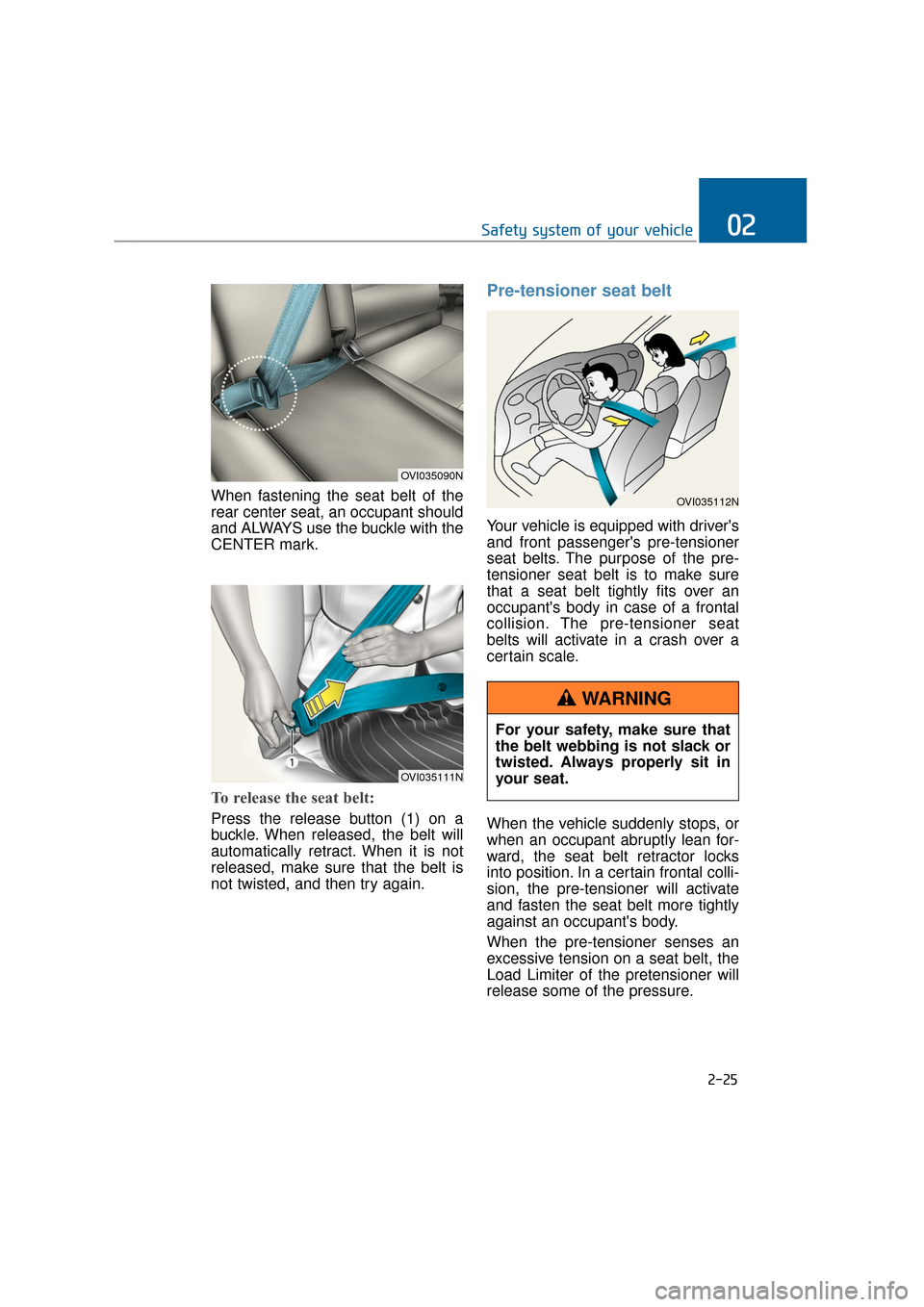
When fastening the seat belt of the
rear center seat, an occupant should
and ALWAYS use the buckle with the
CENTER mark.
To release the seat belt:
Press the release button (1) on a
buckle. When released, the belt will
automatically retract. When it is not
released, make sure that the belt is
not twisted, and then try again.
Pre-tensioner seat belt
Your vehicle is equipped with driver's
and front passenger's pre-tensioner
seat belts. The purpose of the pre-
tensioner seat belt is to make sure
that a seat belt tightly fits over an
occupant's body in case of a frontal
collision. The pre-tensioner seat
belts will activate in a crash over a
certain scale.
When the vehicle suddenly stops, or
when an occupant abruptly lean for-
ward, the seat belt retractor locks
into position. In a certain frontal colli-
sion, the pre-tensioner will activate
and fasten the seat belt more tightly
against an occupant's body.
When the pre-tensioner senses an
excessive tension on a seat belt, the
Load Limiter of the pretensioner will
release some of the pressure.
2-25
Safety system of your vehicle02
OVI035112N
OVI035111N
OVI035090N
For your safety, make sure that
the belt webbing is not slack or
twisted. Always properly sit in
your seat.
WARNING
Page 61 of 477
2-34
Safety system of your vehicleTo reduce the chance of serious
or fatal injuries:
Children of all ages are safer when being restrained in a
rear seat. A child, seating in
front, may be forcefully struck
with an inflating air bag. This
may result in serious or fatal
injury.
Always follow the instructions of the child restraint manufac-
turer's for installation and
usage.
Always make sure that the child seat is properly secured,
and that your child is securely
restrained in the child seat.
Never hold a child in your arms or on your laps when
riding in a vehicle. The violent
impact in a crash may force
you miss the child from your
arms and the child may strike
against the vehicle interior.
Never fasten a single seat belt over you and a child. In a
crash, the belt may apply
sharp pressure on the child,
causing serious internal
injury.
Never leave a child unattend- ed in a vehicle – not even for a
short time. The vehicle is eas-
ily heated up, resulting in seri-
ous injury of a child inside.
Even very young children may
inadvertently move the vehi-
cle, entangle themselves in a
window frame, or lock them-
selves or others inside the
vehicle.
(Continued)
(Continued)
Never allow two children, orany two persons, to fasten the
same seat belt.
Children often squirm and shift their position. Never let a
child ride with the shoulder
belt under their arm or behind
their back. Always properly
seat and secure a child in a
rear seat.
Never allow a child to stand up, or kneel on a seat or a
floor mat, while the vehicle is
in motion. During a collision
or a sudden stop, the child
may be violently strike against
the vehicle interior, resulting
in serious injury.
Never use an infant carrier or a child safety seat, which
"hooks" over a seatback. It
may not provide adequate
security in an accident.
Do not operate a rear power seat, when a child seat is
installed. The power seat may
be broken.
After an accident, have an authorized EQUUS dealer
check the child restraint, seat
belt, and tether/lower
anchors.
When the space to place a child restraint is insufficient
due to the driver's seat, install
it in the right rear seat.WARNING
Page 63 of 477
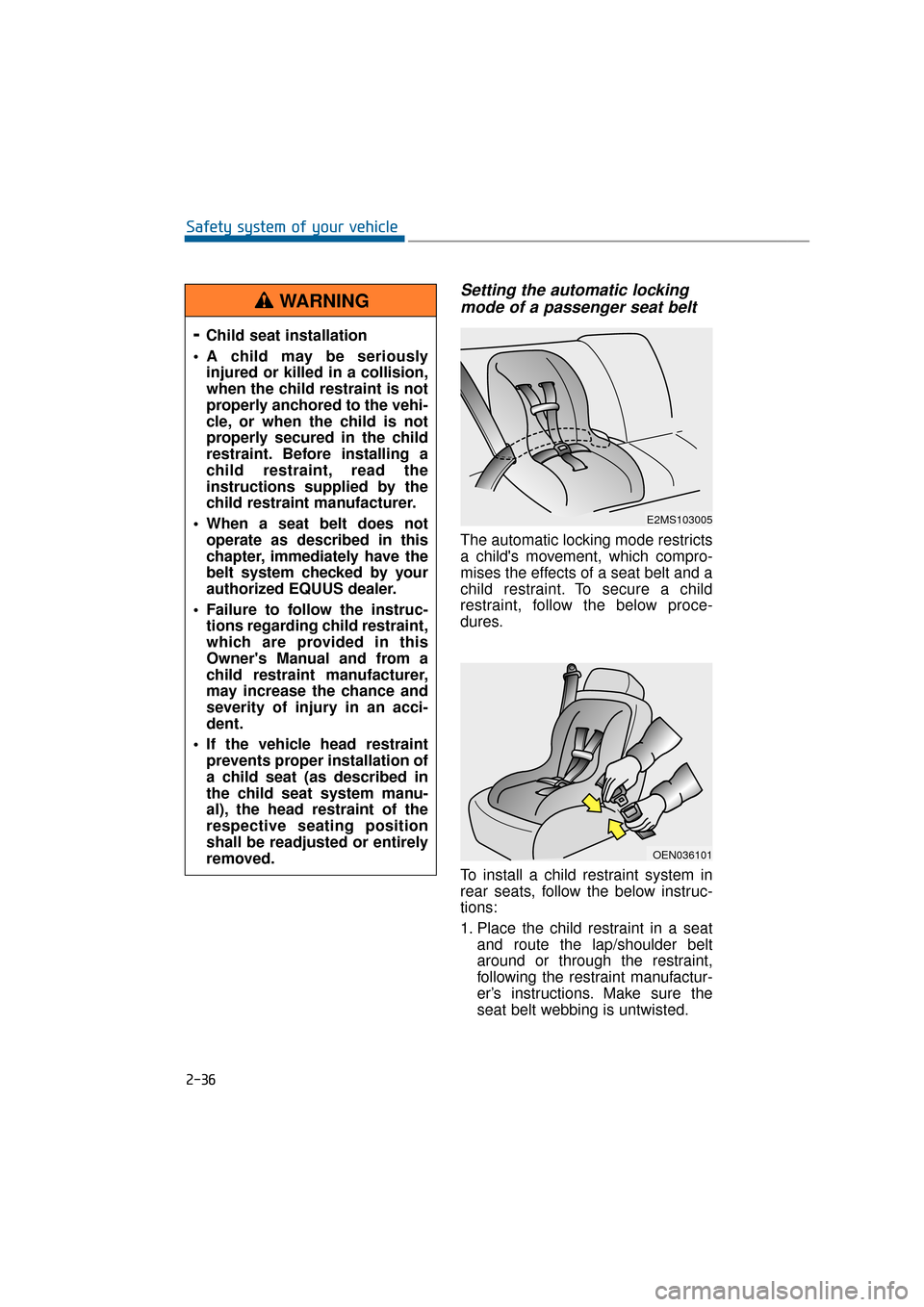
Setting the automatic lockingmode of a passenger seat belt
The automatic locking mode restricts
a child's movement, which compro-
mises the effects of a seat belt and a
child restraint. To secure a child
restraint, follow the below proce-
dures.
To install a child restraint system in
rear seats, follow the below instruc-
tions:
1. Place the child restraint in a seat
and route the lap/shoulder belt
around or through the restraint,
following the restraint manufactur-
er’s instructions. Make sure the
seat belt webbing is untwisted.
2-36
Safety system of your vehicle
- Child seat installation
A child may be seriously injured or killed in a collision,
when the child restraint is not
properly anchored to the vehi-
cle, or when the child is not
properly secured in the child
restraint. Before installing a
child restraint, read the
instructions supplied by the
child restraint manufacturer.
When a seat belt does not operate as described in this
chapter, immediately have the
belt system checked by your
authorized EQUUS dealer.
Failure to follow the instruc- tions regarding child restraint,
which are provided in this
Owner's Manual and from a
child restraint manufacturer,
may increase the chance and
severity of injury in an acci-
dent.
If the vehicle head restraint prevents proper installation of
a child seat (as described in
the child seat system manu-
al), the head restraint of the
respective seating position
shall be readjusted or entirely
removed.
WARNING
E2MS103005
OEN036101
Page 64 of 477
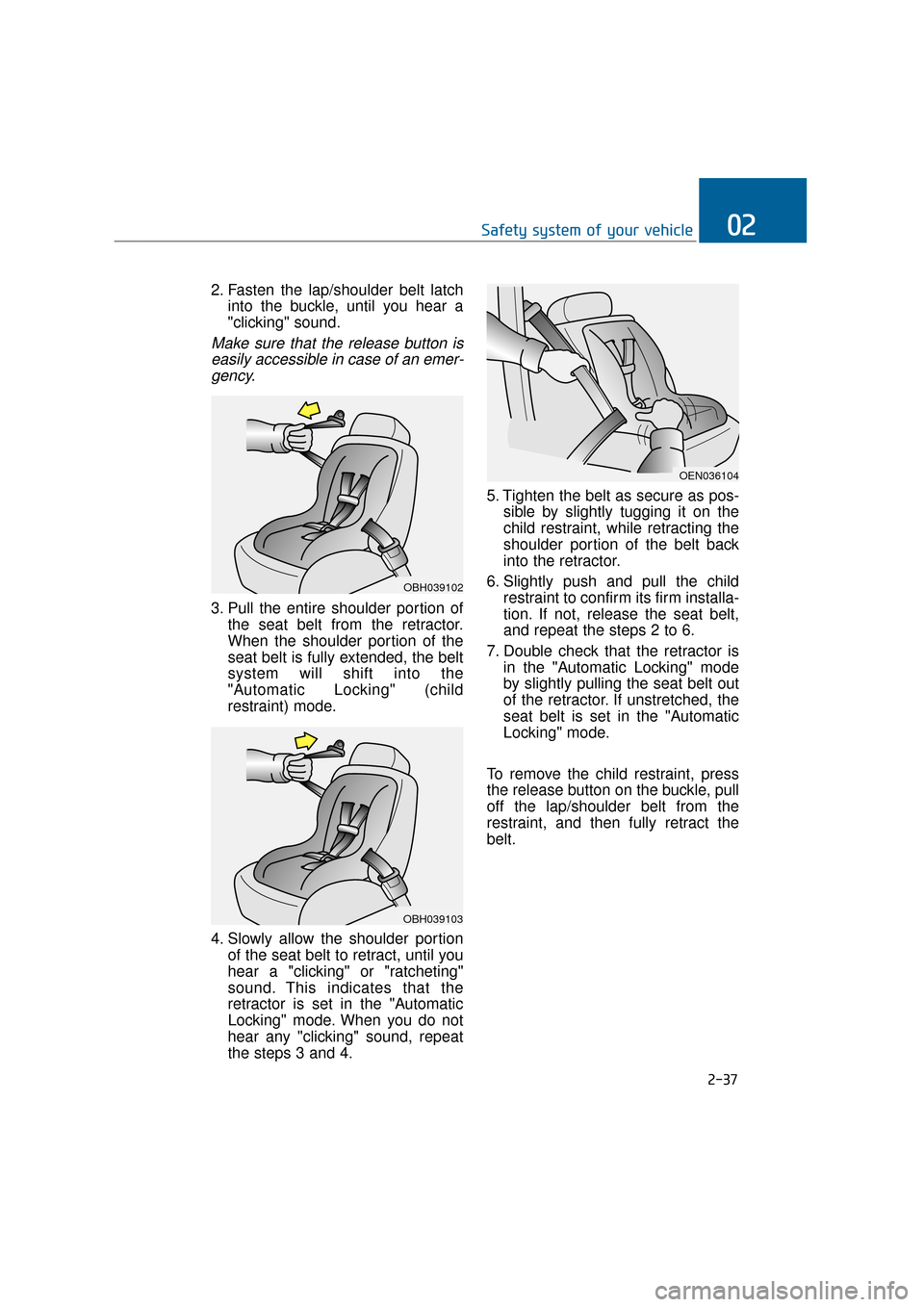
2. Fasten the lap/shoulder belt latchinto the buckle, until you hear a
"clicking" sound.
Make sure that the release button iseasily accessible in case of an emer-gency.
3. Pull the entire shoulder portion of the seat belt from the retractor.
When the shoulder portion of the
seat belt is fully extended, the belt
system will shift into the
"Automatic Locking" (child
restraint) mode.
4. Slowly allow the shoulder portion of the seat belt to retract, until you
hear a "clicking" or "ratcheting"
sound. This indicates that the
retractor is set in the "Automatic
Locking" mode. When you do not
hear any "clicking" sound, repeat
the steps 3 and 4. 5. Tighten the belt as secure as pos-
sible by slightly tugging it on the
child restraint, while retracting the
shoulder portion of the belt back
into the retractor.
6. Slightly push and pull the child restraint to confirm its firm installa-
tion. If not, release the seat belt,
and repeat the steps 2 to 6.
7. Double check that the retractor is in the "Automatic Locking" mode
by slightly pulling the seat belt out
of the retractor. If unstretched, the
seat belt is set in the "Automatic
Locking" mode.
To remove the child restraint, press
the release button on the buckle, pull
off the lap/shoulder belt from the
restraint, and then fully retract the
belt.
2-37
Safety system of your vehicle02
OBH039102
OBH039103
OEN036104
Page 65 of 477
Once the seat belt is released after
being fully retracted, the retractor
will automatically switch from the
"Automatic Locking" mode to the
"Emergency Locking" mode for
normal usage.
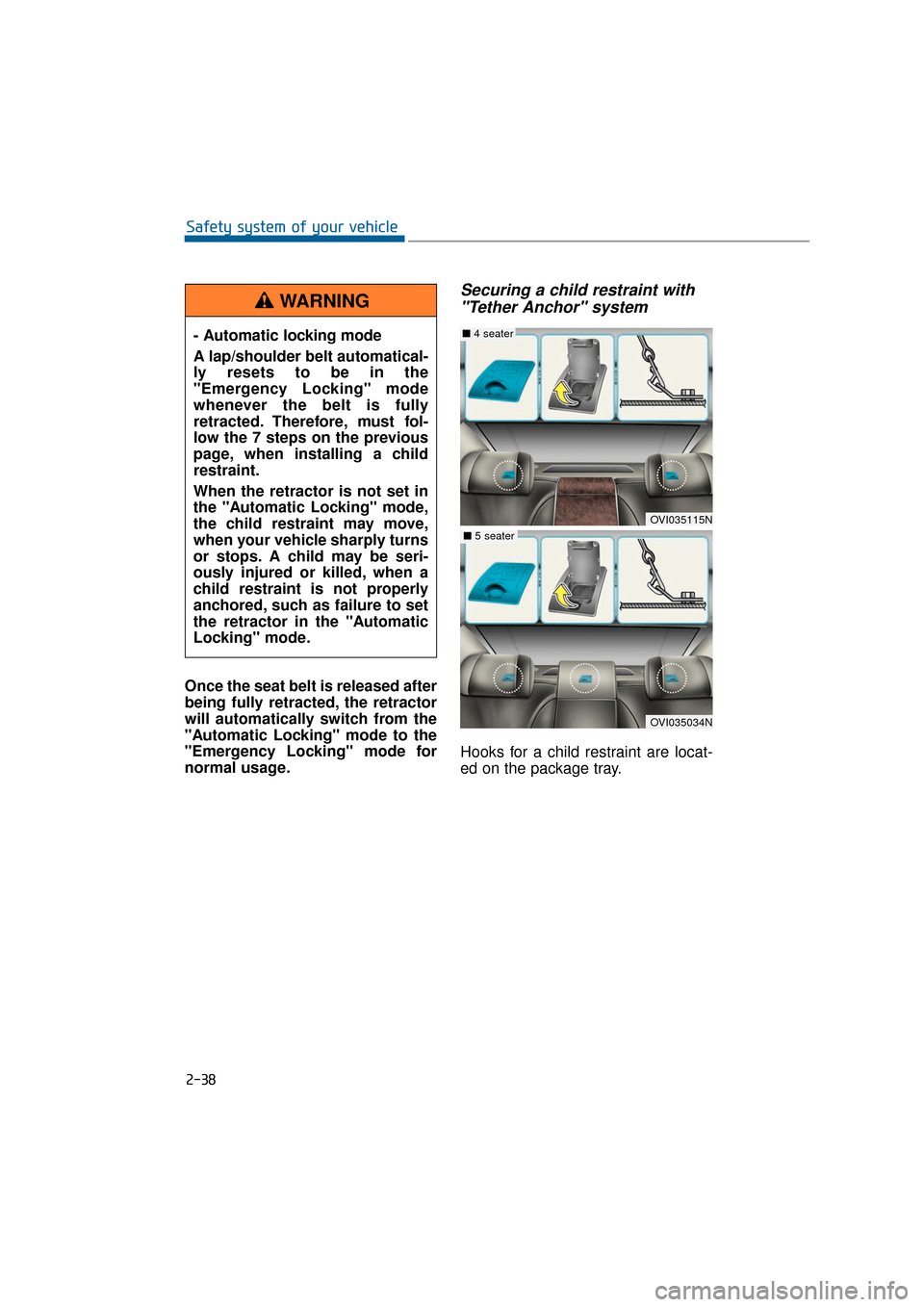
Securing a child restraint with"Tether Anchor" system
Hooks for a child restraint are locat-
ed on the package tray.
2-38
Safety system of your vehicle
OVI035115N
■ 4 seater
OVI035034N
■ 5 seater
- Automatic loc king mode
A lap/shoulder belt automatical-
ly resets to be in the
"Emergency Locking" mode
whenever the belt is fully
retracted. Therefore, must fol-
low the 7 steps on the previous
page, when installing a child
restraint.
When the retractor is not set in
the "Automatic Locking" mode,
the child restraint may move,
when your vehicle sharply turns
or stops. A child may be seri-
ously injured or killed, when a
child restraint is not properly
anchored, such as failure to set
the retractor in the "Automatic
Locking" mode.
WARNING
Page 72 of 477
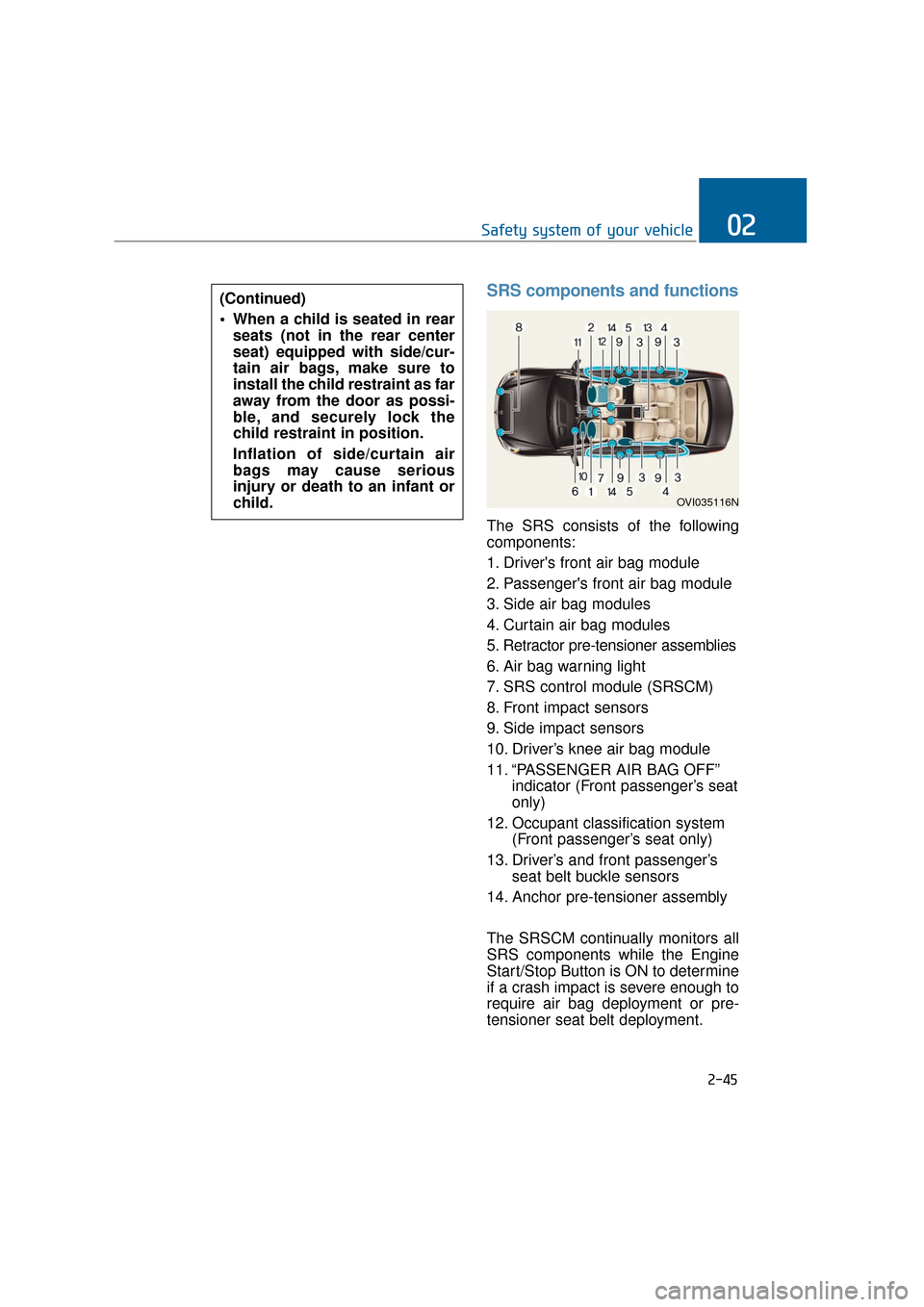
SRS components and functions
The SRS consists of the following
components:
1. Driver's front air bag module
2. Passenger's front air bag module
3. Side air bag modules
4. Curtain air bag modules
5. Retractor pre-tensioner assemblies
6. Air bag warning light
7. SRS control module (SRSCM)
8. Front impact sensors
9. Side impact sensors
10. Driver’s knee air bag module
11. “PASSENGER AIR BAG OFF”indicator (Front passenger’s seat
only)
12. Occupant classification system (Front passenger’s seat only)
13. Driver’s and front passenger’s seat belt buckle sensors
14. Anchor pre-tensioner assembly
The SRSCM continually monitors all
SRS components while the Engine
Start/Stop Button is ON to determine
if a crash impact is severe enough to
require air bag deployment or pre-
tensioner seat belt deployment.
2-45
Safety system of your vehicle02
(Continued)
When a child is seated in rear seats (not in the rear center
seat) equipped with side/cur-
tain air bags, make sure to
install the child restraint as far
away from the door as possi-
ble, and securely lock the
child restraint in position.
Inflation of side/curtain air
bags may cause serious
injury or death to an infant or
child.
OVI035116N
Page 86 of 477
The side air bags are designed to
deploy only in a certain side-impact
collision, depending on an impact
severity, an angle, a speed and a
direction. The side air bags are not
designed to deploy in all side-impact
crashes.
2-59
Safety system of your vehicle02
Do not allow occupants to lean
their heads or bodies toward
doors, to put their arms on the
doors, to stretch their arms out
of the window, or to place
objects between the doors and
the occupant, when they occu-
py the seat equipped with side
and/or curtain air bags.
WARNING
The side air bag is supplemen-tal to the seat belt system, not
a substitute. Therefore, your
seat belt must be fastened at
all times while the vehicle is in
motion. The air bags deploy
only in a certain side impact,
which is severe enough to
cause significant injury.
For the maximum protection from side air bags and to
avoid injury by a deploying
side air bag, all occupants
should sit in an upright posi-
tion with a seat belt properly
fastened. The driver's hands
should be placed on the steer-
ing wheel in the 9:00-o'clock
and 3:00-o'clock position. The
passenger' arms and hands
should be placed on their
laps.
(Continued)
(Continued)
Do not use any accessoryseat covers.
Use of a seat cover may reduce the system effects or
prevent the system operation.
Do not install any accessories over or near the side air bags.
Do not place any objects over the air bag or between the air
bag and yourself.
Do not place any objects (i.e. umbrella and bag) between a
door and a seat. Such objects
may become dangerous pro-
jectiles and may cause injury,
when a side air bag inflates.
To prevent inadvertent deployment of a side air bag,
which may result in personal
injury, avoid any impact on the
air bag sensor, when the igni-
tion switch is ON.
When a seat or a seat cover is damaged, have the vehicle
checked and repaired by an
authorized EQUUS dealer
because your vehicle is
equipped with side air bags
and an occupant classifica-
tion system.
WARNING
Page 87 of 477
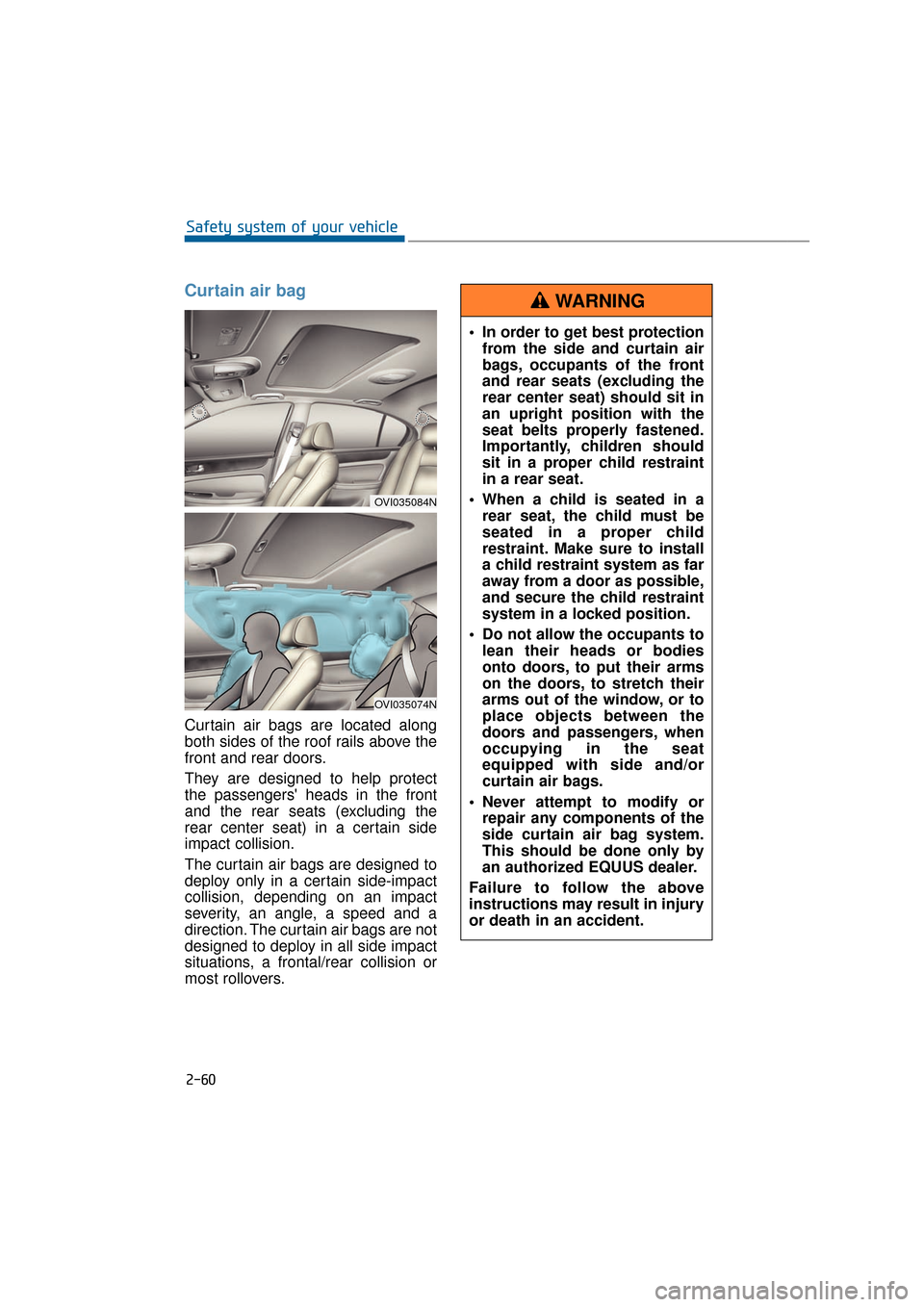
Curtain air bag
Curtain air bags are located along
both sides of the roof rails above the
front and rear doors.
They are designed to help protect
the passengers' heads in the front
and the rear seats (excluding the
rear center seat) in a certain side
impact collision.
The curtain air bags are designed to
deploy only in a certain side-impact
collision, depending on an impact
severity, an angle, a speed and a
direction. The curtain air bags are not
designed to deploy in all side impact
situations, a frontal/rear collision or
most rollovers.
2-60
Safety system of your vehicle
OVI035084N
OVI035074N
In order to get best protectionfrom the side and curtain air
bags, occupants of the front
and rear seats (excluding the
rear center seat) should sit in
an upright position with the
seat belts properly fastened.
Importantly, children should
sit in a proper child restraint
in a rear seat.
When a child is seated in a rear seat, the child must be
seated in a proper child
restraint. Make sure to install
a child restraint system as far
away from a door as possible,
and secure the child restraint
system in a locked position.
Do not allow the occupants to lean their heads or bodies
onto doors, to put their arms
on the doors, to stretch their
arms out of the window, or to
place objects between the
doors and passengers, when
occupying in the seat
equipped with side and/or
curtain air bags.
Never attempt to modify or repair any components of the
side curtain air bag system.
This should be done only by
an authorized EQUUS dealer.
Failure to follow the above
instructions may result in injury
or death in an accident.
WARNING