park assist Hyundai Equus 2016 User Guide
[x] Cancel search | Manufacturer: HYUNDAI, Model Year: 2016, Model line: Equus, Model: Hyundai Equus 2016Pages: 477, PDF Size: 16.25 MB
Page 200 of 477
Inoperable conditions of the
Parking Assist System
The Parking Assist System maynot properly operate, when:
1. Moisture is frozen over the sensor.
(It will operate normally again
when the frozen ice melts.)
2. The sensor is covered or blocked with foreign substances, such as
snow or water. (It will normally
operate again when the substance
is removed, and the sensor is no
longer blocked.)
3. The sensor is stained with foreign substances such as snow or
water. (The sensing range will
return to normal when foreign sub-
stances are removed.)
There is a possible malfunctionwith the Parking Assist Systemwhen:
1. The vehicle drives on uneven road
surfaces such as unpaved roads,
gravels, bumps, or slopes.
2. The sensor is interfered with objects, which generate excessive
noise, such as horns, motorcycle
engines, or truck air brakes.
3. Heavy rain or water is sprayed.
4. Wireless transmitters or mobile phones are near the sensor.
5. The sensor is covered with snow.
Detecting range may decrease when:
1. Outside air temperature is
extremely hot or cold.
2. The sensor cannot detect an object, as it is smaller than 39 in (1
m) or narrower than 5.5 in (14 cm)
in diameter.
The following objects may notbe recognized by the sensor:
1. A sharp or slim object, such as
ropes, chains or small poles.
2. An object, such as clothes, spongy material or snow, absorbs the sen-
sor frequency.
Information
1. The warning may not soundsequentially depending on the speed
and shapes of the objects detected.
2. The Parking Assist System may malfunction if the vehicle bumper
height or sensor installation is mod-
ified. Any unauthorized installment
of equipment or accessories may
also limit the sensor performance.
3. Sensor may not recognize objects within 12 in (30 cm), or it may mis-
calculate the distance.
4. When the sensor is frozen or stained with snow or water, the sensor may
be inoperative until the stains are
removed using a soft cloth.
5. Do not push, scratch or strike the sensor with any hard objects that
could damage the sensor surface.
This may damage the sensor.
i
3-105
Convenient features of your vehicle03
Page 201 of 477

Information
This system can only sense objects
within the certain range and location.
it cannot detect objects in other areas
where sensors are not installed. Also,
the sensor may not detect small and
slim objects, or objects located in
blind spots between sensors.
Always check the presence of any
objects in front of or behind the vehi-
cle with your eyes when parking.
Make sure to inform these system
capabilities and limitations to any
drivers of this vehicle who may be
unfamiliar with the system.
Self-diagnosis
If you do not hear an audible warning
sound or if the buzzer sounds inter-
mittently when shifting the gear to
the R (Reverse) position, this may
indicate a malfunction with the rear
Parking Assist System. In this case,
have your vehicle checked by an
authorized EQUUS dealer as soon
as possible.
i
3-106
Convenient features of your vehiclePay close attention when the
vehicle is driven close to
objects on the road, particularly
pedestrians, and especially
children. Be aware that some
objects may not be detected by
the sensors, due to the object
distance, size or material, all of
which can limit the effective-
ness of the sensor. Always
make sure that the vehicle
stands clear of all objects with
your eyes before moving the
vehicle in any direction.
WARNING
Your new vehicle warranty does
not cover any accidents or dam-
age to the vehicle or injuries to
its occupants related to the
Parking Assist System. Always
drive safely and cautiously.
WARNING
Page 203 of 477
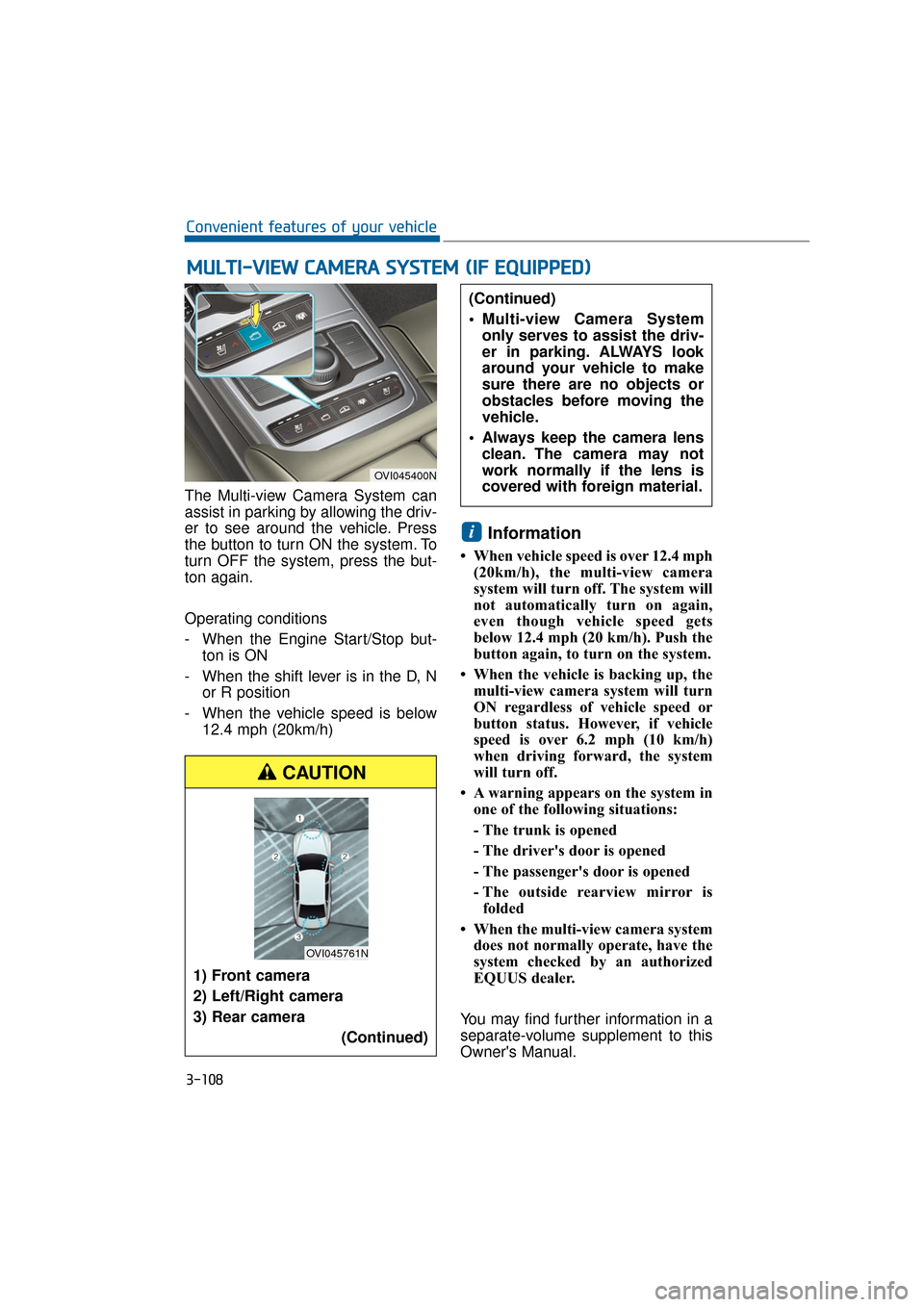
The Multi-view Camera System can
assist in parking by allowing the driv-
er to see around the vehicle. Press
the button to turn ON the system. To
turn OFF the system, press the but-
ton again.
Operating conditions
- When the Engine Start/Stop but-ton is ON
- When the shift lever is in the D, N or R position
- When the vehicle speed is below 12.4 mph (20km/h)
Information
• When vehicle speed is over 12.4 mph(20km/h), the multi-view camera
system will turn off. The system will
not automatically turn on again,
even though vehicle speed gets
below 12.4 mph (20 km/h). Push the
button again, to turn on the system.
• When the vehicle is backing up, the multi-view camera system will turn
ON regardless of vehicle speed or
button status. However, if vehicle
speed is over 6.2 mph (10 km/h)
when driving forward, the system
will turn off.
• A warning appears on the system in one of the following situations:
- The trunk is opened
- The driver's door is opened
- The passenger's door is opened
- The outside rearview mirror isfolded
• When the multi-view camera system does not normally operate, have the
system checked by an authorized
EQUUS dealer.
You may find further information in a
separate-volume supplement to this
Owner's Manual.
i
M M U
UL
LT
T I
I-
- V
V I
IE
E W
W
C
C A
A M
M E
ER
R A
A
S
S Y
Y S
ST
T E
EM
M
(
( I
IF
F
E
E Q
Q U
UI
IP
P P
PE
ED
D )
)
3-108
Convenient features of your vehicle
OVI045400N
1) Front camera
2) Left/Right camera
3) Rear camera
(Continued)
(Continued)
Multi-view Camera Systemonly serves to assist the driv-
er in parking. ALWAYS look
around your vehicle to make
sure there are no objects or
obstacles before moving the
vehicle.
Always keep the camera lens clean. The camera may not
work normally if the lens is
covered with foreign material.
CAUTION
OVI045761N
Page 252 of 477
Driving your vehicle
Before driving.........................................................5-5
Before entering vehicle ...................................................5-5
Necessary inspections .....................................................5-5
Before starting .................................................................5-5
Engine start/stop button ......................................5-7
Illuminated Engine Start/Stop Button ..........................5-7
Engine Start/Stop Button position ...............................5-7
Starting the engine ................................................5-9
Automatic transmission .......................................5-11
Automatic transmission operation ..............................5-12
Good driving practices ...................................................5-15
Brake system ........................................................5-17
Power brakes ...................................................................5-17
Electric parking brake (EPB) ........................................5-19
Emergency braking .........................................................5-22
AUTO HOLD ......................................................................5-\
23
Anti-lock brake system (ABS) .....................................5-26
Electronic stability control (ESC) ................................5-28
Hill-start assist control (HAC) ......................................5-32
Good braking practices..................................................5-32
Drive mode integrated control system .............5-34
DRIVE mode / SNOW mode ..........................................5-34
Electronic controlled suspension (ECS) ...........5-36
To control the vehicle height .......................................5-36
ECS (Electronic Controlled Suspension) malfunction
warning message.............................................................5-37
Page 259 of 477
START
To start the engine, depress the
brake pedal and press the Engine
Start/Stop Button with the shift gear
in P(Park) or N(Neutral).
For your safety, start the engine with
the shift gear in P(Park).
Information
• If you press the Engine Start/Stopbutton without depressing the brake
pedal, the engine does not start.
When the Engine Start/Stop button
is pressed, it changes as follows:
OFF → →
ACC →
→
ON →
→
OFF
• If you leave the Engine Start/Stop Button in the ACC or the ON posi-
tion for a long time, the battery will
be discharged.
i
5-8
Driving your vehicle
Never press the Engine Start/Stop button while the
vehicle is in motion except in
an emergency situation. This
would turn the engine OFF,
resulting in loss of power
assist for the steering wheel
and brake. This may lead to
loss of directional control and
braking function, which could
cause an accident.
(Continued)
(Continued)
Before leaving the driver’sseat, always make sure the
shift gear is engaged in P
(Park), fully set the parking
brake and turn the engine
OFF. Unexpected and sudden
vehicle movement may occur
if these precautions are not
taken.
Never touch the Engine Start/Stop button, or any other
controls on the steering wheel
while the vehicle is in motion.
Reaching out for those con-
trols with your hand or arm
may cause a loss of vehicle
control, an accident, serious
bodily injury or death.
Do not place any loose objects around the driver’s
seat, as they may toss about
while driving, interfering with
the driver's pedal operation
and leading to an accident.
WARNING
Page 272 of 477
A clicking sound may be heardwhile setting or releasing the
EPB. This is a normal condition,
and indicates that the EPB prop-
erly functions.
When leaving your key with a parking lot attendant or valet
assistant, inform him/her of the
EPB operation.
The EPB may malfunction if you drive with the EPB set.
Gradually depress the accelera- tor, when you want to automati-
cally release EPB by depressing
it.
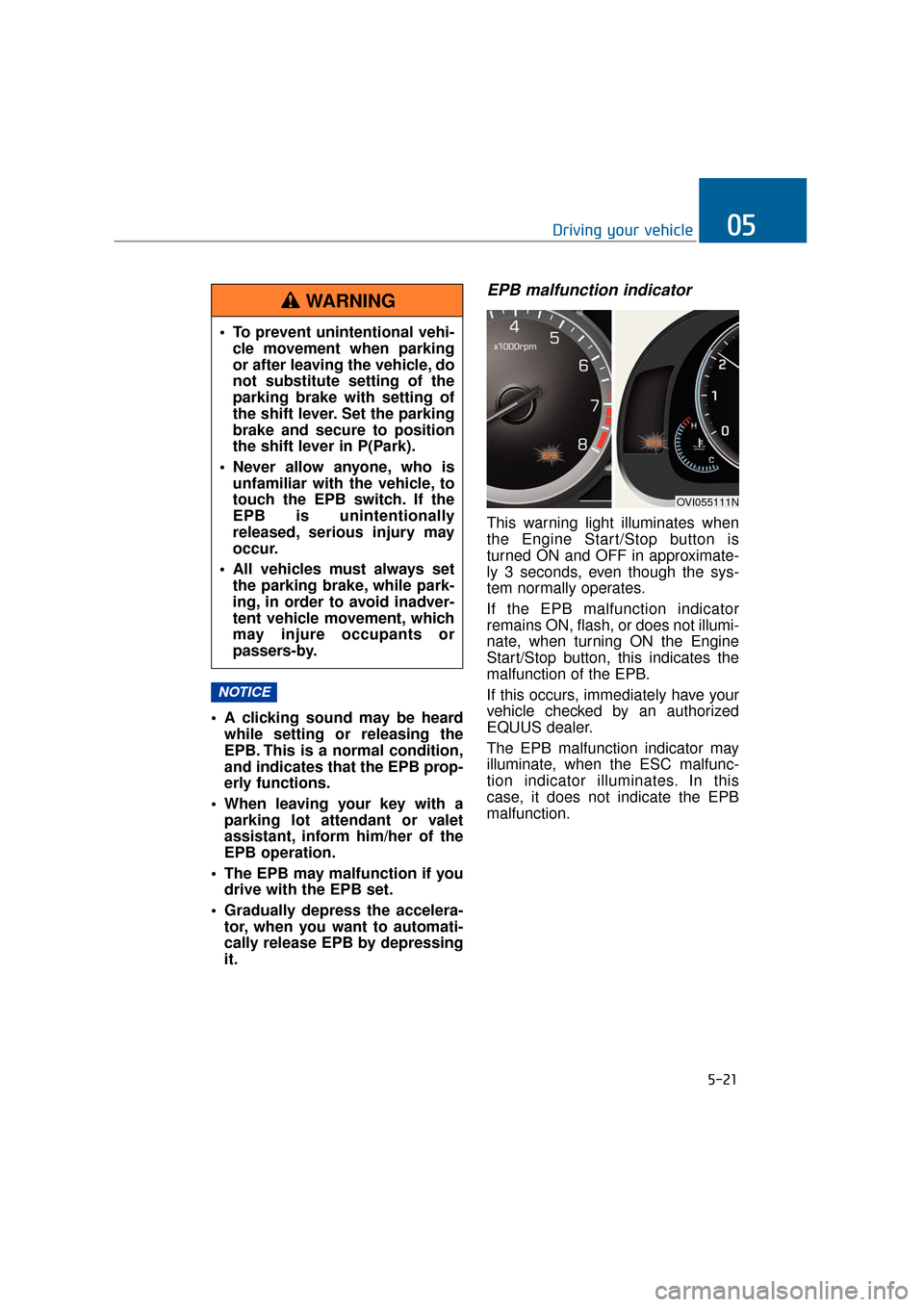
EPB malfunction indicator
This warning light illuminates when
the Engine Start/Stop button is
turned ON and OFF in approximate-
ly 3 seconds, even though the sys-
tem normally operates.
If the EPB malfunction indicator
remains ON, flash, or does not illumi-
nate, when turning ON the Engine
Start/Stop button, this indicates the
malfunction of the EPB.
If this occurs, immediately have your
vehicle checked by an authorized
EQUUS dealer.
The EPB malfunction indicator may
illuminate, when the ESC malfunc-
tion indicator illuminates. In this
case, it does not indicate the EPB
malfunction.
NOTICE
5-21
Driving your vehicle05
To prevent unintentional vehi-cle movement when parking
or after leaving the vehicle, do
not substitute setting of the
parking brake with setting of
the shift lever. Set the parking
brake and secure to position
the shift lever in P(Park).
Never allow anyone, who is unfamiliar with the vehicle, to
touch the EPB switch. If the
EPB is unintentionally
released, serious injury may
occur.
All vehicles must always set the parking brake, while park-
ing, in order to avoid inadver-
tent vehicle movement, which
may injure occupants or
passers-by.
WARNING
OVI055111N
Page 283 of 477
Hill-start assist control (HAC)
A vehicle has the tendency to slide
backwards on a steep slope, when the
driver begins to accelerate after a
stop. The HAC prevents the vehicle
from sliding backwards by automati-
cally operating the brake systems for
about 2 seconds. The brake systems
are automatically released, when the
accelerator pedal is depressed or after
about 2 seconds.
Information
• The HAC does not operate when theshift lever is in P(Park) or
N(Neutral).
• The HAC activates, even when the ESC is OFF. However, it does not
activate, when the ESC malfunc-
tions.
Good braking practices
Make sure the parking brake isreleased and that the parking
brake indicator goes OFF before
driving.
Driving through water may get the brakes wet. The brakes may also
get wet after washing the vehicle.
Wet brakes can be dangerous!
Your vehicle may not quickly stop,
when the brakes are wet. Wet
brakes may cause the vehicle to
slide to one side.
To dry the brake, lightly depress
the brake pedal until the braking
operation returns to normal, taking
care to keep the vehicle under con-
trol at all times. When the braking
operation does not return to nor-
mal, immediately and safely stop
the vehicle and call an authorized
EQUUS dealer for assistance.i
5-32
Driving your vehicle
The HAC is activated only for
about 2 seconds, so always
depress the accelerator pedal
to begin driving upwards after a
stop.
WARNING
Whenever parking or leaving the vehicle, always securely
set the parking brake and
locate the vehicle's shift lever
in P(Park). A vehicle, of which
the shift lever is not in P(Park)
with the parking brake set ON,
is at risk of inadvertently mov-
ing and injuring you or others.
All vehicles should always set the parking brake, when park-
ing, to avoid inadvertent
movement, which may injure
occupants or pedestrians.
WARNING
Page 336 of 477
If engine stalls while driving
1.Gradually reduce your drivingspeed while driving straight ahead.
Cautiously drive off the road to a
safe place.
2.Press the emergency hazard flash- er.
3.Try to re-start the engine again. When your vehicle does not re-
start, contact an authorized
EQUUS dealer for the qualified
assistance.When the engine does not
revolve, or slowly revolves
1.Make sure that the shift lever is inN(Neutral) or P (Park), and the
emergency brake is set.
2.Check that the battery connections are clean and tight.
3.Turn ON the interior light. When the light dims or goes out upon operat-
ing the starter, the battery is dis-
charged.
4.Check that the starter connections are securely tightened.
5.Do not push or pull the vehicle to start it. Follow instructions provided
in "Jump starting".
When the engine normally
revolves, but does not start
1.Check the fuel level.
2.With the Engine Start/Stop Buttonin the OFF position, check all con-
nectors of the ignition coils and the
spark plugs. Reconnect any dis-
connected or loose parts.
3.If the engine still does not start, contact an authorized EQUUS
dealer for the qualified assistance
6-3
What to do in an emergency06
I IF
F
T
T H
H E
E
E
E N
N G
GI
IN
N E
E
W
W I
IL
L L
L
N
N O
O T
T
S
S T
T A
A R
RT
T
When the engine does not start,
do not push or pull the car to
start it. This may result in a col-
lision or cause other damage.
CAUTION
Page 337 of 477
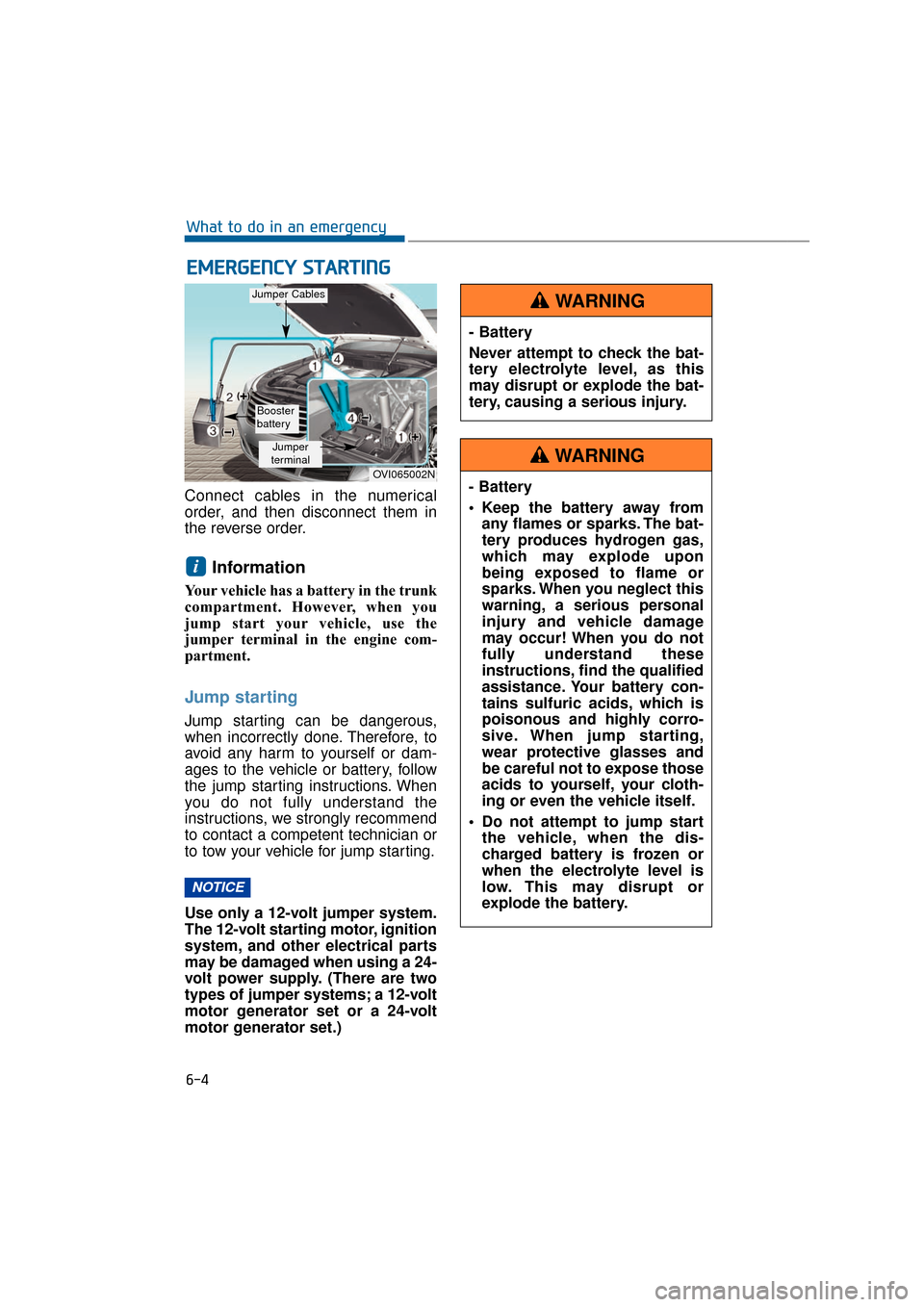
Connect cables in the numerical
order, and then disconnect them in
the reverse order.
Information
Your vehicle has a battery in the trunk
compartment. However, when you
jump start your vehicle, use the
jumper terminal in the engine com-
partment.
Jump starting
Jump starting can be dangerous,
when incorrectly done. Therefore, to
avoid any harm to yourself or dam-
ages to the vehicle or battery, follow
the jump starting instructions. When
you do not fully understand the
instructions, we strongly recommend
to contact a competent technician or
to tow your vehicle for jump starting.
Use only a 12-volt jumper system.
The 12-volt starting motor, ignition
system, and other electrical parts
may be damaged when using a 24-
volt power supply. (There are two
types of jumper systems; a 12-volt
motor generator set or a 24-volt
motor generator set.)
NOTICE
i
E EM
M E
ER
R G
G E
EN
N C
CY
Y
S
S T
T A
A R
RT
TI
IN
N G
G
6-4
What to do in an emergency
OVI065002N
Jumper
terminal
Jumper Cables
Booster
battery
- Battery
Never attempt to check the bat-
tery electrolyte level, as this
may disrupt or explode the bat-
tery, causing a serious injury.
WARNING
- Battery
• Keep the battery away from any flames or sparks. The bat-
tery produces hydrogen gas,
which may explode upon
being exposed to flame or
sparks. When you neglect this
warning, a serious personal
injury and vehicle damage
may occur! When you do not
fully understand these
instructions, find the qualified
assistance. Your battery con-
tains sulfuric acids, which is
poisonous and highly corro-
sive. When jump starting,
wear protective glasses and
be careful not to expose those
acids to yourself, your cloth-
ing or even the vehicle itself.
Do not attempt to jump start the vehicle, when the dis-
charged battery is frozen or
when the electrolyte level is
low. This may disrupt or
explode the battery.
WARNING
Page 339 of 477
When the temperature gauge indi-
cates engine overheating, you may
experience a loss of power, loud
pinging, or knocking. The engine is
probably too hot. If this happens, you
should:
1.Pull off the road and stop the vehi-cle as soon as it is safe to do so.
2.Place the shift lever in P(Park), and set the parking brake. When the
A/C is turned ON, turn it OFF.
3.When the engine coolant gushes out, or when steam comes out
from the hood, stop the engine. Do
not open the hood until the coolant
outrushing or steaming stops.
Even when there is no more
coolant outrushing, leave the
engine running and operate the
engine cooling fan. When the fan
does not operate, turn the engine
OFF.
4.Check whether the water pump drive belt is missing. When it is not,
check its tightening. When it seems
to be loose, check for any coolant
leaking from the radiator or hoses
underneath the vehicle. (When the
A/C is turned ON, cold-water drain-
ing is normal upon stopping the
vehicle.) 5.When the water pump drive belt is
broken, or when engine coolant
leaks out, immediately stop the
engine and contact the nearest
authorized EQUUS dealer for
assistance.
6.When you cannot find a cause, wait until the engine temperature
cools down. When there is serious
loss of engine coolant, carefully
add coolant into the reservoir to
bring the fluid level above the
halfway mark.
7.Be cautious and keep alert for fur- ther signs of overheating. When
finding further overheating signs,
contact an authorized EQUUS
dealer for assistance.
I IF
F
T
T H
H E
E
E
E N
N G
GI
IN
N E
E
O
O V
VE
ER
R H
H E
EA
A T
TS
S
6-6
What to do in an emergency
While the engine is running,
keep hair, hands, and clothing
away from moving parts, such
as the fan and drive belts, in
order to prevent an injury.
WARNING
Do not remove theradiator cap, when the
engine is hot. This may
blow out the engine
coolant out of the
opening and cause a
serious burn.
WARNING
Serious loss of coolant indi-
cates a leakage in the cooling
system. This should be immedi-
ately checked by an authorized
EQUUS dealer.
CAUTION