transmission Hyundai Equus 2016 User Guide
[x] Cancel search | Manufacturer: HYUNDAI, Model Year: 2016, Model line: Equus, Model: Hyundai Equus 2016Pages: 477, PDF Size: 16.25 MB
Page 284 of 477
Do not slide down (or coast down)the vehicle on a slope out of gear.
This is extremely hazardous. Keep
the vehicle in gear at all times,
depress the brake pedal to slow
down, and then shift to a lower
gear so that engine braking will
help you maintain a safe speed.
Do not "ride" the brake pedal. Resting your foot on the brake
pedal, while driving, is dangerous
because it may result brake over-
heating or lose braking effects. It
also wears out the brake compo-
nents.
If a tire goes flat while driving, gen- tly depress the brake pedal. Keep
the driving direction straight ahead
while slowing down the speed.
When the speed is lowered
enough to be safe, pull off and stop
the vehicle in a safe place.
When your vehicle is equipped with an automatic transmission, do
not let your car creep forward. To
avoid creeping forward, firmly
depress the brake pedal when
stopping the vehicle.
Be careful when parking on a slope. Firmly set the parking brake
and place the shift lever in P(Park).
When parking the vehicle on a
downward slope, steer the front
wheels sideways (into the curbs) to
prevent the vehicle from rolling.
When parking the vehicle on an
upwards, turn the front wheels
sideways (away from the curb) to
prevent the vehicle from rolling.
If there is no curb, or if it is required
by other conditions, block the
wheels with obstacles to keep the
vehicle from rolling. Under some conditions, your park-
ing brake may freeze in the
engaged position. This is most like-
ly to happen, when there is an
accumulation of snow or ice
around or near the rear brakes, or
when the brake is wet. When there
is a risk that the parking brake may
freeze, temporarily depress the
brake pedal while locating the shift
lever(automatic transmission) in
P(Park) and block the rear wheels.
Thus, the vehicle may not roll.
Then, release the parking brake.
Do not hold the vehicle on a slope by depressing the accelerator. This
may overheat the transmission.
Always use the brake pedal or
parking brake.
5-33
Driving your vehicle05
Page 286 of 477
SPORT mode
The SPORT mode focuses on the
driving dynamics by automatically
adjusting the steering wheel, sus-
pension (where the ECS is
equipped), engine and transmission
system.is selected by pressing
the DRIVE MODE but-
ton, the SPORT indica-
tor will illuminate.
Even after the SPORT mode is acti- vated, restarting of the engine
resets the DRIVE mode to be in the
NORMAL mode. Thus, when nec-
essary, re-select the SPORT mode.
ed:
- The RPM(revolutions per minutes) level is maintained over a certain
length of time, even when the
accelerator is released.
- Up-shifting timing is delayed, when accelerating.
Information
In the Sport mode, the fuel efficiency
may decrease.
Information
When a Driving Mode theme is select-
ed in the User Settings Mode of the
LCD display (if equipped), the
SPORT and SNOW indicators will not
illuminate on the instrument cluster.
SNOW mode (if equipped)
Snow mode helps the driver to more
effectively drive a vehicle on slippery
roads, such as snowy or muddy
roads.
is selected by pressing
the DRIVE MODE but-
ton, the SNOW indicator
will illuminate.
i
i
5-35
Driving your vehicle05
Page 318 of 477
5-67
Driving your vehicle05
Hazardous driving conditions
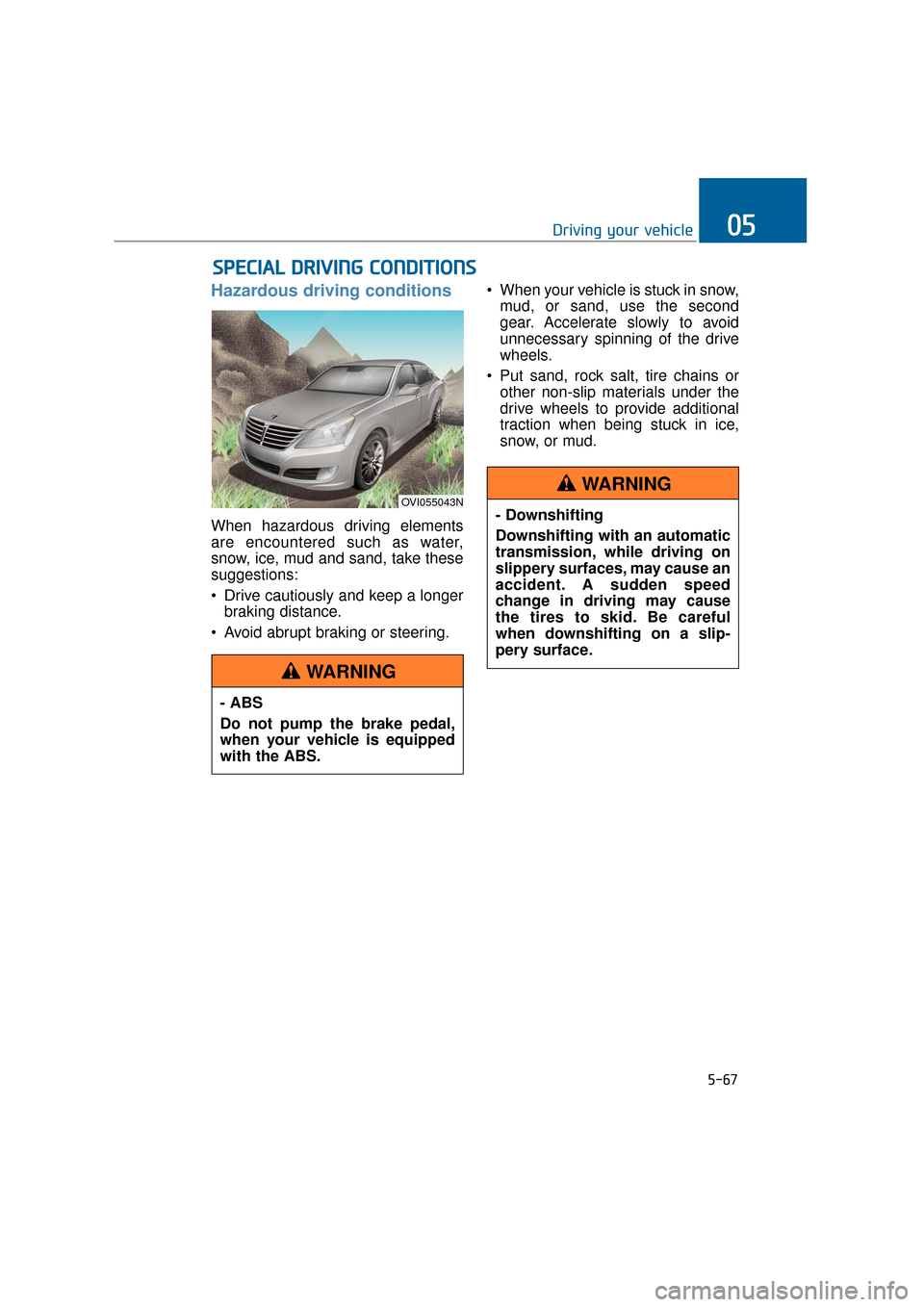
When hazardous driving elements
are encountered such as water,
snow, ice, mud and sand, take these
suggestions:
Drive cautiously and keep a longerbraking distance.
Avoid abrupt braking or steering. When your vehicle is stuck in snow,
mud, or sand, use the second
gear. Accelerate slowly to avoid
unnecessary spinning of the drive
wheels.
Put sand, rock salt, tire chains or other non-slip materials under the
drive wheels to provide additional
traction when being stuck in ice,
snow, or mud.
S SP
P E
EC
CI
IA
A L
L
D
D R
RI
IV
V I
IN
N G
G
C
C O
O N
ND
DI
IT
T I
IO
O N
NS
S
OVI055043N
- ABS
Do not pump the brake pedal,
when your vehicle is equipped
with the ABS.
WARNING
- Downshifting
Downshifting with an automatic
transmission, while driving on
slippery surfaces, may cause an
accident. A sudden speed
change in driving may cause
the tires to skid. Be careful
when downshifting on a slip-
pery surface.
WARNING
Page 319 of 477
5-68
Driving your vehicle
Rocking the vehicle
When it is necessary to rock the
vehicle to escape from snow, sand,
or mud, first move the steering wheel
from side to side to clear the front-
wheel area. Then, move the shift
lever back and forth between
R(Reverse) and any forward gears.
Do not race the engine, and avoid
unnecessary wheel spins. When
your vehicle is still stuck in after try-
ing the above, have the vehicle
pulled out by a tow truck to avoid
engine overheating and transmission
damages.
A long-time rocking may overheat
the engine and damage the trans-
mission/tires.
Information
The ESC system must be turned OFF
before rocking the vehicle.
i
NOTICE
- Spinning tires
Do not spin the wheels, espe-
cially faster than 35 mph (56
km/h). Spinning the wheels at a
high speed, while parking, may
overheat a tire and injure
passers-by.
WARNING
When your vehicle is stuck in
snow, mud, sand, etc., you may
rock the vehicle to escape by
moving forwards and back-
wards. Do not attempt this,
when people or objects are any-
where near the vehicle. Rocking
the vehicle may cause it to sud-
denly move forwards or back-
wards, as it becomes unstuck,
injuring nearby people or dam-
aging objects.
WARNING
Page 338 of 477
Jump starting procedure
Information
Your vehicle has a battery in the trunk
compartment. However, when you
jump start your vehicle, use the
jumper terminal in the engine com-
partment.
1.Make sure the booster battery is12-volt and that its negative termi-
nal is grounded.
2.When the booster battery is in another vehicle, separate the two
vehicles apart.
3.Turn OFF all unnecessary electri- cal systems.
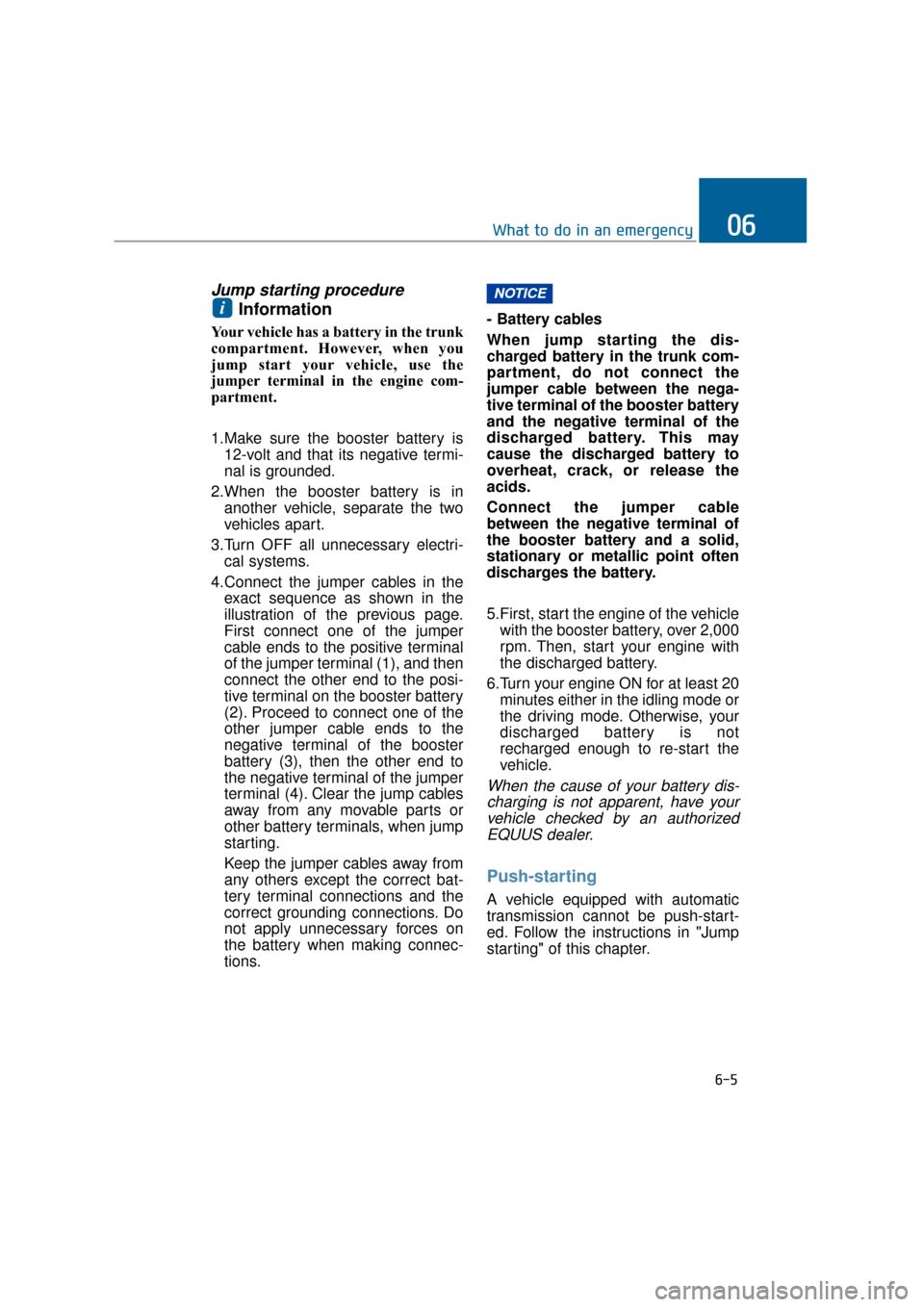
4.Connect the jumper cables in the exact sequence as shown in the
illustration of the previous page.
First connect one of the jumper
cable ends to the positive terminal
of the jumper terminal (1), and then
connect the other end to the posi-
tive terminal on the booster battery
(2). Proceed to connect one of the
other jumper cable ends to the
negative terminal of the booster
battery (3), then the other end to
the negative terminal of the jumper
terminal (4). Clear the jump cables
away from any movable parts or
other battery terminals, when jump
starting.
Keep the jumper cables away from
any others except the correct bat-
tery terminal connections and the
correct grounding connections. Do
not apply unnecessary forces on
the battery when making connec-
tions. - Battery cables
When jump starting the dis-
charged battery in the trunk com-
partment, do not connect the
jumper cable between the nega-
tive terminal of the booster battery
and the negative terminal of the
discharged battery. This may
cause the discharged battery to
overheat, crack, or release the
acids.
Connect the jumper cable
between the negative terminal of
the booster battery and a solid,
stationary or metallic point often
discharges the battery.
5.First, start the engine of the vehicle
with the booster battery, over 2,000
rpm. Then, start your engine with
the discharged battery.
6.Turn your engine ON for at least 20 minutes either in the idling mode or
the driving mode. Otherwise, your
discharged battery is not
recharged enough to re-start the
vehicle.
When the cause of your battery dis-charging is not apparent, have yourvehicle checked by an authorizedEQUUS dealer.
Push-starting
A vehicle equipped with automatic
transmission cannot be push-start-
ed. Follow the instructions in "Jump
starting" of this chapter.
NOTICE
i
6-5
What to do in an emergency06
Page 352 of 477
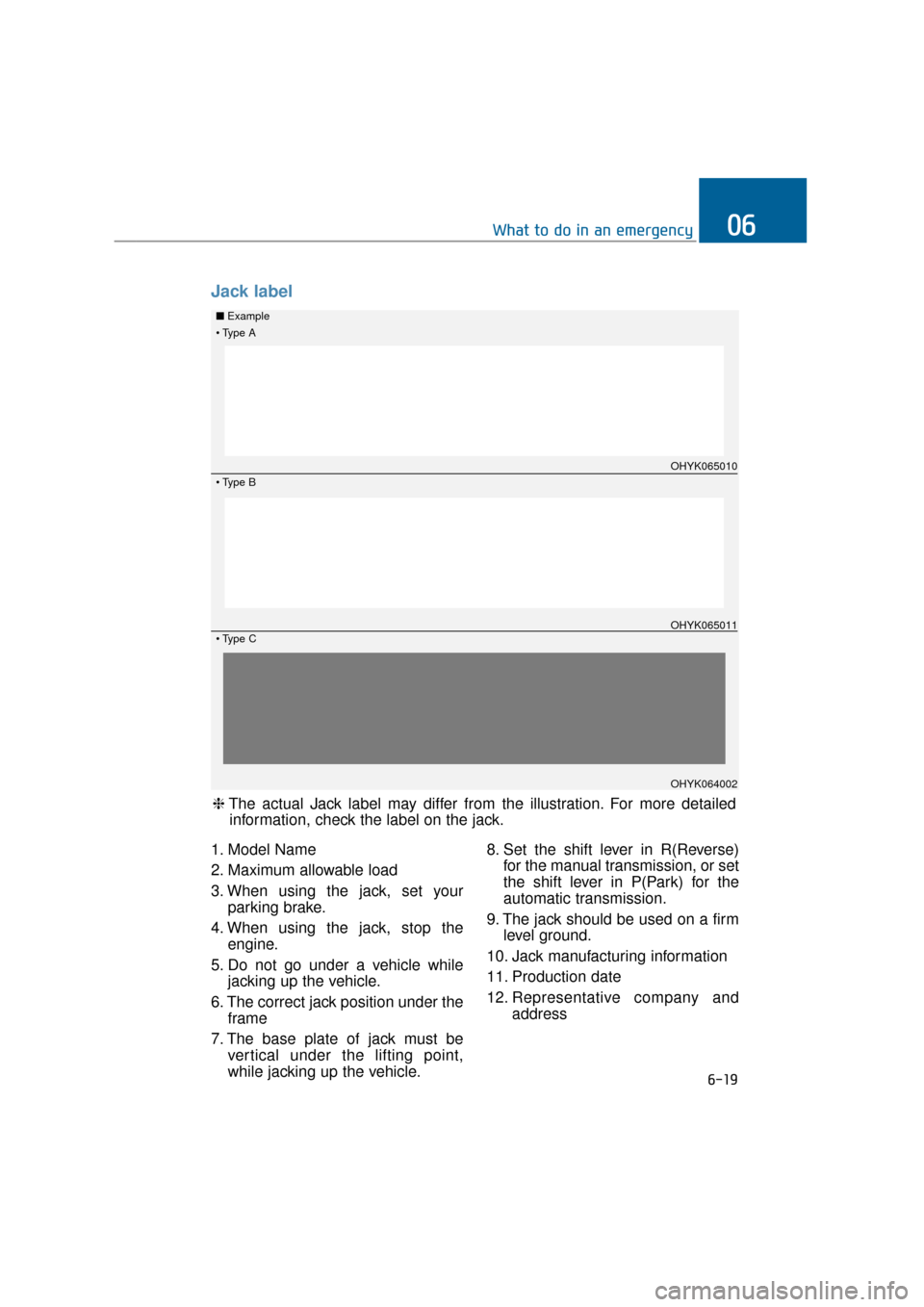
1. Model Name
2. Maximum allowable load
3. When using the jack, set yourparking brake.
4. When using the jack, stop the engine.
5. Do not go under a vehicle while jacking up the vehicle.
6. The correct jack position under the frame
7. The base plate of jack must be vertical under the lifting point,
while jacking up the vehicle. 8. Set the shift lever in R(Reverse)
for the manual transmission, or set
the shift lever in P(Park) for the
automatic transmission.
9. The jack should be used on a firm level ground.
10. Jack manufacturing information
11. Production date
12. Representative company and address
6-19
What to do in an emergency06
❈The actual Jack label may differ from the illustration. For more detailed
information, check the label on the jack.
Jack label
OHYK065010
■ Example
OHYK065011
OHYK064002
Page 354 of 477
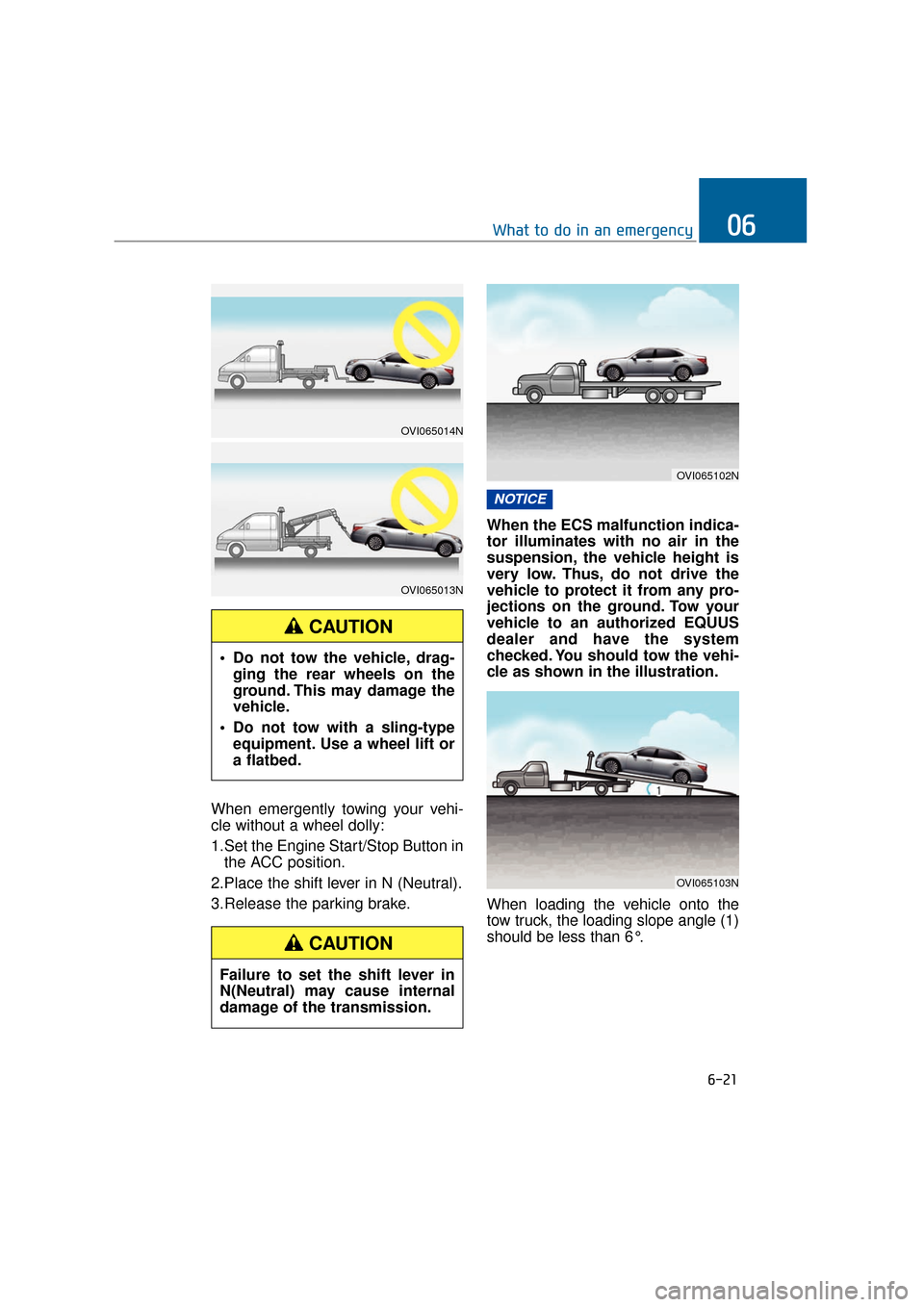
When emergently towing your vehi-
cle without a wheel dolly:
1.Set the Engine Start/Stop Button inthe ACC position.
2.Place the shift lever in N (Neutral).
3.Release the parking brake. When the ECS malfunction indica-
tor illuminates with no air in the
suspension, the vehicle height is
very low. Thus, do not drive the
vehicle to protect it from any pro-
jections on the ground. Tow your
vehicle to an authorized EQUUS
dealer and have the system
checked. You should tow the vehi-
cle as shown in the illustration.
When loading the vehicle onto the
tow truck, the loading slope angle (1)
should be less than 6°.
NOTICE
6-21
What to do in an emergency06
Do not tow the vehicle, drag-
ging the rear wheels on the
ground. This may damage the
vehicle.
Do not tow with a sling-type equipment. Use a wheel lift or
a flatbed.
CAUTION
Failure to set the shift lever in
N(Neutral) may cause internal
damage of the transmission.
CAUTION
OVI065102N
OVI065103N
OVI065014N
OVI065013N
Page 357 of 477
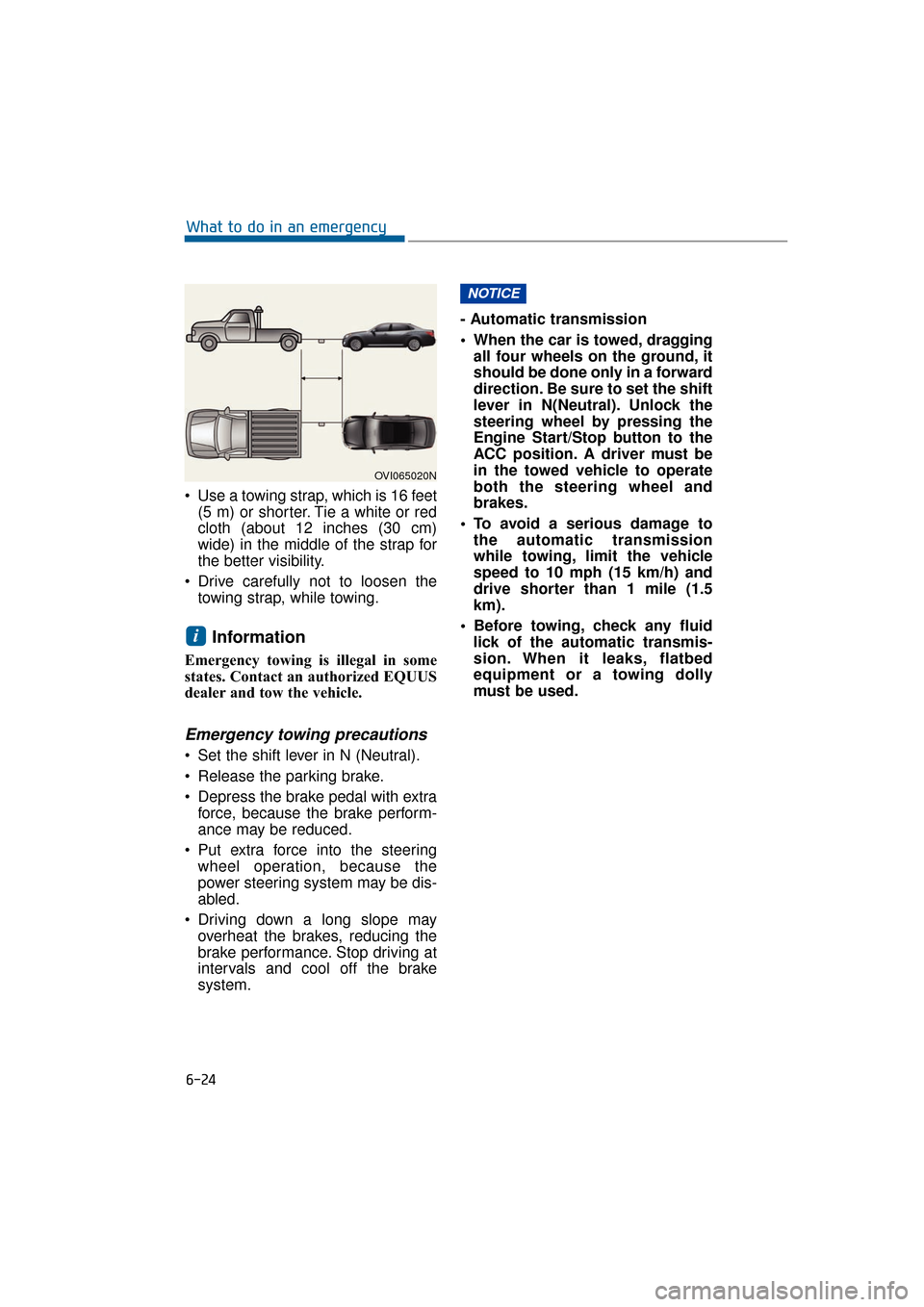
Use a towing strap, which is 16 feet(5 m) or shorter. Tie a white or red
cloth (about 12 inches (30 cm)
wide) in the middle of the strap for
the better visibility.
Drive carefully not to loosen the towing strap, while towing.
Information
Emergency towing is illegal in some
states. Contact an authorized EQUUS
dealer and tow the vehicle.
Emergency towing precautions
Set the shift lever in N (Neutral).
Release the parking brake.
Depress the brake pedal with extraforce, because the brake perform-
ance may be reduced.
Put extra force into the steering wheel operation, because the
power steering system may be dis-
abled.
Driving down a long slope may overheat the brakes, reducing the
brake performance. Stop driving at
intervals and cool off the brake
system. - Automatic transmission
When the car is towed, dragging
all four wheels on the ground, it
should be done only in a forward
direction. Be sure to set the shift
lever in N(Neutral). Unlock the
steering wheel by pressing the
Engine Start/Stop button to the
ACC position. A driver must be
in the towed vehicle to operate
both the steering wheel and
brakes.
To avoid a serious damage to the automatic transmission
while towing, limit the vehicle
speed to 10 mph (15 km/h) and
drive shorter than 1 mile (1.5
km).
Before towing, check any fluid lick of the automatic transmis-
sion. When it leaks, flatbed
equipment or a towing dolly
must be used.
NOTICE
i
6-24
What to do in an emergency
OVI065020N
Page 364 of 477
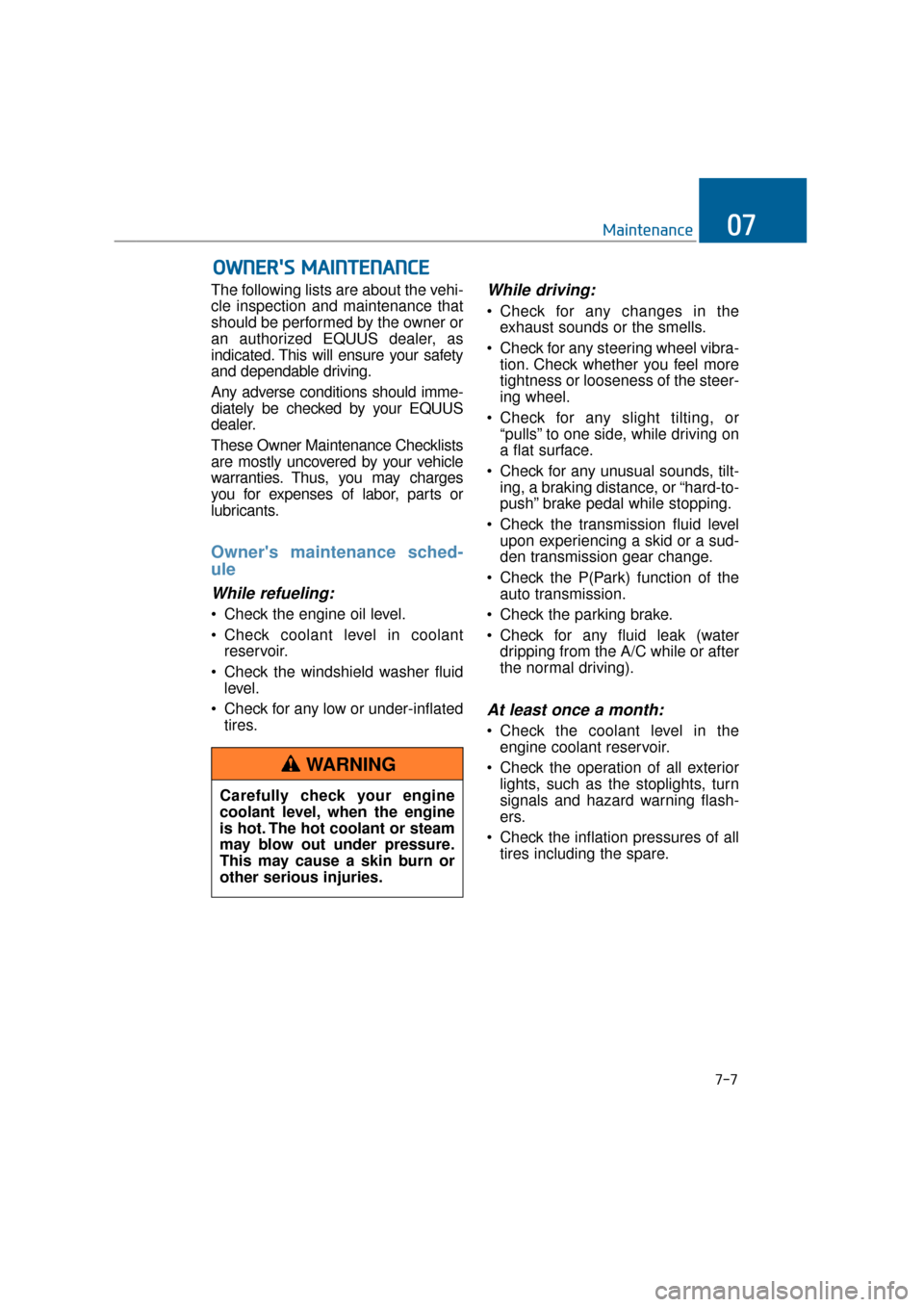
The following lists are about the vehi-
cle inspection and maintenance that
should be performed by the owner or
an authorized EQUUS dealer, as
indicated. This will ensure your safety
and dependable driving.
Any adverse conditions should imme-
diately be checked by your EQUUS
dealer.
These Owner Maintenance Checklists
are mostly uncovered by your vehicle
warranties. Thus, you may charges
you for expenses of labor, parts or
lubricants.
Owner's maintenance sched-
ule
While refueling:
Check the engine oil level.
Check coolant level in coolantreservoir.
Check the windshield washer fluid level.
Check for any low or under-inflated tires.
While driving:
Check for any changes in theexhaust sounds or the smells.
Check for any steering wheel vibra- tion. Check whether you feel more
tightness or looseness of the steer-
ing wheel.
Check for any slight tilting, or “pulls” to one side, while driving on
a flat surface.
Check for any unusual sounds, tilt- ing, a braking distance, or “hard-to-
push” brake pedal while stopping.
Check the transmission fluid level upon experiencing a skid or a sud-
den transmission gear change.
Check the P(Park) function of the auto transmission.
Check the parking brake.
Check for any fluid leak (water dripping from the A/C while or after
the normal driving).
At least once a month:
Check the coolant level in theengine coolant reservoir.
Check the operation of all exterior lights, such as the stoplights, turn
signals and hazard warning flash-
ers.
Check the inflation pressures of all tires including the spare.
O OW
W N
NE
ER
R '
'S
S
M
M A
AI
IN
N T
TE
EN
N A
AN
N C
CE
E
7-7
Maintenance07
Carefully check your engine
coolant level, when the engine
is hot. The hot coolant or steam
may blow out under pressure.
This may cause a skin burn or
other serious injuries.
WARNING
Page 365 of 477
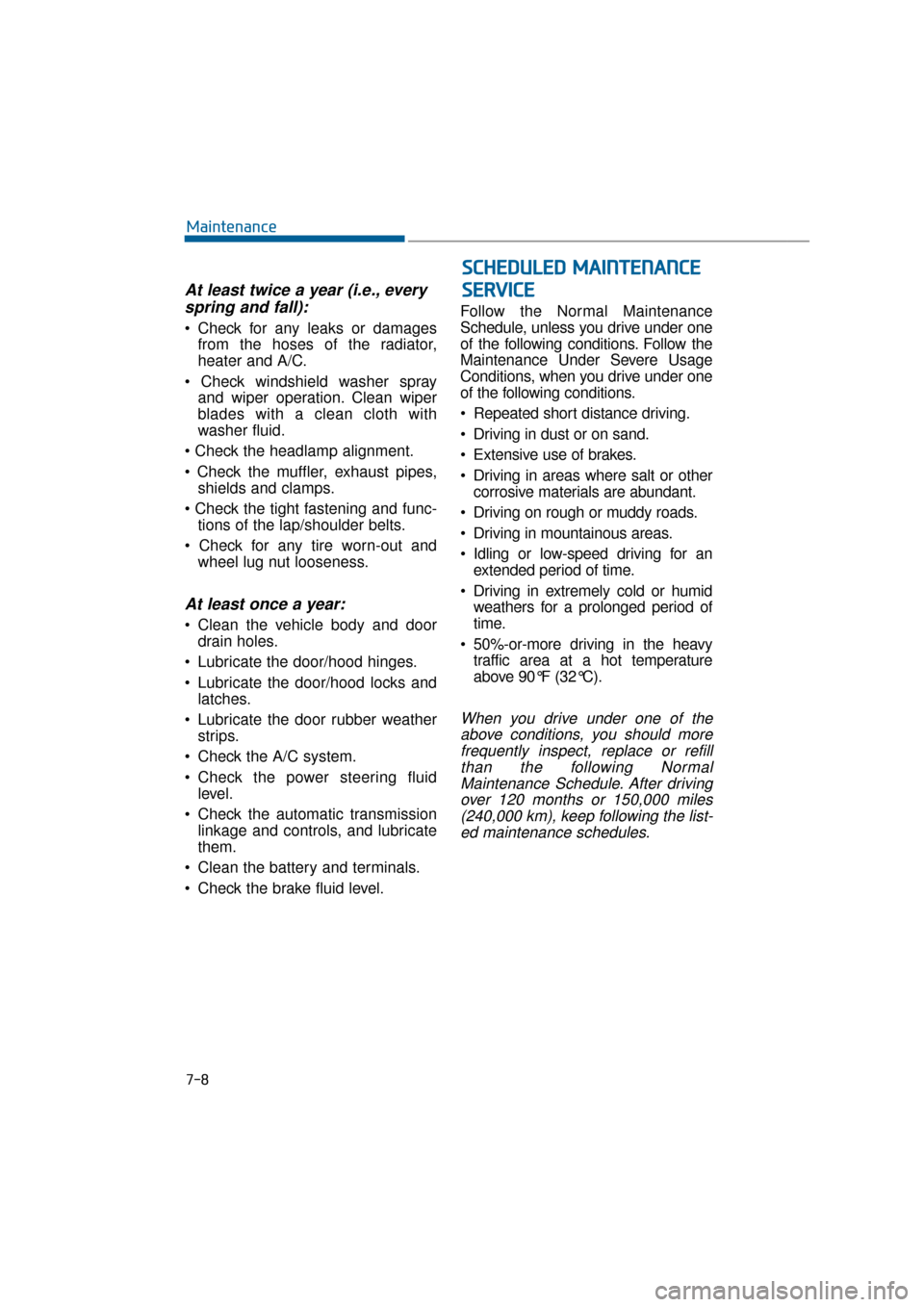
At least twice a year (i.e., everyspring and fall):
Check for any leaks or damages
from the hoses of the radiator,
heater and A/C.
and wiper operation. Clean wiper
blades with a clean cloth with
washer fluid.
shields and clamps.
tions of the lap/shoulder belts.
wheel lug nut looseness.
At least once a year:
Clean the vehicle body and doordrain holes.
Lubricate the door/hood hinges.
Lubricate the door/hood locks and latches.
Lubricate the door rubber weather strips.
Check the A/C system.
Check the power steering fluid level.
Check the automatic transmission linkage and controls, and lubricate
them.
Clean the battery and terminals.
Check the brake fluid level. Follow the Normal Maintenance
Schedule, unless you drive under one
of the following conditions. Follow the
Maintenance Under Severe Usage
Conditions, when you drive under one
of the following conditions.
Repeated short distance driving.
Driving in dust or on sand.
Extensive use of brakes.
Driving in areas where salt or other
corrosive materials are abundant.
Driving on rough or muddy roads.
Driving in mountainous areas.
Idling or low-speed driving for an extended period of time.
Driving in extremely cold or humid weathers for a prolonged period of
time.
50%-or-more driving in the heavy traffic area at a hot temperature
above 90°F (32°C).
When you drive under one of theabove conditions, you should morefrequently inspect, replace or refillthan the following NormalMaintenance Schedule. After drivingover 120 months or 150,000 miles(240,000 km), keep following the list-ed maintenance schedules.
7-8
Maintenance
S S C
C H
H E
ED
D U
U L
LE
E D
D
M
M A
AI
IN
N T
TE
EN
N A
AN
N C
CE
E
S
S E
E R
R V
V I
IC
C E
E