weight Hyundai Equus 2016 User Guide
[x] Cancel search | Manufacturer: HYUNDAI, Model Year: 2016, Model line: Equus, Model: Hyundai Equus 2016Pages: 477, PDF Size: 16.25 MB
Page 316 of 477
5-65
Driving your vehicle05
Your vehicle's fuel economy depends
mainly on your driving style such as
where you drive and when you drive.
Each of these factors affects your
fuel economy (how many miles/kilo-
meters you can drive with a
gallon/liter of fuel). To drive your vehi-
cle as economically as possible, fol-
low the below driving suggestions.
These will help you save in both the
fuel and repair expenses:
Drive smoothly. Accelerate at amoderate rate. Do not make
"jackrabbit" starts or full-throttle
shifts. Maintain a steady cruising
speed. Do not race between stop-
lights. Try to adjust your speed in
accordance with other traffic to
avoid unnecessary speed
changes. Avoid heavy traffic when-
ever possible. Always maintain a
safe distance from a vehicle in
front to avoid unnecessary braking.
This also reduces brake wear-out.
Drive at a moderate speed. The faster you drive, the more fuel your
vehicle uses. Driving at a moderate
speed, in the highest gear appro-
priate for the driving conditions
especially on the highway, is one of
the most effective ways to reduce
fuel consumption.
Do not "ride" the brake pedal. This can increase fuel consumption and
also wear out the brake compo-
nents. In addition, resting your foot
on the brake pedal, while driving,
may overheat the brake, reducing
breaking effects and possibly lead-
ing a serious consequence.
Check your tire conditions. Keep them inflated to the recommended
pressure level. Under or over infla-
tion will unnecessarily tire wear-
out. Check the tire pressures at
least once a month. Make sure that the wheels are cor-
rectly aligned. Hitting a curb or
driving too fast on uneven surfaces
may distort the wheel alignment.
Poor alignment causes faster tire
wear-out and may also result in
other problems as well as greater
fuel consumption.
Keep your vehicle in good condi- tion. For the better fuel economy
and the cheaper maintenance
expenses, maintain your vehicle in
accordance with the maintenance
schedule in the chapter 7. When
you drive your vehicle in harsh con-
ditions, more frequent mainte-
nance is required (refer to the
chapter 7 for further information).
Keep your vehicle clean. Your vehi- cle should be kept clean and away
from any corrosive substances. It is
especially important that mud, dirt,
ice and others are not daubed
under the vehicle. This extra weight
may increase the fuel consumption
and also cause corrosion.
Avoid a heavy loading. Do not carry unnecessary weight in your
vehicle. It will improve your fuel
economy.
Do not let the engine idle longer than necessary. When you wait
(not in traffic), turn OFF the engine.
Then restart the engine, when you
are ready to go.
Remember that your vehicle does not require the engine warm-up for
a long time. After turning On the
engine, run the engine for 10 to 20
seconds, before shifting the gear.
In cold weather, however, your
engine needs a slightly longer
warm-up period.
E EC
CO
O N
NO
O M
M I
IC
C A
A L
L
O
O P
PE
ER
R A
A T
TI
IO
O N
N
Page 325 of 477
5-74
Driving your vehicle
An AutoSock, which is in the wrong size or is improperly
installed, may damage brake
lines, suspension, body and
wheels of your vehicle.
Stop driving and retighten the AutoSock, whenever there are
snapping sounds between the
vehicle and the AutoSock.
Use high quality ethylene gly-
col coolant
The cooling system of your vehicle is
filled with the high-quality ethylene
glycol coolant when being delivered.
It is the only type of coolant that your
vehicle is filled with, because it pre-
vents corrosion of the cooling sys-
tem, lubricates the water pump and
prevents freezing. Refill the cooling
system in accordance with your
maintenance schedule in the chapter
7. Before winter, check your coolant
to assure that the freezing point is
sufficiently lower than the expected
winter temperature.
Check battery and cables
The winter temperature increases
the battery consumption. Inspect the
battery and cables, as described in
the chapter 7. The battery charging
level can be checked by an author-
ized EQUUS dealer or in a service
station.
Change to "winter weight" oil,
if necessary
In some regions during the cold win-
ter, it is recommended to use the
"winter weight" oil with lower viscosi-
ty. For further information about this,
refer to the chapter 8. When you can-
not be sure about a type of winter
weight oil, consult an authorized
EQUUS dealer.
Check spark plugs and ignition
system
Inspect your spark plugs and, if nec-
essary, replace them. Also check all
ignition wirings and components for
any cracks, wear-out, and damage.
NOTICE
- Chain installation
When installing the AutoSock,
park the vehicle on level ground
away from other vehicles. Press
ON the Hazard Warning flasher
and place a warning triangle
behind your vehicle, if available.
Place the shift lever in P(Park),
set the parking brake and turn
OFF the engine, before
installing the AutoSock.
WARNING
- Tire chains
The use of the AutoSock may
adversely affect vehicle han-
dling.
Do not drive faster than the lower of the two - 20 mph (30
km/h) and the AutoSock manu-
facturer’s recommended
speed limit.
Drive carefully and avoid bumps, holes, sharp turns, and
other road hazards, which may
bounce the vehicle.
Avoid turning sharply or lock- ing the wheel brake.
WARNING
Page 327 of 477
5-76
Driving your vehicle
V
VE
EH
H I
IC
C L
LE
E
L
L O
O A
AD
D
L
L I
IM
M I
IT
T
Tire and loading information
label
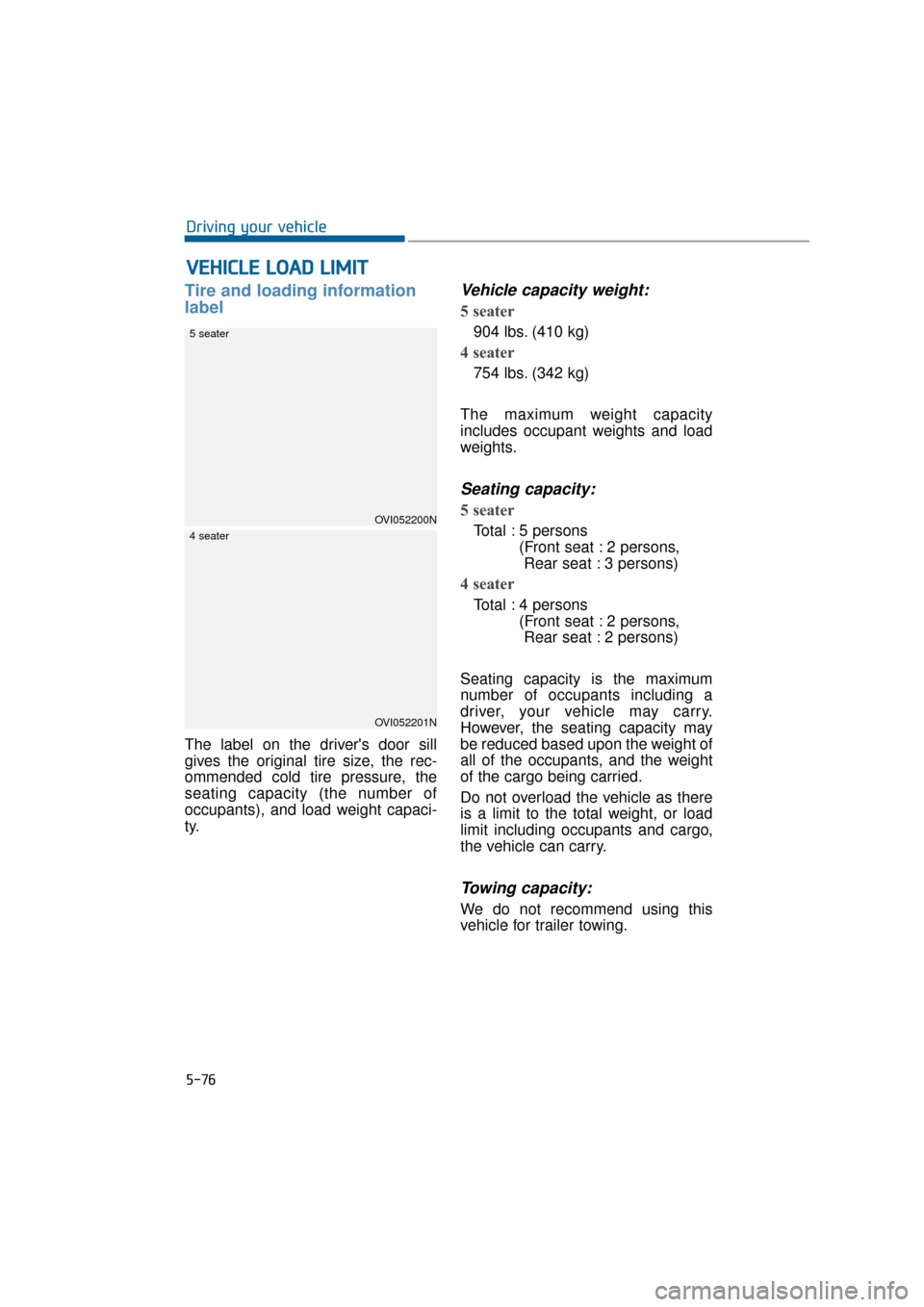
The label on the driver's door sill
gives the original tire size, the rec-
ommended cold tire pressure, the
seating capacity (the number of
occupants), and load weight capaci-
ty.
Vehicle capacity weight:
5 seater
904 lbs. (410 kg)
4 seater
754 lbs. (342 kg)
The maximum weight capacity
includes occupant weights and load
weights.
Seating capacity:
5 seater
Total : 5 persons (Front seat : 2 persons, Rear seat : 3 persons)
4 seater
Total : 4 persons (Front seat : 2 persons, Rear seat : 2 persons)
Seating capacity is the maximum
number of occupants including a
driver, your vehicle may carry.
However, the seating capacity may
be reduced based upon the weight of
all of the occupants, and the weight
of the cargo being carried.
Do not overload the vehicle as there
is a limit to the total weight, or load
limit including occupants and cargo,
the vehicle can carry.
Towing capacity:
We do not recommend using this
vehicle for trailer towing.
OVI052200N
5 seater
OVI052201N
4 seater
Page 328 of 477
5-77
Driving your vehicle05
Cargo capacity:
The cargo capacity of your vehicle
will increase or decrease depending
on the weight and the number of
occupants.
Steps For Determining CorrectLoad Limit -
1. Locate the statement "The com-
bined weight of occupants and
cargo should never exceed XXX
kg or XXX lbs.'' on your vehicle's
placard.
2. Determine the combined weight of the driver and passengers that will
be riding in your vehicle.
3. Subtract the combined weight of the driver and passengers from
XXX kg or XXX lbs.
4. The resulting figure equals the available amount of cargo and lug-
gage load capacity. For example, if
the "XXX" amount equals 1400
lbs. and there will be five 150 lb
passengers in your vehicle, the
amount of available cargo and lug-
gage load capacity is 650 lbs.
(1400 - 750(5x150) = 650 lbs.)
5. Determine the combined weight of luggage and cargo being loaded
on the vehicle. That weight may
not safely exceed the available
cargo and luggage load capacity
calculated in Step 4. 6. If your vehicle will be towing a trail-
er, load from your trailer will be
transferred to your vehicle. Consult
this manual to determine how this
reduces the available cargo and
luggage load capacity of your
vehicle.Information
We do not recommend using this vehi-
cle to tow a trailer.
i
Page 329 of 477
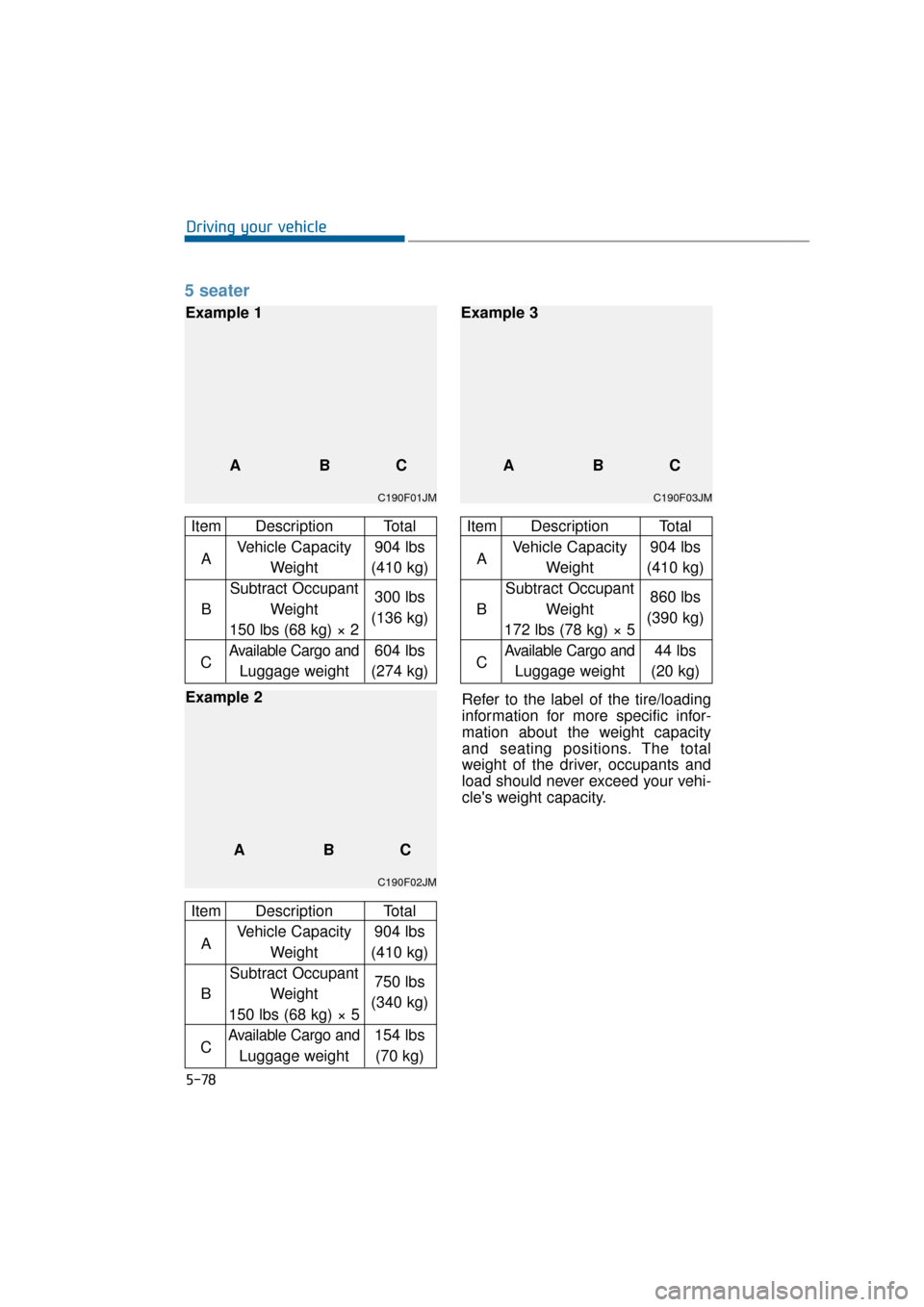
5-78
Driving your vehicle
5 seater
C190F01JM
Item Description TotalA Vehicle Capacity 904 lbs
Weight (410 kg)
Subtract Occupant
B Weight 300 lbs
150 lbs (68 kg) × 2 (136 kg)
C
Available Cargo and604 lbs
Luggage weight (274 kg)
Example 1
ABC
C190F02JM
Item Description TotalA Vehicle Capacity 904 lbs
Weight (410 kg)
Subtract Occupant
B Weight 750 lbs
150 lbs (68 kg) × 5 (340 kg)
C
Available Cargo and154 lbs
Luggage weight (70 kg)
ABC
Example 2
C190F03JM
Item Description Total
A Vehicle Capacity 904 lbs
Weight (410 kg)
Subtract Occupant
B Weight 860 lbs
172 lbs (78 kg) × 5 (390 kg)
C
Available Cargo and44 lbs
Luggage weight (20 kg)
ABC
Example 3
Refer to the label of the tire/loading
information for more specific infor-
mation about the weight capacity
and seating positions. The total
weight of the driver, occupants and
load should never exceed your vehi-
cle's weight capacity.
Page 330 of 477
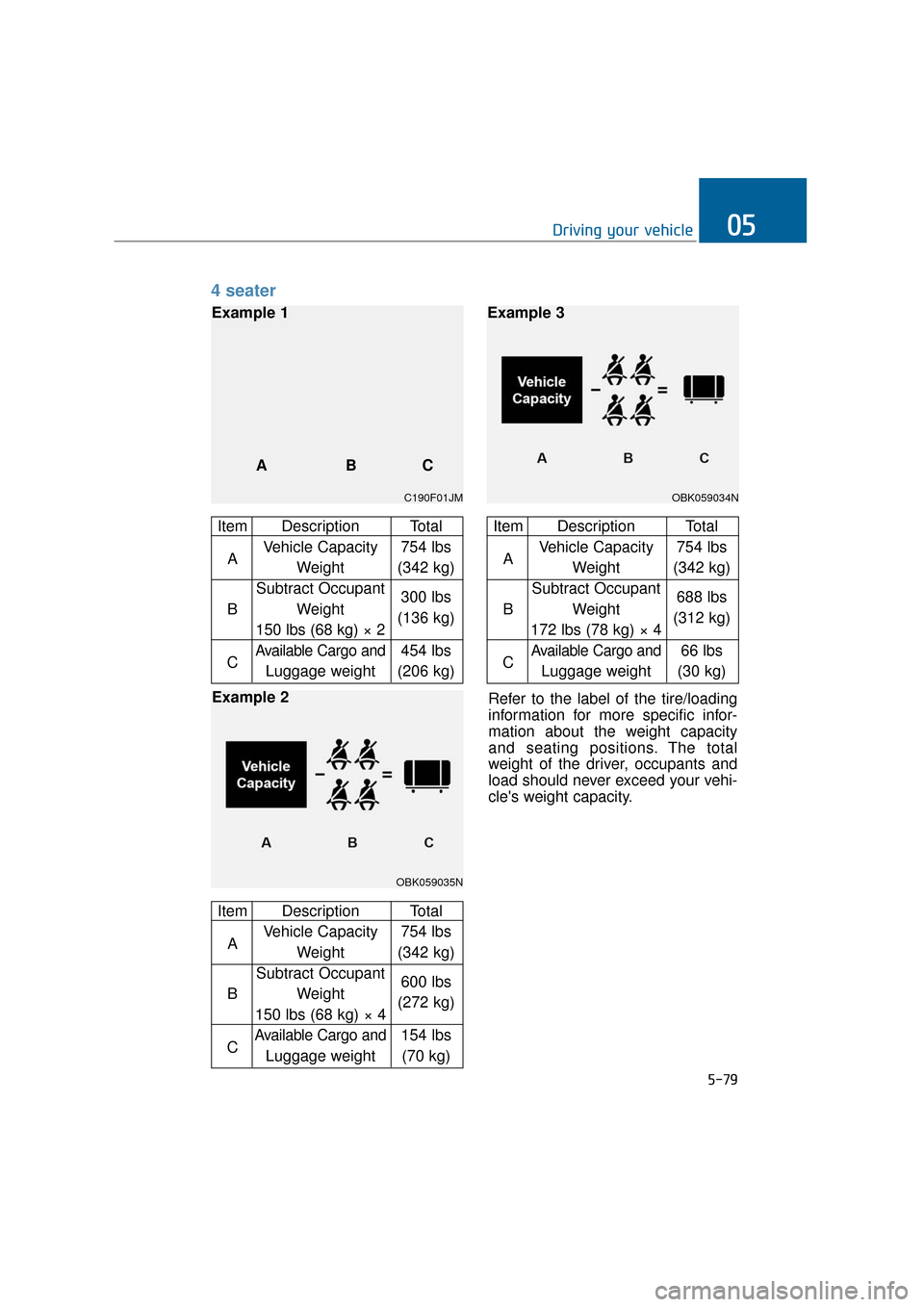
5-79
Driving your vehicle05
4 seater
C190F01JM
Item Description TotalA Vehicle Capacity 754 lbs
Weight (342 kg)
Subtract Occupant
B Weight 300 lbs
150 lbs (68 kg) × 2 (136 kg)
C
Available Cargo and454 lbs
Luggage weight (206 kg)
Example 1
ABC
OBK059035N
Item Description TotalA Vehicle Capacity 754 lbs
Weight (342 kg)
Subtract Occupant
B Weight 600 lbs
150 lbs (68 kg) × 4 (272 kg)
C
Available Cargo and154 lbs
Luggage weight (70 kg)
Example 2
OBK059034N
Item Description Total
A Vehicle Capacity 754 lbs
Weight (342 kg)
Subtract Occupant
B Weight 688 lbs
172 lbs (78 kg) × 4 (312 kg)
C
Available Cargo and66 lbs
Luggage weight (30 kg)
Example 3
Refer to the label of the tire/loading
information for more specific infor-
mation about the weight capacity
and seating positions. The total
weight of the driver, occupants and
load should never exceed your vehi-
cle's weight capacity.
Page 331 of 477
5-80
Driving your vehicle
Certification label
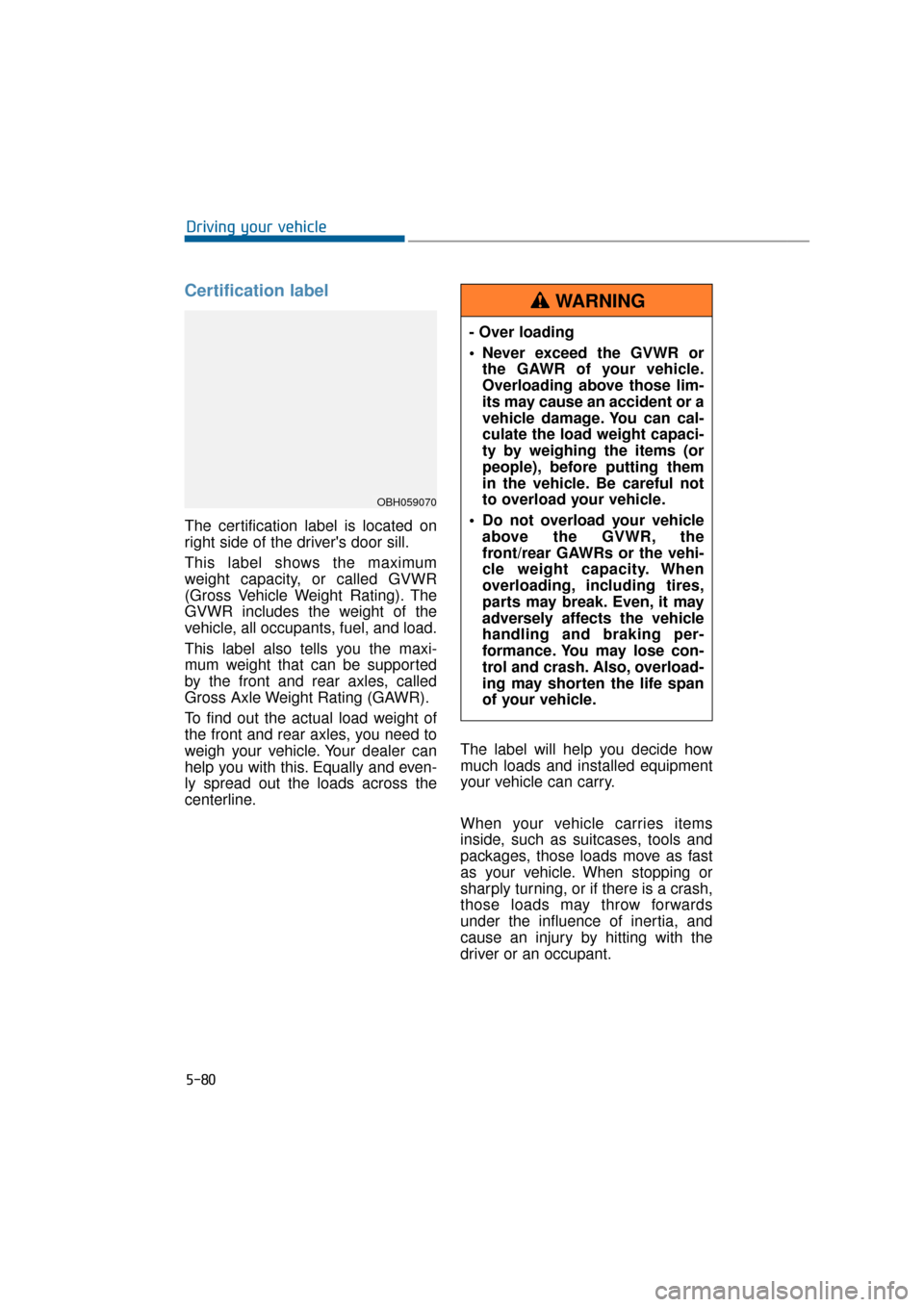
The certification label is located on
right side of the driver's door sill.
This label shows the maximum
weight capacity, or called GVWR
(Gross Vehicle Weight Rating). The
GVWR includes the weight of the
vehicle, all occupants, fuel, and load.
This label also tells you the maxi-
mum weight that can be supported
by the front and rear axles, called
Gross Axle Weight Rating (GAWR).
To find out the actual load weight of
the front and rear axles, you need to
weigh your vehicle. Your dealer can
help you with this. Equally and even-
ly spread out the loads across the
centerline.The label will help you decide how
much loads and installed equipment
your vehicle can carry.
When your vehicle carries items
inside, such as suitcases, tools and
packages, those loads move as fast
as your vehicle. When stopping or
sharply turning, or if there is a crash,
those loads may throw forwards
under the influence of inertia, and
cause an injury by hitting with the
driver or an occupant.
OBH059070
- Over loading
Never exceed the GVWR or
the GAWR of your vehicle.
Overloading above those lim-
its may cause an accident or a
vehicle damage. You can cal-
culate the load weight capaci-
ty by weighing the items (or
people), before putting them
in the vehicle. Be careful not
to overload your vehicle.
Do not overload your vehicle above the GVWR, the
front/rear GAWRs or the vehi-
cle weight capacity. When
overloading, including tires,
parts may break. Even, it may
adversely affects the vehicle
handling and braking per-
formance. You may lose con-
trol and crash. Also, overload-
ing may shorten the life span
of your vehicle.
WARNING
Page 332 of 477
5-81
Driving your vehicle05
Overloading may damage yourvehicle. Repairs are not covered
by your warranty. Do not over-
load your vehicle.
Heavier suspension compo- nents for higher durability may
not change the weight capacity.
Ask your dealer to help you load
your vehicle the right way.
NOTICE
Overloading your vehicle mayoverheat the tires and cause
tire failure, possibly leading to
a crash.
Overloading your vehicle may increase a stopping distance,
possibly leading to a crash.
A crash, which is resulted from poor handling, vehicle
damage, tire failure, or a
longer stopping distance, may
result in a serious injury or
death.
WARNING
- Unsecured loads
Items you carry inside your
vehicle may hit and injure an
occupant in a sudden stop or
turn, or in a crash.
Put items in the trunk. Try toevenly spread the weight.
Never stack up items, like suitcases, inside the vehicle,
especially above the seat-
backs.
Do not leave an unsecured child restraint in your vehicle.
When you carry something inside the vehicle, secure it.
WARNING
Page 333 of 477
This is to guide you to load in a prop-
er manner, and to keep the load
weight under the maximum weight
capacity. Proper loading will provide
maximum vehicle performance.
Before loading your vehicle, read the
following terms and explanation for
determining your vehicle's loading
weight, based on the vehicle's speci-
fications and the certification label:
Base curb weight
This is the weight of the vehicle, only
including a full tank of fuel and all
standard equipment. This weight
excludes optional equipment, loads,
or occupants.
Vehicle curb weight
This is the weight of your new vehi-
cle, upon being delivered from a
dealer, including any optional equip-
ment.
Load weight
This is the weight of all the addition-
al items, including the loads and
optional equipment.
GAW (Gross axle weight)
This is the total weight on each
axle(front and rear), including the
vehicle curb weight and the load
weight.
GAWR
(Gross axle weight rating)
This is the maximum weight capacity
of a single axle (front or rear). This
GAWR is shown on the certification
label. The total load weight on each
axle must never exceed its GAWR.
GVW (Gross vehicle weight)
This is the accumulated weight of the
base curb weight, the actual load
weight, and the occupants' weight.
GVWR
(Gross vehicle weight rating)
This is the maximum weight capacity
of a vehicle, including all options,
equipment, occupants and loads.
The GVWR is shown on the certifica-
tion label on the driver’s door sill.
T TR
R A
A I
IL
L E
E R
R
T
T O
O W
W I
IN
N G
G
We do not recommend using this
vehicle to tow a trailer.
V VE
EH
H I
IC
C L
LE
E
W
W E
EI
IG
G H
H T
T
Driving your vehicle
5-82
Page 350 of 477
To prevent the jack, jack handle,
wheel lug nut wrench and spare tire
from rattling inside a vehicle while
driving, store them in a proper place.
Important - use of compactspare tire
Your vehicle is equipped with a com-
pact spare tire. This compact spare
tire takes up less space than an orig-
inal one. This tire is smaller than an
original one, and is designed for tem-
porary use only.
You should carefully drive when
a compact spare tire is in use.
The compact spare tire should
immediately be replaced with a
proper regular tire.
Driving on more than one com- pact spare tire is not recom-
mended. A compact spare tire should be inflat-
ed to 60 psi (420 kPa).Information
Check the inflation pressure after
installing a spare tire. Adjust its pres-
sure to the recommended level, if nec-
essary.
When using a compact spare tire,
take the following precautions:
Under no circumstances should a
driving speed exceed 50 mph (80
km/h). A higher speed may dam-
age the tire.
You should drive slowly enough to avoid all hazards in accordance of
road conditions. Any road hazard,
such as a pothole or debris, may
seriously damage a compact
spare.
Any continuous driving on a spare tire may result in tire failure, loss of
vehicle control, and a possible per-
sonal injury.
Do not exceed the vehicle’s maxi- mum weight capacity or the load
capacity, which is detailed on a
side of a compact spare tire.
i
NOTICE
6-17
What to do in an emergency06
- Inadequate spare tire pressure
Immediately check the inflation
pressures of a spare tire after
installment. If necessary, adjust
it to the recommended pres-
sure. Refer to “Tires and
wheels” in the chapter 8.
WARNING
A compact spare tire is for
emergency use only. Do not
drive your vehicle on this com-
pact spare at a speed over 50
mph (80 km/h). Replacement
with a proper regular tire should
immediately be done to avoid
failure of the spare tire, possibly
leading to a personal injury or
death.
WARNING