weight Hyundai Equus 2016 Owner's Guide
[x] Cancel search | Manufacturer: HYUNDAI, Model Year: 2016, Model line: Equus, Model: Hyundai Equus 2016Pages: 477, PDF Size: 16.25 MB
Page 399 of 477
7-42
Maintenance
Keep the battery away from water or any other liquid.
The battery is located in the trunk. Thus, be careful when
loading a container filled with
liquid inside the trunk.
For your safety, use only the genuine HYUNDAI battery, when
replacing it.
Reset items
Items should be reset after either a
battery discharge or a battery dis-
connection.
Auto up/down window (See the chapter 3)
Rear door window curtains (See the chapter 3)
Sunroof (See the chapter 3)
Driver position memory system (See the chapter 3)
Trip computer (See the chapter 3)
Climate control system (See the chapter 3)
Clock (See DIS manual)
Audio (See DIS manual)
Power trunk (See the chapter 3)
Tire care
For the better maintenance, safety,
and fuel economy, you must always
maintain the recommended tire infla-
tion pressures, and follow the load
limits and weight distribution recom-
mendation.
Recommended cold tire infla-
tion pressures
The tire pressure (including the
spare) should be measured, when it
is cold. A “cold tire” means the vehi-
cle does not drive for the last 3 hours
or is driven shorter than 1 mile (1.6
km).
The recommended pressure must be
maintained for the best driving, han-
dling, and the minimum tire wear-out.
For the information about the recom-
mended inflation pressure, refer to
“Tire and wheels” in the chapter 8.
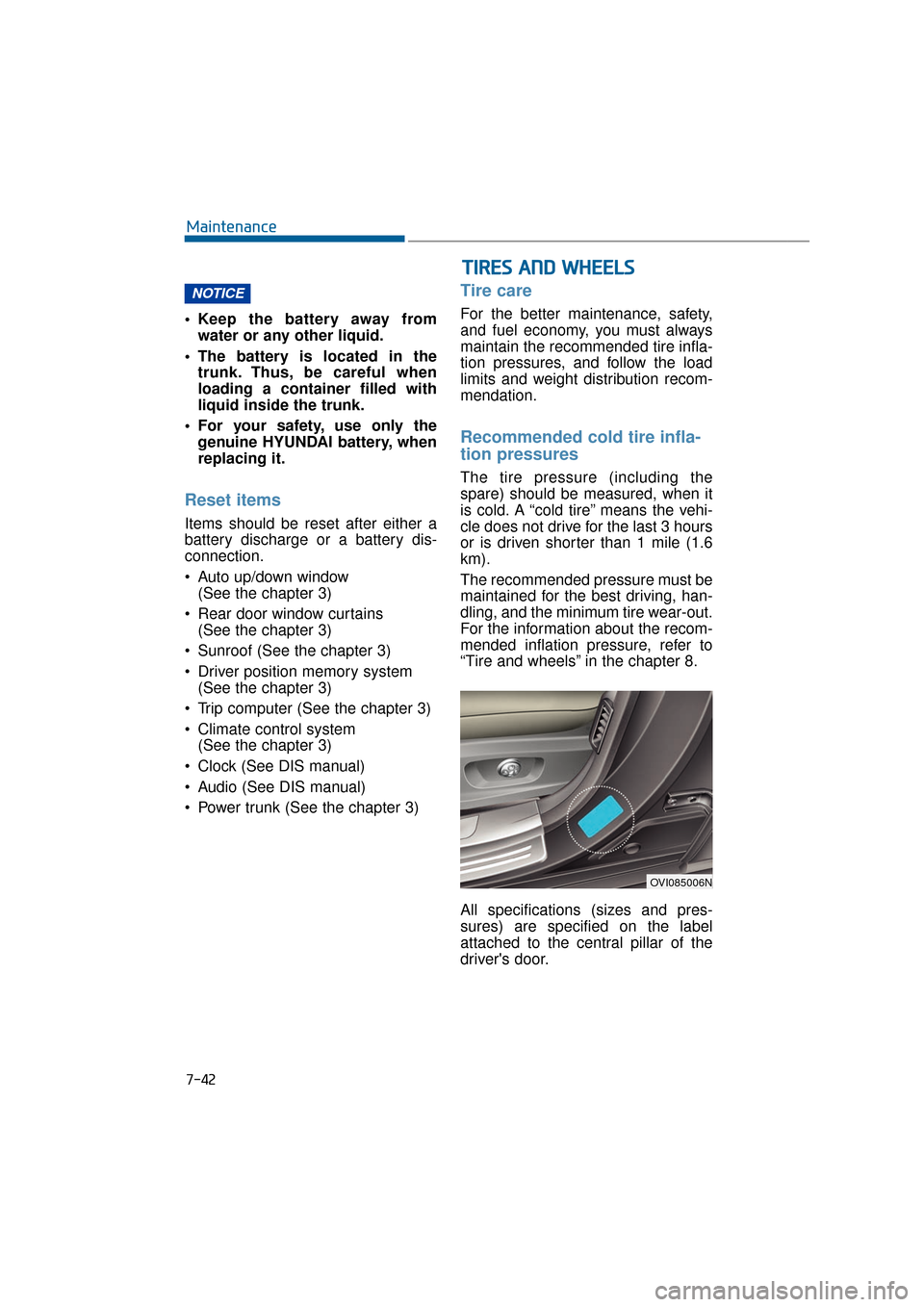
All specifications (sizes and pres-
sures) are specified on the label
attached to the central pillar of the
driver's door.
NOTICE
T T I
IR
R E
ES
S
A
A N
N D
D
W
W H
HE
EE
EL
LS
S
OVI085006N
Page 402 of 477
7-45
Maintenance07
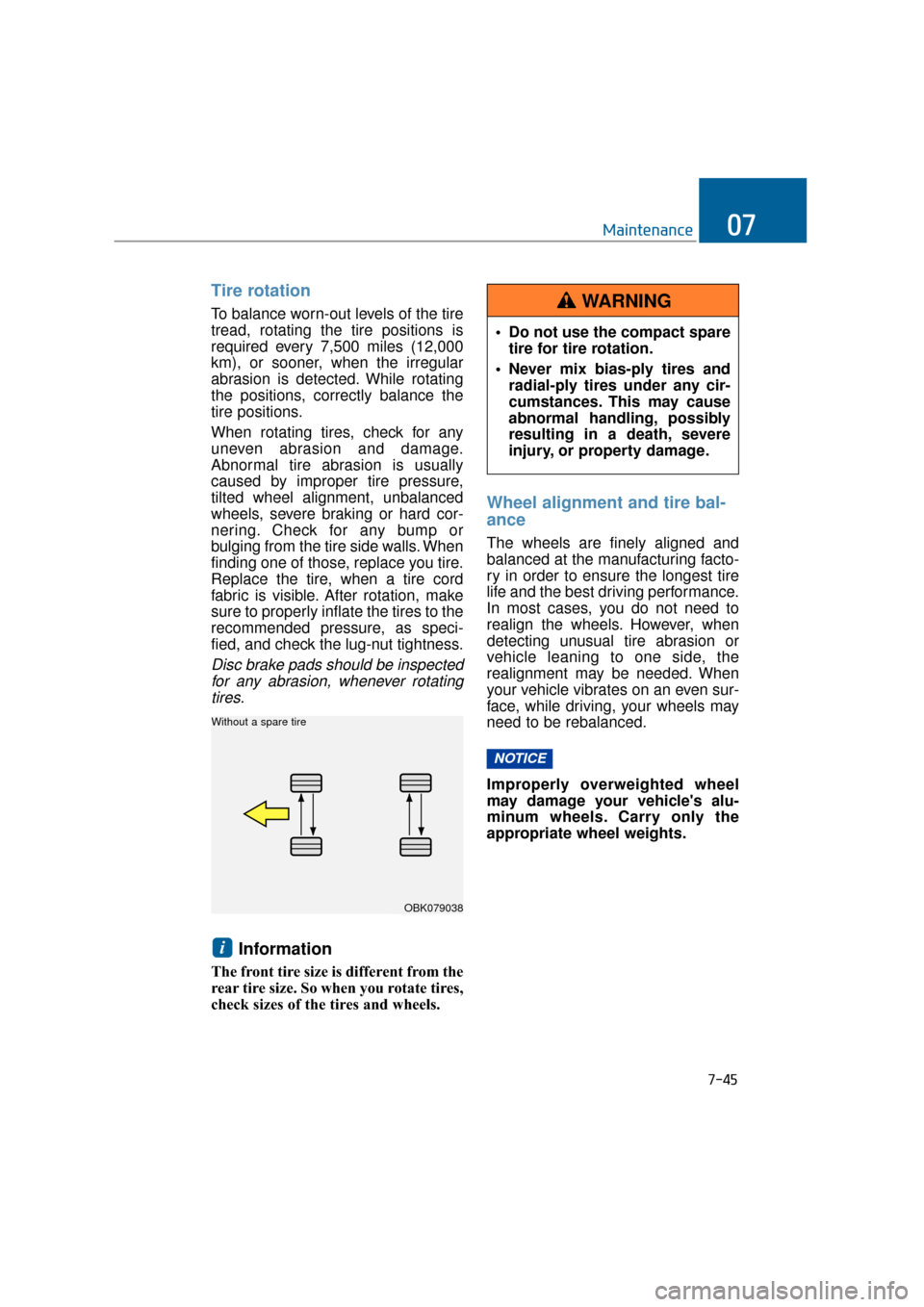
Tire rotation
To balance worn-out levels of the tire
tread, rotating the tire positions is
required every 7,500 miles (12,000
km), or sooner, when the irregular
abrasion is detected. While rotating
the positions, correctly balance the
tire positions.
When rotating tires, check for any
uneven abrasion and damage.
Abnormal tire abrasion is usually
caused by improper tire pressure,
tilted wheel alignment, unbalanced
wheels, severe braking or hard cor-
nering. Check for any bump or
bulging from the tire side walls. When
finding one of those, replace you tire.
Replace the tire, when a tire cord
fabric is visible. After rotation, make
sure to properly inflate the tires to the
recommended pressure, as speci-
fied, and check the lug-nut tightness.
Disc brake pads should be inspectedfor any abrasion, whenever rotatingtires.
Information
The front tire size is different from the
rear tire size. So when you rotate tires,
check sizes of the tires and wheels.
Wheel alignment and tire bal-
ance
The wheels are finely aligned and
balanced at the manufacturing facto-
ry in order to ensure the longest tire
life and the best driving performance.
In most cases, you do not need to
realign the wheels. However, when
detecting unusual tire abrasion or
vehicle leaning to one side, the
realignment may be needed. When
your vehicle vibrates on an even sur-
face, while driving, your wheels may
need to be rebalanced.
Improperly overweighted wheel
may damage your vehicle's alu-
minum wheels. Carry only the
appropriate wheel weights.
NOTICE
i
OBK079038
Without a spare tire
Do not use the compact spare
tire for tire rotation.
Never mix bias-ply tires and radial-ply tires under any cir-
cumstances. This may cause
abnormal handling, possibly
resulting in a death, severe
injury, or property damage.
WARNING
Page 409 of 477
7-52
Maintenance
Tire terminology and defini-
tions
Air Pressure:The amount of air
inside a tire, pressing the inside the
tire outwards. Air pressure is meas-
ured in pounds per square inch (psi)
or kilopascal (kPa).
Accessory Weight: This is the com-
bined weights of optional acces-
sories. Some examples of optional
accessories are the automatic trans-
mission, power seats, and air condi-
tioning.
Aspect Ratio: The ratio of a tire
width to a height.
Belt: A rubber coated layer of cords
that is located between the plies and
the tread. Cords may be made from
steel or other reinforcing materials.
Bead: The tire bead contains the
steel wires wrapped with steel cords.
This holds a tire onto a rim. Bias Ply Tire:
This is a pneumatic
tire, in which plies are laid at alter-
nate angles less than 90 degrees on
the tread centerline.
Cold Tire Pressure: This is the
amount of air pressure inside a tire,
measured in pounds per square inch
(psi) or kilopascals (kPa), before the
heat build-up due to driving.
Curb Weight: This is the vehicle
weight with standard and optional
equipment including the full fuel tank,
oil tanks and coolant tanks. However,
this excludes the weight of passen-
gers and loads.
DOT Markings: This code is marked
on a tire side wall, as an indication of
the its compliance with the U.S.
Department of Transportation motor
vehicle safety standards. The DOT
code includes the Tire Identification
Number (TIN), alphanumeric desig-
nator for the manufacturer identifica-
tion, manufacturing plant, brand and
manufacturing date.
GVWR: Gross Vehicle Weight Rating
GAWR FRT: Gross Axle Weight
Rating for the Front Axle.
GAWR RR: Gross Axle Weight
Rating for the Rear axle.
Intended Outboard Sidewall: This
asymmetrical tire side must face out-
wards, while being installed on a
vehicle.
Kilopascal (kPa): The metric unit for
air pressure.
Light Truck (LT) Tire: A tire desig-
nated by its manufacturer as primari-
ly intended for use on lightweight
trucks or multipurpose passenger
vehicles.
Load Ratings: The maximum load
that a tire is rated to carry for a given
inflation pressure.
• It is difficult to recognize a tire
damage only with your eyes.
When there is a slight hint of a
tire damage, check and
replace the tire to prevent the
damage caused by air leak-
age.
When a tire is damaged while driving on a rough road, off a
road, or over obstacles, such
as a pothole, manhole, or curb
stone, your warranty does not
cover the damage.
The tire information is speci- fied on the tire side wall.
CAUTION
Page 410 of 477
7-53
Maintenance07
Load Index:The numerical index,
on a scale of 1 to 279, to indicate a
tire loading capacity.
Maximum Inflation Pressure: The
maximum air pressure to which a
cold tire may be inflated. The maxi-
mum air pressure information is
specified on a tire side wall.
Maximum Load Rating: The load-
ing capacity for a tire, which is inflat-
ed to the maximum.
Maximum Loaded Vehicle Weight:
The sum of curb weight; accessory
weight; vehicle capacity weight; and
production options weight.
Normal Occupant Weight: The mul-
tiplication of the designated occu-
pant seat number by 150 pounds (68
kg).
Occupant Distribution: Designated
seating positions.
Outward Facing Sidewall: The side
of a asymmetrical tire that has a par-
ticular side that faces outward when
mounted on a vehicle. The outward
facing sidewall bears white lettering
or bears manufacturer, brand, and/or
model name molding that is higher or
deeper than the same moldings on
the inner facing sidewall.
Passenger (P-Metric) Tire: This tire
is for a passenger vehicle, a light
truck or a multipurpose vehicle.
Ply: A layer of rubber-coated parallel
cords
Pneumatic Tire: A mechanical
device made of rubber, chemicals,
fabric and steel or other materials,
that, when mounted on an automo-
tive wheel, provides the traction and
contains the gas or fluid that sustains
the load. Production Options Weight:
The
combined weight of installed regular
production options weighing over 5
lb.(2.3 kg) in excess of the standard
items which they replace, not previ-
ously considered in curb weight or
accessory weight, including heavy
duty brakes, ride levelers, roof rack,
heavy duty battery, and special trim.
Recommended Inflation Pressure:
Vehicle manufacturer's recommend-
ed pressure to inflate a tire. This is
specified on a tire placard.
Radial Ply Tire: A pneumatic tire in
which the ply cords that extend to the
beads are laid at 90 degrees to the
centerline of the tread.
Rim: A metal support for a tire and
upon which the tire beads are seat-
ed.
Sidewall: The portion of a tire
between the tread and the bead.
Speed Rating: An alphanumeric
code to indicate the maximum speed
to which a tire can operate.
Traction: The friction between a tire
and a road surface. The amount of
grip provided.
Tread: The contacting portion of a
tire with the road.
Treadwear Indicators: This is a nar-
row band, sometimes called "wear
bars." This appears across the tread,
when only 2/32 inch of tread
remains.
UTQGS: The Uniform Tire Quality
Grading Standards is the information
of traction, temperature and tread
abrasion. A rating is measured by a
tire manufacturer in accordance with
the government-specified testing
procedure. The rating information is
specified on the tire side wall.
Page 411 of 477
7-54
Maintenance
Vehicle Capacity Weight: The mul-
tiplication of the designated occu-
pant seat number by 150 pounds (68
kg) plus the loading weight.
Vehicle Maximum Load on the
Tire: Loading capacity for an individ-
ual tire. The curb and accessory
weights plus the maximum occupant
and loading weights.
Vehicle Normal Load on the Tire:
Loading capacity for an individual
axle. The sum of the curb, accessory,
and normal occupant weights is
divided by 2.
Vehicle Placard: A label, perma-
nently attached to a vehicle, to indi-
cate the original equipment tire size
and the recommended inflation pres-
sure.
All season tires
HYUNDAI designated some models
of all-season tires to provide good
performance for use all year round,
including snowy and icy road condi-
tions. All-season tires are identified
by ALL SEASON and/or M+S (Mud
and Snow) on the tire side wall.
Snow tires have better snow traction
than all season tires and may be
more appropriate in some areas.
Summer tires
HYUNDAI designated some models
of summer tires to provide superior
performance on dry roads. Summer
tire performance is substantially
reduced in snow and ice. Summer
tires do not have a tire traction rating
mark, M+S (Mud and Snow), on the
tire side wall. Before driving in snowy
or icy conditions, it is recommended
to install snow tires or all-season
tires on all four wheels.
Snow tires
When equipping your vehicle with
snow tires, the tires should be in the
same size and have the same load
capacity as the original ones. Snow
tires should be installed on all four
wheels. Otherwise, it may cause
poor handling. Snow tires should be
more inflated by 4 psi (28 kPa) than
the lesser of the two recommended
pressures - one specified on the tire
label attached to the central pillar on
the driver's side, and the other spec-
ified on the tire side wall.
Do not drive faster than 75 mph (120
km/h) when your car is equipped with
snow tires.
- Snow or ice
When driving on a snowy or icy road, drive slower than 20
mph (30 km/h).
Use the SAE “S” class or wire chains.
When you hear chain-rattling noise, retighten the chain to
avoid its contact with the
vehicle body.
To prevent damage to the vehicle body, retighten the
chains after driving 0.3~0.6
miles (0.5~1.0 km).
Do not use tire chains on a vehicle equipped with alu-
minum wheels. In unavoidable
circumstance, use the wire-
type chains.
Use the wire chains, of which the diameter is less than 0.47
inches (12 mm), to prevent
damage to the chain connect-
ing parts.
WARNING
Page 473 of 477

Vanity mirror lamp ........................................................................\
....................3-120
Vehicle break-in process ........................................................................\
.............F-11
Vehicle certification label........................................................................\
..............8-6
Vehicle data collection and event data recorders................................................F-12
Vehicle identification number (VIN) ....................................................................8-6
Vehicle load limitCertification label ........................................................................\
.................5-80
Tire and loading information label...............................................................5-76
Vehicle weight ........................................................................\
.............................5-82
Warning light ........................................................................\
...............................3-89
Warning Messages.........................................................\
......................................3-78
Washer fluid ........................................................................\
................................7-32
Welcome system........................................................................\
........................3-121 Headllamp ........................................................................\
..........................3-121
Interior light ........................................................................\
......................3-121
Puddle lamp ........................................................................\
.......................3-121
Wheel alignment and tire balance.......................................................................7\
-45
Wheel replacement ........................................................................\
......................7-47
Windows........................................................................\
......................................3-28 Power window lock button................................................\
...........................3-32
Rear door window curtains ........................................................................\
..3-31
Windshield defrosting and defogging ...............................................................3-138
Windshield washer ........................................................................\
....................3-117
Windshield wipers ........................................................................\
.....................3-115
Winter driving ........................................................................\
.............................5-72 Snow tires ........................................................................\
.............................5-72
Tire chains ........................................................................\
............................5-73
Wiper blades........................................................................\
................................7-36
Wipers and washer ........................................................................\
....................3-115 Windshield washer ........................................................................\
.............3-117
Windshield wipers ........................................................................\
.............3-115
I-15
IndexI
V
W