warning Hyundai Equus 2016 Owner's Manual
[x] Cancel search | Manufacturer: HYUNDAI, Model Year: 2016, Model line: Equus, Model: Hyundai Equus 2016Pages: 477, PDF Size: 16.25 MB
Page 407 of 477
7-50
Maintenance
4. Tire ply composition andmaterial
There are a number of layers or plies
of rubber-coated fabrics in the tire.
Tire manufacturers indicate the
materials on the tire, such as steel,
nylon and polyester. The letter "R"
means radial ply construction; the
letter "D" means diagonal or bias ply
construction; and the letter "B"
means belted-bias ply construction.
5. Maximum permissible infla-tion pressure
This number indicates the air pres-
sure limit of the tire. Do not inflate the
tire over the maximum pressure.
Refer to "Tire and Loading
Information Label" for the recom-
mended inflation pressure.
6. Maximum load rating
This number indicates the maximum
loading capacity in kilograms or in
pounds that a tire can carry. When
replacing the tires, always use the
tire of the same load rating as the
original one.
7. Uniform tire quality grading
Quality grades can be found where
applicable on the tire sidewall
between tread shoulder and maxi-
mum section width.
For example: TREAD wear 200
TRACTION AA
TEMPERATURE A
Tread wear
The tread wear grade is a compara-
tive rating based on a tire wear-out
rating, which is recorded while being
tested under a controlled condition
on a test course specified by a gov-
ernment. For example, a tire, of
which the tread wear grade is 150,
would wear out one-and-a half times
(1½) faster than a tire graded 100.
The actual tread wear rating
depends on the actual driving condi-
tions. In addition, the actual tread
wear rating may significantly vary
from the tread wear grade due to a
lot of variations, such as driving
habits, maintenance conditions, road
characteristics and climates.
These grades are written on the tire
side wall of a passenger vehicle. The
available tires with the standard or
optional equipment may vary with
respect to this grade.
Traction - AA, A, B & C
The traction grades, from the highest
to the lowest, are AA, A, B and C.
Those grades represent the stopping
performance level of a tire measured
on a wet test surface specified by the
government under a controlled con-
dition. A tire marked with the letter, C,
may have poor traction.
The traction grade of a tire is
based on a braking traction test,
while driving straight ahead. The
test does not include accelerat-
ing, cornering, hydroplaning, or
towing situations.
WARNING
Page 408 of 477
7-51
Maintenance07
Temperature -A, B & C
The temperature grades of a tire are
A, B and C, from the highest to the
lowest, representing the heat-resist-
ing and the heat-dissipating capabili-
ty. A tire is tested under a controlled
condition on a specified indoor labo-
ratory test wheel.
Continuous driving at a high temper-
ature may degenerate the tire mate-
rials and reduce the tire life. Also, a
quick temperature increase may
cause a sudden tire failure. A tire
with the grade C just meets the per-
formance level required by the
Federal Vehicle Safety Standard No.
109, which all tires for a passenger
vehicle must meet. Grades A and B
represent a higher performance level
of a tire on the indoor laboratory test
wheel, above the minimum law
requirement.
Low aspect ratio tire
(if equipped)
A low aspect ratio tire, of which the
aspect ratio is lower than 50, is
designed for a sporty-look vehicle.
The low aspect ratio is to optimize
handling and braking. Thus, it may
be uncomfortable to ride and it may
generate noises, in comparison with
a normal tire.
- Tire temperature
The temperature grade for this
tire is established for a tire that
is properly inflated and not
overloaded. Excessive speed,
underinflation, or excessive
loading, either separately or in
combination, can cause heat
build-up and possible sudden
tire failure. This can cause loss
of vehicle control and serious
injury or death.
WARNING
The side wall of a low aspect
ratio tire is shorter than the nor-
mal one. Thus, the low-aspect
wheel and tire are easily dam-
aged. Follow the below instruc-
tions.
When driving on a rough road or driving off a road, be care-
ful not to damage the tires
and wheels. After driving,
inspect the tires and wheels.
When passing over a pothole, speed bump, manhole, or
curb stone, slowly drive the
vehicle not to damage the
tires and wheels.
When there is an impact on a tire, inspect the tire condition.
Or, contact an authorized
EQUUS dealer.
Inspect the tire condition and pressure every 1,800 miles
(3,000 km) to prevent a tire
damage.
CAUTION
Page 411 of 477
7-54
Maintenance
Vehicle Capacity Weight: The mul-
tiplication of the designated occu-
pant seat number by 150 pounds (68
kg) plus the loading weight.
Vehicle Maximum Load on the
Tire: Loading capacity for an individ-
ual tire. The curb and accessory
weights plus the maximum occupant
and loading weights.
Vehicle Normal Load on the Tire:
Loading capacity for an individual
axle. The sum of the curb, accessory,
and normal occupant weights is
divided by 2.
Vehicle Placard: A label, perma-
nently attached to a vehicle, to indi-
cate the original equipment tire size
and the recommended inflation pres-
sure.
All season tires
HYUNDAI designated some models
of all-season tires to provide good
performance for use all year round,
including snowy and icy road condi-
tions. All-season tires are identified
by ALL SEASON and/or M+S (Mud
and Snow) on the tire side wall.
Snow tires have better snow traction
than all season tires and may be
more appropriate in some areas.
Summer tires
HYUNDAI designated some models
of summer tires to provide superior
performance on dry roads. Summer
tire performance is substantially
reduced in snow and ice. Summer
tires do not have a tire traction rating
mark, M+S (Mud and Snow), on the
tire side wall. Before driving in snowy
or icy conditions, it is recommended
to install snow tires or all-season
tires on all four wheels.
Snow tires
When equipping your vehicle with
snow tires, the tires should be in the
same size and have the same load
capacity as the original ones. Snow
tires should be installed on all four
wheels. Otherwise, it may cause
poor handling. Snow tires should be
more inflated by 4 psi (28 kPa) than
the lesser of the two recommended
pressures - one specified on the tire
label attached to the central pillar on
the driver's side, and the other spec-
ified on the tire side wall.
Do not drive faster than 75 mph (120
km/h) when your car is equipped with
snow tires.
- Snow or ice
When driving on a snowy or icy road, drive slower than 20
mph (30 km/h).
Use the SAE “S” class or wire chains.
When you hear chain-rattling noise, retighten the chain to
avoid its contact with the
vehicle body.
To prevent damage to the vehicle body, retighten the
chains after driving 0.3~0.6
miles (0.5~1.0 km).
Do not use tire chains on a vehicle equipped with alu-
minum wheels. In unavoidable
circumstance, use the wire-
type chains.
Use the wire chains, of which the diameter is less than 0.47
inches (12 mm), to prevent
damage to the chain connect-
ing parts.
WARNING
Page 413 of 477
7-56
Maintenance
A vehicle’s electrical system is pro-
tected from a possible electrical
overloading damage by fuses.
This vehicle has 4 fuse panels - two
on the driver’s side, another on the
panel bolster of the passenger's
side, and the other in the engine
compartment.
When any of your lights, acces-
sories, or controls does not operate,
check the appropriate circuit fuse.
When a fuse is out, some elements
may melt inside.
When the electrical system does not
operate, check the fuse panel on the
driver's side first.
Before replacing the fuse, disconnect
the negative battery cable. Always
replace it with a fuse of the same rat-
ing. When the newly-replaced fuse
blows, there may be an electrical
problem. Avoid using any pertinent
systems. Immediately consult an
authorized EQUUS dealer.
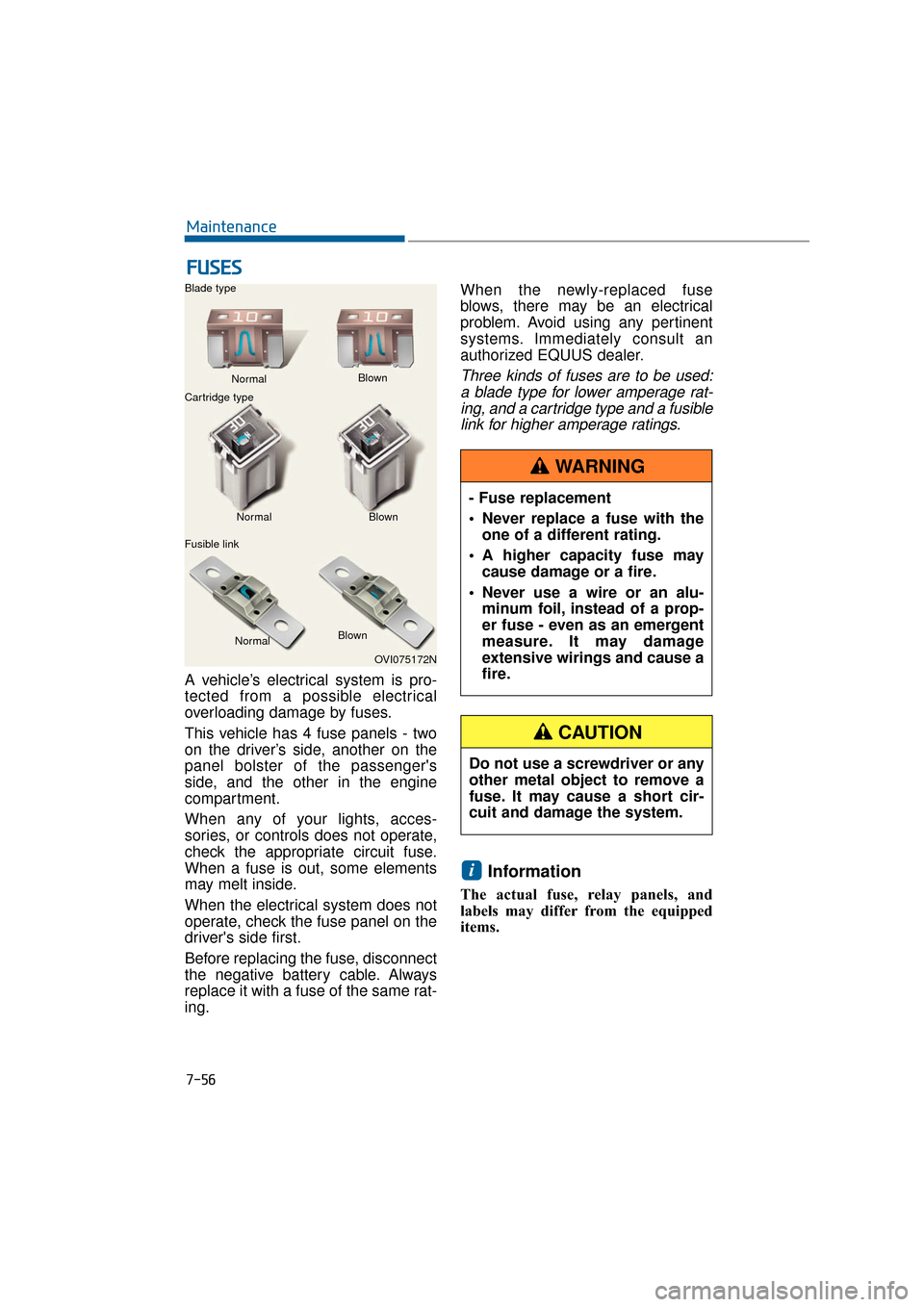
Three kinds of fuses are to be used:
a blade type for lower amperage rat-ing, and a cartridge type and a fusiblelink for higher amperage ratings.
Information
The actual fuse, relay panels, and
labels may differ from the equipped
items.
i
F F U
U S
SE
E S
S
OVI075172N
Normal
Normal
Blade type
Cartridge type
Fusible link Blown
Blown
Normal Blown
- Fuse replacement
Never replace a fuse with the
one of a different rating.
A higher capacity fuse may cause damage or a fire.
Never use a wire or an alu- minum foil, instead of a prop-
er fuse - even as an emergent
measure. It may damage
extensive wirings and cause a
fire.
WARNING
Do not use a screwdriver or any
other metal object to remove a
fuse. It may cause a short cir-
cuit and damage the system.
CAUTION
Page 426 of 477
7-69
Maintenance07
L
LI
IG
G H
H T
T
B
B U
U L
LB
B S
S
Use only the bulbs of the specified
wattage.
Make sure to replace the burned-
out bulb with a new one of the
same wattage rating. Otherwise, it
may cause damage to a fuse or an
electric wiring system.
When you are not equipped with
necessary tools, the appropriate
bulbs and the expertise, consult an
authorized EQUUS dealer. In many
cases, it is difficult to replace vehi-
cle light bulbs, because some parts
of the vehicle must be disassem-
bled before getting to the bulb. This
is especially true when disassem-
bling to replace the headlamp
bulb(s). Removing/installing the
headlamp assembly may damage
your vehicle.
Information
After heavy rain or vehicle washing,
headlamp and taillight lenses may
appear to be frosty. This is caused by
the temperature difference between
the lamp inside and outside. This is
similar to the dew condensation on
your windows inside while raining.
This does not indicate a problem with
your vehicle. When water penetrates
into the lamp circuitry, have the vehi-
cle checked by an authorized EQUUS
dealer.
i
NOTICE
NOTICE
- Working on the lights
Before working on the light,
firmly set the parking brake,
turn the ignition switch to the
LOCK position, and turn OFF
the lights. These are to prevent
a sudden vehicle movement,
burning your fingers or an elec-
tric shock.
WARNING
Page 429 of 477
7-72
Maintenance
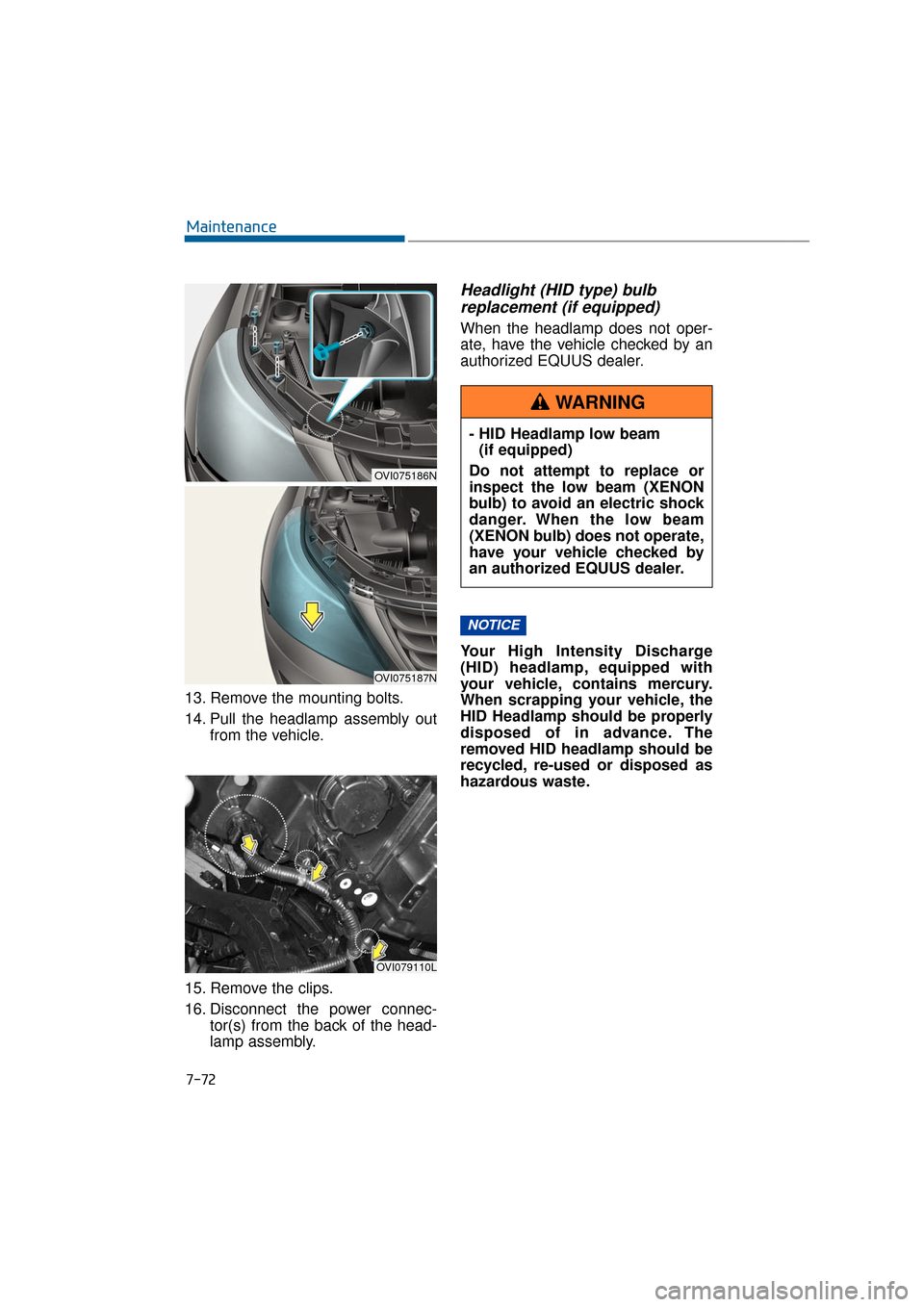
13. Remove the mounting bolts.
14. Pull the headlamp assembly out from the vehicle.
15. Remove the clips.
16. Disconnect the power connec- tor(s) from the back of the head-
lamp assembly.
Headlight (HID type) bulbreplacement (if equipped)
When the headlamp does not oper-
ate, have the vehicle checked by an
authorized EQUUS dealer.
Your High Intensity Discharge
(HID) headlamp, equipped with
your vehicle, contains mercury.
When scrapping your vehicle, the
HID Headlamp should be properly
disposed of in advance. The
removed HID headlamp should be
recycled, re-used or disposed as
hazardous waste.
NOTICE
OVI075186N
OVI075187N
OVI079110L
- HID Headlamp low beam
(if equipped)
Do not attempt to replace or
inspect the low beam (XENON
bulb) to avoid an electric shock
danger. When the low beam
(XENON bulb) does not operate,
have your vehicle checked by
an authorized EQUUS dealer.
WARNING
Page 430 of 477
7-73
Maintenance07
Information
HID lamps have superior perform-
ance in comparison to halogen bulbs.
HID lamps are estimated to last twice
as long as halogen bulbs, or longer, by
the manufacturer, depending on the
usage hours. HID lamps needs to be
replaced at some point within the
vehicle life. Frequent turning the
headlamps ON and OFF shortens the
HID lamps life. HID lamps do not
blow out in the same manner as halo-
gen incandescent lamps. When a
headlamp blows out after a period of
operation, the lamp light gradually
fades away after being turned ON.
Even when the lamp is turned ON by
turning ON the switch, it needs to be
replaced. The HID lamp components
are more complex than the ones of
conventional halogen bulbs. Thus, the
repairing costs are more expensive.
Headlight (bulb type), front turnsignal, position, side markerand fog light bulbs
When a bulb is out, have the vehicle
checked by an authorized EQUUS
dealer.
Headlamp bulb i
OKH073081N.
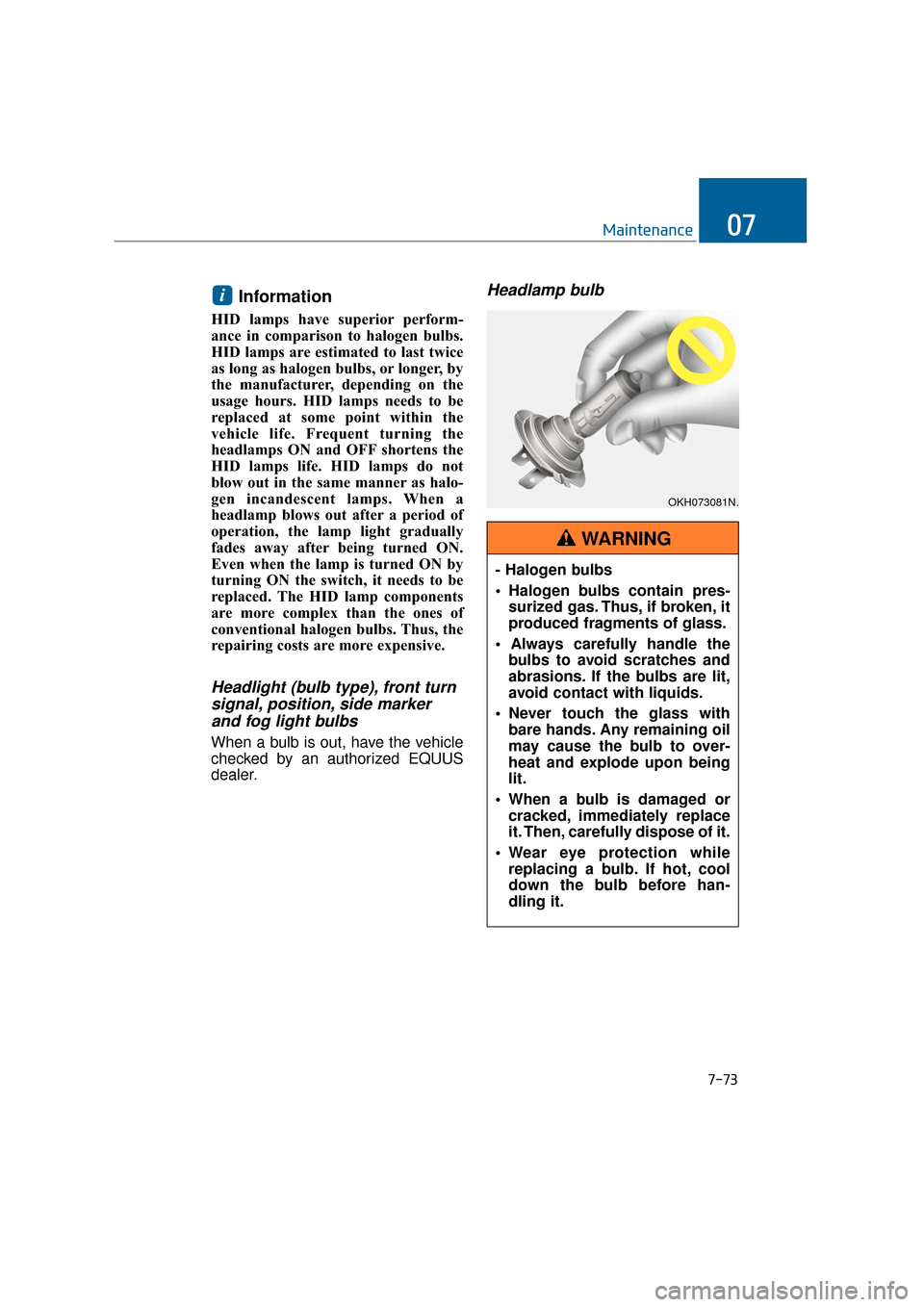
- Halogen bulbs
Halogen bulbs contain pres-
surized gas. Thus, if broken, it
produced fragments of glass.
bulbs to avoid scratches and
abrasions. If the bulbs are lit,
avoid contact with liquids.
Never touch the glass with bare hands. Any remaining oil
may cause the bulb to over-
heat and explode upon being
lit.
When a bulb is damaged or cracked, immediately replace
it. Then, carefully dispose of it.
Wear eye protection while replacing a bulb. If hot, cool
down the bulb before han-
dling it.
WARNING
Page 439 of 477
7-82
Maintenance
Interior light bulb replacement
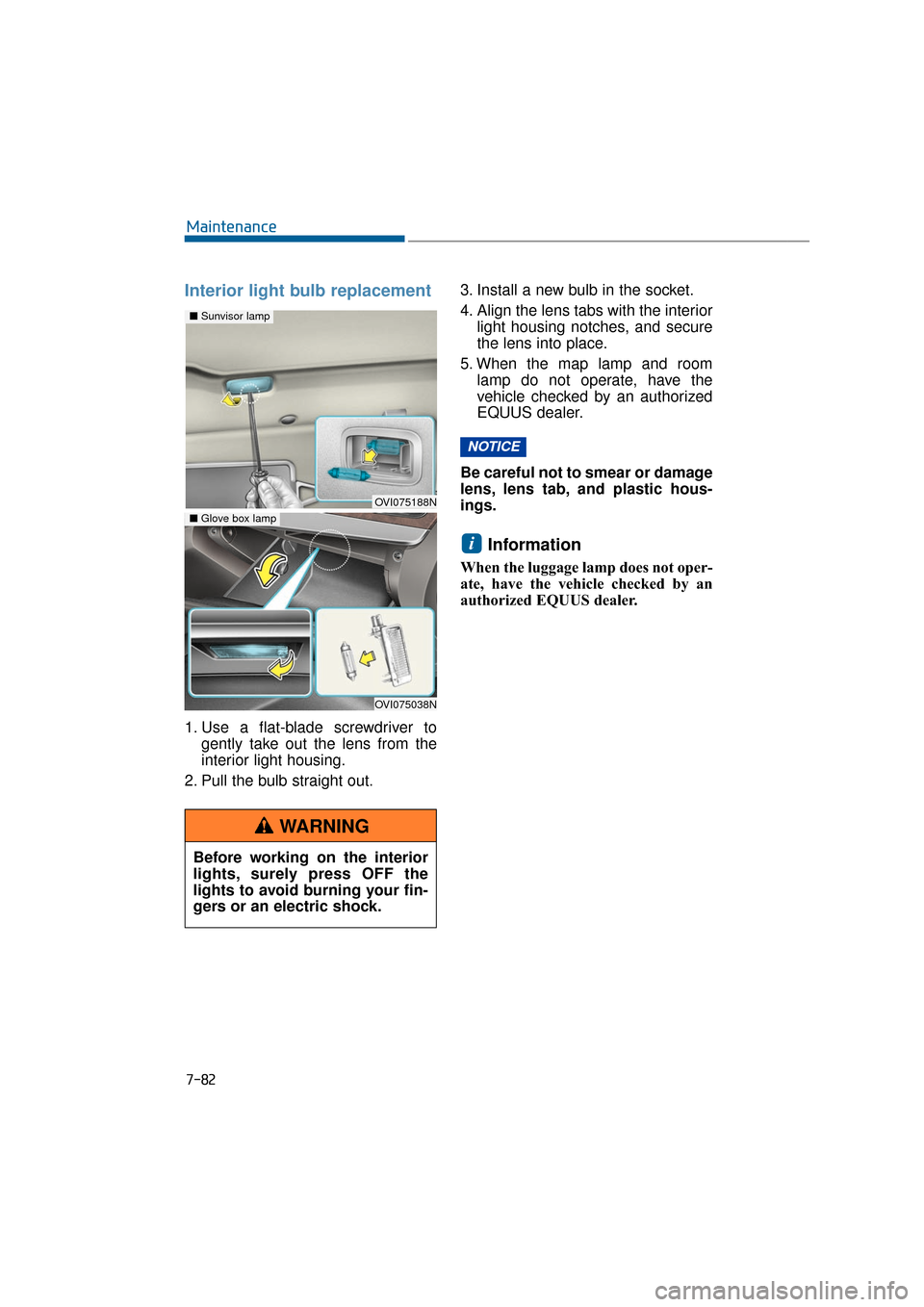
1. Use a flat-blade screwdriver togently take out the lens from the
interior light housing.
2. Pull the bulb straight out. 3. Install a new bulb in the socket.
4. Align the lens tabs with the interior
light housing notches, and secure
the lens into place.
5. When the map lamp and room lamp do not operate, have the
vehicle checked by an authorized
EQUUS dealer.
Be careful not to smear or damage
lens, lens tab, and plastic hous-
ings.
Information
When the luggage lamp does not oper-
ate, have the vehicle checked by an
authorized EQUUS dealer.
i
NOTICE
OVI075188N
■ Sunvisor lamp
OVI075038N
■Glove box lamp
Before working on the interior
lights, surely press OFF the
lights to avoid burning your fin-
gers or an electric shock.
WARNING
Page 440 of 477
7-83
Maintenance07
A
AP
PP
PE
EA
A R
RA
A N
N C
CE
E
C
C A
A R
RE
E
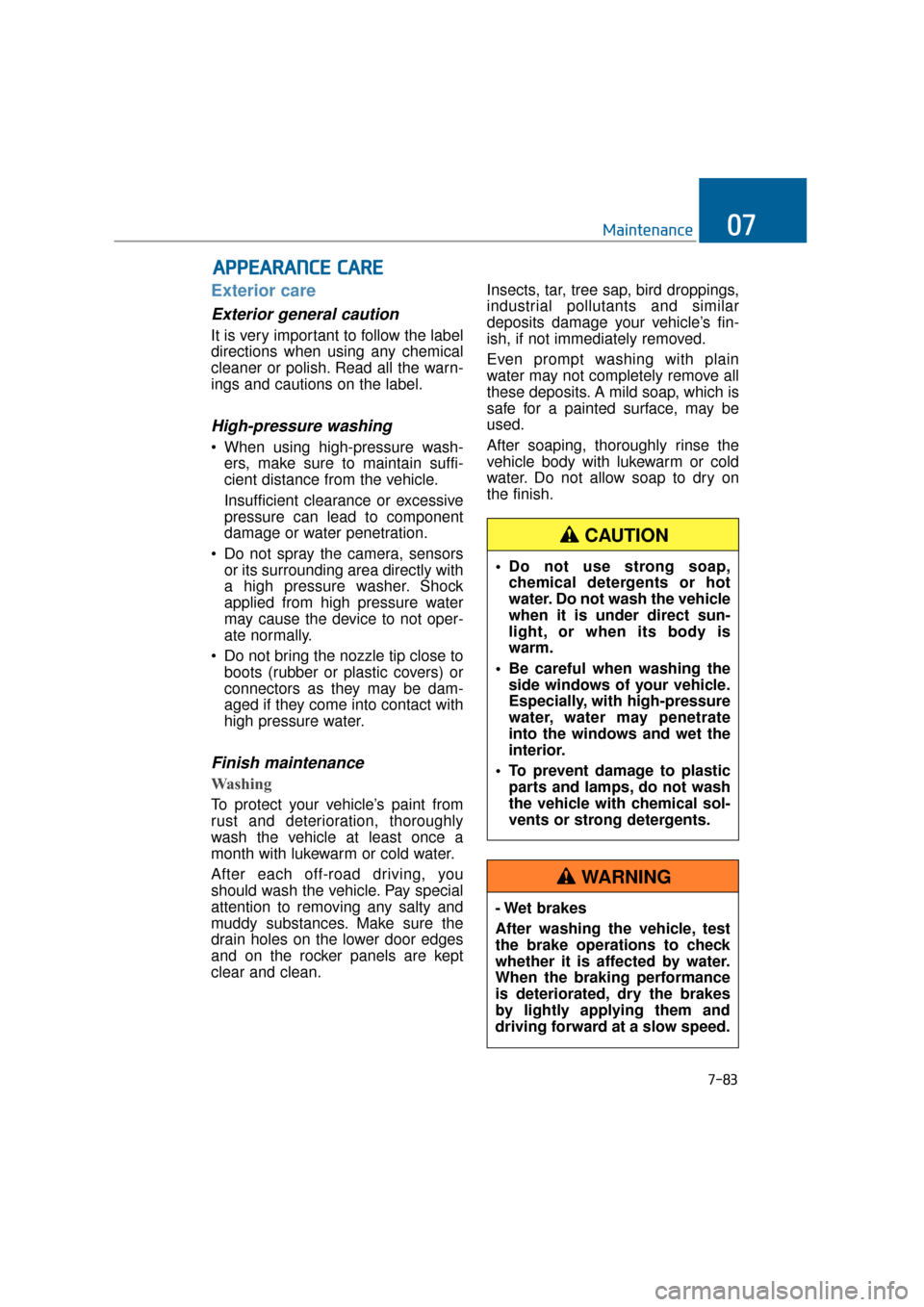
Exterior care
Exterior general caution
It is very important to follow the label
directions when using any chemical
cleaner or polish. Read all the warn-
ings and cautions on the label.
High-pressure washing
• When using high-pressure wash-
ers, make sure to maintain suffi-
cient distance from the vehicle.
Insufficient clearance or excessive
pressure can lead to component
damage or water penetration.
Do not spray the camera, sensors or its surrounding area directly with
a high pressure washer. Shock
applied from high pressure water
may cause the device to not oper-
ate normally.
Do not bring the nozzle tip close to boots (rubber or plastic covers) or
connectors as they may be dam-
aged if they come into contact with
high pressure water.
Finish maintenance
Washing
To protect your vehicle’s paint from
rust and deterioration, thoroughly
wash the vehicle at least once a
month with lukewarm or cold water.
After each off-road driving, you
should wash the vehicle. Pay special
attention to removing any salty and
muddy substances. Make sure the
drain holes on the lower door edges
and on the rocker panels are kept
clear and clean. Insects, tar, tree sap, bird droppings,
industrial pollutants and similar
deposits damage your vehicle’s fin-
ish, if not immediately removed.
Even prompt washing with plain
water may not completely remove all
these deposits. A mild soap, which is
safe for a painted surface, may be
used.
After soaping, thoroughly rinse the
vehicle body with lukewarm or cold
water. Do not allow soap to dry on
the finish.
• Do not use strong soap, chemical detergents or hot
water. Do not wash the vehicle
when it is under direct sun-
light, or when its body is
warm.
Be careful when washing the side windows of your vehicle.
Especially, with high-pressure
water, water may penetrate
into the windows and wet the
interior.
To prevent damage to plastic parts and lamps, do not wash
the vehicle with chemical sol-
vents or strong detergents.
CAUTION
- Wet brakes
After washing the vehicle, test
the brake operations to check
whether it is affected by water.
When the braking performance
is deteriorated, dry the brakes
by lightly applying them and
driving forward at a slow speed.
WARNING
Page 442 of 477
7-85
Maintenance07
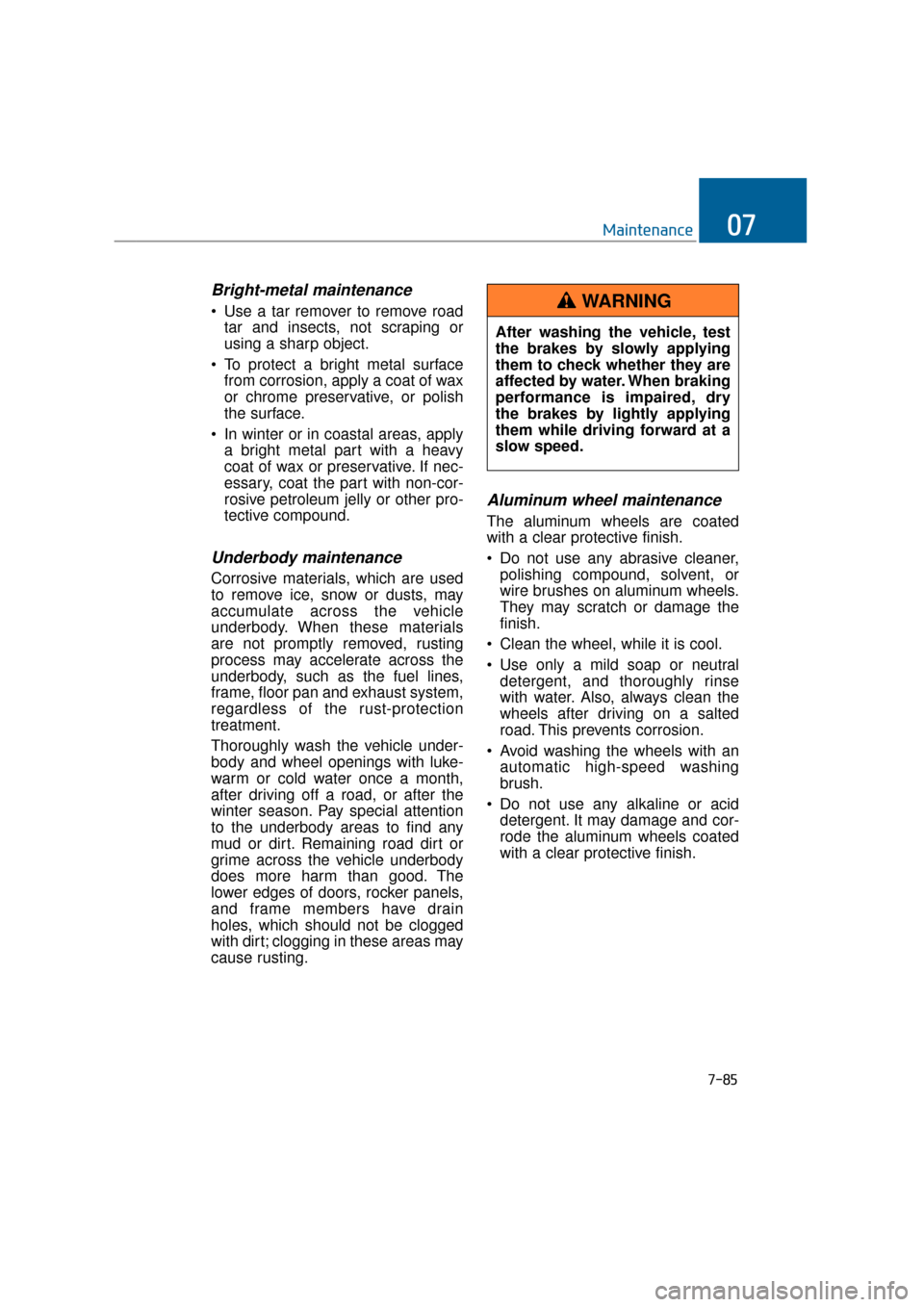
Bright-metal maintenance
Use a tar remover to remove roadtar and insects, not scraping or
using a sharp object.
To protect a bright metal surface from corrosion, apply a coat of wax
or chrome preservative, or polish
the surface.
In winter or in coastal areas, apply a bright metal part with a heavy
coat of wax or preservative. If nec-
essary, coat the part with non-cor-
rosive petroleum jelly or other pro-
tective compound.
Underbody maintenance
Corrosive materials, which are used
to remove ice, snow or dusts, may
accumulate across the vehicle
underbody. When these materials
are not promptly removed, rusting
process may accelerate across the
underbody, such as the fuel lines,
frame, floor pan and exhaust system,
regardless of the rust-protection
treatment.
Thoroughly wash the vehicle under-
body and wheel openings with luke-
warm or cold water once a month,
after driving off a road, or after the
winter season. Pay special attention
to the underbody areas to find any
mud or dirt. Remaining road dirt or
grime across the vehicle underbody
does more harm than good. The
lower edges of doors, rocker panels,
and frame members have drain
holes, which should not be clogged
with dirt; clogging in these areas may
cause rusting.
Aluminum wheel maintenance
The aluminum wheels are coated
with a clear protective finish.
Do not use any abrasive cleaner,polishing compound, solvent, or
wire brushes on aluminum wheels.
They may scratch or damage the
finish.
Clean the wheel, while it is cool.
Use only a mild soap or neutral detergent, and thoroughly rinse
with water. Also, always clean the
wheels after driving on a salted
road. This prevents corrosion.
Avoid washing the wheels with an automatic high-speed washing
brush.
Do not use any alkaline or acid detergent. It may damage and cor-
rode the aluminum wheels coated
with a clear protective finish.
After washing the vehicle, test
the brakes by slowly applying
them to check whether they are
affected by water. When braking
performance is impaired, dry
the brakes by lightly applying
them while driving forward at a
slow speed.
WARNING