warning Hyundai Equus 2016 Owner's Manual
[x] Cancel search | Manufacturer: HYUNDAI, Model Year: 2016, Model line: Equus, Model: Hyundai Equus 2016Pages: 477, PDF Size: 16.25 MB
Page 317 of 477
5-66
Driving your vehicle
Do not "lug" or "over-rev" the engine. Lugging is to drive too
slowly in a high gear, resulting in
the engine bucking. In this case,
shift to a lower gear. Over-revving
is racing the engine beyond its safe
limit. This can be avoided by decel-
erating to a recommended speed.
Use your air conditioning at inter- vals. The air conditioning system
operates by engine power. Thus,
your fuel economy will decline,
when turning it ON.
Opening the windows, while driv- ing at a high speed, may reduce
the fuel economy.
The fuel economy will decline in the crosswind and headwind. To
offset some of this loss, slow down
the driving speed.
Keeping a vehicle in good operating
condition is important both for the
fuel economy and safety. Therefore,
have your vehicle inspected and
maintained by an authorized EQUUS
dealer on a regular basis. - Turning the engine OFF while
driving
Never turn the engine OFF to
coast down hills or anytime the
vehicle is in motion. The power
steering and power brakes will
not properly operate, when the
engine is turned OFF. Keep the
engine ON and downshift to an
appropriate gear for engine
braking effect. Moreover, turn-
ing OFF the ignition, while driv-
ing, may lock the steering
wheel, blocking the steer wheel
movement and causing a seri-
ous injury or death.
WARNING
Page 318 of 477
5-67
Driving your vehicle05
Hazardous driving conditions
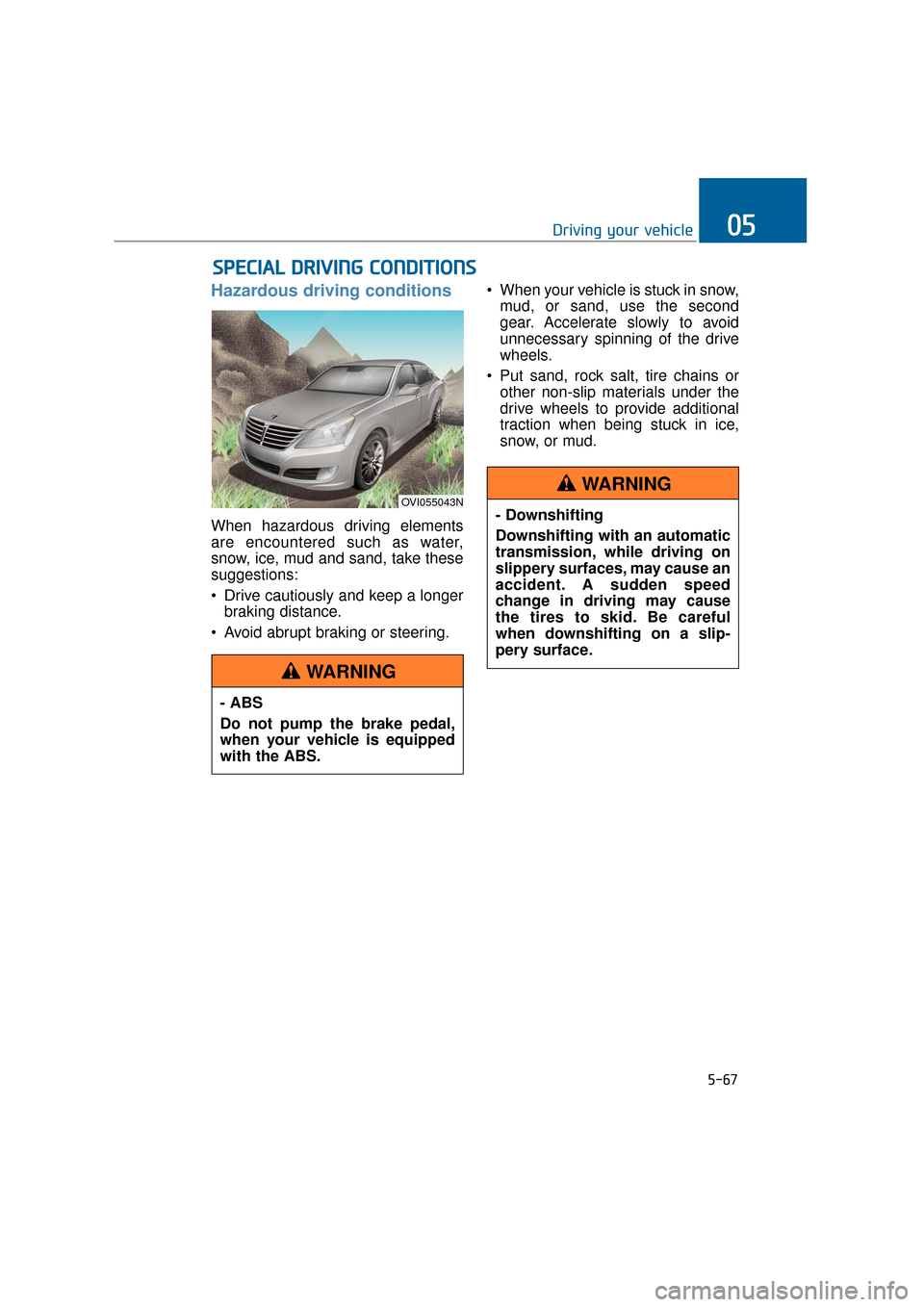
When hazardous driving elements
are encountered such as water,
snow, ice, mud and sand, take these
suggestions:
Drive cautiously and keep a longerbraking distance.
Avoid abrupt braking or steering. When your vehicle is stuck in snow,
mud, or sand, use the second
gear. Accelerate slowly to avoid
unnecessary spinning of the drive
wheels.
Put sand, rock salt, tire chains or other non-slip materials under the
drive wheels to provide additional
traction when being stuck in ice,
snow, or mud.
S SP
P E
EC
CI
IA
A L
L
D
D R
RI
IV
V I
IN
N G
G
C
C O
O N
ND
DI
IT
T I
IO
O N
NS
S
OVI055043N
- ABS
Do not pump the brake pedal,
when your vehicle is equipped
with the ABS.
WARNING
- Downshifting
Downshifting with an automatic
transmission, while driving on
slippery surfaces, may cause an
accident. A sudden speed
change in driving may cause
the tires to skid. Be careful
when downshifting on a slip-
pery surface.
WARNING
Page 319 of 477
5-68
Driving your vehicle
Rocking the vehicle
When it is necessary to rock the
vehicle to escape from snow, sand,
or mud, first move the steering wheel
from side to side to clear the front-
wheel area. Then, move the shift
lever back and forth between
R(Reverse) and any forward gears.
Do not race the engine, and avoid
unnecessary wheel spins. When
your vehicle is still stuck in after try-
ing the above, have the vehicle
pulled out by a tow truck to avoid
engine overheating and transmission
damages.
A long-time rocking may overheat
the engine and damage the trans-
mission/tires.
Information
The ESC system must be turned OFF
before rocking the vehicle.
i
NOTICE
- Spinning tires
Do not spin the wheels, espe-
cially faster than 35 mph (56
km/h). Spinning the wheels at a
high speed, while parking, may
overheat a tire and injure
passers-by.
WARNING
When your vehicle is stuck in
snow, mud, sand, etc., you may
rock the vehicle to escape by
moving forwards and back-
wards. Do not attempt this,
when people or objects are any-
where near the vehicle. Rocking
the vehicle may cause it to sud-
denly move forwards or back-
wards, as it becomes unstuck,
injuring nearby people or dam-
aging objects.
WARNING
Page 322 of 477
5-71
Driving your vehicle05
Highway driving
Tires
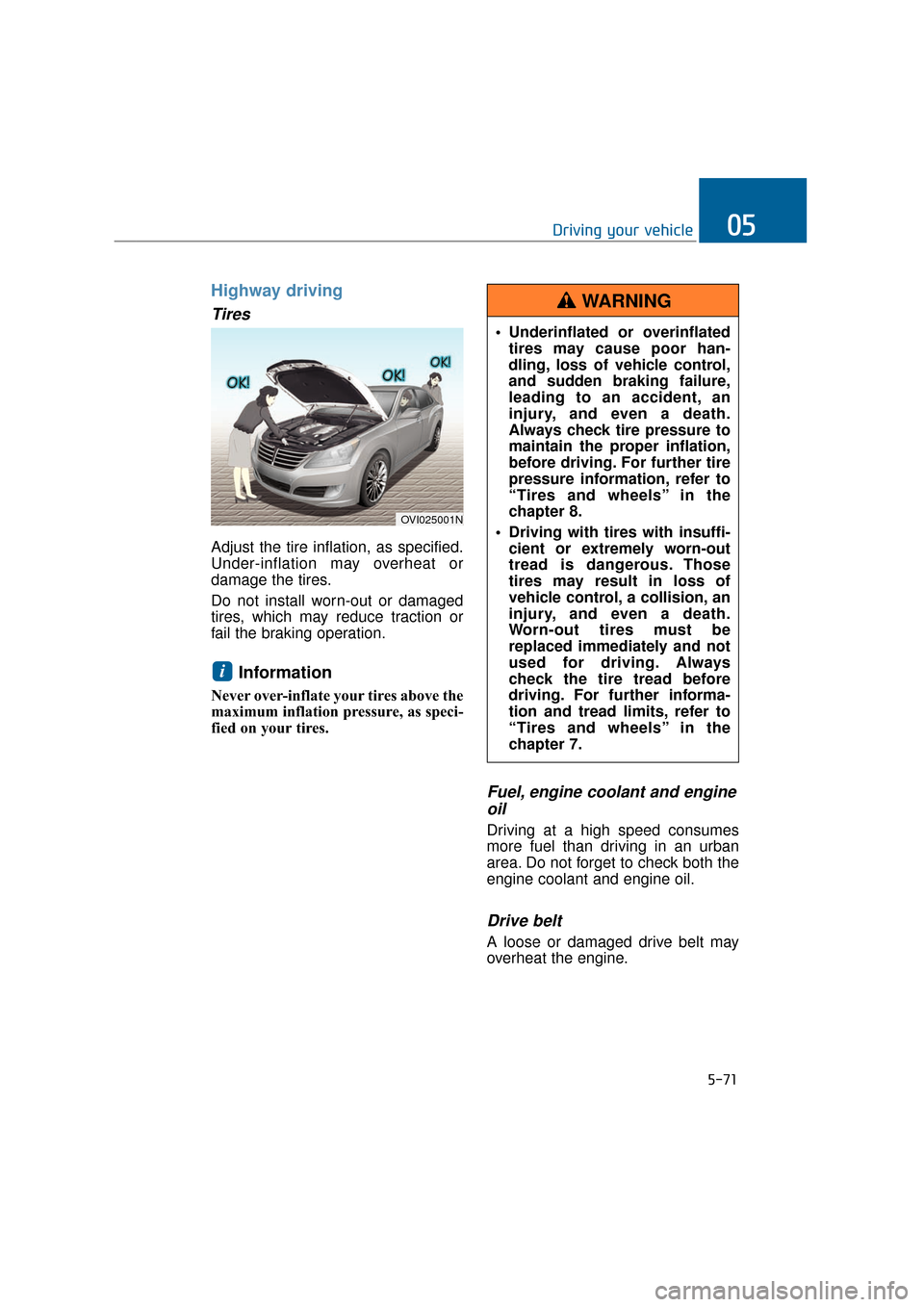
Adjust the tire inflation, as specified.
Under-inflation may overheat or
damage the tires.
Do not install worn-out or damaged
tires, which may reduce traction or
fail the braking operation.
Information
Never over-inflate your tires above the
maximum inflation pressure, as speci-
fied on your tires.
Fuel, engine coolant and engineoil
Driving at a high speed consumes
more fuel than driving in an urban
area. Do not forget to check both the
engine coolant and engine oil.
Drive belt
A loose or damaged drive belt may
overheat the engine.
i
OVI025001N
Underinflated or overinflated
tires may cause poor han-
dling, loss of vehicle control,
and sudden braking failure,
leading to an accident, an
injury, and even a death.
Always check tire pressure to
maintain the proper inflation,
before driving. For further tire
pressure information, refer to
“Tires and wheels” in the
chapter 8.
Driving with tires with insuffi- cient or extremely worn-out
tread is dangerous. Those
tires may result in loss of
vehicle control, a collision, an
injury, and even a death.
Worn-out tires must be
replaced immediately and not
used for driving. Always
check the tire tread before
driving. For further informa-
tion and tread limits, refer to
“Tires and wheels” in the
chapter 7.
WARNING
Page 323 of 477
5-72
Driving your vehicle
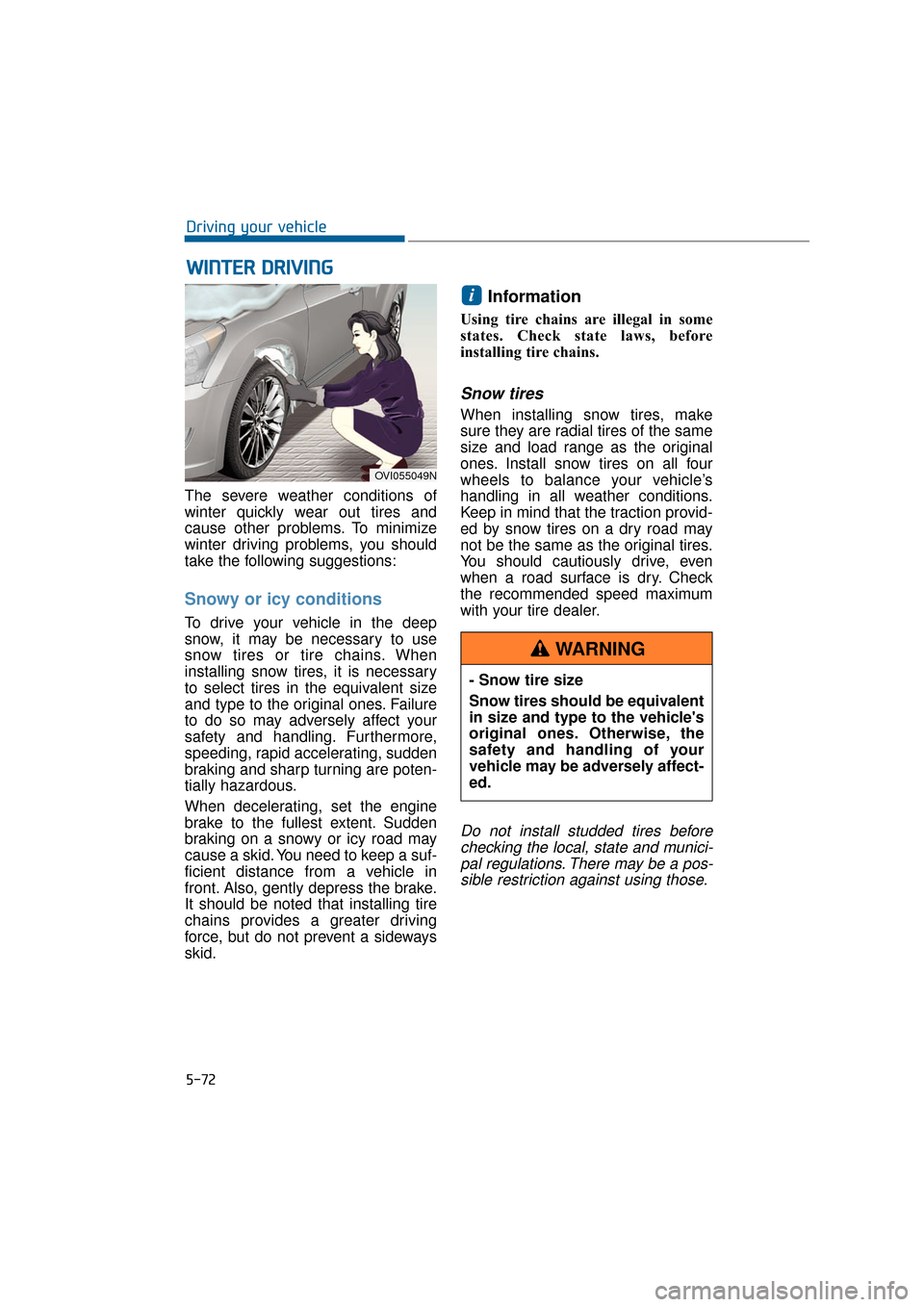
The severe weather conditions of
winter quickly wear out tires and
cause other problems. To minimize
winter driving problems, you should
take the following suggestions:
Snowy or icy conditions
To drive your vehicle in the deep
snow, it may be necessary to use
snow tires or tire chains. When
installing snow tires, it is necessary
to select tires in the equivalent size
and type to the original ones. Failure
to do so may adversely affect your
safety and handling. Furthermore,
speeding, rapid accelerating, sudden
braking and sharp turning are poten-
tially hazardous.
When decelerating, set the engine
brake to the fullest extent. Sudden
braking on a snowy or icy road may
cause a skid. You need to keep a suf-
ficient distance from a vehicle in
front. Also, gently depress the brake.
It should be noted that installing tire
chains provides a greater driving
force, but do not prevent a sideways
skid.
Information
Using tire chains are illegal in some
states. Check state laws, before
installing tire chains.
Snow tires
When installing snow tires, make
sure they are radial tires of the same
size and load range as the original
ones. Install snow tires on all four
wheels to balance your vehicle’s
handling in all weather conditions.
Keep in mind that the traction provid-
ed by snow tires on a dry road may
not be the same as the original tires.
You should cautiously drive, even
when a road surface is dry. Check
the recommended speed maximum
with your tire dealer.
Do not install studded tires before checking the local, state and munici-pal regulations. There may be a pos-sible restriction against using those.
i
W W I
IN
N T
TE
ER
R
D
D R
RI
IV
V I
IN
N G
G
OVI055049N
- Snow tire size
Snow tires should be equivalent
in size and type to the vehicle's
original ones. Otherwise, the
safety and handling of your
vehicle may be adversely affect-
ed.
WARNING
Page 325 of 477
5-74
Driving your vehicle
An AutoSock, which is in the wrong size or is improperly
installed, may damage brake
lines, suspension, body and
wheels of your vehicle.
Stop driving and retighten the AutoSock, whenever there are
snapping sounds between the
vehicle and the AutoSock.
Use high quality ethylene gly-
col coolant
The cooling system of your vehicle is
filled with the high-quality ethylene
glycol coolant when being delivered.
It is the only type of coolant that your
vehicle is filled with, because it pre-
vents corrosion of the cooling sys-
tem, lubricates the water pump and
prevents freezing. Refill the cooling
system in accordance with your
maintenance schedule in the chapter
7. Before winter, check your coolant
to assure that the freezing point is
sufficiently lower than the expected
winter temperature.
Check battery and cables
The winter temperature increases
the battery consumption. Inspect the
battery and cables, as described in
the chapter 7. The battery charging
level can be checked by an author-
ized EQUUS dealer or in a service
station.
Change to "winter weight" oil,
if necessary
In some regions during the cold win-
ter, it is recommended to use the
"winter weight" oil with lower viscosi-
ty. For further information about this,
refer to the chapter 8. When you can-
not be sure about a type of winter
weight oil, consult an authorized
EQUUS dealer.
Check spark plugs and ignition
system
Inspect your spark plugs and, if nec-
essary, replace them. Also check all
ignition wirings and components for
any cracks, wear-out, and damage.
NOTICE
- Chain installation
When installing the AutoSock,
park the vehicle on level ground
away from other vehicles. Press
ON the Hazard Warning flasher
and place a warning triangle
behind your vehicle, if available.
Place the shift lever in P(Park),
set the parking brake and turn
OFF the engine, before
installing the AutoSock.
WARNING
- Tire chains
The use of the AutoSock may
adversely affect vehicle han-
dling.
Do not drive faster than the lower of the two - 20 mph (30
km/h) and the AutoSock manu-
facturer’s recommended
speed limit.
Drive carefully and avoid bumps, holes, sharp turns, and
other road hazards, which may
bounce the vehicle.
Avoid turning sharply or lock- ing the wheel brake.
WARNING
Page 331 of 477
5-80
Driving your vehicle
Certification label
The certification label is located on
right side of the driver's door sill.
This label shows the maximum
weight capacity, or called GVWR
(Gross Vehicle Weight Rating). The
GVWR includes the weight of the
vehicle, all occupants, fuel, and load.
This label also tells you the maxi-
mum weight that can be supported
by the front and rear axles, called
Gross Axle Weight Rating (GAWR).
To find out the actual load weight of
the front and rear axles, you need to
weigh your vehicle. Your dealer can
help you with this. Equally and even-
ly spread out the loads across the
centerline.The label will help you decide how
much loads and installed equipment
your vehicle can carry.
When your vehicle carries items
inside, such as suitcases, tools and
packages, those loads move as fast
as your vehicle. When stopping or
sharply turning, or if there is a crash,
those loads may throw forwards
under the influence of inertia, and
cause an injury by hitting with the
driver or an occupant.
OBH059070
- Over loading
Never exceed the GVWR or
the GAWR of your vehicle.
Overloading above those lim-
its may cause an accident or a
vehicle damage. You can cal-
culate the load weight capaci-
ty by weighing the items (or
people), before putting them
in the vehicle. Be careful not
to overload your vehicle.
Do not overload your vehicle above the GVWR, the
front/rear GAWRs or the vehi-
cle weight capacity. When
overloading, including tires,
parts may break. Even, it may
adversely affects the vehicle
handling and braking per-
formance. You may lose con-
trol and crash. Also, overload-
ing may shorten the life span
of your vehicle.
WARNING
Page 332 of 477
5-81
Driving your vehicle05
Overloading may damage yourvehicle. Repairs are not covered
by your warranty. Do not over-
load your vehicle.
Heavier suspension compo- nents for higher durability may
not change the weight capacity.
Ask your dealer to help you load
your vehicle the right way.
NOTICE
Overloading your vehicle mayoverheat the tires and cause
tire failure, possibly leading to
a crash.
Overloading your vehicle may increase a stopping distance,
possibly leading to a crash.
A crash, which is resulted from poor handling, vehicle
damage, tire failure, or a
longer stopping distance, may
result in a serious injury or
death.
WARNING
- Unsecured loads
Items you carry inside your
vehicle may hit and injure an
occupant in a sudden stop or
turn, or in a crash.
Put items in the trunk. Try toevenly spread the weight.
Never stack up items, like suitcases, inside the vehicle,
especially above the seat-
backs.
Do not leave an unsecured child restraint in your vehicle.
When you carry something inside the vehicle, secure it.
WARNING
Page 334 of 477
What to do in an emergency
Road warning..........................................................6-2
Hazard warning flasher ...................................................6-2
In case of an emergency while driving ..............6-2
If the engine stalls at a crossroad or a railroad
crossing........................................................................\
........6-2
If you have a flat tire while driving..............................6-2
If engine stalls while driving...........................................6-3
If the engine will not start ...................................6-3
When the engine does not revolve, or slowly
revolves........................................................................\
........6-3
When the engine normally revolves, but does not
start.....................................................................\
..................6-3
Emergency starting ...............................................6-4
Jump starting ......................................................................6-\
4
Push-starting .....................................................................6-5\
If the engine overheats ........................................6-6
Tire pressure monitoring system (TPMS) ..........6-7
Low tire pressure telltale ................................................6-8
Low tire pressure position telltale ................................6-8
TPMS (Tire Pressure Monitoring System)
malfunction indicator .......................................................6-9
Changing a tire with TPMS...........................................6-10
If you have a flat tire..........................................6-12
Jack and tools ..................................................................6-12
Removing and storing the spare tire .........................6-13
Changing tires .................................................................6-13
Jack label ........................................................................\
...6-19
Towing ...................................................................6-20
Towing service .................................................................6-20
Removable towing hook ................................................6-22
Emergency towing ..........................................................6-22
Page 335 of 477
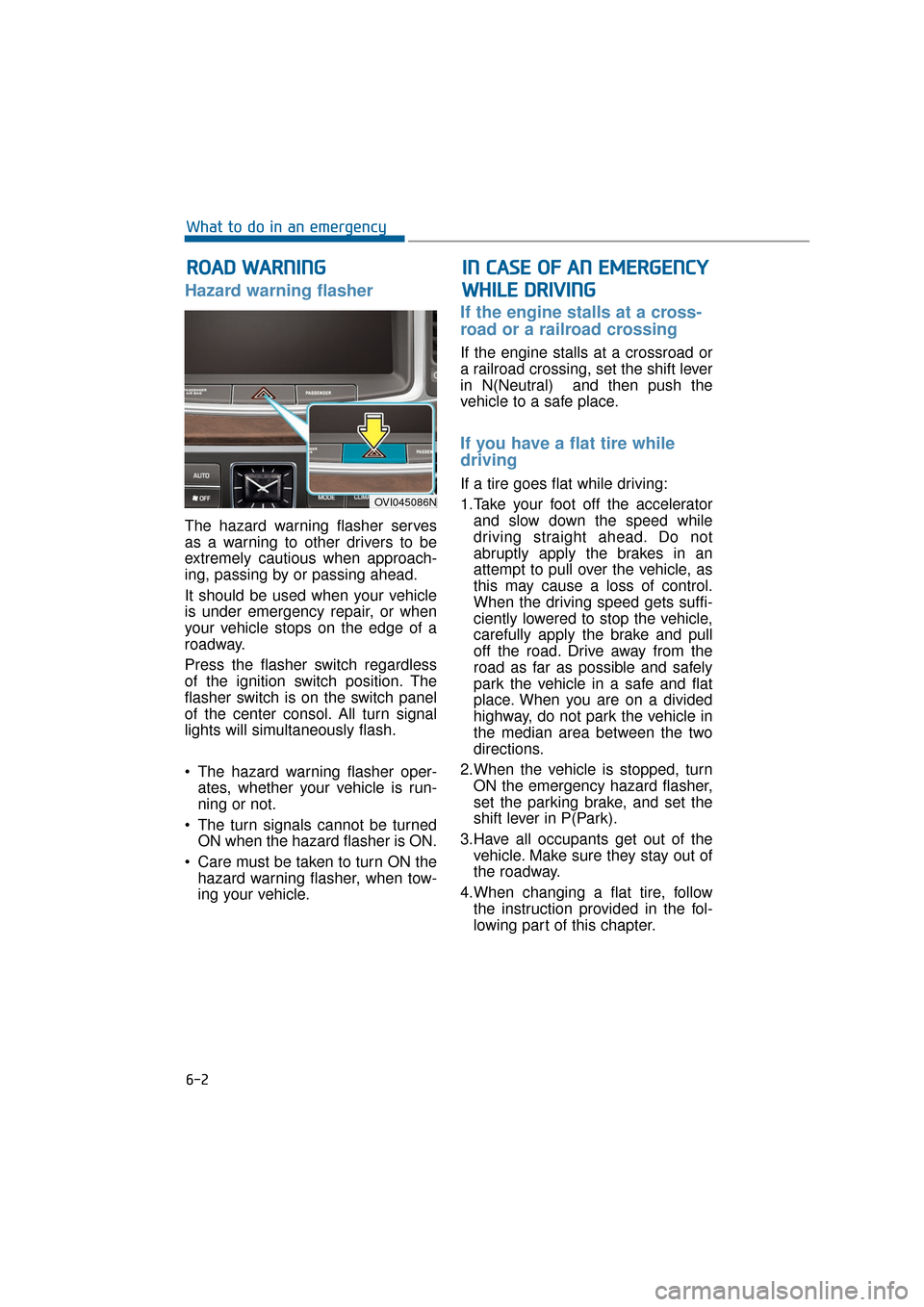
Hazard warning flasher
The hazard warning flasher serves
as a warning to other drivers to be
extremely cautious when approach-
ing, passing by or passing ahead.
It should be used when your vehicle
is under emergency repair, or when
your vehicle stops on the edge of a
roadway.
Press the flasher switch regardless
of the ignition switch position. The
flasher switch is on the switch panel
of the center consol. All turn signal
lights will simultaneously flash.
• The hazard warning flasher oper-ates, whether your vehicle is run-
ning or not.
The turn signals cannot be turned ON when the hazard flasher is ON.
Care must be taken to turn ON the hazard warning flasher, when tow-
ing your vehicle.
If the engine stalls at a cross-
road or a railroad crossing
If the engine stalls at a crossroad or
a railroad crossing, set the shift lever
in N(Neutral) and then push the
vehicle to a safe place.
If you have a flat tire while
driving
If a tire goes flat while driving:
1.Take your foot off the acceleratorand slow down the speed while
driving straight ahead. Do not
abruptly apply the brakes in an
attempt to pull over the vehicle, as
this may cause a loss of control.
When the driving speed gets suffi-
ciently lowered to stop the vehicle,
carefully apply the brake and pull
off the road. Drive away from the
road as far as possible and safely
park the vehicle in a safe and flat
place. When you are on a divided
highway, do not park the vehicle in
the median area between the two
directions.
2.When the vehicle is stopped, turn ON the emergency hazard flasher,
set the parking brake, and set the
shift lever in P(Park).
3.Have all occupants get out of the vehicle. Make sure they stay out of
the roadway.
4.When changing a flat tire, follow the instruction provided in the fol-
lowing part of this chapter.
R RO
O A
AD
D
W
W A
AR
RN
N I
IN
N G
G
6-2
What to do in an emergency
OVI045086N
I
IN
N
C
C A
A S
SE
E
O
O F
F
A
A N
N
E
E M
M E
ER
R G
G E
EN
N C
CY
Y
W
W H
HI
IL
L E
E
D
D R
RI
IV
V I
IN
N G
G