warning Hyundai Equus 2016 Owner's Manual
[x] Cancel search | Manufacturer: HYUNDAI, Model Year: 2016, Model line: Equus, Model: Hyundai Equus 2016Pages: 477, PDF Size: 16.25 MB
Page 389 of 477
7-32
Maintenance
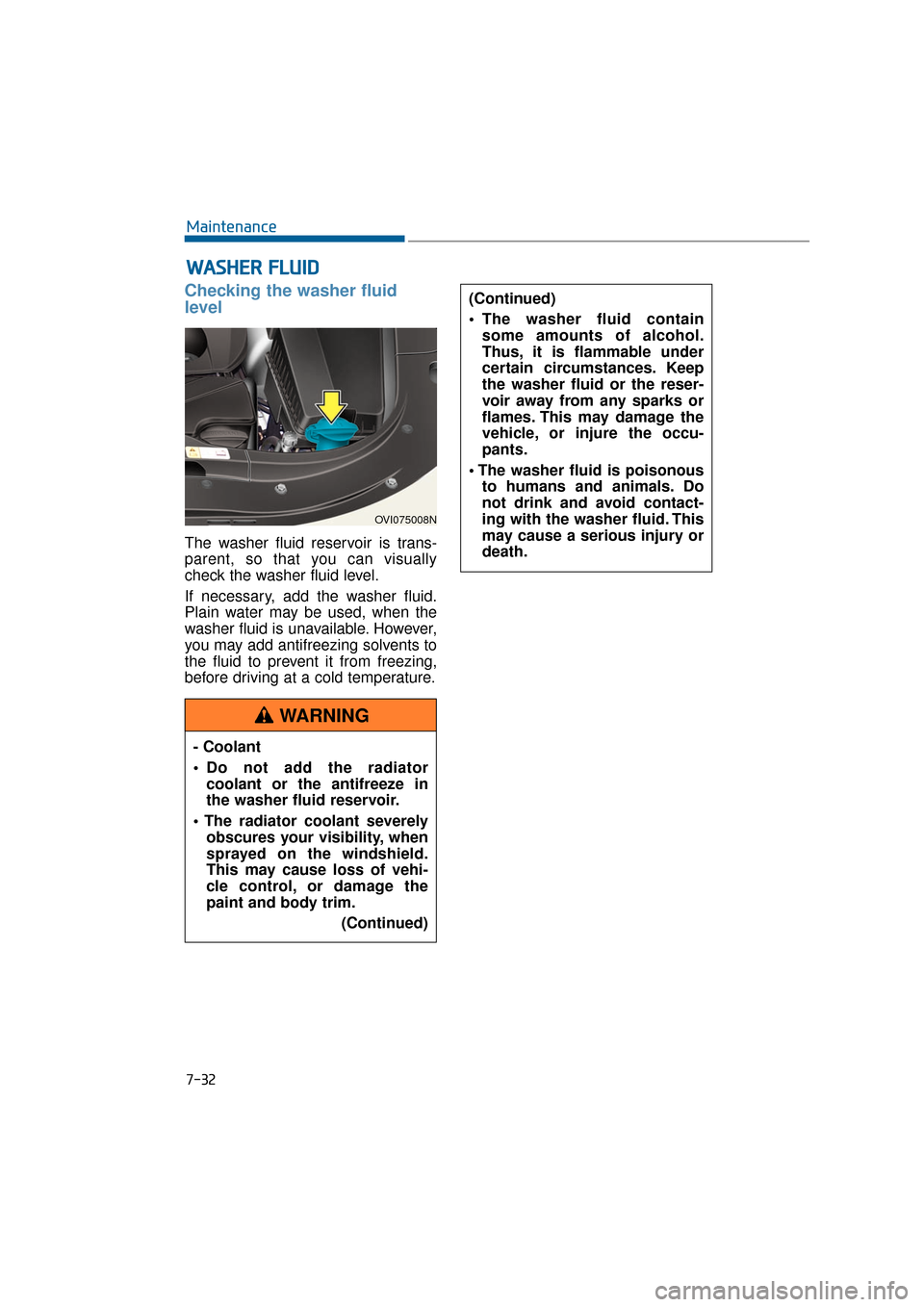
Checking the washer fluid
level
The washer fluid reservoir is trans-
parent, so that you can visually
check the washer fluid level.
If necessary, add the washer fluid.
Plain water may be used, when the
washer fluid is unavailable. However,
you may add antifreezing solvents to
the fluid to prevent it from freezing,
before driving at a cold temperature.
W WA
AS
SH
H E
ER
R
F
F L
LU
U I
ID
D
OVI075008N
- Coolant
Do not add the radiator
coolant or the antifreeze in
the washer fluid reservoir.
obscures your visibility, when
sprayed on the windshield.
This may cause loss of vehi-
cle control, or damage the
paint and body trim.
(Continued)
(Continued)
The washer fluid containsome amounts of alcohol.
Thus, it is flammable under
certain circumstances. Keep
the washer fluid or the reser-
voir away from any sparks or
flames. This may damage the
vehicle, or injure the occu-
pants.
to humans and animals. Do
not drink and avoid contact-
ing with the washer fluid. This
may cause a serious injury or
death.
WARNING
Page 396 of 477
7-39
Maintenance07
For best battery service
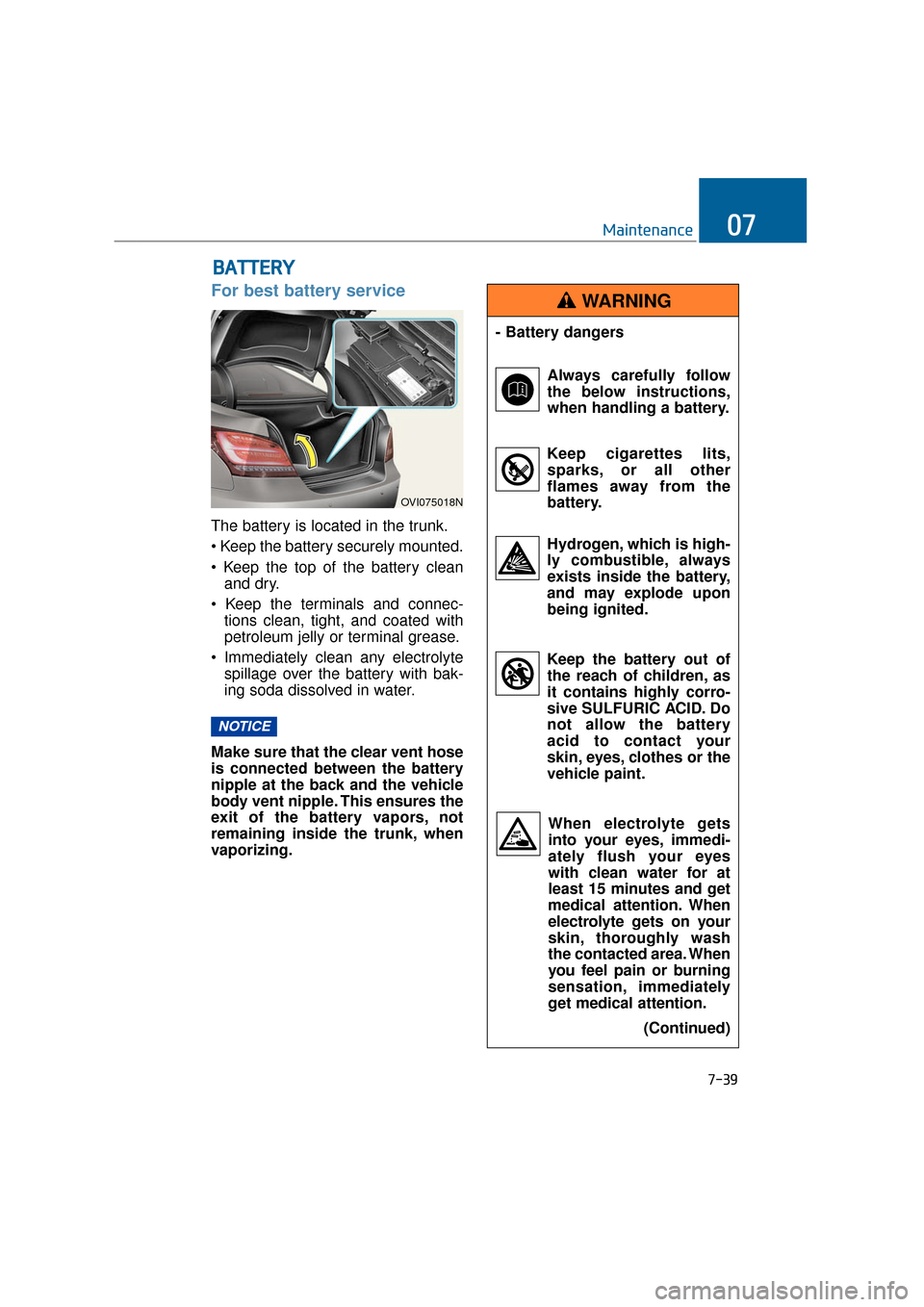
The battery is located in the trunk.
and dry.
tions clean, tight, and coated with
petroleum jelly or terminal grease.
spillage over the battery with bak-
ing soda dissolved in water.
Make sure that the clear vent hose
is connected between the battery
nipple at the back and the vehicle
body vent nipple. This ensures the
exit of the battery vapors, not
remaining inside the trunk, when
vaporizing.
NOTICE
B B A
A T
TT
TE
ER
R Y
Y
OVI075018N
- Battery dangers
Always carefully follow
the below instructions,
when handling a battery.
Keep cigarettes lits, sparks, or all other
flames away from the
battery.
Hydrogen, which is high- ly combustible, always
exists inside the battery,
and may explode upon
being ignited.
Keep the battery out of the reach of children, as
it contains highly corro-
sive SULFURIC ACID. Do
not allow the battery
acid to contact your
skin, eyes, clothes or the
vehicle paint.
When electrolyte getsinto your eyes, immedi-
ately flush your eyes
with clean water for at
least 15 minutes and get
medical attention. When
electrolyte gets on your
skin, thoroughly wash
the contacted area. When
you feel pain or burning
sensation, immediately
get medical attention.
(Continued)
WARNING
Page 397 of 477
7-40
Maintenance When your vehicle is not drivenfor a long period of time at a low
temperature, remove the battery
and keep it indoors.
The power trunk is not com-
pletely closed, when the battery
is removed. When you remove
the battery, refer to "Power
trunk" in the chapter 3.
Always fully charge the battery to prevent a case damage at a
low temperature.
When unauthorized electronic devices are connected with the
battery, it may discharge the bat-
tery. Never connect unautho-
rized devices.
NOTICE
(Continued)
Wear eye protectionwhen charging the bat-
tery or working some-
where near it. Always
provide proper ventila-
tion when working in an
enclosed space.
An inappropriately dis- posed battery may be
harmful to the environ-
ment and human health.
Dispose the battery in
accordance with your
local law(s) or regula-
tions.
When lifting up the battery in a plastic case, putting exces-
sive pressure on the case may
leak the battery acid, resulting
in a personal injury. Lift up the
battery case by holding the
both sides of it.
battery when the battery
cables are connected.
works with high voltage.
Never touch these compo-
nents, when the engine is run-
ning, or when the ignition
switch is turned on.
Failure to follow the above
warnings may result in a seri-
ous bodily injury or death.
Battery posts, terminals, and
related accessories contain
lead and lead compounds,
chemicals known to the State of
California to cause cancer, birth
defects and reproductive harm.
Batteries also contain other
chemicals known to the State of
California to cause cancer.
Wash hands after handling.
CALIFORNIA PROPOSI- TION 65 WARNING
Removing the battery from the
vehicle should be done at an
authorized EQUUS dealer.
WARNING
Page 398 of 477
7-41
Maintenance07
Battery recharging by battery
charger
Your vehicle has a maintenance-free,
calcium-based battery.
When the battery is discharged ina short period of time (possibly
because the headlamps or interior
lights remain on, while the vehicle
is not in use), slowly recharge it
(trickle) for 10 hours.
When the battery is gradually dis- charged due to high electric load,
while the vehicle is in use,
recharge it at 20-30A for 2 hours.
Battery recharging by vehicle
After jump-starting from a good bat-
tery, run the engine for 20-30 min-
utes in either the idle or driving
modes, before turning off the engine.
Your vehicle may not restart, when
the engine is shortly turned off with-
out having an adequate recharging
time.
- Recharging battery
When recharging the battery,
follow the below precautions:
The battery must be removed from the vehicle and placed in
a well-ventilated area.
Keep cigarette lits, sparks, or flames away from the battery.
(Continued)
(Continued)
Keep paying attention to thebattery condition, while
recharging. Stop or slow the
recharging rate, when the bat-
tery gas violently leaks (boil-
ing),or when an electrolyte
temperature exceeds 120°F
(49°C).
Wear the proper eye protection, while watching the battery
recharging conditions.
Disconnect the battery charger in the following order.
1. Turn off the main switch of the battery charger.
2. Unhook the negative clamp from the negative battery ter-
minal.
3. Unhook the positive clamp from the positive battery ter-
minal.
WARNING
Before maintaining orrecharging the battery, turn
off all accessories and stop
the engine.
The negative battery cable must be disconnected first, or
be connected last.
Operation related to the bat- tery should be done by an
authorized EQUUS dealer.
WARNING
Page 400 of 477
7-43
Maintenance07
The pressure of a warm tire isnormally higher than the one of
a cold tire by 4 to 6 psi (28 to 41
kPa). Do not release air from a
warm tire to adjust the pressure.
Otherwise, the tire will be under-
inflated.
(Continued)(Continued)
Make sure to close the tire infla-
tion valve cap. When the valve is
opened, dirt or moisture may get
into the valve core and cause air
leakage. When a valve cap is
lost, immediately buy a new one,
and close the valve.
- Tire pressure
Always observe the following:
Measure the tire pressure when it is cold. (When the vehicle
does not drive for the last 3
hours, or when it drives shorter
than 1 mile (1.6 km), after start-
ing up.)
Check the pressure of a spare tire whenever checking the pres-
sures of other tires.
Never overload your vehicle. Be careful not to overload on the
luggage rack, when your vehicle
is equipped with one.
Worn-out, old tires may cause an accident. When your tread is
badly worn out, or when tires are
damaged, replace them.
NOTICE
NOTICE
- Underinflated tire
Severe under-inflation of tire
may cause severe build-up of
heat, causing blowouts, tread
separation and other failures.
This may result in the loss of
vehicle control, leading to a
severe injury or death. This risk
may increase when the weather
is hot, or when the vehicle
drives for a long period of time
at a high speed.
WARNING
- Tire Inflation
Over-inflation or under-inflation
may reduce tire life, adversely
affect vehicle handling, and
lead to a sudden tire failure.
This may result in a loss of vehi-
cle control and a potential
injury.
WARNING
Under-inflation also mayresult in excessive tire wear-
put, poor handling and inferi-
or fuel economy. Also, wheel
deformation may be resulted.
Maintain your tire pressure at
the recommended level. When
your tire frequently needs to
be inflated, have it checked by
an authorized EQUUS dealer.
Over-inflation may cause harsh driving, excessive tire
wear-out, especially for the
central tread of a tire, and
more possibilities of damage
from road hazards.
CAUTION
Page 401 of 477
7-44
Maintenance
Checking tire inflation pres-
sure
Check your tires at least once a
month.
Also, check the spare tire pressure.
How to check
Use a good-quality gauge to check
the tire pressure. You cannot proper-
ly measure the tire inflation only with
your eyes. A radial tire may look
properly inflated, even when it is
underinflated.
Check the tire inflation pressure,
when it is cold. - A "cold" means
your vehicle does not drive for the
last 3 hours, or drives shorter than 1
mile (1.6 km).
Open the tire valve cap. Press the
tire gauge firmly onto the valve to
measure the pressure. When the
cold tire is inflated as recommended,
as specified on the tire and loading
information labels, further adjust-
ment is not needed. When a tire is
underinflated, inflate it to the recom-
mended pressure.
When overinflating the tire, release
air by pressing the metal stem on the
tire valve. Re-measure the tire pres-
sure with the gauge. Make sure to
close the valve caps over the valve
stems. This prevents air leakage and
keeps out dirt and moisture. Frequently check your tires,
especially inflation pressure,
abrasion and damage. Always
use a tire pressure gauge.
Overinflated or underinflated tires may unevenly wear out,
causing poor handling, a loss
of vehicle control, and a sud-
den tire failure. This may lead
to an accident, injury, and
even death. The cold tire pres-
sure recommendation of your
vehicle is specified in this
manual and on the tire label,
which is located on the center
pillar on the driver's side.
Tire abrasion may cause an accident. Replace the worn-
out or damaged tires.
Remember to check the spare tire pressure. It is recom-
mended to check the spare
whenever checking the pres-
sures of other tires.
WARNING
Page 402 of 477
7-45
Maintenance07
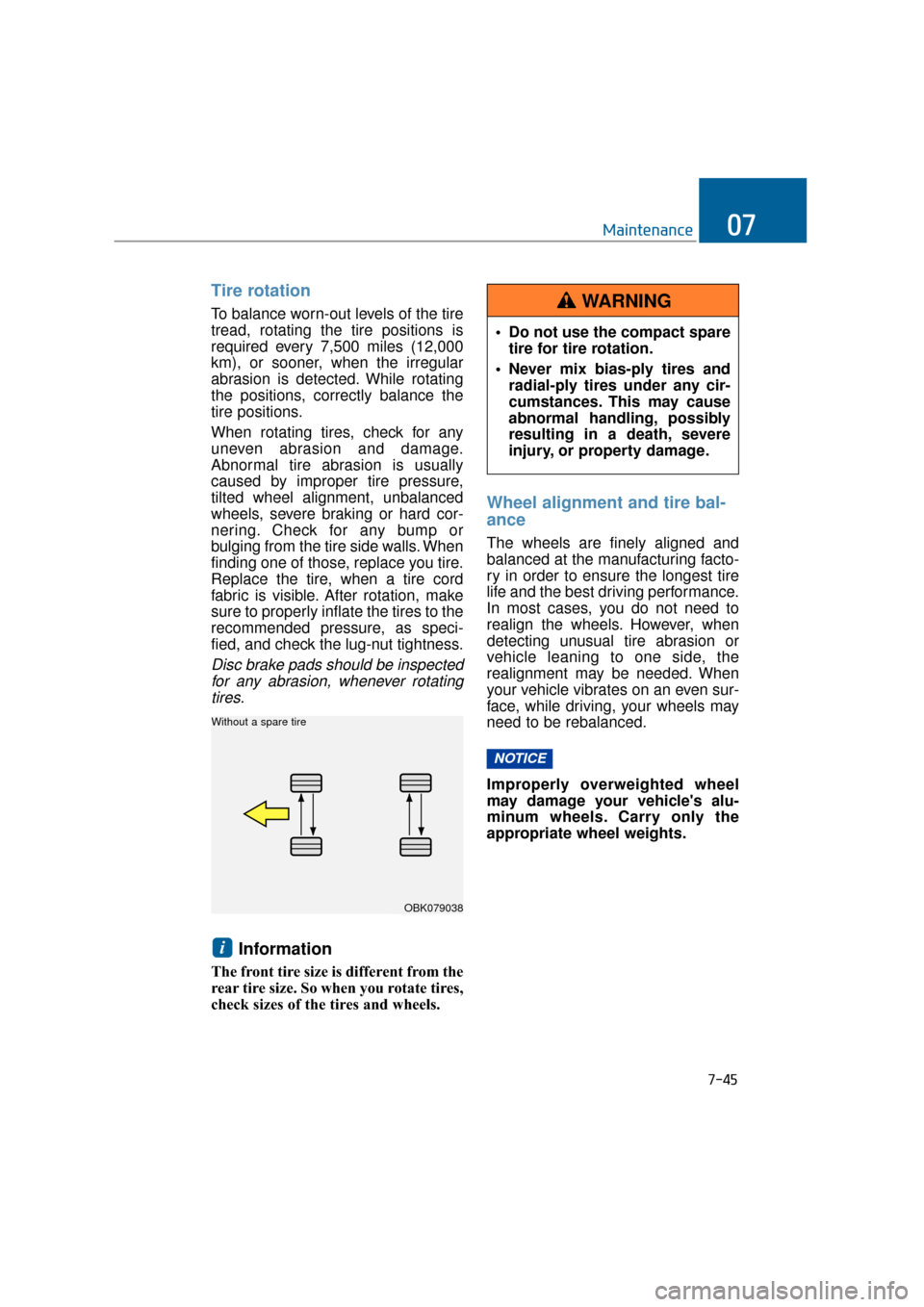
Tire rotation
To balance worn-out levels of the tire
tread, rotating the tire positions is
required every 7,500 miles (12,000
km), or sooner, when the irregular
abrasion is detected. While rotating
the positions, correctly balance the
tire positions.
When rotating tires, check for any
uneven abrasion and damage.
Abnormal tire abrasion is usually
caused by improper tire pressure,
tilted wheel alignment, unbalanced
wheels, severe braking or hard cor-
nering. Check for any bump or
bulging from the tire side walls. When
finding one of those, replace you tire.
Replace the tire, when a tire cord
fabric is visible. After rotation, make
sure to properly inflate the tires to the
recommended pressure, as speci-
fied, and check the lug-nut tightness.
Disc brake pads should be inspectedfor any abrasion, whenever rotatingtires.
Information
The front tire size is different from the
rear tire size. So when you rotate tires,
check sizes of the tires and wheels.
Wheel alignment and tire bal-
ance
The wheels are finely aligned and
balanced at the manufacturing facto-
ry in order to ensure the longest tire
life and the best driving performance.
In most cases, you do not need to
realign the wheels. However, when
detecting unusual tire abrasion or
vehicle leaning to one side, the
realignment may be needed. When
your vehicle vibrates on an even sur-
face, while driving, your wheels may
need to be rebalanced.
Improperly overweighted wheel
may damage your vehicle's alu-
minum wheels. Carry only the
appropriate wheel weights.
NOTICE
i
OBK079038
Without a spare tire
Do not use the compact spare
tire for tire rotation.
Never mix bias-ply tires and radial-ply tires under any cir-
cumstances. This may cause
abnormal handling, possibly
resulting in a death, severe
injury, or property damage.
WARNING
Page 403 of 477
7-46
Maintenance
Tire replacement
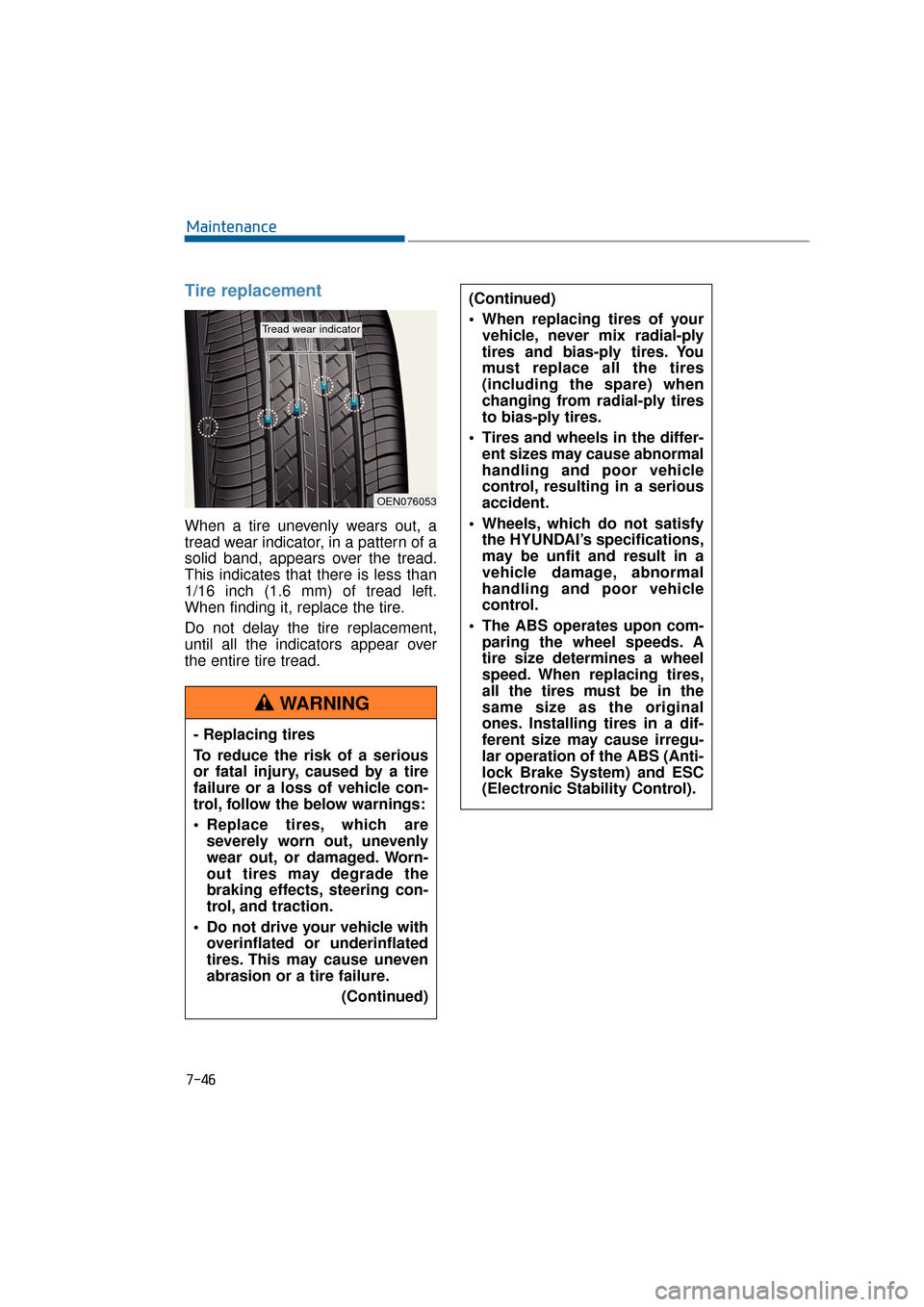
When a tire unevenly wears out, a
tread wear indicator, in a pattern of a
solid band, appears over the tread.
This indicates that there is less than
1/16 inch (1.6 mm) of tread left.
When finding it, replace the tire.
Do not delay the tire replacement,
until all the indicators appear over
the entire tire tread.
OEN076053
Tread wear indicator
- Replacing tires
To reduce the risk of a serious
or fatal injury, caused by a tire
failure or a loss of vehicle con-
trol, follow the below warnings:
Replace tires, which areseverely worn out, unevenly
wear out, or damaged. Worn-
out tires may degrade the
braking effects, steering con-
trol, and traction.
Do not drive your vehicle with overinflated or underinflated
tires. This may cause uneven
abrasion or a tire failure.
(Continued)
(Continued)
When replacing tires of yourvehicle, never mix radial-ply
tires and bias-ply tires. You
must replace all the tires
(including the spare) when
changing from radial-ply tires
to bias-ply tires.
Tires and wheels in the differ- ent sizes may cause abnormal
handling and poor vehicle
control, resulting in a serious
accident.
Wheels, which do not satisfy the HYUNDAI’s specifications,
may be unfit and result in a
vehicle damage, abnormal
handling and poor vehicle
control.
The ABS operates upon com- paring the wheel speeds. A
tire size determines a wheel
speed. When replacing tires,
all the tires must be in the
same size as the original
ones. Installing tires in a dif-
ferent size may cause irregu-
lar operation of the ABS (Anti-
lock Brake System) and ESC
(Electronic Stability Control).
WARNING
Page 404 of 477
7-47
Maintenance07
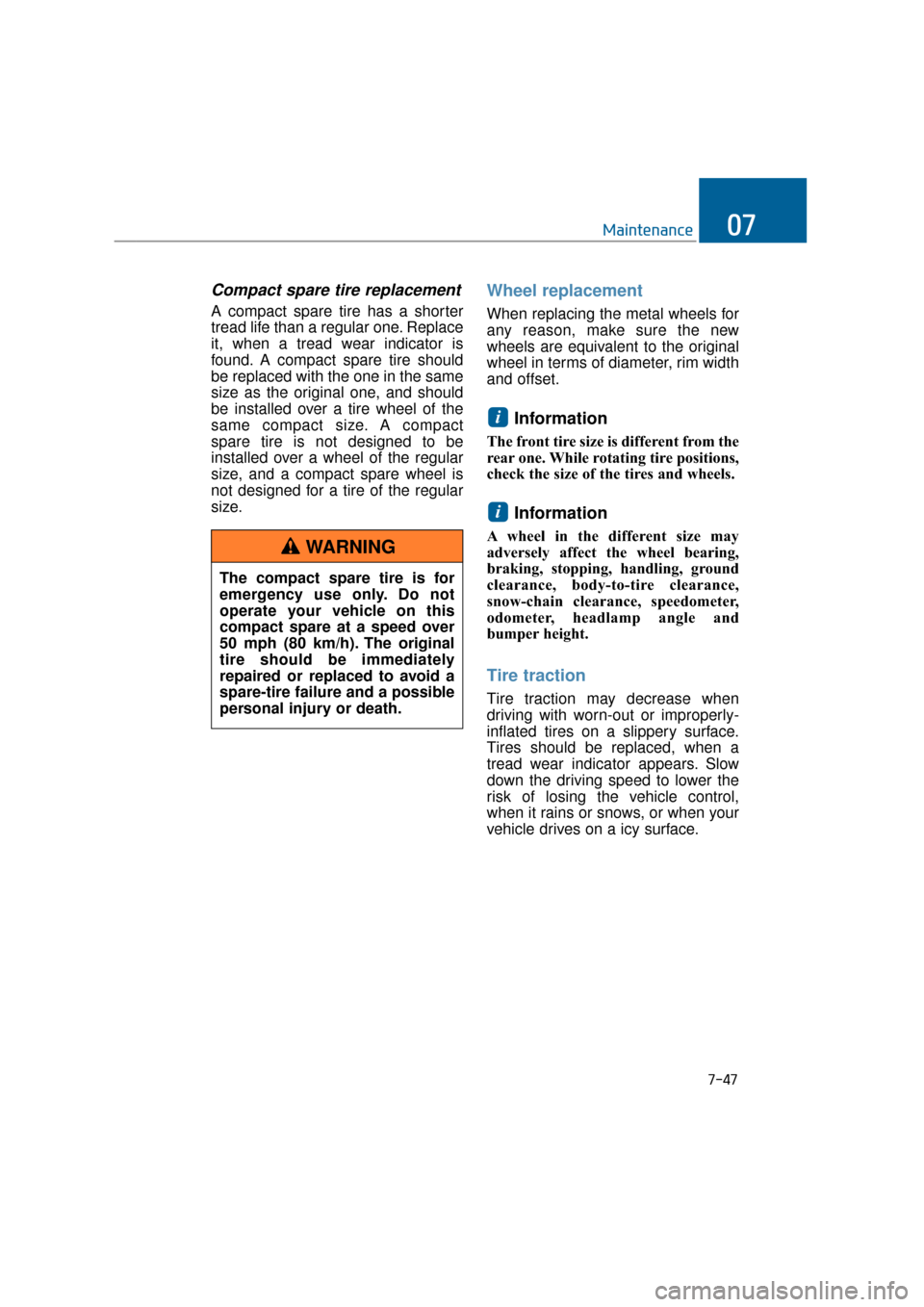
Compact spare tire replacement
A compact spare tire has a shorter
tread life than a regular one. Replace
it, when a tread wear indicator is
found. A compact spare tire should
be replaced with the one in the same
size as the original one, and should
be installed over a tire wheel of the
same compact size. A compact
spare tire is not designed to be
installed over a wheel of the regular
size, and a compact spare wheel is
not designed for a tire of the regular
size.
Wheel replacement
When replacing the metal wheels for
any reason, make sure the new
wheels are equivalent to the original
wheel in terms of diameter, rim width
and offset.
Information
The front tire size is different from the
rear one. While rotating tire positions,
check the size of the tires and wheels.
Information
A wheel in the different size may
adversely affect the wheel bearing,
braking, stopping, handling, ground
clearance, body-to-tire clearance,
snow-chain clearance, speedometer,
odometer, headlamp angle and
bumper height.
Tire traction
Tire traction may decrease when
driving with worn-out or improperly-
inflated tires on a slippery surface.
Tires should be replaced, when a
tread wear indicator appears. Slow
down the driving speed to lower the
risk of losing the vehicle control,
when it rains or snows, or when your
vehicle drives on a icy surface.
i
i
The compact spare tire is for
emergency use only. Do not
operate your vehicle on this
compact spare at a speed over
50 mph (80 km/h). The original
tire should be immediately
repaired or replaced to avoid a
spare-tire failure and a possible
personal injury or death.
WARNING
Page 406 of 477
7-49
Maintenance07
Wheel size designation
Wheels are also marked with impor-
tant specifications. The following
example of the wheel size designa-
tion explains how the letters and
numbers are interpreted.
Example wheel size designation:
8.0JX19
8.0 - Rim width in inches.
J - Rim contour designation.
19 - Rim diameter in inches.
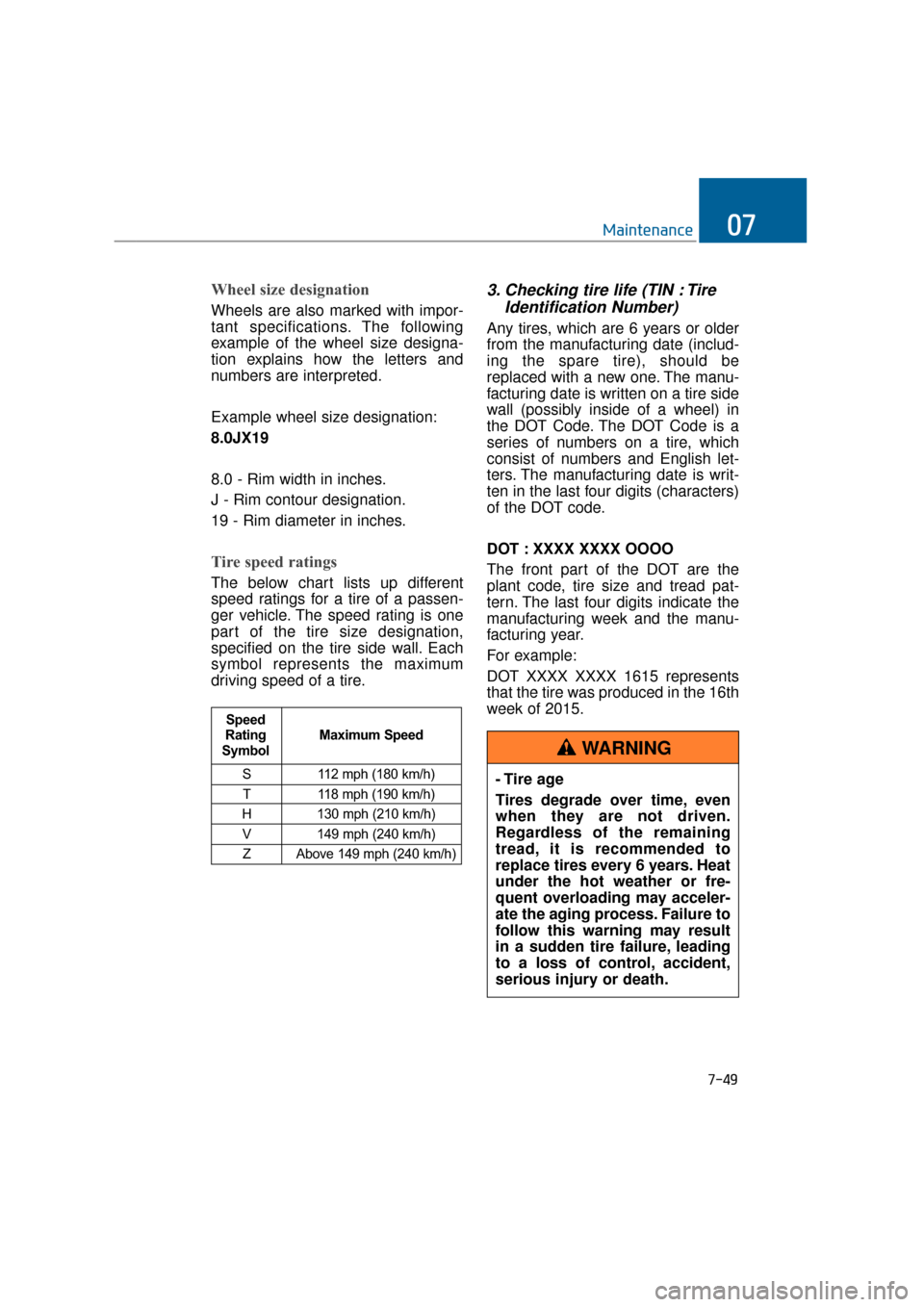
Tire speed ratings
The below chart lists up different
speed ratings for a tire of a passen-
ger vehicle. The speed rating is one
part of the tire size designation,
specified on the tire side wall. Each
symbol represents the maximum
driving speed of a tire.
3. Checking tire life (TIN : TireIdentification Number)
Any tires, which are 6 years or older
from the manufacturing date (includ-
ing the spare tire), should be
replaced with a new one. The manu-
facturing date is written on a tire side
wall (possibly inside of a wheel) in
the DOT Code. The DOT Code is a
series of numbers on a tire, which
consist of numbers and English let-
ters. The manufacturing date is writ-
ten in the last four digits (characters)
of the DOT code.
DOT : XXXX XXXX OOOO
The front part of the DOT are the
plant code, tire size and tread pat-
tern. The last four digits indicate the
manufacturing week and the manu-
facturing year.
For example:
DOT XXXX XXXX 1615 represents
that the tire was produced in the 16th
week of 2015.
S 112 mph (180 km/h)
T 118 mph (190 km/h)
H 130 mph (210 km/h) V 149 mph (240 km/h)Z Above 149 mph (240 km/h)
Maximum Speed
Speed
Rating
Symbol
- Tire age
Tires degrade over time, even
when they are not driven.
Regardless of the remaining
tread, it is recommended to
replace tires every 6 years. Heat
under the hot weather or fre-
quent overloading may acceler-
ate the aging process. Failure to
follow this warning may result
in a sudden tire failure, leading
to a loss of control, accident,
serious injury or death.
WARNING