chapter 8 Hyundai Equus 2016 Workshop Manual
[x] Cancel search | Manufacturer: HYUNDAI, Model Year: 2016, Model line: Equus, Model: Hyundai Equus 2016Pages: 477, PDF Size: 16.25 MB
Page 382 of 477
7-25
Maintenance07
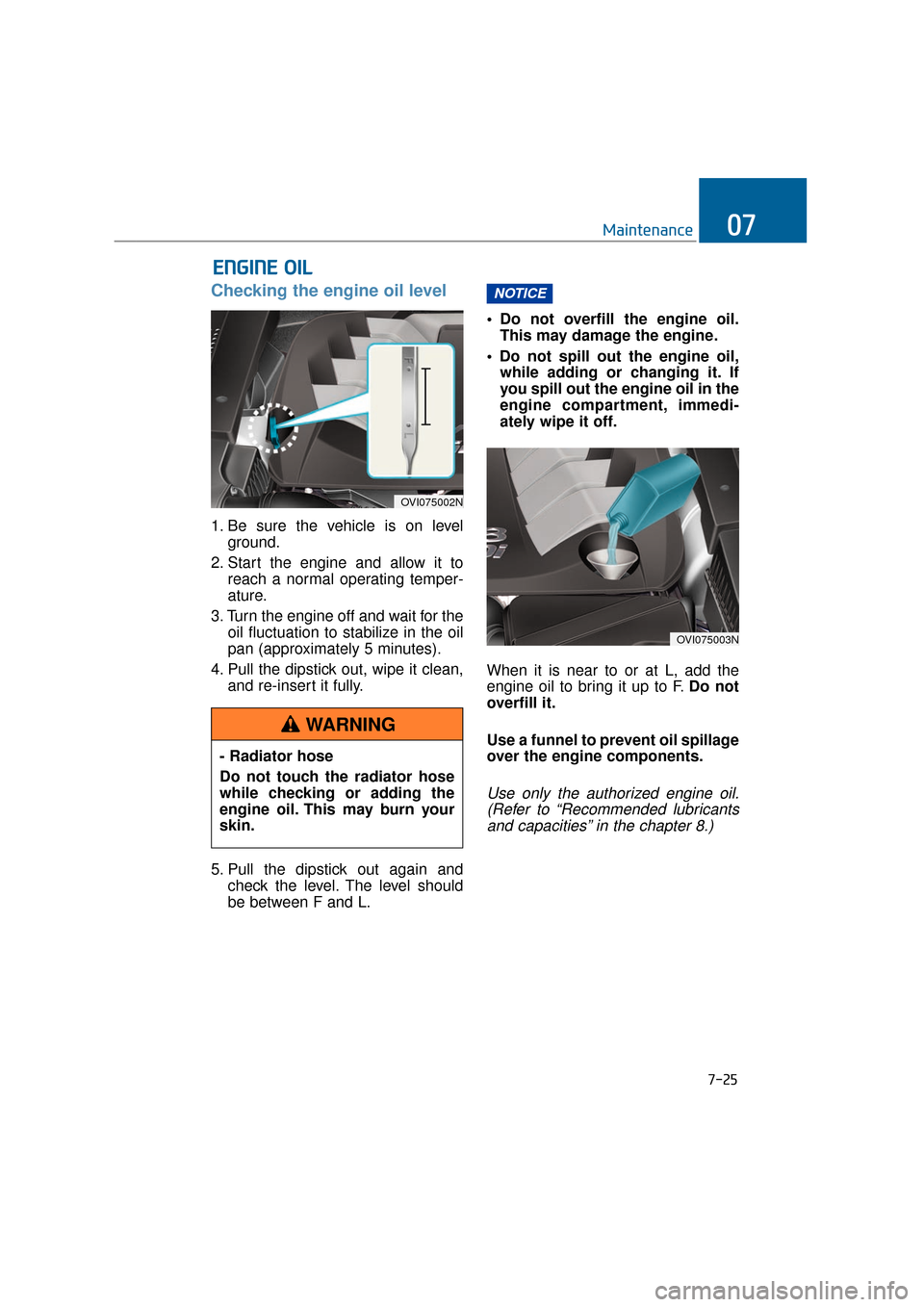
Checking the engine oil level
1. Be sure the vehicle is on levelground.
2. Start the engine and allow it to reach a normal operating temper-
ature.
3. Turn the engine off and wait for the oil fluctuation to stabilize in the oil
pan (approximately 5 minutes).
4. Pull the dipstick out, wipe it clean, and re-insert it fully.
5. Pull the dipstick out again and check the level. The level should
be between F and L. Do not overfill the engine oil.
This may damage the engine.
while adding or changing it. If
you spill out the engine oil in the
engine compartment, immedi-
ately wipe it off.
When it is near to or at L, add the
engine oil to bring it up to F. Do not
overfill it.
Use a funnel to prevent oil spillage
over the engine components.
Use only the authorized engine oil. (Refer to “Recommended lubricantsand capacities” in the chapter 8.)
NOTICE
E E N
N G
GI
IN
N E
E
O
O I
IL
L
OVI075002N
- Radiator hose
Do not touch the radiator hose
while checking or adding the
engine oil. This may burn your
skin.
WARNING
OVI075003N
Page 383 of 477
7-26
Maintenance
Changing the engine oil and
filter
Have engine oil and filter changed by
an authorized EQUUS dealer in
accordance with the Maintenance
Schedule, as specified in the begin-
ning of this chapter.
Engine oil contains chemicals
known to the State of California
to cause cancer, birth defects
and reproductive harm. Used
engine oil may cause irritation
or cancer of the skin if left in
contact with the skin for pro-
longed periods of time. Always
protect your skin by washing
your hands thoroughly with
soap and warm water as soon
as possible after handling used
oil.
CALIFORNIA PROPOSI-TION 65 WARNING
OVI075161N
Page 386 of 477
7-29
Maintenance07
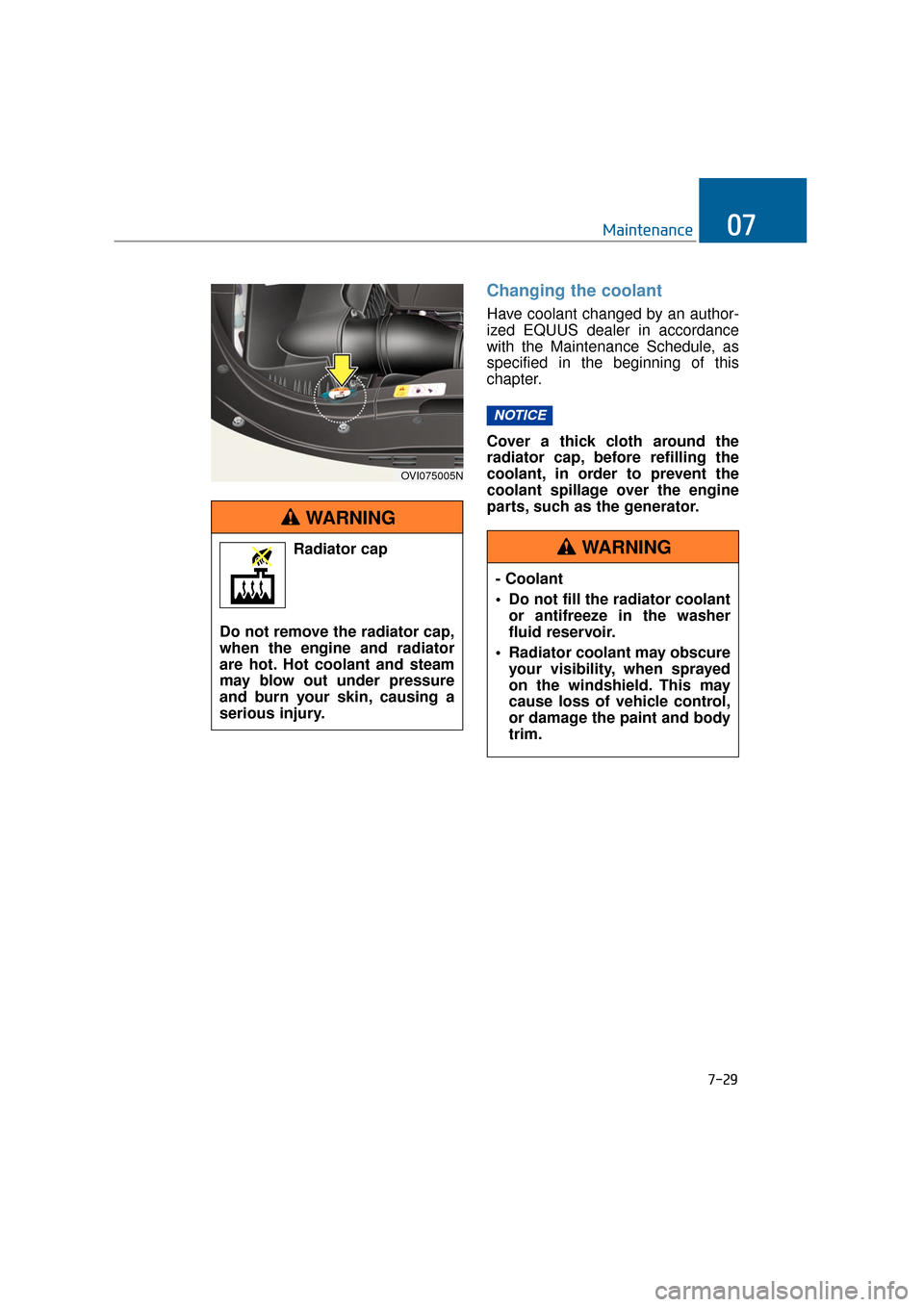
Changing the coolant
Have coolant changed by an author-
ized EQUUS dealer in accordance
with the Maintenance Schedule, as
specified in the beginning of this
chapter.
Cover a thick cloth around the
radiator cap, before refilling the
coolant, in order to prevent the
coolant spillage over the engine
parts, such as the generator.
NOTICE
OVI075005N
Radiator cap
Do not remove the radiator cap,
when the engine and radiator
are hot. Hot coolant and steam
may blow out under pressure
and burn your skin, causing a
serious injury.
WARNING
- Coolant
Do not fill the radiator coolant or antifreeze in the washer
fluid reservoir.
Radiator coolant may obscure your visibility, when sprayed
on the windshield. This may
cause loss of vehicle control,
or damage the paint and body
trim.
WARNING
Page 387 of 477
7-30
Maintenance
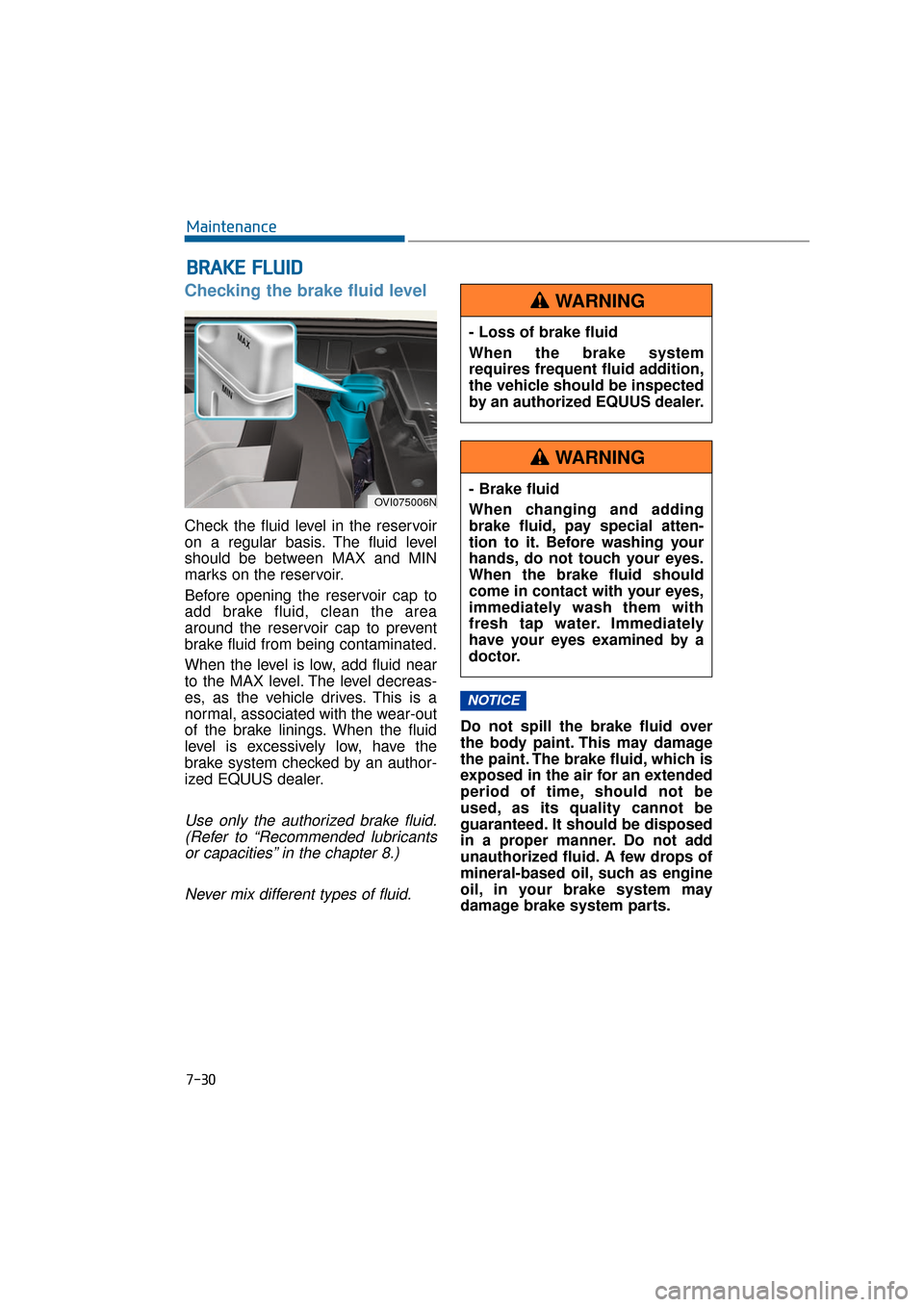
Checking the brake fluid level
Check the fluid level in the reservoir
on a regular basis. The fluid level
should be between MAX and MIN
marks on the reservoir.
Before opening the reservoir cap to
add brake fluid, clean the area
around the reservoir cap to prevent
brake fluid from being contaminated.
When the level is low, add fluid near
to the MAX level. The level decreas-
es, as the vehicle drives. This is a
normal, associated with the wear-out
of the brake linings. When the fluid
level is excessively low, have the
brake system checked by an author-
ized EQUUS dealer.
Use only the authorized brake fluid.(Refer to “Recommended lubricantsor capacities” in the chapter 8.)
Never mix different types of fluid.
Do not spill the brake fluid over
the body paint. This may damage
the paint. The brake fluid, which is
exposed in the air for an extended
period of time, should not be
used, as its quality cannot be
guaranteed. It should be disposed
in a proper manner. Do not add
unauthorized fluid. A few drops of
mineral-based oil, such as engine
oil, in your brake system may
damage brake system parts.
NOTICE
B B R
RA
A K
KE
E
F
F L
LU
U I
ID
D
- Loss of brake fluid
When the brake system
requires frequent fluid addition,
the vehicle should be inspected
by an authorized EQUUS dealer.
WARNING
- Brake fluid
When changing and adding
brake fluid, pay special atten-
tion to it. Before washing your
hands, do not touch your eyes.
When the brake fluid should
come in contact with your eyes,
immediately wash them with
fresh tap water. Immediately
have your eyes examined by a
doctor.
WARNING
OVI075006N
Page 391 of 477
7-34
Maintenance
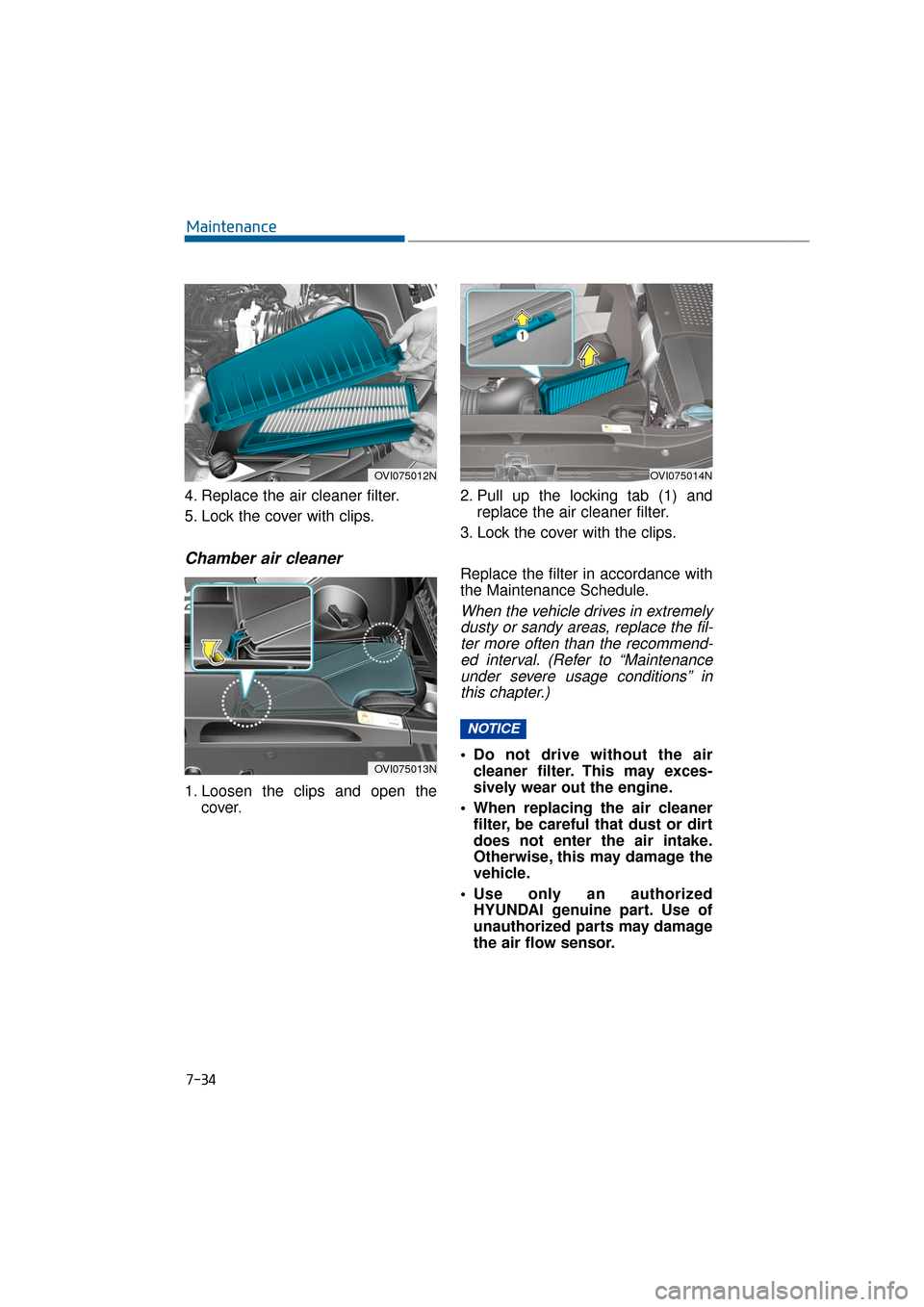
4. Replace the air cleaner filter.
5. Lock the cover with clips.
Chamber air cleaner
1. Loosen the clips and open the cover. 2. Pull up the locking tab (1) and
replace the air cleaner filter.
3. Lock the cover with the clips.
Replace the filter in accordance with
the Maintenance Schedule.
When the vehicle drives in extremely dusty or sandy areas, replace the fil-ter more often than the recommend-ed interval. (Refer to “Maintenanceunder severe usage conditions” inthis chapter.)
Do not drive without the air cleaner filter. This may exces-
sively wear out the engine.
When replacing the air cleaner filter, be careful that dust or dirt
does not enter the air intake.
Otherwise, this may damage the
vehicle.
Use only an authorized HYUNDAI genuine part. Use of
unauthorized parts may damage
the air flow sensor.
NOTICE
OVI075012N
OVI075013N
OVI075014N
Page 397 of 477
7-40
Maintenance When your vehicle is not drivenfor a long period of time at a low
temperature, remove the battery
and keep it indoors.
The power trunk is not com-
pletely closed, when the battery
is removed. When you remove
the battery, refer to "Power
trunk" in the chapter 3.
Always fully charge the battery to prevent a case damage at a
low temperature.
When unauthorized electronic devices are connected with the
battery, it may discharge the bat-
tery. Never connect unautho-
rized devices.
NOTICE
(Continued)
Wear eye protectionwhen charging the bat-
tery or working some-
where near it. Always
provide proper ventila-
tion when working in an
enclosed space.
An inappropriately dis- posed battery may be
harmful to the environ-
ment and human health.
Dispose the battery in
accordance with your
local law(s) or regula-
tions.
When lifting up the battery in a plastic case, putting exces-
sive pressure on the case may
leak the battery acid, resulting
in a personal injury. Lift up the
battery case by holding the
both sides of it.
battery when the battery
cables are connected.
works with high voltage.
Never touch these compo-
nents, when the engine is run-
ning, or when the ignition
switch is turned on.
Failure to follow the above
warnings may result in a seri-
ous bodily injury or death.
Battery posts, terminals, and
related accessories contain
lead and lead compounds,
chemicals known to the State of
California to cause cancer, birth
defects and reproductive harm.
Batteries also contain other
chemicals known to the State of
California to cause cancer.
Wash hands after handling.
CALIFORNIA PROPOSI- TION 65 WARNING
Removing the battery from the
vehicle should be done at an
authorized EQUUS dealer.
WARNING
Page 399 of 477
7-42
Maintenance
Keep the battery away from water or any other liquid.
The battery is located in the trunk. Thus, be careful when
loading a container filled with
liquid inside the trunk.
For your safety, use only the genuine HYUNDAI battery, when
replacing it.
Reset items
Items should be reset after either a
battery discharge or a battery dis-
connection.
Auto up/down window (See the chapter 3)
Rear door window curtains (See the chapter 3)
Sunroof (See the chapter 3)
Driver position memory system (See the chapter 3)
Trip computer (See the chapter 3)
Climate control system (See the chapter 3)
Clock (See DIS manual)
Audio (See DIS manual)
Power trunk (See the chapter 3)
Tire care
For the better maintenance, safety,
and fuel economy, you must always
maintain the recommended tire infla-
tion pressures, and follow the load
limits and weight distribution recom-
mendation.
Recommended cold tire infla-
tion pressures
The tire pressure (including the
spare) should be measured, when it
is cold. A “cold tire” means the vehi-
cle does not drive for the last 3 hours
or is driven shorter than 1 mile (1.6
km).
The recommended pressure must be
maintained for the best driving, han-
dling, and the minimum tire wear-out.
For the information about the recom-
mended inflation pressure, refer to
“Tire and wheels” in the chapter 8.
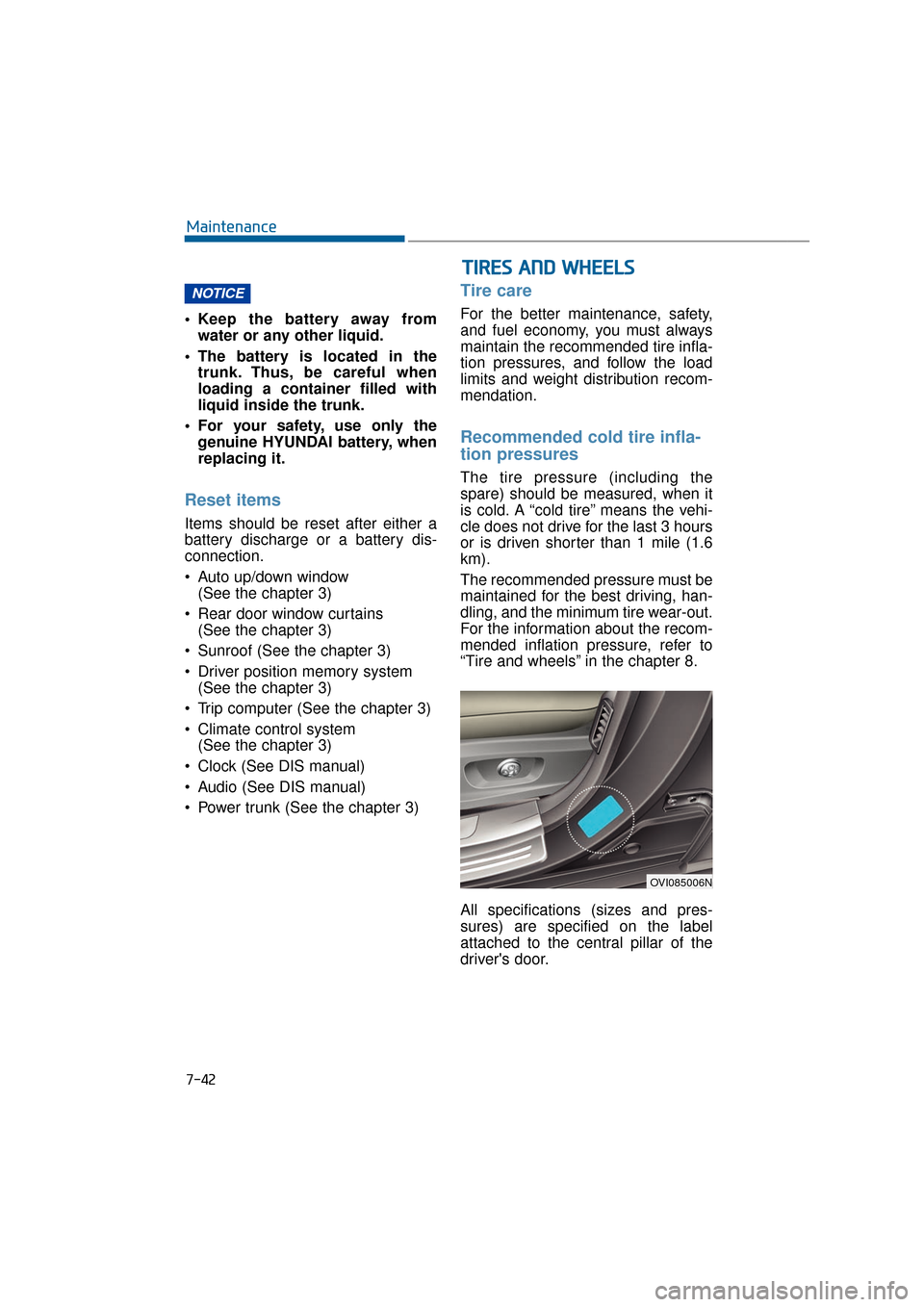
All specifications (sizes and pres-
sures) are specified on the label
attached to the central pillar of the
driver's door.
NOTICE
T T I
IR
R E
ES
S
A
A N
N D
D
W
W H
HE
EE
EL
LS
S
OVI085006N
Page 405 of 477
7-48
Maintenance
Tire maintenance
In addition to the proper inflation
pressure, correct wheel alignment
prevents tire abrasion. When you find
uneven tire abrasion, have the wheel
alignment checked by your EQUUS
dealer.
When replacing your tires, make
sure they are well balanced. This
increases your driving comfort and
tire life. Additionally, a tire should be
rebalanced after being removed from
a wheel.
Tire sidewall labeling
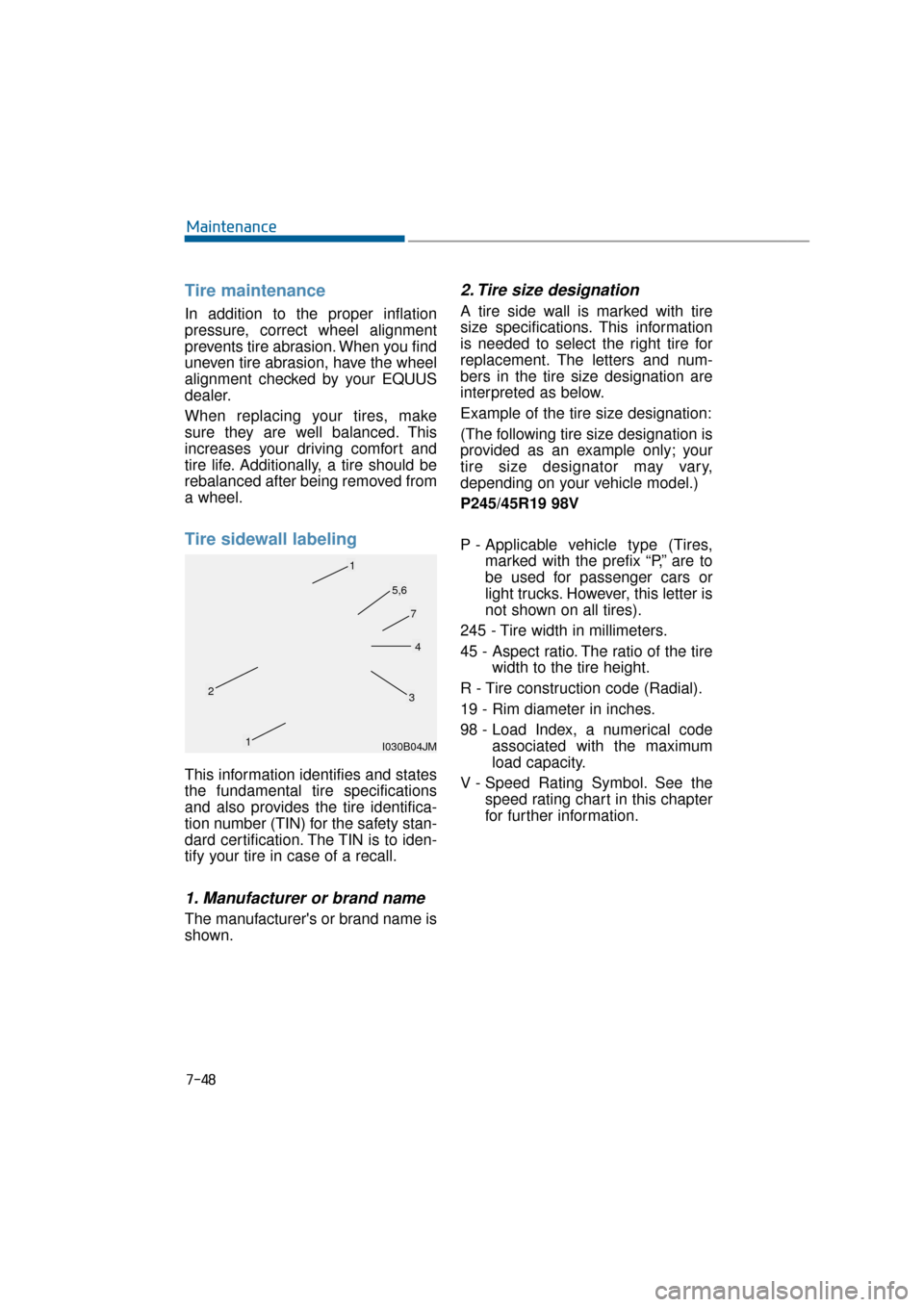
This information identifies and states
the fundamental tire specifications
and also provides the tire identifica-
tion number (TIN) for the safety stan-
dard certification. The TIN is to iden-
tify your tire in case of a recall.
1. Manufacturer or brand name
The manufacturer's or brand name is
shown.
2. Tire size designation
A tire side wall is marked with tire
size specifications. This information
is needed to select the right tire for
replacement. The letters and num-
bers in the tire size designation are
interpreted as below.
Example of the tire size designation:
(The following tire size designation is
provided as an example only; your
tire size designator may vary,
depending on your vehicle model.)
P245/45R19 98V
P - Applicable vehicle type (Tires,marked with the prefix “P,’’ are to
be used for passenger cars or
light trucks. However, this letter is
not shown on all tires).
245 - Tire width in millimeters.
45 - Aspect ratio. The ratio of the tire width to the tire height.
R - Tire construction code (Radial).
19 - Rim diameter in inches.
98 - Load Index, a numerical code associated with the maximum
load capacity.
V - Speed Rating Symbol. See the speed rating chart in this chapter
for further information.
I030B04JM
1
1
23
4
5,6
7
Page 412 of 477
7-55
Maintenance07
Tire chains
Tire chains, if necessary, should be
installed on the drive wheels (rear
wheels).
Make sure that the chains are
installed in accordance with the man-
ufacturer's instructions.
To minimize the abrasion of tires and
chains, do not use the chains, when
unnecessary.
Radial-ply tires
Radial-ply tires provide longer tread
life, better road hazard resistance
and smoother riding at a high speed.
The radial-ply tires used on this vehi-
cle are of belted construction, and
are to improve your driving and han-
dling. Radial-ply tires have the same
loading capacity as the bias-ply or
bias-belted tires of the same size.
Inflate the radial-ply tires to the same
recommended inflation pressure. It is
not recommended to attempt a
cross-combination of radial-ply tires
and bias-ply(or bias-belted) tires on
the same vehicle. Any cross-combi-
nation of radial-ply and bias-ply(or
bias-belted) tires on one vehicle will
seriously deteriorate vehicle han-
dling. The best rule to follow is:
Identical radial-ply tires should
always be used for a set of four tires.
A tire, which is driven for a long peri-
od of time, is more susceptible to
irregular tread abrasion. It is very
important to rotate tires, at the inter-
val instructed in this chapter, to use it
up to its potential tread life. Any cut
and puncture on a radial-ply tire is
repairable, only when it is on the
tread, because of the side wall flex-
ing. Consult your tire dealer for a
radial-ply tire repair.
Page 476 of 477
Please consult your Owner's Handbook & Warranty Information book-
let for your vehicle's specific warranty coverage.
The maintenance requirements for your new HYUNDAI are found in
Chapter 7. As the owner, it is your responsibility to see that all maintenance
operations specified by the manufacturer are carried out at the appropriate
intervals. When the vehicle is used in severe driving conditions, more fre-
quent maintenance is required for some operations. Maintenance require-
ments for severe operating conditions are also included in Chapter 7.
WARRANTIES FOR YOUR HYUNDAI VEHICLE
RESPONSIBILITY FOR MAINTENANCE