fuel Hyundai Equus 2016 Repair Manual
[x] Cancel search | Manufacturer: HYUNDAI, Model Year: 2016, Model line: Equus, Model: Hyundai Equus 2016Pages: 477, PDF Size: 16.25 MB
Page 409 of 477
7-52
Maintenance
Tire terminology and defini-
tions
Air Pressure:The amount of air
inside a tire, pressing the inside the
tire outwards. Air pressure is meas-
ured in pounds per square inch (psi)
or kilopascal (kPa).
Accessory Weight: This is the com-
bined weights of optional acces-
sories. Some examples of optional
accessories are the automatic trans-
mission, power seats, and air condi-
tioning.
Aspect Ratio: The ratio of a tire
width to a height.
Belt: A rubber coated layer of cords
that is located between the plies and
the tread. Cords may be made from
steel or other reinforcing materials.
Bead: The tire bead contains the
steel wires wrapped with steel cords.
This holds a tire onto a rim. Bias Ply Tire:
This is a pneumatic
tire, in which plies are laid at alter-
nate angles less than 90 degrees on
the tread centerline.
Cold Tire Pressure: This is the
amount of air pressure inside a tire,
measured in pounds per square inch
(psi) or kilopascals (kPa), before the
heat build-up due to driving.
Curb Weight: This is the vehicle
weight with standard and optional
equipment including the full fuel tank,
oil tanks and coolant tanks. However,
this excludes the weight of passen-
gers and loads.
DOT Markings: This code is marked
on a tire side wall, as an indication of
the its compliance with the U.S.
Department of Transportation motor
vehicle safety standards. The DOT
code includes the Tire Identification
Number (TIN), alphanumeric desig-
nator for the manufacturer identifica-
tion, manufacturing plant, brand and
manufacturing date.
GVWR: Gross Vehicle Weight Rating
GAWR FRT: Gross Axle Weight
Rating for the Front Axle.
GAWR RR: Gross Axle Weight
Rating for the Rear axle.
Intended Outboard Sidewall: This
asymmetrical tire side must face out-
wards, while being installed on a
vehicle.
Kilopascal (kPa): The metric unit for
air pressure.
Light Truck (LT) Tire: A tire desig-
nated by its manufacturer as primari-
ly intended for use on lightweight
trucks or multipurpose passenger
vehicles.
Load Ratings: The maximum load
that a tire is rated to carry for a given
inflation pressure.
• It is difficult to recognize a tire
damage only with your eyes.
When there is a slight hint of a
tire damage, check and
replace the tire to prevent the
damage caused by air leak-
age.
When a tire is damaged while driving on a rough road, off a
road, or over obstacles, such
as a pothole, manhole, or curb
stone, your warranty does not
cover the damage.
The tire information is speci- fied on the tire side wall.
CAUTION
Page 419 of 477
7-62
Maintenance
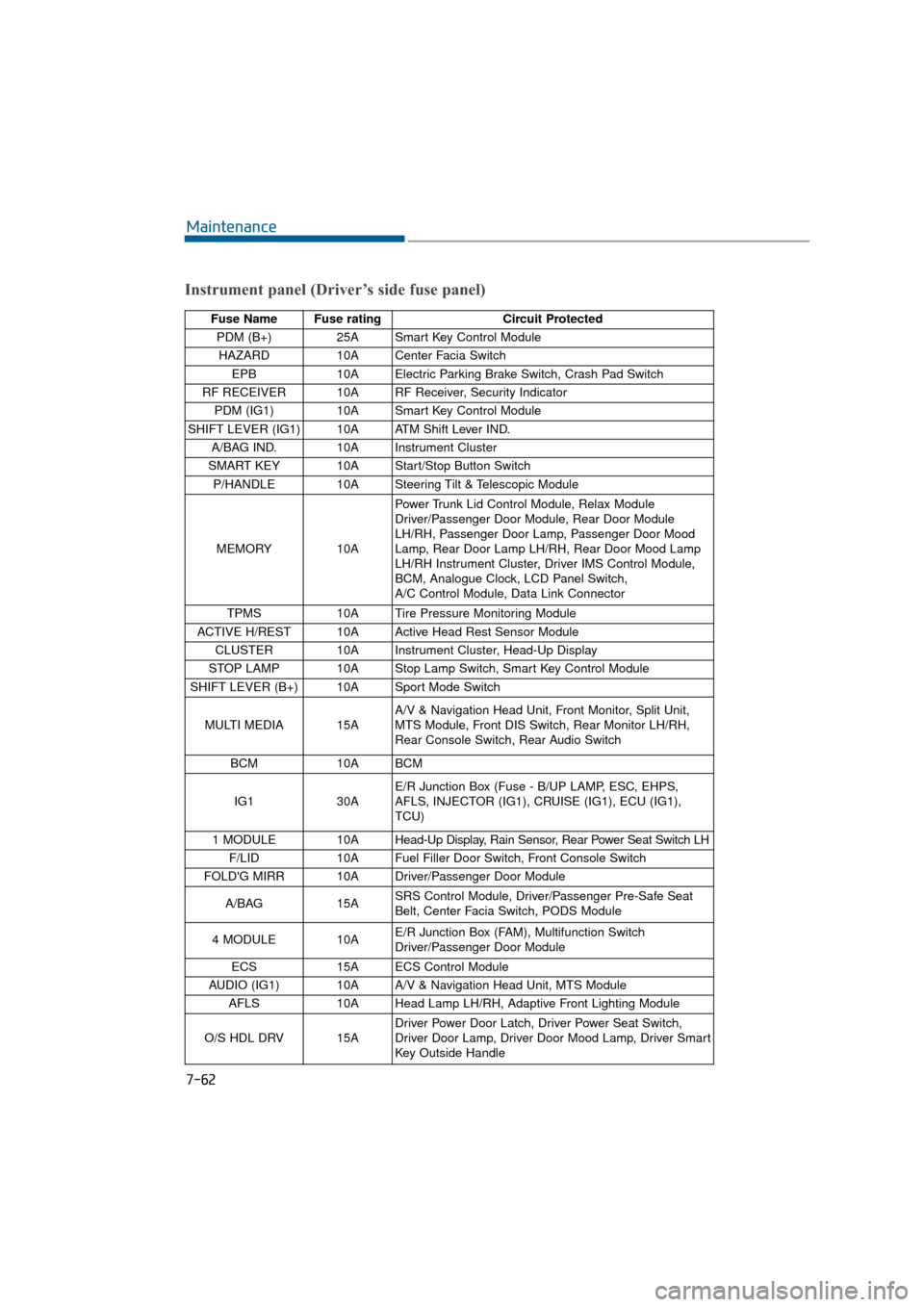
Instrument panel (Driver’s side fuse panel)
Fuse Name Fuse ratingCircuit Protected
PDM (B+) 25A Smart Key Control Module
HAZARD 10A Center Facia Switch
EPB 10A Electric Parking Brake Switch, Crash Pad Switch
RF RECEIVER 10A RF Receiver, Security Indicator PDM (IG1) 10A Smart Key Control Module
SHIFT LEVER (IG1) 10A ATM Shift Lever IND. A/BAG IND. 10A Instrument Cluster
SMART KEY 10A Start/Stop Button Switch P/HANDLE 10A Steering Tilt & Telescopic Module
MEMORY 10APower Trunk Lid Control Module, Relax Module
Driver/Passenger Door Module, Rear Door Module
LH/RH, Passenger Door Lamp, Passenger Door Mood
Lamp, Rear Door Lamp LH/RH, Rear Door Mood Lamp
LH/RH Instrument Cluster, Driver IMS Control Module,
BCM, Analogue Clock, LCD Panel Switch,
A/C Control Module, Data Link Connector
TPMS 10A Tire Pressure Monitoring Module
ACTIVE H/REST 10A Active Head Rest Sensor Module CLUSTER 10A Instrument Cluster, Head-Up Display
STOP LAMP 10A Stop Lamp Switch, Smart Key Control Module
SHIFT LEVER (B+) 10A Sport Mode Switch
MULTI MEDIA 15A A/V & Navigation Head Unit, Front Monitor, Split Unit,
MTS Module, Front DIS Switch, Rear Monitor LH/RH,
Rear Console Switch, Rear Audio Switch
BCM 10A BCM
IG1 30AE/R Junction Box (Fuse - B/UP LAMP, ESC, EHPS,
AFLS, INJECTOR (IG1), CRUISE (IG1), ECU (IG1),
TCU)
1 MODULE 10A Head-Up Display, Rain Sensor, Rear Power Seat Switch LH
F/LID 10A Fuel Filler Door Switch, Front Console Switch
FOLD'G MIRR 10A Driver/Passenger Door Module
A/BAG 15ASRS Control Module, Driver/Passenger Pre-Safe Seat
Belt, Center Facia Switch, PODS Module
4 MODULE 10A E/R Junction Box (FAM), Multifunction Switch
Driver/Passenger Door Module
ECS 15A ECS Control Module
AUDIO (IG1) 10A A/V & Navigation Head Unit, MTS Module AFLS 10A Head Lamp LH/RH, Adaptive Front Lighting Module
O/S HDL DRV 15A Driver Power Door Latch, Driver Power Seat Switch,
Driver Door Lamp, Driver Door Mood Lamp, Driver Smart
Key Outside Handle
Page 442 of 477
7-85
Maintenance07
Bright-metal maintenance
Use a tar remover to remove roadtar and insects, not scraping or
using a sharp object.
To protect a bright metal surface from corrosion, apply a coat of wax
or chrome preservative, or polish
the surface.
In winter or in coastal areas, apply a bright metal part with a heavy
coat of wax or preservative. If nec-
essary, coat the part with non-cor-
rosive petroleum jelly or other pro-
tective compound.
Underbody maintenance
Corrosive materials, which are used
to remove ice, snow or dusts, may
accumulate across the vehicle
underbody. When these materials
are not promptly removed, rusting
process may accelerate across the
underbody, such as the fuel lines,
frame, floor pan and exhaust system,
regardless of the rust-protection
treatment.
Thoroughly wash the vehicle under-
body and wheel openings with luke-
warm or cold water once a month,
after driving off a road, or after the
winter season. Pay special attention
to the underbody areas to find any
mud or dirt. Remaining road dirt or
grime across the vehicle underbody
does more harm than good. The
lower edges of doors, rocker panels,
and frame members have drain
holes, which should not be clogged
with dirt; clogging in these areas may
cause rusting.
Aluminum wheel maintenance
The aluminum wheels are coated
with a clear protective finish.
Do not use any abrasive cleaner,polishing compound, solvent, or
wire brushes on aluminum wheels.
They may scratch or damage the
finish.
Clean the wheel, while it is cool.
Use only a mild soap or neutral detergent, and thoroughly rinse
with water. Also, always clean the
wheels after driving on a salted
road. This prevents corrosion.
Avoid washing the wheels with an automatic high-speed washing
brush.
Do not use any alkaline or acid detergent. It may damage and cor-
rode the aluminum wheels coated
with a clear protective finish.
After washing the vehicle, test
the brakes by slowly applying
them to check whether they are
affected by water. When braking
performance is impaired, dry
the brakes by lightly applying
them while driving forward at a
slow speed.
WARNING
Page 446 of 477
7-89
Maintenance07
The emission control system of your
vehicle is covered by a written limited
warranty. Please refer to the Owner’s
Handbook & Warranty Information
booklet for more warranty information.
Your vehicle is equipped with an
emission control system to meet all
applicable emission regulations.
Below are the three emission control
systems.
(1) Crankcase emission control sys-tem
(2) Evaporative emission control sys- tem
(3) Exhaust emission control system
In order to assure the proper opera-
tion of the emission control systems,
it is recommended that you have
your car inspected and maintained
by an authorized EQUUS dealer in
accordance with the maintenance
schedule in this manual.
Caution for the Inspection and
Maintenance Test (With Electronic
Stability Control (ESC) system)
To prevent a misfiring during a dynamometer test, press the
Electronic Stability Control (ESC)
system OFF.
After a dynamometer test, turn ON the ESC system back.1. Crankcase emission control system
The positive crankcase ventilation
system is to prevent the gas emis-
sion from the crankcase and to
reduce the air pollution. This system
supplies filtered-out, fresh air to the
crankcase through the air intake
hose. Inside the crankcase, the fil-
tered-out air mixes with gases, which
then pass through the PCV valve into
the induction system.
2. Evaporative emission control(including ORVR: Onboard
Refueling Vapor Recovery)
system
The Evaporative Emission Control
System is designed to prevent fuel
vapor emission into the atmosphere.
(The ORVR system is designed to
keep the fuel vapors in a canister
while being refueled at the gas sta-
tion, preventing the fuel vapor emis-
sion into the atmosphere.)
Canister
Fuel vapors generated inside the fuel
tank are absorbed and stored in the
onboard canister. When the engine is
running, the fuel vapors are
absorbed in the canister, and are
drawn into the engine intake mani-
fold through the purge control sole-
noid valve.
E EM
M I
IS
S S
SI
IO
O N
N
C
C O
O N
NT
TR
R O
O L
L
S
S Y
Y S
ST
T E
EM
M
Page 447 of 477
7-90
Maintenance
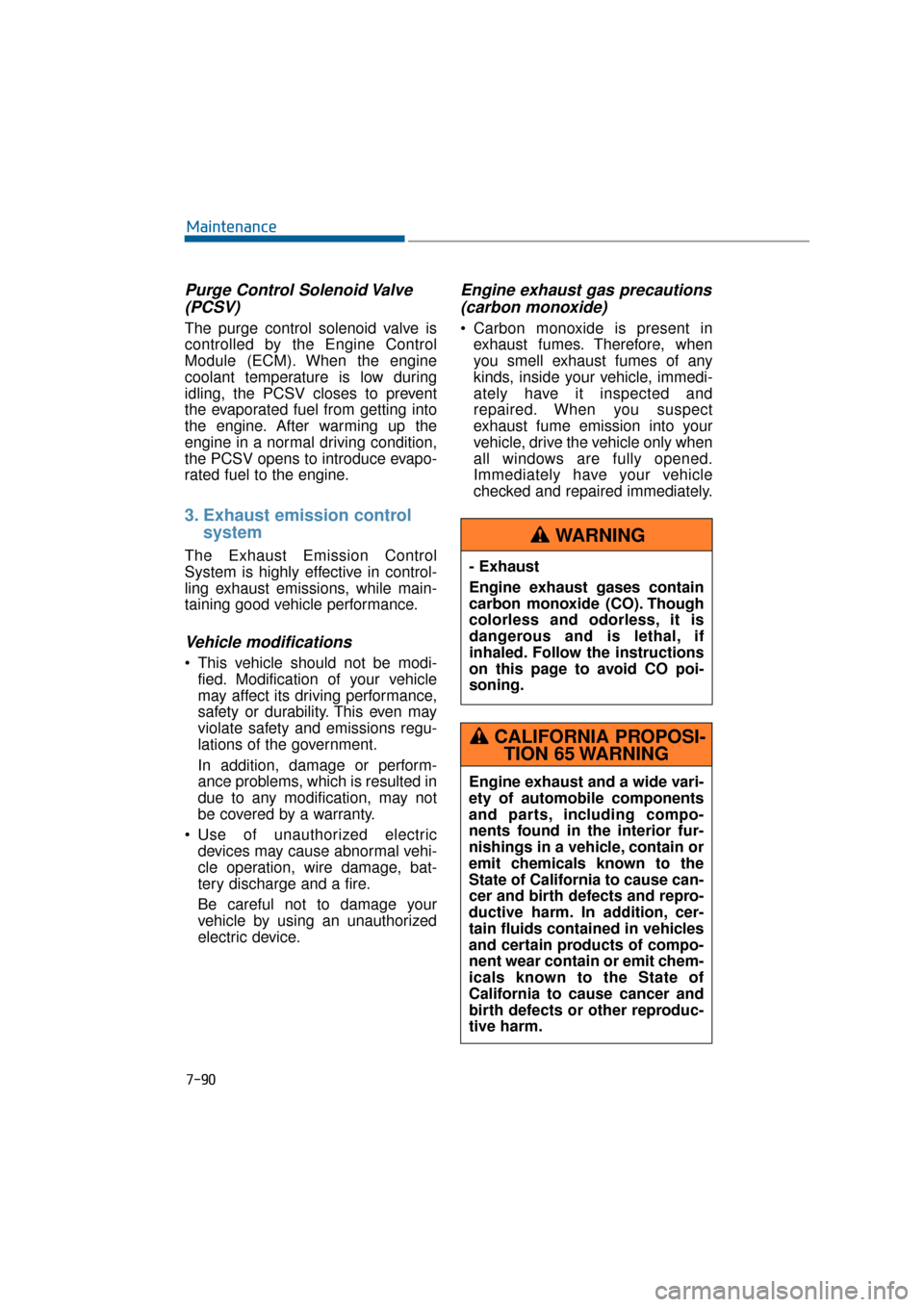
Purge Control Solenoid Valve(PCSV)
The purge control solenoid valve is
controlled by the Engine Control
Module (ECM). When the engine
coolant temperature is low during
idling, the PCSV closes to prevent
the evaporated fuel from getting into
the engine. After warming up the
engine in a normal driving condition,
the PCSV opens to introduce evapo-
rated fuel to the engine.
3. Exhaust emission control system
The Exhaust Emission Control
System is highly effective in control-
ling exhaust emissions, while main-
taining good vehicle performance.
Vehicle modifications
This vehicle should not be modi-
fied. Modification of your vehicle
may affect its driving performance,
safety or durability. This even may
violate safety and emissions regu-
lations of the government.
In addition, damage or perform-
ance problems, which is resulted in
due to any modification, may not
be covered by a warranty.
Use of unauthorized electric devices may cause abnormal vehi-
cle operation, wire damage, bat-
tery discharge and a fire.
Be careful not to damage your
vehicle by using an unauthorized
electric device.
Engine exhaust gas precautions (carbon monoxide)
Carbon monoxide is present in
exhaust fumes. Therefore, when
you smell exhaust fumes of any
kinds, inside your vehicle, immedi-
ately have it inspected and
repaired. When you suspect
exhaust fume emission into your
vehicle, drive the vehicle only when
all windows are fully opened.
Immediately have your vehicle
checked and repaired immediately.
- Exhaust
Engine exhaust gases contain
carbon monoxide (CO). Though
colorless and odorless, it is
dangerous and is lethal, if
inhaled. Follow the instructions
on this page to avoid CO poi-
soning.
WARNING
Engine exhaust and a wide vari-
ety of automobile components
and parts, including compo-
nents found in the interior fur-
nishings in a vehicle, contain or
emit chemicals known to the
State of California to cause can-
cer and birth defects and repro-
ductive harm. In addition, cer-
tain fluids contained in vehicles
and certain products of compo-
nent wear contain or emit chem-
icals known to the State of
California to cause cancer and
birth defects or other reproduc-
tive harm.
CALIFORNIA PROPOSI- TION 65 WARNING
Page 448 of 477
7-91
Maintenance07
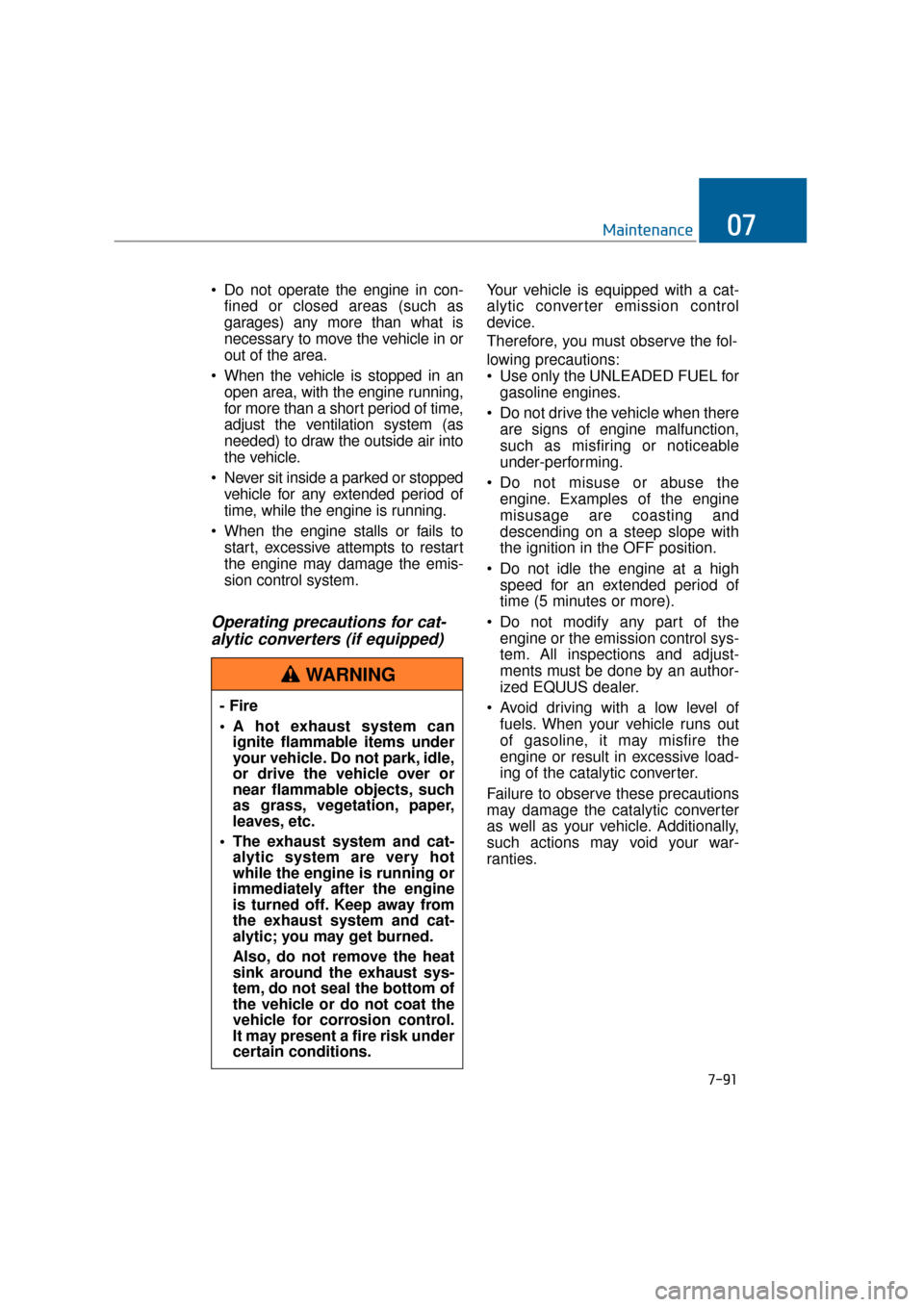
Do not operate the engine in con-fined or closed areas (such as
garages) any more than what is
necessary to move the vehicle in or
out of the area.
When the vehicle is stopped in an open area, with the engine running,
for more than a short period of time,
adjust the ventilation system (as
needed) to draw the outside air into
the vehicle.
Never sit inside a parked or stopped vehicle for any extended period of
time, while the engine is running.
When the engine stalls or fails to start, excessive attempts to restart
the engine may damage the emis-
sion control system.
Operating precautions for cat-alytic converters (if equipped)
Your vehicle is equipped with a cat-
alytic converter emission control
device.
Therefore, you must observe the fol-
lowing precautions:
Use only the UNLEADED FUEL for
gasoline engines.
Do not drive the vehicle when there are signs of engine malfunction,
such as misfiring or noticeable
under-performing.
Do not misuse or abuse the engine. Examples of the engine
misusage are coasting and
descending on a steep slope with
the ignition in the OFF position.
Do not idle the engine at a high speed for an extended period of
time (5 minutes or more).
Do not modify any part of the engine or the emission control sys-
tem. All inspections and adjust-
ments must be done by an author-
ized EQUUS dealer.
Avoid driving with a low level of fuels. When your vehicle runs out
of gasoline, it may misfire the
engine or result in excessive load-
ing of the catalytic converter.
Failure to observe these precautions
may damage the catalytic converter
as well as your vehicle. Additionally,
such actions may void your war-
ranties.
- Fire
A hot exhaust system can
ignite flammable items under
your vehicle. Do not park, idle,
or drive the vehicle over or
near flammable objects, such
as grass, vegetation, paper,
leaves, etc.
The exhaust system and cat- alytic system are very hot
while the engine is running or
immediately after the engine
is turned off. Keep away from
the exhaust system and cat-
alytic; you may get burned.
Also, do not remove the heat
sink around the exhaust sys-
tem, do not seal the bottom of
the vehicle or do not coat the
vehicle for corrosion control.
It may present a fire risk under
certain conditions.
WARNING
Page 453 of 477
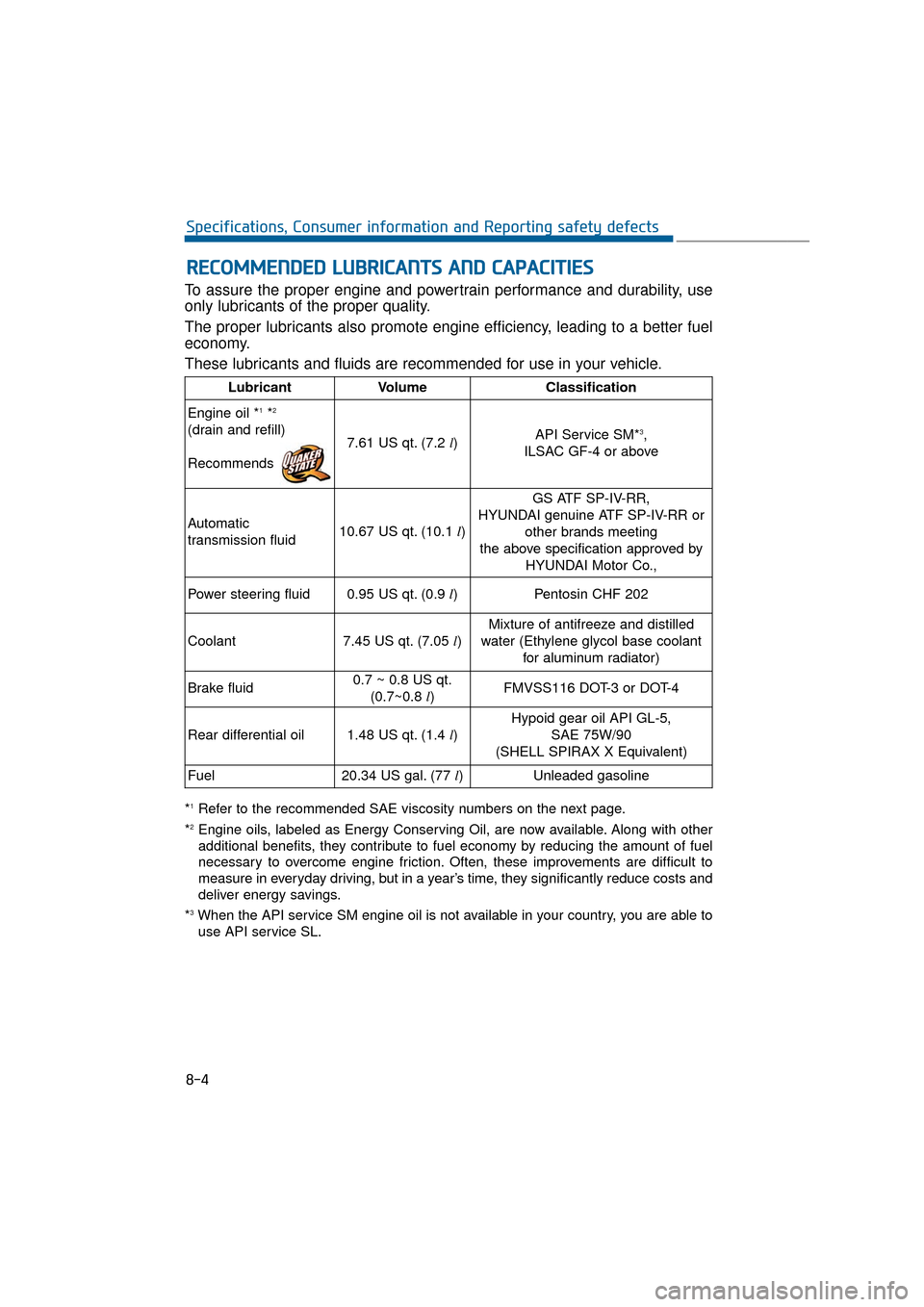
To assure the proper engine and powertrain performance and durability, use
only lubricants of the proper quality.
The proper lubricants also promote engine efficiency, leading to a better fuel
economy.
These lubricants and fluids are recommended for use in your vehicle.
*1Refer to the recommended SAE viscosity numbers on the next page.
*
2Engine oils, labeled as Energy Conserving Oil, are now available. Along with other
additional benefits, they contribute to fuel economy by reducing the amount of fuel
necessary to overcome engine friction. Often, these improvements are difficult to
measure in everyday driving, but in a year’s time, they significantly reduce costs and
deliver energy savings.
*
3When the API service SM engine oil is not available in your country, you are able to use API service SL.
R R E
EC
CO
O M
M M
ME
EN
N D
DE
ED
D
L
L U
U B
BR
RI
IC
C A
A N
N T
TS
S
A
A N
N D
D
C
C A
A P
PA
A C
CI
IT
T I
IE
E S
S
8-4
Specifications, Consumer information and Reporting safety defects
Lubricant Volume Classification
Engine oil *
1*2
(drain and refill)
Recommends 7.61 US qt. (7.2
l)API Service SM*3,
ILSAC GF-4 or above
Automatic
transmission fluid 10.67 US qt. (10.1
l)GS ATF SP-IV-RR,
HYUNDAI genuine ATF SP-IV-RR or other brands meeting
the above specification approved by HYUNDAI Motor Co.,
Power steering fluid 0.95 US qt. (0.9
l)
Pentosin CHF 202
Coolant 7.45 US qt. (7.05
l)Mixture of antifreeze and distilled
water (Ethylene glycol base coolant for aluminum radiator)
Brake fluid 0.7 ~ 0.8 US qt.
(0.7~0.8 l) FMVSS116 DOT-3 or DOT-4
Rear differential oil 1.48 US qt. (1.4 l) Hypoid gear oil API GL-5,
SAE 75W/90
(SHELL SPIRAX X Equivalent)
Fuel 20.34 US gal. (77 l)
Unleaded gasoline
Page 454 of 477
Recommended SAE viscosity number
Always be sure to clean the filler-plug area, drain plug, or dipstick before
checking or draining any lubricant. This is especially important in dusty
or sandy areas or after driving on an unpaved road. The practice to
maintain the plug and dipstick areas clean prevents dirt and grit from
entering the engine or the other mechanisms, which may be damaged.
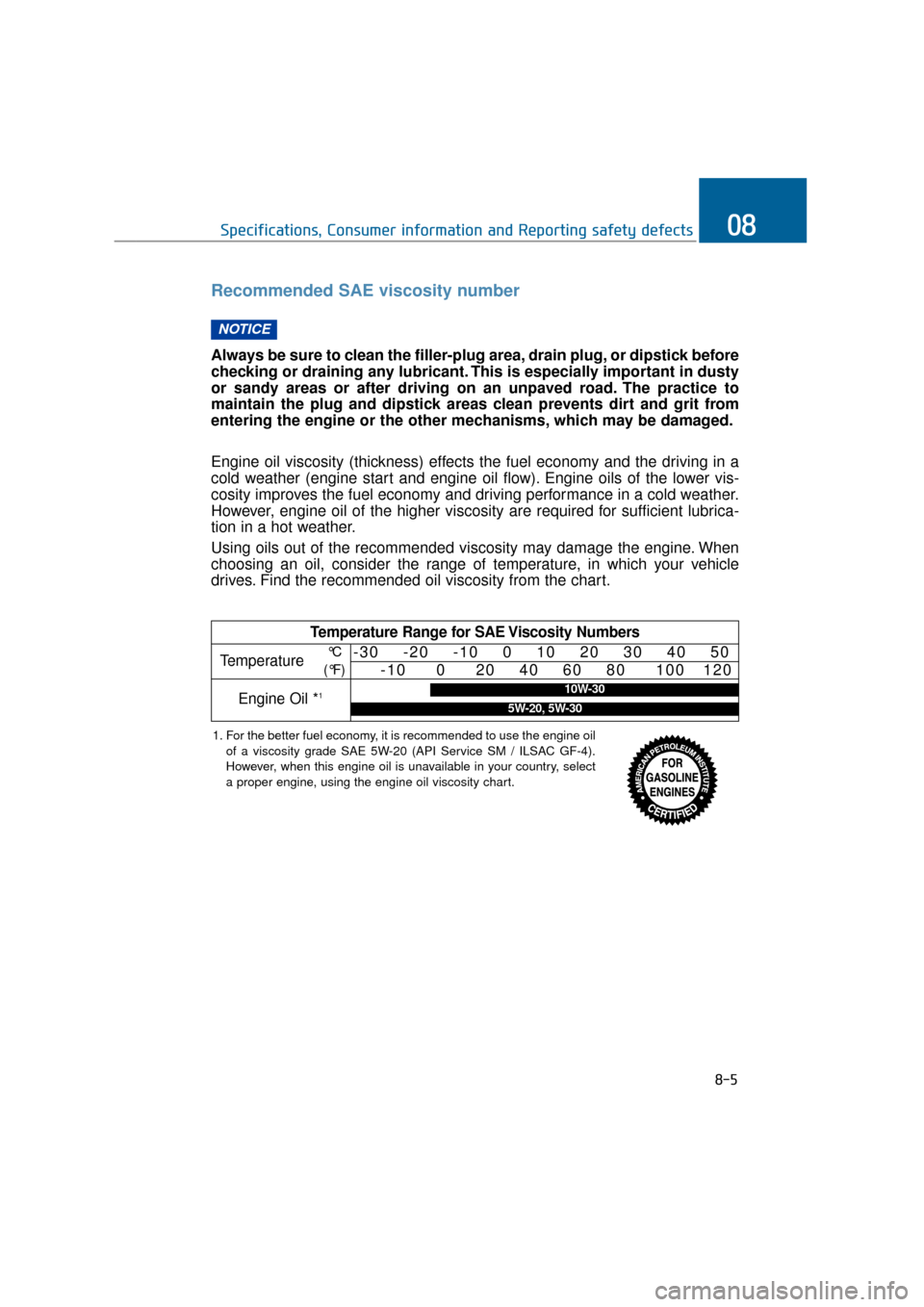
Engine oil viscosity (thickness) effects the fuel economy and the driving in a
cold weather (engine start and engine oil flow). Engine oils of the lower vis-
cosity improves the fuel economy and driving performance in a cold weather.
However, engine oil of the higher viscosity are required for sufficient lubrica-
tion in a hot weather.
Using oils out of the recommended viscosity may damage the engine. When
choosing an oil, consider the range of temperature, in which your vehicle
drives. Find the recommended oil viscosity from the chart.
NOTICE
8-5
Specifications, Consumer information and Reporting safety defects08
Temperature Range for SAE Viscosity Numbers
TemperatureEngine Oil *
1
°C
(°F)-30 -20 -10 0 10 20 30 40 50 -10 0 20 40 60 80 100 120
1. For the better fuel economy, it is recommended to use the engine oil
of a viscosity grade SAE 5W-20 (API Service SM / ILSAC GF-4).
However, when this engine oil is unavailable in your country, select
a proper engine, using the engine oil viscosity chart.
10W-30
5W-20, 5W-30
Page 464 of 477

Emission control system ........................................................................\
.............7-89Crankcase emission control system .............................................................7-89
Evaporative emission control system ...........................................................7-89
Exhaust emission control system .................................................................7-90
Engine compartment ........................................................................\
.....................1-6
Engine compartment fuse........................................................................\
............7-59
Engine coolant........................................................................\
.............................7-27
Engine coolant temperature gauge ......................................................................3-\
66
Engine number ........................................................................\
..............................8-7
Engine oil ........................................................................\
....................................7-25
Engine overheating......................................................\
..........................................6-6
Engine start/stop button ........................................................................\
................5-7
Evaporative emission control system..................................................................7-89
Exhaust emission control system ........................................................................\
7-90
Explanation of scheduled maintenance items .....................................................7-23
Exterior care ........................................................................\
................................7-83
Exterior overview (Front) ........................................................................\
.............1-2
Exterior overview (Rear) ........................................................................\
..............1-3
Flat tire ........................................................................\
.......................................6-12 Changing tires ........................................................................\
......................6-13
Compact spare tire........................................................................\
................6-17
Jack and tools ........................................................................\
.......................6-12
Removing and storing the spare tire ............................................................6-13
Floor mat anchor(s) ........................................................................\
...................3-150
Fluid Brake fluid ........................................................................\
............................7-30
Power steering fluid ........................................................................\
.............7-31
Washer fluid ........................................................................\
.........................7-32
Fog light ........................................................................\
...................................3-113
Front seat adjustment ........................................................................\
....................2-4
Fuel Economy ........................................................................\
.............................3-87
Fuel filler lid........................................................................\
................................3-34
Fuel gauge ........................................................................\
...................................3-67
Fuel requirements.......................................................\
...........................................F-8
Fuse switch ........................................................................\
..................................7-58
I-6
Index
F
Page 472 of 477
.............................................................6-7
Tire rotation ........................................................................\
.........")
Tire pressure monitoring system (TPMS).............................................................6-7
Tire rotation ........................................................................\
.................................7-45
Tire specification and pressure label.....................................................................8-6\
Tires specifications........................................................................\
........................8-3
Tires and wheels........................................................................\
..........................7-42Checking tire inflation pressure ...................................................................7-44
Compact spare tire replacement ...................................................................7-47
Low aspect ratio tire ........................................................................\
.............7-51
Recommended cold tire inflation pressures .................................................7-42
Tire care ........................................................................\
................................7-42
Tire maintenance ........................................................................\
..................7-48
Tire replacement ........................................................................\
...................7-46
Tire rotation ........................................................................\
..........................7-45
Tire sidewall labeling ........................................................................\
...........7-48
Tire terminology and definitions ..................................................................7-52
Tire traction ........................................................................\
..........................7-47
Wheel alignment and tire balance ................................................................7-45
Wheel replacement ........................................................................\
...............7-47
Towing........................................................................\
.........................................6-20
Trailer towing ........................................................................\
..............................5-81
Transmission Automatic transmission ........................................................................\
........5-11
Trip A/B........................................................................\
.......................................3-86
Trip computer ........................................................................\
..............................3-86 Fuel Economy ........................................................................\
......................3-87
Trip A/B ........................................................................\
................................3-86
Trip computer mode ........................................................................\
....................3-70
Trunk Emergency trunk safety release ...................................................................3-23
Non-powered trunk ........................................................................\
..............3-18
Power trunk ........................................................................\
..........................3-19
Smart trunk ........................................................................\
...........................3-24
Trunk room lamp........................................................................\
.......................3-119
Turn by turn mode (TBT) ........................................................................\
...........3-70
Turn signals and lane change signals ................................................................3-112
User settings mode ........................................................................\
......................3-72
I-14
Index
U