fuel Hyundai Equus 2016 Service Manual
[x] Cancel search | Manufacturer: HYUNDAI, Model Year: 2016, Model line: Equus, Model: Hyundai Equus 2016Pages: 477, PDF Size: 16.25 MB
Page 331 of 477
5-80
Driving your vehicle
Certification label
The certification label is located on
right side of the driver's door sill.
This label shows the maximum
weight capacity, or called GVWR
(Gross Vehicle Weight Rating). The
GVWR includes the weight of the
vehicle, all occupants, fuel, and load.
This label also tells you the maxi-
mum weight that can be supported
by the front and rear axles, called
Gross Axle Weight Rating (GAWR).
To find out the actual load weight of
the front and rear axles, you need to
weigh your vehicle. Your dealer can
help you with this. Equally and even-
ly spread out the loads across the
centerline.The label will help you decide how
much loads and installed equipment
your vehicle can carry.
When your vehicle carries items
inside, such as suitcases, tools and
packages, those loads move as fast
as your vehicle. When stopping or
sharply turning, or if there is a crash,
those loads may throw forwards
under the influence of inertia, and
cause an injury by hitting with the
driver or an occupant.
OBH059070
- Over loading
Never exceed the GVWR or
the GAWR of your vehicle.
Overloading above those lim-
its may cause an accident or a
vehicle damage. You can cal-
culate the load weight capaci-
ty by weighing the items (or
people), before putting them
in the vehicle. Be careful not
to overload your vehicle.
Do not overload your vehicle above the GVWR, the
front/rear GAWRs or the vehi-
cle weight capacity. When
overloading, including tires,
parts may break. Even, it may
adversely affects the vehicle
handling and braking per-
formance. You may lose con-
trol and crash. Also, overload-
ing may shorten the life span
of your vehicle.
WARNING
Page 333 of 477
This is to guide you to load in a prop-
er manner, and to keep the load
weight under the maximum weight
capacity. Proper loading will provide
maximum vehicle performance.
Before loading your vehicle, read the
following terms and explanation for
determining your vehicle's loading
weight, based on the vehicle's speci-
fications and the certification label:
Base curb weight
This is the weight of the vehicle, only
including a full tank of fuel and all
standard equipment. This weight
excludes optional equipment, loads,
or occupants.
Vehicle curb weight
This is the weight of your new vehi-
cle, upon being delivered from a
dealer, including any optional equip-
ment.
Load weight
This is the weight of all the addition-
al items, including the loads and
optional equipment.
GAW (Gross axle weight)
This is the total weight on each
axle(front and rear), including the
vehicle curb weight and the load
weight.
GAWR
(Gross axle weight rating)
This is the maximum weight capacity
of a single axle (front or rear). This
GAWR is shown on the certification
label. The total load weight on each
axle must never exceed its GAWR.
GVW (Gross vehicle weight)
This is the accumulated weight of the
base curb weight, the actual load
weight, and the occupants' weight.
GVWR
(Gross vehicle weight rating)
This is the maximum weight capacity
of a vehicle, including all options,
equipment, occupants and loads.
The GVWR is shown on the certifica-
tion label on the driver’s door sill.
T TR
R A
A I
IL
L E
E R
R
T
T O
O W
W I
IN
N G
G
We do not recommend using this
vehicle to tow a trailer.
V VE
EH
H I
IC
C L
LE
E
W
W E
EI
IG
G H
H T
T
Driving your vehicle
5-82
Page 336 of 477
If engine stalls while driving
1.Gradually reduce your drivingspeed while driving straight ahead.
Cautiously drive off the road to a
safe place.
2.Press the emergency hazard flash- er.
3.Try to re-start the engine again. When your vehicle does not re-
start, contact an authorized
EQUUS dealer for the qualified
assistance.When the engine does not
revolve, or slowly revolves
1.Make sure that the shift lever is inN(Neutral) or P (Park), and the
emergency brake is set.
2.Check that the battery connections are clean and tight.
3.Turn ON the interior light. When the light dims or goes out upon operat-
ing the starter, the battery is dis-
charged.
4.Check that the starter connections are securely tightened.
5.Do not push or pull the vehicle to start it. Follow instructions provided
in "Jump starting".
When the engine normally
revolves, but does not start
1.Check the fuel level.
2.With the Engine Start/Stop Buttonin the OFF position, check all con-
nectors of the ignition coils and the
spark plugs. Reconnect any dis-
connected or loose parts.
3.If the engine still does not start, contact an authorized EQUUS
dealer for the qualified assistance
6-3
What to do in an emergency06
I IF
F
T
T H
H E
E
E
E N
N G
GI
IN
N E
E
W
W I
IL
L L
L
N
N O
O T
T
S
S T
T A
A R
RT
T
When the engine does not start,
do not push or pull the car to
start it. This may result in a col-
lision or cause other damage.
CAUTION
Page 340 of 477
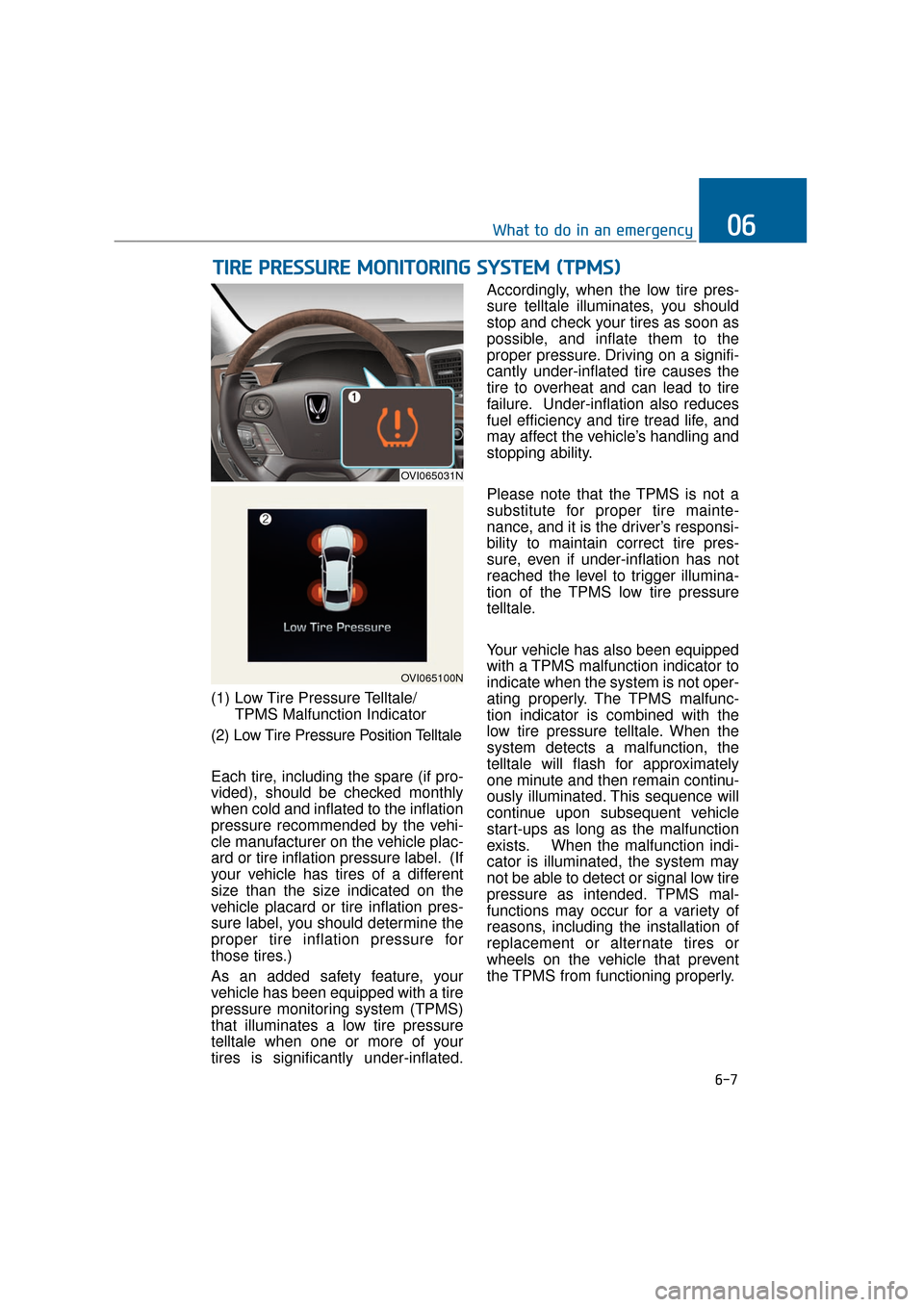
(1) Low Tire Pressure Telltale/TPMS Malfunction Indicator
(2) Low Tire Pressure Position Telltale
Each tire, including the spare (if pro-
vided), should be checked monthly
when cold and inflated to the inflation
pressure recommended by the vehi-
cle manufacturer on the vehicle plac-
ard or tire inflation pressure label. (If
your vehicle has tires of a different
size than the size indicated on the
vehicle placard or tire inflation pres-
sure label, you should determine the
proper tire inflation pressure for
those tires.)
As an added safety feature, your
vehicle has been equipped with a tire
pressure monitoring system (TPMS)
that illuminates a low tire pressure
telltale when one or more of your
tires is significantly under-inflated. Accordingly, when the low tire pres-
sure telltale illuminates, you should
stop and check your tires as soon as
possible, and inflate them to the
proper pressure. Driving on a signifi-
cantly under-inflated tire causes the
tire to overheat and can lead to tire
failure. Under-inflation also reduces
fuel efficiency and tire tread life, and
may affect the vehicle’s handling and
stopping ability.
Please note that the TPMS is not a
substitute for proper tire mainte-
nance, and it is the driver’s responsi-
bility to maintain correct tire pres-
sure, even if under-inflation has not
reached the level to trigger illumina-
tion of the TPMS low tire pressure
telltale.
Your vehicle has also been equipped
with a TPMS malfunction indicator to
indicate when the system is not oper-
ating properly. The TPMS malfunc-
tion indicator is combined with the
low tire pressure telltale. When the
system detects a malfunction, the
telltale will flash for approximately
one minute and then remain continu-
ously illuminated. This sequence will
continue upon subsequent vehicle
start-ups as long as the malfunction
exists. When the malfunction indi-
cator is illuminated, the system may
not be able to detect or signal low tire
pressure as intended. TPMS mal-
functions may occur for a variety of
reasons, including the installation of
replacement or alternate tires or
wheels on the vehicle that prevent
the TPMS from functioning properly.
T T
I
IR
R E
E
P
P R
R E
ES
SS
SU
U R
RE
E
M
M O
ON
NI
IT
T O
O R
RI
IN
N G
G
S
S Y
Y S
ST
T E
EM
M
(
( T
T P
P M
M S
S)
)
6-7
What to do in an emergency06
OVI065031N
OVI065100N
Page 364 of 477
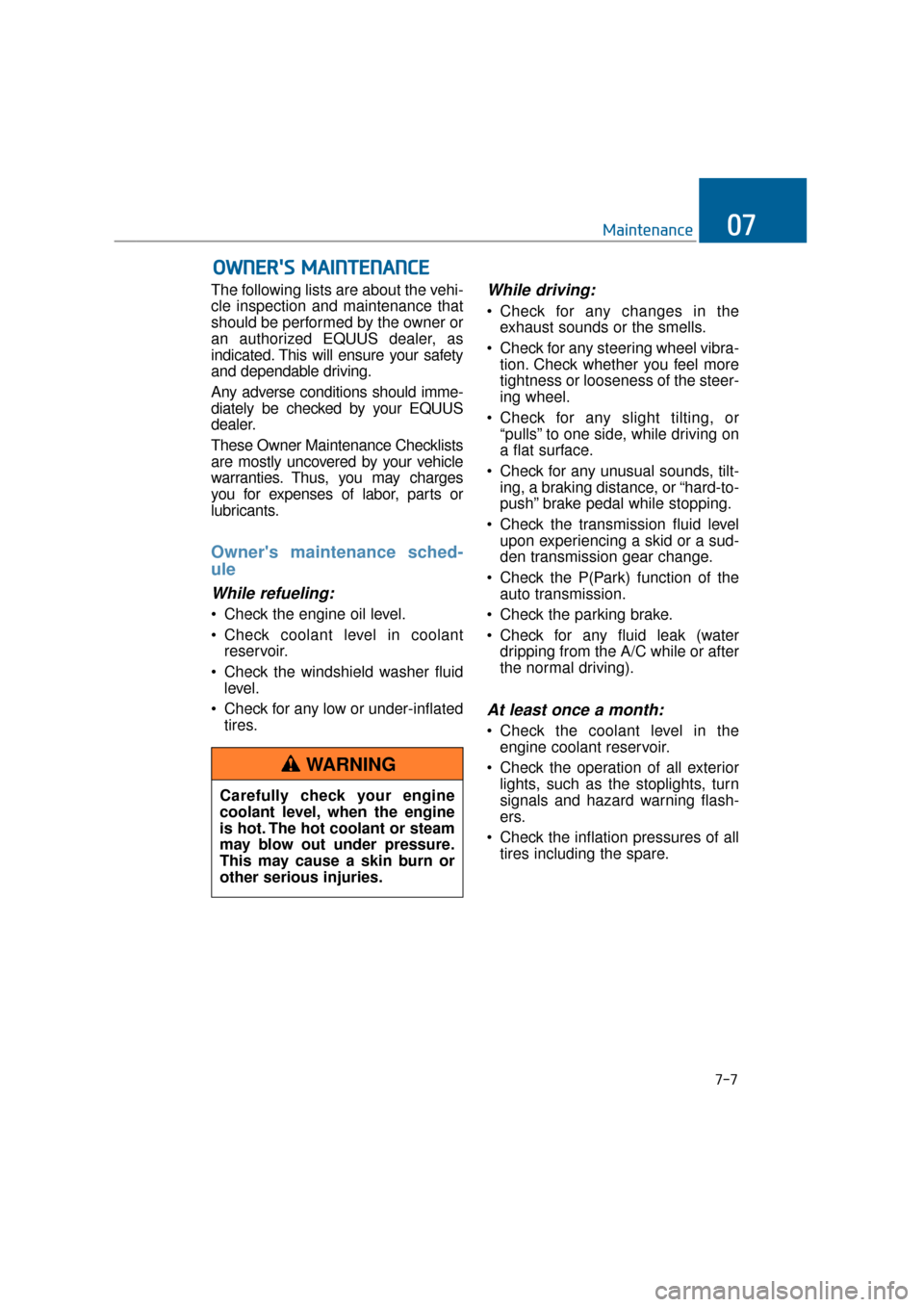
The following lists are about the vehi-
cle inspection and maintenance that
should be performed by the owner or
an authorized EQUUS dealer, as
indicated. This will ensure your safety
and dependable driving.
Any adverse conditions should imme-
diately be checked by your EQUUS
dealer.
These Owner Maintenance Checklists
are mostly uncovered by your vehicle
warranties. Thus, you may charges
you for expenses of labor, parts or
lubricants.
Owner's maintenance sched-
ule
While refueling:
Check the engine oil level.
Check coolant level in coolantreservoir.
Check the windshield washer fluid level.
Check for any low or under-inflated tires.
While driving:
Check for any changes in theexhaust sounds or the smells.
Check for any steering wheel vibra- tion. Check whether you feel more
tightness or looseness of the steer-
ing wheel.
Check for any slight tilting, or “pulls” to one side, while driving on
a flat surface.
Check for any unusual sounds, tilt- ing, a braking distance, or “hard-to-
push” brake pedal while stopping.
Check the transmission fluid level upon experiencing a skid or a sud-
den transmission gear change.
Check the P(Park) function of the auto transmission.
Check the parking brake.
Check for any fluid leak (water dripping from the A/C while or after
the normal driving).
At least once a month:
Check the coolant level in theengine coolant reservoir.
Check the operation of all exterior lights, such as the stoplights, turn
signals and hazard warning flash-
ers.
Check the inflation pressures of all tires including the spare.
O OW
W N
NE
ER
R '
'S
S
M
M A
AI
IN
N T
TE
EN
N A
AN
N C
CE
E
7-7
Maintenance07
Carefully check your engine
coolant level, when the engine
is hot. The hot coolant or steam
may blow out under pressure.
This may cause a skin burn or
other serious injuries.
WARNING
Page 366 of 477
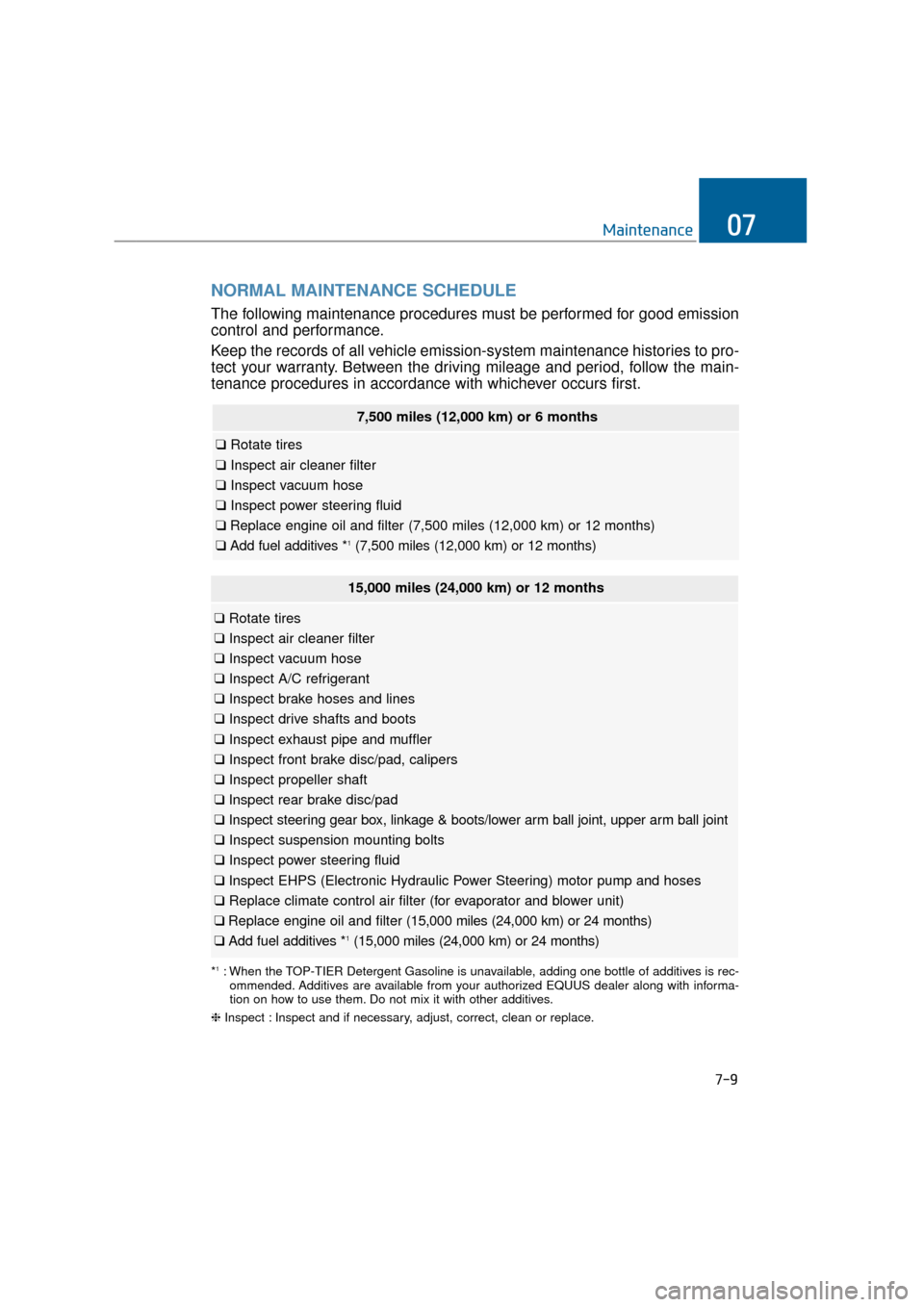
NORMAL MAINTENANCE SCHEDULE
The following maintenance procedures must be performed for good emission
control and performance.
Keep the records of all vehicle emission-system maintenance histories to pro-
tect your warranty. Between the driving mileage and period, follow the main-
tenance procedures in accordance with whichever occurs first.
7-9
Maintenance07
7,500 miles (12,000 km) or 6 months
❑Rotate tires
❑ Inspect air cleaner filter
❑ Inspect vacuum hose
❑ Inspect power steering fluid
❑ Replace engine oil and filter (7,500 miles (12,000 km) or 12 months)\
❑ Add fuel additives *
1(7,500 miles (12,000 km) or 12 months)
15,000 miles (24,000 km) or 12 months
❑ Rotate tires
❑ Inspect air cleaner filter
❑ Inspect vacuum hose
❑ Inspect A/C refrigerant
❑ Inspect brake hoses and lines
❑ Inspect drive shafts and boots
❑ Inspect exhaust pipe and muffler
❑ Inspect front brake disc/pad, calipers
❑ Inspect propeller shaft
❑ Inspect rear brake disc/pad
❑ Inspect steering gear box, linkage & boots/lower arm ball joint, upper arm ball joint
❑ Inspect suspension mounting bolts
❑ Inspect power steering fluid
❑ Inspect EHPS (Electronic Hydraulic Power Steering) motor pump and hoses
❑ Replace climate control air filter (for evaporator and blower unit)
❑ Replace engine oil and filter (15,000 miles (24,000 km) or 24 months)
❑ Add fuel additives *
1(15,000 miles (24,000 km) or 24 months)
*1: When the TOP-TIER Detergent Gasoline is unavailable, adding one bottle of additives is rec-
ommended. Additives are available from your authorized EQUUS dealer along with informa-
tion on how to use them. Do not mix it with other additives.
❈ Inspect : Inspect and if necessary, adjust, correct, clean or replace.
Page 367 of 477
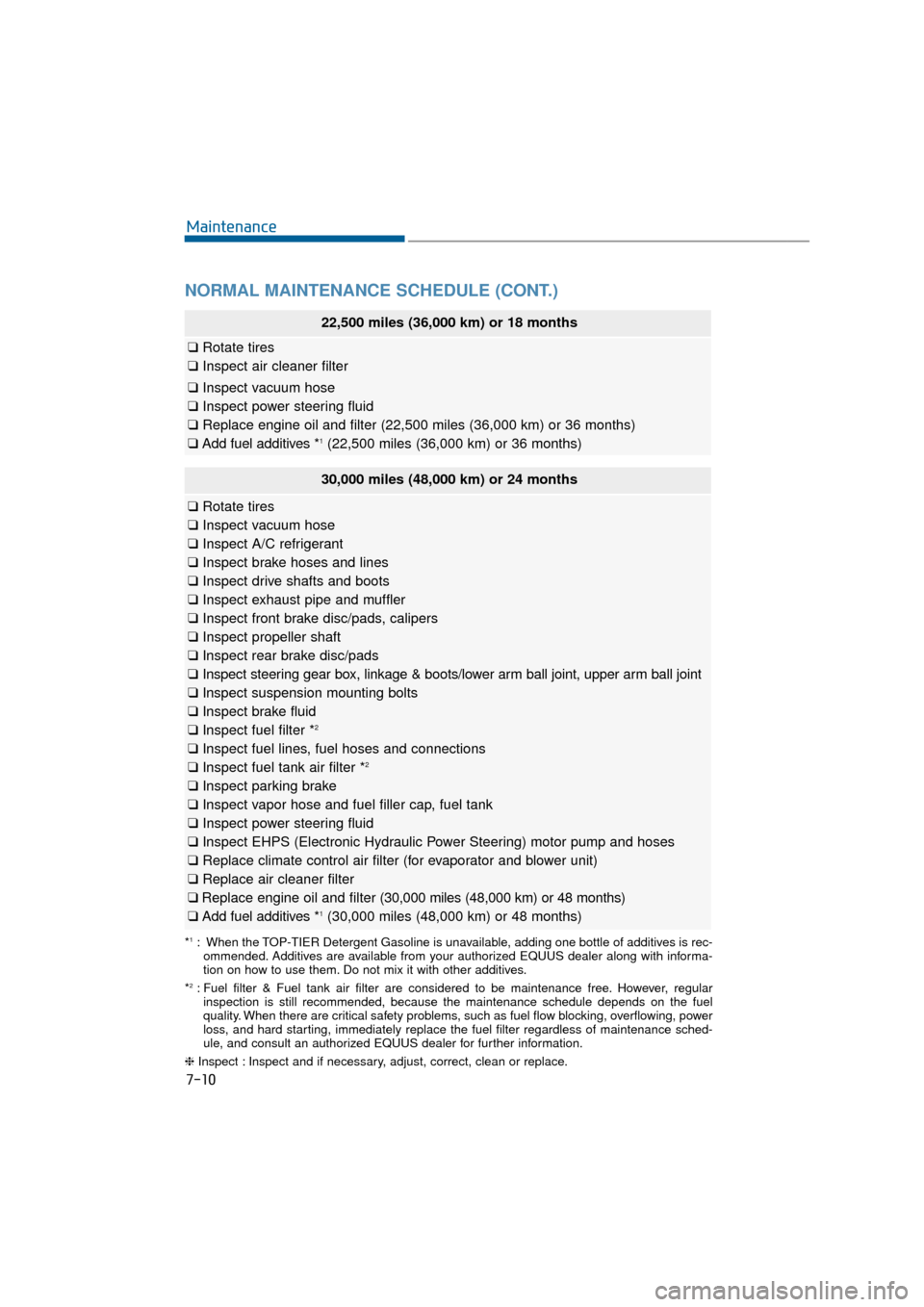
NORMAL MAINTENANCE SCHEDULE (CONT.)
7-10
Maintenance
22,500 miles (36,000 km) or 18 months
❑Rotate tires
❑ Inspect air cleaner filter
❑ Inspect vacuum hose
❑ Inspect power steering fluid
❑ Replace engine oil and filter (22,500 miles (36,000 km) or 36 months)\
❑ Add fuel additives *
1(22,500 miles (36,000 km) or 36 months)
*1: When the TOP-TIER Detergent Gasoline is unavailable, adding one bottle of additives is rec-
ommended. Additives are available from your authorized EQUUS dealer along with informa-
tion on how to use them. Do not mix it with other additives.
*
2: Fuel filter & Fuel tank air filter are considered to be maintenance free\
. However, regular inspection is still recommended, because the maintenance schedule depend\
s on the fuel
quality. When there are critical safety problems, such as fuel flow blocking, overflowing, power
loss, and hard starting, immediately replace the fuel filter regardless of maintenance sche\
d-
ule, and consult an authorized EQUUS dealer for further information.
❈ Inspect : Inspect and if necessary, adjust, correct, clean or replace.
30,000 miles (48,000 km) or 24 months
❑Rotate tires
❑ Inspect vacuum hose
❑ Inspect A/C refrigerant
❑ Inspect brake hoses and lines
❑ Inspect drive shafts and boots
❑ Inspect exhaust pipe and muffler
❑ Inspect front brake disc/pads, calipers
❑ Inspect propeller shaft
❑ Inspect rear brake disc/pads
❑ Inspect steering gear box, linkage & boots/lower arm ball joint, upper arm ball joint
❑ Inspect suspension mounting bolts
❑ Inspect brake fluid
❑ Inspect fuel filter *
2
❑Inspect fuel lines, fuel hoses and connections
❑ Inspect fuel tank air filter *2
❑Inspect parking brake
❑ Inspect vapor hose and fuel filler cap, fuel tank
❑ Inspect power steering fluid
❑ Inspect EHPS (Electronic Hydraulic Power Steering) motor pump and hoses
❑ Replace climate control air filter (for evaporator and blower unit)
❑ Replace air cleaner filter
❑ Replace engine oil and filter (30,000 miles (48,000 km) or 48 months)
❑ Add fuel additives *
1(30,000 miles (48,000 km) or 48 months)
Page 368 of 477
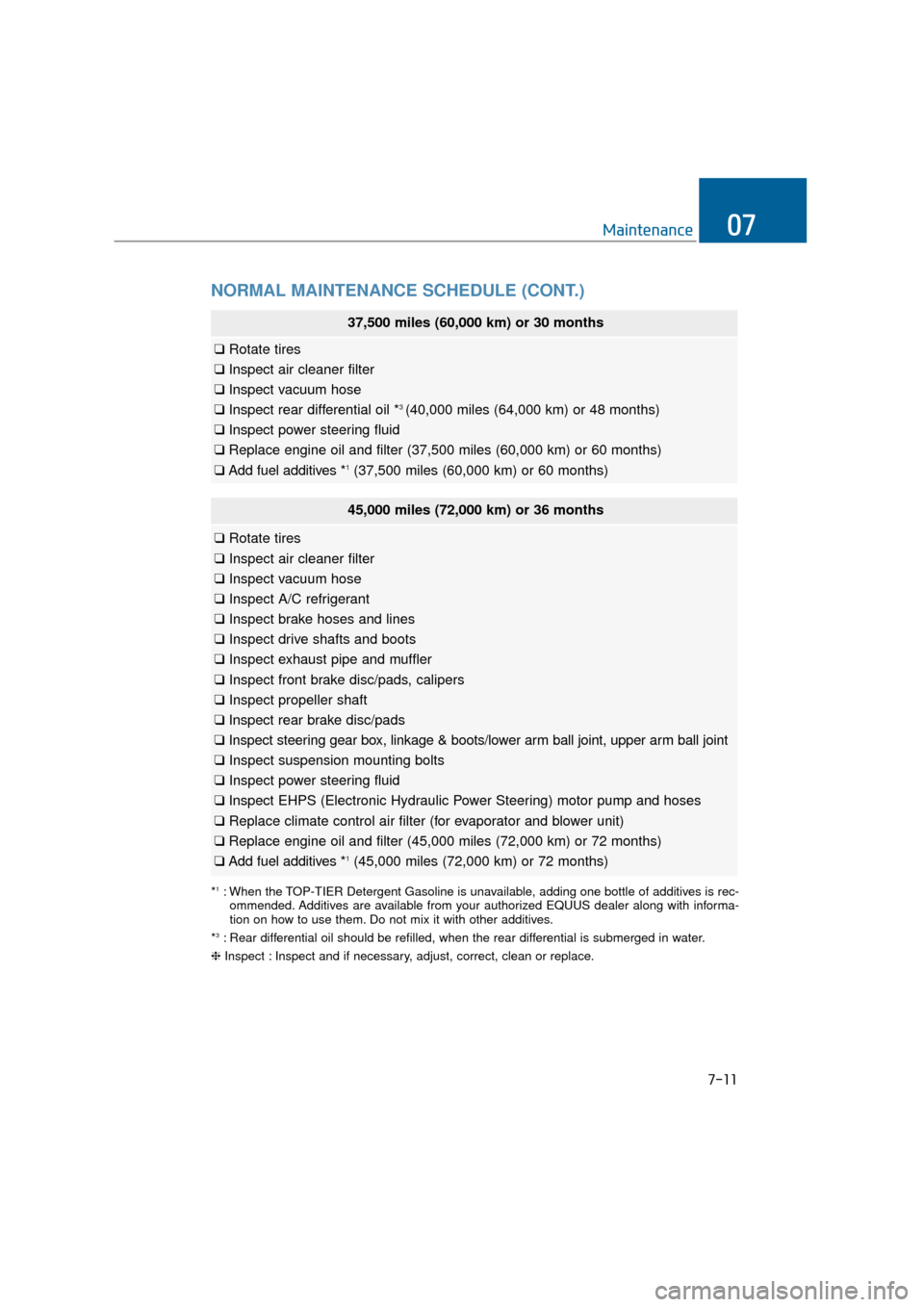
NORMAL MAINTENANCE SCHEDULE (CONT.)
7-11
Maintenance07
37,500 miles (60,000 km) or 30 months
❑Rotate tires
❑ Inspect air cleaner filter
❑ Inspect vacuum hose
❑ Inspect rear differential oil *
3 (40,000 miles (64,000 km) or 48 months)
❑ Inspect power steering fluid
❑ Replace engine oil and filter (37,500 miles (60,000 km) or 60 months)\
❑ Add fuel additives *
1(37,500 miles (60,000 km) or 60 months)
45,000 miles (72,000 km) or 36 months
❑ Rotate tires
❑ Inspect air cleaner filter
❑ Inspect vacuum hose
❑ Inspect A/C refrigerant
❑ Inspect brake hoses and lines
❑ Inspect drive shafts and boots
❑ Inspect exhaust pipe and muffler
❑ Inspect front brake disc/pads, calipers
❑ Inspect propeller shaft
❑ Inspect rear brake disc/pads
❑ Inspect steering gear box, linkage & boots/lower arm ball joint, upper arm ball joint
❑ Inspect suspension mounting bolts
❑ Inspect power steering fluid
❑ Inspect EHPS (Electronic Hydraulic Power Steering) motor pump and hoses
❑ Replace climate control air filter (for evaporator and blower unit)
❑ Replace engine oil and filter (45,000 miles (72,000 km) or 72 months)\
❑ Add fuel additives *
1(45,000 miles (72,000 km) or 72 months)
*1: When the TOP-TIER Detergent Gasoline is unavailable, adding one bottle of additives is rec-
ommended. Additives are available from your authorized EQUUS dealer along with informa-
tion on how to use them. Do not mix it with other additives.
*
3: Rear differential oil should be refilled, when the rear differential is submerged in water.
❈ Inspect : Inspect and if necessary, adjust, correct, clean or replace.
Page 369 of 477
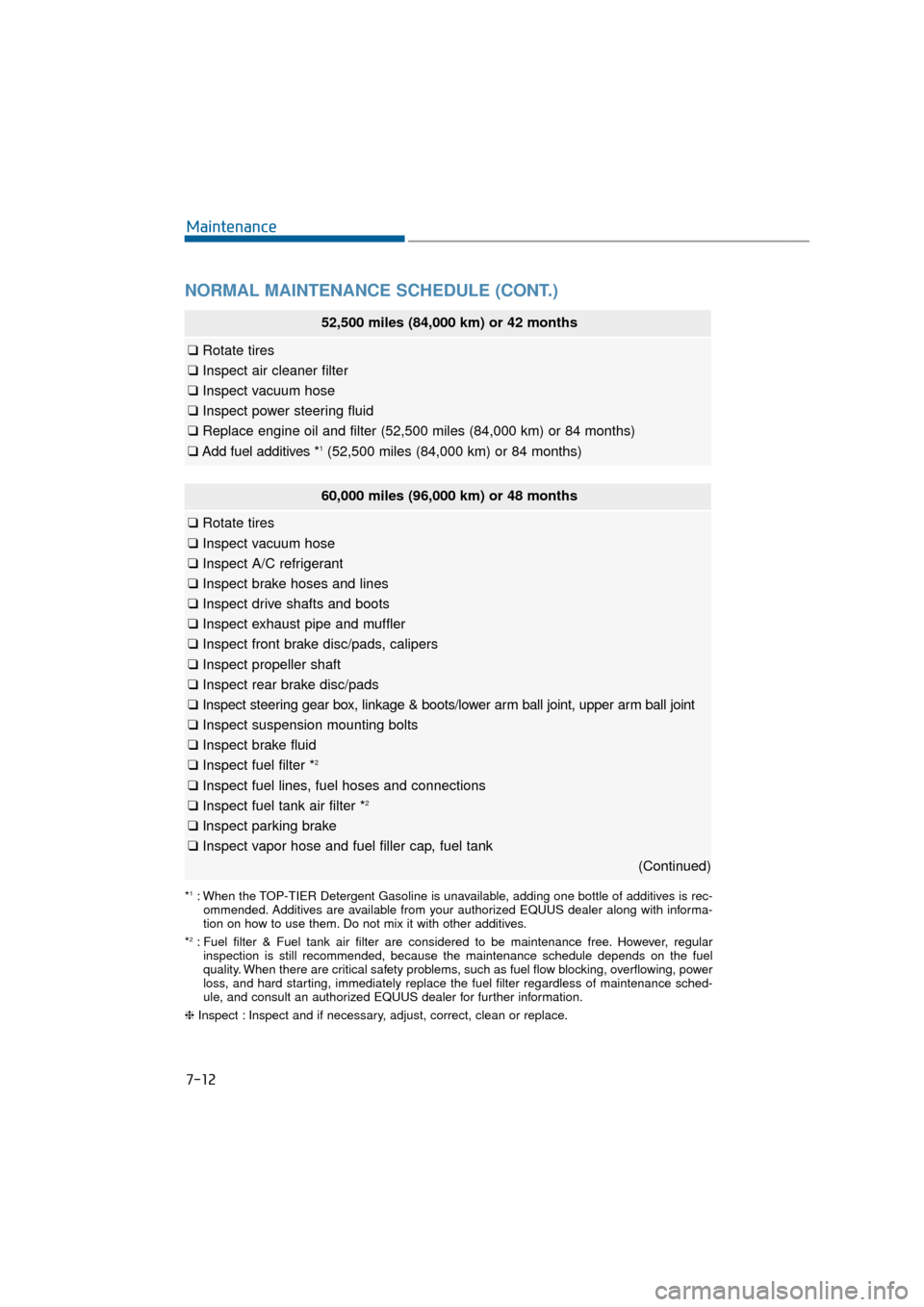
NORMAL MAINTENANCE SCHEDULE (CONT.)
7-12
Maintenance
52,500 miles (84,000 km) or 42 months
❑Rotate tires
❑ Inspect air cleaner filter
❑ Inspect vacuum hose
❑ Inspect power steering fluid
❑ Replace engine oil and filter (52,500 miles (84,000 km) or 84 months)\
❑ Add fuel additives *
1(52,500 miles (84,000 km) or 84 months)
60,000 miles (96,000 km) or 48 months
❑ Rotate tires
❑ Inspect vacuum hose
❑ Inspect A/C refrigerant
❑ Inspect brake hoses and lines
❑ Inspect drive shafts and boots
❑ Inspect exhaust pipe and muffler
❑ Inspect front brake disc/pads, calipers
❑ Inspect propeller shaft
❑ Inspect rear brake disc/pads
❑ Inspect steering gear box, linkage & boots/lower arm ball joint, upper arm ball joint
❑ Inspect suspension mounting bolts
❑ Inspect brake fluid
❑ Inspect fuel filter *
2
❑Inspect fuel lines, fuel hoses and connections
❑ Inspect fuel tank air filter *2
❑Inspect parking brake
❑ Inspect vapor hose and fuel filler cap, fuel tank
(Continued)
*1: When the TOP-TIER Detergent Gasoline is unavailable, adding one bottle of additives is rec-ommended. Additives are available from your authorized EQUUS dealer along with informa-
tion on how to use them. Do not mix it with other additives.
*
2: Fuel filter & Fuel tank air filter are considered to be maintenance free\
. However, regular inspection is still recommended, because the maintenance schedule depend\
s on the fuel
quality. When there are critical safety problems, such as fuel flow blocking, overflowing, power
loss, and hard starting, immediately replace the fuel filter regardless of maintenance sche\
d-
ule, and consult an authorized EQUUS dealer for further information.
❈ Inspect : Inspect and if necessary, adjust, correct, clean or replace.
Page 370 of 477
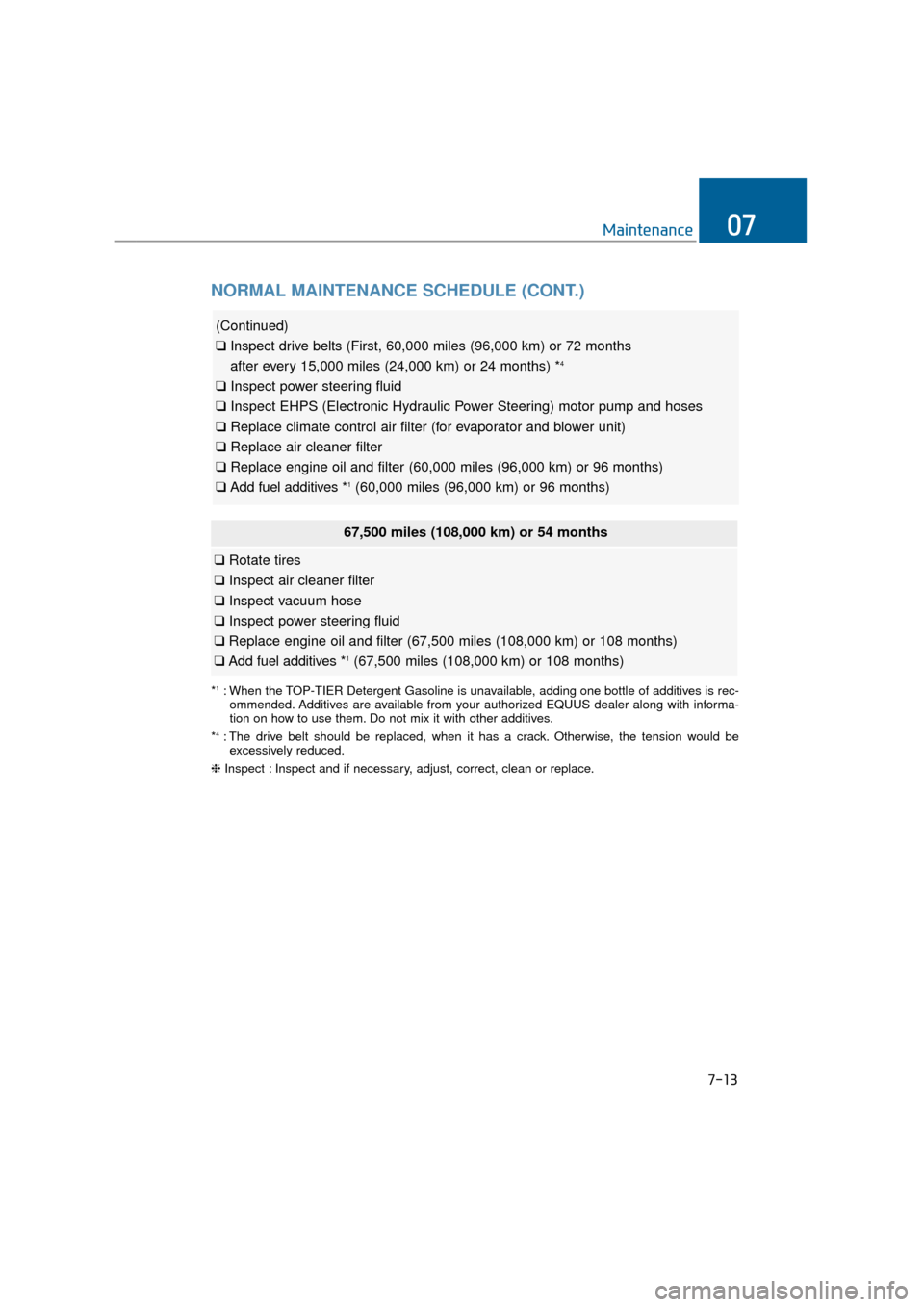
NORMAL MAINTENANCE SCHEDULE (CONT.)
7-13
Maintenance07
67,500 miles (108,000 km) or 54 months
❑Rotate tires
❑ Inspect air cleaner filter
❑ Inspect vacuum hose
❑ Inspect power steering fluid
❑ Replace engine oil and filter (67,500 miles (108,000 km) or 108 month\
s)
❑ Add fuel additives *
1(67,500 miles (108,000 km) or 108 months)
(Continued)
❑ Inspect drive belts (First, 60,000 miles (96,000 km) or 72 months
after every 15,000 miles (24,000 km) or 24 months) *
4
❑ Inspect power steering fluid
❑ Inspect EHPS (Electronic Hydraulic Power Steering) motor pump and hoses
❑ Replace climate control air filter (for evaporator and blower unit)
❑ Replace air cleaner filter
❑ Replace engine oil and filter (60,000 miles (96,000 km) or 96 months)\
❑ Add fuel additives *
1(60,000 miles (96,000 km) or 96 months)
*1: When the TOP-TIER Detergent Gasoline is unavailable, adding one bottle of additives is rec-
ommended. Additives are available from your authorized EQUUS dealer along with informa-
tion on how to use them. Do not mix it with other additives.
*
4: The drive belt should be replaced, when it has a crack. Otherwise, the tension would be excessively reduced.
❈ Inspect : Inspect and if necessary, adjust, correct, clean or replace.