wheel Hyundai Equus 2016 Repair Manual
[x] Cancel search | Manufacturer: HYUNDAI, Model Year: 2016, Model line: Equus, Model: Hyundai Equus 2016Pages: 477, PDF Size: 16.25 MB
Page 325 of 477
5-74
Driving your vehicle
An AutoSock, which is in the wrong size or is improperly
installed, may damage brake
lines, suspension, body and
wheels of your vehicle.
Stop driving and retighten the AutoSock, whenever there are
snapping sounds between the
vehicle and the AutoSock.
Use high quality ethylene gly-
col coolant
The cooling system of your vehicle is
filled with the high-quality ethylene
glycol coolant when being delivered.
It is the only type of coolant that your
vehicle is filled with, because it pre-
vents corrosion of the cooling sys-
tem, lubricates the water pump and
prevents freezing. Refill the cooling
system in accordance with your
maintenance schedule in the chapter
7. Before winter, check your coolant
to assure that the freezing point is
sufficiently lower than the expected
winter temperature.
Check battery and cables
The winter temperature increases
the battery consumption. Inspect the
battery and cables, as described in
the chapter 7. The battery charging
level can be checked by an author-
ized EQUUS dealer or in a service
station.
Change to "winter weight" oil,
if necessary
In some regions during the cold win-
ter, it is recommended to use the
"winter weight" oil with lower viscosi-
ty. For further information about this,
refer to the chapter 8. When you can-
not be sure about a type of winter
weight oil, consult an authorized
EQUUS dealer.
Check spark plugs and ignition
system
Inspect your spark plugs and, if nec-
essary, replace them. Also check all
ignition wirings and components for
any cracks, wear-out, and damage.
NOTICE
- Chain installation
When installing the AutoSock,
park the vehicle on level ground
away from other vehicles. Press
ON the Hazard Warning flasher
and place a warning triangle
behind your vehicle, if available.
Place the shift lever in P(Park),
set the parking brake and turn
OFF the engine, before
installing the AutoSock.
WARNING
- Tire chains
The use of the AutoSock may
adversely affect vehicle han-
dling.
Do not drive faster than the lower of the two - 20 mph (30
km/h) and the AutoSock manu-
facturer’s recommended
speed limit.
Drive carefully and avoid bumps, holes, sharp turns, and
other road hazards, which may
bounce the vehicle.
Avoid turning sharply or lock- ing the wheel brake.
WARNING
Page 326 of 477
5-75
Driving your vehicle05
To prevent the locks from
frozen
To prevent the locks from being
frozen, spray authorized de-icing
fluid or glycerin into key openings.
When a lock opening is already cov-
ered with ice, spray authorized de-
icing fluid on the ice to remove it.
When an internal part of a lock
freezes, try to thaw it with a heated
key. Carefully use the heated key to
avoid an injury.
Use authorized window-wash-
er anti-freezer solution in sys-
tem
To prevent the window washer from
being frozen, add authorized win-
dow-washer anti-freeze solution, as
instructed on the window-washer
container. Window-washer anti-
freeze solution is available from an
authorized EQUUS dealer, and so
are the most auto parts outlets. Do
not use engine coolant or other types
of anti-freezer solution, because
these may damage the vehicle paint.
Do not let your parking brake
freeze
Under some conditions, your parking
brake may freeze in the engaged
position. This is most likely to hap-
pen, when there is an accumulation
of snow or ice around/near the rear
brakes, or when the brakes are wet.
When there is the risk that your park-
ing brake may freeze, temporarily
apply it after locating the shift lever in
P(Park). Also, block the rear wheels
in advance, so the vehicle may not
roll. Then, release the parking brake.
Do not let ice and snow accu-
mulate underneath
Under some conditions, snow and
ice may build up under the fenders
and interfere with the steering. When
driving in such conditions during the
severe winter, you should check
underneath the vehicle on a regular
basis to assure that moving the front
wheels and the steering components
is unobstructed.
Carry emergency equipment
In accordance with weather condi-
tions, you should carry appropriate
emergency equipment, while driving.
Some of the items you may want to
carry include tire chains, tow straps,
chains, flashlight, emergency flares,
sand, a shovel, jumper cables, a win-
dow scraper, gloves, ground cloth,
coveralls and a blanket.
Do not place objects or materi-
als in the engine compartment
Putting objects or materials in the
engine compartment may cause an
engine failure or combustion,
because those may block the engine
cooling. The manufacturer is not
responsible for the damage caused
by such placement.
Page 340 of 477
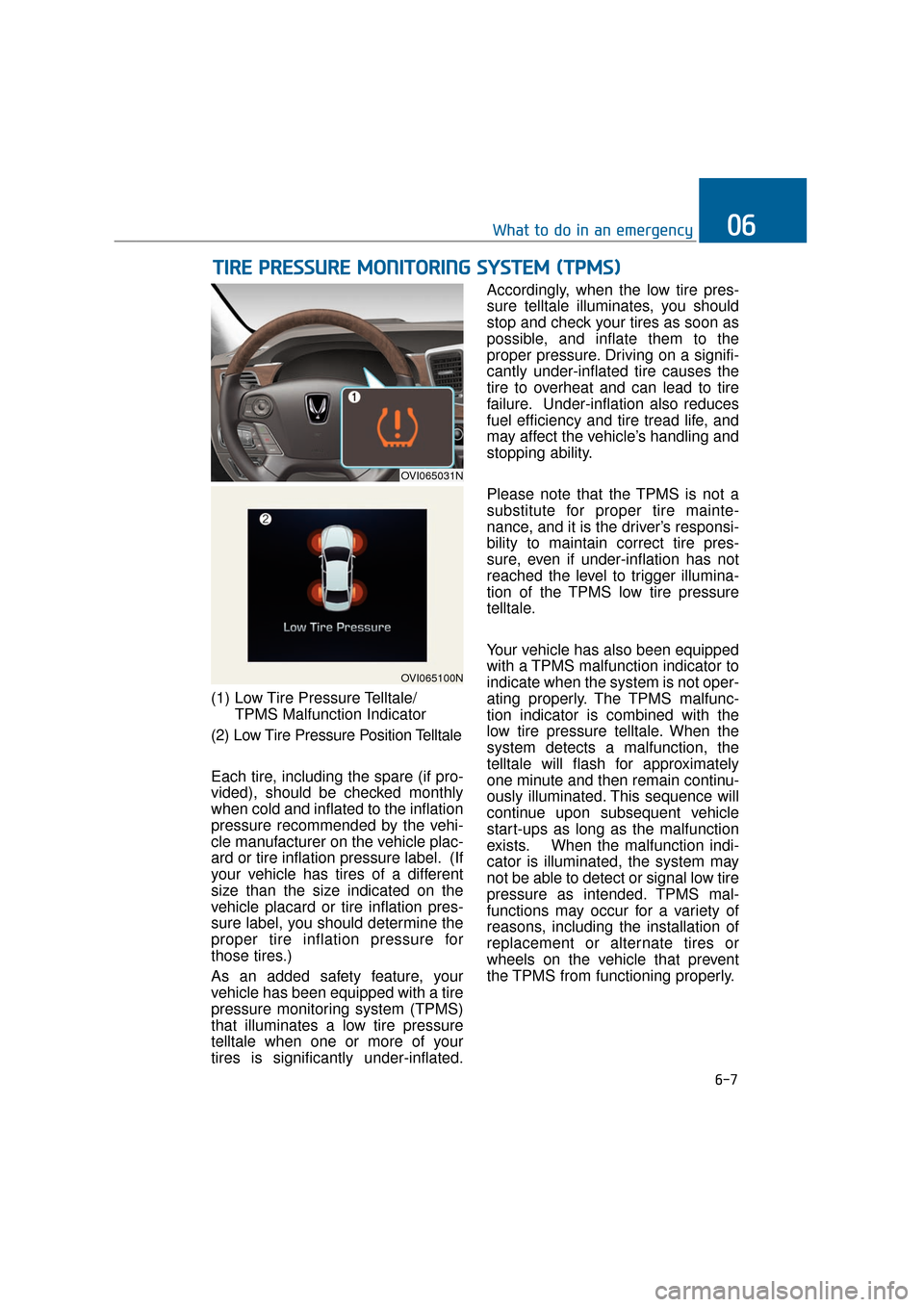
(1) Low Tire Pressure Telltale/TPMS Malfunction Indicator
(2) Low Tire Pressure Position Telltale
Each tire, including the spare (if pro-
vided), should be checked monthly
when cold and inflated to the inflation
pressure recommended by the vehi-
cle manufacturer on the vehicle plac-
ard or tire inflation pressure label. (If
your vehicle has tires of a different
size than the size indicated on the
vehicle placard or tire inflation pres-
sure label, you should determine the
proper tire inflation pressure for
those tires.)
As an added safety feature, your
vehicle has been equipped with a tire
pressure monitoring system (TPMS)
that illuminates a low tire pressure
telltale when one or more of your
tires is significantly under-inflated. Accordingly, when the low tire pres-
sure telltale illuminates, you should
stop and check your tires as soon as
possible, and inflate them to the
proper pressure. Driving on a signifi-
cantly under-inflated tire causes the
tire to overheat and can lead to tire
failure. Under-inflation also reduces
fuel efficiency and tire tread life, and
may affect the vehicle’s handling and
stopping ability.
Please note that the TPMS is not a
substitute for proper tire mainte-
nance, and it is the driver’s responsi-
bility to maintain correct tire pres-
sure, even if under-inflation has not
reached the level to trigger illumina-
tion of the TPMS low tire pressure
telltale.
Your vehicle has also been equipped
with a TPMS malfunction indicator to
indicate when the system is not oper-
ating properly. The TPMS malfunc-
tion indicator is combined with the
low tire pressure telltale. When the
system detects a malfunction, the
telltale will flash for approximately
one minute and then remain continu-
ously illuminated. This sequence will
continue upon subsequent vehicle
start-ups as long as the malfunction
exists. When the malfunction indi-
cator is illuminated, the system may
not be able to detect or signal low tire
pressure as intended. TPMS mal-
functions may occur for a variety of
reasons, including the installation of
replacement or alternate tires or
wheels on the vehicle that prevent
the TPMS from functioning properly.
T T
I
IR
R E
E
P
P R
R E
ES
SS
SU
U R
RE
E
M
M O
ON
NI
IT
T O
O R
RI
IN
N G
G
S
S Y
Y S
ST
T E
EM
M
(
( T
T P
P M
M S
S)
)
6-7
What to do in an emergency06
OVI065031N
OVI065100N
Page 341 of 477
Always check the TPMS malfunction
telltale after replacing one or more
tires or wheels on your vehicle to
ensure that the replacement or alter-
nate tires and wheels allow the TPMS
to continue to function properly.
Information
If any of the followings happens, we
recommend that the system be
checked by an authorized EQUUS
dealer.
1. The low tire pressure telltale/TPMSmalfunction indicator does not illu-
minate for 3 seconds when the igni-
tion switch is turned ON or engine is
running.
2. The TPMS malfunction indicator remains ON after flashing for
approximately 1 minute.
3. The Low tire pressure position tell- tale remains ON.
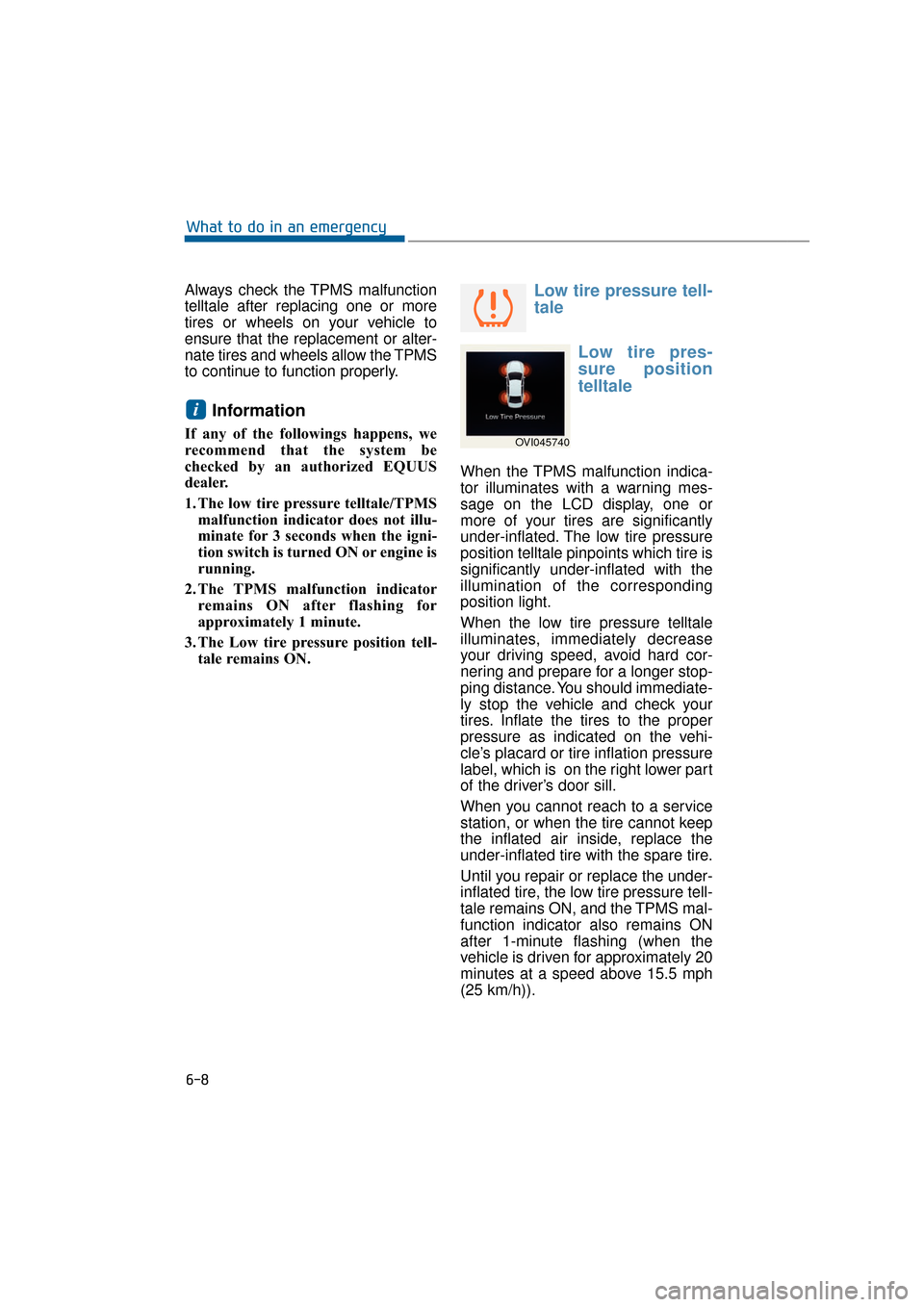
Low tire pressure tell-
tale
Low tire pres-
sure position
telltale
When the TPMS malfunction indica-
tor illuminates with a warning mes-
sage on the LCD display, one or
more of your tires are significantly
under-inflated. The low tire pressure
position telltale pinpoints which tire is
significantly under-inflated with the
illumination of the corresponding
position light.
When the low tire pressure telltale
illuminates, immediately decrease
your driving speed, avoid hard cor-
nering and prepare for a longer stop-
ping distance. You should immediate-
ly stop the vehicle and check your
tires. Inflate the tires to the proper
pressure as indicated on the vehi-
cle’s placard or tire inflation pressure
label, which is on the right lower part
of the driver’s door sill.
When you cannot reach to a service
station, or when the tire cannot keep
the inflated air inside, replace the
under-inflated tire with the spare tire.
Until you repair or replace the under-
inflated tire, the low tire pressure tell-
tale remains ON, and the TPMS mal-
function indicator also remains ON
after 1-minute flashing (when the
vehicle is driven for approximately 20
minutes at a speed above 15.5 mph
(25 km/h)).
i
6-8
What to do in an emergency
OVI045740
Page 343 of 477
Changing a tire with TPMS
When you have a flat tire, both of the
low tire pressure telltale and the low
tire position telltale will illuminate.
Immediately have the flat tire
repaired or replaced by an author-
ized EQUUS dealer.
The spare tire is not equipped with a
tire pressure monitoring sensor.
Thus, when replacing with the spare
tire, the low tire pressure telltale will
remain ON.
Also, the TPMS Malfunction Indicator
will illuminate after 1-minute flashing,
when the vehicle drives at a speed
above 15.5 mph (25 km/h) for
approximately 20 minutes.
When the tire equipped with a tire
pressure monitoring sensor is re-
inflated to the recommended level,
the low tire pressure telltale and
TPMS malfunction indicator will go
OFF for a few minutes.
When the indicator illumination does
not go OFF after a few minutes,
please visit an authorized EQUUS
dealer.Each wheel is equipped with a tire
pressure sensor, inside the tire and
behind the valve stem (except for the
spare tire). You must use the TPMS-
specific wheels. It is recommended
that you always have your tires serv-
iced by an authorized EQUUS deal-
er.
You cannot diagnose under-inflation
of a tire only with eyes. Always use a
tire pressure gauge of good quality to
measure the pressure level. Please
note that a heated tire (from being
driven) has higher pressure meas-
urement criteria than a cold tire.
A cold tire means the vehicle was
driven for less than 1 mile (1.6 km),
or was mostly idle for the last 3
hours.
Cool down the tire before measuring
the inflation pressure. Always make
sure that the tire is cold before inflat-
ing the tire to the recommended
pressure level.
6-10
What to do in an emergency
Never use an unauthorized
puncture-repairing agent to
repair and/or inflate an under-
inflated tire. Unauthorized tire
sealant may damage the tire
pressure sensor.
CAUTION
- TPMS
The TPMS cannot alert the driver to a sudden but severe
tire damage caused by exter-
nal factors, such as nails or
road debris.
When you sense any driving instability, immediately take
your foot off the accelerator,
lightly apply the brakes, and
slowly drive to a safe place off
the road.
WARNING
Page 345 of 477
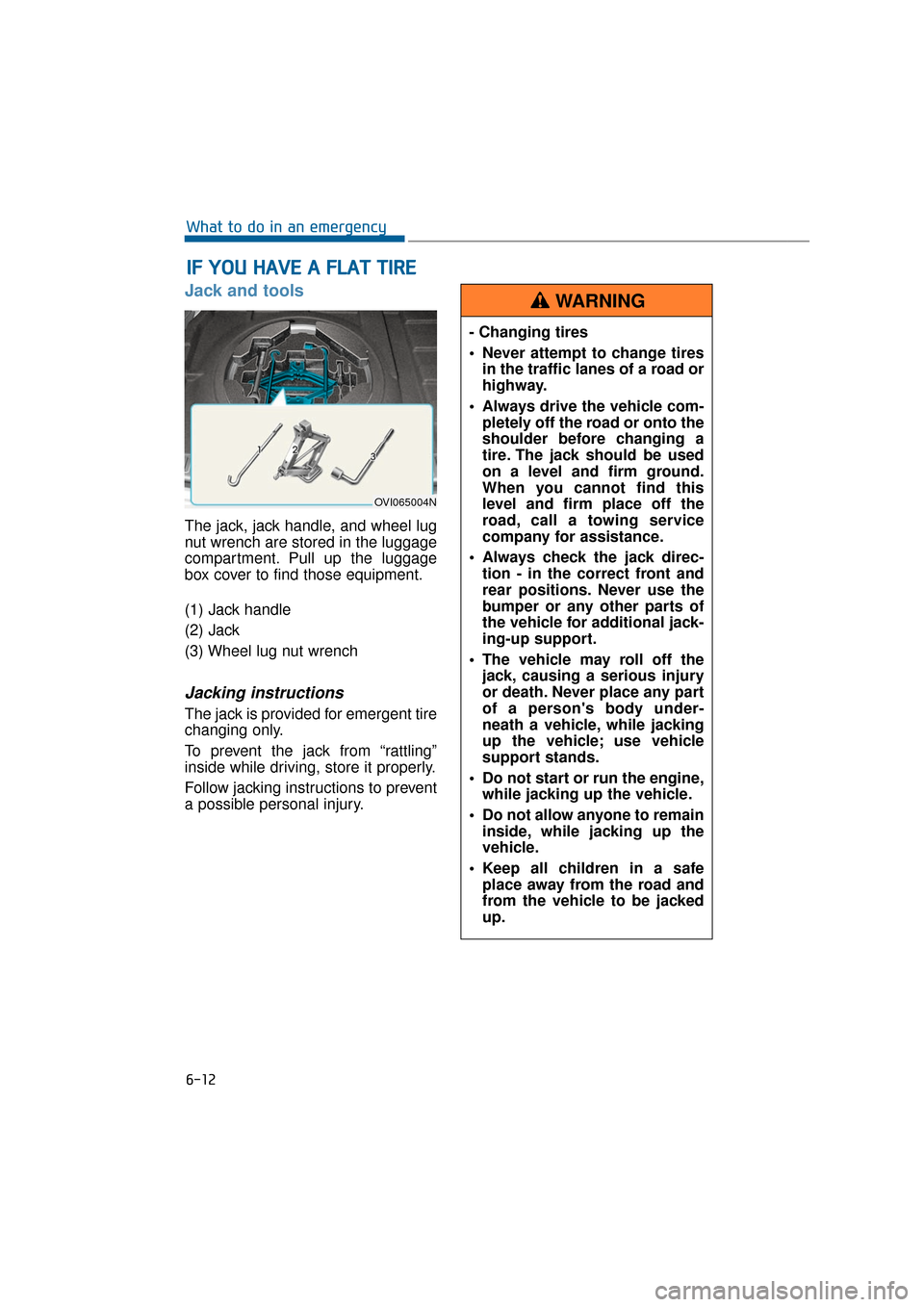
Jack and tools
The jack, jack handle, and wheel lug
nut wrench are stored in the luggage
compartment. Pull up the luggage
box cover to find those equipment.
(1) Jack handle
(2) Jack
(3) Wheel lug nut wrench
Jacking instructions
The jack is provided for emergent tire
changing only.
To prevent the jack from “rattling”
inside while driving, store it properly.
Follow jacking instructions to prevent
a possible personal injury.
I IF
F
Y
Y O
O U
U
H
H A
AV
VE
E
A
A
F
F L
LA
A T
T
T
T I
IR
R E
E
6-12
What to do in an emergency
OVI065004N
- Changing tires
Never attempt to change tires
in the traffic lanes of a road or
highway.
Always drive the vehicle com- pletely off the road or onto the
shoulder before changing a
tire. The jack should be used
on a level and firm ground.
When you cannot find this
level and firm place off the
road, call a towing service
company for assistance.
Always check the jack direc- tion - in the correct front and
rear positions. Never use the
bumper or any other parts of
the vehicle for additional jack-
ing-up support.
The vehicle may roll off the jack, causing a serious injury
or death. Never place any part
of a person's body under-
neath a vehicle, while jacking
up the vehicle; use vehicle
support stands.
Do not start or run the engine, while jacking up the vehicle.
Do not allow anyone to remain inside, while jacking up the
vehicle.
Keep all children in a safe place away from the road and
from the vehicle to be jacked
up.
WARNING
Page 346 of 477
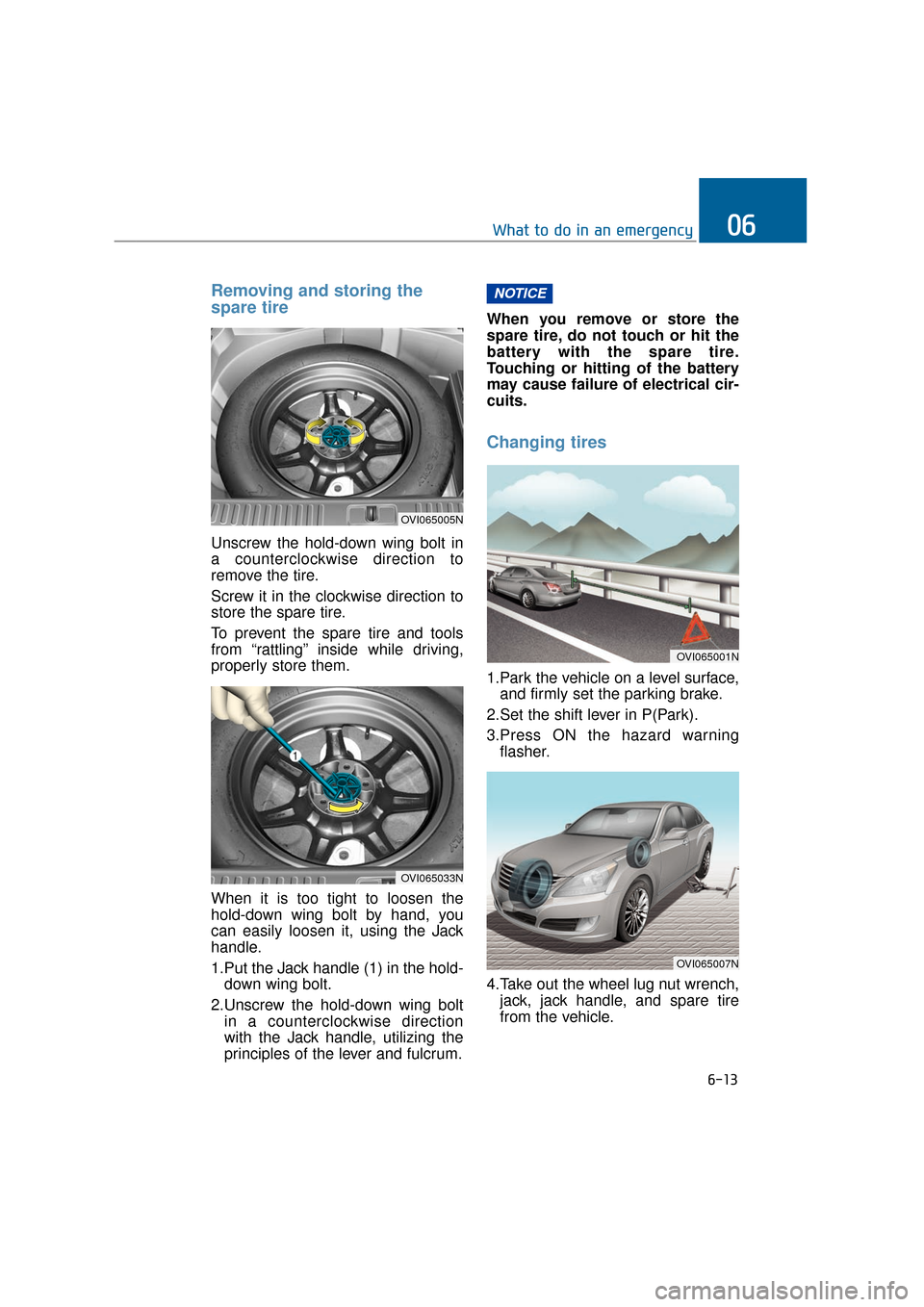
Removing and storing the
spare tire
Unscrew the hold-down wing bolt in
a counterclockwise direction to
remove the tire.
Screw it in the clockwise direction to
store the spare tire.
To prevent the spare tire and tools
from “rattling” inside while driving,
properly store them.
When it is too tight to loosen the
hold-down wing bolt by hand, you
can easily loosen it, using the Jack
handle.
1.Put the Jack handle (1) in the hold-down wing bolt.
2.Unscrew the hold-down wing bolt in a counterclockwise direction
with the Jack handle, utilizing the
principles of the lever and fulcrum. When you remove or store the
spare tire, do not touch or hit the
battery with the spare tire.
Touching or hitting of the battery
may cause failure of electrical cir-
cuits.
Changing tires
1.Park the vehicle on a level surface,
and firmly set the parking brake.
2.Set the shift lever in P(Park).
3.Press ON the hazard warning flasher.
4.Take out the wheel lug nut wrench, jack, jack handle, and spare tire
from the vehicle.
NOTICE
6-13
What to do in an emergency06
OVI065005N
OVI065033N
OVI065001N
OVI065007N
Page 347 of 477
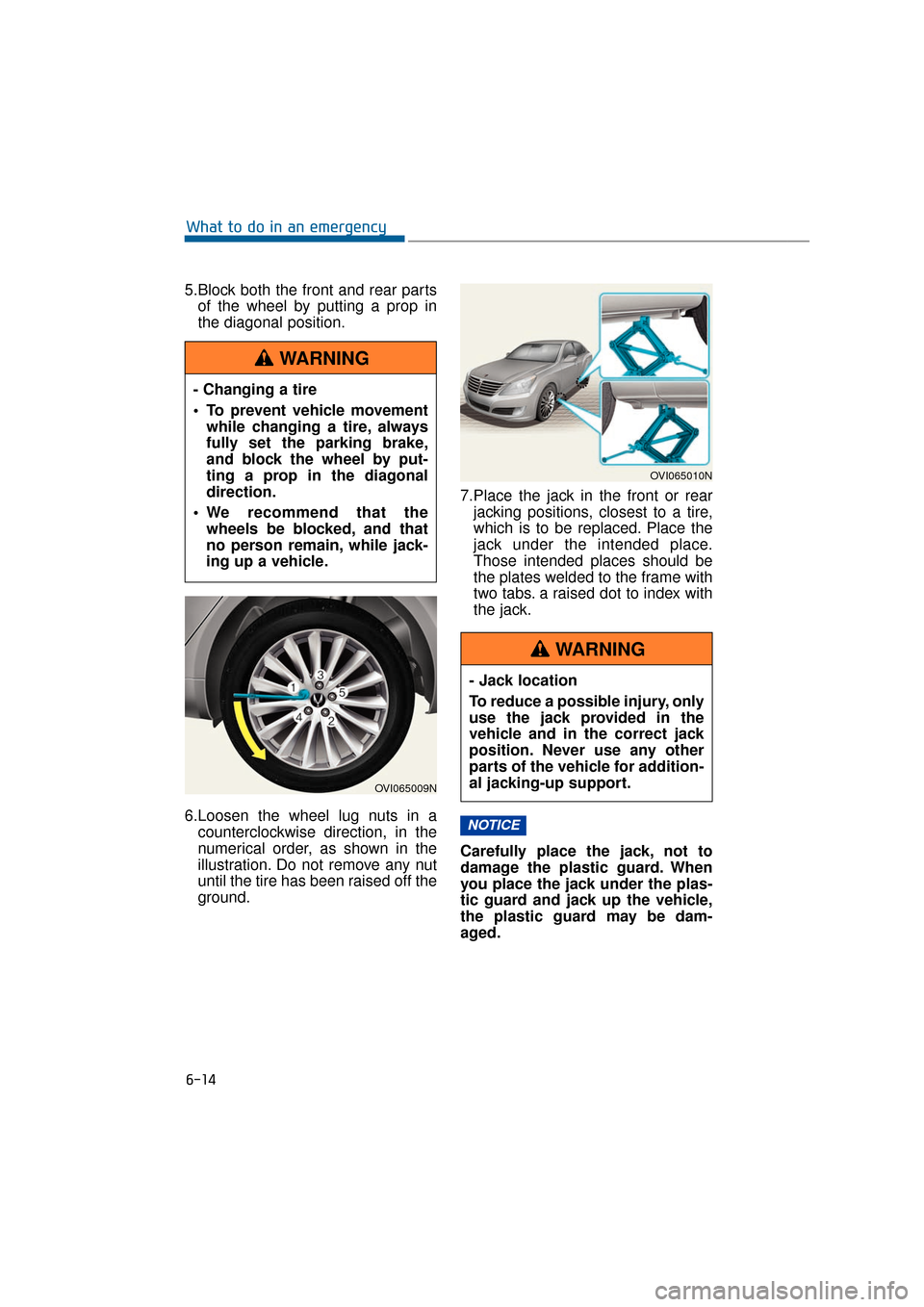
5.Block both the front and rear partsof the wheel by putting a prop in
the diagonal position.
6.Loosen the wheel lug nuts in a counterclockwise direction, in the
numerical order, as shown in the
illustration. Do not remove any nut
until the tire has been raised off the
ground. 7.Place the jack in the front or rear
jacking positions, closest to a tire,
which is to be replaced. Place the
jack under the intended place.
Those intended places should be
the plates welded to the frame with
two tabs. a raised dot to index with
the jack.
Carefully place the jack, not to
damage the plastic guard. When
you place the jack under the plas-
tic guard and jack up the vehicle,
the plastic guard may be dam-
aged.
NOTICE
6-14
What to do in an emergency - Changing a tire
To prevent vehicle movement while changing a tire, always
fully set the parking brake,
and block the wheel by put-
ting a prop in the diagonal
direction.
We recommend that the wheels be blocked, and that
no person remain, while jack-
ing up a vehicle.
WARNING
- Jack location
To reduce a possible injury, only
use the jack provided in the
vehicle and in the correct jack
position. Never use any other
parts of the vehicle for addition-
al jacking-up support.
WARNING
OVI065009N
OVI065010N
Page 348 of 477
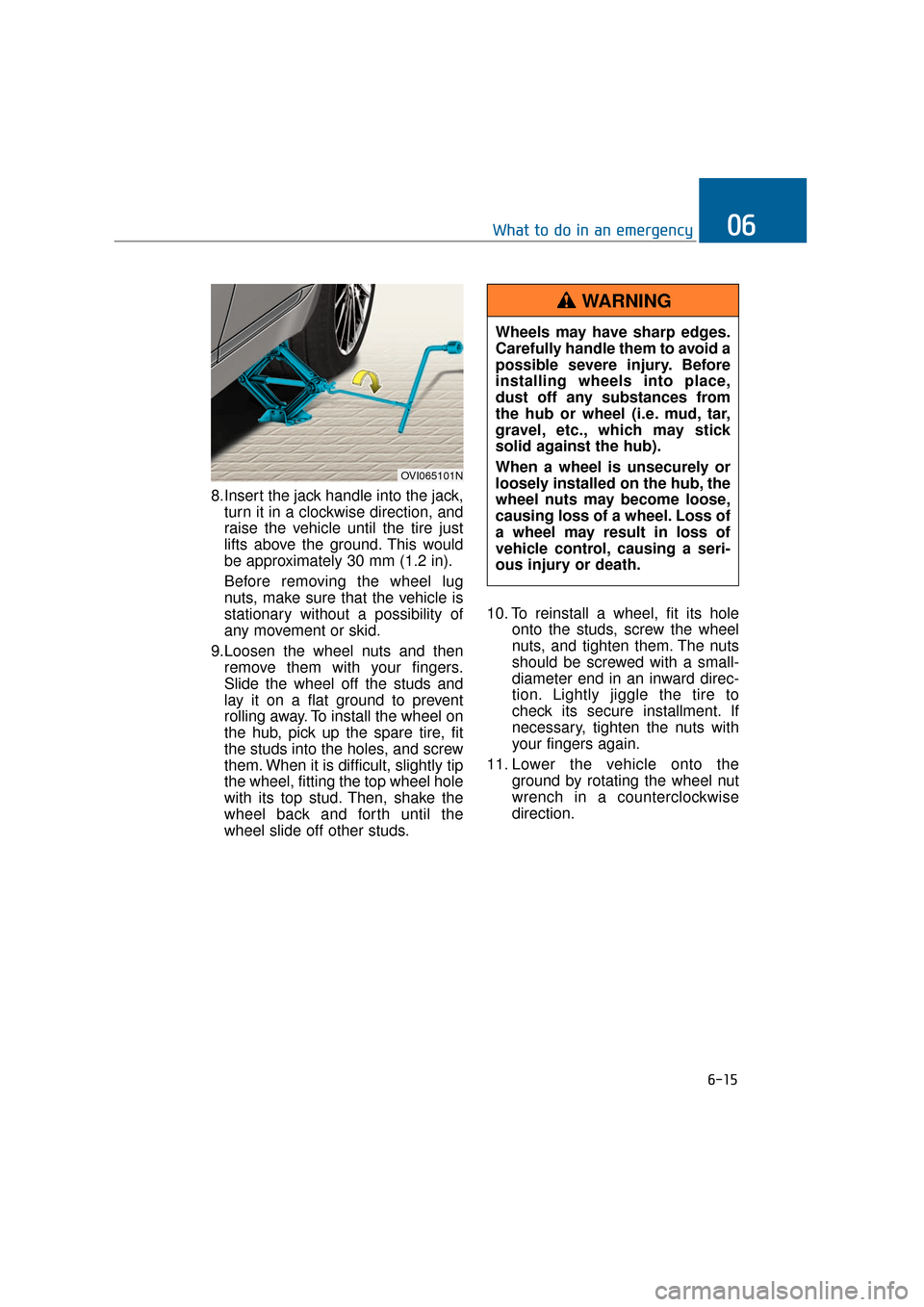
8.Insert the jack handle into the jack,turn it in a clockwise direction, and
raise the vehicle until the tire just
lifts above the ground. This would
be approximately 30 mm (1.2 in).
Before removing the wheel lug
nuts, make sure that the vehicle is
stationary without a possibility of
any movement or skid.
9.Loosen the wheel nuts and then remove them with your fingers.
Slide the wheel off the studs and
lay it on a flat ground to prevent
rolling away. To install the wheel on
the hub, pick up the spare tire, fit
the studs into the holes, and screw
them. When it is difficult, slightly tip
the wheel, fitting the top wheel hole
with its top stud. Then, shake the
wheel back and forth until the
wheel slide off other studs. 10. To reinstall a wheel, fit its hole
onto the studs, screw the wheel
nuts, and tighten them. The nuts
should be screwed with a small-
diameter end in an inward direc-
tion. Lightly jiggle the tire to
check its secure installment. If
necessary, tighten the nuts with
your fingers again.
11. Lower the vehicle onto the ground by rotating the wheel nut
wrench in a counterclockwise
direction.
6-15
What to do in an emergency06
Wheels may have sharp edges.
Carefully handle them to avoid a
possible severe injury. Before
installing wheels into place,
dust off any substances from
the hub or wheel (i.e. mud, tar,
gravel, etc., which may stick
solid against the hub).
When a wheel is unsecurely or
loosely installed on the hub, the
wheel nuts may become loose,
causing loss of a wheel. Loss of
a wheel may result in loss of
vehicle control, causing a seri-
ous injury or death.
WARNING
OVI065101N
Page 349 of 477
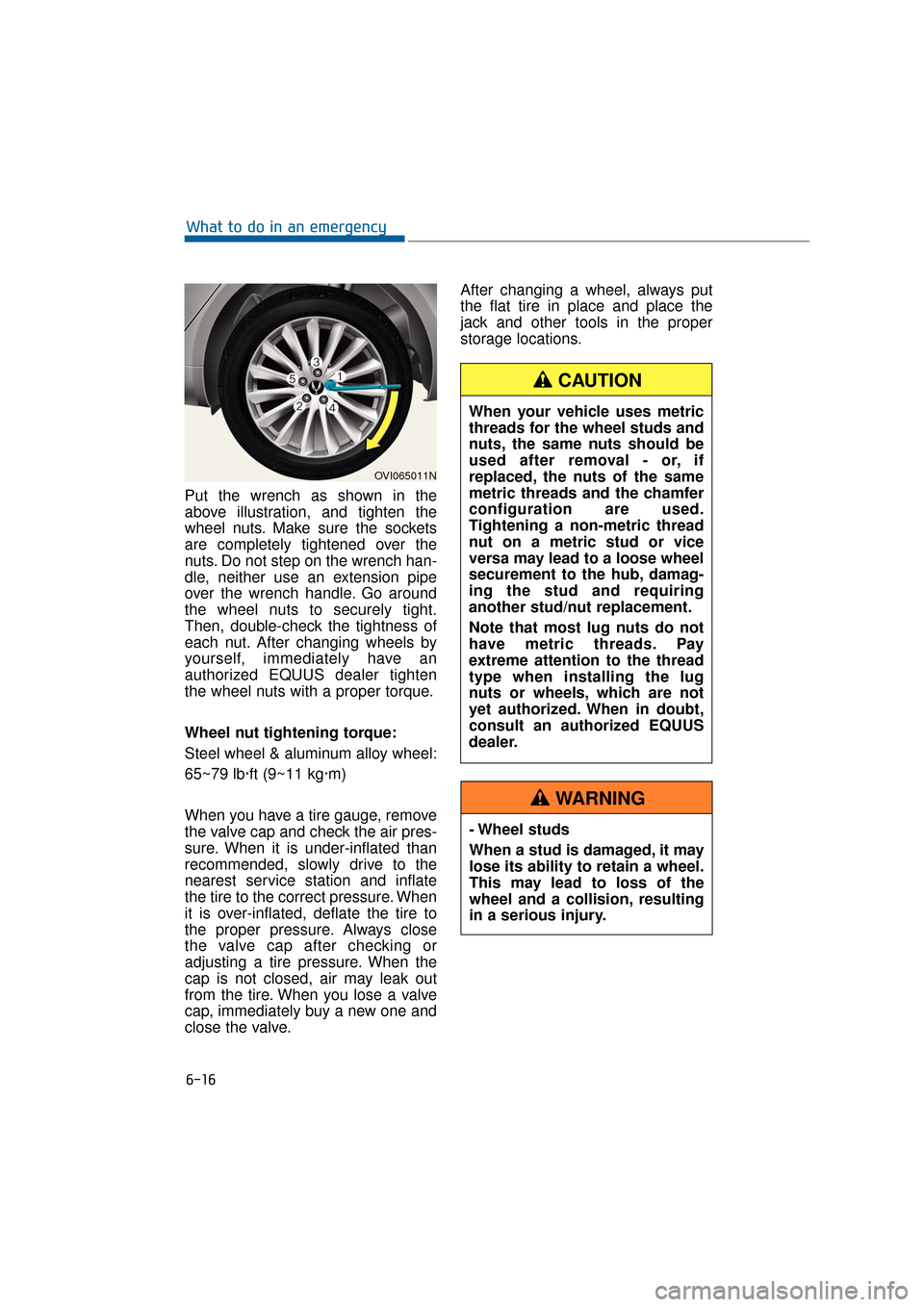
Put the wrench as shown in the
above illustration, and tighten the
wheel nuts. Make sure the sockets
are completely tightened over the
nuts. Do not step on the wrench han-
dle, neither use an extension pipe
over the wrench handle. Go around
the wheel nuts to securely tight.
Then, double-check the tightness of
each nut. After changing wheels by
yourself, immediately have an
authorized EQUUS dealer tighten
the wheel nuts with a proper torque.
Wheel nut tightening torque:
Steel wheel & aluminum alloy wheel:
65~79 lb·ft (9~11 kg·m)
When you have a tire gauge, remove
the valve cap and check the air pres-
sure. When it is under-inflated than
recommended, slowly drive to the
nearest service station and inflate
the tire to the correct pressure. When
it is over-inflated, deflate the tire to
the proper pressure. Always close
the valve cap after checking or
adjusting a tire pressure. When the
cap is not closed, air may leak out
from the tire. When you lose a valve
cap, immediately buy a new one and
close the valve.After changing a wheel, always put
the flat tire in place and place the
jack and other tools in the proper
storage locations.
6-16
What to do in an emergency
OVI065011N
When your vehicle uses metric
threads for the wheel studs and
nuts, the same nuts should be
used after removal - or, if
replaced, the nuts of the same
metric threads and the chamfer
configuration are used.
Tightening a non-metric thread
nut on a metric stud or vice
versa may lead to a loose wheel
securement to the hub, damag-
ing the stud and requiring
another stud/nut replacement.
Note that most lug nuts do not
have metric threads. Pay
extreme attention to the thread
type when installing the lug
nuts or wheels, which are not
yet authorized. When in doubt,
consult an authorized EQUUS
dealer.
CAUTION
- Wheel studs
When a stud is damaged, it may
lose its ability to retain a wheel.
This may lead to loss of the
wheel and a collision, resulting
in a serious injury.
WARNING