warning Hyundai Genesis 2011 Owner's Manual
[x] Cancel search | Manufacturer: HYUNDAI, Model Year: 2011, Model line: Genesis, Model: Hyundai Genesis 2011Pages: 409, PDF Size: 38.54 MB
Page 3 of 409
F3
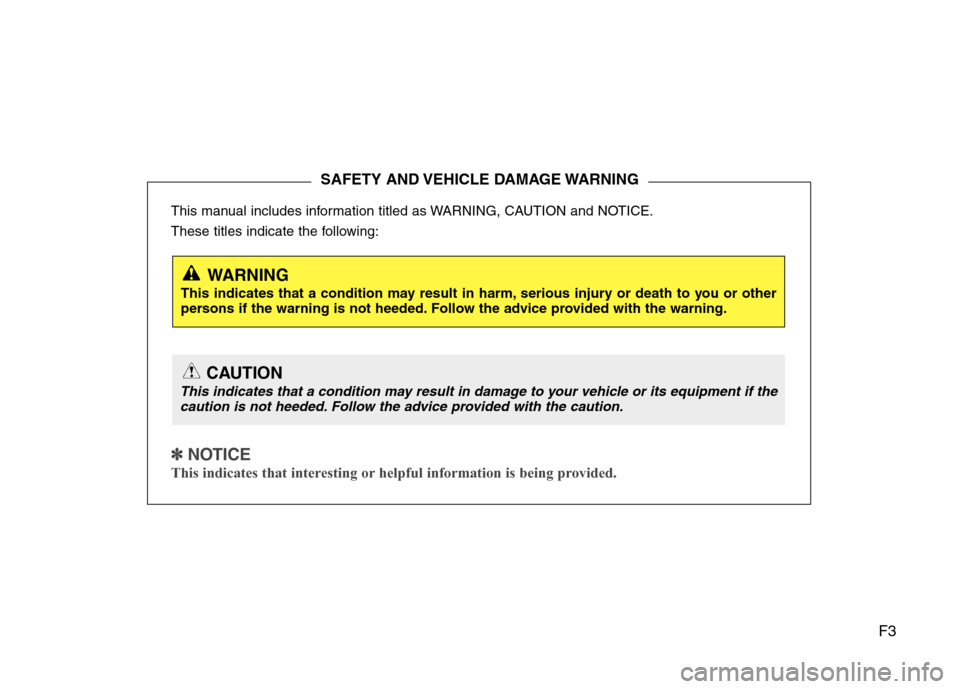
This manual includes information titled as WARNING, CAUTION and NOTICE.
These titles indicate the following:
✽ ✽
NOTICE
This indicates that interesting or helpful information is being provided.
SAFETY AND VEHICLE DAMAGE WARNING
WARNING
This indicates that a condition may result in harm, serious injury or death to you or other
persons if the warning is not heeded. Follow the advice provided with the warning.
CAUTION
This indicates that a condition may result in damage to your vehicle or its equipment if the
caution is not heeded. Follow the advice provided with the caution.
Page 9 of 409
Introduction
2 1
A010000AHM
We want to help you get the greatest
possible driving pleasure from your vehi-
cle. Your Owner’s Manual can assist you
in many ways. We strongly recommend
that you read the entire manual. In order
to minimize the chance of death or injury,
you must read the WARNING and CAU-
TION sections in the manual.
Illustrations complement the words in this
manual to best explain how to enjoy your
vehicle. By reading your manual, you will
learn about features, important safety
information, and driving tips under vari-
ous road conditions.The general layout of the manual is pro-
vided in the Table of Contents. A good
place to start is the index; it has an alpha-
betical listing of all information in your
manual.
Sections: This manual has eight sections
plus an index. Each section begins with a
brief list of contents so you can tell at a
glance if that section has the information
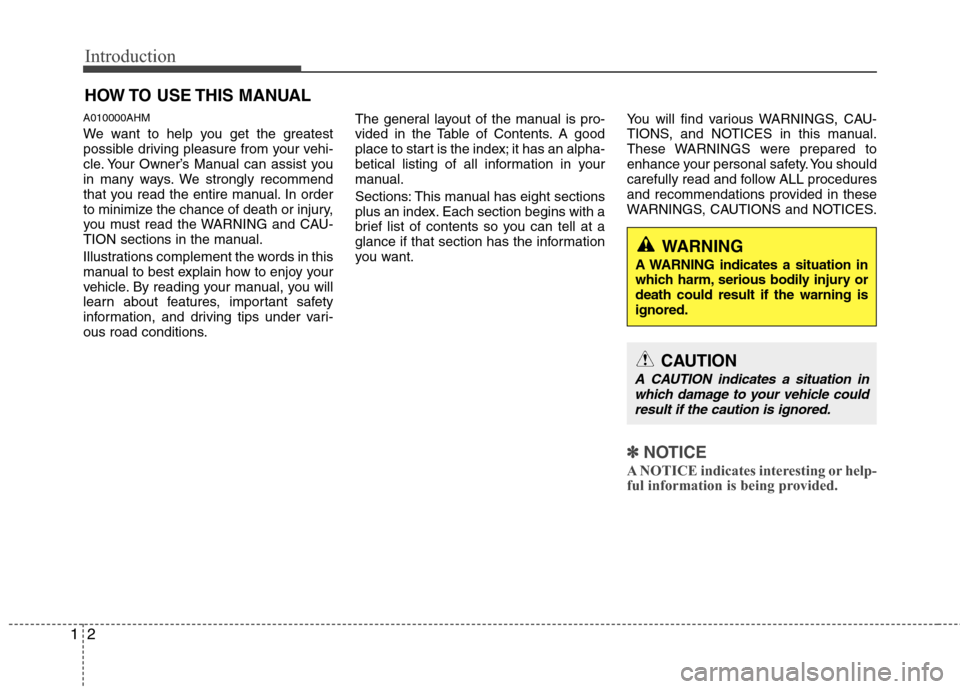
you want.You will find various WARNINGS, CAU-
TIONS, and NOTICES in this manual.
These WARNINGS were prepared to
enhance your personal safety. You should
carefully read and follow ALL procedures
and recommendations provided in these
WARNINGS, CAUTIONS and NOTICES.
✽ ✽
NOTICE
A NOTICE indicates interesting or help-
ful information is being provided.
HOW TO USE THIS MANUAL
WARNING
A WARNING indicates a situation in
which harm, serious bodily injury or
death could result if the warning is
ignored.
CAUTION
A CAUTION indicates a situation in
which damage to your vehicle could
result if the caution is ignored.
Page 10 of 409
13
Introduction
A020101ABH-EU
3.8 engine
Your new vehicle is designed to use only
unleaded fuel having a pump octane
number ((R+M)/2) of 87 (Research
Octane Number 91) or higher.
4.6 engine
Your new vehicle is designed to use only
unleaded fuel having a pump octane
number ((R+M)/2) of 87 or higher.
For improved vehicle performance, pre-
mium unleaded fuel with a Pump Octane
Rating of 91 (Research Octane Number
95) or higher is recommended.
Your new vehicle is designed to obtain
maximum performance with UNLEADED
FUEL, as well as minimize exhaust emis-
sions and spark plug fouling.
A020103AUN-EU
Gasoline containing alcohol and
methanol
Gasohol, a mixture of gasoline and
ethanol (also known as grain alcohol),
and gasoline or gasohol containing
methanol (also known as wood alcohol)
are being marketed along with or instead
of leaded or unleaded gasoline.
Do not use gasohol containing more than
10% ethanol, and do not use gasoline or
gasohol containing any methanol. Either
of these fuels may cause drivability prob-
lems and damage to the fuel system.
Discontinue using gasohol of any kind if
drivability problems occur.
Vehicle damage or drivability problems
may not be covered by the manufactur-
er’s warranty if they result from the use
of:
1. Gasohol containing more than 10%
ethanol.
2. Gasoline or gasohol containing
methanol.
3. Leaded fuel or leaded gasohol.
FUEL REQUIREMENTS
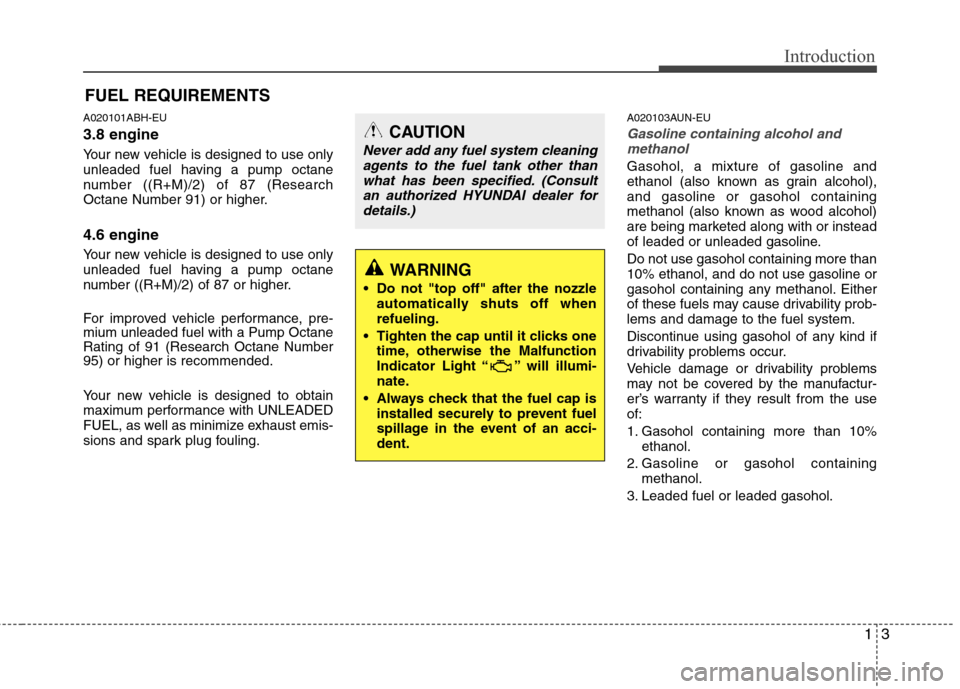
CAUTION
Never add any fuel system cleaning
agents to the fuel tank other than
what has been specified. (Consult
an authorized HYUNDAI dealer for
details.)
WARNING
• Do not "top off" after the nozzle
automatically shuts off when
refueling.
Tighten the cap until it clicks one
time, otherwise the Malfunction
Indicator Light “ ” will illumi-
nate.
Always check that the fuel cap is
installed securely to prevent fuel
spillage in the event of an acci-
dent.
Page 12 of 409
15
Introduction
A030000BUN
No special break-in period is needed. By
following a few simple precautions for the
first 600 miles (1,000 km) you may add to
the performance, economy and life of
your vehicle.
Do not race the engine.
While driving, keep your engine speed
(rpm, or revolutions per minute)
between 2,000 rpm and 4,000 rpm.
Do not maintain a single speed for long
periods of time, either fast or slow.
Varying engine speed is needed to
properly break-in the engine.
Avoid hard stops, except in emergen-
cies, to allow the brakes to seat prop-
erly.
Don't let the engine idle longer than 3
minutes at one time.
Don't tow a trailer during the first 1,200
miles (2,000 km) of operation.
VEHICLE BREAK-IN PROCESS
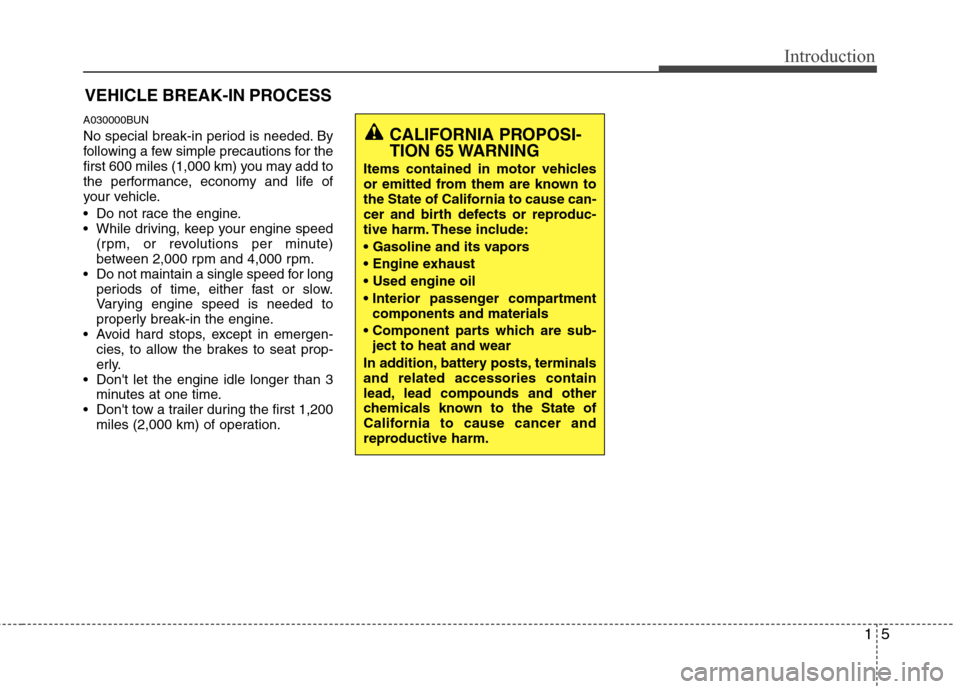
CALIFORNIA PROPOSI-
TION 65 WARNING
Items contained in motor vehicles
or emitted from them are known to
the State of California to cause can-
cer and birth defects or reproduc-
tive harm. These include:
components and materials
ject to heat and wear
In addition, battery posts, terminals
and related accessories contain
lead, lead compounds and other
chemicals known to the State of
California to cause cancer and
reproductive harm.
Page 14 of 409
17
Introduction
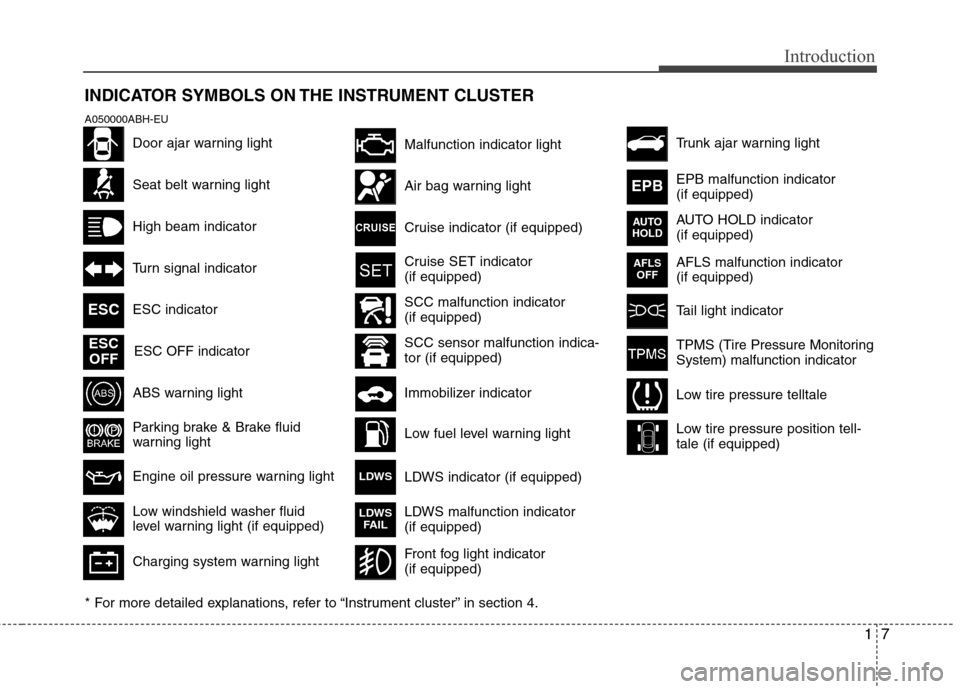
INDICATOR SYMBOLS ON THE INSTRUMENT CLUSTER
Seat belt warning light
High beam indicator
Turn signal indicator
ABS warning light
Parking brake & Brake fluid
warning light
Engine oil pressure warning light ESC indicator
ESC OFF indicator
Malfunction indicator light
Air bag warning light
Cruise indicator (if equipped)
Cruise SET indicator
(if equipped)
Immobilizer indicator
Low fuel level warning light
* For more detailed explanations, refer to “Instrument cluster” in section 4.
Charging system warning light
Low windshield washer fluid
level warning light (if equipped)
A050000ABH-EU
Door ajar warning light
AFLS malfunction indicator
(if equipped)
Tail light indicator
Trunk ajar warning light
Front fog light indicator
(if equipped)
ESC
ESC
OFF
AFLS
OFF
TPMS (Tire Pressure Monitoring
System) malfunction indicator
Low tire pressure telltale
Low tire pressure position tell-
tale (if equipped)
SCC malfunction indicator
(if equipped)
SCC sensor malfunction indica-
tor (if equipped)EPB malfunction indicator
(if equipped)
AUTO HOLD indicator
(if equipped)
EPB
AUTO
HOLD
LDWS indicator (if equipped)LDWS
LDWS malfunction indicator
(if equipped)LDWS
FAIL
Page 16 of 409
Your vehicle at a glance
2 2
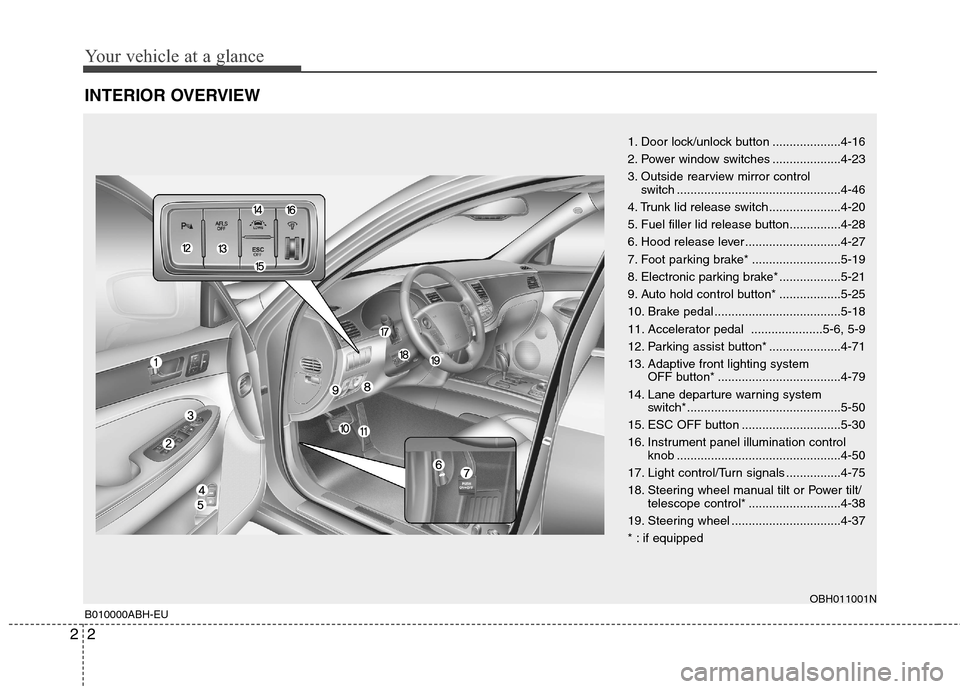
INTERIOR OVERVIEW
B010000ABH-EUOBH011001N
1. Door lock/unlock button ....................4-16
2. Power window switches ....................4-23
3. Outside rearview mirror control
switch ................................................4-46
4. Trunk lid release switch .....................4-20
5. Fuel filler lid release button...............4-28
6. Hood release lever ............................4-27
7. Foot parking brake* ..........................5-19
8. Electronic parking brake* ..................5-21
9. Auto hold control button* ..................5-25
10. Brake pedal .....................................5-18
11. Accelerator pedal .....................5-6, 5-9
12. Parking assist button* .....................4-71
13. Adaptive front lighting system
OFF button* ....................................4-79
14. Lane departure warning system
switch*.............................................5-50
15. ESC OFF button .............................5-30
16. Instrument panel illumination control
knob ................................................4-50
17. Light control/Turn signals ................4-75
18. Steering wheel manual tilt or Power tilt/
telescope control* ...........................4-38
19. Steering wheel ................................4-37
* : if equipped
Page 17 of 409
23
Your vehicle at a glance
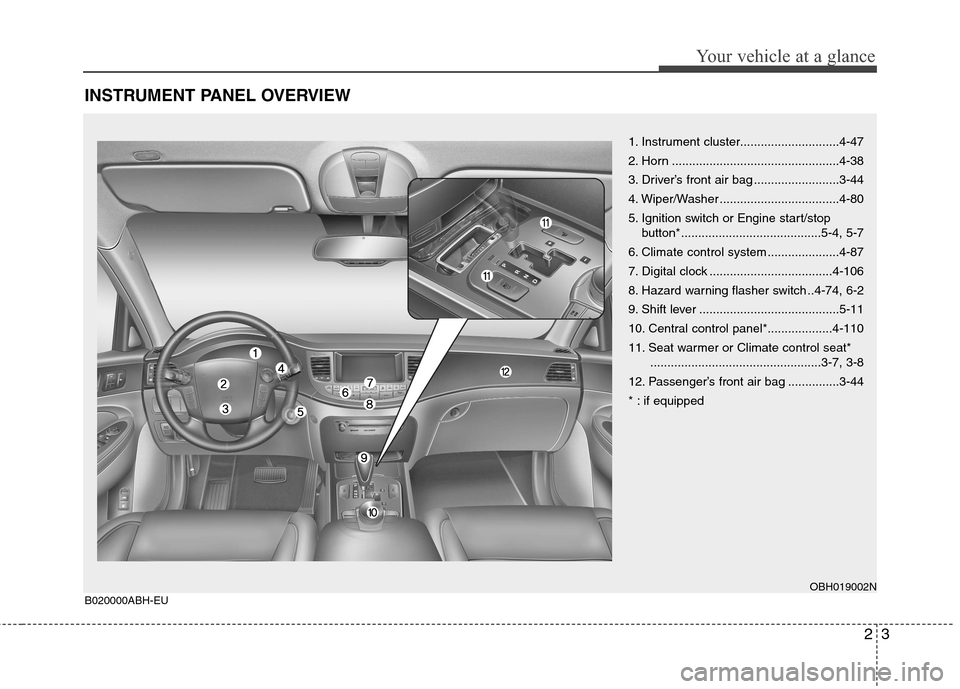
INSTRUMENT PANEL OVERVIEW
OBH019002NB020000ABH-EU
1. Instrument cluster.............................4-47
2. Horn .................................................4-38
3. Driver’s front air bag .........................3-44
4. Wiper/Washer ...................................4-80
5. Ignition switch or Engine start/stop
button*.........................................5-4, 5-7
6. Climate control system .....................4-87
7. Digital clock ....................................4-106
8. Hazard warning flasher switch ..4-74, 6-2
9. Shift lever .........................................5-11
10. Central control panel*...................4-110
11. Seat warmer or Climate control seat*
..................................................3-7, 3-8
12. Passenger’s front air bag ...............3-44
* : if equipped
Page 22 of 409
33
Safety features of your vehicle
C010200AEN
Front seat adjustment - power
The front seat can be adjusted by using
the control knob located on the outside of
the seat cushion. Before driving, adjust
the seat to the proper position so as to
easily control the steering wheel, pedals
and switches on the instrument panel.
WARNING- Driver’s seat
Never attempt to adjust the seat
while the vehicle is moving. This
could result in loss of control,
and an accident causing death,
serious injury, or property dam-
age.
Do not allow anything to interfere
with the normal position of the
seatback. Storing items against a
seatback or in any other way
interfering with proper locking of
a seatback could result in serious
or fatal injury in a sudden stop or
collision.
seatback upright and the lap por-
tion of the seat belt snug and low
across the hips. This is the best
position to protect you in case of
an accident.
In order to avoid unnecessary
and perhaps severe air bag
injuries, always sit as far back as
possible from the steering wheel
while maintaining comfortable
control of the vehicle. We recom-
mend that your chest be at least
10 inches (250 mm) away from
the steering wheel.
WARNING- Loose objects
Loose objects in the driver’s foot
area could interfere with the opera-
tion of the foot pedals, possibly
causing an accident. Do not place
anything under the front seats.
WARNING- Driver respon-
sibility for passengers
Riding in a vehicle with the seat-
back reclined could lead to serious
or fatal injury in an accident. If a
seat is reclined during an accident,
the occupant’s hips may slide
under the lap portion of the seat
belt applying great force to the
unprotected abdomen. Serious or
fatal internal injuries could result.
The driver must advise the passen-
ger to keep the seatback in an
upright position whenever the vehi-
cle is in motion.
WARNING
The power seat is operable with the
ignition OFF.
Therefore, children should never be
left unattended in the car.
Page 25 of 409
Safety features of your vehicle
6 3
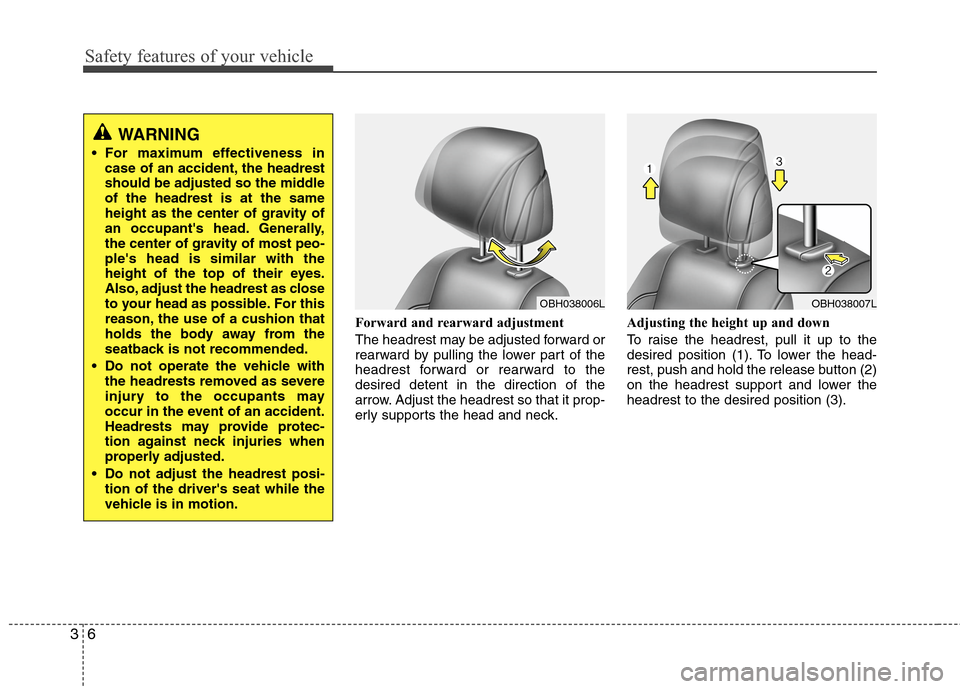
Forward and rearward adjustment
The headrest may be adjusted forward or
rearward by pulling the lower part of the
headrest forward or rearward to the
desired detent in the direction of the
arrow. Adjust the headrest so that it prop-
erly supports the head and neck.Adjusting the height up and down
To raise the headrest, pull it up to the
desired position (1). To lower the head-
rest, push and hold the release button (2)
on the headrest support and lower the
headrest to the desired position (3).
OBH038006LOBH038007L
WARNING
For maximum effectiveness in
case of an accident, the headrest
should be adjusted so the middle
of the headrest is at the same
height as the center of gravity of
an occupant's head. Generally,
the center of gravity of most peo-
ple's head is similar with the
height of the top of their eyes.
Also, adjust the headrest as close
to your head as possible. For this
reason, the use of a cushion that
holds the body away from the
seatback is not recommended.
Do not operate the vehicle with
the headrests removed as severe
injury to the occupants may
occur in the event of an accident.
Headrests may provide protec-
tion against neck injuries when
properly adjusted.
Do not adjust the headrest posi-
tion of the driver's seat while the
vehicle is in motion.
Page 26 of 409
37
Safety features of your vehicle
Removal
For your safety, the front headrest can’t
be removed. If there is any problem with
the front headrest, take your vehicle to an
authorized HYUNDAI dealer and have
the system checked.
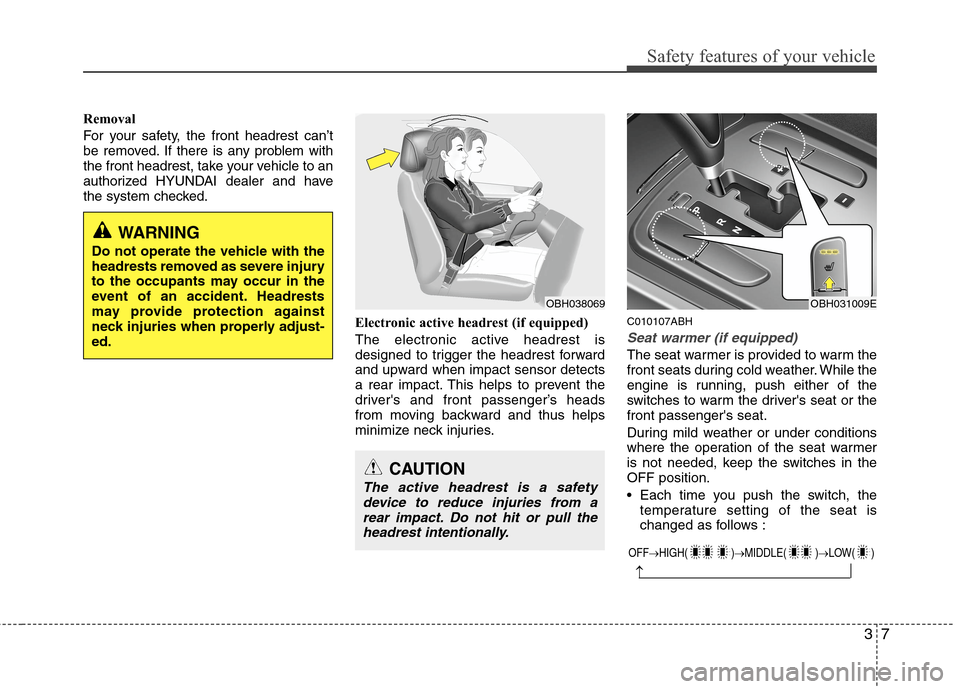
Electronic active headrest (if equipped)
The electronic active headrest is
designed to trigger the headrest forward
and upward when impact sensor detects
a rear impact. This helps to prevent the
driver's and front passenger’s heads
from moving backward and thus helps
minimize neck injuries.
C010107ABH
Seat warmer (if equipped)
The seat warmer is provided to warm the
front seats during cold weather. While the
engine is running, push either of the
switches to warm the driver's seat or the
front passenger's seat.
During mild weather or under conditions
where the operation of the seat warmer
is not needed, keep the switches in the
OFF position.
Each time you push the switch, the
temperature setting of the seat is
changed as follows :
WARNING
Do not operate the vehicle with the
headrests removed as severe injury
to the occupants may occur in the
event of an accident. Headrests
may provide protection against
neck injuries when properly adjust-
ed.
OBH038069OBH031009E
CAUTION
The active headrest is a safety
device to reduce injuries from a
rear impact. Do not hit or pull the
headrest intentionally.
OFF→HIGH( )→MIDDLE( )→LOW( )
→