drive mode Hyundai Genesis 2013 Owner's Guide
[x] Cancel search | Manufacturer: HYUNDAI, Model Year: 2013, Model line: Genesis, Model: Hyundai Genesis 2013Pages: 429, PDF Size: 8.94 MB
Page 254 of 429
515
Driving your vehicle
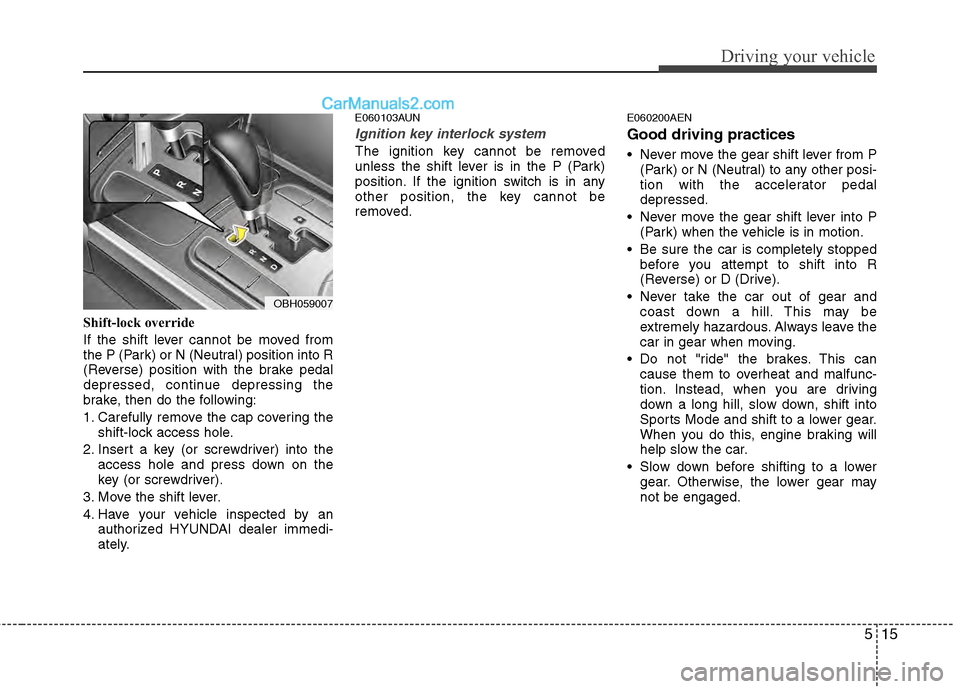
Shift-lock override
If the shift lever cannot be moved from
the P (Park) or N (Neutral) position into R
(Reverse) position with the brake pedal
depressed, continue depressing the
brake, then do the following:
1. Carefully remove the cap covering theshift-lock access hole.
2. Insert a key (or screwdriver) into the access hole and press down on the
key (or screwdriver).
3. Move the shift lever.
4. Have your vehicle inspected by an authorized HYUNDAI dealer immedi-
ately.
E060103AUN
Ignition key interlock system
The ignition key cannot be removed
unless the shift lever is in the P (Park)
position. If the ignition switch is in any
other position, the key cannot be
removed.
E060200AEN
Good driving practices
Never move the gear shift lever from P(Park) or N (Neutral) to any other posi-
tion with the accelerator pedal
depressed.
Never move the gear shift lever into P (Park) when the vehicle is in motion.
Be sure the car is completely stopped before you attempt to shift into R
(Reverse) or D (Drive).
Never take the car out of gear and coast down a hill. This may be
extremely hazardous. Always leave the
car in gear when moving.
Do not "ride" the brakes. This can cause them to overheat and malfunc-
tion. Instead, when you are driving
down a long hill, slow down, shift into
Sports Mode and shift to a lower gear.
When you do this, engine braking will
help slow the car.
Slow down before shifting to a lower gear. Otherwise, the lower gear may
not be engaged.
OBH059007
Page 265 of 429
Driving your vehicle
26
5
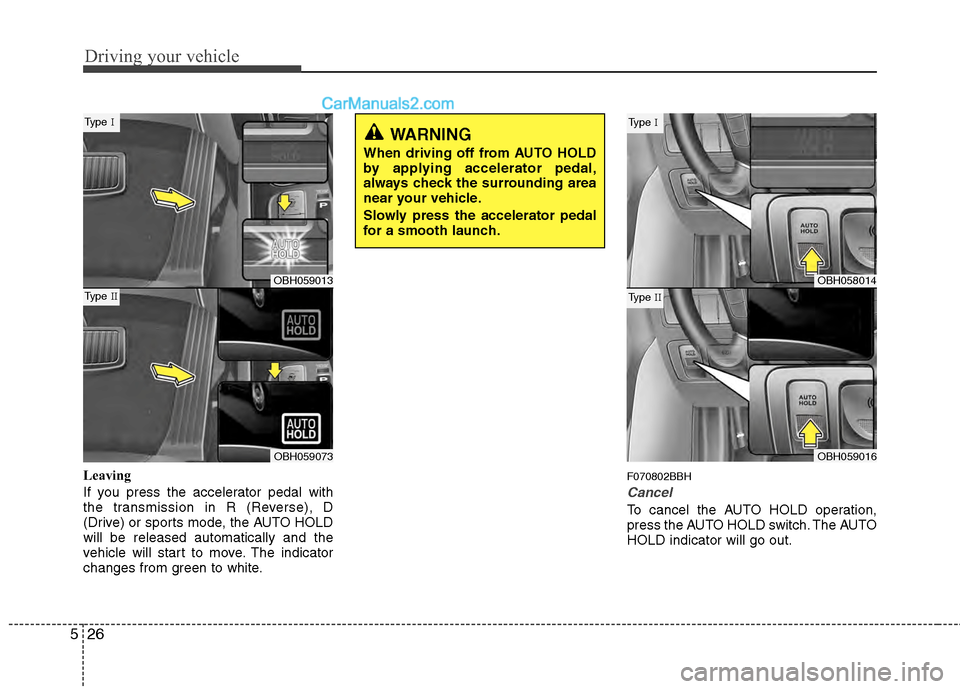
Leaving
If you press the accelerator pedal with
the transmission in R (Reverse), D
(Drive) or sports mode, the AUTO HOLD
will be released automatically and the
vehicle will start to move. The indicator
changes from green to white.F070802BBH
Cancel
To cancel the AUTO HOLD operation,
press the AUTO HOLD switch. The AUTO
HOLD indicator will go out.
WARNING
When driving off from AUTO HOLD
by applying accelerator pedal,
always check the surrounding area
near your vehicle.
Slowly press the accelerator pedal
for a smooth launch.
OBH059013
OBH059073
Type I
Type IIOBH058014
OBH059016
Type I
Type II
Page 292 of 429
553
Driving your vehicle
The LDWS does not operate
when:
The driver turns on the turn signal tochange lane.
However, when the hazard warning
flasher is operating, the LDWS oper-
ates normally.
Operating the wiper switch with HI mode due to heavy rain.
Driving on the lane line.
✽ ✽ NOTICE
To change lane, operate the turn signal
switch then change the lane.
The LDWS may not warn you even
if the vehicle leaves the lane, or
may warn you even if the vehicle
does not leave the lane when:
The lane can't be visible due to snow,
rain, stain, a puddle or many other
things.
The brightness outside changes sud- denly.
Not turning on the headlights at night or in a tunnel.
Difficult to distinguish the color of the lane marking from the road.
Driving on a steep grade or a curve.
Light reflects from the water on the road.
The lens or windshield is stained with foreign matter.
The sensor cannot detect the lane because of fog, heavy rain or heavy
snow.
The surrounding of the inside rear view mirror temperature is high due to a
direct sun light.
The lane is very wide or narrow.
The lane line is damaged or indistinct.
A shadow is on the lane line by a medi- an strip.
There is a mark that looks like lane line.
There is a boundary structure. The distance from vehicle ahead is
very short or the vehicle ahead drives
hiding the lane line.
The vehicle shakes heavily.
The lane number increases or decreases or the lane lines are cross-
ing.
Putting something on the dashboard.
Driving with the sun in front of you.
Driving in areas under construction.
The lane line is more than two.
Page 293 of 429
Driving your vehicle
54
5
E100000AEN
Your vehicle's fuel economy depends
mainly on your style of driving, where you
drive and when you drive.
Each of these factors affects how many
miles (kilometers) you can get from a gal-
lon (liter) of fuel. To operate your vehicle
as economically as possible, use the fol-
lowing driving suggestions to help save
money in both fuel and repairs:
Drive smoothly. Accelerate at a moder-
ate rate. Don't make "jack-rabbit" starts
or full-throttle shifts and maintain a
steady cruising speed. Don't race
between stoplights. Try to adjust your
speed to that of the other traffic so you
don't have to change speeds unneces-
sarily. Avoid heavy traffic whenever
possible. Always maintain a safe dis-
tance from other vehicles so you can
avoid unnecessary braking. This also
reduces brake wear.
Drive at a moderate speed. The faster you drive the more fuel your vehicle
uses. Driving at a moderate speed, in
the highest gear appropriate for the
conditions, especially on the highway,
is one of the most effective ways to
reduce fuel consumption. Don't "ride" the brake pedal. This can
increase fuel consumption and also
increase wear on these components.
In addition, driving with your foot rest-
ing on the brake pedal may cause the
brakes to overheat, which reduces
their effectiveness and may lead to
more serious consequences.
Take care of your tires. Keep them inflated to the recommended pressure.
Incorrect inflation, either too much or
too little, results in unnecessary tire
wear. Check the tire pressures at least
once a month.
Be sure that the wheels are aligned correctly. Improper alignment can
result from hitting curbs or driving too
fast over irregular surfaces. Poor align-
ment causes faster tire wear and may
also result in other problems as well as
greater fuel consumption. Keep your car in good condition. For
better fuel economy and reduced
maintenance costs, maintain your car
in accordance with the maintenance
schedule in section 7. If you drive your
car in severe conditions, more frequent
maintenance is required (see section 7
for details).
Keep your car clean. For maximum service, your vehicle should be kept
clean and free of corrosive materials. It
is especially important that mud, dirt,
ice, etc. not be allowed to accumulate
on the underside of the car. This extra
weight can result in increased fuel con-
sumption and also contribute to corro-
sion.
Travel lightly. Don't carry unnecessary weight in your car. Weight reduces fuel
economy.
Don't let the engine idle longer than necessary. If you are waiting (and not
in traffic), turn off your engine and
restart only when you're ready to go.
ECONOMICAL OPERATION
Page 381 of 429
747
Maintenance
All season tires
HYUNDAI specifies all season tires
on some models to provide good
performance for use all year round,
including snowy and icy road condi-
tions. All season tires are identified
by ALL SEASON and/or M+S (Mud
and Snow) on the tire sidewall. Snow
tires have better snow traction than
all season tires and may be more
appropriate in some areas.Summer tires
HYUNDAI specifies summer tires on
some models to provide superior
performance on dry roads. Summer
tire performance is substantially
reduced in snow and ice. Summer
tires do not have the tire traction rat-
ing M+S (Mud and Snow) on the tire
side wall. If you plan to operate your
vehicle in snowy or icy conditions,
HYUNDAI recommends the use of
snow tires or all season tires on all
four wheels.Snow tires
If you equip your car with snow tires,
they should be the same size and
have the same load capacity as the
original tires. Snow tires should be
installed on all four wheels; other-
wise, poor handling may result.
Snow tires should carry 4 psi (28
kPa) more air pressure than the
pressure recommended for the stan-
dard tires on the tire label on the dri-
ver's side of the center pillar, or up to
the maximum pressure shown on the
tire sidewall, whichever is less.
Do not drive faster than 75 mph (120
km/h) when your car is equipped with
snow tires.
Page 424 of 429

Index
2I
Air bag - advanced supplemental restraint system ······ 3-35Air bag warning label ··················\
··················\
············ 3-60
Curtain air bag ··················\
··················\
··················\
····· 3-52
Driver's and passenger's front air bag ··················\
····· 3-46
Occupant classification system ··················\
··············· 3-41
Side impact air bag ··················\
··················\
················ 3-50
SRS components and functions ··················\
··············· 3-38
Air cleaner ··················\
··················\
··················\
············· 7-24
Appearance care ··················\
··················\
··················\
···· 7-69
Audio system ··················\
··················\
··················\
······· 4-115 Antenna ················\
··················\
··················\
··············· 4-115
Bluetooth
®Wireless Technology phone operation ····4-151
HD RadioTM··················\
··················\
··················\
··········4-147
PA710BH ·················\
··················\
··················\
············ 4-120
PA760BH ·················\
··················\
··················\
············ 4-133
Steering wheel audio control ··················\
················· 4-115
Automatic climate control system ··················\
············· 4-89 Air conditioning ··················\
··················\
··················\
·· 4-96
Automatic heating and air conditioning ··················\
·· 4-90
Manual heating and air conditioning ··················\
······ 4-91
Rear vent ··················\
··················\
··················\
··········· 4-100
Automatic transmission ··················\
··················\
··········· 5-11 Ignition key interlock system ··················\
··················\
5-15
Shift lock system ··················\
··················\
··················\
· 5-14
Sports mode ··················\
··················\
··················\
········· 5-14 Battery ················\
··················\
··················\
··················\
··· 7-32
Before driving ··················\
··················\
··················\
·········· 5-3
Binding arbitration ··················\
··················\
··················\
· 8-10
Brake fluid ··················\
··················\
··················\
············· 7-21
Brake system ··················\
··················\
··················\
········· 5-18
Anti-lock brake system (ABS) ··················\
················ 5-28
Auto hold ··················\
··················\
··················\
···············5-25
Electric parking brake (EPB) ··················\
··················\
··5-20
Electronic stability control (ESC) ··················\
··········· 5-30
Parking brake ··················\
··················\
··················\
······· 5-19
Power brakes ··················\
··················\
··················\
······· 5-18
Bulb wattage ··················\
··················\
··················\
············ 8-2
California perchlorate notice ··················\
··················\
··· 7-78
Child restraint system ··················\
··················\
·············· 3-27 Placing a passenger seat belt into the auto lock mode ·················\
··················\
··················\
··················\
· 3-29
Securing a child restraint seat with tether anchor system ·················\
··················\
··················\
················· 3-31
Securing a child restraint seat with child seat lower anchor system ··················\
··················\
··················\
···· 3-33
Climate control air filter ··················\
··················\
·········· 7-27
Consumer information ··················\
··················\
··············· 8-9
Cruise control system ··················\
··················\
·············· 5-36
AB
C