battery Hyundai Genesis Coupe 2013 Service Manual
[x] Cancel search | Manufacturer: HYUNDAI, Model Year: 2013, Model line: Genesis Coupe, Model: Hyundai Genesis Coupe 2013Pages: 414, PDF Size: 38.89 MB
Page 329 of 414
Maintenance
22
7
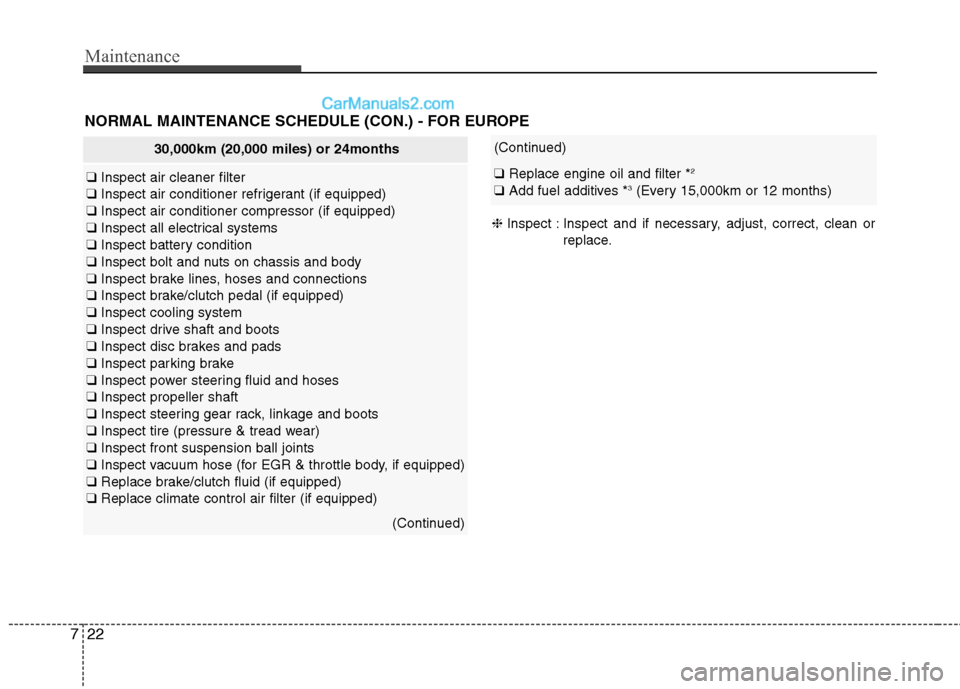
30,000km (20,000 miles) or 24months
❑ Inspect air cleaner filter
❑ Inspect air conditioner refrigerant (if equipped)
❑ Inspect air conditioner compressor (if equipped)
❑ Inspect all electrical systems
❑ Inspect battery condition
❑ Inspect bolt and nuts on chassis and body
❑ Inspect brake lines, hoses and connections
❑ Inspect brake/clutch pedal (if equipped)
❑ Inspect cooling system
❑ Inspect drive shaft and boots
❑ Inspect disc brakes and pads
❑ Inspect parking brake
❑ Inspect power steering fluid and hoses
❑ Inspect propeller shaft
❑ Inspect steering gear rack, linkage and boots
❑ Inspect tire (pressure & tread wear)
❑ Inspect front suspension ball joints
❑ Inspect vacuum hose (for EGR & throttle body, if equipped)
❑ Replace brake/clutch fluid (if equipped)
❑ Replace climate control air filter (if equipped)
(Continued)
NORMAL MAINTENANCE SCHEDULE (CON.) - FOR EUROPE
(Continued)
❑Replace engine oil and filter * 2
❑ Add fuel additives * 3
(Every 15,000km or 12 months)
❈ Inspect : Inspect and if necessary, adjust, correct, clean or
replace.
Page 330 of 414
723
Maintenance
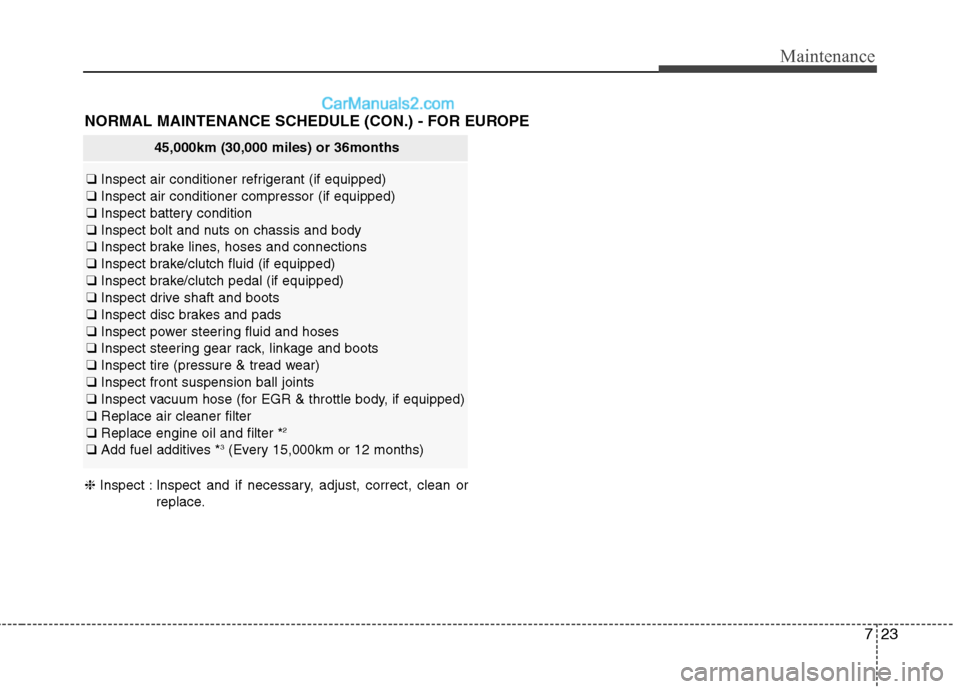
NORMAL MAINTENANCE SCHEDULE (CON.) - FOR EUROPE
45,000km (30,000 miles) or 36months
❑Inspect air conditioner refrigerant (if equipped)
❑ Inspect air conditioner compressor (if equipped)
❑ Inspect battery condition
❑ Inspect bolt and nuts on chassis and body
❑ Inspect brake lines, hoses and connections
❑ Inspect brake/clutch fluid (if equipped)
❑ Inspect brake/clutch pedal (if equipped)
❑ Inspect drive shaft and boots
❑ Inspect disc brakes and pads
❑ Inspect power steering fluid and hoses
❑ Inspect steering gear rack, linkage and boots
❑ Inspect tire (pressure & tread wear)
❑ Inspect front suspension ball joints
❑ Inspect vacuum hose (for EGR & throttle body, if equipped)
❑ Replace air cleaner filter
❑ Replace engine oil and filter * 2
❑ Add fuel additives * 3
(Every 15,000km or 12 months)
❈ Inspect : Inspect and if necessary, adjust, correct, clean or
replace.
Page 331 of 414
Maintenance
24
7
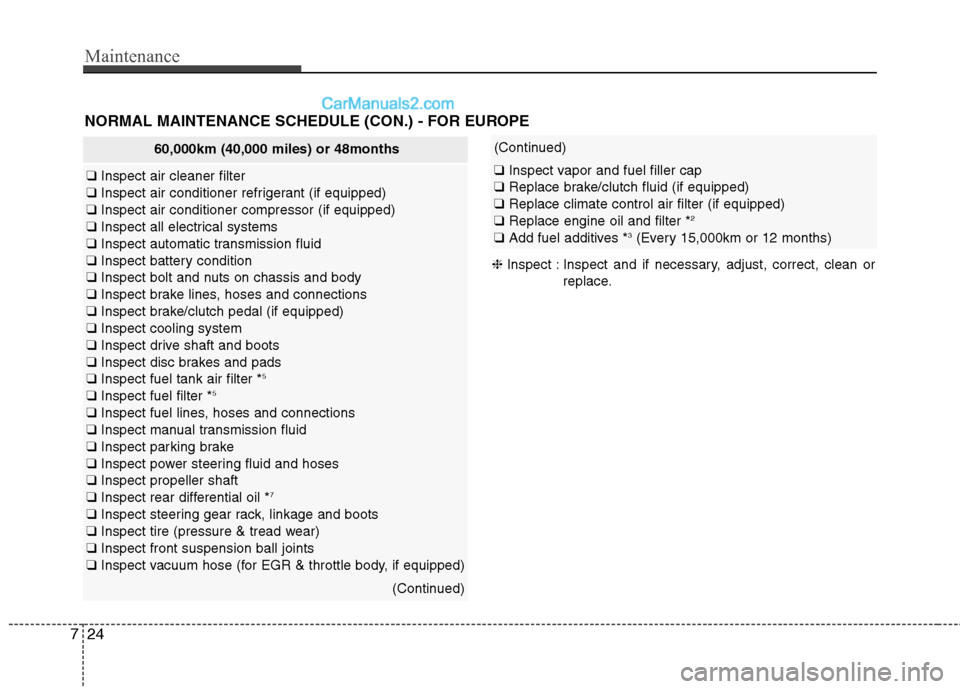
NORMAL MAINTENANCE SCHEDULE (CON.) - FOR EUROPE
60,000km (40,000 miles) or 48months
❑ Inspect air cleaner filter
❑ Inspect air conditioner refrigerant (if equipped)
❑ Inspect air conditioner compressor (if equipped)
❑ Inspect all electrical systems
❑ Inspect automatic transmission fluid
❑ Inspect battery condition
❑ Inspect bolt and nuts on chassis and body
❑ Inspect brake lines, hoses and connections
❑ Inspect brake/clutch pedal (if equipped)
❑ Inspect cooling system
❑ Inspect drive shaft and boots
❑ Inspect disc brakes and pads
❑ Inspect fuel tank air filter * 5
❑ Inspect fuel filter * 5
❑ Inspect fuel lines, hoses and connections
❑ Inspect manual transmission fluid
❑ Inspect parking brake
❑ Inspect power steering fluid and hoses
❑ Inspect propeller shaft
❑ Inspect rear differential oil * 7
❑ Inspect steering gear rack, linkage and boots
❑ Inspect tire (pressure & tread wear)
❑ Inspect front suspension ball joints
❑ Inspect vacuum hose (for EGR & throttle body, if equipped)
(Continued)
(Continued)
❑Inspect vapor and fuel filler cap
❑ Replace brake/clutch fluid (if equipped)
❑ Replace climate control air filter (if equipped)
❑ Replace engine oil and filter * 2
❑ Add fuel additives * 3
(Every 15,000km or 12 months)
❈ Inspect : Inspect and if necessary, adjust, correct, clean or
replace.
Page 332 of 414
725
Maintenance
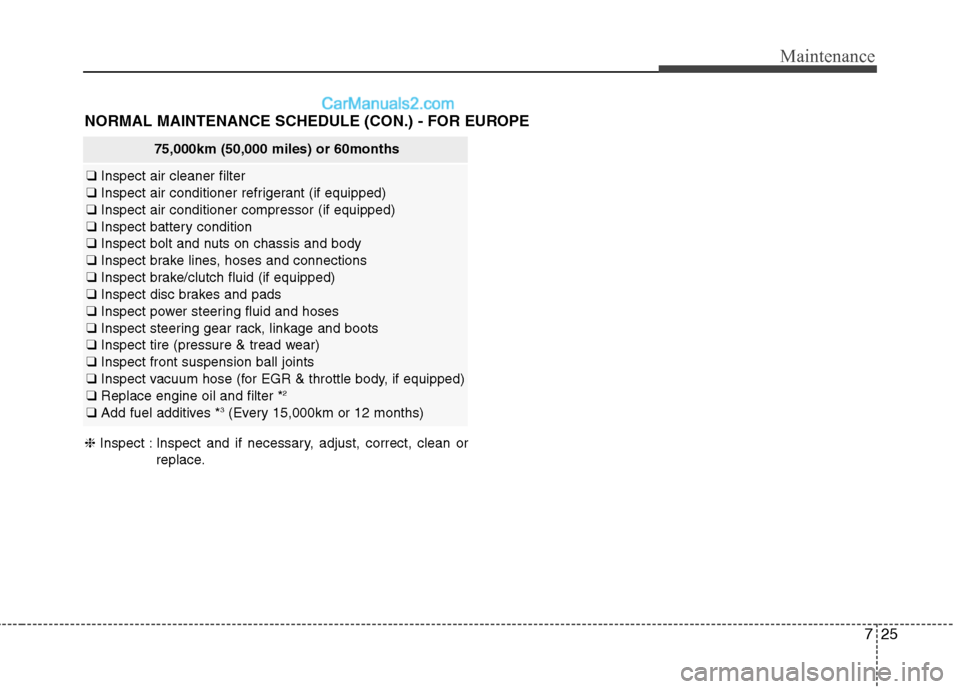
NORMAL MAINTENANCE SCHEDULE (CON.) - FOR EUROPE
75,000km (50,000 miles) or 60months
❑Inspect air cleaner filter
❑ Inspect air conditioner refrigerant (if equipped)
❑ Inspect air conditioner compressor (if equipped)
❑ Inspect battery condition
❑ Inspect bolt and nuts on chassis and body
❑ Inspect brake lines, hoses and connections
❑ Inspect brake/clutch fluid (if equipped)
❑ Inspect disc brakes and pads
❑ Inspect power steering fluid and hoses
❑ Inspect steering gear rack, linkage and boots
❑ Inspect tire (pressure & tread wear)
❑ Inspect front suspension ball joints
❑ Inspect vacuum hose (for EGR & throttle body, if equipped)
❑ Replace engine oil and filter * 2
❑ Add fuel additives * 3
(Every 15,000km or 12 months)
❈ Inspect : Inspect and if necessary, adjust, correct, clean or
replace.
Page 333 of 414
Maintenance
26
7
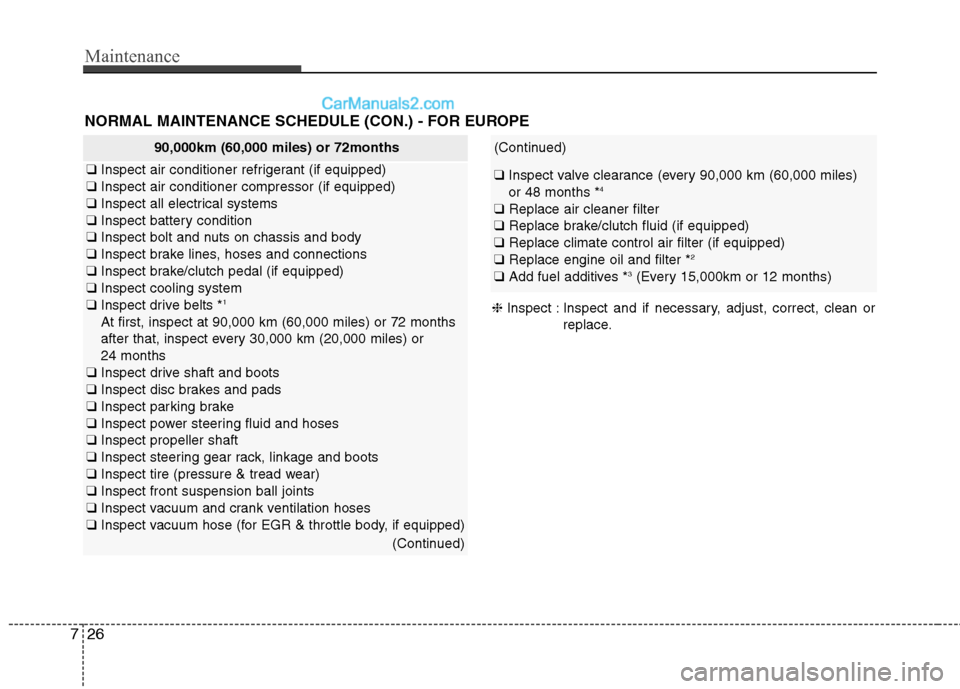
90,000km (60,000 miles) or 72months
❑ Inspect air conditioner refrigerant (if equipped)
❑ Inspect air conditioner compressor (if equipped)
❑ Inspect all electrical systems
❑ Inspect battery condition
❑ Inspect bolt and nuts on chassis and body
❑ Inspect brake lines, hoses and connections
❑ Inspect brake/clutch pedal (if equipped)
❑ Inspect cooling system
❑ Inspect drive belts * 1
At first, inspect at 90,000 km (60,000 miles) or 72 months
after that, inspect every 30,000 km (20,000 miles) or 24 months
❑ Inspect drive shaft and boots
❑ Inspect disc brakes and pads
❑ Inspect parking brake
❑ Inspect power steering fluid and hoses
❑ Inspect propeller shaft
❑ Inspect steering gear rack, linkage and boots
❑ Inspect tire (pressure & tread wear)
❑ Inspect front suspension ball joints
❑ Inspect vacuum and crank ventilation hoses
❑ Inspect vacuum hose (for EGR & throttle body, if equipped)
(Continued)
NORMAL MAINTENANCE SCHEDULE (CON.) - FOR EUROPE
(Continued)
❑Inspect valve clearance (every 90,000 km (60,000 miles) or 48 months * 4
❑ Replace air cleaner filter
❑ Replace brake/clutch fluid (if equipped)
❑ Replace climate control air filter (if equipped)
❑ Replace engine oil and filter * 2
❑ Add fuel additives * 3
(Every 15,000km or 12 months)
❈ Inspect : Inspect and if necessary, adjust, correct, clean or
replace.
Page 334 of 414
727
Maintenance
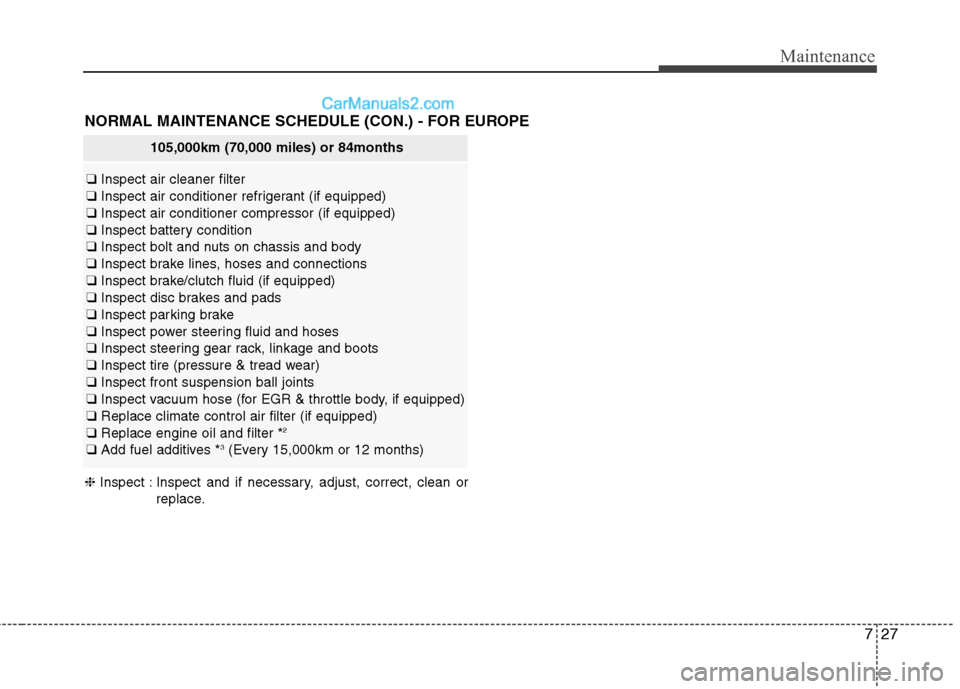
105,000km (70,000 miles) or 84months
❑Inspect air cleaner filter
❑ Inspect air conditioner refrigerant (if equipped)
❑ Inspect air conditioner compressor (if equipped)
❑ Inspect battery condition
❑ Inspect bolt and nuts on chassis and body
❑ Inspect brake lines, hoses and connections
❑ Inspect brake/clutch fluid (if equipped)
❑ Inspect disc brakes and pads
❑ Inspect parking brake
❑ Inspect power steering fluid and hoses
❑ Inspect steering gear rack, linkage and boots
❑ Inspect tire (pressure & tread wear)
❑ Inspect front suspension ball joints
❑ Inspect vacuum hose (for EGR & throttle body, if equipped)
❑ Replace climate control air filter (if equipped)
❑ Replace engine oil and filter * 2
❑ Add fuel additives * 3
(Every 15,000km or 12 months)
NORMAL MAINTENANCE SCHEDULE (CON.) - FOR EUROPE ❈ Inspect : Inspect and if necessary, adjust, correct, clean or
replace.
Page 335 of 414
Maintenance
28
7
NORMAL MAINTENANCE SCHEDULE (CON.) - FOR EUROPE
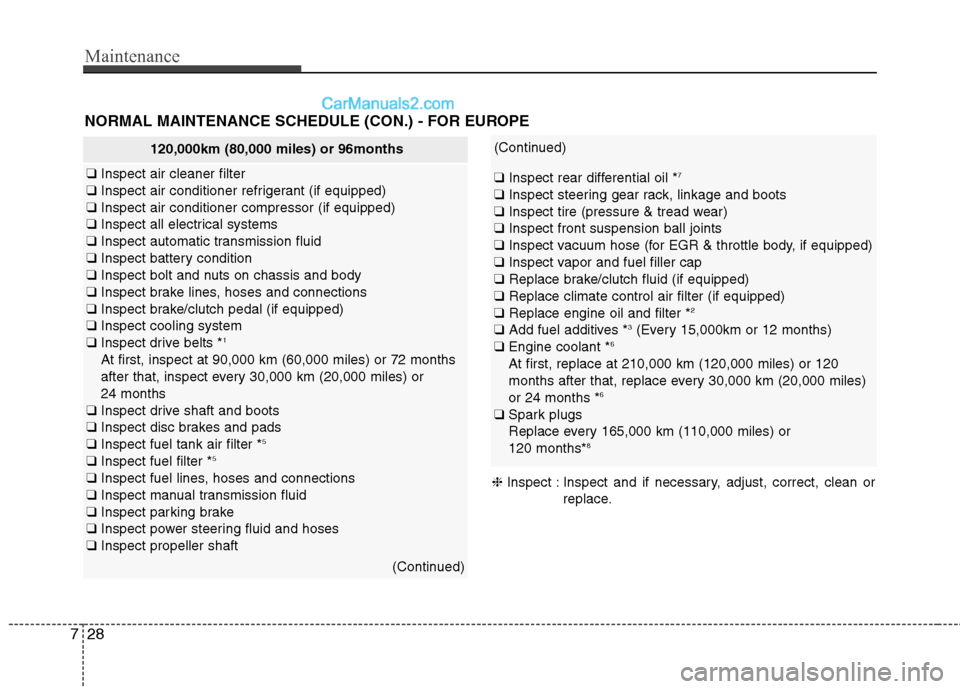
120,000km (80,000 miles) or 96months
❑ Inspect air cleaner filter
❑ Inspect air conditioner refrigerant (if equipped)
❑ Inspect air conditioner compressor (if equipped)
❑ Inspect all electrical systems
❑ Inspect automatic transmission fluid
❑ Inspect battery condition
❑ Inspect bolt and nuts on chassis and body
❑ Inspect brake lines, hoses and connections
❑ Inspect brake/clutch pedal (if equipped)
❑ Inspect cooling system
❑ Inspect drive belts * 1
At first, inspect at 90,000 km (60,000 miles) or 72 months
after that, inspect every 30,000 km (20,000 miles) or 24 months
❑ Inspect drive shaft and boots
❑ Inspect disc brakes and pads
❑ Inspect fuel tank air filter * 5
❑ Inspect fuel filter * 5
❑ Inspect fuel lines, hoses and connections
❑ Inspect manual transmission fluid
❑ Inspect parking brake
❑ Inspect power steering fluid and hoses
❑ Inspect propeller shaft
(Continued)
(Continued)
❑Inspect rear differential oil * 7
❑ Inspect steering gear rack, linkage and boots
❑ Inspect tire (pressure & tread wear)
❑ Inspect front suspension ball joints
❑ Inspect vacuum hose (for EGR & throttle body, if equipped)
❑ Inspect vapor and fuel filler cap
❑ Replace brake/clutch fluid (if equipped)
❑ Replace climate control air filter (if equipped)
❑ Replace engine oil and filter * 2
❑ Add fuel additives * 3
(Every 15,000km or 12 months)
❑ Engine coolant * 6
At first, replace at 210,000 km (120,000 miles) or 120
months after that, replace every 30,000 km (20,000 miles)or 24 months * 6
❑ Spark plugs
Replace every 165,000 km (110,000 miles) or 120 months* 8
❈ Inspect : Inspect and if necessary, adjust, correct, clean or
replace.
Page 344 of 414
737
Maintenance
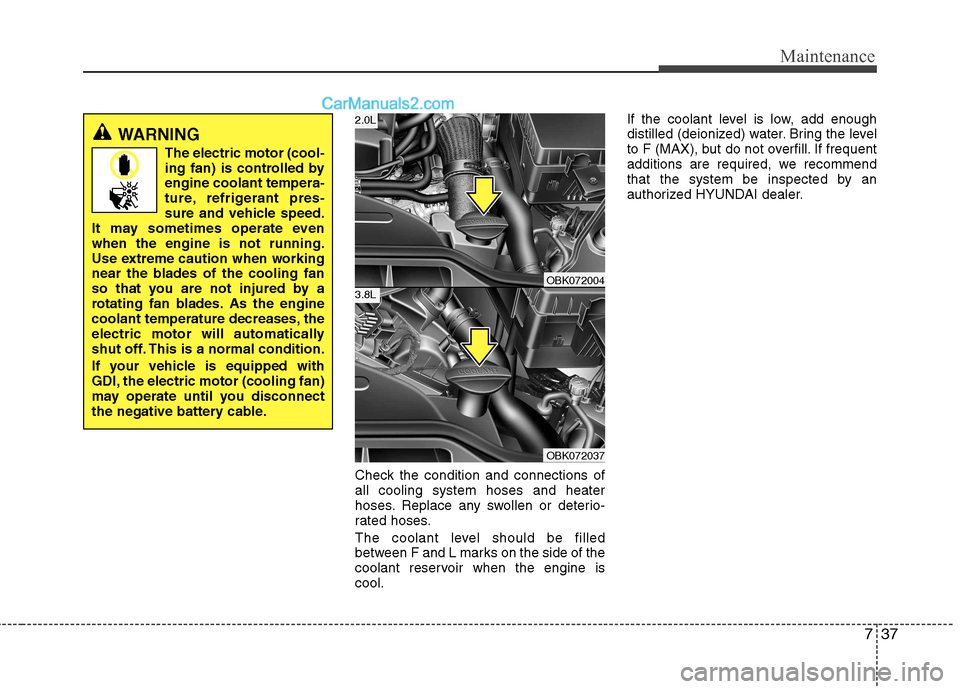
Check the condition and connections of all cooling system hoses and heater
hoses. Replace any swollen or deterio-
rated hoses.
The coolant level should be filled
between F and L marks on the side of the
coolant reservoir when the engine iscool.If the coolant level is low, add enough
distilled (deionized) water. Bring the level
to F (MAX), but do not overfill. If frequent
additions are required, we recommend
that the system be inspected by an
authorized HYUNDAI dealer.
OBK072004
OBK072037
2.0L
3.8L
WARNING
The electric motor (cool-
ing fan) is controlled byengine coolant tempera-
ture, refrigerant pres-
sure and vehicle speed.
It may sometimes operate evenwhen the engine is not running.
Use extreme caution when working
near the blades of the cooling fan
so that you are not injured by a
rotating fan blades. As the engine
coolant temperature decreases, the
electric motor will automatically
shut off. This is a normal condition.
If your vehicle is equipped with
GDI, the electric motor (cooling fan)
may operate until you disconnect
the negative battery cable.
Page 357 of 414
Maintenance
50
7
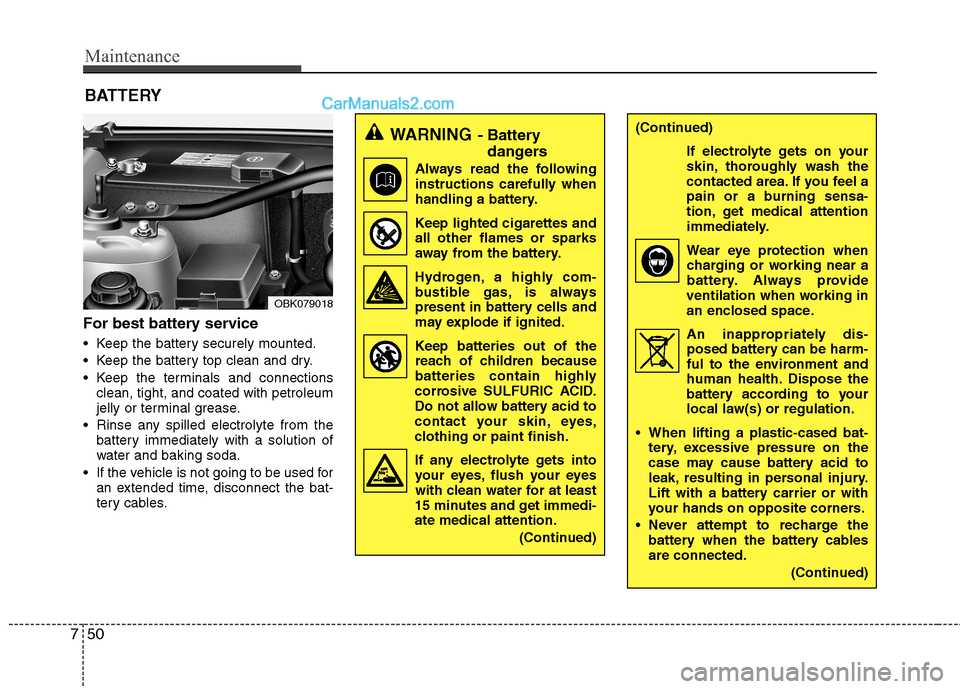
BATTERY
For best battery service
Keep the battery securely mounted.
Keep the battery top clean and dry.
Keep the terminals and connections clean, tight, and coated with petroleum
jelly or terminal grease.
Rinse any spilled electrolyte from the battery immediately with a solution of
water and baking soda.
If the vehicle is not going to be used for an extended time, disconnect the bat-
tery cables.
OBK079018
WARNING - Battery
dangers
Always read the following
instructions carefully when
handling a battery.
Keep lighted cigarettes and all other flames or sparks
away from the battery.
Hydrogen, a highly com- bustible gas, is always
present in battery cells and
may explode if ignited.
Keep batteries out of the reach of children because
batteries contain highly
corrosive SULFURIC ACID.
Do not allow battery acid to
contact your skin, eyes,
clothing or paint finish.
If any electrolyte gets into your eyes, flush your eyes
with clean water for at least
15 minutes and get immedi-ate medical attention.
(Continued)(Continued)
If electrolyte gets on your
skin, thoroughly wash the
contacted area. If you feel a
pain or a burning sensa-
tion, get medical attention
immediately.
Wear eye protection whencharging or working near a
battery. Always provide
ventilation when working in
an enclosed space.
An inappropriately dis- posed battery can be harm-
ful to the environment and
human health. Dispose the
battery according to your
local law(s) or regulation.
When lifting a plastic-cased bat- tery, excessive pressure on the
case may cause battery acid to
leak, resulting in personal injury.
Lift with a battery carrier or with
your hands on opposite corners.
Never attempt to recharge the battery when the battery cablesare connected.
(Continued)
Page 358 of 414
751
Maintenance
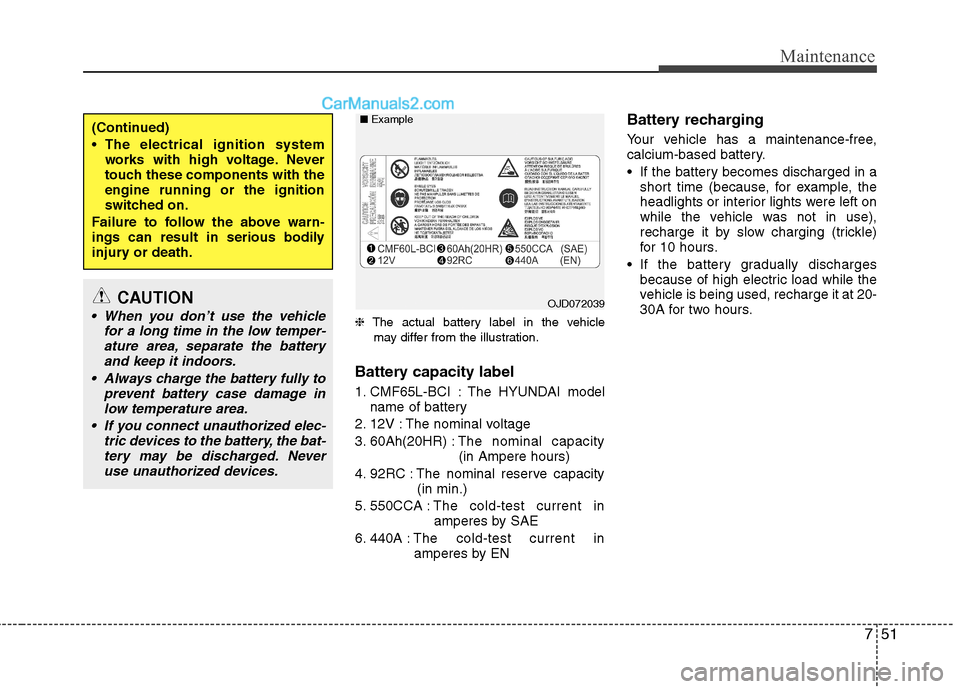
❈The actual battery label in the vehicle
may differ from the illustration.
Battery capacity label
1. CMF65L-BCI : The HYUNDAI model name of battery
2. 12V : The nominal voltage
3. 60Ah(20HR) : The nominal capacity
(in Ampere hours)
4. 92RC : The nominal reserve capacity (in min.)
5. 550CCA : The cold-test current in
amperes by SAE
6. 440A : The cold-test current in
amperes by EN Battery recharging
Your vehicle has a maintenance-free,
calcium-based battery.
If the battery becomes discharged in a
short time (because, for example, the
headlights or interior lights were left on
while the vehicle was not in use),
recharge it by slow charging (trickle)
for 10 hours.
If the battery gradually discharges because of high electric load while the
vehicle is being used, recharge it at 20-
30A for two hours.
(Continued)
The electrical ignition systemworks with high voltage. Never
touch these components with theengine running or the ignition
switched on.
Failure to follow the above warn-
ings can result in serious bodily
injury or death.
CAUTION
When you don’t use the vehicle for a long time in the low temper-ature area, separate the batteryand keep it indoors.
Always charge the battery fully to prevent battery case damage in
low temperature area.
If you connect unauthorized elec- tric devices to the battery, the bat-tery may be discharged. Neveruse unauthorized devices.OJD072039
■
Example