power steering Hyundai Genesis Coupe 2013 Owner's Manual
[x] Cancel search | Manufacturer: HYUNDAI, Model Year: 2013, Model line: Genesis Coupe, Model: Hyundai Genesis Coupe 2013Pages: 414, PDF Size: 38.89 MB
Page 10 of 414
Your vehicle at a glance
4
2
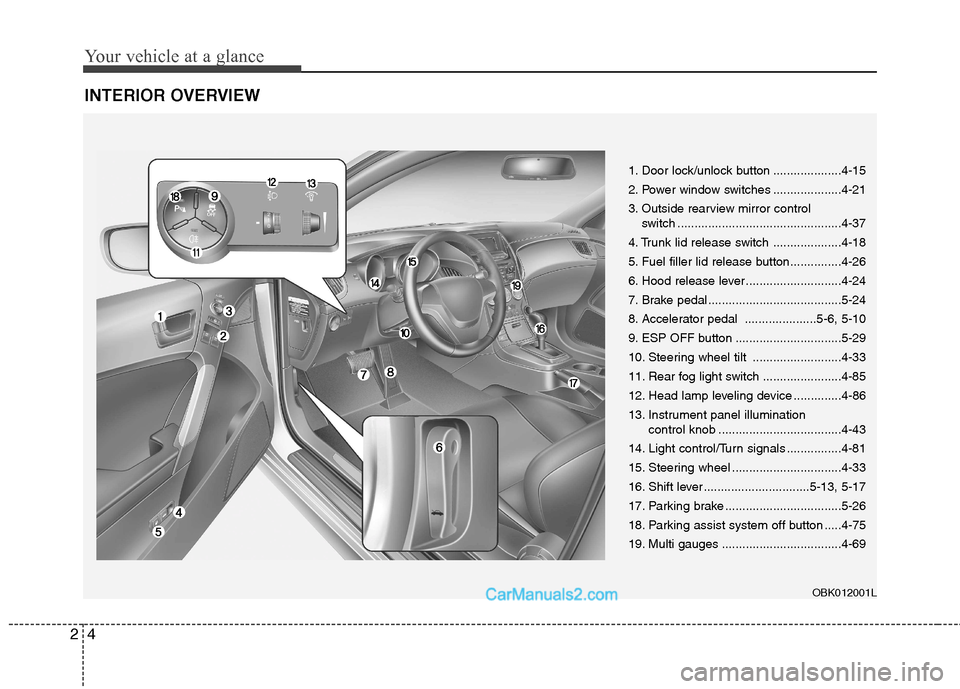
INTERIOR OVERVIEW
1. Door lock/unlock button ....................4-15
2. Power window switches ....................4-21
3. Outside rearview mirror control
switch ................................................4-37
4. Trunk lid release switch ....................4-18
5. Fuel filler lid release button...............4-26
6. Hood release lever ............................4-24
7. Brake pedal .......................................5-24
8. Accelerator pedal .....................5-6, 5-10
9. ESP OFF button ...............................5-29
10. Steering wheel tilt ..........................4-33
11. Rear fog light switch .......................4-85
12. Head lamp leveling device ..............4-86
13. Instrument panel illumination control knob ....................................4-43
14. Light control/Turn signals ................4-81
15. Steering wheel ................................4-33
16. Shift lever ...............................5-13, 5-17
17. Parking brake ..................................5-26
18. Parking assist system off button .....4-75
19. Multi gauges ...................................4-69
OBK012001L
Page 12 of 414
Your vehicle at a glance
6
2
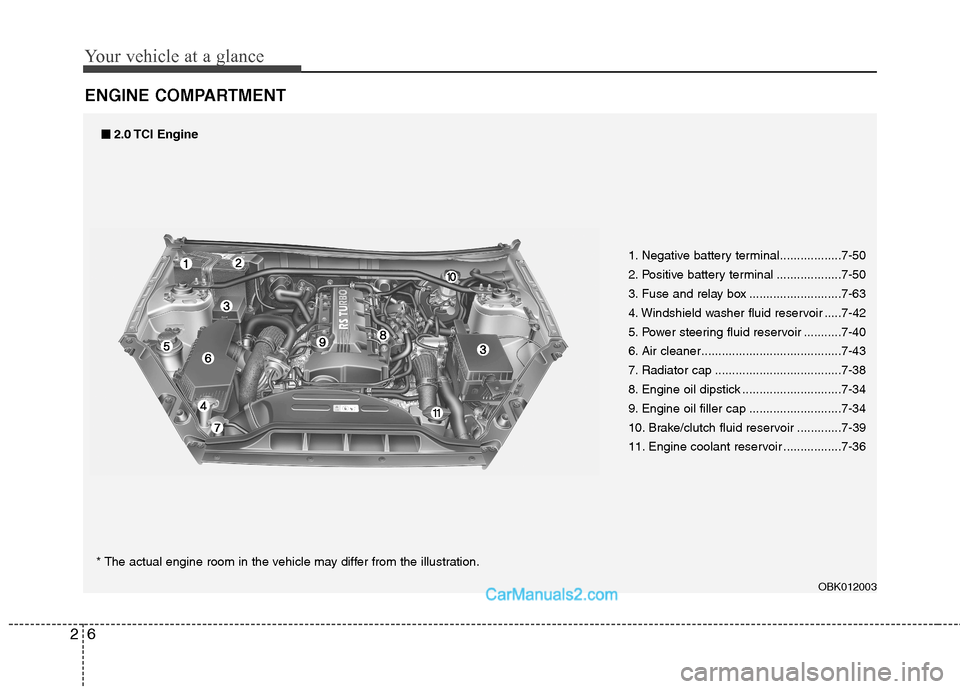
ENGINE COMPARTMENT
1. Negative battery terminal..................7-50
2. Positive battery terminal ...................7-50
3. Fuse and relay box ...........................7-63
4. Windshield washer fluid reservoir .....7-42
5. Power steering fluid reservoir ...........7-40
6. Air cleaner.........................................7-43
7. Radiator cap .....................................7-38
8. Engine oil dipstick .............................7-34
9. Engine oil filler cap ...........................7-34
10. Brake/clutch fluid reservoir .............7-39
11. Engine coolant reservoir .................7-36
OBK012003
■■2.0 TCI Engine
* The actual engine room in the vehicle may differ from the illustration.
Page 13 of 414
27
Your vehicle at a glance
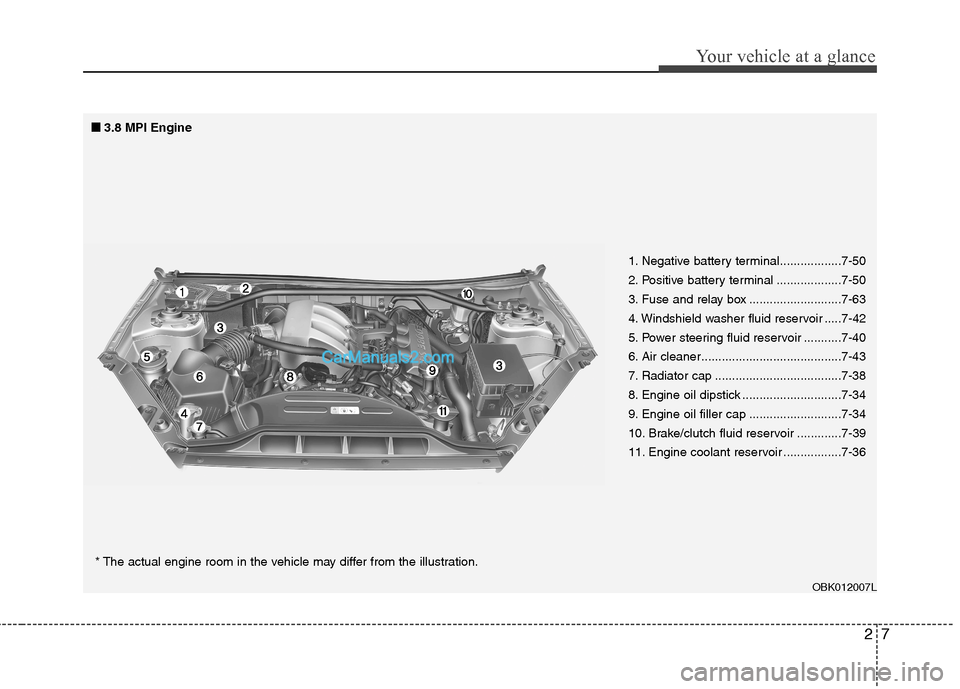
1. Negative battery terminal..................7-50
2. Positive battery terminal ...................7-50
3. Fuse and relay box ...........................7-63
4. Windshield washer fluid reservoir .....7-42
5. Power steering fluid reservoir ...........7-40
6. Air cleaner.........................................7-43
7. Radiator cap .....................................7-38
8. Engine oil dipstick .............................7-34
9. Engine oil filler cap ...........................7-34
10. Brake/clutch fluid reservoir .............7-39
11. Engine coolant reservoir .................7-36
■
■
3.8 MPI Engine
* The actual engine room in the vehicle may differ from the illustration.
OBK012007L
Page 14 of 414
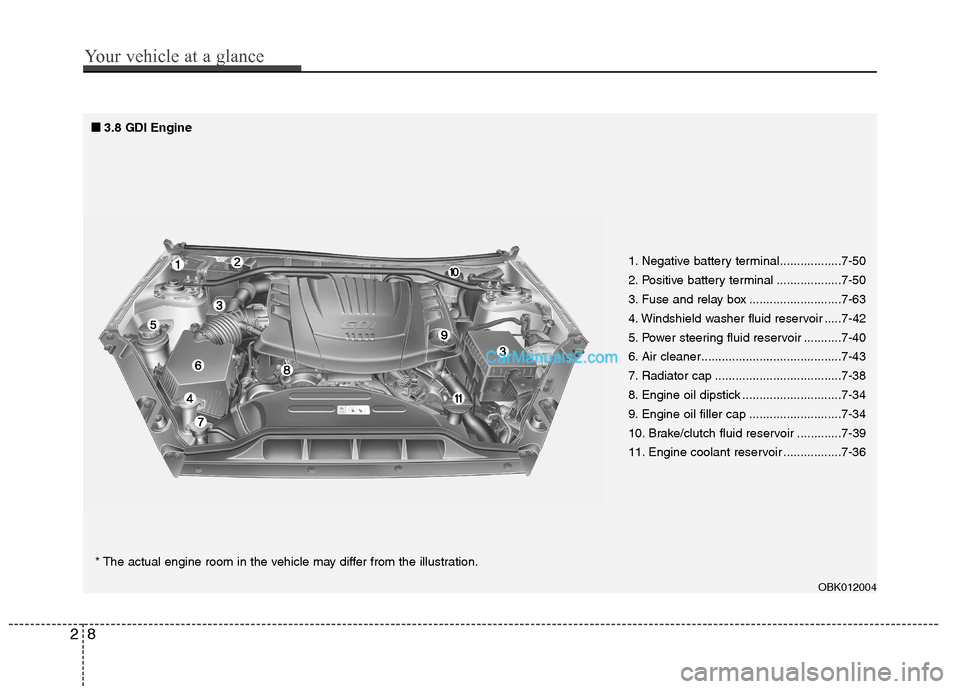
1. Negative battery terminal..................7-50
2. Positive battery terminal ...................7-50
3. Fuse and relay box ...........................7-63
4. Windshield washer fluid reservoir .....7-42
5. Power steering fluid reservoir ...........7-40
6. Air cleaner.........................................7-43
7. Radiator cap .....................................7-38
8. Engine oil dipstick .............................7-34
9. Engine oil filler cap ...........................7-34
10. Brake/clutch fluid reservoir .............7-39
11. Engine coolant reservoir .................7-36
■
■
3.8 GDI Engine
* The actual engine room in the vehicle may differ from the illustration.
OBK012004
28
Your vehicle at a glance
Page 19 of 414
35
Safety features of your vehicle
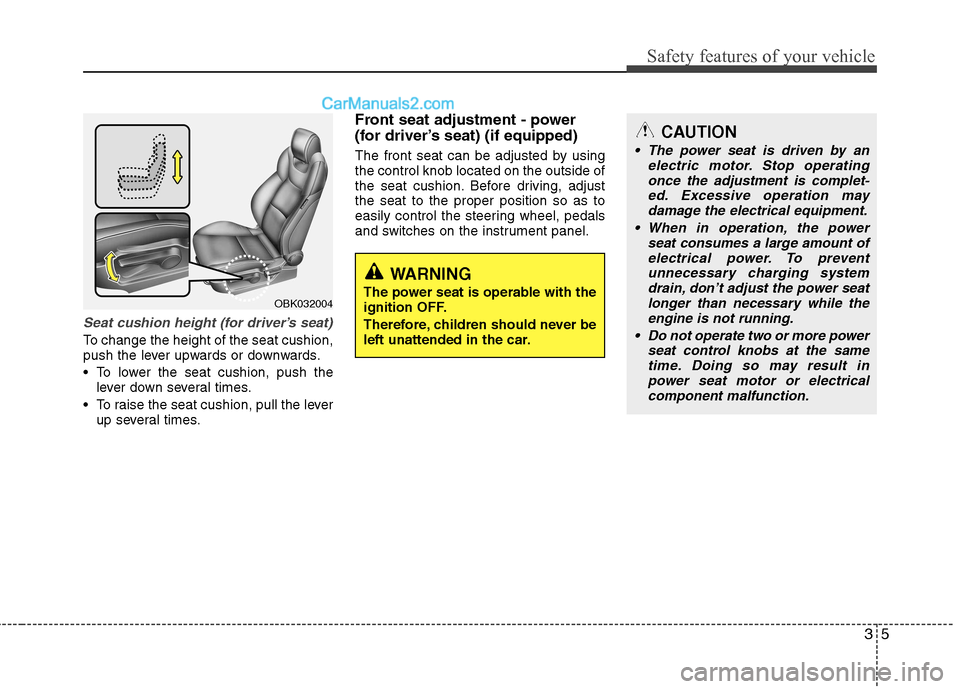
Seat cushion height (for driver’s seat)
To change the height of the seat cushion,
push the lever upwards or downwards.
• To lower the seat cushion, push thelever down several times.
To raise the seat cushion, pull the lever up several times. Front seat adjustment - power
(for driver’s seat) (if equipped)
The front seat can be adjusted by using the control knob located on the outside of
the seat cushion. Before driving, adjustthe seat to the proper position so as to
easily control the steering wheel, pedals
and switches on the instrument panel.
OBK032004
WARNING
The power seat is operable with the
ignition OFF.
Therefore, children should never be
left unattended in the car.
CAUTION
The power seat is driven by an electric motor. Stop operating
once the adjustment is complet- ed. Excessive operation maydamage the electrical equipment.
When in operation, the power seat consumes a large amount ofelectrical power. To preventunnecessary charging system drain, don’t adjust the power seat
longer than necessary while the engine is not running.
Do not operate two or more power seat control knobs at the sametime. Doing so may result in
power seat motor or electricalcomponent malfunction.
Page 99 of 414
433
Features of your vehicle
Power steering
Power steering uses energy from the
engine to assist you in steering the vehi-
cle. If the engine is off or if the power
steering system becomes inoperative,
the vehicle may still be steered, but it will
require increased steering effort.
Should you notice any change in the
effort required to steer during normal
vehicle operation, we recommend that
the system be checked by an authorized
HYUNDAI dealer.✽✽NOTICE
If the power steering drive belt breaks
or if the power steering pump malfunc-
tions, the steering effort will greatly
increase.
✽
✽ NOTICE
If the vehicle is parked for extended
periods outside in cold weather (below -
10°C/14°F), the power steering may
require increased effort when the engine
is first started. This is caused by
increased fluid viscosity due to the cold
weather and does not indicate a mal-function.
When this happens, increase the engine
RPM by depressing accelerator until the
RPM reaches 1,500 rpm then release or
let the engine idle for two or three min-utes to warm up the fluid.
Tilt steering
Tilt steering allows you to adjust the
steering wheel before you drive. You can
also raise it to give your legs more room
when you exit and enter the vehicle.
The steering wheel should be positioned
so that it is comfortable for you to drive,
while permitting you to see the instru-
ment panel warning lights and gauges.
STEERING WHEEL
CAUTION
Never hold the steering wheel
against a stop (extreme right or leftturn) for more than 5 seconds withthe engine running. Holding the
steering wheel for more than 5 sec-onds in either position may causedamage to the power steering pump.
WARNING
Never adjust the angle of the steering wheel while driving. You
may lose steering control and
cause severe personal injury,death or accidents.
After adjusting, push the steering wheel both up and down to be
certain it is locked in position.
Page 192 of 414
![Hyundai Genesis Coupe 2013 Owners Manual Features of your vehicle
126
4
Digital clock
Whenever the battery terminals or relat-
ed fuses are disconnected, you must
reset the time.
Setup the clock
With audio off
1. Press the [SETUP] or [Clo](/img/35/14690/w960_14690-191.png "Hyundai Genesis Coupe 2013 Owners Manual Features of your vehicle
126
4
Digital clock
Whenever the battery terminals or relat-
ed fuses are disconnected, you must
reset the time.
Setup the clock
With audio off
1. Press the [SETUP] or [Clo")
Features of your vehicle
126
4
Digital clock
Whenever the battery terminals or relat-
ed fuses are disconnected, you must
reset the time.
Setup the clock
With audio off
1. Press the [SETUP] or [Clock] button(1)
until the clock of the display blinks.
2. Set the clock by turning the knob(2) and press it.
With audio on
1. Press the [SETUP] or [Clock] button (1).
2. Select the clock menu by turning the knob (2).
3. Set the clock by turning the knob(2) and press it.
WARNING
Do not adjust the clock while driv-
ing. You may lose your steering
control and cause an accident that
results in severe personal injury ordeath.
OBK042111
WARNING
Do not put a finger or a foreign ele-
ment (pin, etc.) into a power outlet
and do not touch with a wet hand.
You may get an electric shock.
Page 231 of 414
4165
Features of your vehicle
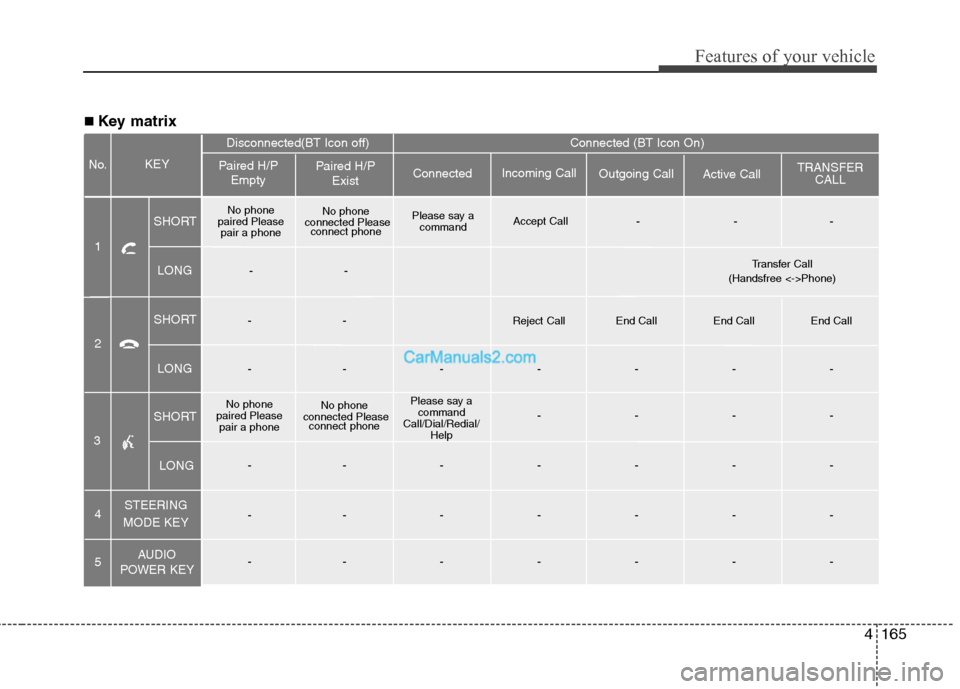
■ Key matrix
No.
Disconnected(BT Icon off) Connected (BT Icon On)
Paired H/P Empty Paired H/P
Exist
1 SHORT
LONG
SHORT
LONG
STEERING
MODE KEY
AUDIO
POWER KEY Incoming Call
Outgoing Call Active CallTRANSFER
CALL
Connected
KEY
--
Reject Call End Call End Call End Call
-------
No phone
paired Please pair a phone No phone
connected Please connect phone Please say a
command
Call/Dial/Redial/ Help ----
-------
-------
-------
No phone
paired Please pair a phone No phone
connected Please connect phone Please say a
command Accept Call
---
4 5
2
3
SHORT
LONG
-- Transfer Call
(Handsfree <->Phone)
Page 259 of 414
Driving your vehicle
24
5
Power brakes
Your vehicle has power-assisted brakes
that adjust automatically through normal
usage.
In the event that the power-assisted
brakes lose power because of a stalled
engine or some other reason, you can
still stop your vehicle by applying greater
force to the brake pedal than you nor-
mally would. The stopping distance, how-
ever, will be longer.
When the engine is not running, the
reserve brake power is partially depleted
each time the brake pedal is applied. Do
not pump the brake pedal when the
power assist has been interrupted.
Pump the brake pedal only when neces-
sary to maintain steering control on slip-
pery surfaces. BRAKE SYSTEM (Continued)
Always, confirm the position of
the brake and accelerator pedal
before driving. If you don't checkthe position of the accelerator
and brake pedal before driving,
you may depress the accelerator
instead of the brake pedal. It maycause a serious accident.WARNING - Brakes
Do not drive with your foot rest- ing on the brake pedal. This will create abnormal high brake tem-
peratures, excessive brake lining
and pad wear, and increasedstopping distances.
When descending a long or steep hill, shift to a lower gear and
avoid continuous application of
the brakes. Continuous brakeapplication will cause the brakes
to overheat and could result in a
temporary loss of braking per-
formance.
Wet brakes may impair the vehi- cle’s ability to safely slow down;
the vehicle may also pull to oneside when the brakes are applied.
Applying the brakes lightly will
indicate whether they have been
affected in this way. Always test
your brakes in this fashion after
driving through deep water. To
dry the brakes, apply them lightly
while maintaining a safe forward
speed until brake performancereturns to normal.
(Continued)
Page 275 of 414
Driving your vehicle
40
5
Remember, your vehicle does not
require extended warm-up. After the
engine has started, allow the engine to
run for 10 to 20 seconds prior to plac-
ing the vehicle in gear. In very cold
weather, however, give your engine a
slightly longer warm-up period.
Don't "lug" or "over-rev" the engine. Lugging is driving too slowly in too high
a gear resulting in the engine bucking.
If this happens, shift to a lower gear.
Over-revving is racing the engine
beyond its safe limit. This can be avoid-
ed by shifting at the recommended
speeds. Use your air conditioning sparingly.
The air conditioning system is operat-
ed by engine power so your fuel econ-
omy is reduced when you use it.
Open windows at high speeds can reduce fuel economy.
Fuel economy is less in crosswinds and headwinds. To help offset some of
this loss, slow down when driving in
these conditions.
Keeping a vehicle in good operating con-
dition is important both for economy and
safety. Therefore, we recommend that the
system be serviced by an authorized
HYUNDAI dealer.
WARNING - Engine off dur-
ing motion
Never turn the engine off to coast
down hills or anytime the vehicle is
in motion. The power steering and
power brakes will not function
properly without the engine run-
ning. Instead, keep the engine on
and downshift to an appropriate
gear for engine braking effect. In
addition, turning off the ignition
while driving could engage the
steering wheel lock resulting in
loss of vehicle steering which
could cause serious injury ordeath.