Engine drive belt Hyundai Getz 2002 User Guide
[x] Cancel search | Manufacturer: HYUNDAI, Model Year: 2002, Model line: Getz, Model: Hyundai Getz 2002Pages: 428, PDF Size: 6.13 MB
Page 174 of 428
6. Do-It-Yourself Maintenance
Engine compartment ...................................................................... 6-2
General checks ................................................................................ 6-6
Checking the engine oil .................................................................... 6-7
Changing the oil and filter ................................................................. 6-9
Checking and changing the engine coolant....................................6-13
Spark plugs .................................................................................... 6-15
Changing the air cleaner filter ......................................................... 6-17
Checking the transaxle oil (Manual)............................................... 6-18
Checking the transaxle fluid (Automatic)....................................... 6-19
Checking the brakes ...................................................................... 6-21
Air conditioning care ....................................................................... 6-22
Checking drive belts ...................................................................... 6-25
Checking and replacing fuses ........................................................ 6-26
Power steering fluid level ............................................................... 6-30
Replacement of bulbs .................................................................... 6-32
Fuse panel description ................................................................... 6-38
6
Page 179 of 428
6- 6 DO-IT-YOURSELF MAINTENANCE
G020A01A-AAT GENERAL CHECKS Engine Compartment The following should be checked regu-larly:
o Engine oil level and condition
o Transaxle fluid level and condition
o Brake fluid level
o Clutch fluid level
o Engine coolant level
o Windshield washer fluid level
o Accessory drive belt condition
o Engine coolant hose condition
o Fluid leaks (on or below compo-
nents)
o Power steering fluid level
o Battery condition G020C01A-AAT Vehicle Interior The following should be checked each time when the vehicle is driven:
o Lights operation
o Windshield wiper operation
o Horn operation
o Defroster, heater system operation
(and air conditioning, if installed)
o Steering operation and condition
o Mirror condition and operation
o Turn signal operation
o Accelerator pedal operation
o Brake operation, including parking brake
o Manual transaxle operation, includ- ing clutch operation
o Automatic transaxle operation, in- cluding "Park" mechanism opera-tion
o Seat control condition and opera- tion
o Seat belt condition and operation
o Sunvisor operation If you notice anything that does not operate correctly or appears to befunctioning incorrectly, inspect it care- fully and seek assistance from your Hyundai dealer if service is needed.
G020B01A-AAT Vehicle Exterior The following should be checked monthly:
o Overall appearance and condition
o Wheel condition and wheel nut
torgue
o Air filter condition
o Exhaust system condition
o Light condition and operation
o Windshield glass condition
o Wiper blade condition
o Paint condition and body corrosion
o Fluid leaks
o Door and hood lock condition
o Tire pressure and condition (including spare tire)
Page 195 of 428

6- 22 DO-IT-YOURSELF MAINTENANCE
G140A01A-AAT AIR CONDITIONING CARE Keeping the Condenser Clean The air conditioning condenser (and engine radiator) should be checked periodically for accumulation of dirt,dead insects, leaves, etc. These can interfere with maximum cooling effi- ciency. When removing such accumu-lations, brush or hose them away care- fully to avoid bending the cooling fans.
G140B01A-AAT Checking the Air Conditioning Operation
1. Start the engine and let it run at a fast idle for several minutes with the air conditioning set at the maximum cold setting.
2. If the air coming out of the in-dash vents is not cold, have the air condi-tioning system inspected by yourHyundai dealer. G140C01A-AAT Lubrication To lubricate the compressor and the seals in the system, the air condition-ing should be run for at least 10 min- utes each week. This is particularly important during cool weather whenthe air conditioning system is not oth- erwise in use. G140D01TB-GAT Checking the Compressor Drive Belt
!
CAUTION:
Running the air conditioning sys- tem for extended periods of timewith a low refrigerant level may damage the compressor. G140D01TB
Power steering
Crank pully
A/C pully
5 ~ 5.5 mm (0.19 ~ 0.21 in.)
1.1L
G120E01TB-AAT Adding Brake Fluid
WARNING:
Handle brake fluid carefully. It can damage your vision if it gets intoyour eyes. Use only DOT 3 or DOT 4 specification fluid from a sealed container. Do not allow the fluidcan or reservoir to remain open any longer than required. This will pre- vent entry of dirt and moisture whichcan damage the brake system and cause improper operation.
!
To add brake fluid;
1) If it is necessary, remove the air cleaner cover.
2) Wipe away any dirt then unscrew the fluid reservoir cap.
3) Slowly pour the recommended fluid
into the reservoir using by a funnel. Do not overfill.
4) Carefully replace the cap on the res-
ervoir and tighten.
Page 196 of 428

DO-IT-YOURSELF MAINTENANCE 6- 23
CRANK PULLEY
When the air conditioning is being used regularly, the compressor drive belt tension should be checked at least once a month.To check the drive belt tension, press down on the belt halfway between the engine crankshaft and compressorpulleys. Pressing with your finger, you should not be able to deflect this belt anymore than 8.0 mm (1.1L: 5~ 5.5mm). If you have the instruments to check it with a force of 98N (22 lb.), the deflection should be approx. 8.0 mm(0.315 in.). If the belt is too loose, have it adjusted by your Hyundai dealer. HTB219
A/C
TENSION PULLEY 8mm (0.315 in.)
1.3/1.6L
HTB290
B145A01TB-GAT CHANGING THE AIR FILTER
(In Front of evaporator unit)(If Installed) The air filter is located in front of the evaporator unit behind the glove box. It operates to decrease pollutants fromentering the car and to filter the air.
HTB291
2. Remove the cable and the wiring from the filter cover.
1. Remove the adjusting pins on both sides of the glove box to open halfthe glove box.
HTB292
3. Remove the filter cover to push the upside of the filter cover.
Page 198 of 428

DO-IT-YOURSELF MAINTENANCE 6- 25
Water Pump Pulley
Alternator Pulley
Crankshaft Pulley 5.1~6 mm(0.2~0.24 in.)
G190A01A-GAT CHECKING DRIVE BELTS (Gasoline)
G180A01A-GAT CHECKING BRAKE PEDAL CLEARANCE
G180A01L
45.1 mm (1.78 in.)
You need a helper to check the brake pedal clearance. With the engine run- ning, have your helper press down on the brake pedal several times and thenhold it down with a force of about 490 N (50 Kg, 110 lbs). The brake pedal clearance is the distance from the topsurface of the brake pedal to the as- phalt sheeting under the floor mat. If the brake pedal clearance is notwithin the limits specified in the illustra- tion, have it inspected by your Hyundai dealer and adjusted or repaired if nec-essary. HTB186
1.1L
1.3L/1.6L Crankshaft pulley
Alternator
HTB220
Water Pump Pulley
9.5 ~11.0 mm (0.37 ~ 0.43 in.)
G170A01A-GAT CHECKING BRAKE PEDAL FREEPLAY
HXGS508
3 ~ 8 mm (0.12 ~ 0.31 in.)
With the engine off, press down on the brake pedal several times to reduce the vacuum in the brake booster.Then, using your hand, press down slowly on the brake pedal until you feel a change in resistance. This is thebrake pedal freeplay. The freeplay should be within the limits specified in the illustration. If it is not,have it inspected by your Hyundai dealer and adjusted or repaired if nec- essary.
Page 199 of 428

6- 26 DO-IT-YOURSELF MAINTENANCE
Drive belts should be checked periodi- cally for proper tension and adjusted if necessary. At the same time, beltsshould be examined for cracks, wear, fraying or other evidence of deteriora- tion and replaced if necessary.Belt routing should also be checked to be sure there is no interference be- tween the belts and other parts of theengine. After a belt is replaced, the new belt should be adjusted again after two or three weeks to eliminateslack resulting from initial stretching after use. G200A01A-AAT CHECKING AND REPLACING FUSESReplacing a Fusible Link
G200A01L
Melted
Good
G190B01TB-GAT CHECKING DRIVE BELTS (Diesel)
A/C comp.
Auto tensioner Pulley
G190B01TB
AlternatorPower steering pump
At the scheduled maintenance inspec- tion, belts should be examined forcracks, wear, fraying or other evidence of deterioration and replaced if neces- sary.Belt routing should also be checked to be sure there is no interference be- tween the belts and other parts of theengine. A fusible link will melt if the electricalcircuits from the battery are ever over-loaded, thus preventing damage to the entire wiring harness. (This could be caused by a short in the system draw-ing too much current.) If this ever happens, have a Hyundai dealer de- termine the cause, repair the systemand replace the fusible link. The fusible links are located in a fuse box for easy inspection.
Page 230 of 428
INDEX 10- 3
D Defrosting / Defogging .............................................. 1-80
Door Door locks ................................................................ 1-7
Locking, unlocking front doors with a key ............... 1-7
Drink Holder .............................................................. 1-59
Drive Belts ................................................................ 6-25
Driving
Economical driving ................................................. 2-14
Smooth cornering ................................................... 2-15
Winter driving ......................................................... 2-15
EEmission Control Syst em ........................................... 7-2
Engine Before starting the engine ....................................... 2-3
Compartment ........................................................... 6-2
Coolant ................................................................... 6-13
Coolant temperature gauge ................................... 1-49
If the engine overheats ............................................ 3-4
Number .................................................................... 8-2
Oil ............................................................................. 6-7
Starting ..................................................................... 2-3
Engine Exhaust Can Be Dangerous ........................... 2-2F Fog Light
Front ....................................................................... 1-57
Rear ....................................................................... 1-57
Front Seats Adjustable front seats ............................................ 1-13
Adjustable headrest s .............................................. 1-14
Adjusting seat forward and rear ward..................... 1-13
Adjusting seatback angle .......................................1-13
Lumbar support control .................. ........................ 1-14
Seat cushion height adjustment............................ 1-15
Seat warmer ........................................................... 1-19
Fuel Capacity ................................................................... 9-2
Gauge .................................................................... 1-48
recommendations ..................................................... 1-2
Fuel Filler Lid Remote release ...................................................... 1-68
Fuses ........................................................................ 6-26
Fuse Panel description ............................................. 6-38
G General Checks .......................................................... 6-6
Glove Box ................................................................. 1-63
Page 274 of 428
1- 30 FEATURES OF YOUR HYUNDAI
o For maximum safety protection in
all types of crashes, all occupants including the driver should alwayswear their seat belts whether ornot an airbag is also provided attheir seating position to minimize the risk of severe injury or death in the event of a crash. Do not sit orlean unnecessarily close to theairbag while the vehicle is in mo-tion.
o The SRS airbag system must de- ploy very rapidly to provide pro-tection in a crash. If an occupant isout of position because of notwearing a seat belt, the airbag mayforcefully contact the occupantcausing serious or fatal injuries.
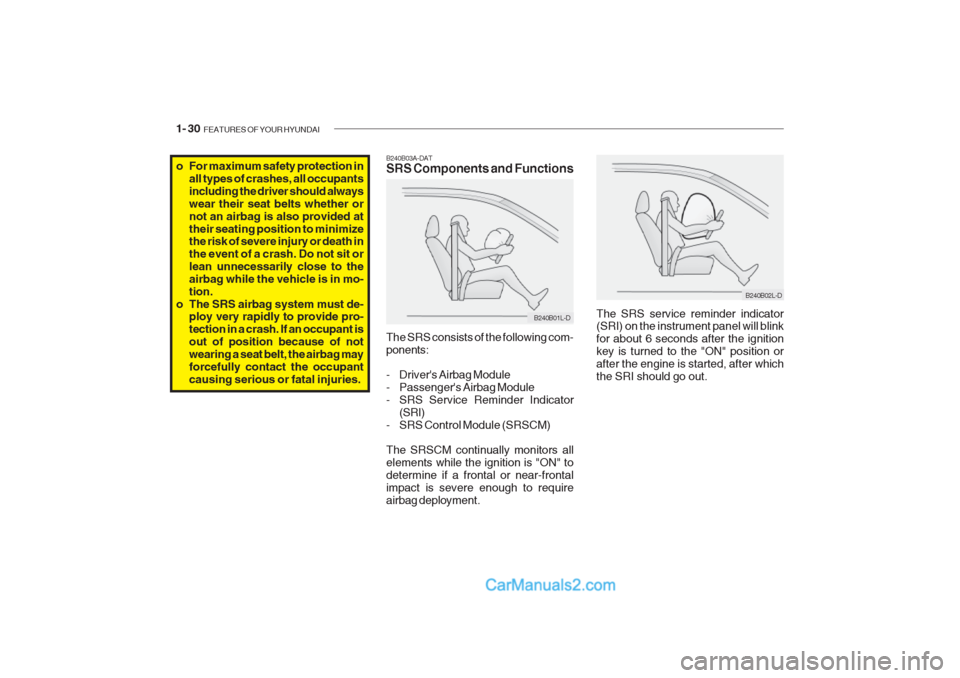
The SRS consists of the following com- ponents:
- Driver's Airbag Module
- Passenger's Airbag Module
- SRS Service Reminder Indicator
(SRI)
- SRS Control Module (SRSCM) The SRSCM continually monitors all elements while the ignition is "ON" todetermine if a frontal or near-frontalimpact is severe enough to requireairbag deployment.
B240B03A-DAT SRS Components and Functions
The SRS service reminder indicator (SRI) on the instrument panel will blink for about 6 seconds after the ignitionkey is turned to the "ON" position orafter the engine is started, after whichthe SRI should go out.
B240B01L-D
B240B02L-D
Page 276 of 428
1- 32 FEATURES OF YOUR HYUNDAI
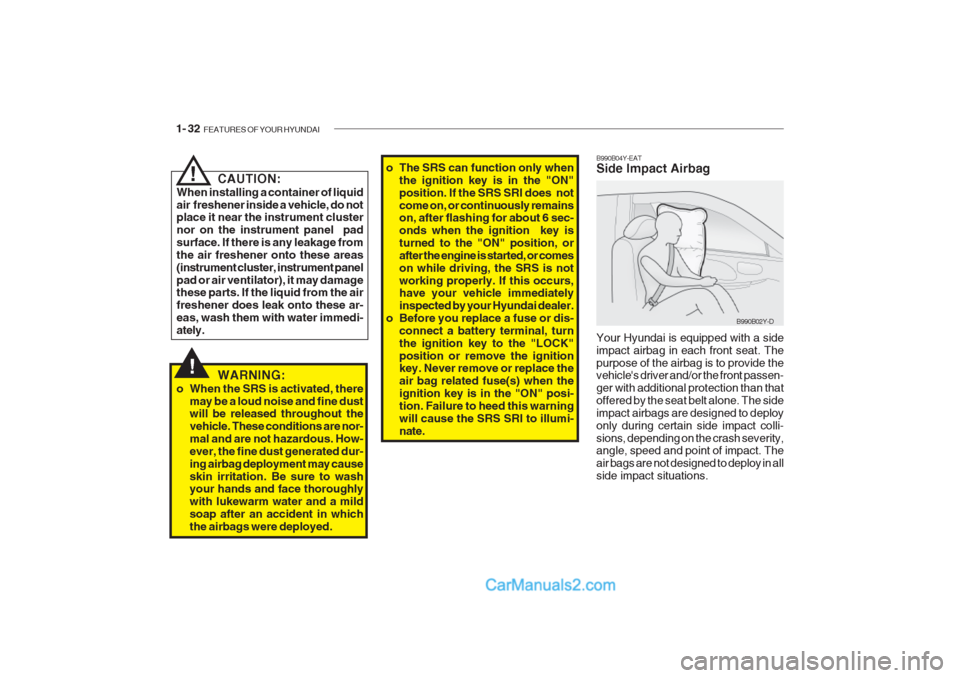
B990B04Y-EAT Side Impact Airbag Your Hyundai is equipped with a side impact airbag in each front seat. Thepurpose of the airbag is to provide the vehicle's driver and/or the front passen- ger with additional protection than thatoffered by the seat belt alone. The sideimpact airbags are designed to deployonly during certain side impact colli-sions, depending on the crash severity, angle, speed and point of impact. The air bags are not designed to deploy in allside impact situations.
B990B02Y-D
!
!
CAUTION:
When installing a container of liquid air freshener inside a vehicle, do not place it near the instrument cluster nor on the instrument panel padsurface. If there is any leakage fromthe air freshener onto these areas(instrument cluster, instrument panelpad or air ventilator), it may damage these parts. If the liquid from the air freshener does leak onto these ar-eas, wash them with water immedi-ately.
WARNING:
o When the SRS is activated, there may be a loud noise and fine dust will be released throughout the vehicle. These conditions are nor-mal and are not hazardous. How-ever, the fine dust generated dur-ing airbag deployment may causeskin irritation. Be sure to wash your hands and face thoroughly with lukewarm water and a mildsoap after an accident in whichthe airbags were deployed. o The SRS can function only when
the ignition key is in the "ON"position. If the SRS SRI does notcome on, or continuously remains on, after flashing for about 6 sec- onds when the ignition key isturned to the "ON" position, orafter the engine is started, or comeson while driving, the SRS is notworking properly. If this occurs, have your vehicle immediately inspected by your Hyundai dealer.
o Before you replace a fuse or dis- connect a battery terminal, turnthe ignition key to the "LOCK"position or remove the ignition key. Never remove or replace the air bag related fuse(s) when theignition key is in the "ON" posi-tion. Failure to heed this warningwill cause the SRS SRI to illumi-nate.
Page 283 of 428

FEATURES OF YOUR HYUNDAI 1- 39
SB210M1-E
CHARGING SYSTEM WARNING LIGHT
The charging system warning light should illuminate when the ignition switch is turned to the "ON" position and should be extinguished when theengine is started. If the light fails toilluminate when the ignition is turned"ON" or fails to extinguish after startingthe engine, the nearest Hyundai dealer should be contacted. If the light illumi- nates whilst the vehicle is being driven,stop the vehicle as soon as it is safe todo so and check the condition of thegenerator drive belt. If the belt is in SB2100I-E
DOOR AJAR WARNING LIGHT
The door ajar warning light indicates that a door is not correctly closed.Ensure that the light is extinguishedprior to driving the vehicle.
B260B01FC-EAT
TAIL GATE OPEN WARNING LIGHT
The tail gate warning light indicates when the tail gate is open or is not fully closed. Ensure that the light has extin-guished prior to driving the vehicle. SB210P1-E
LOW FUEL LEVEL WARNING LIGHT
The low fuel warning light serves to warn the driver that the remaining fuelquantity is approximately 9 litres andthat the vehicle should be refuelled. Ifthe vehicle is driven for an extendedperiod with the low fuel warning light illuminated there exists a possibility that misfiring due to fuel shortage mayoccur. This situation must be avoidedto prevent damage to the catalyst oc-curring.
recommended to assist in bringing thevehicle to rest. The vehicle must not bedriven once brake failure has occurreduntil the system has been repaired andis functioning normally. The braking system employs a vacuum servo in order that the pedal efforts arereduced. Power for the servo is derivedfrom the engine and therefore, in theevent of the engine stopping or thevehicle being towed, pedal efforts will be substantially increased.
place and the tension is satisfactory, the advice of a Hyundai dealer shouldbe sought.
CAUTION:
If the drive belt (generator belt) isloosen, broken, or missing while thevehicle is driving, there may be aserious malfunction, engine couldoverheat because this belt also drivesthe water pump.
!
B260N02FC-EAT MALFUNCTION INDICA- TOR LIGHT
This light illuminates when there is a malfunction of an exhaust gas relatedcomponent, and the system is not func- tioning properly so that the exhaust gas regulation values are not satisfied. Thislight will illuminate when the ignition keyis tuned to the "ON" position, and will goout after the engine start. If it illumi-nates while driving, or does not illumi- nate when the ignition key is turned to the "ON" position, take your car to your