Engine drive belt Hyundai Getz 2002 Owner's Guide
[x] Cancel search | Manufacturer: HYUNDAI, Model Year: 2002, Model line: Getz, Model: Hyundai Getz 2002Pages: 428, PDF Size: 6.13 MB
Page 286 of 428

1- 42 FEATURES OF YOUR HYUNDAI
SB215B1-E ENGINE COOLANT TEMPERA- TURE GAUGE The engine coolant temperature gauge indicates the engine coolant tempera-ture and will, under normal circum- stances, give an indication in the "Nor- mal" or centre portion of the scale.Should the indication move into theupper or "Hot" portion of the scale,engine overheating is indicated. Underthese circumstances, the vehicle should be brought to rest as soon as is safe to do so and the engine turned off. Oncethe engine has cooled somewhat, thecoolant level and the condition of thegenerator/water pump drive belt shouldbe checked. If the cause of the over- SB215C1-E SPEEDOMETER
HTB007A
heating cannot be readily established, the assistance of a Hyundai dealershould be sought.
!
HTB004A
The speedometer indicates the vehicle speed in both miles and kilometres perhour.
WARNING:
The engine cooling system is pres-surized and removal of the radiator cap when the engine is hot may cause hot water and steam to beejected from the radiator resulting inburns and scalding. The radiator capmust only be removed when the en-gine has cooled. Do not add cold water to a hot engine to avoid the possibility of engine damage. Theuse of plain water in the coolingsystem is not recommended sincethe aluminium components of thecooling system require the use of a corrosion inhibitor found in the rec- ommended Ethylene Glycol type antifreeze solutions.
A Type B Type
Page 341 of 428

DRIVING YOUR HYUNDAI 2- 15
o Keep your car in good condition. For
better fuel economy and reduced maintenance costs, maintain yourcar in accordance with the mainte- nance schedule in Section 5. If you drive your car in severe conditions,more frequent maintenance is re- quired (see Section 5 for details).
o Keep your car clean. For maximum service, your car should be keptclean and free of corrosive materi- als. It is especially important thatmud, dirt, ice, etc. not be allowed to accumulate on the underside of the car. This extra weight can result inincreased fuel consumption and also contribute to corrosion.
o Travel lightly. Don't carry unneces- sary weight in your car. Weight is anenemy of good fuel economy.
o Don't let the engine idle longer than necessary. If you are waiting (andnot in traffic), turn off your engine and restart only when you're readyto go.
o Remember, your car does not re-
quire extended warm-up. As soonas the engine is running smoothly, you can drive away. In very cold weather, however, give your enginea slightly longer warm-up period. o Don't "lug" or "over-rev" the engine.
Lugging is driving too slowly in toohigh a gear resulting in the enginebucking. If this happens to you, shift to a lower gear. Over-revving is racing the enginebeyond its safe limit. This can be avoided by shifting at the recom- mended speeds.
o Use your air conditioning sparingly. The air conditioning system is oper-ated by the engine power so yourfuel economy is reduced when you use it.
SC160A1-F SMOOTH CORNERING Avoid braking or gear changing in cor- ners, especially when roads are wet. Ideally, corners should always be takenunder gentle acceleration. If you follow these suggestions, tyre wear will be held to a minimum. SC170A1-E WINTER MOTORING The onset of winter conditions subject motor vehicles to greater operatingdemands. Therefore, the following suggestions will assist in maintaining peak performance and reliability dur-ing these periods: ZC170B1-E Electrical System Winter conditions impose severe de- mands upon vehicle electrical systems, particularly the charging circuit. The battery condition and performance along with the alternator performanceand drive belt condition should be checked prior to the onset of winter.
Page 350 of 428

3- 4 WHAT TO DO IN AN EMERGENCY
D030A01TB-EAT IF THE ENGINE OVERHEATS If the temperature gauge indicates overheating:
1. Pull off the road and stop as soon as
it is safe to do so.
2. Place the gear selector lever in "P" (automatic), or neutral (manual transaxle) and set the parking brake. If the air conditioning is on, turn it off. 3. If coolant is running out under the
car or steam is coming out fromunder the bonnet stop the engine.Do not open the bonnet until the coolant has stopped running or the steaming has stopped. If there is novisible loss of coolant and no steam, leave the engine running and check to be sure the engine cooling fan isoperating. If the fan is not running, turn the engine off.
4. Check to see if the water pump drive belt is missing. If it is not missing,check to see that it is tight. If thedrive belt seems to be satisfactory, check for coolant leaking from the radiator, hoses or under the car. (Ifthe air conditioning had been in use, it is normal for cold water to be draining from it).
WARNING:
Whilst the engine is running, keephands and clothing away from mov-ing parts such as the fan and drive belts to prevent injury.
!
7. Remove jump cables in the reverse order of installation (black cable first).
CAUTION:
If the jump cable is incorrectly in- stalled, damage to the vehicle elec-trical system may occur, in particu- lar the electronic components such as the Fuel Injection system com-puter and the Automatic transaxle computer. The battery must never be disconnected whilst the engineis running.
!
!WARNING (Diesel only):
Never work on injection system with engine running or within 30 sec- onds after shutting off engine. Highpressure pump, rail, injectors and high pressure pipes are subject to high pressure even after the enginestopped. The fuel jet produced by fuel leaks may cause serious in- jury, if it touch the body. Peopleusing pacemakers should not move than 30cm closer to the ECU or wiring harness within the engineroom while engine is running, since the high currents in the Common Rail system produce considerablemagnetic fields.
5. If the water pump drive belt is bro- ken or coolant is leaking out, stop the engine immediately and call thenearest Hyundai dealer for assis- tance.
Page 367 of 428

VEHICLE MAINTENANCE REQUIREMENTS 5- 3
AF040C4-E
SCHEDULED MAINTENANCE
In order to ensure the continued safety, reliability and longevity of the vehicle, the following maintenance service operations should be performed at the time or mileage intervals specified. It is recommended that all routine maintenance services are entrusted to a Hyundai dealer to ensure that the manufacturers recommended procedures are employed and that only genuine Hyundai replacement parts are used. Incorrect mainte- nance techniques or the use of non genuine replacement parts may invalidate the vehicle warranty. F030B01TB-EAT R : REPLACE I : INSPECT AND, AFTER INSPECTION, CLEAN, ADJUST, REPAIR OR REPLACE IF NECESSARY
Note : (1) SF OR LOWER: EVERY 6,000 MILES OR 6 MONTHS : "R" (2) FOR EVERY 25,000 MILES : "R"
ENGINE CONTROL SYSTEM MAINTENANCE (PETROL)
1 ENGINE OIL & FILTER (SG OR ABOVE) See Note (1)
2 DRIVE BELT (WATER PUMP, ALTERNATOR & A/CON)
3 FUEL FILTER (MFI)
4 FLUID LEAKS
5 TIMING BELT
6 VENTILATION HOSES
7 AIR CLEANER FILTER
8 SPARK PLUGS
NO. DESCRIPTION60 72
5060
4048
3036
2024
1012
MILES X 1000 MONTHS
R
I II
R
R
I
R
I
R
I
R
II
R
R
I I I
R
III
R
R
I I
See Note (2)
Page 368 of 428
5- 4 VEHICLE MAINTENANCE REQUIREMENTS
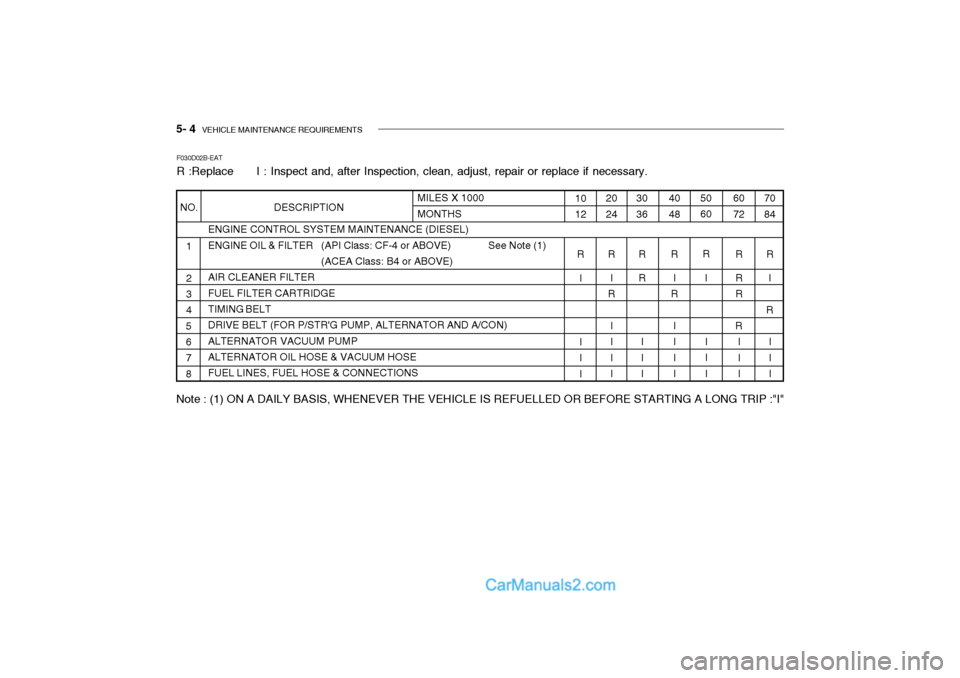
F030D02B-EAT
R :Replace I : Inspect and, after Inspection, clean, adjust, repair or replace if necessary.
ENGINE CONTROL SYSTEM MAINTENANCE (DIESEL)
ENGINE OIL & FILTER (API Class: CF-4 or ABOVE) See Note (1)
(ACEA Class: B4 or ABOVE)
AIR CLEANER FILTERFUEL FILTER CARTRIDGE TIMING BELT DRIVE BELT (FOR P/STR'G PUMP, ALTERNATOR AND A/CON)ALTERNATOR VACUUM PUMP ALTERNATOR OIL HOSE & VACUUM HOSE FUEL LINES, FUEL HOSE & CONNECTIONS
1 2 3 4
5 6 7 8 6072
R R R
R I II
50 60
R I
II I40 48 R I
R
I I II30 36
R R
I II20 24R I
R
I I II
10 12
R I I I IMILES X 1000 MONTHS70 84
R I
R III
Note : (1) ON A DAILY BASIS, WHENEVER THE VEHICLE IS REFUELLED OR BEFORE STARTING A LONG TRIP :"I"
NO. DESCRIPTION
Page 371 of 428

VEHICLE MAINTENANCE REQUIREMENTS 5- 7
6ZF060A1-A
EXPLANATION OF SCHEDULED MAINTENANCE ITEMS
6ZF060M1-A
o Engine oil and filter
The engine oil and filter should be changed at the intervals specified inthe maintenance schedule. If the car is being driven in severe conditions, more frequent oil and filter changesare required. 6ZF060B1-A
o Drive belts
Inspect all drive belts for evidence of cuts, cracks, excessive wear or oilsaturation and replace if necessary. Drive belts should be checked peri- odically for proper tension and ad-justed as necessary. 6ZF060C1-A
o Fuel filter
A clogged filter can limit the speed at
which the vehicle may be driven, dam- age the emission system and cause hard starting. If an excessive amountof foreign matter accumulates in the fuel tank, the filter may require re- placement more frequently.
After installing a new filter, run the
engine for several minutes, and checkfor leaks at the connections.
F060D01TB-EAT
o Fuel lines, fuel hoses and con- nections
Check the fuel lines, fuel hoses and
connections for leakage and damage. Replace any damaged or leaking parts immediately.
6ZF060E1-A o Timing belt Replace timimg belt and inspect all associated parts related for damageand deformation. Replace any dam- aged parts immediately.
!WARNING (Diesel only):
Never work on injection system with engine running or within 30 seconds after shutting off engine. High pressure pump, rail, injectorsand high pressure pipes are sub- jected to high pressure even after the engine has been switched off.The fuel jet produced by fuel leaks may cause serious injury, if it con- tacts with the body. People usingpacemakers should not move closer than 30cm to the ECU or wiring harness within the engine room with the engine running, since the high currents in the CommonRail system produce considerable magnetic fields.
Page 375 of 428

6. Do-It-Yourself Maintenance
Engine compartment ........................................................................ 6-2
Daily operating checks ..................................................................... 6-6
Engine oil .......................................................................................... 6-6
Engine and filter Replacement ......................................................... 6-9
Engine coolant Checking and Replacing .......................................6-10
Spark plug Replacement ................................................................ 6-13
Changing the air cleaner filter ......................................................... 6-14
Manual Transaxle Lubricant........................................................... 6-15
Automatic Transaxle fluid ............................................................... 6-16
Brake System Checking ................................................................ 6-18
Air conditioning System .................................................................. 6-19
Drive belts ...................................................................................... 6-23
Individual Circuit Fuses .................................................................. 6-24
Power steering fluid level ............................................................... 6-26
Replacing Light Bulbs .................................................................... 6-28
Fuse panel description ................................................................... 6-34
6
Page 380 of 428

6- 6 DO-IT-YOURSELF MAINTENANCE
SG020B1-E DAILY OPERATING CHECKS The following items should be checked on a daily basis or whenever the vehicleis refuelled, whichever occurs sooner.
o Engine oil level.
o Engine coolant level.
o Power steering fluid level.
o Brake fluid level.
o Windscreen washer fluid level.
o Battery condition.
o Tyre condition and pressures.
o Operation and cleanliness of all light-
ing equipment.
o Windscreen wiper and washer opera- tion.
o Horn operation.
o Warning light operation.
o Adjustment and cleanliness of mir- rors.
o Seat and seat belt adjustment and operation.
o Fluid leakage. The vehicle must not be driven if the daily operating checks indicate that any item of equipment related to thesafety or roadworthiness of the vehicle is not functioning correctly. G030B02A-EAT Recommended Oil
1. Petrol engine A multi grade oil having a specification which meets A.P.I. specification of SGor above is recommended. The oil vis- cosity should be selected according to the operating environment of the engineby means of the table shown in the illustration. The engine oil recommen- dations are complete in themselvesand the use of additives is neither required nor recommended. The use of engine oil additives may result in invali-dation of the vehicle warranty.
G030A01FC-EAT ENGINE OIL The correct engine oil level is of para- mount importance. An excessively highor low oil level may result in irreparable damage being sustained by the engine. The engine oil level must be checkedon a daily basis, whenever the vehicle is refuelled or before starting a long trip, whichever occurs sooner.In addition, it is imperative that only an approved grade and specification of oil is used to avoid the possibility of seri-ous engine damage and premature wear. The use of "budget price" oil is a false economy that must be avoided if themaximum reliability and useful life is to be obtained from the vehicle.
G030B01L
Page 394 of 428
6- 20 DO-IT-YOURSELF MAINTENANCE
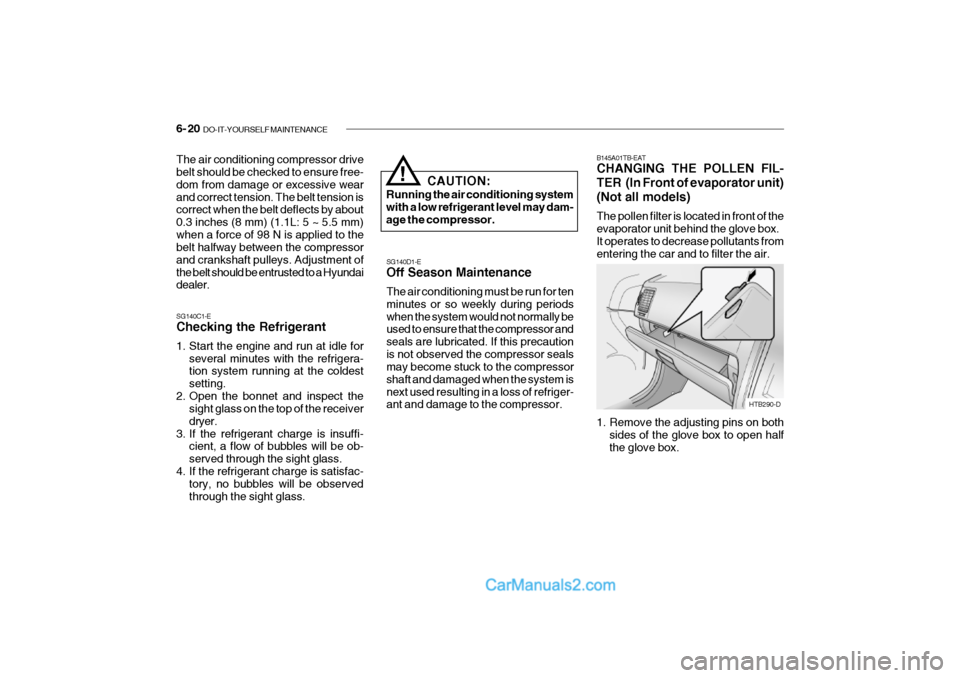
B145A01TB-EAT CHANGING THE POLLEN FIL-
TER (In Front of evaporator unit)(Not all models) The pollen filter is located in front of the evaporator unit behind the glove box. It operates to decrease pollutants fromentering the car and to filter the air.
1. Remove the adjusting pins on both
sides of the glove box to open half the glove box.
HTB290-D
SG140D1-E Off Season Maintenance The air conditioning must be run for ten minutes or so weekly during periodswhen the system would not normally be used to ensure that the compressor and seals are lubricated. If this precautionis not observed the compressor seals may become stuck to the compressor shaft and damaged when the system isnext used resulting in a loss of refriger- ant and damage to the compressor.
SG140C1-E Checking the Refrigerant
1. Start the engine and run at idle for
several minutes with the refrigera- tion system running at the coldest setting.
2. Open the bonnet and inspect the sight glass on the top of the receiverdryer.
3. If the refrigerant charge is insuffi- cient, a flow of bubbles will be ob-served through the sight glass.
4. If the refrigerant charge is satisfac- tory, no bubbles will be observedthrough the sight glass. CAUTION:
Running the air conditioning systemwith a low refrigerant level may dam-age the compressor.
!
The air conditioning compressor drive belt should be checked to ensure free- dom from damage or excessive wearand correct tension. The belt tension is correct when the belt deflects by about 0.3 inches (8 mm) (1.1L: 5 ~ 5.5 mm)when a force of 98 N is applied to the belt halfway between the compressor and crankshaft pulleys. Adjustment ofthe belt should be entrusted to a Hyundai dealer.
Page 397 of 428
DO-IT-YOURSELF MAINTENANCE 6- 23
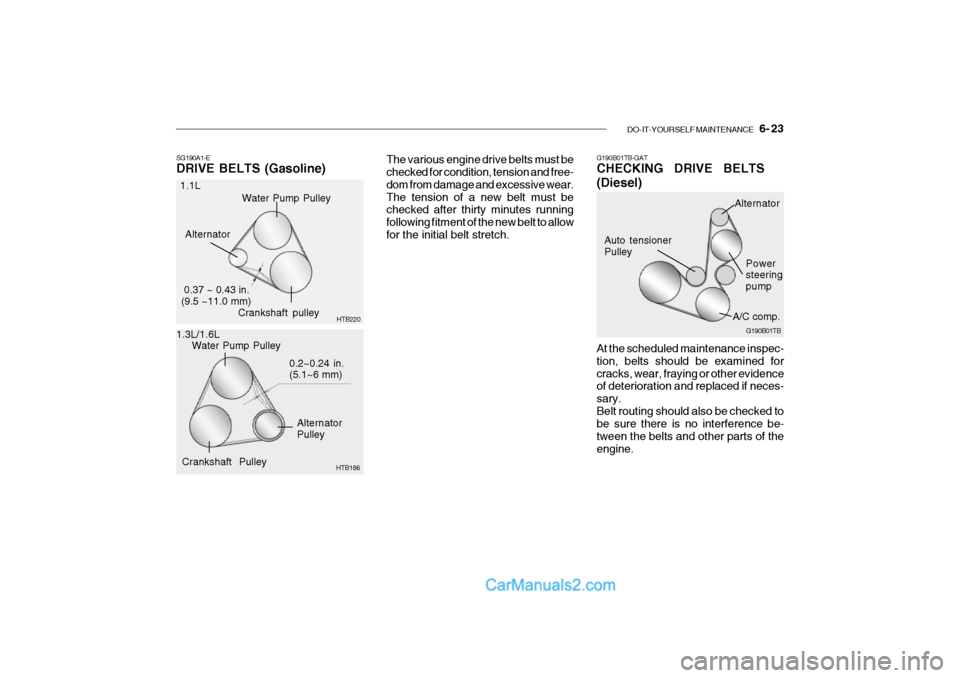
The various engine drive belts must be checked for condition, tension and free- dom from damage and excessive wear.The tension of a new belt must be checked after thirty minutes running following fitment of the new belt to allowfor the initial belt stretch. G190B01TB-GAT CHECKING DRIVE BELTS (Diesel)
A/C comp.
Auto tensioner Pulley
G190B01TB
AlternatorPower steering pump
At the scheduled maintenance inspec- tion, belts should be examined forcracks, wear, fraying or other evidence of deterioration and replaced if neces- sary.Belt routing should also be checked to be sure there is no interference be- tween the belts and other parts of theengine.
Crankshaft Pulley
SG190A1-E DRIVE BELTS (Gasoline)
1.1L
1.3L/1.6L Alternator
0.37 ~ 0.43 in. (9.5 ~11.0 mm)
Water Pump Pulley
Alternator Pulley
0.2~0.24 in.(5.1~6 mm)
HTB186
Crankshaft pulley
HTB220
Water Pump Pulley