fluid Hyundai Getz 2002 Service Manual
[x] Cancel search | Manufacturer: HYUNDAI, Model Year: 2002, Model line: Getz, Model: Hyundai Getz 2002Pages: 428, PDF Size: 6.13 MB
Page 282 of 428

1- 38 FEATURES OF YOUR HYUNDAI
SB210J1-E
HIGH BEAM INDICATOR LIGHT
The high beam indicator light will illumi- nate whenever the headlights areswitched to high beam of flash position.
B260H03A-EATPARKING BRAKE/ BRAKE FLUID LEVELWARNING LIGHT
SB210K1-EOIL PRESSURE WARNING LIGHT
!CAUTION:
If the oil pressure light illuminates when the engine is running, an in-sufficient oil pressure level for con-tinued safe operation of the engine exists. Continued operation of the engine in this condition may resultin serious engine damage. Under normal circumstances, the light will illuminate when the igni- tion is turned "on" and will be extin- guished when the engine is started.If the oil pressure warning light illu-minates whilst the engine is run-ning, stop the engine immediatelyand check the engine oil level. If the level is insufficient, add the required amount of oil as indicated by theengine oil dipstick. If the light fails to extinguish when the engine is re-started, do not continue to operatethe vehicle.If the oil pressure light illuminatesduring normal operation and the cause is not an insufficient oil level, or the light fails to illuminate whenthe ignition is turned "on", contactthe nearest Hyundai dealer beforefurther operating the vehicle.
Warning light operation The parking brake/brake fluid level warn- ing light will be illuminated wheneverthe ignition switch is turned to the "ON"position irrespective of whether or notthe parking brake is applied and must be extinguished when the engine starts and the parking brake released.If the warning light fails to extinguish orilluminates at any other time, the ve-hicle must be brought to rest in a safelocation and the level of brake fluid in the reservoir checked. If the fluid level is incorrect, fluid conforming to DOT 3or DOT 4 specifications should be added.If, after correcting the brake fluid level,the warning light continues to be illumi-nated, the advice of the nearest Hyundai dealer must be sought before the ve- hicle is driven again.
Your Hyundai is equipped with a diago-nally split dual braking system whichwill ensure that in the event of one of thebrake circuits becoming defective, ap- proximately fifty per cent of the normal braking performance will be available.If failure of one of the circuits occurs,the required amount of pedal effort,pedal travel and stopping distance willbe increased. Use of the gearbox is
WARNING:
In the event of problems being sus-pected with the braking system, theadvice of the nearest Hyundai dealermust be sought before the vehicle isdriven. Driving the vehicle with ei-ther an electrical or hydraulic brak- ing system defect may be danger- ous, resulting in accident or per-sonal injury.
!
Page 292 of 428
1- 48 FEATURES OF YOUR HYUNDAI
HTB019-D
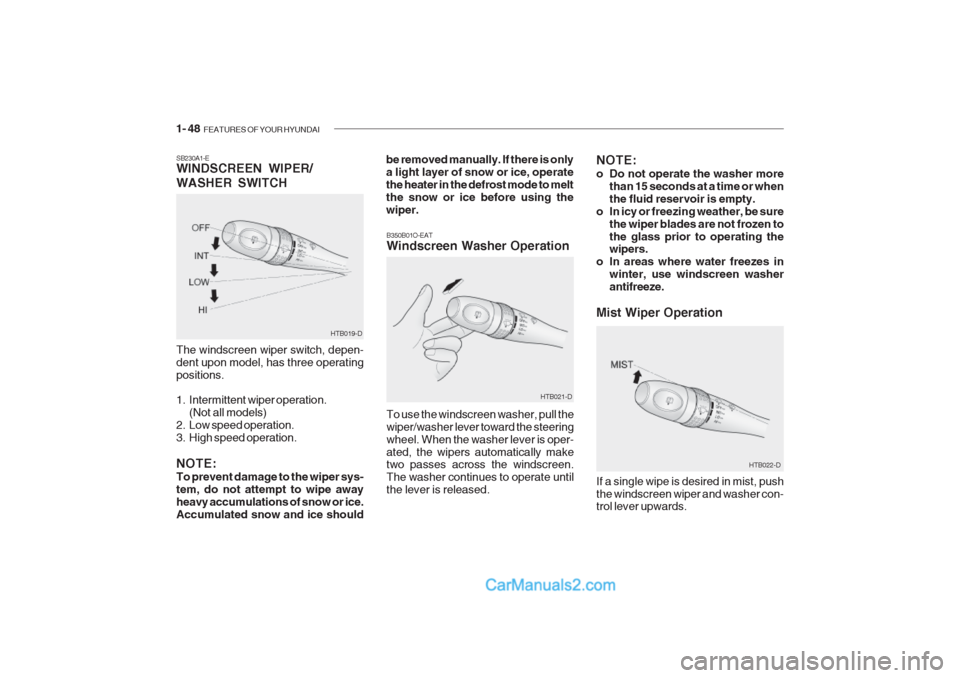
SB230A1-E WINDSCREEN WIPER/ WASHER SWITCH The windscreen wiper switch, depen- dent upon model, has three operatingpositions.
1. Intermittent wiper operation.
(Not all models)
2. Low speed operation.
3. High speed operation. NOTE: To prevent damage to the wiper sys- tem, do not attempt to wipe awayheavy accumulations of snow or ice.Accumulated snow and ice should be removed manually. If there is onlya light layer of snow or ice, operatethe heater in the defrost mode to meltthe snow or ice before using thewiper.
NOTE:
o Do not operate the washer more
than 15 seconds at a time or when the fluid reservoir is empty.
o In icy or freezing weather, be sure the wiper blades are not frozen tothe glass prior to operating the wipers.
o In areas where water freezes in winter, use windscreen washer antifreeze.
Mist Wiper Operation
HTB022-D
To use the windscreen washer, pull the wiper/washer lever toward the steeringwheel. When the washer lever is oper-ated, the wipers automatically make two passes across the windscreen. The washer continues to operate untilthe lever is released.
B350B01O-EAT Windscreen Washer Operation
HTB021-DIf a single wipe is desired in mist, push the windscreen wiper and washer con- trol lever upwards.
Page 293 of 428
FEATURES OF YOUR HYUNDAI 1- 49
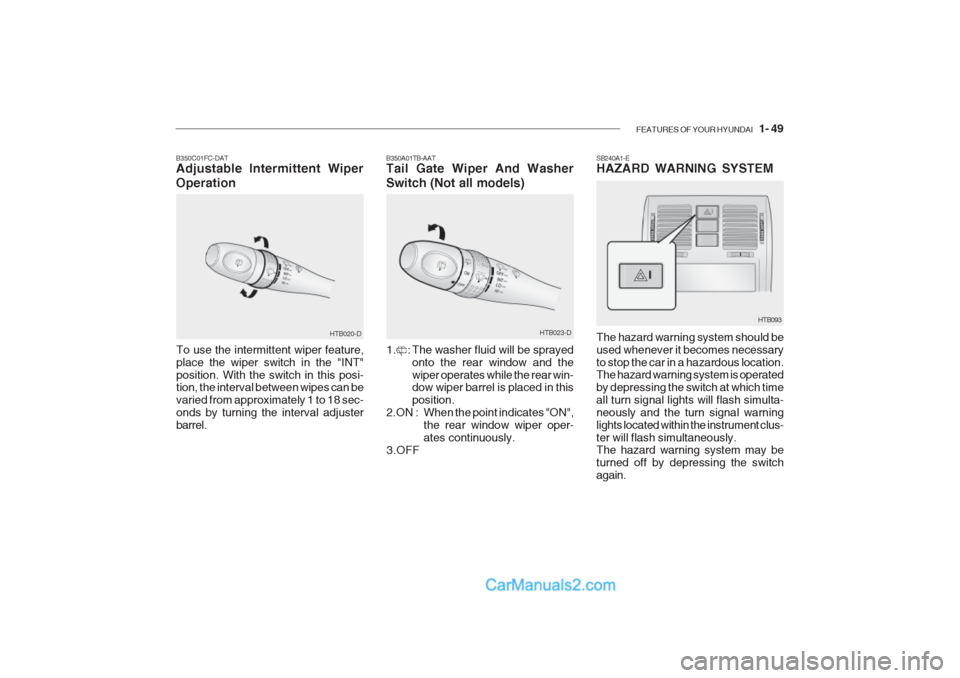
SB240A1-E HAZARD WARNING SYSTEM The hazard warning system should be used whenever it becomes necessaryto stop the car in a hazardous location. The hazard warning system is operated by depressing the switch at which timeall turn signal lights will flash simulta-neously and the turn signal warninglights located within the instrument clus-ter will flash simultaneously. The hazard warning system may be turned off by depressing the switchagain. HTB093B350A01TB-AAT Tail Gate Wiper And Washer Switch (Not all models)
HTB023-D
1. : The washer fluid will be sprayed onto the rear window and the wiper operates while the rear win- dow wiper barrel is placed in this position.
2.ON : When the point indicates "ON",
the rear window wiper oper-ates continuously.
3.OFFB350C01FC-DAT Adjustable Intermittent Wiper Operation
To use the intermittent wiper feature, place the wiper switch in the "INT"position. With the switch in this posi- tion, the interval between wipes can be varied from approximately 1 to 18 sec-onds by turning the interval adjusterbarrel. HTB020-D
Page 306 of 428
1- 62 FEATURES OF YOUR HYUNDAI
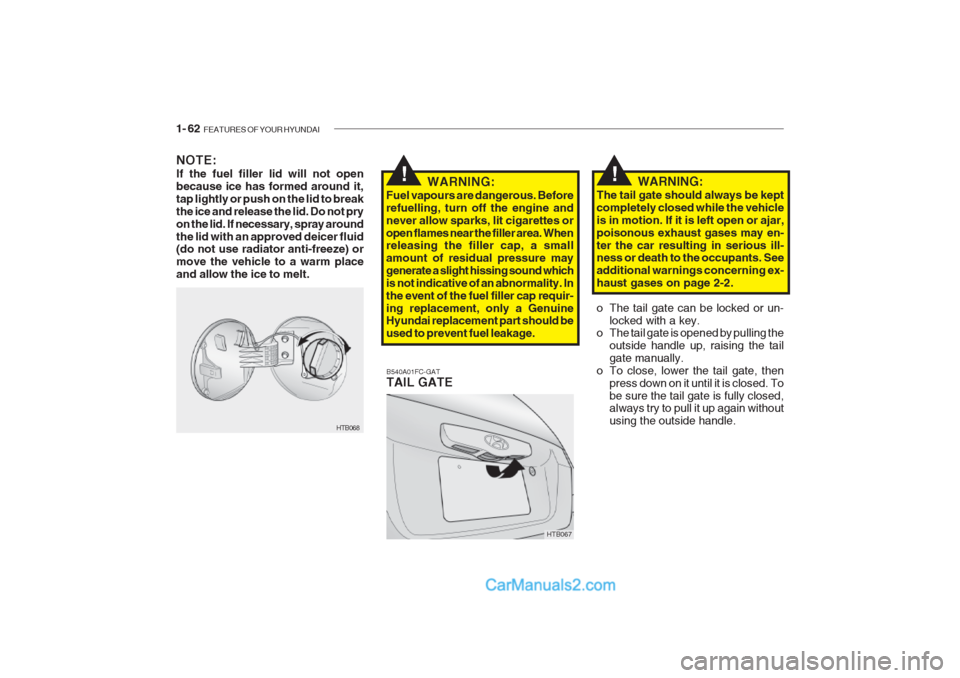
NOTE: If the fuel filler lid will not open because ice has formed around it,tap lightly or push on the lid to breakthe ice and release the lid. Do not pryon the lid. If necessary, spray aroundthe lid with an approved deicer fluid (do not use radiator anti-freeze) or move the vehicle to a warm placeand allow the ice to melt.
B540A01FC-GAT TAIL GATE
HTB067WARNING:
The tail gate should always be kept completely closed while the vehicleis in motion. If it is left open or ajar,poisonous exhaust gases may en-ter the car resulting in serious ill- ness or death to the occupants. See additional warnings concerning ex-haust gases on page 2-2.
o The tail gate can be locked or un- locked with a key.
o The tail gate is opened by pulling the
outside handle up, raising the tail gate manually.
o To close, lower the tail gate, then press down on it until it is closed. Tobe sure the tail gate is fully closed, always try to pull it up again without using the outside handle.
HTB068
!!WARNING:
Fuel vapours are dangerous. Before refuelling, turn off the engine andnever allow sparks, lit cigarettes oropen flames near the filler area. When releasing the filler cap, a small amount of residual pressure maygenerate a slight hissing sound which
is not indicative of an abnormality. Inthe event of the fuel filler cap requir-ing replacement, only a Genuine Hyundai replacement part should be used to prevent fuel leakage.
Page 337 of 428

DRIVING YOUR HYUNDAI 2- 11
C090H01A-EAT NOTE:
o The brake pedal should be de-
pressed when shifting from NEU- TRAL to a forward or reversegear.
o The brake pedal fully depressed
in order to move the shift leverfrom the "P" (Park) position to any of the other positions.
o It is always possible to shift from "R", "N", "D", "2", "L" position.
!
C090I02A-EAT
CAUTION:
o Shift into "R" and "P" only when the vehicle has completely stopped.
o Do not accelerate the engine in reverse or any of the forwardpositions with the brakes applied.
o Always apply the footbrake when shifting from "P" or "N", to "R","D", "2" or "L" position.
o Do not use the "P" (Park) posi- tion in place of the parking brake.Always set the parking brake,shift the transaxle into "P" (Park) and turn off the ignition when you leave the vehicle, even mo-mentarily. Never leave the vehicle unattended whilst the engine is running.
o Check the automatic transaxle fluid level regularly, and add fluidas necessary.See the maintenance schedule for the proper fluid recommen- dation. FC120D1-E General Operating Instructions
o The button in the selector handle
must be depressed before the se- lector can be moved.
o The engine may only be started
when the selector is at position "P"or "N".
o Ensure that the footbrake is firmly
applied when shifting from "P" or"N" to "D", "2", "L" or "R" and vice versa.
o Always engage the parking brake when the vehicle is unattended,never use the "P" position in place of the parking brake.
o Under normal circumstances, the selector should be placed in the "D"position and the transaxle allowedto select the most ideal ratio for the circumstances. In this position maxi- mum fuel economy will be achieved.
o When descending steep gradients where engine braking is required,the selector should be placed at the"2" or "L" position depending upon the vehicle speed.
Page 342 of 428

2- 16 DRIVING YOUR HYUNDAI
ZC170C1-E Anti-freeze/Corrosion inhibitor The cooling system must always con- tain an Ethylene-Glycol based anti-freeze solution. The system is filled during manufacture with solution of the correct strength which should bechecked before the onset of winter and adjusted or changed as required. NOTE: The anti-freeze solution contains a corrosion inhibitor to prevent deg- radation of the aluminum castings contained within the engine. There-fore, never, drain the system and refill with water only. In addition, anti-freeze solution must ALWAYS be used in vehicles fitted with air conditioning, to prevent theheater matrix from freezing and sub- sequently bursting with the refrigera- tion system in use. SC170E1-E Windscreen Washers and Wip- ers The windscreen washer bottle should be filled with a solution of water and a proprietary winter screen wash addi-tive. The windscreen wipers should not be used if the blades are frozen to the windscreen or if they are coveredwith snow, before this is removed. NOTE: Never allow undiluted screen washer fluid additive to spill upon the paintwork or use engine cool- ant anti-freeze since damage to thepaintwork may result.
o When driving in extreme conditions,
the windscreen wiper blades may fail to clear the screen properly due to the formation of ice upon theblade edge. It will therefore be nec- essary to periodically remove such ice to restore their efficiency.
o If the power operated door mirrors become frozen, attempts to adjustthese may damage the mechanism.
ZC170D1-E Door Locks Should the door lock mechanism be- come frozen, a proprietary lock de-icer should be used. Alternatively, warm- ing the door key may thaw the doorlock. However, the key should be handled carefully to avoid burning the fingers.Never attempt to thaw a frozen door lock using hot water, since the water will eventually freeze and compoundthe problem. NOTE: The proper temperature for using the immobilizer key is from -40°F to 176°F (-40°C to 80°C). If you heat the immobilizer key over 176°F (80°C)to open the frozen lock, it may cause damage to the transponder in its head.
Page 346 of 428

2- 20 DRIVING YOUR HYUNDAI
When being passed by a large ve- hicle, keep a constant speed and steer straight ahead. If there is toomuch wind buffeting slow down to get out of the other vehicle's air turbulence.
8. When parking your car and trailer, especially on a hill, be sure to followall the normal precautions. Turn yourfront wheel into the curb, set the parking brake firmly, and put the transaxle in 1st or Reverse (manual)or Park (automatic). In addition, place wheel chocks at each of the trailer's tyres.
9. If the trailer has electric brakes, start your vehicle and trailer mov-ing, and then apply the trailer brakecontroller by hand to be sure the brakes are working. This lets you check your electrical connection atthe same time.
10. During your trip, check occasion-
ally to be sure that the load issecure, and that the lights and any trailer brakes are still working.
11. Avoid jerky starts, sudden accel- eration or sudden stops.
12. Avoid sharp turns and rapid lane
changes. 13. Avoid holding the brake pedal
down too long or too frequently. This could cause the brakes tooverheat, resulting in reduced brak- ing efficiency.
14. When going down a hill, shift into a lower gear and use the enginebraking effect.When ascending a long grade,
downshift the transaxle to a lowergear and reduce speed to reduce chances of engine overloading and/or overheating.
15. If you have to stop while going
uphill, do not hold the vehicle inplace by pressing on the accelera- tor. This can cause the automatic transaxle to overheat. Use the park-ing brake or footbrake.
NOTE: When towing check transaxle fluid more frequently. CAUTION:
If overheating should occur when towing, (temperature gauge reads near red zone), taking the followingaction may reduce or eliminate the problem.
1. Turn off the air conditioner.
2. Reduce highway speed.
3. Select a lower gear when going uphill.
4. While in stop and go traffic, place
the gear selection in park or neutraland idle the engine at a higher speed.
!
Page 351 of 428

WHAT TO DO IN AN EMERGENCY 3- 5
D040A01TB-EAT TEMPORARY SPARE TYRE (Not all models) The following instructions for the tem- porary spare tyre should be observed:
1. Check inflation pressure as soon as
practical after installing the spare tyre, and adjust to the specifiedpressure. The tyre pressure should be periodically checked and main- tained at the specified pressurewhile the tyre is stored.
!
6. If the cause of the overheating can-
not be found, wait until the engine temperature has returned to nor- mal. Then, if coolant has been lost, carefully remove the radiator capand add water to bring the fluid level in the reservoir up to the base of the radiator fill opening. Fill the coolantexpansion tank to the halfway mark.
7. Proceed with caution until it is es-
tablished that the engine is operat-ing normally. If the engine over- heats repeatedly, the advice of a Hyundai dealer should be sought. WARNING:
Do not remove the radiator cap whenthe engine is hot since steam and boiling water may be ejected from the radiator resulting in burns orscalding.
!
Inflation Pressure
Tyre Size
T105/70D14 420 kPa (60 psi)
2. The spare tyre should only be used temporarily and should be returned to the luggage compartment as soonas the original tyre can be repaired or replaced.
3. Continuous use at speeds of over 50 mph(80 km/h) is not recom-mended.
4. As the temporary spare tyre is spe- cifically designed for your car, itshould not be used on any other vehicle.
Spare Tyre Pressure
CAUTION:
Serious loss of coolant indicates there is a leak in the cooling system and this should be checked as soonas possible by a Hyundai dealer. YD050A1-E SPARE TYRE For Full Size (Not all models) The following instructions for the FULL SIZE spare tyre should be observed: Check inflation pressure as soon aspossible after installing the spare tyre, and adjust to the specified pressure. The tyre pressure should be periodi-cally checked and maintained at the specified pressure while the tyre is stored. Spare Tyre Pressure
Tyre Size Inflation Pressure
FULL SIZE 30 psi (210 kPa)
Page 358 of 428
3- 12 WHAT TO DO IN AN EMERGENCY
!
CAUTION:
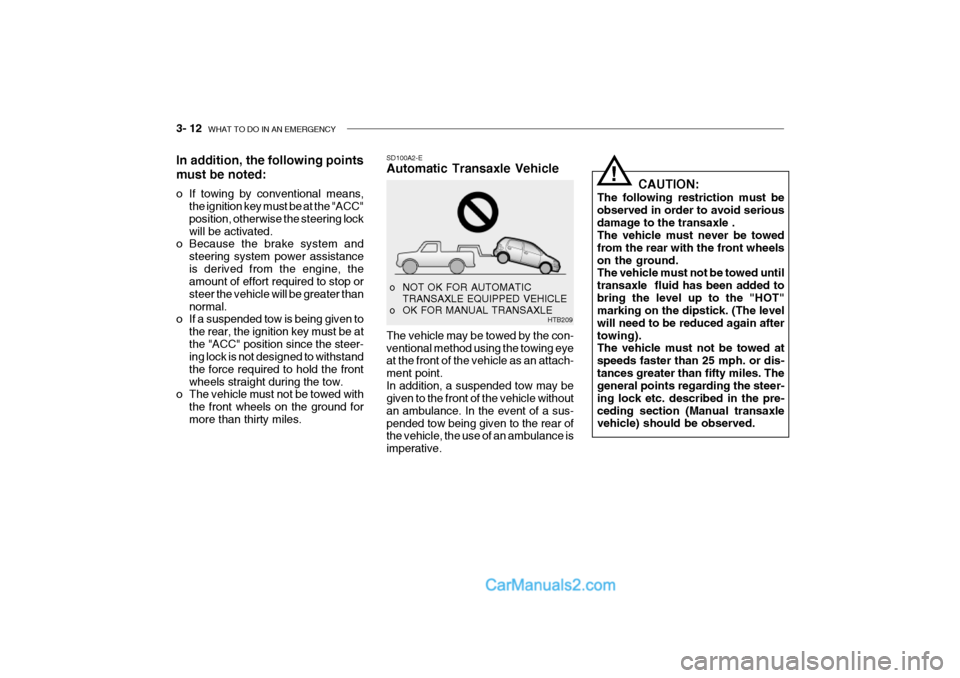
The following restriction must be observed in order to avoid seriousdamage to the transaxle . The vehicle must never be towed from the rear with the front wheelson the ground. The vehicle must not be towed until transaxle fluid has been added tobring the level up to the "HOT" marking on the dipstick. (The level will need to be reduced again aftertowing). The vehicle must not be towed at speeds faster than 25 mph. or dis-tances greater than fifty miles. The general points regarding the steer- ing lock etc. described in the pre-ceding section (Manual transaxle vehicle) should be observed.
SD100A2-E Automatic Transaxle Vehicle The vehicle may be towed by the con- ventional method using the towing eye at the front of the vehicle as an attach- ment point.In addition, a suspended tow may be given to the front of the vehicle without an ambulance. In the event of a sus-pended tow being given to the rear of the vehicle, the use of an ambulance is imperative.
o NOT OK FOR AUTOMATIC
TRANSAXLE EQUIPPED VEHICLE
o OK FOR MANUAL TRANSAXLE HTB209
In addition, the following points must be noted:
o If towing by conventional means,
the ignition key must be at the "ACC" position, otherwise the steering lockwill be activated.
o Because the brake system and
steering system power assistanceis derived from the engine, the amount of effort required to stop or steer the vehicle will be greater thannormal.
o If a suspended tow is being given to
the rear, the ignition key must be atthe "ACC" position since the steer- ing lock is not designed to withstand the force required to hold the frontwheels straight during the tow.
o The vehicle must not be towed with
the front wheels on the ground formore than thirty miles.
Page 363 of 428
4- 4 CORROSION PREVENTION AND APPEARANCE CARE
SE040E1-E BUMPER MAINTENANCE The special material from which the bumpers are manufactured warrantsspecial attention to preserve the ap- pearance of the bumpers. Avoid con- tact with battery electrolyte or brakefluid and ensure that accidental spill- ages are immediately flushed with water.Do not use abrasive cleaning materi- als which may damage the bumpers. Avoid subjecting the bumpers to hightemperatures such as may be encoun- tered in high bake paint ovens.
SE040F1-E ACCIDENT REPAIRS In the event of the body work sustain- ing damage, the following points should be noted prior to repairs being under- taken.If body panels are replaced or re- paired, anti corrosion treatment must be applied to the repair area. Theproduct used must be compatible with those used in manufacture. It is rec- ommended that repairs are entrustedto a Hyundai dealer to ensure that replacement parts used are of the same high quality as those used in manufac- ture of the vehicle and that the correctrepair methods and materials will en- sure adequate levels of corrosion pro- tection and the continued validity of theAnti Perforation Warranty. SE050A1-E INTERIOR During the winter period, it is possible that the passenger compartment floor- ing may become wet from damp foot- wear or quantities of snow adhering tofootwear. The carpet should not be allowed to remain in this condition since the carpet may begin to create mustysmells and will promote corrosion of the floor pan in addition to the carpet and under felt beginning to rot.
SE050C1-E INTERIOR VALETING The soft trim and carpets should be maintained with the regular use of avacuum cleaner. Heavy soiling should be removed with a dry cleaning agent recommended for this purpose follow-ing the instructions of the product manufacturer. Paint thinner, solvents or other such cleaning materials shouldnot be used since damage to the up- holstery may result. SE050D1-E SEAT BELTS Seat belts should be cleaned only with a mild soap solution. Strong deter- gents, solvens or bleaches may dam- age the belt webbing and thereforereduce the effectiveness of the belt. Belts which display signs of fraying, wear of cut should be replaced.