lock Hyundai Getz 2003 Owner's Manual
[x] Cancel search | Manufacturer: HYUNDAI, Model Year: 2003, Model line: Getz, Model: Hyundai Getz 2003Pages: 444, PDF Size: 13.82 MB
Page 356 of 444
2- 14 DRIVING YOUR HYUNDAI
!WARNING:
ABS will not prevent accidents due to improper or dangerous driving maneuvers. Even though vehicle control is improved during emer-gency braking, always maintain a safe distance between you and ob- jects ahead. Vehicle speeds shouldalways be reduced during extreme road conditions. The braking distance for carsequipped with an anti-lock braking system may be longer than for those without it in the following road con- ditions.
o Driving on rough, gravel or snow- covered roads.
o Driving with tyre chains installed.
o Driving on roads where the road surface is pitted or has differentsurface height. These roads should be driven atreduced speeds. The safety featuresof an ABS equipped vehicle should not be tested by high speed driving or cornering. This could endangerthe safety of yourself or others. SC150A1-F DRIVING FOR ECONOMY You can save fuel and get more miles from your car if you follow these sug- gestions:
o Drive smoothly. Accelerate at a
moderate rate. Don't make "jack- rabbit" starts or full-throttle shifts and maintain a steady cruisingspeed. Don't race between stop- lights. Try to adjust your speed to that of the other traffic so you don'thave to change speeds unneces- sarily. Avoid heavy traffic whenever pos-sible. Al-ways maintain a safe dis- tance from other vehicles so you can avoid unnecessary braking. Thisalso reduces brake wear. o Drive at a moderate speed. The
faster you drive, the more fuel yourcar uses. Driving at a moderatespeed, especially on the highway, is one of the most effective ways to reduce fuel consumption.
o Don't "ride" the brake or clutch pedal. This can increase fuel consumptionand also increase wear on thesecomponents. In addition, driving with your foot resting on the brake pedal may cause the brakes to overheat,which reduces their effectiveness and may lead to more serious con- sequences.
o Take care of your tyres. Keep them inflated to the recommended pres-sure. Incorrect infla-tion, either toomuch or too little, results in unnec- essary tyre wear. Check the tyre pres-sures at least once a month.
o Be sure that the wheels are aligned correctly. Improper alignment canresult from hitting curbs or drivingtoo fast over irregular surfaces. Poor alignment causes faster tyre wear and may also result in other prob-lems as well as greater fuel con- sumption.
Page 358 of 444

2- 16 DRIVING YOUR HYUNDAI
ZC170C1-E Anti-freeze/Corrosion inhibitor The cooling system must always con- tain an Ethylene-Glycol based anti-freeze solution. The system is filled during manufacture with solution of the correct strength which should bechecked before the onset of winter and adjusted or changed as required. NOTE: The anti-freeze solution contains a corrosion inhibitor to prevent deg- radation of the aluminum castings contained within the engine. There-fore, never, drain the system and refill with water only. In addition, anti-freeze solution must ALWAYS be used in vehicles fitted with air conditioning, to prevent theheater matrix from freezing and sub- sequently bursting with the refrigera- tion system in use. SC170E1-E Windscreen Washers and Wip- ers The windscreen washer bottle should be filled with a solution of water and a proprietary winter screen wash addi-tive. The windscreen wipers should not be used if the blades are frozen to the windscreen or if they are coveredwith snow, before this is removed. NOTE: Never allow undiluted screen washer fluid additive to spill upon the paintwork or use engine cool- ant anti-freeze since damage to thepaintwork may result.
o When driving in extreme conditions,
the windscreen wiper blades may fail to clear the screen properly due to the formation of ice upon theblade edge. It will therefore be nec- essary to periodically remove such ice to restore their efficiency.
o If the power operated door mirrors become frozen, attempts to adjustthese may damage the mechanism.
ZC170D1-E Door Locks Should the door lock mechanism be- come frozen, a proprietary lock de-icer should be used. Alternatively, warm- ing the door key may thaw the doorlock. However, the key should be handled carefully to avoid burning the fingers.Never attempt to thaw a frozen door lock using hot water, since the water will eventually freeze and compoundthe problem. NOTE: The proper temperature for using the immobilizer key is from -40°F to 176°F (-40°C to 80°C). If you heat the immobilizer key over 176°F (80°C)to open the frozen lock, it may cause damage to the transponder in its head.
Page 368 of 444
3- 6 WHAT TO DO IN AN EMERGENCY
SD060A1-E IN THE EVENT OF A PUNCTURE If a puncture occurs whilst driving the vehicle:
1. Bring the car to rest as soon as it is
safe to do so and with the minimum amount of braking required which will assist in maintaining the maxi- mum amount of control. The vehicleshould be parked wherever pos- sible upon firm level ground to facili- tate wheel changing.
2. If the vehicle is creating a hazard and the road conditions do not per-mit the wheel to be changed safely,assistance should be sought.
3. Passengers must not be allowed to
remain inside the vehicle duringwheel changing. If a puncture oc- curs whilst the vehicle is on a motorway, the passengers shouldtake refuge on the motorway em- bankment to avoid the possibility of injury occurring should the vehiclebe struck by other motorway traffic.
4. Wheel changing should be per-
formed according to the followinginstructions.
SD050A2-E SPARE WHEEL (Not all models) The spare wheel is stored under the luggage compartment floor and is ac-cessed from within the luggage com- partment by lifting the carpet and the floor panel.To remove the spare wheel, unscrew the retainer, rotating this in an anti clockwise direction and lift out thewheel. To replace the wheel, screw the retainer by hand until tight having located the wheel in the luggage com-partment floor well. The inflation pres- sure of the spare wheel should be checked at least monthly and when-ever the wheel is fitted to the vehicle.
Inflation Pressure
Tyre Size
Spare Tyre Pressure
Full Size 210 kPa (30 psi)
CAUTION:
o Do not use snow chains with your temporary spare tyre.
o Do not use more than one tempo- rary spare tyre at a time.
!
5. The temporary spare tyre should
not be used on any other wheels, nor should standard tyre, snow tyre,wheel covers or trim rings be used with the temporary spare wheel. If such use is attempted, damage tothese items or other car compo- nents may occur.
6. The temporary spare tyre pressure should be checked once a monthwhile the tyre is stored.
Page 370 of 444
3- 8 WHAT TO DO IN AN EMERGENCY
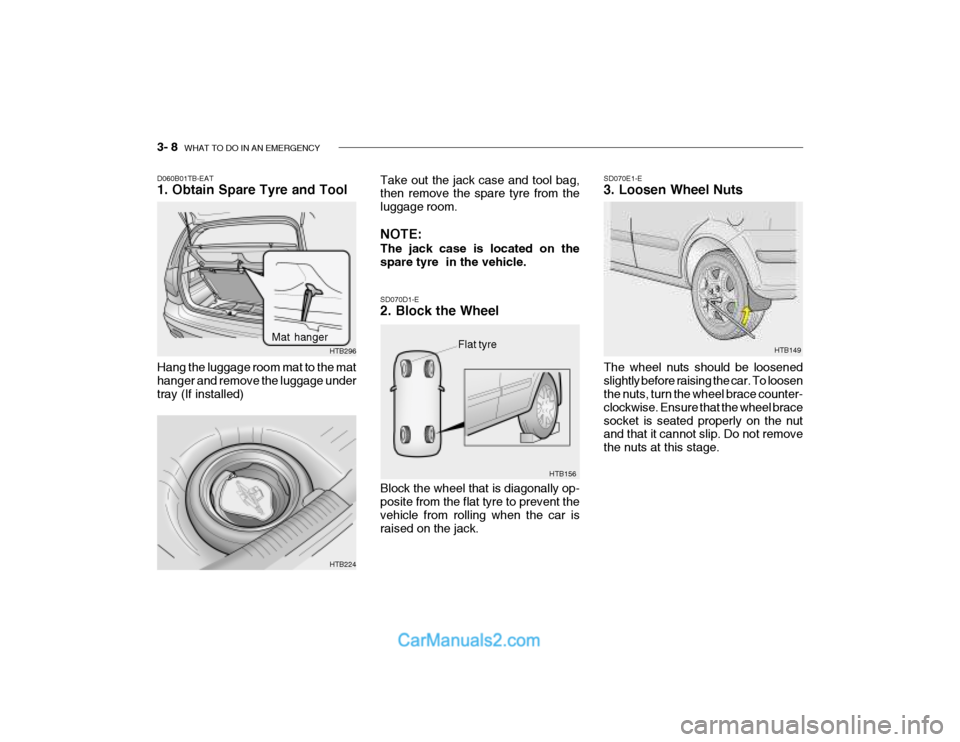
HTB149
SD070E1-E 3. Loosen Wheel Nuts The wheel nuts should be loosened slightly before raising the car. To loosen the nuts, turn the wheel brace counter- clockwise. Ensure that the wheel bracesocket is seated properly on the nut and that it cannot slip. Do not remove the nuts at this stage.Flat tyre
HTB156
SD070D1-E 2. Block the Wheel Block the wheel that is diagonally op- posite from the flat tyre to prevent the vehicle from rolling when the car israised on the jack.
Take out the jack case and tool bag, then remove the spare tyre from the luggage room. NOTE: The jack case is located on the spare tyre in the vehicle.
Hang the luggage room mat to the mat hanger and remove the luggage under tray (If installed)
D060B01TB-EAT 1. Obtain Spare Tyre and Tool
HTB224
HTB296
Mat hanger
Page 371 of 444
WHAT TO DO IN AN EMERGENCY 3- 9
!
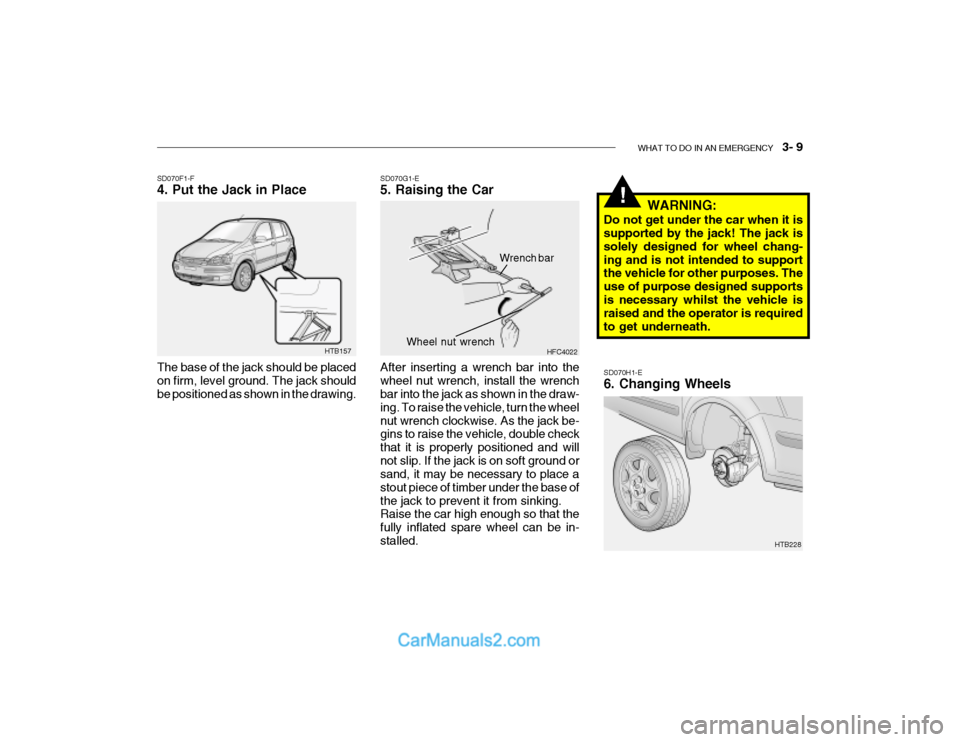
SD070H1-E 6. Changing Wheels
HTB157
SD070F1-F 4. Put the Jack in Place The base of the jack should be placed on firm, level ground. The jack should be positioned as shown in the drawing.
SD070G1-E 5. Raising the Car After inserting a wrench bar into the wheel nut wrench, install the wrench bar into the jack as shown in the draw- ing. To raise the vehicle, turn the wheelnut wrench clockwise. As the jack be- gins to raise the vehicle, double check that it is properly positioned and willnot slip. If the jack is on soft ground or sand, it may be necessary to place a stout piece of timber under the base ofthe jack to prevent it from sinking. Raise the car high enough so that the fully inflated spare wheel can be in-stalled. HFC4022
Wrench bar
Wheel nut wrench
WARNING:
Do not get under the car when it is supported by the jack! The jack is solely designed for wheel chang-ing and is not intended to support the vehicle for other purposes. The use of purpose designed supportsis necessary whilst the vehicle is raised and the operator is required to get underneath.
HTB228
Page 372 of 444
3- 10 WHAT TO DO IN AN EMERGENCY
!
HTB150
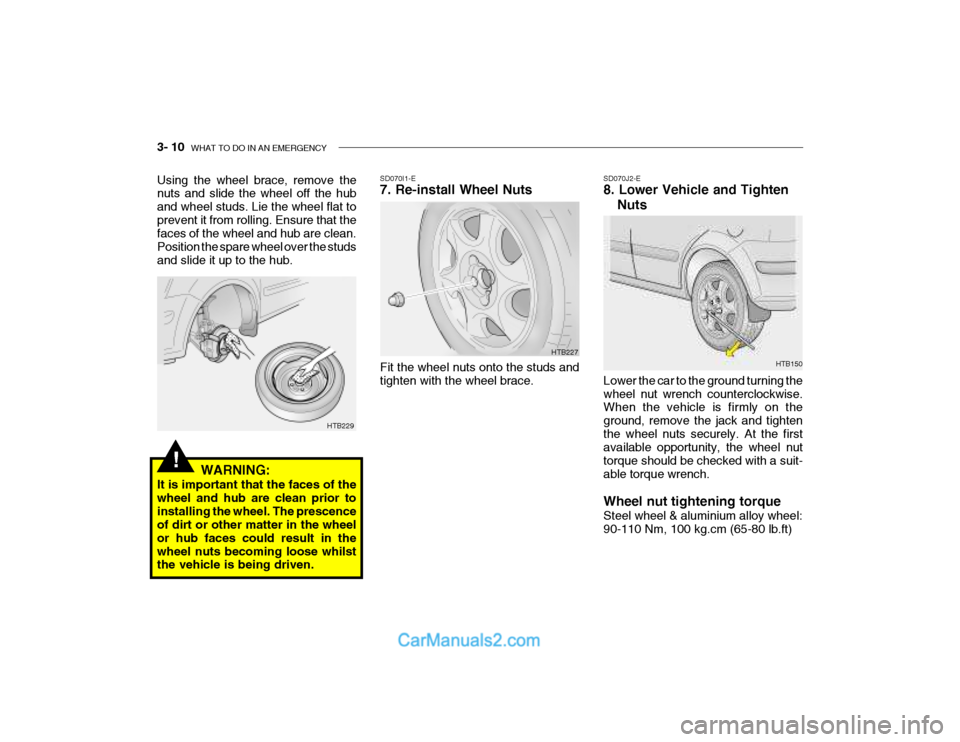
SD070J2-E 8. Lower Vehicle and Tighten
Nuts
Lower the car to the ground turning the wheel nut wrench counterclockwise. When the vehicle is firmly on the ground, remove the jack and tightenthe wheel nuts securely. At the first available opportunity, the wheel nut torque should be checked with a suit-able torque wrench. Wheel nut tightening torque Steel wheel & aluminium alloy wheel: 90-110 Nm, 100 kg.cm (65-80 lb.ft)
SD070I1-E 7. Re-install Wheel NutsFit the wheel nuts onto the studs and tighten with the wheel brace.
HTB227
Using the wheel brace, remove the nuts and slide the wheel off the hub and wheel studs. Lie the wheel flat toprevent it from rolling. Ensure that the faces of the wheel and hub are clean. Position the spare wheel over the studsand slide it up to the hub.
HTB229
WARNING:
It is important that the faces of the wheel and hub are clean prior toinstalling the wheel. The prescence of dirt or other matter in the wheel or hub faces could result in thewheel nuts becoming loose whilst the vehicle is being driven.
Page 374 of 444
3- 12 WHAT TO DO IN AN EMERGENCY
!
CAUTION:
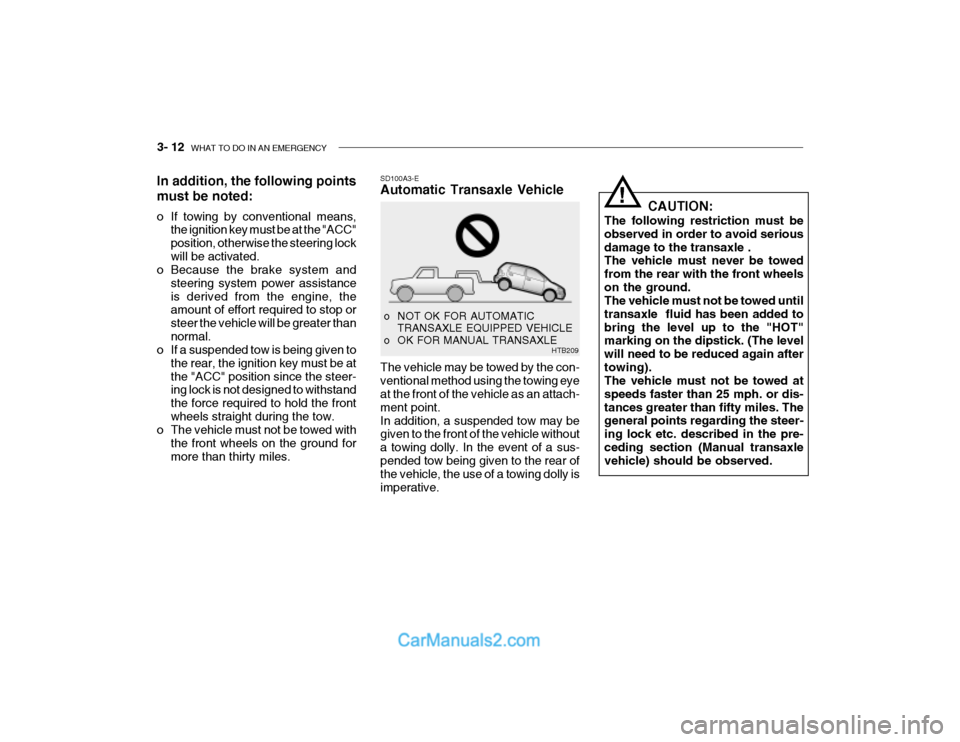
The following restriction must be observed in order to avoid seriousdamage to the transaxle . The vehicle must never be towed from the rear with the front wheelson the ground. The vehicle must not be towed until transaxle fluid has been added tobring the level up to the "HOT" marking on the dipstick. (The level will need to be reduced again aftertowing). The vehicle must not be towed at speeds faster than 25 mph. or dis-tances greater than fifty miles. The general points regarding the steer- ing lock etc. described in the pre-ceding section (Manual transaxle vehicle) should be observed.
SD100A3-E Automatic Transaxle Vehicle The vehicle may be towed by the con- ventional method using the towing eye at the front of the vehicle as an attach- ment point.In addition, a suspended tow may be given to the front of the vehicle without a towing dolly. In the event of a sus-pended tow being given to the rear of the vehicle, the use of a towing dolly is imperative.
o NOT OK FOR AUTOMATIC
TRANSAXLE EQUIPPED VEHICLE
o OK FOR MANUAL TRANSAXLE HTB209
In addition, the following points must be noted:
o If towing by conventional means,
the ignition key must be at the "ACC" position, otherwise the steering lockwill be activated.
o Because the brake system and
steering system power assistanceis derived from the engine, the amount of effort required to stop or steer the vehicle will be greater thannormal.
o If a suspended tow is being given to
the rear, the ignition key must be atthe "ACC" position since the steer- ing lock is not designed to withstand the force required to hold the frontwheels straight during the tow.
o The vehicle must not be towed with
the front wheels on the ground formore than thirty miles.
Page 375 of 444
WHAT TO DO IN AN EMERGENCY 3- 13
D120A01A-EAT IF YOU LOSE YOUR KEYS Information about the key of immobi- lizer system will be found on page 1-4.CAUTION:
If the car is being towed with allfour wheels on the ground, it can be towed only from the front. Besure that the transaxle is in neu- tral. Do not tow at speeds greater
than 30 mph (50 km/h) and for more
than 15 miles(25 km). Be sure the steering is unlocked by placing the key in the "ACC" posi- tion. A driver must be in the towed vehicle to operate the steering andbrakes.
!
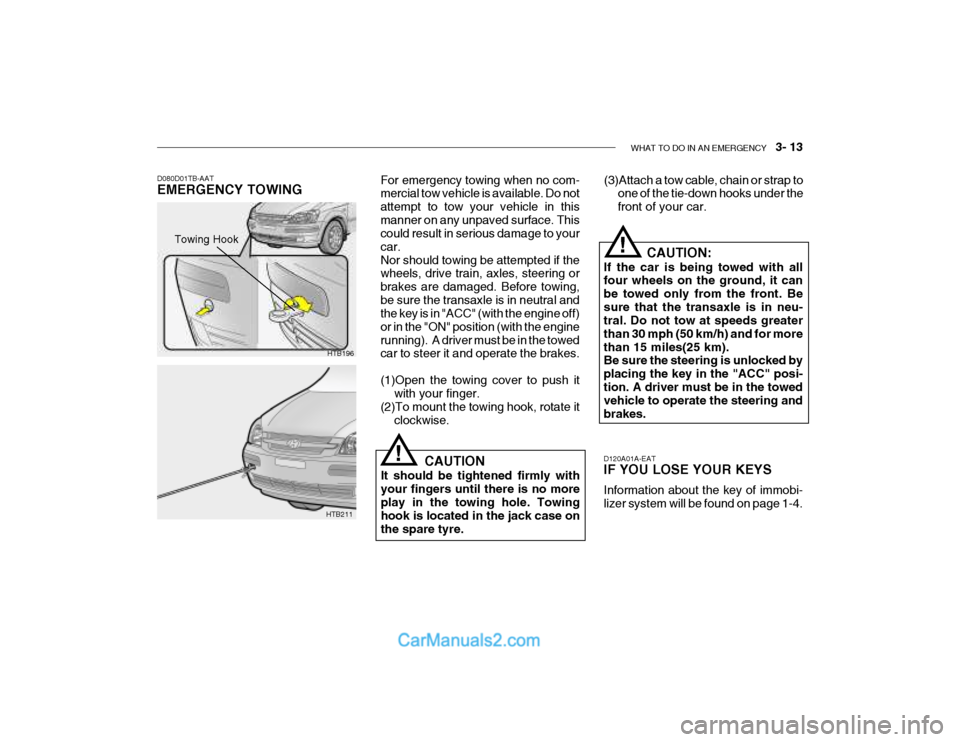
(3)Attach a tow cable, chain or strap to
one of the tie-down hooks under the front of your car.
D080D01TB-AAT EMERGENCY TOWING For emergency towing when no com- mercial tow vehicle is available. Do not attempt to tow your vehicle in thismanner on any unpaved surface. This could result in serious damage to your car.Nor should towing be attempted if the wheels, drive train, axles, steering or brakes are damaged. Before towing,be sure the transaxle is in neutral and the key is in "ACC" (with the engine off) or in the "ON" position (with the enginerunning). A driver must be in the towed car to steer it and operate the brakes. (1)Open the towing cover to push it
with your finger.
(2)To mount the towing hook, rotate it clockwise.
HTB196
HTB211 CAUTION
It should be tightened firmly with your fingers until there is no moreplay in the towing hole. Towing hook is located in the jack case on the spare tyre.
!
Towing Hook
Page 385 of 444
VEHICLE MAINTENANCE REQUIREMENTS 5- 5
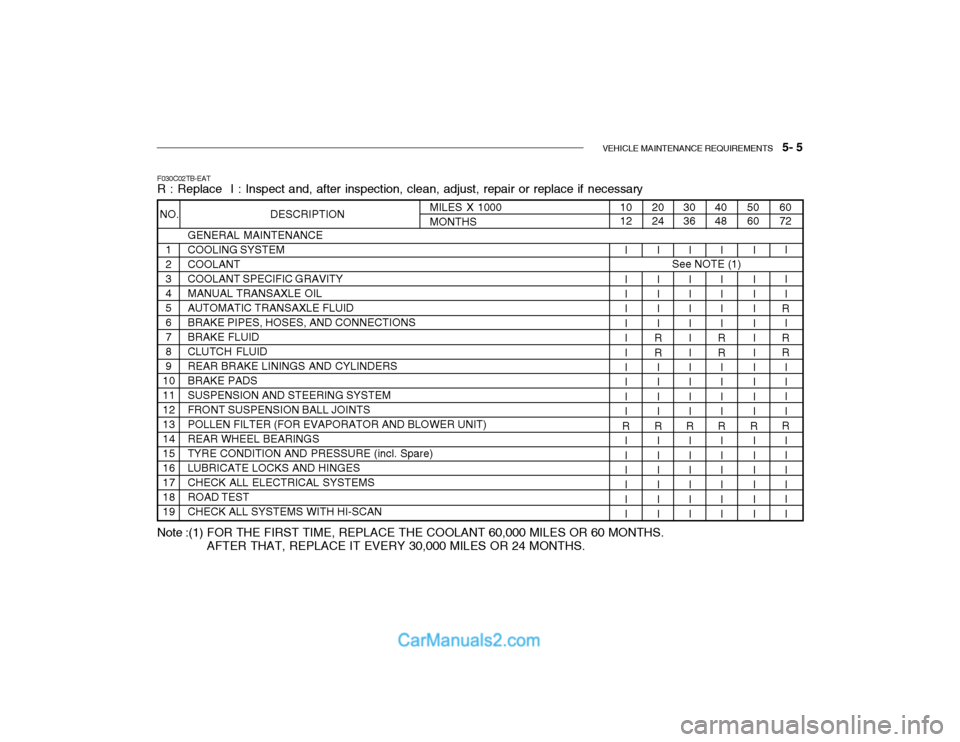
F030C02TB-EAT R : Replace I : Inspect and, after inspection, clean, adjust, repair or replace if necessary
GENERAL MAINTENANCE COOLING SYSTEMCOOLANTCOOLANT SPECIFIC GRAVITYMANUAL TRANSAXLE OILAUTOMATIC TRANSAXLE FLUIDBRAKE PIPES, HOSES, AND CONNECTIONSBRAKE FLUIDCLUTCH FLUIDREAR BRAKE LININGS AND CYLINDERSBRAKE PADSSUSPENSION AND STEERING SYSTEMFRONT SUSPENSION BALL JOINTSPOLLEN FILTER (FOR EVAPORATOR AND BLOWER UNIT)REAR WHEEL BEARINGSTYRE CONDITION AND PRESSURE (incl. Spare)LUBRICATE LOCKS AND HINGESCHECK ALL ELECTRICAL SYSTEMSROAD TESTCHECK ALL SYSTEMS WITH HI-SCAN
60 72
5060
4048
I I I
R
I
RR II I I
R III I II
I I I IIIII I II
R II I III
I I I II
RR I I II
R II I III
30 36
2024
I I I IIIII I II
R II I III
I I I II
RR I I II
R II I III
10 12
I I I IIIII I II
R II I III
MILES X 1000MONTHS
NO. DESCRIPTION
1 23456789
10111213141516171819
See NOTE (1)
Note :(1) FOR THE FIRST TIME, REPLACE THE COOLANT 60,000 MILES OR 60 MONTHS. AFTER THAT, REPLACE IT EVERY 30,000 MILES OR 24 MONTHS.
Page 398 of 444
6- 8 DO-IT-YOURSELF MAINTENANCE
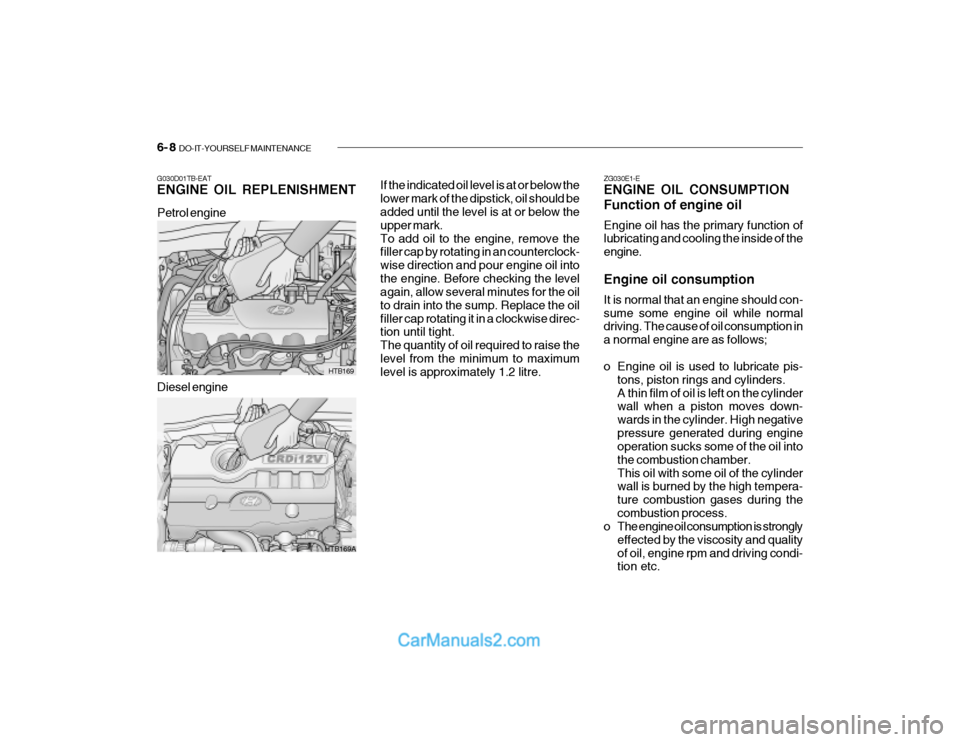
Petrol engine
HTB169
HTB169A
Diesel engine
G030D01TB-EAT ENGINE OIL REPLENISHMENT
If the indicated oil level is at or below the lower mark of the dipstick, oil should be added until the level is at or below the upper mark.To add oil to the engine, remove the filler cap by rotating in an counterclock- wise direction and pour engine oil intothe engine. Before checking the level again, allow several minutes for the oil to drain into the sump. Replace the oilfiller cap rotating it in a clockwise direc- tion until tight. The quantity of oil required to raise thelevel from the minimum to maximum level is approximately 1.2 litre.ZG030E1-E ENGINE OIL CONSUMPTION Function of engine oil Engine oil has the primary function of lubricating and cooling the inside of the engine. Engine oil consumption It is normal that an engine should con- sume some engine oil while normal driving. The cause of oil consumption in a normal engine are as follows;
o Engine oil is used to lubricate pis-
tons, piston rings and cylinders. A thin film of oil is left on the cylinder wall when a piston moves down- wards in the cylinder. High negativepressure generated during engine operation sucks some of the oil into the combustion chamber.This oil with some oil of the cylinder wall is burned by the high tempera- ture combustion gases during thecombustion process.
o The engine oil consumption is strongly
effected by the viscosity and qualityof oil, engine rpm and driving condi- tion etc.