change wheel Hyundai Getz 2003 User Guide
[x] Cancel search | Manufacturer: HYUNDAI, Model Year: 2003, Model line: Getz, Model: Hyundai Getz 2003Pages: 444, PDF Size: 13.82 MB
Page 360 of 444
2- 18 DRIVING YOUR HYUNDAI
C190E02L
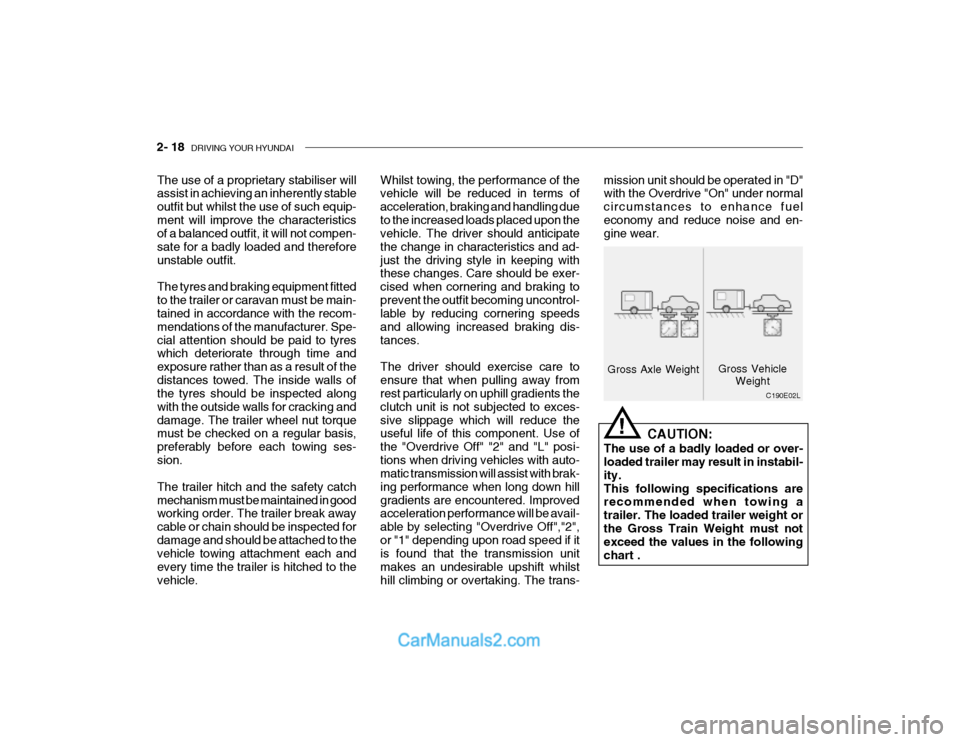
Gross Axle Weight
Gross Vehicle
Weight
The use of a proprietary stabiliser will assist in achieving an inherently stable outfit but whilst the use of such equip-ment will improve the characteristics of a balanced outfit, it will not compen- sate for a badly loaded and thereforeunstable outfit. The tyres and braking equipment fitted to the trailer or caravan must be main- tained in accordance with the recom- mendations of the manufacturer. Spe-cial attention should be paid to tyres which deteriorate through time and exposure rather than as a result of thedistances towed. The inside walls of the tyres should be inspected along with the outside walls for cracking anddamage. The trailer wheel nut torque must be checked on a regular basis, preferably before each towing ses-sion. The trailer hitch and the safety catch mechanism must be maintained in good working order. The trailer break away cable or chain should be inspected fordamage and should be attached to the vehicle towing attachment each and every time the trailer is hitched to thevehicle. Whilst towing, the performance of the vehicle will be reduced in terms of acceleration, braking and handling dueto the increased loads placed upon the vehicle. The driver should anticipate the change in characteristics and ad-just the driving style in keeping with these changes. Care should be exer- cised when cornering and braking toprevent the outfit becoming uncontrol- lable by reducing cornering speeds and allowing increased braking dis-tances. The driver should exercise care to ensure that when pulling away from rest particularly on uphill gradients the clutch unit is not subjected to exces-sive slippage which will reduce the useful life of this component. Use of the "Overdrive Off" "2" and "L" posi-tions when driving vehicles with auto- matic transmission will assist with brak- ing performance when long down hillgradients are encountered. Improved acceleration performance will be avail- able by selecting "Overdrive Off","2",or "1" depending upon road speed if it is found that the transmission unit makes an undesirable upshift whilsthill climbing or overtaking. The trans- mission unit should be operated in "D" with the Overdrive "On" under normal circumstances to enhance fueleconomy and reduce noise and en- gine wear.
CAUTION:
The use of a badly loaded or over-loaded trailer may result in instabil- ity.This following specifications are recommended when towing a trailer. The loaded trailer weight orthe Gross Train Weight must not exceed the values in the following chart .
!
Page 362 of 444

2- 20 DRIVING YOUR HYUNDAI
When being passed by a large ve- hicle, keep a constant speed and steer straight ahead. If there is toomuch wind buffeting slow down to get out of the other vehicle's air turbulence.
8. When parking your car and trailer, especially on a hill, be sure to followall the normal precautions. Turn yourfront wheel into the curb, set the parking brake firmly, and put the transaxle in 1st or Reverse (manual)or Park (automatic). In addition, place wheel chocks at each of the trailer's tyres.
9. If the trailer has electric brakes, start your vehicle and trailer mov-ing, and then apply the trailer brakecontroller by hand to be sure the brakes are working. This lets you check your electrical connection atthe same time.
10. During your trip, check occasion-
ally to be sure that the load issecure, and that the lights and any trailer brakes are still working.
11. Avoid jerky starts, sudden accel- eration or sudden stops.
12. Avoid sharp turns and rapid lane
changes. 13. Avoid holding the brake pedal
down too long or too frequently. This could cause the brakes tooverheat, resulting in reduced brak- ing efficiency.
14. When going down a hill, shift into a lower gear and use the enginebraking effect.When ascending a long grade,
downshift the transaxle to a lowergear and reduce speed to reduce chances of engine overloading and/or overheating.
15. If you have to stop while going
uphill, do not hold the vehicle inplace by pressing on the accelera- tor. This can cause the automatic transaxle to overheat. Use the park-ing brake or footbrake.
NOTE: When towing check transaxle fluid more frequently. CAUTION:
If overheating should occur when towing, (temperature gauge reads near red zone), taking the followingaction may reduce or eliminate the problem.
1. Turn off the air conditioner.
2. Reduce highway speed.
3. Select a lower gear when going uphill.
4. While in stop and go traffic, place
the gear selection in park or neu- tral and idle the engine at a higher speed.
!
Page 368 of 444
3- 6 WHAT TO DO IN AN EMERGENCY
SD060A1-E IN THE EVENT OF A PUNCTURE If a puncture occurs whilst driving the vehicle:
1. Bring the car to rest as soon as it is
safe to do so and with the minimum amount of braking required which will assist in maintaining the maxi- mum amount of control. The vehicleshould be parked wherever pos- sible upon firm level ground to facili- tate wheel changing.
2. If the vehicle is creating a hazard and the road conditions do not per-mit the wheel to be changed safely,assistance should be sought.
3. Passengers must not be allowed to
remain inside the vehicle duringwheel changing. If a puncture oc- curs whilst the vehicle is on a motorway, the passengers shouldtake refuge on the motorway em- bankment to avoid the possibility of injury occurring should the vehiclebe struck by other motorway traffic.
4. Wheel changing should be per-
formed according to the followinginstructions.
SD050A2-E SPARE WHEEL (Not all models) The spare wheel is stored under the luggage compartment floor and is ac-cessed from within the luggage com- partment by lifting the carpet and the floor panel.To remove the spare wheel, unscrew the retainer, rotating this in an anti clockwise direction and lift out thewheel. To replace the wheel, screw the retainer by hand until tight having located the wheel in the luggage com-partment floor well. The inflation pres- sure of the spare wheel should be checked at least monthly and when-ever the wheel is fitted to the vehicle.
Inflation Pressure
Tyre Size
Spare Tyre Pressure
Full Size 210 kPa (30 psi)
CAUTION:
o Do not use snow chains with your temporary spare tyre.
o Do not use more than one tempo- rary spare tyre at a time.
!
5. The temporary spare tyre should
not be used on any other wheels, nor should standard tyre, snow tyre,wheel covers or trim rings be used with the temporary spare wheel. If such use is attempted, damage tothese items or other car compo- nents may occur.
6. The temporary spare tyre pressure should be checked once a monthwhile the tyre is stored.
Page 369 of 444
WHAT TO DO IN AN EMERGENCY 3- 7
HTB153
HTB152
Groove
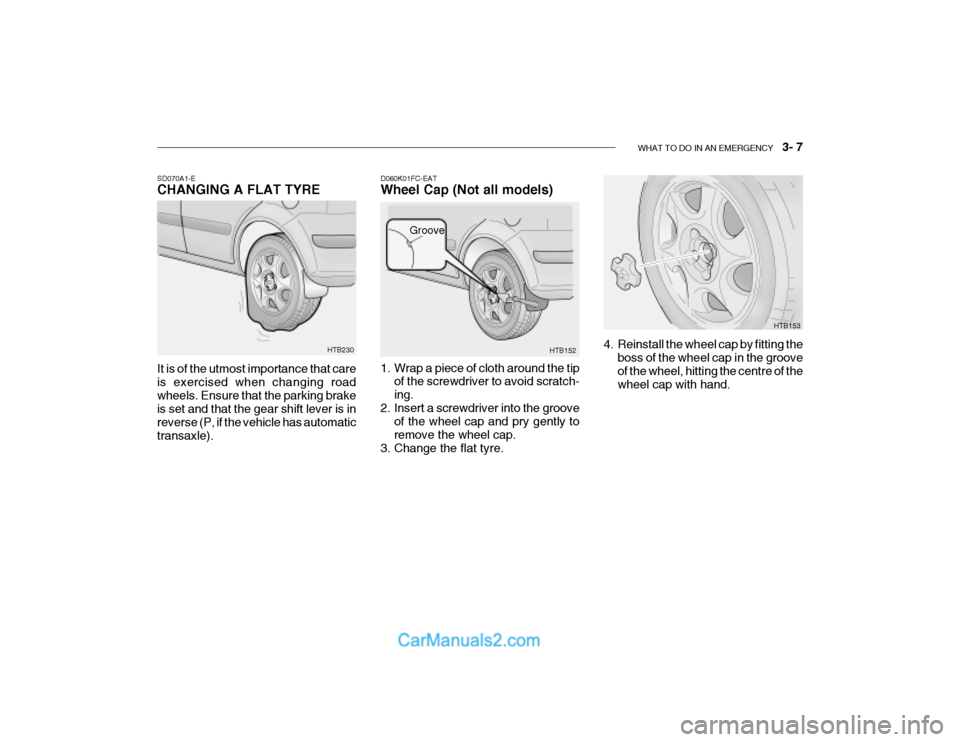
D060K01FC-EAT Wheel Cap (Not all models)
1. Wrap a piece of cloth around the tip
of the screwdriver to avoid scratch- ing.
2. Insert a screwdriver into the groove of the wheel cap and pry gently toremove the wheel cap.
3. Change the flat tyre. 4. Reinstall the wheel cap by fitting the
boss of the wheel cap in the grooveof the wheel, hitting the centre of thewheel cap with hand.
HTB230
SD070A1-E CHANGING A FLAT TYRE It is of the utmost importance that care is exercised when changing roadwheels. Ensure that the parking brake is set and that the gear shift lever is in reverse (P, if the vehicle has automatictransaxle).