heating Hyundai Getz 2003 Owner's Guide
[x] Cancel search | Manufacturer: HYUNDAI, Model Year: 2003, Model line: Getz, Model: Hyundai Getz 2003Pages: 444, PDF Size: 13.82 MB
Page 157 of 444
DRIVING YOUR HYUNDAI 2- 21
6. Check the condition and air pres-
sure of all tires on the trailer and your car. Low tire pressure canseriously affect the handling. Also check the spare tire.
7. The vehicle/trailer combination is more affected by crosswind andbuffeting. When being passed by a largevehicle, keep a constant speed and steer straight ahead. If there is too much wind buffeting slow downto get out of the other vehicle's air turbulence.
8. When parking your car and trailer, especially on a hill, be sure to fol-low all the normal precautions. Turn your front wheel into the curb, setthe parking brake firmly, and put the transaxle in 1st or Reverse (manual) or Park (automatic). Inaddition, place wheel chocks at each of the trailer's tires.
9. If the trailer has electric brakes, start your vehicle and trailer mov-ing, and then apply the trailer brake controller by hand to be sure thebrakes are working. This lets you check your electrical connection at the same time. 10. During your trip, check occasion-
ally to be sure that the load issecure, and that the lights andany trailer brakes are still working.
11. Avoid jerky starts, sudden accel-
eration or sudden stops.
12. Avoid sharp turns and rapid lane changes.
13. Avoid holding the brake pedal down too long or too frequently. This could cause the brakes to over- heat, resulting in reduced brakingefficiency.
14. When going down a hill, shift into a
lower gear and use the engine brak-ing effect. When ascending a long grade, downshift the transaxle to a lowergear and reduce speed to reduce chances of engine overloading and/ or overheating.
15. If you have to stop while going uphill, do not hold the vehicle inplace by pressing on the accelera-tor. This can cause the automatic transaxle to overheat. Use the park- ing brake or footbrake.
NOTE: When towing check transaxle fluid more frequently. CAUTION:
If overheating should occur whentowing, (temperature gauge readsnear red zone), taking the following action may reduce or eliminate the problem.
1. Turn off the air conditioner.
2. Reduce highway speed.
3. Select a lower gear when going uphill.
4. While in stop and go traffic, place the gear selection in park or neutral and idle the engine at a higher speed.
!
Page 161 of 444
3- 4 WHAT TO DO IN AN EMERGENCY
D030A01TB-AAT IF THE ENGINE OVERHEATS If your temperature gauge indicates overheating, you experience a loss of power, or hear loud pinging or knock- ing, the engine is probably too hot. Ifthis happens to you, you should:
1. Pull off the road and stop as soon as
it is safe to do so.
2. Place the gear selector lever in "P"
(automatic), or neutral (manual transaxle) and set the parking brake. If the air conditioning is on, turn it off.
6. Carefully remove the jumper cables
in the reverse order of attachment.
If you do not know why your battery became discharged (because the lights were left on, etc.), have the chargingsystem checked by your Hyundai dealer. 3. If engine coolant is running out un-
der the car or steam is coming out from the hood, stop the engine. Donot open the hood until the engine coolant has stopped running or the steaming has stopped. If there is novisible loss of engine coolant and no steam, leave the engine running and check to be sure the enginecooling fan is operating. If the fan is not running, turn the engine off.
4. Check to see if the water pump drive belt is missing. If it is not missing,check to see that it is tight. If the drive belt seems to be satisfactory,check for coolant leaking from the radiator, hoses or under the car. (If the air conditioning had been in use,it is normal for cold water to be draining from it when you stop). WARNING (Diesel only):
Never work on injection system with engine running or within 30 sec- onds after shutting off engine. High pressure pump, rail, injectors andhigh pressure pipes are subject to high pressure even after the engine stopped. The fuel jet produced byfuel leaks may cause serious in- jury, if it touch the body. People using pacemakers should not movethan 30cm closer to the ECU or wiring harness within the engine room while engine is running, sincethe high currents in the Common Rail system produce considerable magnetic fields.
WARNING:
While the engine is running, keep hair, hands, and clothing away from moving parts such as the fan anddrive belts to prevent injury.
!
!
5. If the water pump drive belt is bro- ken or coolant is leaking out, stop the engine immediately and call the nearest Hyundai dealer for assis-tance.
Page 162 of 444
WHAT TO DO IN AN EMERGENCY 3- 5
Inflation Pressure
Tire Size
T105/70D14 420 kPa (60 psi)
2. The spare tire should only be used temporarily and should be returned to the luggage compartment as soonas the original tire can be repaired or replaced.
3. Continuous use at speeds of over 80 km/h (50 mph) is not recom-mended.
4. As the temporary spare tire is spe- cifically designed for your car, itshould not be used on any other vehicle.
D040A01TB-GAT TEMPORARY SPARE TIRE The following instructions for the tem- porary spare tire should be observed:
1. Check inflation pressure as soon as
practical after installing the spare tire, and adjust to the specified pres- sure. The tire pressure should be periodically checked and maintainedat the specified pressure while the tire is stored.
Spare Tire Pressure
WARNING:
Do not remove the radiator cap whenthe engine is hot. This can allow coolant to be blown out of the open-ing and cause serious burns.
6. If you cannot find the cause of the overheating, wait until the engine temperature has returned to nor- mal. Then, if the engine coolant hasbeen lost, carefully remove the ra- diator cap and add engine coolant to bring the fluid level in the reservoir up to the halfway mark.
7. Proceed with caution, keeping alert for further signs of overheating. Ifoverheating happens again, call a Hyundai dealer for assistance.
!
!
!
CAUTION:
Serious loss of engine coolant indi- cates there is a leak in the cooling system and this should be checked as soon as possible by a Hyundaidealer. 5. The temporary spare tire should not
be used on any other wheels, norshould standard tires, snow tires,wheel covers or trim rings be used with the temporary spare wheel. If such use is attempted, damage tothese items or other car compo- nents may occur.
6. The temporary spare tire pressure should be checked once a monthwhile the tire is stored.
CAUTION:
o Do not use snow chains with your temporary spare tire.
o Do not use more than one tempo-
rary spare tire at a time.
Page 246 of 444

10- 4 INDEX
H
Hazard Warning System ........................................... 1-56
Headlight Aiming Adjustment .................................... 6-31
Headlight Leveling Device System ........................... 1-59
Heating and cooling control ...................................... 1-75
Heating and Ventilation ............................................. 1-76
Air flow control ....................................................... 1-77
Air intake control .................................................... 1-77
Bi-level heating ....................................................... 1-80
Fan speed control .................................................. 1-76
Temperature control ............................................... 1-79
High-Mounted Rear Stop Light ................................. 1-67
Hood Release ........................................................... 1-67
How to use luggage room ........................................ 1-70
Horn .......................................................................... 1-74 I
Ignition Switch ............................................................. 2-3
Immobilizer System ..................................................... 1-5
Instrument Cluster and Indicator .............................. 1-41 I Interior Light
Interior light ............................................................ 1-63
Map light ................................................................ 1-62
Intermittent Wiper ..................................................... 1-55 J
Jump Starting .............................................................. 3-3 K
Key .............................................................................. 1-4
If you lose your keys ............................................. 3-14
Positions ................................................................... 2-4
L
Lubrication Chart ......................................................... 9-4
Luggage Net ............................................................. 1-72
Luggage Board .......................................................... 1-72
Luggage Under Tray ................................................. 1-71 M Maintenance Intervals Explanation of scheduled maintenance items
................................................................................. 5-8
Maintenance under severe usage conditions .......... 5-7
Scheduled maintenance ........................................... 5-4
Service requirements ............................................... 5-2
Mirrors Day-night inside rearview ....................................... 1-66
Outside rearview mirror heater .............................. 1-66
O
Odometer .................................................................. 1-50
Outside rear view ...................................................... 1-64
Page 259 of 444

YOUR VEHICLE AT A GLANCE
1. Glove Box
2. Passenger's Airbag (Not all models)
3. Heating/Air Conditioning Control Panel(Not all models)
4. Rear Fog Light Switch
5. Front Fog Light Switch (Not all models)
6. Hazard Warning Light
7. Windshield Wiper/Washer Switch
8. Horn and Driver's Airbag (Not all models)
9. Instrument Cluster
10. Multi-Function Light Switch
CAUTION:
When installing a container of liquid air freshener inside a vehicle, do not place it near the instrument cluster nor on the instrument panel pad surface. If there is any leakage from the air freshener onto these areas (instrument cluster, instrument panel pad or air ventilator), it may damage these parts. If the liquid from the air freshener does leak onto these areas, wash them with water immediately. 11. Headlight Leveling Switch (Not all models)
12. Rear Drink Holder
13. Cigarette Lighter
14. Parking Brake Lever
15. Shift Lever (Not all models)
16. Front Drink Holder
17. Ashtray
18. Fuse Box
19. Hood Release Lever
!
Page 261 of 444
1. FEATURES OF YOUR HYUNDAI
Fuel Recommendations ................................................................... 1-2
Running In ........................................................................................ 1-3
Immobilizer system .......................................................................... 1-4
Door locks (Theft-alarm system) ..................................................... 1-5Power windows.............................................................................. 1-10
Seat ................................................................................................ 1-11
Seat Belt ......................................................................................... 1-16
Child restraint system .................................................................... 1-21
Supplemental restraint (AIRBAG) system .....................................1-29
Instrument cluster and indicator lights ............................................1-35
Warning Light and Indicator ............................................................ 1-37
Trip computer ................................................................................. 1-44
Multi-Function Light Sw itch ............................................................ 1-46
Windshield wiper/Washer Switch ...................................................1-48
Sunroof ........................................................................................... 1-53
Mirror .............................................................................................. 1-57
Bonnet Release .............................................................................. 1-60
How to use luggage Room ............................................................. 1-63
Heating and cooling control ............................................................ 1-68
Stereo sound system ..................................................................... 1-77
Antenna .......................................................................................... 1-81
1
Page 300 of 444

1- 40 FEATURES OF YOUR HYUNDAI
B260S01B-GAT
DIESEL PRE-HEAT INDICATORLIGHT-AMBER(Diesel Engine)
The indicator light illuminates amber when the ignition switch is placed at the "ON" position. The engine can be started after the pre-heat indicator lightgoes off. The illuminating time varies with the water temperature, air tem- perature and battery condition. NOTE: If the engine were not started 10 seconds after the preheating is com-pleted, turn the ignition key once more to the "LOCK" position, and then to the "ON" position, in orderto preheat again.
B260T01TB-GAT
ELECTRIC POWER STEERING SYSTEM(EPS) WARNING LIGHT (Not all models)
This indicator light comes on about 4 seconds after the ignition key is turned to the "ON" position or after the engine is started, it will go out.This light also comes on when the EPS has some troubles. If it comes on while driving, have your vehicle inspected byan authorized Hyundai Dealer. B260E01HP-GAT
SEAT BELT WARNING LIGHT
The seat belt warning light blinks for about 6 seconds when the ignition key is turned from the "OFF" position to "ON" or "START".
CAUTION:
When you move the electric power steering back-end and forth-end continuously in stop position, steer- ing wheel plays heavily to operateanti-overload system. It is normal condition. It returns to be nomal getting time.!
B260U01TB-EAT IMMOBILIZER
INDICATOR LIGHT(Not all models)
This indicator light comes on for some seconds after the ignition key is turned to the "ON" position. At this time, youcan start the engine. The light goes out after the engine is running. In case this light goes out before you start the en-gine, you must turn to the "LOCK" position and restart the engine. In case this light blinks for five seconds whenthe ignition key is turned to "ON" posi- tion, this indicates that the immobilizer system is out of order. At this time,consult to the Hyundai dealer.
nearest authorized Hyundai dealer and have the system checked.
Page 302 of 444

1- 42 FEATURES OF YOUR HYUNDAI
!
SB215B1-E ENGINE COOLANT TEMPERA- TURE GAUGE
The engine coolant temperature gauge indicates the engine coolant tempera- ture and will, under normal circum-stances, give an indication in the "Nor- mal" or centre portion of the scale. Should the indication move into theupper or "Hot" portion of the scale, engine overheating is indicated. Under these circumstances, the vehicle shouldbe brought to rest as soon as is safe to do so and the engine turned off. Once the engine has cooled somewhat, thecoolant level and the condition of the generator/water pump drive belt should be checked. If the cause of the over- SB215C1-E SPEEDOMETER
HTB007A
heating cannot be readily established, the assistance of a Hyundai dealer should be sought.
HTB004A
The speedometer indicates the vehicle speed in both miles and kilometres per hour.
WARNING:
The engine cooling system is pres- surized and removal of the radiator cap when the engine is hot maycause hot water and steam to be ejected from the radiator resulting in burns and scalding. The radiator capmust only be removed when the en- gine has cooled. Do not add cold water to a hot engine to avoid thepossibility of engine damage. The use of plain water in the cooling system is not recommended sincethe aluminium components of the cooling system require the use of a corrosion inhibitor found in the rec-ommended Ethylene Glycol type anti freeze solutions.
A Type B Type
Page 310 of 444
1- 50 FEATURES OF YOUR HYUNDAI
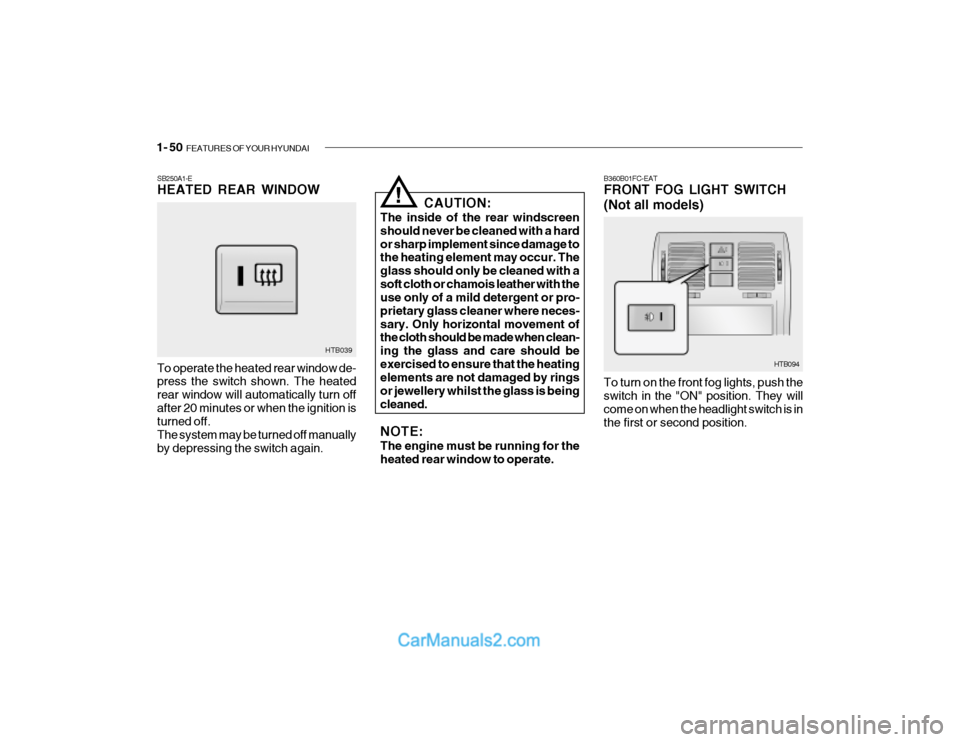
SB250A1-E HEATED REAR WINDOW To operate the heated rear window de- press the switch shown. The heated rear window will automatically turn offafter 20 minutes or when the ignition is turned off. The system may be turned off manuallyby depressing the switch again. HTB039CAUTION:
The inside of the rear windscreenshould never be cleaned with a hardor sharp implement since damage to the heating element may occur. The glass should only be cleaned with asoft cloth or chamois leather with the use only of a mild detergent or pro- prietary glass cleaner where neces-sary. Only horizontal movement of the cloth should be made when clean- ing the glass and care should beexercised to ensure that the heating elements are not damaged by rings or jewellery whilst the glass is beingcleaned. NOTE: The engine must be running for the heated rear window to operate.
! B360B01FC-EAT FRONT FOG LIGHT SWITCH (Not all models)
HTB094
To turn on the front fog lights, push the switch in the "ON" position. They will come on when the headlight switch is inthe first or second position.
Page 328 of 444
1- 68 FEATURES OF YOUR HYUNDAI
B710A01TB-EAT
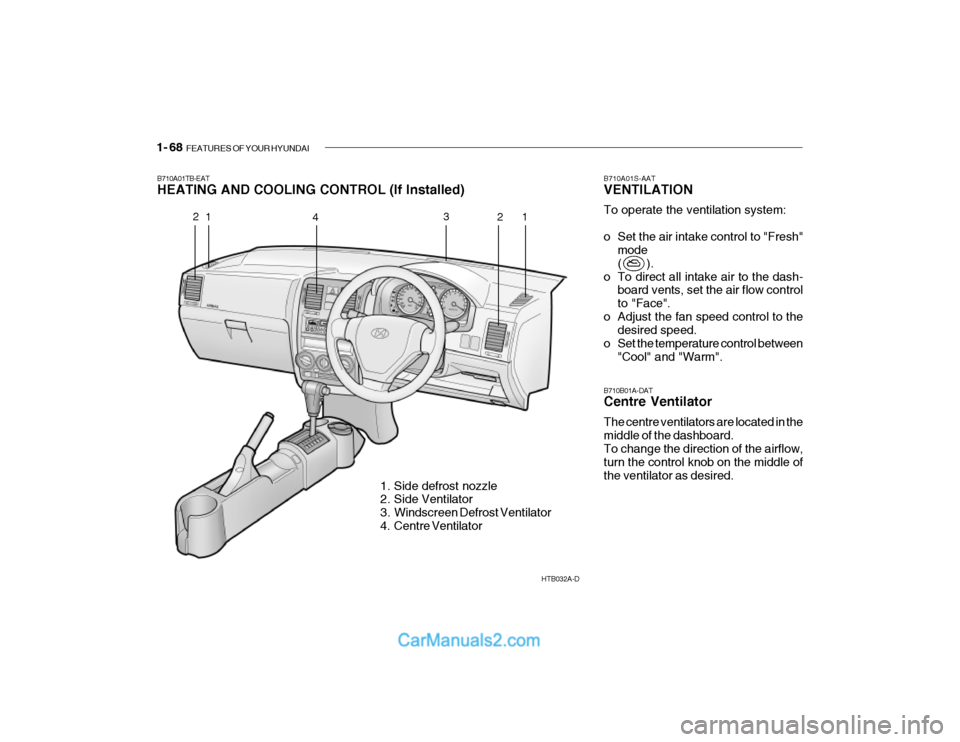
HEATING AND COOLING CONTROL (If Installed)
1. Side defrost nozzle
2. Side Ventilator
3. Windscreen Defrost Ventilator
4. Centre Ventilator B710A01S-AAT VENTILATION To operate the ventilation system:
o Set the air intake control to "Fresh"
mode
( ).
o To direct all intake air to the dash- board vents, set the air flow controlto "Face".
o Adjust the fan speed control to the desired speed.
o Set the temperature control between "Cool" and "Warm".
HTB032A-D
1
2
3
4 1
2
B710B01A-DAT Centre Ventilator The centre ventilators are located in the middle of the dashboard. To change the direction of the airflow, turn the control knob on the middle ofthe ventilator as desired.